 2015, Vol. 35

 [PDF全文]
2. 湿润亚热带生态地理过程教育部重点实验室, 福州 350007;
3. 福建师范大学地理研究所, 福州 350007
 , WEI Ran1, 2
 , NI Jinzhi1, 3, YANG Liuming1, 2, CHEN Longjie1, SUN Shanshan1, 2, LI Yang1, 2
 2. Key Laboratory of Humid Subtropical Eco-geographical Process of the Ministry of Education, Fuzhou 350007;
3. Institute of Geography, Fujian Normal University, Fuzhou 350007
三氯生(Triclosan,TCS,分子式如图 1a所示)是一种常用的广谱抗菌剂,广泛应用于牙膏、漱口水等日化用品中,也常用于手术器械等医疗用品和纺织品、皮革等的消毒.近年来的研究发现,三氯生具有疏水性,易在沉积物中积累,对藻类等水生生物有一定的毒害作用(Reiss et al.,2009;Ciniglia et al.,2005),并且三氯生的分解会产生二 英、氯仿等毒性较大的有害物质(Lozano et al.,2013;Dann et al.,2011;Fiss et al.,2007).在人类活动集中的地区,三氯生的检出频率和检出量越来越高.随着城市规模不断扩大、人口迅速增长,居民生活、医疗机构、纺织业等排放的大量污水将三氯生带入环境中并在沉积物中逐渐积累,从而造成潜在的生态风险.因此,研究福州市内河沉积物中三氯生的含量和来源,并对其生态风险进行评估,对福州市内河的治理和水资源的可持续利用具有重要的现实意义.甲基三氯生(Methyl-triclosan,MTCS,分子式如图 1b所示)是三氯生酚羟基上的氢原子被甲基取代的产物,疏水性和稳定性比三氯生更强(Lozano et al.,2012),更易于在环境中和生物体内积累(Gonzalo-Lumbreras et al.,2014).由于MTCS是TCS在环境中微生物作用下产生的甲基化产物,因此,同时检测这两种物质可以更全面地反应TCS的污染状况.基于此,本文通过对福州市20个内河表层沉积物样品中的三氯生(TCS)和甲基三氯生(MTCS)的含量进行测定,并对其生态风险进行评估,以期为福州市内河的治理和水资源的可持续利用提供参考.
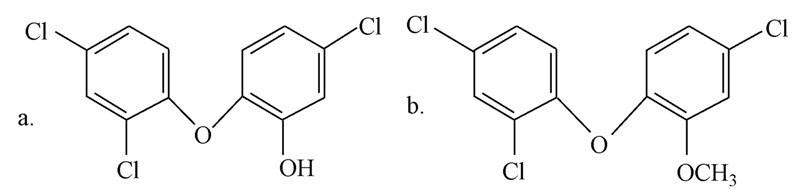 |
| 图 1 TCS(a)和MTCS(b)分子的结构式 Fig. 1 Structures of TCS(a) and MTCS(b) |
福州市位于福建省东部,闽江下游,地理位置为25°15′~26°39′N,118°08′~120°31′E,海拔在600~1000 km之间,全市总面积约1.2万km2,其中,市区总面积0.1万km2(陈卫锋等,2010).本研究综合考虑了福州市内河、居民区和工业区分布的特点,以及河道的治理情况(有些经过治理的内河河段无法采集到底泥),于2013年7—8月利用底泥采样器在福州市区共采集了20个内河底泥样品,范围覆盖全市各区,采样位点分布如图 2所示.采集的样品装在车载冰箱中运回实验室,置于-20 ℃冰箱冷冻保存.使用时用冷冻干燥机冻干,研磨后过60目筛,除去石子和植物碎屑等杂质.
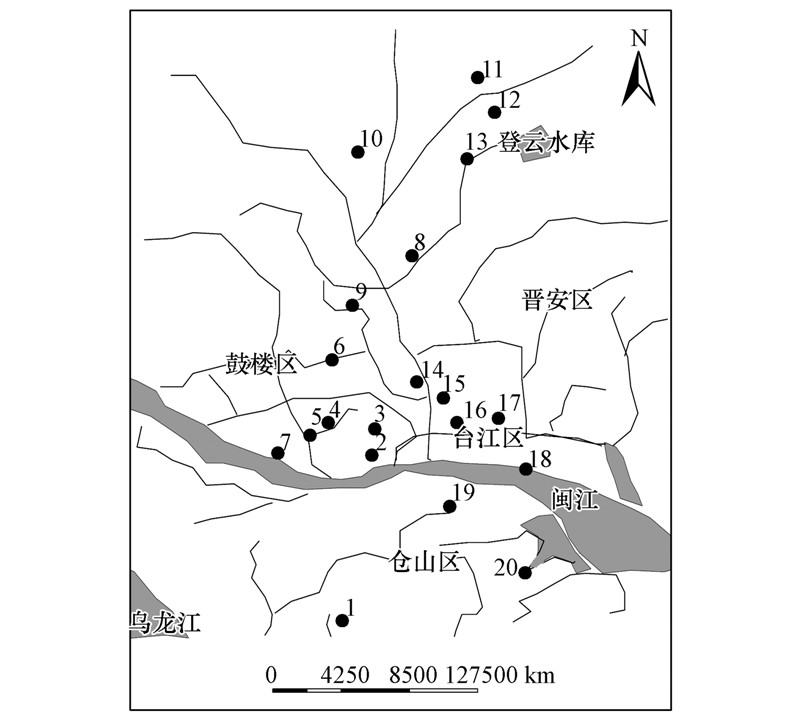 |
| 图 2 采样点分布示意(1. 洋洽河,2. 白马河,3. 大庆河,4. 新西河,5. 陆庄河,6. 文藻河,7. 大庆. 新西汇流,8. 龙峰河,9. 琴亭河,10. 屏西河,11. 晋安河,12. 茶园河,13. 登云溪,14. 洋下河,15. 东郊河,16. 竹屿河,17. 化工河,18. 凤坂河,19. 连江河,20. 光明港) Fig. 2 The schematic map of sampling sites |
沉积物样品中总有机碳采用元素分析仪(Elemetar Vario Max CN Germany)测定.
2.3 TCS和MTCS的提取及纯化称取0.5 g沉积物样品(每个样品做3个平行)于带聚四氟衬盖的玻璃离心管,加入5 mL丙酮,振荡混匀.30 ℃、40 kHz下超声30 min后,在4 ℃、3000 r · min-1下离心30 min,将上清转移至另一玻璃离心管.再加入5 mL丙酮,重复超声和离心,合并两次上清液,用N2吹至0.5 mL左右,加入4.5 mL去离子水,制成水样样品,以备固相萃取使用.
用少量石英棉塞住玻璃滴管底部,向滴管中加入0.1 g LC-C18填料,制成固相萃取小柱.用1 mL甲醇对其进行活化,并用1 mL去离子水淋洗.将离心管中的样品转移至萃取小柱中,用真空泵抽干.用0.5 mL丙酮和4.5 mL去离子水洗涤离心管管壁,洗涤液再次转移至萃取小柱中,抽干.最后用0.5 mL乙酸乙酯洗脱萃取小柱,洗脱液收集于棕色色谱瓶中.
2.4 TCS和MTCS的测定TCS沸点较高,挥发性较差,不适合直接用气相色谱进行检测,因此,要对其进行衍生化,以提高其分析的灵敏度(周雪飞等,2011).本实验采用的衍生化试剂为N-甲基-N(三甲基硅)-三氟乙酰胺(MSTFA).固相萃取的洗脱液用氮吹仪吹干,加入50 μL MSTFA,70 ℃下反应30 min.反应完毕后用乙酸乙酯定容至0.5 mL,用GC-MS(5975C/7890A,Agilent)进行检测.
GC-MS条件:采用DB-5MS(30 m×250 μm×0.25 μm)毛细管柱,进样口温度260 ℃,离子源温度230 ℃,能量为70 eV.载气为He,流速1 mL · min-1,无分流进样,进样量1 μL.升温程序:初始温度80 ℃,保持1 min;以10 ℃ · min-1升温至180 ℃,保持1 min;以4 ℃ · min-1升温至220 ℃,保持1 min;以20 ℃ · min-1升温至280 ℃,保持1 min.定量离子:TCS的定量离子为345、347、360、362,MTCS的定量离子为252、254、302、304.
2.5 质量控制与保证称取0.5 g沉积物样品,添加TCS和MTCS的混标,使沉积物样品中TCS和MTCS的含量都分别为5、100和2000 ng · g-1,同时做不加标的空白对照,用上述方法进行提取和测定.TCS和MTCS的回收率范围分别为85.6%~95.7%和84.4%~106.7%.实验所测定的沉积物中TCS和MTCS的含量未经回收率校正.
3 结果与讨论(Results and discussion) 3.1 沉积物中TCS和MTCS的含量福州市区20条内河沉积物中的TCS和MTCS含量如表 1所示.从表 1中可以看出,20条内河沉积物中均检测到了TCS,其中,1、2、3、5、6、11、17和19号这8个位点的沉积物中TCS含量都在60 μg · kg-1以上,明显高于其他12个位点.可能的原因是这8个位点都位于市区繁华地段或轻工业集中地带,居民区、医院或纺织、皮革等加工厂较多,生活污水和工业废水的排放将大量TCS带入内河,并在沉积物中逐渐积累.MTCS在除9、16和18号之外的17个内河沉积物中都有检出,其中,1和12号点位的含量相对较高,其他15个沉积物样品中的含量都很低.有研究表明,进入污水处理厂的污水,在细菌的甲基化作用下TCS含量会减少,而在出水口处甲基化产物MTCS含量会增加(Erickson,2012).1和12号两个采样点都是排污口的所在地,这可能是其MTCS含量较高的原因.
由表 1还可以看出,TOC含量较高的样品,TCS含量普遍较高,如1、2、5、6和17号样品等;而TOC含量低的样品,TCS含量也普遍较低.相关分析结果表明,TCS与TOC含量之间存在显著正相关关系(r=0.590,p<0.05)(图 3).可能的原因是沉积物中有机质含量较高,对TCS的吸附容量也较高,而吸附态的TCS生物有效性相对较低,使其易在沉积物中逐渐积累.沉积物样品中MTCS的含量普遍较低,与TOC、TCS含量之间均没有显著的相关性(p>0.05).
| 表 1 芦苇生态特征及水盐因子的统计学参数 Table 1 Descriptive statistical parameters of the ecological characteristics of Phragmites australis and water-salt indicators |
 |
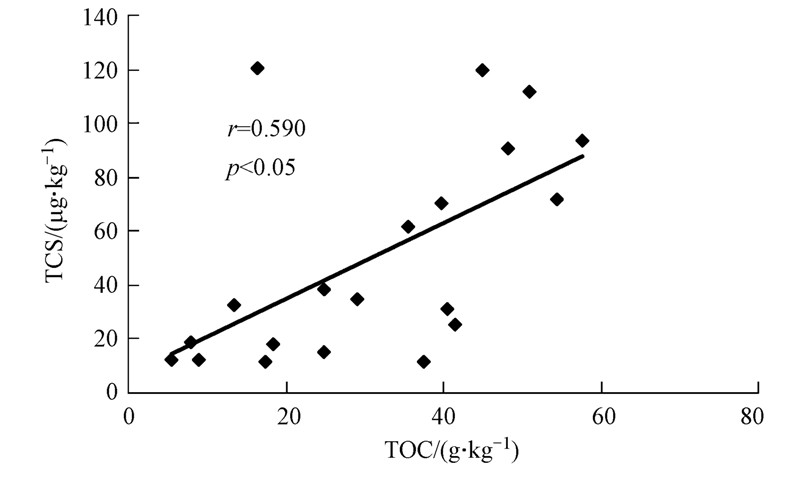 |
| 图 3 沉积物样品中TCS含量和TOC含量的相关性 Fig. 3 Correlation between the concentrations of TCS and TOC in sediment samples |
表 2列出了国内外文献中报道的一些河流、湖泊沉积物中的TCS和MTCS含量.福州内河TCS含量范围为11.8~120.4 μg · kg-1,平均含量为50.1 μg · kg-1,低于珠江三角洲和美国牙买加湾,略低于西班牙地中海沿岸和中国长江水系,高于中国辽河、海河、黄河、美国罗德岛州和Pecan溪、西班牙Guadalete河、日本多摩川及印度Kaveri河,在国内外文献报道的含量中处于中等水平.福州内河MTCS含量分布范围为n.d.~41.7 μg · kg-1,平均含量为7.8 μg · kg-1,低于德国莱茵河,高于西班牙Guadalete河,国内目前暂无相关数据.影响沉积物中TCS和MTCS含量的因素很多,其中,最重要的原因是人类活动的剧烈程度,除此之外,水文条件和地质条件也会造成一定的影响(Zhao et al.,2010).因此,人类活动集中的地区及重要的污水排放地(珠江三角洲、牙买加湾、地中海沿岸、莱茵河沿岸等地)TCS和MTCS的检出量高于其他地区.
| 表 2 TCS和MTCS在国内外不同地区沉积物中的含量 Table 2 Concentrations of TCS and MTCS in sediments from different areas at home and abroad |
|
TCS作为一种广谱、高效的抗菌剂,主要应用于以下几方面:牙膏、漱口水、洗手液等日化用品;医院中手术器械等医疗用品的消毒;纺织品、皮革制品等的消毒.因此,居民生活区、医疗机构、纺织品或皮革制品的加工厂等场所排放的废水成为环境中TCS的主要来源.2、3和6号采样点位于福州市老城区鼓楼区,居民区和医院较多,且年代较久,因此,生活污水和医疗污水排放较多,导致这几个采样点的沉积物中TCS含量较高.11、17和19号采样点位于新发展的晋安区,最近几年居民活动急剧增加,加之附近有针织手套厂等纺织品加工厂,生活污水及含有杀菌剂的工业废水的大量排放,使这几个采样点的沉积物中TCS含量也较高.1号采样点位于新开发的仓山区,附近有大量居民区和多所高校.仓山区过去是县城,居民活动时间较长,且近几年居民数量和工业生产急剧增加,生活污水和工业污水的排放也是这一区域TCS含量偏高的重要原因.同时,沉积物中TCS含量较高的采样点多位于河道下游,水动力较弱、堆积效应较强,易使污染物在此处形成一定积累(Yao et al.,2005),这可能也是上述7个位点沉积物中TCS含量相对较高的原因.其他13个采样点或为郊区,或为主干河流的分支或河道上游,极少有工业和生活污水直接排入其中,因此,沉积物中TCS含量相对较低.其中,12、18和20号采样点位置河面较宽,河水流动性较强,沉积物更新较快,导致沉积物中TCS含量较低;而13号采样点由于处在登云水库的下游,无污染的上游水的冲刷也使得此处沉积物中TCS含量极低.
MTCS是TCS在环境中微生物甲基化作用下的产物,易在营养丰富、溶氧量高的污水处理厂的废水中产生,并通过排污口排出(Coogan et al.,2007).在所有样点中1和12号都是排污口所在地,因此,这两个采样点沉积物中MTCS的含量最高,而这可能也是12号样品中TCS含量较低但MTCS含量相对较高的原因.
3.3 沉积物中TCS和MTCS的生态风险根据欧盟委员会(European Commission)制定的《Technical Guidance Document on Risk Assessment》,对福州内河沉积物中TCS和MTCS的生态风险进行了评估(European Commission,2003).采用风险熵RQ(Risk Quotient)来评估TCS和MTCS的风险程度,RQ等于目标化合物的检测环境浓度(MEC)与预测无效应浓度(PNEC)的比值.具体分类为:RQ<0.01,无风险;0.01≤RQ<0.1,低风险;0.1≤RQ<1,中等风险;RQ≥1,高风险(温智皓等,2013).虽然目前缺少TCS和MTCS在陆生生物中的相关毒性数据,但可以将沉积物中两种物质的浓度换算成孔隙水中的相应浓度,而对孔隙水中两种物质的生态风险进行评估时可采用与表层水相同的方法(Viganò et al.,2008),因此,可以利用公式(1)和(2)将水体中的PNECwater换算成沉积物中的PNECsolid(Van Vlaardingen et al.,2003).

式中,Kd为固体-水分配系数,Koc 为有机碳分配系数,foc为底泥样品中总有机碳含量.由于缺少MTCS的毒性数据,因此,采用QSAR(Quantitative Structure-Activity Relationship,定量构效关系)模型估算MTCS的PNECwater值,以此对MTCS的生态风险进行评价(Rüdel et al.,2013).TCS和MTCS的Koc和PNECwater值见表 3.
| 表 3 TCS和MTCS的Koc值和PNECwater Table 3 Koc and PNECwater of TCS and MTCS |
|
根据计算结果(表 4),7、12、13、16、18和20号6个沉积物样品中TCS的RQ值在0.1~1之间,表现为中等风险,在另外14个样品中TCS的RQ值都大于1,表现为高风险; 2、3、5、6、7和17号6个沉积物样品中MTCS的RQ值在0.1~1之间,表现为中等风险,在另外11个样品中MTCS的RQ值大于1,表现为高风险.其中,1、4、8、10、11、14、15和19号8个沉积物样品中TCS和MTCS都呈高风险.这表明福州地区TCS和MTCS污染情况较严重,应当引起重视.鉴于TCS具有高效低毒的优点,短时间内很难大量减少用量甚至完全停止使用.因此,必须改进城市污水处理工艺来降低TCS的残留,并通过寻找合适的替代品来减少TCS的使用.
| 表 4 沉积物中TCS和MTCS的RQ值 Table 4 RQs of TCS and MTCS in sediment samples |
|
1)福州市区内河表层沉积物中TCS含量在国内外不同地区沉积物的含量中处于中上水平,影响TCS含量的主要原因是居民活动和医疗机构的分布,大致呈现出居民生活区越集中、TCS检出量越高的趋势;TCS检出量与总有机碳含量之间呈显著正相关关系.
2)福州市区内河表层沉积物中MTCS含量在国内外不同地区沉积物的含量中处于较低水平,在排污口处MTCS检出量较高,表明污水处理可能对MTCS的含量有一定的影响.
3)20个沉积物样品中,有14个样品的TCS呈高风险,11个样品的MTCS呈高风险,其中有8个样品的两种物质都呈高风险,其他样品均表现为中等风险.
| [1] | Agüe ra A,Fernández-Alba A R,Piedra L,et al.2003.Evaluation of triclosan and biphenylol in marine sediments and urban wastewaters by pressurized liquid extraction and solid phase extraction followed by gas chromatography mass spectrometry and liquid chromatography mass spectrometry[J].Analytica Chimica Acta,480(2):193-205 |
| [2] | Boehmer W,Rudel H,Wenzel A,et al.2004.Retrospective monitoring of triclosan and methyl-triclosan in fish:results from the German Environmental Specimen Bank [J].Organohalog Compounds,66:1516-1521 |
| [3] | 陈卫锋,倪进治,杨红玉,等.2010.福州内河沉积物中多环芳烃的分布、来源及其风险评[J].中国环境科学,30(12):1670-1677 |
| [4] | Chen X J,Nielsen J L,Furgal K,et al.2011.Biodegradation of triclosan and formation of methyl-triclosan in activated sludge under aerobic conditions [J].Chemosphere,84(4):452-456 |
| [5] | Ciniglia C,Cascone C,Giudice R L,et al.2005.Application of methods for assessing the geno- and cytotoxicity of triclosan to C.ehrenbergii [J].Hazard Journal of Hazardous Materials,122(3):227-232 |
| [6] | Coogan M A,Edziyie R E,La Point T W,et al.2007.Algal bioaccumulation of triclocarban,triclosan,and methyl-triclosan in a North Texas wastewater treatment plant receiving stream [J].Chemosphere,67(10):1911-1918 |
| [7] | Dann A B,Hontela A.2011.Triclosan:Environmental exposure,toxicity and mechanisms of action [J].Journal of Applied Toxicology,31(4):285-311 |
| [8] | Erickson B E.2002.Methyl triclosan found in Swiss lakes [J].Environmental Science & Technology,36(11):228A-230A |
| [9] | European Commission.2003.Technical guidance document on risk assessment in support of Commission Directive 93/67 on risk assessment for new notified substances,Commission Regulation (EC) No.1488/94 on risk assessment for existing substances and Directive 98/8/EC of the European Parliament and of the council concerning the placing of biocidal products on the market [Z].Part I,II and III.EUR 20418 EN/1,2 and 3.Ispra,Italy:Joint Research Centre |
| [10] | Fernandes M,Shareef A,Kookana R,et al.2011.The distribution of triclosan and methyl-triclosan in marine sediments of Barker Inlet,South Australia[J].Journal of Environmental Monitoring,13(4):801-806 |
| [11] | Fiss E M,Rule K L,Vikesland P J.2007.Formation of chloroform and other chlorinated byproducts by chlorination of triclosan-containing antibacterial products [J].Environmental Science & Technology,41(7):2387-2394 |
| [12] | Furuichi T,Kannan K,Giesy J P,et al.2004.Contribution of known endocrine disrupting substances to the estrogenic activity in Tama River water samples from Japan using instrumental analysis and in vitro reporter gene assay[J].Water Research,38(20):4491-4501 |
| [13] | Gonzalo-Lumbreras R,Sanz-Landaluze J,Cámara C.2014.Analytical performance of two miniaturised extraction methods for triclosan and methyltriclosan,in fish roe and surimi samples [J].Food Chemistry,146:141-148 |
| [14] | Katz D R,Cantwell M G,Sullivan J C,et al.2013.Factors regulating the accumulation and spatial distribution of the emerging contaminant triclosan in the sediments of an urbanized estuary:Greenwich Bay,Rhode Island,USA [J].Science of the Total Environment,443:123-133 |
| [15] | Lozano N,Rice C P,Ramirez M,et al.2012.Fate of triclosan and methyltriclosan in soil from biosolids application [J].Environmental Pollution,160:103-108 |
| [16] | Lozano N,Rice C P,Ramirez M,et al.2013.Fate of Triclocarban,Triclosan and Methyltriclosan during wastewater and biosolids treatment processes [J].Water Research,47(13):4519-4527 |
| [17] | Miller T R,Heidler J,Chillrud S N,et al.2008.Fate of triclosan and evidence for reductive dechlorination of triclocarban in estuarine sediments [J].Environmental Science & Technology,42(12):4570-4576 |
| [18] | Pintado-Herrera M G,González-Mazo E,Lara-Martín P A.2014.Determining the distribution of triclosan and methyl triclosan in estuarine settings [J].Chemosphere,95:478-485 |
| [19] | Ramaswamy B R,Shanmugam G,Velu G,et al.2011.GC-MS analysis and ecotoxicological risk assessment of triclosan,carbamazepine and parabens in Indian rivers [J].Journal of Hazardous Materials,186(2/3):1586-1593 |
| [20] | Raut S A,Angus R A.2010.Triclosan has endocrine-disrupting effects in male western mosquitofish,Gambusia affinis [J].Environmental Toxicology and Chemistry,29(6):1287-1291 |
| [21] | Reiss R,Lewis G,Griffin J.2009.An ecological risk assessment for triclosan in the terrestrial environment [J].Environmental Toxicology and Chemistry,28(7):1546-1556 |
| [22] | Rüdel H,Böhmer W,Müller M,et al.2013.Retrospective study of triclosan and methyl-triclosan residues in fish and suspended particulate matter:Results from the German Environmental Specimen Bank [J].Chemosphere,91(11):1517-1524 |
| [23] | Van Vlaardingen P L A,Posthumus R,Traas T P.2003.Environmental risk limits for alkylphenols and alkylphenol ethoxylates.Report 601501019.Bilthoven,the Netherlands:National Institute of Public Health and the Environment |
| [24] | Viganò L,Benfenati E,Van Cauwenberge A,et al.2008.Estrogenicity profile and estrogenic compounds determined in river sediments by chemical analysis,ELISA and yeast assays[J].Chemosphere,73(7):1078-1089 |
| [25] | Wang L,Ying G G,Chen F,et al.2012.Monitoring of selected estrogenic compounds and estrogenic activity in surface water and sediment of the Yellow River in China using combined chemical and biological tools [J].Environmental Pollution,165:241-249 |
| [26] | 温智皓,段艳平,孟祥周,等.2013.城市污水处理厂及其受纳水体中5种典型PPCPs的赋存特征和生态风险[J].环境科学,34(3):927-932 |
| [27] | Yao C X,Chen Z L,Xu S Y,et al.2005.Pollution characteristics of the rivers in suburban Shanghai [J].Journal of Geographical Sciences,15(1):29-36 |
| [28] | Zarate F M Jr,Schulwitz S E,Stevens K J,et al.2012.Bioconcentration of triclosan,methyl-triclosan,and triclocarban in the plants and sediments of a constructed wetland [J].Chemosphere,88(3):323-329 |
| [29] | Zhao J L,Ying G G,Liu Y S,et al.2010.Occurrence and risks of triclosan and triclocarban in the Pearl River system,South China:From source to the receiving environment [J].Journal of Hazardous Materials,179(1/3):215-222 |
| [30] | Zhao J L,Zhang Q Q,Chen F,et al.2013.Evaluation of triclosan and triclocarban at river basin scale using monitoring and modeling tools:implications for controlling of urban domestic sewage discharge [J].Water Research,47(1):395-405 |
| [31] | 周雪飞,陈家斌,周世兵,等.2011.污水处理系统中三氯生固相萃取(SPE)-气相色谱(GC)-电子俘获检测器(ECD)测定方法的建立和优化[J].环境化学,30(2):506-510 |