 2015, Vol. 35

 [PDF全文]


2. 旱区作物逆境生物学国家重点实验室, 杨凌 712100
2. State Key Laboratory of Crop Stress Biology for Arid Areas, Northwest A&F University, Yangling 712100
1999年,Daughton和Ternes发表了第一篇关于药品及个人护理用品(Pharmaceuticals and personal care products,PPCPs)的综述文章,自此PPCPs这一新型污染源逐渐受到人们的关注.各类药品、化妆品等都有可能导致生态污染,特别是水体环境更易受到影响.研究发现,PPCPs 类物质大多以ng · L-1到μg · L-1的水平存在(Kolpin et al., 2002;Andreozzi et al., 2003;Pedersen et al., 2003;Stackelberg et al., 2004;Jones et al., 2005; Nakada et al., 2006; Ferguson et al., 2013;陈伟伟等,2011;朱赛嫦等,2012).近年来,随着分析技术的发展,在不同国家和地区检测出的微量污染物越来越多.令人遗憾的是,城市污水处理厂对PPCPs类物质的去除能力有限,随着时间的推移,许多最初痕量存在的PPCPs组分不断积累.抗炎非处方药品布洛芬属于PPCPs 类物质,大量生产且广泛使用的该药品容易流入到生态环境中,已严重威胁到水生生物的生存,且其遗传毒性和累积效应已经初步被实验证实(Gabrielle et al., 2010;Parolini et al., 2011;杨晓凡等,2013).因此,我们有理由推测在浓度达到一定阈值时,这些污染物将对人类产生直接的危害.目前,国内对抗生素类药物生态风险、处理技术等方面的研究已经初具规模(姜蕾等,2010),但对于布洛芬等非处方药的关注较少,虽然一些研究者也就布洛芬等药物的生态风险做了评估(杨晓凡等,2012),然而并没有形成体系.从已经报道的PPCPs类物质处理方法来看,目前还没有一种通用的、高效的去除方法,且目前报道的方法也大多停留在实验室阶段(Bui et al., 2009; Matamoros and Bayona, 2008; Matamoros et al., 2008; Méndez-Arriaga et al., 2008; Hijosa-Valsero et al., 2010).
微生物降解污染物不易产生二次污染,相比其它方式更为高效,是一种更好的处理环境中布洛芬等药品残留的方法.就芳香族化合物而言,已经分离到许多高效降解菌株,有些化合物的代谢通路已经有较为详尽的阐述(Krishnan et al., 2004; Kim et al., 2006; Cao et al., 2008; Marco-Urrea et al., 2009; Choi et al., 2013; Jin et al., 2013).已经有学者研究表明,细菌等微生物可以降解布洛芬.例如,Murdoch等(2005)筛选到一株可以降解布洛芬的菌株Ibu-2(Sphingomonas sp.),并对其降解布洛芬的代谢通路进行了初步研究,但并未定位降解基因.在此之后,Kagle等(2009)对Ibu-2菌株代谢布洛芬的途径进行了较全面的研究(如图 1所示),发现该菌株降解布洛芬时首先去除布洛芬苯环上的羧基侧链,之后进行苯环的开环反应.Murdoch等(2013)再次撰文,阐明了降解布洛芬的基因簇及功能基因的定位.Choi等(2013)从被石油污染的土壤中分离出BD-a59菌株,发现该菌株可以降解6种苯系物.这些研究者使用NCBI提供的一系列序列分析服务,寻找可能有生物学功能的GIs序列等,同时利用质谱分析了这6种苯系物的代谢中间产物,两者结合定位了代谢通路中的一些酶,并对其它的GIs序列的功能进行了预测.Almeida等(2013)对I11菌株(Patulibacter sp.)进行了蛋白质组学分析,发现该菌株能够表达一些与芳香族化合物代谢有关的蛋白质,其中,有7种可能与布洛芬代谢有关.实验室前期筛选到了3株布洛芬高效降解菌株,且降解耐受浓度优于参比菌株Ibu-2.基于此,本次实验主要测试菌株的部分降解特性,以期为微生物综合治理苯系物多重污染提供理论基础.
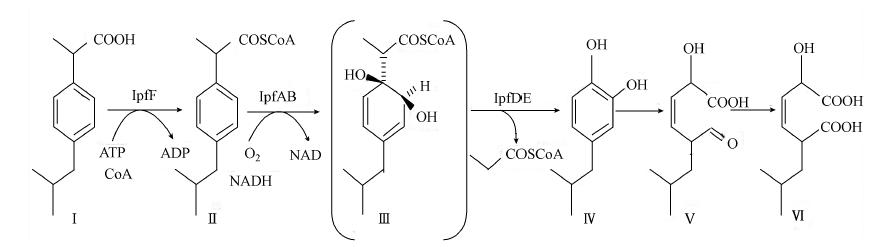 |
| 图 1 Sphingomonas sp.菌株Ibu-2降解布洛芬途径(Kagle et al., 2009)(I: ibuprofen; II: ibuprofen-CoA; III: 1,2-cis-diol-2-hydroibuprofen-CoA; IV: 4-isobutylcatechol; V:5-formyl-2-hydroxy-7-methylocta-2,4-dienoic acid; VI: 2-hydroxy-5-isobutylhexa-2,4-dienedioic acid) Fig. 1 Proposed pathway of ibuprofen degradation by Sphingomonas sp. strain Ibu-2 |
3 株细菌(Klebsiella sp.Yangling I2、Pseudomonas sp. Yangling I4和Acinetobacter sp. Yangling I14)分离自西安污水处理厂污水样品,GenBank登录号分别为JX196956、JX196957和JX196959.
布洛芬同系物包括苯甲酸、苯丙酸、对苯二酚、邻苯二酚、间苯二酚、对甲基苯甲酸、邻甲基苯甲酸.布洛芬及以上底物以甲醇为溶剂,配制50 mg · mL-1的贮存液,-20 ℃保存备用.以上试剂均为国产或进口分析纯.
无机盐培养基(MS培养基,g · L-1):K2HPO4 1.6,KH2PO4 0.4,NaNO3 0.4,CaCl2 0.02,MgSO4 · 7H2O 0.2,FeSO4 · 7H2O 0.01,pH=6.8~7.2.LB培养基(g · L-1):胰蛋白胨10,酵母浸粉5,NaCl 10.配置固体培养基时则加入琼脂20 g · L-1.
2.2 实验方法 2.2.1 布洛芬降解菌株生长特性检测将冰箱保存的I2菌株转接于LB液体培养基中,30 ℃过夜培养;离心(5000 r · min-1,5 min)收集菌体,以磷酸缓冲溶液洗涤3次并重悬菌体,调整菌悬液浓度至OD600值为2左右,4 ℃冰箱保存备用.以同样的方法制备I4、I14菌株的菌悬液.菌悬液以2%的体积比接种于LB液体培养基,摇床培养(30 ℃,130 r · min-1),从0 h开始间隔取样测定OD600,绘制生长曲线以确定菌株在LB液体培养基中的生长状况.以同样的方法,测定菌株在加入500 mg · L-1布洛芬的无机盐液体培养基中的生长曲线.
2.2.2 布洛芬降解菌株降解谱测试分别按照梯度终浓度(表 1~3),在无机盐培养基中加入各芳香族化合物,制成固体筛选培养基.I2菌株转接于LB液体培养基中,30 ℃过夜培养;收集菌体(5000 r · min-1,5 min),以磷酸缓冲溶液洗涤3次并重悬菌体,调整菌悬液浓度至OD600值为0.8左右;将菌悬液稀释500倍制成稀释菌悬液,4 ℃冰箱保存备用.以同样的方法制备I4、I14菌株的稀释菌悬液.分别取2 μL I2、I-4、I14菌株的稀释菌悬液涂布于上述固体培养基上,30 ℃培养,观察菌落生长情况.对照为相应菌在LB培养基、加入同浓度布洛芬的无机盐培养基上培养.若菌株可以在上述培养基上生长,则进一步加大底物浓度,以同样的条件培养,继续观察3株菌的生长情况,直至达到菌株的致死浓度.
3 结果与分析(Results and analysis) 3.1 I2、I4、I14菌株生长曲线 3.1.1 I2、I4、I14菌株在LB液体培养基中的生长状况用LB液体培养基培养I2、I4、I14菌株,绘制生长曲线,结果如图 2所示.由图可知,菌株接种到LB液体培养基中初始的OD600值为0.04左右,3株菌生长状况良好,菌株活性较好.生长曲线显示,I2、I4、I14菌株没有出现明显的延滞期,菌体数呈现先增加后稳定再逐步减少的趋势,符合细菌生长曲线特征.
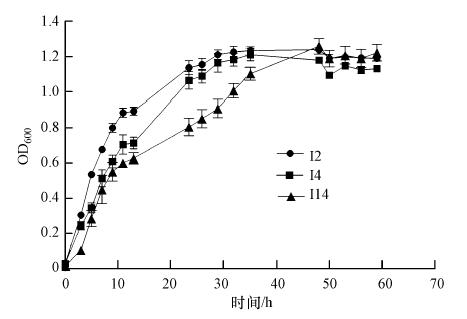 |
| 图 2 LB培养基中I2、I4、I14菌株的生长曲线 Fig. 2 Growth curves of I2,I4 and I14 cultivated in LB |
用加入500 mg · L-1布洛芬的MS培养基培养I2、I4、I14菌株,初始OD600值同样为0.04左右.由于前期试验显示,菌株在仅加入布洛芬的无机盐培养基中生长缓慢,因此,在原有培养基的基础上加入1 g · L-1的酵母粉,用以促进菌体生长,绘制生长曲线(图 3). 由图 3可知,在添加了500 mg · L-1布洛芬的培养基中,3株菌的生长状况符合微生物的生长曲线特征,在1 d内菌株大量繁殖并处于对数期,在1~3 d中处于稳定期,之后逐渐进入衰亡期,与用LB培养相比菌株活力未受影响.
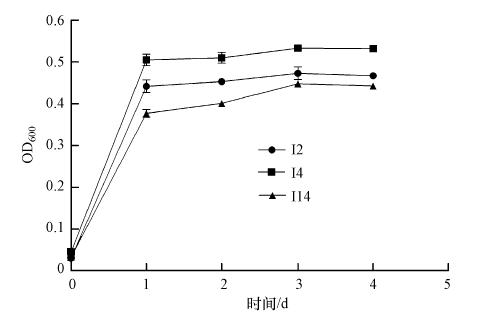 |
| 图 3 MS培养基中I2、I4、I14的生长曲线 Fig. 3 Growth curve of I2,I4 and I14 cultivated in MS |
由表 1可知,在底物浓度为25~300 mg · L-1时,I2菌株在这7种底物的筛选培养基上均可以生长,证明其可以降解以上布洛芬同系物.由实验结果得出I2菌株对各底物的最大耐受浓度为:苯甲酸600 mg · L-1、苯丙酸1100 mg · L-1、邻苯二酚600 mg · L-1、对苯二酚300 mg · L-1、间苯二酚2500 mg · L-1、对甲基苯甲酸900 mg · L-1、邻甲基苯甲酸600 mg · L-1.
| 表1 降解菌I2对芳香族化合物的降解谱 Table 1 Degradation spectrum of aromatic compounds by degradable strain I2 |
 |
在底物为间苯二酚、苯甲酸、苯丙酸的培养基上,菌株生长状况更优,菌株对这几种苯系物的分解能力较强;菌株在邻苯二酚、对苯二酚为底物的培养基上,生长状况与其他实验组相比明显较差.该菌株实验组生长状况都比对照组(布洛芬)差,而且在超过各个底物的最大耐受浓度时,菌株仍能在这些浓度的布洛芬培养基上生长.推测布洛芬是这种或这一系列降解酶的最适底物,或者是与布洛芬有关的降解酶活性较强,这些需要进一步实验验证.随着各底物浓度的增加,观察到菌落的时间逐步延长,菌株的延滞期时间增长,底物对菌体的毒性增加.
I4菌株的降解谱(表 2)与I2菌株有相似之处,在底物浓度为25~350 mg · L-1时,I4菌株在上述筛选培养基上均可以生长.I4菌株对各底物的最大耐受浓度为:苯甲酸600 mg · L-1、苯丙酸800 mg · L-1、邻苯二酚350 mg · L-1、对苯二酚500 mg · L-1、间苯二酚2000 mg · L-1、对甲基苯甲酸700 mg · L-1、邻甲基苯甲酸600 mg · L-1.I4菌株的各底物的最大耐受浓度整体比I2菌株低,但差异不大.
| 表2 降解菌I4对芳香族化合物的降解谱 Table 2 Degradation spectrum of aromatic compounds by degradable strain I4 |
|
通过表 3可知,I14菌株对各底物的最大耐受浓度为:苯甲酸350 mg · L-1、苯丙酸600 mg · L-1、邻苯二酚150 mg · L-1、对苯二酚50 mg · L-1、间苯二酚1200 mg · L-1、对甲基苯甲酸400 mg · L-1、邻甲基苯甲酸450 mg · L-1.尽管I14菌株对布洛芬同系物的广谱性降解也是存在的,但与其它2株菌相比,I14菌株的最大耐受浓度要低很多.I14菌株对于苯甲酸、间苯二酚有较好的耐受性,而对于邻苯二酚、对苯二酚十分敏感,这与I2、I4菌株相似.
| 表3 降解菌I14对芳香族化合物的降解谱 Table 3 Degradation spectrum of aromatic compounds by degradable strain I14 |
|
布洛芬的同系物为芳香族化合物,大部分是医药、化工中间体,如果未经降解排放到环境中可能造成严重的生态危害,分开治理这些污染物耗时长、见效慢且操作复杂,因此,需要对菌体降解谱进行探究.本次布洛芬降解菌株降解谱实验中,3株布洛芬高效降解菌都可以降解实验选定的7种布洛芬同系物.结合已报道的各芳香族化合物代谢通路、降解菌的降解特性等(张瑞富等,2004; Nwanna et al., 2006; Pandey et al., 2012),不难发现其共性,这些研究成果与本次实验结果都表明有的降解菌拥有耐受多种污染物的能力,因此,同时治理多重污染是可以实现的.
本次布洛芬降解菌株降解谱实验虽证实了降解广谱性的存在,但各菌株对其降解谱各底物的降解能力也有一定的差异,这是降解菌应用到污染治理中的障碍,需要进一步分析研究.Kagle等(2009)研究的代谢通路显示,Ibu2菌株降解布洛芬过程中会产生中间物质4-isobutylcatechol,该物质为邻苯二酚的同系物,并且结合其它已报道的苯系物代谢通路可以看出,有相当一部分苯系物的降解经过了邻苯二酚途径(Sachan et al., 2006;Zeinali et al., 2008; Marco-Urrea et al., 2009;张晓云等,2012;Choi et al., 2013;袁怀瑜等,2013). 而本实验中的3株菌并不符合这一规律,与其它底物相比,相对较低浓度的邻苯二酚、对苯二酚即可造成菌体死亡,说明这2种酚类物质或其降解产物对本次实验菌株毒性较大.也有可能是代谢产物的大量积累,对催化该反应的降解酶活性产生影响,菌体不能继续以这2种酚作为碳源,进而菌体无法生存,因此,这3株菌不适合处理对苯二酚和邻苯二酚造成的污染.以上结果都表明,这3株菌苯系物的降解通路与已报道的菌株不同.而这3株菌对间苯二酚的耐受性较好,最高耐受浓度都在1000 mg · L-1以上,应用于处理间苯二酚的污染将更有效.由于实验菌株是筛选出的布洛芬降解菌且间苯二酚耐受性高,说明间苯二酚有可能是布洛芬降解的中间产物或是某种中间产物的同系物,即在这3株菌中苯系物的降解可能经过间苯二酚途径,这还需要后续进一步研究.
5 结论(Conclusions)1)I2、I4、I14菌株均可以降解选定的7种布洛芬同系物,通过降解谱实验可以为各菌株对各底物的降解能力进行排序,I2菌株为:布洛芬>间苯二酚>苯丙酸>对甲基苯甲酸>苯甲酸>邻甲基苯甲酸>邻苯二酚>对苯二酚;I4菌株为:布洛芬>间苯二酚>苯丙酸>对甲基苯甲酸>邻甲基苯甲酸>苯甲酸>对苯二酚>邻苯二酚;I14菌株为:布洛芬>间苯二酚>苯丙酸>邻甲基苯甲酸>对甲基苯甲酸>苯甲酸>邻苯二酚>对苯二酚.
2)目前所监测到的环境中的布洛芬等污染物都是痕量(ng · L-1到μg · L-1)存在的,而3株菌对7种布洛芬同系物最低耐受浓度为50 mg · L-1,因此,这3株菌株都可以用于解决布洛芬等苯系物的多重污染问题. 但I2、I4菌株对这些苯系物的耐受浓度至少为300 mg · L-1,且不论是生长速度还是对几种布洛芬同系物的降解耐受程度都优于I14菌株.因此,整体来看,I2、I4菌株是理想的布洛芬及其同系物降解的优良备选菌株,适合进一步研究.
| [1] | Almeida B,Kjeldal H,Lolas I,et al.2013.Quantitative proteomic analysis of ibuprofen-degrading Patulibacter sp.strainⅠ11[J].Biodegradation,24(5): 615-630 |
| [2] | Andreozzi R,Raffaele M,Nicklas P.2003.Pharmaceuticals in STP effluents and their solar photodegradation in aquatic environment[J].Chemosphere,50(10): 1319-1330 |
| [3] | Bui T X,Choi H. 2009.Adsorptive removal of selected pharmaceuticals by mesoporous silica SBA-15[J].Journal of Hazardous Materials,168(2/3): 602-608 |
| [4] | Cao B,Geng A L,Loh K C.2008.Induction of ortho-and meta-cleavage pathways in Pseudomonas in biodegradation of high benzoate concentration: MS identification of catabolic enzymes[J].Applied Microbiology and Biotechnology,81(1): 99-107 |
| [5] | 陈伟伟,黄俊,隋倩,等.2011.PSE-UPLC-MS/MS法测定污泥中9种药物与个人护理品[J].环境科学研究,24(8): 925-932 |
| [6] | Choi E J,Jin H M,Lee S H.2013.Comparative genomic analysis and benzene,toluene,ethylbenzene,and o-,m-,and p-xylene (BTEX) degradation pathways of Pseudoxanthomonas spadix BD-a59[J].Applied and Environmental Microbiology,79(2): 663-671 |
| [7] | Ferguson P J,Bernot M J,Doll J C,et al.2013.Detection of pharmaceuticals and personal care products (PPCPs) in near-shore habitats of southern Lake Michigan[J].The Science of the Total Environment,458-460: 187-196 |
| [8] | Gabrielle V,Philippe E,Andre L,et al.2010.Toxic effects and bioaccumulation of carbamazepine evaluated by biomarkers measured in organisms of different trophic levels[J].Chemosphere,80(9): 1062-1068 |
| [9] | Hijosa-Valsero M,Matamoros V,Sidrach-Cardona R,et al.2010.Comprehensive assessment of the design configuration of constructed wetlands for the removal of pharmaceuticals and personal care products from urban wastewaters[J].Water Research,44(12): 3669-3678 |
| [10] | 姜蕾,谢丽,周琪,等.2010.水处理中微量抗生素去除的研究及进展[J].中国给水排水,26(18): 18-22; 35 |
| [11] | Jin H M,Choi E J,Jeon C O.2013.Isolation of a BTEX-degrading bacterium,Janibacter sp.SB2,from a sea-tidal flat and optimization of biodegradation conditions[J].Bioresource Technology,145: 57-64 |
| [12] | Jones O A,Lester J N,Voulvoulis N.2005.Pharmaceuticals: a threat to drinking water?[J].Trends in Biotechnology,23(4): 163-167 |
| [13] | Kagle J,Porter A W,Murdoch R W,et al.2009.Chapter 3 biodegradation of pharmaceutical and personal care products[J].Advances in Applied Microbiology,67: 65-108 |
| [14] | Kim Y H,Cho K,Yun S H,et al.2006.Analysis of aromatic catabolic pathways inPseudomonas putida KT 2440 using a combined proteomic approach: 2-DE/MS and cleavable isotope-coded affinity tag analysis[J].Proteomics,6(4): 1301-1318 |
| [15] | Kolpin D W,Furlong E T,Meyer M T,et al.2002.Pharmaceuticals,hormones,and other organic wastewater contaminants in U.S.streams,1999-2000: A national reconnaissance[J].Environmental Science & Technology,36(6): 1202-1211 |
| [16] | Krishnan S,Prabhu Y,Phale P S.2004.O-Phthalic acid,a dead-end product in one of the two pathways of phenanthrene degradation in Pseudomonas sp.strain PP2[J].Indian Journal of Biochemistry & Biophysics,41(5): 227-232 |
| [17] | Marco-Urrea E,Pérez-Trujillo M,Vicent T,et al.2009.Ability of white-rot fungi to remove selected pharmaceuticals and identification of degradation products of ibuprofen by Trametes versicolor[J].Chemosphere,74(6): 765-772 |
| [18] | Matamoros V,Bayona J M.2008.Behavior of Emerging Pollutants in Constructed Wetlands [A]//The Handbook of Environmental Chemistry[D].Berlin,Heidelberg: Springer.199-217 |
| [19] | Matamoros V,García J,Bayona J M.2008.Organic micropollutant removal in a full-scale surface flow constructed wetland fed with secondary effluent[J].Water Research,42(3): 653-660 |
| [20] | Méndez-Arriaga F,Torres-Palma R A,Pétrier C,et al.2008.Ultrasonic treatment of water contaminated with ibuprofen[J].Water Research,42(16): 4243-4248 |
| [21] | Murdoch R W,Hay A G.2005.Formation of catechols via removal of acid side chains from ibuprofen and related aromatic acids[J].Applied and Environmental Microbiology,71(10): 6121-6125 |
| [22] | Murdoch R W,Hay A G.2013.Genetic and chemical characterization of ibuprofen degradation by Sphingomonas Ibu-2[J].Microbiology,159(Pt 3): 621-632 |
| [23] | Nakada N,Tanishima T,Shinohara H,et al.2006. Pharmaceutical chemicals and endocrine disrupters in municipal wastewater in Tokyo and their removal during activated sludge treatment[J].Water Research,40(17): 3297-3303 |
| [24] | Nwanna I E M,George G O,Olusoji I M.2006.Growth study on chrysene degraders isolated from polycyclic aromatic hydrocarbon polluted soils in Nigeria[J].African Journal of Biotechnology,5(10): 823-828 |
| [25] | Pandey A K,Chaudhary P,Singh S B.2012.Deciphering the traits associated with PAH degradation by a novel Serratia marcesencs L-11 strain[J].Journal of Environmental Science and Health,Part A: Toxic/Hazardous Substances and Environmental Engineering,47(5): 755-765 |
| [26] | Parolini M,Binelli A,Provini A.2011.Chronic effects induced by ibuprofen on the freshwater bivalve Dreissena polymorpha[J].Ecotoxicology and Environmental Safety,74(6): 1586-1594 |
| [27] | Pedersen J A,Yeager M A,Suffet I H.2003.Xenobiotic organic compounds in runoff from fields irrigated with treated wastewater[J].Journal of Agricultural and Food Chemistry,51(5): 1360-1372 |
| [28] | Sachan A,Ghosh S,Mitra A.2006.Biotransformation of p-coumaric acid by Paecilomyces variotii[J].Letters in Applied Microbiology,42(1): 35-41 |
| [29] | Stackelberg P E,Furlong E T,Meyer M T,et al.2004.Persistence of pharmaceutical compounds and other organic wastewater contaminants in a conventional drinking-water-treatment plant[J].Science of the Total Environment,329(1/3): 99-113 |
| [30] | 杨晓凡,陆光华,万杰,等.2012.水环境中药物污染、检测及去除研究进展[J].水资源保护,28(2): 1-7 |
| [31] | 杨晓凡,陆光华,刘建超,等.2013.环境相关浓度下的药物对大型蚤的多代慢性毒性[J].中国环境科学,33(3): 538-545 |
| [32] | 袁怀瑜,刘书亮,王志龙,等.2013.3-苯氧基苯甲酸降解真菌的筛选及其降解特性[J].食品科学,34(7): 152-156 |
| [33] | Zeinali M,Vossoughi M,Ardestani S K.2008.Degradation of phenanthrene and anthracene by Nocardia otitidiscaviarum strain TSH1,a moderately thermophilic bacterium[J].Journal of Applied Microbiology,105(2): 398-406 |
| [34] | 张瑞福,戴青华,何健,等.2004.七株有机磷农药降解菌的降解特性比较[J].中国环境科学,24(5): 584-587 |
| [35] | 张晓云,盖忠辉,台萃,等.2012.微生物降解苯甲酸的研究进展[J].微生物学通报,39(12): 1808-1816 |
| [36] | 朱赛嫦,王静,邵卫伟,等.2013.超高效液相色谱-串联质谱法同时检测地表水中18种药物与个人护理品的残留量[J].色谱,31(1): 15-21 |