 2014, Vol. 34

 [PDF全文]


2. 福建省污染控制与资源循环利用重点实验室, 福州 350007
2. Key Laboratory of Pollution Control and Resource Reuse of Fujian Province, Fujian Normal University, Fuzhou 350007
在工业废水中,重金属和含氯有机物常常共同存在.研究发现,金属离子的存在可能会阻碍含氯有机物的降解,而在含氯有机物存在的情况下金属离子的去除也可能受到抑制(Lin et al., 2009; Lee et al., 2002).目前,复合型污染废水的处理大多采用吸附法和微生物法,但吸附法通常只是将污染物转移,不能彻底去除污染物(Oyanedel-Craver et al., 2007).如Lee等(2002)利用有机膨润土同步去除水溶液中的铅离子和氯苯,发现氯苯在2 h内就达到吸附平衡,而铅离子的吸附平衡时间需要15 h.微生物法处理复合污染物存在反应时间长等缺点(Lin et al., 2009).因此,需要寻找一种快速、高效处理复合污染废水的技术.
近年来,纳米铁系材料由于拥有高的比表面积和反应活性,在环境修复中得到大量的研究和应用(Zhang,2003),如处理水体中含氯有机物、杀虫剂、重金属及炸药等各种污染物(Shi et al., 2011a; Zhang et al., 2011; Zhu et al., 2011; Tian et al., 2009).但纳米铁系颗粒常常会因为磁性和范德华力等原因发生团聚而失活(Liu et al., 2010; Bezbaruah et al., 2009).海藻酸钙是一种多孔、“绿色”、可生物降解的支架材料,利用海藻酸钙小球包覆纳米铁系颗粒进而提高纳米颗粒的稳定性和抗氧化性具有其独特的优势.此外,工业废水经常同时含有有机物和重金属离子,而目前纳米铁系材料常用于降解单一污染物,对水体中复合污染物的降解机制研究基本未见报道.基于此,本文将纳米铁镍颗粒(Ni/Fe NPs)包覆于多孔的聚合物溶胶海藻酸钙小球中,制备海藻酸钙包覆纳米Ni/Fe颗粒小球(CA-Ni/Fe NPs),并对材料进行表征分析.同时,研究CA-Ni/Fe NPs同时去除水中铜离子和氯苯的影响因素和机理,并考察其在实际废水中的重复利用率.以期为利用纳米技术同时去除多种污染物提供参考.
2 材料与方法(Materials and methods) 2.1 试剂与仪器试剂:FeCl3 · 6H2O、NiSO4 · 6H2O、NaBH4、海藻酸钠、无水Na2SO4、NaOH、无水乙醇、CaCl2、Cu(NO3)2、氯苯等均为分析纯,购自上海试剂公司.
仪器:PHS-3C型精密pH计,JJ-1精密增力电动搅拌器(国华电器有限公司),AA-240型原子吸收光谱仪(美国Varian公司),3800CP型气相色谱仪(美国Varian公司),扫描电子显微镜(JEOL,JSM-7500F),X射线能量色散谱分析(INCA EDS,英国Oxford公司),X′pert Pro型X射线粉末衍射仪(荷兰Philips).
2.2 Ni/Fe NPs的制备将9.66 g FeCl3 · 6H2O和0.89 g NiSO4 · 6H2O溶解于50 mL体积比为4∶1的乙醇和蒸馏水混合溶剂中,然后加到三颈烧瓶中,剧烈搅拌10 min;将新配的100 mL的NaBH4溶液逐滴加入,持续搅拌40 min;NaBH4溶液滴加完毕后,继续搅拌10 min,整个反应过程都在氮气保护下进行.反应完毕后,快速抽滤,分别用蒸馏水和无水乙醇洗涤冲洗3次以除去残余的NaBH4和NaCl等杂质,置于60 ℃的真空干燥箱中干燥10 h,取出备用.
2.3 CA-Ni/Fe NPs的制备在室温((22±2)℃)条件下取1 g海藻酸钠于50 mL经过脱氧之后的蒸馏水中,置于磁力搅拌器上搅拌均匀形成海藻酸盐和水的混合物,静置30 min排除溶胶中的气泡.称取一定量 Ni/Fe NPs(其中,Ni含量约为10%)(Zhang,2003)慢慢放入2%海藻酸盐水溶胶(W/V,g · mL-1)中,然后通过蠕动泵将其滴入3.5%(体积分数)脱氧的CaCl2溶液中.为保证所有的Ni/Fe NPs被海藻酸钙包覆,用玻璃棒不断搅拌生成的水溶胶.生成的包覆Ni/Fe NPs的溶胶小球在CaCl2溶液中交联时间大约9 h,然后用蒸馏水清洗3遍(Bezbaruah et al.,2009).
2.4 实验方法配制500 mL含有50 mg · L-1铜离子和50 mg · L-1氯苯的混合溶液,加入含有一定量Ni/Fe NPs的海藻酸钙小球(CA-Ni/Fe NPs).在搅拌器转速为250 r · min-1的条件下进行反应,每隔一定时间取0.5 mL水样,经0.45 μm滤膜过滤后用原子吸收法测定剩余铜离子浓度;同时取10 mL水样,经正己烷萃取分层,有机相用无水硫酸钠干燥后,用气相色谱法测氯苯浓度.色谱条件如下:CP-Sil毛细管柱(30 m×0.32 mm×0.25 μm);升温程序控制初始柱温为50 ℃,维持2 min,然后以50 ℃ · min-1的速率升至250 ℃,维持4 min;进样口温度为250 ℃,氮气流速为1 mL · min-1;检测器(FID)温度为300 ℃;进样量为2 μL.
图 1为海藻酸钙小球和CA-Ni/Fe NPs的扫描电镜(SEM)图.由图 1a可见,海藻酸钙小球表面凹凸不平,具有多孔性.而当包覆Ni/Fe NPs后(图 1b),明显发现海藻酸钙中出现呈链状的Ni/Fe NPs,说明Ni/Fe NPs被成功包覆在海藻酸钙小球中.
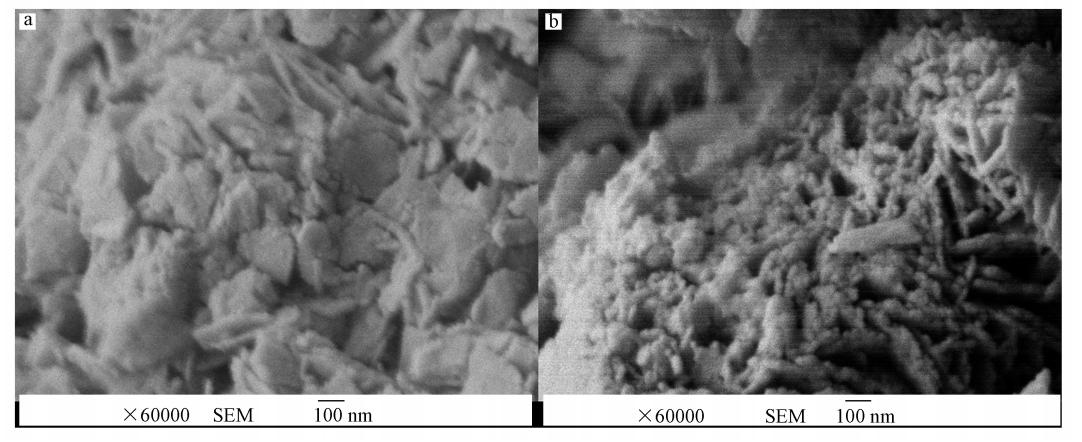 |
| 图 1 海藻酸钙小球(a)和CA- Ni/Fe NPs(b)的扫描电镜图 Fig. 1 SEM images of calcium alginate(a) and Ni/Fe nanoparticles entraped by calcium alginate(b) |
图 2是海藻酸钙小球和CA- Ni/Fe NPs的EDS谱图.从图中可见,海藻酸钙小球主要成分是C、O和Ca元素.而CA-Ni/Fe NPs中除了含有C、O和Ca元素,还出现了Fe和Ni元素的特征峰,进一步证实Ni/Fe NPs被成功地包覆在海藻酸钙小球里.
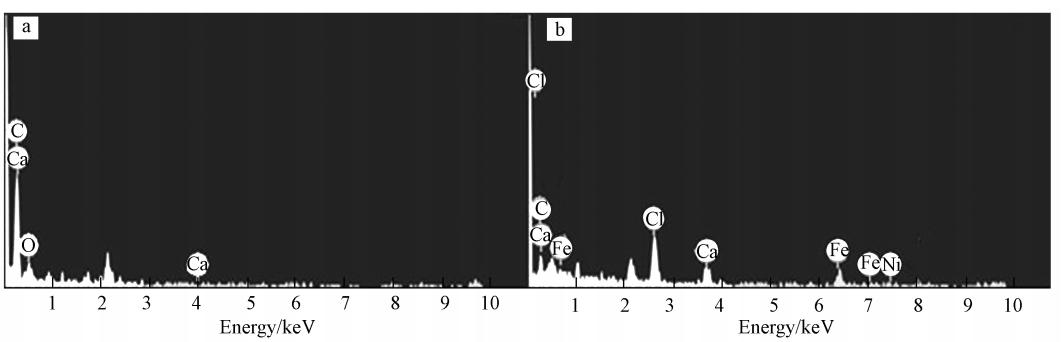 |
| 图 2 海藻酸钙小球(a)和CA- Ni/Fe NPs小球(b)的EDS谱图 Fig. 2 EDS patterns of calcium alginate(a) and Ni/Fe nanoparticles entraped by calcium alginate(b) |
图 3是CA-Ni/Fe NPs小球的XRD谱图.如图所示,在2θ=44.9°处存在明显的零价铁特征峰(Shi et al., 2011a),而铁氧化物的特征峰并不明显,说明制备的CA-Ni/Fe NPs中确实存在零价铁并且没有发生明显氧化.由于Ni催化剂在材料中含量较少,XRD的谱图中没有检测到Ni.XRD结果与上述SEM和EDS结果一致,说明Ni/Fe NPs经过包覆可以克服纳米铁系颗粒因为磁性等原因发生的团聚及易氧化等弱点,进而提高反应活性(Liu et al., 2010; Bezbaruah et al., 2009).
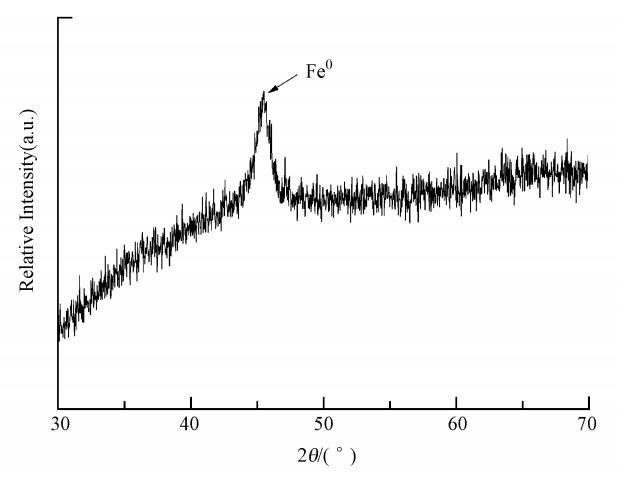 |
| 图 3 CA-Ni/Fe NPs的XRD谱图 Fig. 3 XRD pattern of entrapment of Ni/Fe nanoparticles entraped by calcium alginate |
在500 mL含有50 mg · L-1铜离子和50 mg · L-1氯苯的混合溶液中分别加入1 g Ni/Fe NPs和含有1 g Ni/Fe NPs的CA-Ni/Fe NPs,考察Ni/Fe NPs和CA-Ni/Fe NPs同时去除水中铜离子和氯苯的情况,结果如图 4所示. 从图中可以看出,两种材料对铜离子和氯苯的去除率相当,说明Ni/Fe NPs经海藻酸钙包覆后活性并没有降低.在反应120 min后,Ni/Fe NPs和CA-Ni/Fe NPs对初始浓度为50 mg · L-1铜离子的去除率分别为86.7%和85.9%,对50 mg · L-1氯苯的去除率则分别为99.1%和95.7%.说明海藻酸钙的包覆并未降低Ni/Fe NPs的活性,经海藻酸钙包覆后克服了纳米颗粒不易回收的缺陷,有利于应用于实际废水治理.
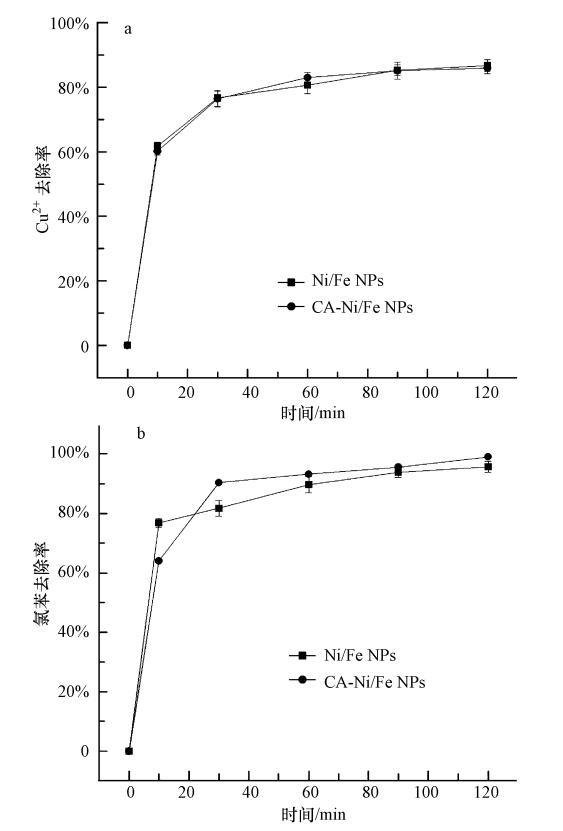 |
| 图 4 Ni/Fe NPs和CA-Ni/Fe NPs同时去除水溶液中铜离子(a)和氯苯(b)的效果 Fig. 4 Ni/Fe NPs and CA-Ni/Fe NPs used for removal of Cu2+(a) and chlorobenzene(b) |
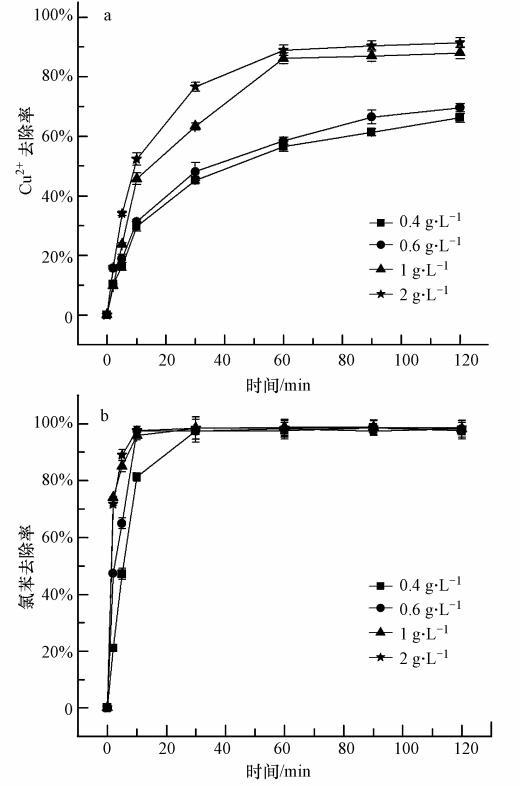
图 5是不同CA-Ni/Fe NPs投加量(以Ni/Fe NPs含量计)对同时去除水中铜离子和氯苯的影响.如图 5a所示,随着CA-Ni/Fe NPs投加量的增大,铜离子的去除率增大.当投加量分别为0.4、0.6、1和2 g · L-1时,对50 mg · L-1铜离子的去除率分别为66.1%、69.5%、87.9%和91.3%.当投加量从1 g · L-1增加到2 g · L-1时,铜离子的去除率并没有明显增加.这主要是因为投加量为1 g · L-1时,对于50 mg · L-1铜离子的去除已经达到饱和,因此,继续增大投加量铜离子的去除率并没有得到相应的升高(Parshetti et al., 2009). 但随着投加量的增大,铜离子的去除速率随之提高(Lien et al., 2007). 这是因为CA-Ni/Fe NPs投加量增大,为铜离子的去除提供了更多的吸附位点,同时在小球内部也提供了更多的反应活性位点(Parshetti et al., 2011; Bezbaruah et al., 2011). 铜离子去除达到平衡比较缓慢,长达90 min,这可能是由于还原过程速率低所致(Zhang et al., 2011). 铜离子经还原后会形成Cu/Ni/Fe,对氯苯的去除有一定促进作用(Shih, et al., 2011).
 |
| 图 5 不同CA-Ni/Fe NPs投加量对同时去除水溶液中铜离子(a)和氯苯(b)的影响 Fig. 5 The effect of CA-Ni/Fe NPs dosage on the removal of Cu2+(a) and chlorobenzene(b) |
图 5b是不同投加量对混合液中氯苯去除率的影响. 从图中可知,CA-Ni/Fe NPs对氯苯的去除在30 min时就达到了平衡,去除率都在97%以上.随着投加量的增大,氯苯的去除速率也随之增大.相对铜离子,氯苯的去除具有更高的反应速率.这从另一方面说明氯苯能更快地被CA-Ni/Fe NPs小球吸附,进而进行脱氯降解.
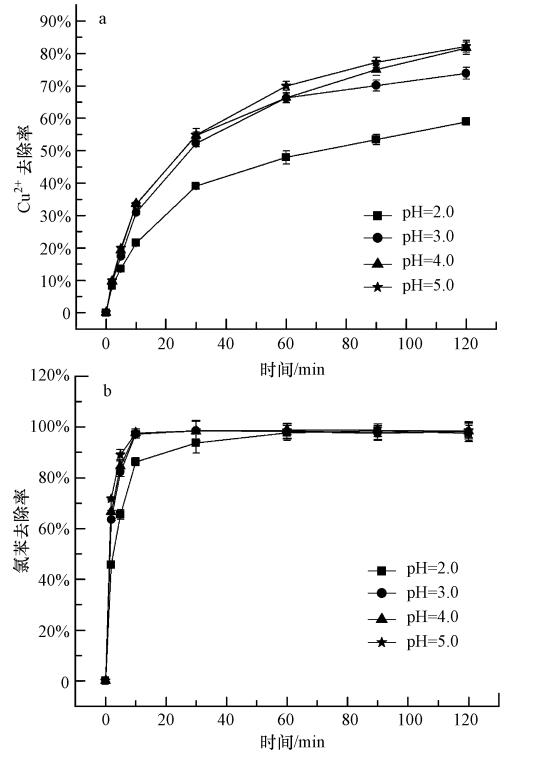
3.3.2 pH的影响图 6是不同初始pH值对CA-Ni/Fe NPs同时去除水溶液中铜离子和氯苯的影响. 如图 6a所示,铜离子的去除率随着pH的升高而增大.反应120 min时,初始pH为2.0、3.0、4.0和5.0的体系中铜离子的去除率分别为58.9%、73.8%、81.6%和82.2%. pH为2.0条件下,CA-Ni/Fe NPs对于铜离子的去除效率较差,这与其它溶液中pH对未负载Ni/Fe纳米颗粒的影响相反(Shi et al., 2011a; Xiao et al., 2011). 可能原因是包覆后的Ni/Fe NPs可以成功抵御外界环境的pH 变化干扰,同时低pH会引起溶液中H+与金属离子的竞争进而导致海藻酸钙小球对铜离子吸附效果的降低(Papageorgiou et al., 2008). 与之类似,CA-Ni/Fe NPs对不同初始pH值下氯苯降解的影响不大,并且低pH也不利于氯苯的降解(图 6b).这是因为低pH不利于氯苯迁移至CA-Ni/Fe NPs小球内部,进而影响Ni/Fe NPs的脱氯效果(Ely et al., 2009).
 |
| 图 6 不同pH对CA-Ni/Fe NPs同时去除水溶液中铜离子(a)和氯苯(b)的影响 Fig. 6 The effect of pH on the removal of Cu2+(a) and chlorobenzene(b)by CA-Ni/Fe NPs |
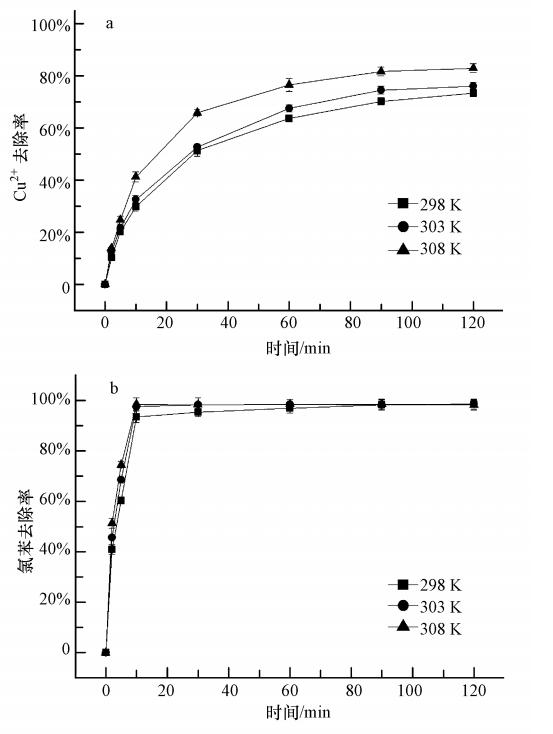
图 7是不同温度对CA-Ni/Fe NPs同时去除水中铜离子和氯苯的影响. 从图 7a可见,随着反应温度的升高,铜离子的去除率不断增强.在反应120 min时,298、303和308 K反应温度条件下,铜离子的去除率分别为73.4%、76.1%和82.9%. 这主要是因为体系反应温度升高有利于铜离子从水溶液中转移到CA-Ni/Fe NPs小球里,进而提高铜离子的去除效果(Bezbaruah et al., 2011; Han et al., 2011),且铜离子被Ni/Fe NPs还原为Cu0(Zhang,2003). 另一方面,在反应120 min降解达到平衡时,在298、303和308 K反应温度下氯苯的去除率分别为98.6%、98.6%和98.3%.不同反应温度下的氯苯去除率并没有太大区别,而在反应前60 min内,氯苯的去除速率是随温度的升高有所增大,这主要是因为提高温度可加快氯苯迁移到海藻酸钙空隙中,导致CA-Ni/Fe NPs对氯苯的降解效率提高(Zhu et al., 2007).
 |
| 图 7 不同温度对CA-Ni/Fe NPs同时去除水溶液中铜离子(a)和氯苯(b)的影响 Fig. 7 The effect of temperature on the removal of Cu2+(a) and chlorobenzene(b)by CA-Ni/Fe NPs |
文献报道(Zhang et al., 2011; Zhu et al., 2007),零价纳米铁及铁系纳米双金属对于铜离子和氯苯的去除符合伪一级动力学,方程式如下:

利用温度条件实验数据拟合得到的动力学参数如表 1所示.由表可知,不同温度下得到的R2均大于0.9,说明采用CA-Ni/Fe NPs用于铜离子和氯苯的同时去除可以用伪一级动力学方程进行表示.在298、303和308 K下,对铜离子和氯苯的降解随着温度的升高表观速率常数也随之增大(Zhu et al., 2007).
| 表1 不同温度条件下的伪一级动力学常数 Table.1 Pseudo-first-order kinetic parameters under different temperatures |
 |
利用Arrhenius公式(2)计算此反应过程的表观活化能Ea,得到铜离子的表观活化能为26.02 kJ · mol-1,而氯苯的表观活化能为33.72 kJ · mol-1. 根据文献报道,表面控制反应的表观活化能大于29 kJ · mol-1,而扩散控制反应的表观活化能为8~21 kJ · mol-1(Shi et al., 2011b). 当Ea值为10~20 kJ · mol-1时反应是一个物理吸附占主导的过程,当Ea>20 kJ · mol-1时化学吸附占主导. 因此,CA-Ni/Fe NPs同步去除铜离子和氯苯是一个化学吸附占主导的反应.

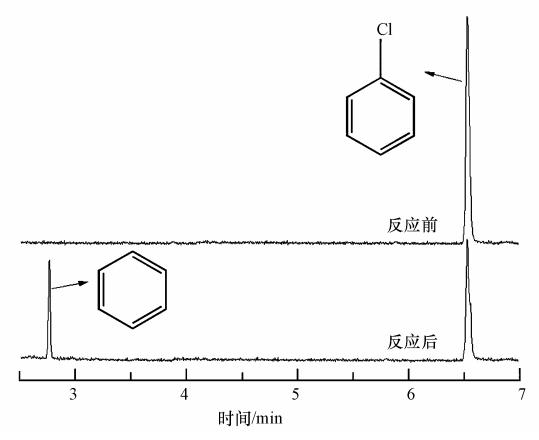
图 8是CA-Ni/Fe NPs与氯苯反应10 min前后溶液的GC-MS图.对照NIST数据库,反应前氯苯(MCB)在6.523 min出峰;反应后的溶液在2.765 min的峰经对照为苯的特征峰,说明MCB经CA-Ni/Fe NPs降解之后生成苯,后续可以结合化学深度氧化或生物处理技术进行苯的矿化;同时,反应后6.523 min时的氯苯峰降低,说明10 min后氯苯部分降解.
 |
| 图 8 反应10 min前后氯苯的GC-MS分析图谱 Fig. 8 GC-MS analysis of MCB 10min before and after reaction |
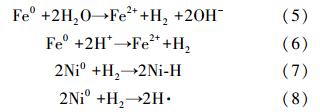
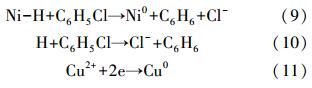
根据以上表征、降解条件和动力学的结果分析可知,CA-Ni/Fe NPs同时去除铜离子和氯苯的机理分为两个途径,即竞争吸附和还原催化降解同时进行的过程.首先,铜离子和氯苯竞争吸附于海藻酸钙或Ni/Fe NPs表面;其次,纳米铁与水产生的氢气在Ni的催化作用下,产生氢自由基,进而发生催化脱氯降解氯苯生成苯(Su et al., 2011),而CA-Ni/Fe NPs中的Fe 被腐蚀释放电子,将 Cu2+ 还原为 Cu0(Zhang et al., 2011). 具体可用以下方程表示.
1)铜离子和氯苯竞争吸附于CA-Ni/Fe NPs上:

2)零价铁在水中腐蚀产生氢气,氢气在Ni0催化作用下生成金属氢化物和氢自由基:
3)氯苯脱氯生产苯,铜离子接受电子被还原为Cu0:
使用CA-Ni/Fe NPs同时去除含有50 mg · L-1铜离子和50 mg · L-1氯苯的工业废水,结果如图 9所示. 从图中可见,反应120 min后,CA-Ni/Fe NPs(使用后经50 mg · L-1 EDTA清洗)重复使用3次后对铜离子和氯苯的去除率分别维持在83.8%和91.7%. 这与纳米铁系材料重复使用之后的结果有明显的不同(Chen et al., 2011),主要是因为CA-Ni/Fe NPs对于外界环境的变化具有更强的适应性,并且拥有更大的污染物处理容量.
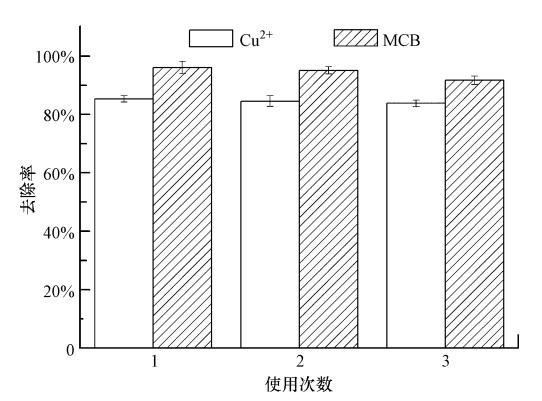 |
| 图 9 CA-Ni/Fe NPs重复使用3次后铜离子和氯苯去除率的变化 Fig. 9 The variation of Cu2+ and MCB removal efficiency by CA-Ni/Fe NPs after treatment for three times |
1)成功制备了海藻酸钙包覆Ni/Fe纳米颗粒小球(CA-Ni/Fe NPs),并将其应用于同时去除水中的铜离子和氯苯. SEM和EDS表征分析发现,Ni/Fe NPs被成功地包覆在海藻酸钙小球里;XRD分析可知,包覆后的Ni/Fe NPs并没有被氧化.
2)CA-Ni/Fe NPs同时去除水溶液中铜离子和氯苯的去除率均随着体系温度、投加量、pH值的升高而增大.动力学和热力学实验研究表明,铜离子和氯苯的同时去除符合伪一级动力学且是化学吸附占主导的反应.
3)重复使用CA-Ni/Fe NPs处理实际废水,结果发现,经过3次使用之后CA-Ni/Fe NPs同时去除水中铜离子和氯苯的效率分别维持在83.8%和91.7%.
4)本研究证明了纳米铁系材料可以被有效地包覆在生物高聚物小球中,提高降解活性;CA-Ni/Fe NPs可以克服纳米铁系材料易团聚、易氧化和使用寿命短等缺陷,并且可以用于同时去除2种不同污染物,这些研究结果为纳米材料修复多种污染物提供了一种新的基础研究参考和学术视野.
| [1] | Bezbaruah A N, Krajangpan S, Chisholm B J, et al. 2009. Entrapment of iron nanoparticles in calcium alginate beads for groundwater remediation applications [J]. Journal of Hazardous Materials, 166(2/3): 1339-1343 |
| [2] | Bezbaruah A N, Shanbhogue S S, Simsek S, et al. 2011. Encapsulation of iron nanoparticles in alginate biopolymer for trichloroethylene remediation [J]. Journal of Nanoparticle Research, 13(12): 6673-6681 |
| [3] | Chen Z X, Jin X Y, Chen Z L, et al. 2011. Removal of methyl orange from aqueous solution using bentonite-supported nanoscale zero-valent iron [J]. Journal of Colloid and Interface Science, 363(2): 601-607 |
| [4] | Ely A, Baudu M, Basly J P, et al. 2009. Copper and nitrophenol pollutants removal by Na-montmorillonite/alginate microcapsules [J]. Journal of Hazardous Materials, 171(1/3): 405-409 |
| [5] | Han Y U, Lee W S, Lee C G, et al. 2011. Entrapment of Mg-Al layered double hydroxide in calcium alginate beads for phosphate removal from aqueous solution [J]. Desalination and Water Treatment, 36(1/3): 178-186 |
| [6] | Lee J J, Choi J, Park J W. 2002. Simultaneous sorption of lead and chlorobenzene by organobentonite [J]. Chemosphere, 49(10): 1309-1315 |
| [7] | Lien H L, Jhuo Y S, Chen L H. 2007. Effect of heavy metals on dechlorination of carbon tetrachloride by iron nanoparticles [J]. Environmental Engineering Science, 24(1): 21-30 |
| [8] | Lin Y H, Hsu C H, Wu C L, et al. 2009. Simultaneous phenol degradation and chromium (VI) reduction in an anaerobic fixed-biofilm process [J]. Proceedings of the Water Environment Federation, 29: 1578-1584 |
| [9] | Liu T Y, Zhao L, Sun D S, et al. 2010. Entrapment of nanoscale zero-valent iron in chitosan beads for hexavalent chromium removal from wastewater [J]. Journal of Hazardous Materials, 184(1/3): 724-730 |
| [10] | Oyanedel-Craver V A, Fuller M, Smith J A. 2007. Simultaneous sorption of benzene and heavy metals onto two organoclays [J]. Journal of Colloid and Interface Science, 309(2): 485-492 |
| [11] | Papageorgiou S, Kouvelos E P, Katsaros F K. 2008. Calcium alginate beads from Laminaria digitata for the removal of Cu2+ and Cd2+ from dilute aqueous metal solutions [J]. Desalination, 224(1/3): 293-306 |
| [12] | Parshetti G K, Doong R. 2009. Dechlorination of trichloroethylene by Ni/Fe nanoparticles immobilized in PEG/PVDF and PEG/nylon 66 membranes [J]. Water Research, 43(12): 3086-3094 |
| [13] | Parshetti G K, Doong R A. 2011. Dechlorination of chlorinated hydrocarbons by bimetallic Ni/Fe immobilized on polyethylene glycol-grafted microfiltration membranes under anoxic conditions [J]. Chemosphere, 86(4): 392-399 |
| [14] | Shi L N, Zhang X, Chen Z L. 2011a. Removal of chromium (VI) from wastewater using bentonite-supported nanoscale zero-valent iron [J]. Water Research, 45(2): 886-892 |
| [15] | Shi L N, Lin Y M, Zhang X, et al. 2011b. Synthesis, characterization and kinetics of bentonite supported nZVI for the removal of Cr(VI) from aqueous solution [J]. Chemical Engineering Journal, 171(2): 612-617 |
| [16] | Shih Y H, Chen M Y, Su Y F. 2011. Pentachlorophenol reduction by Pd/Fe bimetallic nanoparticles: Effects of copper, nickel, and ferric cations [J]. Applied Catalysis (B: Environmental),105(1/2): 24-29 |
| [17] | Su J, Lin Sn, Chen Z L, et al. 2011. Dechlorination of p-chlorophenol from aqueous solution using bentonite supported Fe/Pd nanoparticles: Synthesis, characterization and kinetics [J]. Desalination, 280(1/3): 167-173 |
| [18] | Tian H, Li J J, Mu Z, et al. 2009. Effect of pH on DDT degradation in aqueous solution using bimetallic Ni/Fe nanoparticles [J]. Separation and Purification Technology, 66(1): 84-89 |
| [19] | Xiao S L, Ma H, Shen M W, et al. 2011. Excellent copper (II) removal using zero-valent iron nanoparticle-immobilized hybrid electrospun polymer nanofibrous mats [J]. Colloids and Surfaces A: Physicochemical and Engineering Aspects, 381(1/3): 48-54 |
| [20] | Zhang W X. 2003. Nanoscale iron particles for environmental remediation: An overview [J]. Journal of Nanoparticle Research, 5(3/4): 323-332 |
| [21] | Zhang X, Lin S, Chen Z L, et al. 2011. Kaolinite-supported nanoscale zero-valent iron for removal of Pb2+ from aqueous solution: Reactivity, characterization and mechanism [J]. Water Research, 45(11): 3481-3488 |
| [22] | Zhu B W, Lim T T. 2007. Catalytic reduction of chlorobenzenes with Pd/Fe nanoparticles: reactive sites, catalyst stability, particle aging, and regeneration [J]. Environmental Science & Technology, 41(21): 7523-7529 |
| [23] | Zhu N M, Zhang F S. 2011. Catalytic dechlorination of polychlorinated biphenyls in subcritical water by Ni/Fe nanoparticles [J]. Chemical Engineering Journal, 171(3): 919-925 |