 2014, Vol. 34

 [PDF全文]


2. 福建省污染控制与资源循环利用重点实验室, 福州 350007
2. Key laboratory of pollution control and resource reuse of Fujian Province, Fujian Normal University, Fuzhou 350007
孔雀绿(MG)是一种二氨基三苯甲烷类阳离子染料,广泛应用于印染行业和水产养殖业等各个领域(Khattri et al., 1999). 研究表明,环境中的MG属于持久性有机污染物,很难从水体中去除,在鱼体内长时间残留,可通过食物链对哺乳动物和人类产生“三致”作用(Papinutti et al., 2006). 目前去除水中MG常用的方法有光降解法(Nogueira et al., 2005)、光催化法(Hachem et al., 2001)、微生物法(李妮等.,2009)、吸附法(Hameed et al., 2008)等,这些处理方法成本高还存在许多后续问题. 近年来,零价纳米铁因具有比表面积大和反应活性高等特点(Shi et al., 2011)而被广泛用于环境中抗生素、藻毒素、染料等污染物的去除(翁秀兰 et al., 2012; 高滢 et al., 2013;Chen et al., 2011),已经成为环境科学研究前沿热点之一.
传统合成纳米铁主要是化学法,化学合成法对于发展纳米铁用于环境修复起着积极作用,然而化学法常使用一些有毒的化学物质如还原剂(硼氢化钠)、有机溶剂和不可生物降解的分散剂和稳定剂(Li et al., 2006; Iravani,2011),存在成本高和二次污染等问题. 在被污染环境的原位修复中,开发环境友好、成本低廉的纳米铁合成技术是纳米铁在环境修复中面临的关键问题. 最近,本课题组利用绿茶提取液(GTE)合成纳米铁颗粒(Fe NPs),发现GTE中的一些成分,如有机酸和多酚可将亚铁离子还原为纳米金属铁,这些成分还作为合成过程的分散剂和掩蔽剂(Li et al., 2006; Iravani,2011). 与传统的化学合成方法相比,绿色合成过程避免使用有毒化学物质、降低能量消耗,具有经济性和环境友好等特点. 目前,绿色合成技术备受关注,Njagi等用高粱麸皮在pH 2~3的酸性条件下合成Fe NPs,粒径在50 nm左右(Njagi et al., 2011);Shahwan等利用绿色合成的Fe NPs用于类Fenton氧化阴、阳离子染料(Shahwan et al., 2011)以及本课题组采用桉树叶提取液合成Fe NPs处理富营养化废水(Wang et al., 2014)等.
前期研究发现GTE合成的Fe NPs易团聚并且形成铁的氧化物而导致活性下降. 表面活性剂不仅能够包覆在颗粒表面避免纳米颗粒被氧化而且能消除颗粒之间的作用力而避免团聚(Smuleac et al., 2011),然而表面活性剂对绿色合成Fe NPs的影响,以及表面活性剂作用下制备的Fe NPs对污染物的降解性能尚未报道. 因此,本研究在绿色合成纳米铁过程中加入表面活性剂十六烷基三甲基溴化铵(CTAB)作为分散剂和稳定剂,对绿色合成Fe NPs微观结构进行表征,并用于降解水中孔雀绿(MG),比较GTE直接合成以及CTAB作用下合成的Fe NPs对MG的降解效率,提出了CTAB作用下GTE合成Fe NPs的可能机理.
2 材料与方法(Materials and methods) 2.1 试剂与仪器试剂:FeSO4 · 7H2O、孔雀绿购自天津市福晨化学试剂厂;十六烷基三甲基溴化铵(CTAB)购自国药集团化学试剂有限公司;绿茶购自福建省福州市青宁茶叶厂,属于福建武夷山春季烘青绿茶,无食品添加剂. 所有化学试剂均为分析纯,使用前未进一步纯化.
仪器:THZ-320台式恒温振荡器(上海精宏实验设备有限公司);DZF-6020型真空干燥箱(上海精宏实验设备有限公司);KQ-250E型超声波清洗器(昆山市超声波仪器有限公司);扫描电子显微镜(SEM)(JSM-7500,日本JEOL公司);X射线粉末衍射(XRD)(X′Pert Pro MPD,荷兰Philips公司). 傅里叶变换红外光谱(FTIR)(Thermo Nicolet 5700,美国THERMO NICOLET公司);紫外可见分光光度计(UV-1900,上海凤凰光学科仪有限公司).
2.2 绿茶萃取液(GTE)的制备及GTE合成Fe NPs称取60 g绿茶,用蒸馏水清洗茶叶,自然晾干后加入到1 L蒸馏水中,在353 K下加热1 h后(在此温度下茶叶中的多酚氧化酶失活,多酚就不会被氧化),真空抽滤,再用0.45 μm的滤膜过滤,得到绿茶萃取液(GTE).
GTE和0.1 mol · L-1的FeSO4溶液以2∶1的比例混合,在298 K摇床中振荡1 h制备出GTE合成Fe NPs悬浊液.
2.3 CTAB作用下GTE合成Fe NPs将0.1g CTAB(1×10⁻³ mol · L-1)投加到装有20 mL GTE的50 mL离心管中,在298K、250 r · min-1的摇床中振荡30 min,使CTAB和GTE充分混匀;移取10 mL(0.1 mol · L-1)的FeSO4溶液加入到离心管,在298 K、250 r · min-1的摇床中振荡1 h 制备出的Fe NPs悬浊液.
绿色合成的Fe NPs悬浊液经真空干燥箱333 K温度下干燥后,得到固体粉末,用于样品的表征实验.
2.4 MG降解实验降解反应在离心管中进行,反应温度为298 K,分别移取2 mL GTE合成的Fe NPs悬浊液和CTAB作用下合成的Fe NPs悬浊液至7支离心管中,分别向每个离心管中移入8 mL(50 mg · L-1)的MG溶液,在摇床中分别振荡0、10、20、30、40、50、60 min取样,反应液在10000 r · min-1下离心5 min,上清液用紫外可见分光光度计于617 nm处测定溶液吸光度,用MG的去除率来评价和比较GTE合成的Fe NPs和CTAB作用下GTE合成的Fe NPs的性能.
按式(1)计算MG的去除率(Chen et al., 2011):
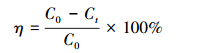
图 1a和图 1b分别为GTE合成Fe NPs和CTAB作用下GTE合成Fe NPs的扫描电镜图. 从图 1a可以看出,GTE合成的Fe NPs粒径在70~80 nm左右,呈圆球形,颗粒表面有机物包裹,对纳米颗粒起到保护作用,纳米铁颗粒出现团聚现象,这主要是由氧化铁的磁性和范德华力作用的结果(Kumar et al., 2013). 图 1b可以看出,CTAB作用下GTE合成的Fe NPs粒径和形状表现出差异,颗粒粒径大一些, Fe NPs形态更加有规则,这是由于阳离子表面活性剂CTAB的存在有助于形成有规则形态的Fe NPs(Khan et al., 2012). 一方面表面活性剂与GTE中多酚等还原剂相互作用提高了多酚溶解度,因此更多Fe2+被还原成为Fe NPs;另一方面CTAB吸附在纳米颗粒表面使得纳米颗粒带电荷,纳米颗粒间电荷斥力导致纳米材料稳定、避免团聚,提高了Fe NPs的分散度(Khan et al., 2012);另外GTE中有机物和CTAB包覆在颗粒表面可以提高Fe NPs稳定性(Kumar et al., 2013).
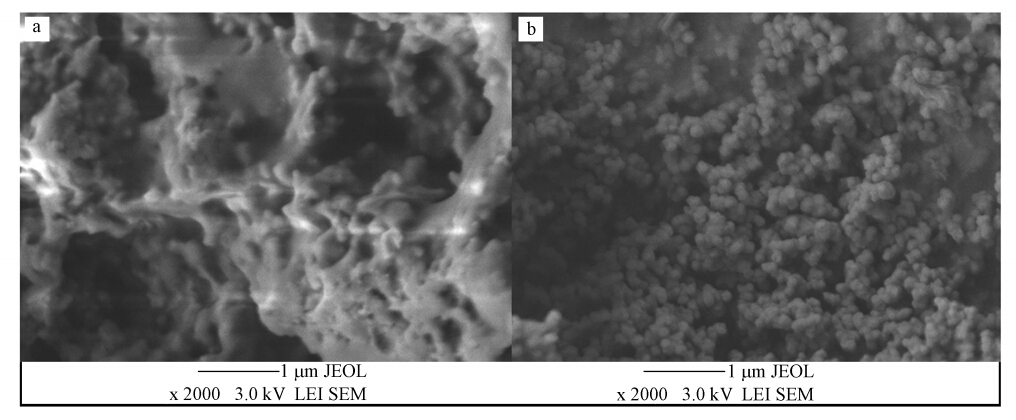 |
| 图 1 试样的SEM图(a: GTE-Fe NPs; b: CTAB作用下合成的GTE-Fe NPs) The SEM spectrum of samples(a: GTE-Fe NPs; b: GTE-Fe NPs with CTAB) |
图 2a和2b分别是GTE合成的Fe NPs和CTAB作用下GTE合成的Fe NPs的XRD图. 从图 2a和b可以看出,2θ=19.56°为GTE中有机成分如茶多酚的主要衍射吸收峰(Shahwan et al., 2011),说明绿色合成的Fe NPs表面被有机物包覆,这与Njagi等人用Sorghum Bran提取液合成Fe NPs的研究结果一致(Njagi et al., 2011). 图 2a中,2θ=20°~30°处存在氧化铁的衍射峰是由于生成的Fe NPs部分被氧化,而Fe0没有被观察到,这是由于植物萃取液绿色合成的纳米铁是无定型态的,无定型态的铁在XRD图上不出现特征峰,这一现象也在其他绿色合成的纳米铁上出现(Hoag et al., 2009; Njagi et al., 2011;Shahwan et al., 2011). 与图 2a相比,图 2b中氧化铁衍射峰消失,这可能是由于 CTAB的存在,合成的Fe NPs被GTE中有机物和CTAB同时包覆,使Fe NPs稳定性提高,不易被氧化,进一步增强Fe NPs的反应活性(Khan et al., 2012; Mittal et al., 2013). 这说明CTAB在合成过程中起到分散剂和掩蔽剂的作用,这些结果与SEM的结果基本一致.
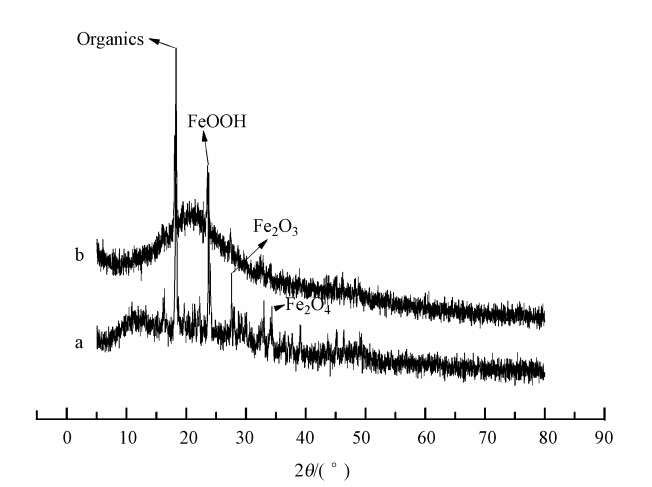 |
| 图 2 试样的XRD图(a.GTE-Fe NPs; b. CTAB作用下合成的GTE-Fe NPs) The XRD of samples(a.GTE-Fe NPs; b. GTE-Fe NPs with CTAB) |
图 3a、3b和3c分别是GTE合成的Fe NPs、CTAB作用下GTE合成的Fe NPs和GTE的红外光谱图. 图 3c中,3389 cm-1附近为O—H的振动吸收峰,1696 cm-1处的强吸收峰为C O伸缩振动峰,1637 cm-1处的弱吸收峰为绿茶酰胺带,1367 cm-1的吸收峰为GTE的特征峰,1040 cm-1的吸收峰为C—O—C的对称伸缩吸收峰,611 cm-1的吸收峰为GTE在Ⅴ区的特征吸收峰(潘燕飞,2008). 与图 3c相比,图 3a中各个官能团的特征吸收峰变化不大,这说明GTE的有机物包裹在纳米铁表面,对避免纳米颗粒被氧化起到关键作用,从而使纳米铁稳定(Kharissova et al., 2013); 546 cm-1出现了新的吸收峰,这是Fe2O3和Fe3O4的Fe—O伸缩振动峰(Gotic et al., 2007),说明合成的Fe NPs部分被氧化. 在图 3b中,2924 cm-1处的吸收峰为季铵盐上有机基团的吸收峰(崔继文等.,2007),说明CTAB包覆在Fe NPs的表面上. 这与XRD和SEM的结果相一致.
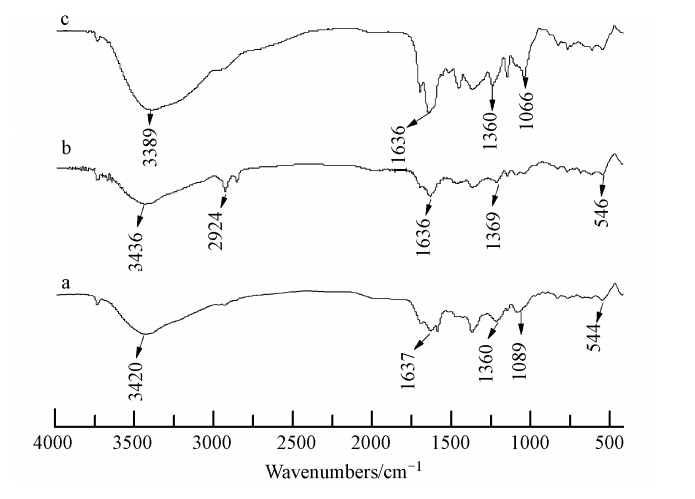 |
| 图 3 试样的FTIR图(a.GTE-Fe NPs;b.CTAB作用下合成的GTE-Fe NPs; c.GTE) The FTIR spectrum of samples(a.GTE-Fe NPs;b.GTE-Fe NPs with CTAB ; c.GTE) |
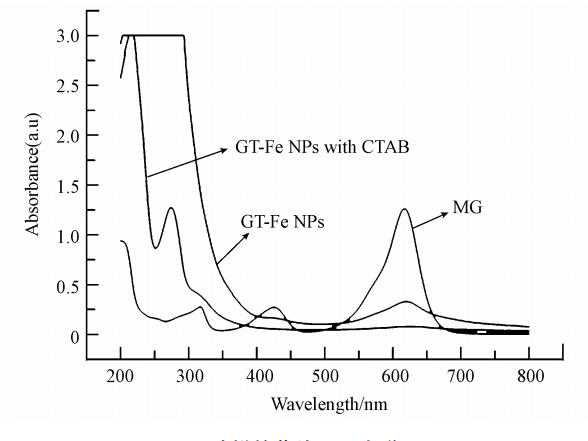
图 4是波长200~800 nm范围内分别对40 mg · L-1 MG、GTE合成的Fe NPs和CTAB作用下GTE合成的Fe NPs去除MG的紫外可见扫描光谱图. 从图中可见,MG在617 nm处有吸收峰(Ju et al., 2012). 经GTE合成的Fe NPs降解60 min后,这一特征吸收峰明显降低; 而经CTAB作用下合成的Fe NPs降解60 min后,MG在617 nm的特征吸收峰几乎消失,表明CTAB作用下去除MG的能力比GTE直接合成的Fe NPs更强,这也说明CTAB作用下合成的Fe NPs更加稳定和分散(Njagi et al., 2011; Khan et al., 2012),导致Fe NPs具有更高的反应活性. 这些结果与上述表征结果相一致.
 |
| 图 4 试样的紫外可见光谱图 The UV-vis scanning of samples |
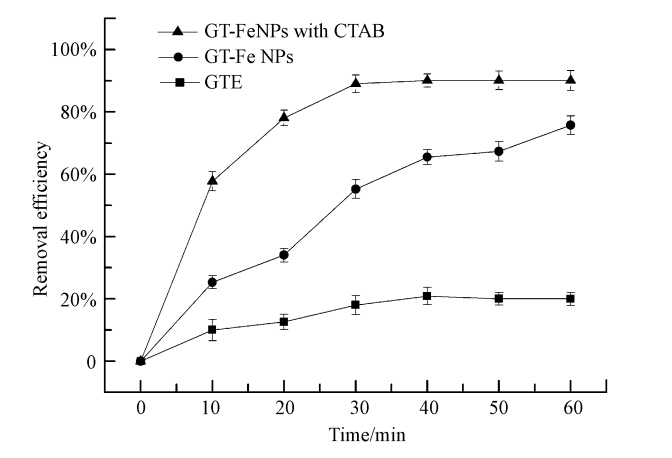
在298 K、摇床振速250 r · min-1、初始pH(约为6),初始浓度为40 mg · L-1 的MG溶液中,考察GTE、GTE合成Fe NPs和CTAB(1×10⁻³ mol · L-1)作用下合成的Fe NPs对MG的去除,结果如图 5所示. 从图中可以看出,GTE中存在多酚等物质对MG有一定的去除作用,30 min达到平衡时去除率为20.03%. GTE合成的Fe NPs对MG的去除率,30 min时为52.28%,60 min基本达到平衡,去除率为75.66%. CTAB作用下合成的Fe NPs具有更高的去除效率,30 min就达到77.78%,60 min后高达91.06%. 根据XRD谱图观察到的结果,CTAB作用下合成的Fe NPs表面的氧化物更少,充分说明绿色合成的主要产物是Fe NPs,氧化物的吸附不是MG去除的主导作用,Fe NPs是还原降解MG的主要物质;同时也说明阳离子表面活性剂CTAB的存在提高了绿色合成Fe NPs的分散度和抗氧化性,Fe NPs具有更高反应活性.
 |
| 图 5 GTE、GTE合成Fe NPs和CTAB存在时GTE合成的Fe NPs 对MG的去除 Comparison of removal rate of MG using GTE,Fe NPs synthesized by GTE and synthesized by GTE in presence of CTAB |
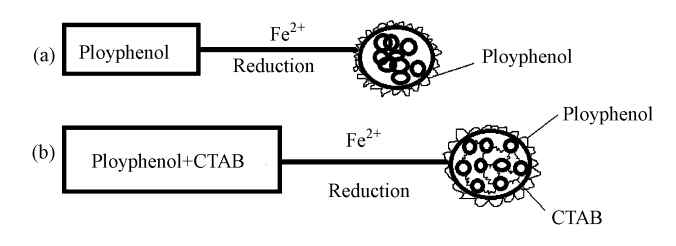
用植物提取液合成纳米金属主要是通过植物提取液中的有机成分如多酚等为还原剂还原金属盐,GTE中多酚可作为还原剂还原亚铁盐制备Fe NPs(Njagi et al., 2011; Shahwan et al., 2011; Kharissova et al., 2013; Mittal et al., 2013). GTE合成Fe NPs和CTAB作用下GTE合成Fe NPs可能的机理如图 6所示. 阳离子表面活性剂CTAB存在时,由于CTAB吸附在纳米颗粒表面导致纳米铁带电荷,纳米颗粒之间的斥力作用使得合成的纳米颗粒更加分散(Khan et al., 2012),从SEM、XRD、FTIR和UV-vis等的表征结果也可证实CTAB的包覆使得合成的纳米铁更加稳定.
 |
| 图 6 GTE合成Fe NPs和CTAB作用下GTE合成Fe NPs的可能机理图 Synthesis mechanisms of Fe NPs by GTE and by GTE in presence of CTAB |
1)通过SEM、XRD、FTIR等表征手段表明CTAB作用下GTE合成的Fe NPs比GTE直接合成的Fe NPs更加分散和稳定,具有更高的反应活性.
2)比较GTE、GTE合成的Fe NPs和CTAB作用下GTE合成的Fe NPs对MG的去除效果发现,GTE对MG有一定的去除作用,30 min达到平衡时,去除率为20.03%;GTE合成的Fe NPs对MG的去除效率30 min为52.28%,反应平衡时达到75.66%;而CTAB作用下GTE合成的Fe NPs对MG的去除效率更大,30 min就达到了77.78%,反应达到平衡高达91.06%. Fe NPs是去除MG的主要物质.
3)在Fe NPs表征结果和对MG的去除效果的基础上,对CTAB影响GTE合成Fe NPs提出了可能的机理,阳离子表面活性剂的存在提高了Fe NPs的分散性和稳定性,增强了Fe NPs的活性.
| [1] | Chen Z X, Jin X Y, Chen Z L, et al. 2011. Removal of methyl orange from aqueous solution using bentonite-supported nanoscale zero-valent iron[J]. Journal of Colloid and Interface Science, 363: 601-607 |
| [2] | 崔继文, 孙瑞岩, 李士伟, 等. 2007. 十六烷基三甲基溴化铵直接处理钙基蒙脱土[J]. 吉林大学学报 (理学版), 45:297-300 |
| [3] | 高滢, 陈征贤, 陈祖亮, 等. 2013. 负载型双金属铁钯纳米催化降解微囊藻毒素-LR[J]. 中国科学: 化学, 43: 217-225 |
| [4] | Goti ć M M, Musi ć S, 2007. Mssbauerr, FT-IR and FE SEM investigation of iron oxides precipitated from FeSO4 solutions[J]. Journal of Molecular Structure, 834-836: 445-453 |
| [5] | Hachem C, Bocquillon F, Zahraa, et al., 2001. Decolourization of textile industry wastewater by the photocatalytic degradation process[J]. Dyes and Pigments, 49: 117-125 |
| [6] | Hameed B, El-Khaiary M. 2008. Batch removal of malachite green from aqueous solutions by adsorption on oil palm trunk fibre: Equilibrium isotherms and kinetic studies[J]. Journal of Hazardous Materials, 154: 237-244 |
| [7] | HoagG, Collins J, Holcomb J, et al.2009. Degradation of bromothylmol blue by 'greener' nano-scale zero-valent iron synthesized using tea polyphenols[J]. Journal of Materials Chememistry, 19: 8671-8677 |
| [8] | Iravani S, 2011. Green synthesis of metal nanoparticles using plants[J]. Green Chemistry, 13: 2638-2650 |
| [9] | Ju Y, Qiao J, Peng X, et al. 2013. Photodegradation of malachite green using UV-vis light from two microwave-powered electrodeless discharge lamps (MPEDL-2): further investigation on products, dominant routes and mechanism[J]. Chemical Engineering Journal, 221: 353-362 |
| [10] | Khan Z, Hussain J I, Hashmi A A. 2012. Shape-directing role of cetyltrimethylammonium bromide in the green synthesis of Ag-nanoparticles using Neem (Azadirachta indica) leaf extract[J]. Colloids and Surfaces (B: Biointerfaces), 95: 229-234 |
| [11] | Kharissova O V, Dias H, Kharisov B I, et al. 2013. The greener synthesis of nanoparticles[J]. Trends in Biotechnology, 31: 240-248 |
| [12] | Khattri S, Singh M, 1999. Colour removal from dye wastewater using sugar cane dust as an adsorbent[J]. Adsorption Science & Technology, 17: 269-282 |
| [13] | Kumar K M, Mandal B K, Kumar K S, et al. 2013. Biobased green method to synthesize palladium and iron nanoparticles using terminalia chebula aqueous extract[J]. Spectrochimica Acta Part A: Molecular and Biomolecular Spectroscopy, 102: 128-133 |
| [14] | 李妮, 李张, 李明雄, 等. 2009. 一株无色杆菌属菌株对孔雀绿的脱色降解[J]. 应用与环境生物学报, 15: 529-533 |
| [15] | Li X Q, Elliott D W, Zhang W X. 2006. Zero-valent iron nanoparticles for abatement of environmental pollutants: materials and engineering aspects[J]. Critical Reviews in Solid State and Materials Sciences, 31: 111-122 |
| [16] | Mittal A K, Chisti Y, Banerjee U C. 2013. Synthesis of metallic nanoparticles using plant extracts[J]. Biotechnology Advances, 31: 346-356 |
| [17] | Njagi E C, Huang H, Stafford L, et al. 2011. Biosynthesis of iron and silver nanoparticles at room temperature using aqueous sorghum bran extracts[J]. Langmuir, 27: 264-271 |
| [18] | Nogueira R F P, Silva M, Tro v ' o A. 2005. Influence of the iron source on the solar photo-Fenton degradation of different classes of organic compounds[J]. Solar Energy, 79: 384-392 |
| [19] | 潘燕飞. 2008. 傅立叶红外光谱法用于茶叶品质的鉴定[J]. 烟台大学学报 (自然科学与工程版), 21:262-272 |
| [20] | Papinutti L, Mouso N, Forchiassin F. 2006. Removal and degradation of the fungicide dye malachite green from aqueous solution using the system wheat bran-Fomes sclerodermeus[J]. Enzyme and Microbial Technology, 39: 848-853 |
| [21] | Shahwan T, AbuSirriah S, Nairat M, et al. 2011. Green synthesis of iron nanoparticles and their application as a Fenton-like catalyst for the degradation of aqueous cationic and anionic dyes[J]. Chemical Engineering Journal, 172: 258-266 |
| [22] | Shi L N, Zhang X, Chen Z L. 2011. Removal of chromium (VI) from wastewater using bentonite-supported nanoscale zero-valent iron[J]. Water Research, 45: 886-892 |
| [23] | Smuleac V, Varma R, Sikdar S, et al. 2011. Green synthesis of Fe and Fe/Pd bimetallic nanoparticles in membranes for reductive degradation of chlorinated organics[J]. Journal of Membrane Science, 379: 131-137 |
| [24] | Wang T, Jin X Y, Chen Z L, et al. 2014.Green synthesis of Fe nanoparticles using eucalyptus leaf extracts for treatment of eutrophic wastewater[J]. Science of The Total Environment, 466-467: 210-213 |
| [25] | 翁秀兰, 林深, 陈祖亮, 等. 2012. 天然膨润土负载纳米铁的制备及其对阿莫西林的降解性能[J]. 中国科学: 化学, 42: 17-23 |