


2. 中国科学院上海应用物理研究所 嘉定园区 上海 201800
2. Shanghai Institute of Applied Physics, Chinese Academy of Sciences, Jiading Campus, Shanghai 201800, China
熔盐具有使用温度范围广、工作压力低、经济性好、传储热性强及化学性能稳定好等优点,使其成为一种理想的中高温传储热工质,在太阳能热利用[1-3]、可再生能源存储[4-6]、高温水解制氢和熔盐反应堆[7-10]等领域得到了广泛应用。采用熔盐作为储热材料既可以降低能源成本,提高能源年利用效率和有效性,又能增强系统运行的可靠性和稳定性。
NaNO3-KNO3-NaNO2 (Hitec)熔盐的熔点低、热物性优异,其作为中高温传储热介质已经在太阳能热利用领域得到广泛应用。如能增加Hitec熔盐的比热和导热系数将进一步扩大其应用领域[11-12]。已有研究发现[13-14],熔盐中添加纳米粒子可以显著增加熔盐的比热容。Chen等[15]研究了不同质量比例的Al2O3纳米颗粒对Hitec熔盐比热的影响。研究发现:当Al2O3纳米颗粒添加量为0.0625%时,Hitec熔盐的比热容明显增强[16-17]。
本研究采用水法技术制备了熔盐纳米复合材料,研究了不同颗粒直径、不同添加量的TiO2对Hitec熔盐比热、导热系数和热稳定性的影响。研究发现:25nm粒径添加质量分数为0.0625%的TiO2对Hitec熔盐比热和导热系数增强效果最佳。该研究成果为Hitec熔盐在中温储热领域的应用提供了重要技术指导。
1 实验部分 1.1 主要原料及试剂纳米TiO2颗粒(粒径分别为25nm、40nm和100nm)由上海麦克林生化科技有限公司提供;NaNO3、KNO3和NaNO2 (AR)由国药集团化学试剂有限公司提供。
1.2 实验方法将NaNO3、KNO3和NaNO2分别按质量配比7%、53%和40%精确称量后共混,将共混后放入石墨坩埚中搅拌均匀,迅速将样品置于井式高温炉中,在空气气氛、300℃下恒温10h,使样品熔化、充分混匀,形成NaNO3-KNO3-NaNO2 (Hitec)熔盐后待用。
将定量纳米TiO2颗粒(添加量为熔盐质量分数0.0625%、0.5%和1%)分别和300g Hitec熔盐混合加入烧杯中。在烧杯中加入去离子水搅拌后超声震荡200min,将溶液放置在结晶皿中在一定温度下加热5h蒸干。样品研磨成粉置于真空干燥箱中以60℃恒温干燥5h后,即为熔盐纳米复合材料。
1.3 测试与表征 1.3.1 比热采用差示扫描量热仪测试样品的比热容,坩埚用石墨,铂铑合金盖,比热容参比物为蓝宝石。其测试温度范围为常温至300℃,测试气氛为Ar,扫描速率为5℃·min-1,测试误差小于5%。
1.3.2 导热系数采用了激光闪光法测试样品的导热系数[18],在Ar气氛保护下,测试温度范围为常温至300℃,升温速率为10℃·min-1,测试误差小于15%。导热系数的计算公式为:
| $ \lambda {\rm{ = }}{C_{\rm{p}}} \cdot \rho \cdot \alpha $ | (1) |
式中:Cp代表比热,J·(g·℃)-1;ρ代表密度,g·cm-3;α代表热扩散系数,W·(m·℃)-1。
1.3.3 热稳定性利用同步热分析测试样品的热稳定性。在Ar气氛下,温度范围为常温至600℃,升温速率为10℃·min-1条件下进行测试。
1.3.4 物相及晶格结构分析将固态熔盐磨成粉末,采用X射线衍射(X-ray Diffraction, XRD)进行物相分析和晶格结构分析。
1.3.5 微观形貌将固态熔盐冷冻断裂后采用扫描电子显微镜观察熔盐微观形貌。
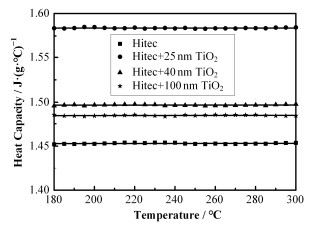
2 结果与讨论 2.1 比热变化图 1为添加质量分数0.5%不同粒径纳米TiO2对Hitec熔盐(180~300 ℃)的比热变化规律曲线。从图 1可以看出,纳米TiO2对Hitec熔盐比热增强。在180~300℃范围内,Hitec熔盐的比热随温度的增加基本保持不变。Hitec熔盐比热为1.45J·(g·℃)-1,25 nm TiO2添加到Hitec熔盐比热为1.58 J·(g·℃)-1,其比热增强幅度9.0%。40 nm TiO2添加到Hitec熔盐比热为1.49 J·(g·℃)-1,其比热增强幅度为3.0%。100 nm TiO2添加到Hitec熔盐比热为1.48 J·(g·℃)-1,其比热增强幅度为2.0%。
|
图 1 Hitec盐加0.5%不同粒径纳米TiO2颗粒的比热变化 Figure 1 Specific heat-capacity curve of Hitec salt with different size of 0.5% TiO2 nanoparticles |
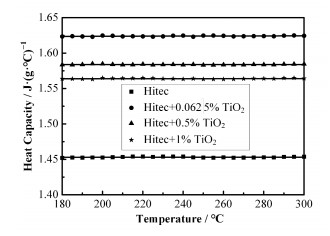
图 2为25 nm粒径不同添加量(质量分数0.0625%、0.5%、1%)TiO2对Hitec熔盐(180~300℃)的比热变化规律曲线。从图 2可以看出,Hitec熔盐比热为1.45 J·(g·℃)-1,0.0625%的TiO2添加到Hitec熔盐比热为1.63 J·(g·℃)-1,其比热增强幅度12.0%。0.5%的TiO2添加到Hitec熔盐比热为1.58J·(g·℃)-1,其比热增强幅度为9.0%。1%的TiO2添加到Hitec熔盐比热为1.56 J·(g·℃)-1,其比热增强幅度为8.0%。由以上分析可以得出,0.0625%添加量25 nm TiO2的Hitec熔盐比热为1.63 J·(g·℃)-1,其比热增强幅度12.0%,比热增强幅度最大。与Hitec熔盐的比热相比,添加纳米TiO2后,Hitec熔盐比热增强明显,这主要是因为熔盐与纳米颗粒间形成两相界面的热阻[17-18],热量不能轻易地传出界面,其贴附在熔盐表面形成半固层结构后进而导致Hitec熔盐的比热增强明显。随着纳米TiO2颗粒粒径的增大,纳米TiO2在Hitec熔盐中的分散性变差,其更容易在熔盐中形成沉降进而导致其界面热阻形成困难,因而导致其比热随着颗粒粒径的增加而降低。在纳米TiO2颗粒粒径相同的条件下,随着纳米TiO2添加量的降低,其在Hitec熔盐中的比热逐渐增加,这主要是由于随着纳米TiO2添加量的降低,纳米TiO2颗粒易于较好地分散于熔盐基体中,不易产生凝聚现象,分散良好。由于纳米TiO2较高的界面热阻,热量不能轻易地传出界面,颗粒小的纳米TiO2易于更好地分散在Hitec熔盐中形成界面热阻,因而其比热增加最明显。
|
图 2 Hitec盐加入25 nm不同添加量TiO2的比热变化 Figure 2 Specific heat-capacity curve of ternary nitrate salt with different addition of 25 nm TiO2 nanoparticles |
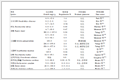
表 1为Hitec盐中加入0.5%不同粒径纳米TiO2的导热系数变化。从表 1可以得出,随着温度提高,Hitec熔盐及添加纳米TiO2的Hitec熔盐的导热系数随温度逐渐增大。在纳米TiO2添加量为0.5%相同温度条件下,与纯Hitec熔盐相比,添加纳米TiO2后Hitec熔盐的导热系数明显增加。其中添加25 nm纳米TiO2 Hitec熔盐导热系数显著增加,且随着纳米TiO2颗粒粒径的增加,其导热系数呈降低趋势。以180 ℃温度为例,纯Hitec熔盐的导热系数为0.385 W·(m·℃)-1,而添加25 nm纳米TiO2 Hitec熔盐的导热系数为0.424 W·(m·℃)-1,当纳米TiO2粒径增加到100 nm时,其导热系数则变为0.392W·(m·℃)-1。这主要是因为粒径小纳米TiO2在Hitec熔盐中的分散性好,不易产生凝聚现象。在熔融状态下,纳米TiO2可以更自由地运动而且拥有非常大的吸附能力。在自由运动的过程中,它们呈现出趋向凝聚的趋势,凝聚之后的纳米TiO2在盐分子之间形成传热网络,因而导致其导热系数提高[19-20]。粒径小的纳米粒子更容易凝聚,因而其导热系数增加较大。
|
表 1 Hitec盐中加入0.5%不同粒径纳米TiO2的导热系数变化 Table 1 Thermal conductivity of Hitec salt with different particle size of 0.5% TiO2 nanoparticles |
表 2为Hitec盐中加入25 nm TiO2的导热系数随不同添加量的变化。从表 2可以得出,随着温度提高,Hitec熔盐及添加纳米TiO2的Hitec熔盐的导热系数随温度逐渐增大。与纯Hitec熔盐相比,相同温度条件下,添加纳米TiO2后Hitec熔盐的导热系数明显增加。在相同温度条件下,添加0.0625%纳米TiO2的Hitec熔盐导热系数显著增加,且随着纳米TiO2含量增加,其导热系数呈降低趋势。这主要是由于纳米TiO2含量增加,其在熔盐中的分散性降低,其更容易发生凝聚现象导致其在Hitec熔盐中沉降出来,因而不能形成均一体系,进而导致其导热降低。
|
|
表 2 Hitec盐中加入不同添加量25 nm TiO2纳米颗粒后的导热系数 Table 2 Thermal conductivity of Hitec salt with different addition of 25 nm TiO2 nanoparticles |
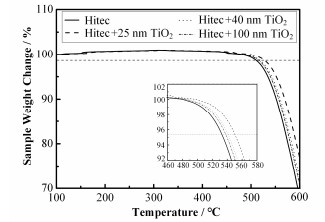
通过同步热分析仪测试Hitec熔盐的高温热稳定性变化。图 3为Hitec盐加入不同粒径纳米TiO2的热失重变化(分解温度是取质量损失5%时,对应的温度)。从表 3可以得出,与纯Hitec熔盐分解温度530℃相比,添加纳米TiO2 Hitec熔盐的分解温度明显提高,其热稳定明显改善。添加25 nm TiO2纳米颗粒的Hitec熔盐的分解温度提高最大达到548℃,稳定性提升18 ℃。其次是添加40 nm TiO2纳米颗粒Hitec熔盐热分解温度为538℃,添加100nm TiO2纳米颗粒Hitec熔盐热分解温度为535℃。
|
图 3 Hitec盐加入不同粒径纳米TiO2的热失重变化 Figure 3 Weight change curve of Hitec salt with different size of TiO2 nanoparticles |
|
|
表 3 Hitec盐加入不同添加量25 nm TiO2纳米颗粒后分解温度 Table 3 Decomposition temperature of Hitec salt with different addition of 25 nm TiO2 nanoparticles |
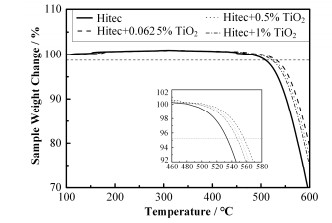
图 4为加入25 nm TiO2 Hitec熔盐不同添加量的热失重变化。从表 4可以得出,添加不同含量的25nm TiO2纳米颗粒均能提高Hitec熔盐的分解温度,增强熔盐的热稳定性。其中添加0.0625% 25 nm TiO2纳米颗粒分解温度为553℃,添加质量分数为0.5%和1%分解温度分别为548℃和544℃。添加纳米TiO2后其热分解温度提高主要是因为熔盐与纳米颗粒形成两相界面热阻。由于纳米TiO2较高的界面热阻,热量不能轻易地传出界面,其贴附在熔盐表面形成半固层结构后进而导致Hitec熔盐的热稳定性增强明显。颗粒小的纳米TiO2易于更好地分散在Hitec熔盐中形成界面热阻,因而其热分解温度增加明显。添加量低的纳米TiO2不易发生凝聚,更容易形成界面热阻效应,因为其热分解温度提高。
|
图 4 加入25 nm TiO2 Hitec熔盐不同添加量的热失重变化 Figure 4 Weight change curve of Hitec salt with different addition of 25nmTiO2 nanoparticles |
|
|
表 4 Hitec盐中加入25 nm TiO2不同添加量的分解温度 Table 4 Decomposition temperature of Hitec salt with different addition of 25 nm TiO2 nanoparticles |
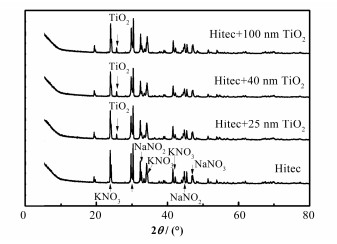
图 5为纯Hitec熔盐以及Hitec熔盐添加不同粒径TiO2纳米颗粒的XRD图谱。从图 5中可以发现,向Hitec熔盐中添加不同粒径TiO2纳米颗粒之后,Hitec熔盐的峰的强度以及特征峰的明显程度均无较大变化。同时,通过比对标准物质峰段,发现添加TiO2纳米颗粒之后,在角度为25°附近,3种添加材料均出现了的TiO2特征峰,其他物质的特征峰均无明显变化。这表明,添加TiO2纳米颗粒之后,Hitec熔盐的物相及晶格结构均无明显变化,同时TiO2纳米颗粒本身无变化。
|
图 5 Hitec盐加入不同粒径纳米TiO2的XRD谱 Figure 5 XRD spectrum of Hitec salt with different size of TiO2 nanoparticles |
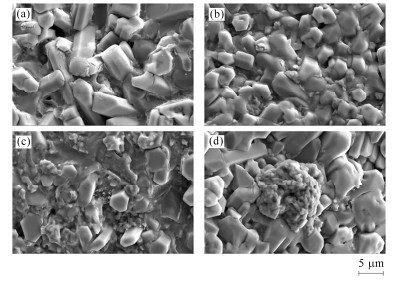
图 6是添加不同粒径TiO2纳米颗粒后Hitec熔盐的微观形貌变化。从图 6可以得出,纯Hitec熔盐分散均匀,25 nm TiO2纳米颗粒后添加到Hitec熔盐中分散均匀,纳米颗粒与熔盐形成均匀两相。40 nm和100 nm TiO2纳米颗粒后添加到Hitec熔盐中,TiO2纳米颗粒存在不同程度的团聚现象,纳米颗粒之间团聚紧密,颗粒间无缝隙,其中添加100nm时,团聚现象尤为明显。从微观形貌上证明了40 nm和100 nm粒径TiO2纳米颗粒的团聚现象导致其比热和导热系数增强幅度较小的原因。这也证明了纳米TiO2增强Hitec熔盐储热特性的原因主要是熔盐与纳米颗粒形成两相界面热阻。纳米TiO2分散在Hitec熔盐中后,纳米TiO2球状结构比表面积大,粒径小纳米TiO2颗粒易于较好地分散于熔盐基体中,不易产生凝聚现象。由于纳米TiO2较高的界面热阻,热量不能轻易地传出界面,因而导致Hitec熔盐的比热、导热系数和热稳定性增加。
|
图 6
Hitec盐加入不同粒径TiO2纳米颗粒后的SEM图
(a)未添加,(b) 25nm TiO2,(c) 40nm TiO2, (d) 100nm TiO2 Figure 6 SEM image of Hitec salt with different size of TiO2 nanoparticles (a) Pure Hitec, (b) With 25nm TiO2, (c) With 40nm TiO2, (d) With 100nm TiO2 |
1) Hitec熔盐中添加不同粒径(25 nm、40 nm和100 nm)的TiO2纳米颗粒,能有效提高Hitec熔盐比热容和导热系数。当粒径为25 nm时,纳米TiO2增强Hitec熔盐比热和导热系数效果最佳。
2) Hitec熔盐中添加不同添加量(质量分数为0.0625%、0.5%、1%)的25 nm TiO2纳米颗粒,有效地提高了Hitec熔盐的比热和导热系数。当添加质量分数为0.0625%时,纳米TiO2对Hitec熔盐的比热和导热系数增强效果最好,其比热可提高10%。
3) 与纯Hitec熔盐的分解温度相比,添加纳米TiO2后Hitec熔盐的分解温度明显提高,其热稳定明显改善。Hitec熔盐中添加质量分数为0.0625%的25 nm TiO2纳米颗粒得到的热稳定性最佳。
| [1] |
Wang A M. Energy storage technologies and in real life applications-a state of the art review[J]. Applied Energy, 2016, 179(10): 350-357. DOI:10.1016/j.apenergy.2016.06.097 |
| [2] |
Liu M, Bell S. Review on concentrating solar power plants and new developments in high temperature thermal energy storage technologies[J]. Renewable & Sustainable Energy Reviews, 2015, 53(09): 1411-1432. DOI:10.1016/j.rser.2015.09.026 |
| [3] |
Ignatiev V V, Feynberg O S. Molten-salt reactors:new possibilities, problems, and solutions[J]. Atomic Energy, 2012, 112(3): 157-165. DOI:10.1007/s10512-012-9537-2 |
| [4] |
Piyush S, Matt E, Manohar S. Molten salts for high temperature reactors: university of Wisconsin molten salt corrosion and flow loop experiments-issues identified and path forward[R]. Idaho National Laboratory, INL/EXT-10-18090, 2010. DOI: 10.2172/980798.
|
| [5] |
Bradshaw R W, Siegel N P. Molten nitrate salt development for thermal energy storage in parabolic through solar power system[M]. Sandia National Laboratory, ES2008-54174, 2008. DOI: 10.1115/ES2009-90140.
|
| [6] |
Pelay U, Lou L, Fan Y. Thermal energy storage systems for concentrated solar power plants[J]. Renewable Sustain Energy, 2013, 79(11): 82-100. DOI:10.1016/j.pecs.2013.02.001 |
| [7] |
江绵恒, 徐洪杰, 戴志敏. 未来先进核裂变能——TMSR核能系统[J]. 中国科学院院刊, 2012, 7(3): 366-374. JIANG Mianheng, XU Hongjie, DAI Zhimin. Advanced fission energy program-TMSR nuclear energy system[J]. Bullet in Chinese Academy of Sciences, 2012, 7(3): 366-374. DOI:10.3969/J.ISSN.1000-3045.2012.03.01 |
| [8] |
金愿, 张鹏. 几种典型熔盐冷却剂的热物性研究[J]. 核技术, 2016, 39(5): 050604. JING Yuan, ZHANG Peng. Research on thermo-physical properties of several typical molten salt coolants[J]. Nuclear Techniques, 2016, 39(5): 050604. DOI:10.11889/j.0253-3219.2016.hjs.39.050604 |
| [9] |
阴慧琴. 腐蚀产物CrF3对LiF-NaF-KF熔盐物化性质的影响研究[D]. 上海: 中国科学院上海应用物理研究所, 2015. YIN Huiqin. The effect study of corrosion product CrF3 on physic-chemical properties of LiF-NaF-KF[D]. Shanghai: Shanghai Institute of Applied Physics, Chinese Academy of Sciences, 2015. |
| [10] |
程进辉. 传蓄热熔盐的热物性研究[D]. 上海: 中国科学院上海应用物理研究所, 2014. CHENG Jinhui. Study on molten salt thermos-physical properties for heat transfer and storage[D]. Shanghai: Shanghai Institute of Applied Physics, Chinese Academy of Sciences, 2014. |
| [11] |
Hani T, Donghyun S. Enhanced specific heat capacity of high-temperature molten salt-based nanofluids[J]. International Journal of Heat and Mass Transfer, 2012, 57(02): 542-548. DOI:10.1016/j.ijheatmasstransfer.2012.10.062 |
| [12] |
Ming X H, Pan C. Optimal concentration of alumina nanoparticles in molten Hitec salt to maximize its specific heat capacity[J]. International Journal of Heat and Mass Transfer, 2013, 70(03): 174-184. DOI:10.1016/j.ijheatmasstransfer.2013.10.078 |
| [13] |
Bharath D, Donghyun S. Effect of nanoparticle dispersion on specific heat capacity of a binary salt eutectic for concentrated solar power applications[J]. International Journal of Heat and Mass Transfer, 2013, 69(07): 37-42. DOI:10.1016/j.ijthermalsci.2013.02.003 |
| [14] |
Donghyun S. Specific heat of nanofluids synthesized by dispersing alumina nanoparticles in alkali salt eutectic[J]. International Journal of Heat and Mass Transfer, 2014, 74(07): 210-214. DOI:10.1016/j.ijheatmasstransfer.2014.02.066 |
| [15] |
Chen J H, Zhang P, An X H, et al. A device for measuring the density and liquids temperature of molten fluorides for heat transfer and storage[J]. Chinese Physics Letters, 2013, 30(12): 126501. DOI:10.1088/0256-307X/30/12/126501 |
| [16] |
An X H, Chen J H, Yin H Q, et al. Thermal conductivity of high temperature fluoride molten salt determined by laser flash technique[J]. International Journal of Heat and Mass Transfer, 2015, 90: 872-877. DOI:10.1016/j.ijheatmasstransfer.2015.07.042 |
| [17] |
Shin D, Banerjee D. Enhanced specific heat of silica nanofluids[J]. Journal of Heat Transfer, 2011, 133(7): 024501. DOI:10.1115/1.4002600 |
| [18] |
Dudda B, Shin D. Effect of nanoparticle dispersion on specific heat capacity of a binary nitrate salt eutectic for concentrated solar power application[J]. International Journal of Thermal Sciences, 2013, 69: 37-42. DOI:10.1016/j.ijthermalsci.2013.02.003 |
| [19] |
Shin D, Banerjee D. Enhanced of specific heat capacity of high-temperature silica-nanofluids synthesized in alkali chloride salt eutectics for solar thermal energy storage applications silica nanofluids[J]. International Journal of Heat and Mass Transfer, 2010, 54: 1064-1071. DOI:10.1016/j.ijheatmasstransfer.2010.11.017 |
| [20] |
Shin D, Banerjee D. Specific heat of nanofluids synthesized by dispersing alumina nanoparticles in alkali salt eutectic[J]. International Journal of Heat and Mass Transfer, 2014, 74: 210-214. DOI:10.1016/j.ijheatmasstransfer.2014.02.066 |