


2. 中国科学院深圳先进技术研究院 深圳 518055
2. Shenzhen Institutes of Advanced Technology, Chinese Academy of Sciences, Shenzhen 518055, China
正电子发射计算机断层显像(Positron Emission Tomography, PET)是高灵敏且具有定量测量能力的分子影像技术。PET利用正电子核素标记的示踪分子探针进行活体显像,能够动态和定量地从分子水平观察活体的生理变化,在生物医学研究领域有着重要的影响力,更重要的是在肿瘤、心血管疾病和脑神经疾病的早期诊断和科学研究领域得到了广泛的应用[1-3]。探测器的性能直接影响整个PET成像系统的性能,提高探测器性能是改进PET成像系统性能,进而提高PET诊断研究精准度的关键[4-5]。PET探测器的性能主要包括位置分辨率、能量分辨率、时间分辨率和灵敏度等[6-8],研发新型和性能更好的探测器一直是PET仪器研发的热点。
PET探测器通常由高探测效率的闪烁晶体阵列和位置灵敏或阵列光探测器组成,闪烁晶体将γ射线转换为成千上万个可见光子,光子经过在晶体中多次反射,部分达到光探测器并被转换为电子,电子在光探测器中倍增引出电信号,通过一系列电子学对信号进行放大处理,得到相互作用伽玛射线的位置、时间和能量等信息,PET探测器符合测量正负电子湮灭产生的两个朝相反方向飞行的伽玛射线。常用的光探测器包括光电倍增管(Photomultiplier Tube, PMT)和硅光电倍增管(Silicon Photomultipliers, SiPM),SiPM由于具有体积小、光电转换效率高、时间性能好、磁兼容、工作电压低、增益大和价格低廉等一系列优点[9-11],被认为今后有望取代PMT而成为PET探测器中光探测器的最佳选择。对于由高效率高分辨率的晶体阵列和SiPM阵列组成的PET探测器,为了降低SiPM阵列成本和读出电路的复杂程度,单个晶体的截面一般要远小于SiPM单元的面积,每一个SiPM单元中耦合多个晶体单元,为了对这些晶体单元进行清楚区分,需要在晶体阵列和SiPM阵列之间放置一定厚度的光导,使部分光子可以扩散到邻近SiPM单元[12-13]。本文将采用小动物PET探测器常用的晶体截面大小(约1mm×1mm)和SiPM单元面积大小(3mm×3mm),研究光导厚度对探测器性能的影响,目标是得到可用于小动物PET探测器的光导最佳厚度。
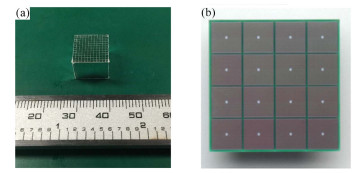
1 材料与方法 1.1 LYSO晶体阵列硅酸钇镥(Lutetium-yttrium Oyorthosilicate, LYSO)是近年来常用的PET探测器晶体,具有探测效率高、光产额高、光衰减时间短和不易潮解等优点[6, 14]。实验使用的12×12 LYSO晶体阵列照片如图 1所示,阵列外围尺寸为11.6 mm×11.6 mm×10 mm,单个晶体单元的尺寸为0.89 mm×0.89 mm×10 mm,为了降低闪烁光子在晶体中的传输损失,晶体六面均抛光处理,晶体间使用美国3M公司的高反射率反射片(Enhanced Specular Reflector, ESR)进行隔离。ESR是一种常用于PET晶体阵列的镜面反射膜,厚度为65μm,在可见光波长范围内反射率大于98.5%[15-16]。晶体阵列除了和SiPM耦合的端面,其余表面都有ESR反射膜。
|
图 1 LYSO晶体阵列(a)和SiPM阵列(b)照片 Figure 1 Photographs of the LYSO arrays (a) and SiPM array (b) |
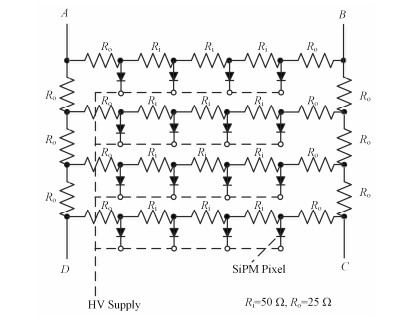
实验使用的日本滨松4×4 SiPM阵列(图 1),总有效探测面积为12.6 mm×12.6 mm,每个SiPM单元的像素尺寸为3 mm×3 mm,间隙为0.2 mm。实验采用电阻网络读出的方法将SiPM 16个信号压缩为4个信号输出[17-19],可以大大减少信号通道数和使用该探测器的PET成像系统的电子学复杂度,具体电阻网络读出电路原理如图 2所示。使用4个输出信号(A, B, C, D)进行探测器能量(E)及位置(X, Y)计算公式如下:
| $ E = A + B + C + D $ | (1) |
| $ X = (B + C)/E $ | (2) |
| $ Y = (A + B)/E $ | (3) |
|
图 2 电阻网络读出电路原理图 Figure 2 Schematic of resistor network readout circuit |
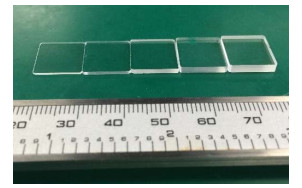
光导材料主要需要具备好的透光性,常用的光导材料包括工程塑料聚碳酸酯(Polycarbonate, PC)、有机玻璃(Polymethyl methacrylate,又叫亚克力)和无机玻璃。本实验采用的光导材料为有机玻璃,制作了如图 3所示的5种不同厚度(0.5 mm、1.0 mm、1.5 mm、2.0 mm、2.5 mm)、面积为13 mm×13 mm的光导片进行实验测试比较。
|
图 3 不同厚度光导照片 (从左至右厚度分别为0.5 mm、1.0mm、1.5 mm、2.0 mm和2.5 mm) Figure 3 Photograph of light guide with different thicknesses (from left to right the thickness are 0.5 mm, 1.0 mm, 1.5 mm, 2.0 mm and 2.5 mm, respectively) |
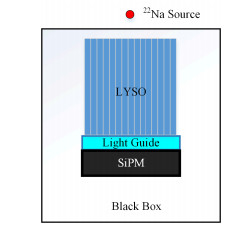
实验装置示意图如图 4所示,LYSO阵列、光导和SiPM之间的接触面均采用光学硅油进行耦合。实验时,将探测器模块置于一个遮光的暗盒中,将一个22Na放射源置于暗盒外距离探测器的正上方约50 mm处,使得整个晶体阵列得到准均匀照射。电阻网络读出电路的4个输出信号经过一个前置放大器进行放大后输入到标准的NIM (Nuclear Instrument Module)插件电子学系统,4路信号通过成形放大后数字化,最后上传至计算机保存。使用MATLAB程序对实验数据进行读取和分析,得到探测器的能谱和晶体分辨图(Flood Histogram)。在晶体分辨图中选取一行中间晶体,通过投影得到一个一维曲线用于晶体分辨图的峰谷比计算,定量比较探测器的晶体分辨图的性能[20]。对晶体分辨图进行分割,得到探测器的晶体查找表,对实验数据重新分析处理,可以得到所有单个晶体的能谱,然后通过高斯拟合可以得到晶体能谱光电峰位置和半高宽,晶体的能量分辨率为半高宽除以峰位值。
|
图 4 实验装置示意图 Figure 4 Schematic view of the experimental setup |
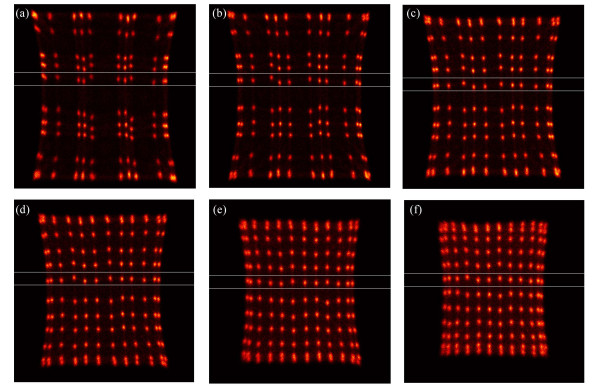
图 5展示了在无光导和5种不同厚度光导(0.5mm、1 mm、1.5 mm、2 mm和2.5 mm)条件下测试得到的能量E > 350 keV的事件的晶体分辨图。从图 5可以看出,无光导时的晶体分辨图均匀性很差,位于同一个SiPM单元的9个晶体单元的距离很近,对边缘两排晶体几乎无法分辨。加入光导后,光子的扩散程度随着光导的厚度而增加,晶体分辨图的均匀性随着光导厚度的增加而改善,对边缘晶体的分辨能力也不断改善;但随着光导厚度的增加,晶体分辨图中每个晶体单元斑点的大小有所增加,晶体分辨图的动态范围也有所减小。
|
图 5 使用不同厚度光导晶体分辨图测试结果 (a)无光导,(b) 0.5 mm,(c) 1.0 mm,(d) 1.5 mm,(e) 2.0 mm,(f) 2.5 mm Figure 5 Results of flood histograms with different thicknesses of light guide (a) Without light guide, (b) 0.5 mm, (c) 1.0 mm, (d) 1.5 mm, (e) 2.0 mm, (f) 2.5 mm |
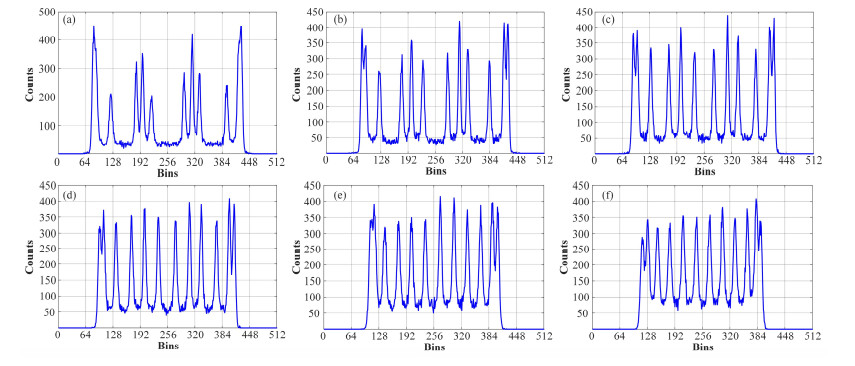
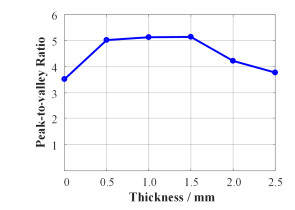
为了能够定量比较晶体分辨图的质量,我们选用图 5中的晶体分辨图的第6行晶体(图中白线区域)对所有计数沿X方向投影,分别得到无光导和使用0.5 mm到2.5 mm厚度光导条件下的投影曲线,如图 6所示。从投影曲线可以看出,加入光导后每个晶体单元所对应峰的间隔、宽度和高度随着光导厚度的增加都更加均匀,和没有光导相比,对边缘晶体的区分也明显改善。但随着光导厚度的增加,每个晶体的峰宽度增加,整个投影区域变窄。通过计算图 6中曲线的12个峰值均值和11个谷值均值的比值,得到这6种情况下的平均峰谷比值,结果如图 7所示。
|
图 6 使用不同厚度光导图 5中第6行晶体的投影曲线 (a)无光导,(b) 0.5 mm,(c) 1.0 mm,(d) 1.5 mm,(e) 2.0 mm,(f) 2.5 mm Figure 6 The projection profiles of the sixth row of crystals in Fig. 5 with different thicknesses of light guide (a) Without light guide, (b) 0.5 mm, (c) 1.0 mm, (d) 1.5 mm, (e) 2.0 mm, (f) 2.5 mm |
|
图 7 不同厚度光导条件下的平均峰谷比曲线 Figure 7 The average peak-to-valley ratio for detectors use light guide of different thicknesses |
峰谷比通常被用于定量比较晶体分辨图的质量,峰谷比值越大,说明晶体单元分辨效果越好。图 7结果表明:在加入光导后探测器晶体分辨图的质量不断改善,在1.5 mm达到最佳,此后晶体分辨图的质量随着光导厚度的增加而不断变差。
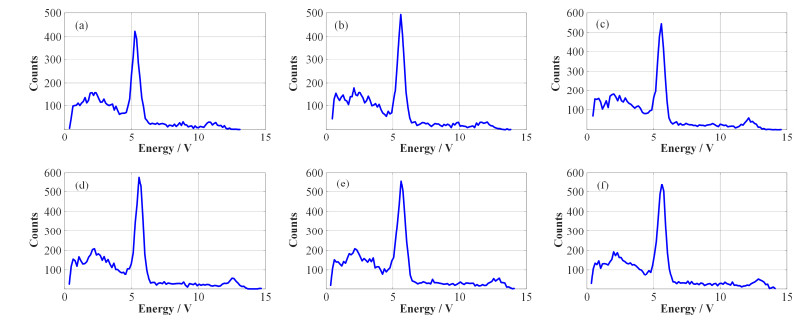
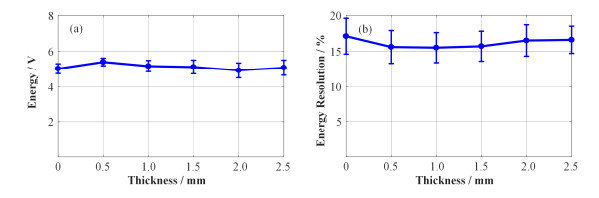
2.2 能谱图在无光导和5种不同厚度光导条件下测试得到的一个中间晶体的能谱如图 8所示。图 9为不同厚度光导条件下探测器所有晶体能谱中511keV全能峰的平均峰位值和平均能量分辨率。从图 8可以看出,加入光导后对探测器的能谱影响很小,从图 9可以看出,在加入光导后,511keV全能峰的平均峰位几乎没有变化,说明光导的加入对闪烁光子的收集效率没有任何降低。在加入光导后探测器的能量分辨率还有所改进,能量分辨率在光导厚度为0.5~1.5 mm时最好,达到15.5%。
|
图 8 不同厚度光导条件下一个中间晶体的能谱 (a)无光导,(b) 0.5 mm,(c) 1.0 mm,(d) 1.5 mm,(e) 2.0 mm,(f) 2.5 mm Figure 8 Energy spectra of a center crystal with different thicknesses of light guide (a) Without light guide, (b) 0.5 mm, (c) 1.0 mm, (d) 1.5 mm, (e) 2.0 mm, (f) 2.5 mm |
|
图 9 不同厚度光导条件下晶体单元能谱中511keV全能峰的平均峰位(a)和平均能量分辨率(b) Figure 9 The average photopeak amplitude (a) and energy resolution (b) of the 511 keV photopeak in the energy spectra of individual crystals for detectors using light guide of different thicknesses |
本文使用晶体单元大小为0.89 mm×0.89 mm× 10 mm的LYSO晶体阵列和日本滨松单元大小为3mm×3 mm的4×4 SiPM阵列,对晶体阵列和SiPM阵列之间使用不同厚度有机玻璃光导条件下探测器的晶体分辨图和能谱进行了测量。由于SiPM单元的大小约为晶体间距的3倍,如果在晶体阵列和光探测器之间不使用光导,位于同一个SiPM单元的9个晶体中产生的闪烁光子主要被该SiPM单元测量到,不利于这些晶体单元的区分。加入光导后,闪烁光子得到了进一步的扩散,更容易被多个SiPM单元测量到。实验结果表明:光导的使用改善了晶体分辨图的均匀性和探测器对边缘晶体的分辨能力,但随着光导厚度的增加,闪烁光子进一步扩散,晶体单元在晶体分辨图中的斑点大小增加,晶体分辨图的动态范围缩小。在晶体分辨图中选取一行晶体进行投影,对投影曲线的峰谷比做了计算,用于不同光导条件下探测器晶体分辨图质量的定量比较,峰谷比越大,晶体分辨图质量越好。在加入光导后探测器晶体分辨图的峰谷比不断增加,在1.5mm达到最大,此后峰谷比随着光导厚度的增加而变小。在PET探测器中,由于峰谷比可以对晶体分辨图的质量给予定量描述,是全面比较探测器位置分辨率好坏的有效方法。光导的使用几乎不影响闪烁光子的收集效率,对晶体能谱的形状和511 keV光电峰的峰位几乎没有影响,在光导厚度为0.5~1.5mm时,和不使用光导相比,探测器的能量分辨率稍有改善。综合上述晶体分辨图均匀性和峰谷比,以及晶体能谱全能峰峰位和能量分辨率实验结果,选择最佳的光导厚度为1.5 mm。但最佳的光导厚度取决于晶体的截面和SiPM单元的面积,对于采用其它晶体截面和SiPM单元面积的PET探测器,则需要对光导厚度重新优化。本文的结果对使用LYSO晶体阵列和SiPM阵列研发小动物PET探测器具有一定的借鉴作用,经本工作优化的PET探测器可以用于高性能小动物PET成像系统的研制。
| [1] |
Cherry S R, Shao Y, Silverman R W, et al. MicroPET:a high resolution PET scanner for imaging small animals[J]. IEEE Transactions on Nuclear Science, 1997, 44(3): 1161-1166. DOI:10.1109/23.596981 |
| [2] |
Townsend D W, Carney J P J, Yap J T, et al. PET/CT today and tomorrow[J]. Journal of Nuclear Medicine, 2004, 45: 4S-14S. |
| [3] |
Slomka P J, Pan T S, Germano G. Recent advances and future progress in PET instrumentation[J]. Seminars in Nuclear Medicine, 2016, 46(1): 5-19. DOI:10.1053/j.semnuclmed.2015.09.006 |
| [4] |
Moses W W. Fundamental limits of spatial resolution in PET[J]. Nuclear Instruments & Methods in Physics Research Section A:Accelerators Spectrometers Detectors and Associated Equipment, 2011, 648: S236-S240. DOI:10.1016/j.nima.2010.11.092 |
| [5] |
Zhang N, Thompson C J, Cayouette F, et al. A prototype modular detector design for high resolution positron emission mammography imaging[J]. IEEE Transactions on Nuclear Science, 2003, 50(5): 1624-1629. DOI:10.1109/TNS.2003.817370 |
| [6] |
邝忠华, 李成, 李兰君, 等. 高分辨率及高灵敏度小动物PET研究进展[J]. 原子核物理评论, 2016, 33(3): 336-344. KUANG Zhonghua, LI Cheng, LI Lanjun, et al. Research progress on PET with high resolution and high sensitivity[J]. Nuclear Physics Review, 2016, 33(3): 336-344. DOI:10.11804/NuclPhysRev.33.03.336 |
| [7] |
Vaquero J J, Seidel J, Siegel S, et al. Performance characteristics of a compact position-sensitive LSO detector module[J]. IEEE Transactions on Medical Imaging, 1998, 17(6): 967-978. DOI:10.1109/TMI.1999.759130 |
| [8] |
Yang Y F, Wu Y B, Qi J Y, et al. A prototype PET scanner with DOI-encoding detectors[J]. Journal of Nuclear Medicine, 2008, 49(7): 1132-1140. DOI:10.2967/jnumed.107.049791 |
| [9] |
Moehrs S, Del Guerra A, Herbert D J, et al. A detector head design for small-animal PET with silicon photomultipliers (SiPM)[J]. Physics in Medicine and Biology, 2006, 51(5): 1113-1128. DOI:10.1088/0031-9155/51/5/004 |
| [10] |
Schaart D R, Van Dam H T, Seifert S, et al. A novel, SiPM-array-based, monolithic scintillator detector for PET[J]. Physics in Medicine and Biology, 2009, 54(11): 3501-3512. DOI:10.1088/0031-9155/54/11/015 |
| [11] |
Kwon S I, Lee J S, Yoon H S, et al. Development of small-animal PET prototype using silicon photomultiplier (SiPM):initial results of phantom and animal imaging studies[J]. Journal of Nuclear Medicine, 2011, 52(4): 572-579. DOI:10.2967/jnumed.110.079707 |
| [12] |
Du J W, Schmall Je P, Di K, et al. Design and optimization of a high-resolution PET detector module for small-animal PET based on a 12×12 silicon photomultiplier array[J]. Biomedical Physics & Engineering Express, 2015, 1(4): 045003. |
| [13] |
Thompson C J, Goertzen A L. Evaluation of a 16:3 signal multiplexor to acquire signals from a SPM array with dual and single layer LYSO crystal blocks[J]. IEEE Transactions on Nuclear Science, 2011, 58(5): 2175-2180. DOI:10.1109/TNS.2011.2160202 |
| [14] |
Pepin C M, Berard P, Perrot A L, et al. Properties of LYSO and recent LSO scintillators for phoswich PET detectors[J]. IEEE Transactions on Nuclear Science, 2004, 51(3): 789-795. DOI:10.1109/TNS.2004.829781 |
| [15] |
冯凯, 徐悦, 鲍鸿, 等. 晶体表面特性对PET探测器性能的影响[J]. 核技术, 2017, 40(6): 060402. FENG Kai, XU Yue, BAO Hong, et al. Effect of crystal surface properties on PET detector performance[J]. Nuclear Techniques, 2017, 40(6): 060402. DOI:10.11889/j.0253-3219.2017.hjs.39.060402 |
| [16] |
Kuang Z H, Wang X H, Li C, et al. Performance of a high-resolution depth encoding PET detector using barium sulfate reflector[J]. Physics in Medicine and Biology, 2017, 62(15): 5945-5958. DOI:10.1088/1361-6560/aa71f3 |
| [17] |
Siegel S, Silverman R W, Shao Y P, et al. Simple charge division readouts for imaging scintillator arrays using a multi-channel PMT[J]. IEEE Transactions on Nuclear Science, 1996, 43(3): 1634-1641. DOI:10.1109/23.507162 |
| [18] |
Yang Y F, Wu Y B, Cherry S R. Investigation of depth of interaction encoding for a pixelated LSO array with a single multi-channel PMT[J]. IEEE Transactions on Nuclear Science, 2009, 56(5): 2594-2599. DOI:10.1109/TNS.2009.2016094 |
| [19] |
Goertzen A L, Zhang X Z, Mcclarty M M, et al. Design and performance of a resistor multiplexing readout circuit for a SiPM detector[J]. IEEE Transactions on Nuclear Science, 2013, 60(3): 1541-1549. DOI:10.1109/TNS.2013.2251661 |
| [20] |
Lee S, Choi Y, Kang J, et al. Development of a multiplexed readout with high position resolution for positron emission tomography[J]. Nuclear Instruments & Methods in Physics Research Section A:Accelerators Spectrometers Detectors and Associated Equipment, 2017, 850: 42-47. DOI:10.1016/j.nima.2017.01.026 |