 2017, Vol. 32


2. 中国科学院边缘海与大洋地质重点实验室(南海海洋研究所), 广州 510301
3. 中国科学院大学, 北京 100049
2. CAS Key Laboratory of Ocean and Marginal Sea Geology, South China Sea Institute of Oceanology, Guangzhou 510301, China
3. University of Chinese Academy of Sciences, Beijing 100049, China
台湾海峡西侧的地质调查主要始于20世纪80年代,原地矿部广州海洋地质调查局、中国科学院南海海洋研究所、福建省海洋研究所和中国海洋石油总公司先后在海峡西部开展了地球物理调查(中国科学院南海海洋研究所台湾海峡课题组和福建海洋研究所台湾海峡课题组, 1989;金庆焕等,1993;王国纯,1993; 黄慈流等,1997),20世纪90年代以后,鲜有海峡西部的地质调查报道(李学杰等, 2008).漳州—汕头外海位于台湾海峡西南端,因构造上属于隆起区而非可能的油气聚集区,勘探投入和研究程度较低,但其作为厦澎断陷和珠江口盆地这两个新生代盆地的边界,对油气的聚集、运移有控制作用,特别是新生代沉积基底的性质和特征对研究台湾海峡西南部的新构造运动和沉积环境变化有不可替代的作用.2015年6月,福建省地震局布设了一条西起赣南、东至台湾海峡中线的广角地震探测剖面,为给深部构造解释提供浅层约束,在漳浦以东海域部署了一条浅层多道地震剖面,本文对该剖面进行了精细处理,得到了较为可靠的浅层地质结构,为提取该剖面新生代沉积基底的岩性,搜集了沿测线的广角地震资料和重力数据,进行了综合地球物理解释,根据高波速、高密度和反射波组特征推断该剖面新生代沉积基底极有可能为玄武岩等基性岩石,该结果可为台湾海峡西南部的地质构造和新生代演化研究提供地球物理学证据.
1 大地构造背景台湾海峡属东海大陆架浅海,大地构造上位于欧亚板块与菲律宾海板块汇聚区(郑天愉和刘鹏程,1996;杨小秋等,2012),是我国东部大陆边缘裂陷的一部分,构成南海北部珠江口盆地与东海陆架盆地之间构造和沉积演化的转折和过渡带(傅志飞等,2012).海峡主体属台湾海峡盆地,是古新世期间在继承白垩系裂陷的基础上进一步张裂而形成的陆缘裂陷,经过晚第三纪以来的陆缘挤压收缩,并于后期受前陆作用影响而进一步转化为前陆盆地的叠合盆地(高天钧和黄辉,1994;刘振湖等,2006).盆地西界台湾海峡隆起区是闽浙中生代断隆区的一部分,主要为侏罗纪至白垩纪的火山—沉积岩系和燕山期花岗岩,经断裂区域变质作用产生的变质岩带向海延伸,构成新生界的基底.盆地南界为澎湖北港隆起,呈ENE向横亘于海峡中、南部,前新生界基底由早白垩世海相沉积岩组成,早第三纪仅在局部见有沉积,中新世地层超覆在前中新世不同时代地层之上.该隆起在新生代经历了多期岩浆活动,多处发现层状基性熔岩流,出露海面的澎湖列岛多为层状玄武岩覆盖的平顶方山(杨肖琪等,1996).HX7多道地震剖面位于漳浦以东约25 km的海域,长约69.7 km,方位角129°,与研究区主要构造走向大致垂直,主要涉及台湾海峡隆起区和澎湖—北港隆起两个构造单元(图 1).

|
图 1 台湾海峡地质构造背景 Figure 1 Geological structure map of Taiwan strait |
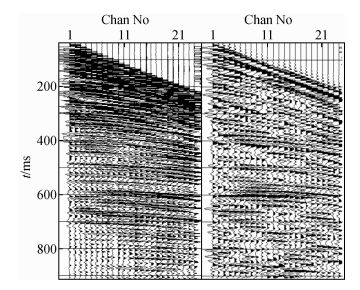
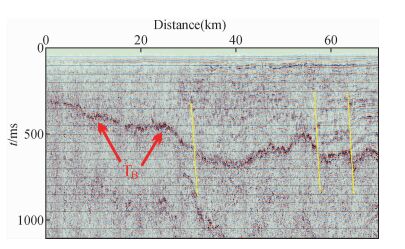
地震数据采集由福建省海洋研究所“延平2号”科考船实施,震源采用4支Sercel G型气枪组成的总容量1340立方英寸(1 in=2.54 cm)的气枪阵列,Hydroscience公司的NTRS-3型多道地震仪器和24道SEAMUX-3固态电缆(道距12.5 m)接收,炮点距37.5 m,最小偏移距62.5 m.原始资料品质较好,主要目的层反射同相轴清晰,但记录中多次波较为发育(图 2a),存在地震波在水层中多次反射形成的鸣震现象,这种强噪声必须加以妥善压制.应用常规的预测反褶积方法效果不理想,注意到虽然测区水深很浅(平均40 m),但最大偏移距仅350 m,海底一次反射波畸变较小,满足SRME(与表面有关的多次波衰减)方法应用的条件(张志军和魏天罡,2013; 潘军等, 2015),因此引入通常在较深水域使用的SRME技术,运用SRME和预测反褶积组合的方法,使多次波得到了很好的压制,有效反射波得到凸显(图 2b).经过速度分析-Kirchhoff叠前时间偏移,得到偏移叠加剖面(图 3).
|
图 2 多次波压制前后道集对比图 Figure 2 Comparison of shot gather records before and after multiple attenuation |
|
图 3 HX7偏移叠加时间剖面 Figure 3 Time section created from Kirchhoff pre-stack time migration |
测线水深变化较小,从西端的约45 m逐渐变浅到东端的约25 m;有一强反射界面(TB)可从西端的300 ms(对应深度约330 m)连续追踪到东侧的600 ms附近(对应深度约680 m),与上覆地层不整合接触,推测为新生代沉积的底界.关于HX7线所在区域的新生代沉积,大陆(高天均和黄辉,1994)和台湾方面(Lin et al., 2003)的研究均认为厚度小于1 km,与此剖面结果相符.该反射界面及其邻近地层被数条倾向东南的正断层切割:桩号30 km附近断块和断面清晰可见,可追踪至约1000 ms;桩号57 km和64 km处可见TB及上覆地层被明显错动.
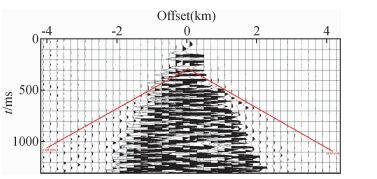
反射地震剖面提供了准确的界面形态,同时还可用Dix公式计算较为准确的上覆层波速,得到TB上方平均波速Vtop约为2205 m/s,这一结果与陈美玲(2006)用台湾方面反射地震资料提取的波速接近.同时我们收集了与反射地震剖面位置重合的折射地震资料,在海底地震仪记录上追踪到了清晰的TB界面折射波(图 4),使用广义互换法计算得到TB下方地层纵波速度Vbot约为5100 m/s,如此大的波速差异与该反射界面的强振幅吻合.
|
图 4 桩号3.7 km处的海底地震仪记录的TB界面折射波 Figure 4 Refraction from TB in the Ocean Bottom Seismometer record (at stake No. 3.7 km) |
台湾海峡西南部缺少钻孔资料,故对海底地质了解主要根据海峡东部资料及地球物理成果综合解释.观察反射地震剖面可以发现,强反射界面TB上覆和下伏地层都较均匀,内部未见可连续追踪的强反射事件,因此我们将其简化为一个双层模型,用重力资料反演上下地层的密度差,以提取下伏地层即新生代沉积基底的密度.
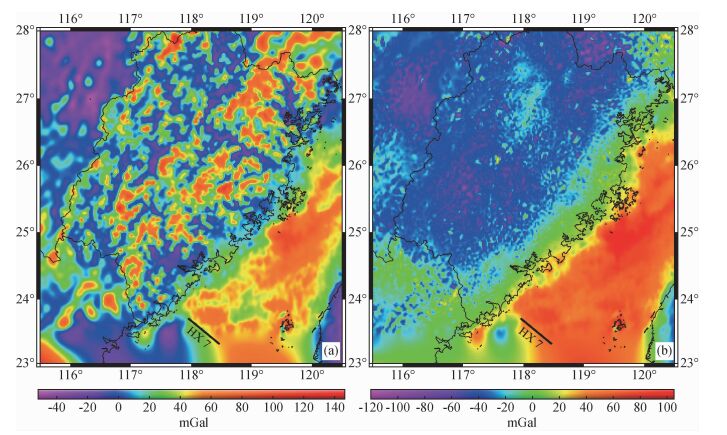
国家海洋局第二海洋研究所提供了部分台湾海峡的船测空间重力异常数据,通常在移去-恢复框架下利用Sandwell和Smith全球重力模型(Sandwell et al., 2013, 2014)插补即可得到测线的空间重力异常,但由于卫星测高方法固有的局限性,卫星重力数据在近岸水域特别古雷半岛附近有较大的偏差,由于剖面西端离海岸仅约20 km,因此必须对此进行改正.为此我们收集了福建省地质矿产局物化探大队1988年绘制的《福建省布格重力异常平面图》(比例尺1:500000),经过反布格改正得到福建地区陆上的空间重力异常,使用陆上空间重力异常数据和船测空间重力异常数据对Sandwell & Smith全球重力模型进行配准,配准后古雷半岛附近的粗大负值干扰消失了,海岸线附近的重力异常值更加准确、可靠(图 5a);最后对测线上的空间重力异常值进行完全布格改正得到布格重力异常值(图 5b).
|
图 5 (a) 福建及台湾海峡空间重力异常图;(b)福建及台湾海峡布格重力异常图 Figure 5 (a)Free-air gravity anomaly in Fujian and TWS; (b)Bouguer gravity anomaly in Fujian and TWS |
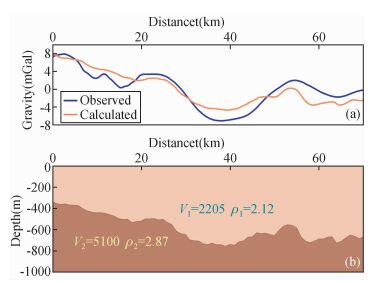
首先对偏移叠加剖面作时深转换,得到深度剖面,并简化为一个简单的二层密度模型,用沉积岩波速-密度的Gardner公式ρ=1.74V0.25将上覆层平均波速转化为密度(Gardner et al., 1974),得到上覆地层密度大约为2.12 g/cm3,与新生代固结程度较低的砂岩、泥岩密度相符.
图 6上为重力异常拟合图,蓝色为观测值,砖红色为计算值,拟合差为1.8 mGal,密度差为0.75 g/cm3.可见求取的密度模型(图 6下)较好的恢复了重力异常的低频成分,具有较高的置信度.下伏地层的密度约为2.12 g/cm3 + 0.75 g/cm3=2.87 g/cm3.反射地震剖面上TB异常大的反射系数也说明该界面波阻抗差极大,如此高的密度可能暗示其岩性为基性岩,而连续性较差、杂乱的同相轴也与喷出相基性岩特征相符.从区域构造上分析,晚中生代以来,台湾海峡地区先后经历了多期岩浆活动(钟建强等,1996),海峡中西部的新生代基底有大面积的中生代火山岩或侵入岩分布(黄慈流等,1997):台湾海峡隆起区南部有大片水平层状玄武岩体向东延伸入海,剖面以西的漳浦沿海见众多玄武岩露头(Zhou and Li, 2000);在澎湖—北港隆起区内,剖面以东约100 km的澎湖列岛通梁1号井在503.5 m以下钻遇玄武岩及玢岩(Yuan et al., 1985);剖面北面的厦澎断陷内的数口钻井也在1500~2000 m深度钻遇玄武岩或安山岩(萧宝宗等,1991),地震剖面上也有诸多火成岩发育的特征(钱星等,2015);剖面南面的珠江口盆地部分钻孔在上中新统粤海组中亦见玄武岩呈夹层(吴进民,1989),据此我们推断该剖面新生代沉积基底极有可能为玄武岩等基性火成岩.
|
图 6 (a) 剖面重力异常拟合图;(b)剖面波速-密度模型 Figure 6 (a)Corresponding gravity profile; (b)Velocity-density model of HX7 |
台湾海峡西南部勘探资料匮乏,特别是缺少钻孔和反射地震剖面,因此须集合现有的地质、地球物理资料开展综合研究,以得到对地质结构的正确认识.本文从浅层反射地震剖面中提取了准确、精细的地层分界面形态和较为准确的上覆地层波速,在此基础上运用重力反演方法求得界面的密度差进而得到下伏地层密度,从折射地震资料中提取了准确的下伏地层波速,综合上述信息并结合邻区地质露头和钻井资料推断该强反射界面对应新生代沉积基底,其岩性可能为玄武岩等基性火成岩,这是一种研究低勘探程度区域的较为可行的方法.
6.2福建省地震局此次采集的HX7浅层地震剖面具有较高的信噪比和分辨率,有利于增进对漳浦外海地质沉积-构造特征的认识,可为台湾海峡西南部的构造演化研究提供地球物理证据.但由于缺少钻井资料支持,该剖面岩石岩性及物性尚待进一步证实.应当注意由于该反射地震剖面最大炮检距仅350 m,难以对较深目的层(1000 m以下)有效成像.若TB下方存在较大的密度异常体,其重力异常可能会影响重力异常拟合结果.
致谢 国家海洋局第二海洋研究所提供了多道地震采集设备,吴招才博士提供了部分台湾海峡的船测空间重力异常数据,匿名审稿专家给出了中肯的修改意见,在此一并表示感谢.| [] | Bahorich M, Farmer S. 1995. 3-D seismic discontinuity for faults and stratigraphic features; the coherence cube[J]. The Leading Edge, 14(10): 1053–1058. DOI:10.1190/1.1437077 |
| [] | Chen K Y, Wu P X, Yang W. 2014. Application of diffusion filtering method to the seismic data processing[J]. Lithologic Reservoirs (in Chinese), 26(1): 117–122. |
| [] | Chen Y B, Zhang S T, Fu Q, et al. 2009. Application of Opendtect system in sequence stratigraphy research[J]. Progress in Geophysics (in Chinese), 24(5): 1768–1775. DOI:10.3969/j.issn.1004-2903.2009.05.030 |
| [] | Cheng J G, Tian J, He Y L, et al. 2004. Fingerprint enhancement algorithm based on nonlinear diffusion filter[J]. Acta Automatica Sinica (in Chinese), 30(6): 854–862. |
| [] | Fang H F, Zhou S, Wang Y L, et al. 2013. Geometric attribute improved-processing in fault interpretation[J]. Oil Geophysical Prospecting (in Chinese), 48(S1): 120–124. |
| [] | Liu A Q, Hao J W, Chen D Y, et al. 2014. Key technologies of seismic imaging and reservoir description for offshore complex fault block:A case study from Wei 12-1 Oilfield in Beibu Gulf Basin[J]. Lithologic Reservoirs (in Chinese), 26(1): 100–104. |
| [] | Luo H Z. 2011. Method and application of orientation filtering and noising cancelling[J]. Petroleum Geology and Recovery Efficiency (in Chinese), 18(6): 50–52, 114. |
| [] | Sun H Q, Shi W Y, Ju Y F. 2003. Image processing with medium value filter[J]. Journal of Chang'an University (Natural Science Edition) (in Chinese), 23(2): 104–106. |
| [] | Sun X P, Du S T, Tang L. 2004. Coherent-enhancing anisotropic diffusion filtering technique[J]. Oil Geophysical Prospecting (in Chinese), 39(6): 651–655, 665. |
| [] | Wang W H. 2000. Coherent signal prediction using mid-value correlative filtering[J]. Oil Geophysical Prospecting (in Chinese), 35(3): 273–282, 402. |
| [] | Zhao J S, Sun Z D. 2013. Application of an improved ant colony algorithm in fault automatic tracking[J]. Science & Technology Review (in Chinese), 31(27): 59–64. |
| [] | Zhao L Y, Fu Q, Pan H B. 2008. Application of opeChen M L. 2006. Sediment velocity structures in the Taiwan strait and the coastal plain of west Taiwan (in Chinese)[Master's thesis]. Taoyuan:National Central University, 70-91. |
| [] | Fu Z F, Jiang X Y, Wang H P, et al. 2012. Geological features and hydrocarbon prospect of the western depression, Taixi Basin[J]. Marine Geology Frontiers (in Chinese), 28(7): 30–35. |
| [] | Gao T J, Huang H. 1994. Tectonic Characteristics and Evolution of the Taiwan Strait[J]. Acta Geologica Sinica (in Chinese), 68(3): 197–207. |
| [] | Gardner G H F, Gardner L W, Gregory A R. 1974. Formation velocity and density-the diagnostic basics for stratigraphic traps[J]. Geophysics, 39(6): 770–780. DOI:10.1190/1.1440465 |
| [] | Huang C L, Su D Q, Chen H Z, et al. 1997. The Integrated Investigation of Geology, Geophysics and Geochemistry in the West Part of Taiwan Strait (in Chinese)[C]. Xiamen:Xiamen University Press. |
| [] | Jin Q H, Gao T J, Zhou C F, et al. 1993. Mesozoic-Cenozoic Tectonics and Petroleum Geology in Taiwan Strait (in Chinese)[M]. Fuzhou: Fujian Science and Technology Press. |
| [] | Li X J, Zhang Y C, Feng Z Q, et al. 2008. Topographic and geological conditions in the Taiwan Strait and suggestion for trans-strait tunnel[J]. Science & Technology Review(in Chinese), 26(22): 80–87. |
| [] | Lin A T, Watts A B, Hesselbo S P. 2003. Cenozoic stratigraphy and subsidence history of the South China Sea margin in the Taiwan region[J]. Basin Research, 15(4): 453–478. DOI:10.1046/j.1365-2117.2003.00215.x |
| [] | Liu Z H, Wang Y M, Wang H R. 2006. Characteristics and evolutions of geologic structures in the Taiwan Strait Basin[J]. Marine Geology & Quaternary Geology (in Chinese), 26(5): 69–75. |
| [] | Pan J, Luan X W, Sun Y B, et al. 2015. The application of SRME in high resolution seismic exploration of shallow sea environment[J]. Progress in Geophysics (in Chinese), 30(1): 429–434. DOI:10.6038/pg20150163 |
| [] | Qian X, Zhang L, Xu L M, et al. 2015. Igneous rocks in Jiulongjiang SAG of Taiwan Strait Basin and implications for petroleum geology[J]. Marine Geology & Quaternary Geology (in Chinese), 35(5): 111–116. |
| [] | Sandwell D T, Garcia E, Soofi K, et al. 2013. Toward 1-mGal accuracy in global marine gravity from CryoSat-2, Envisat, and Jason-1[J]. The Leading Edge, 32(8): 892–899. DOI:10.1190/tle32080892.1 |
| [] | Sandwell D T, Müller R D, Smith W H F, et al. 2014. New global marine gravity model from CryoSat-2 and Jason-1 reveals buried tectonic structure[J]. Science, 346(6205): 65–67. DOI:10.1126/science.1258213 |
| [] | South China Sea Institute of Oceanology, Chinese Academyof Sciences, Fujian Oceanic Institute. 1989. Petroleum Geological and Geophysical Prospecting in West Taiwan Strait (in Chinese)[M]. Beijing: China Ocean Press. |
| [] | Wang G C. 1993. Geological structural characteristics and oil prospects of Taiwan straits[J]. Acta Petrolei Sinica (in Chinese), 14(3): 10–19. |
| [] | Wu J M. 1989. Cenozoic strata of the continental marginal basins of Northern South China Sea[A].//Jin Q H ed. Geology and Petroleum Resources of the South China Sea (in Chinese)[M]. Beijing:Geology Publishing House, 238-265. |
| [] | Xiao B Z, Hu J C, Lin G A, et al. 1991. Evolution of the oil & gas potential in Penghu basin[J]. Petroleum Geology of Taiwan (in Chinese), 26: 215–229. |
| [] | Yang X Q, Shi X B, Xu H H. 2012. Numerical modeling of the current tectonic stress field in Taiwan Strait and its adjacent regions[J]. Chinese Journal of Geophysics (in Chinese), 55(7): 2307–2318. DOI:10.6038/j.issn.0001-5733.2012.07.016 |
| [] | Yang X Q, Song W L, Chen C H. 1996. Characteristics of geological structure in Taiwan Strait[J]. Journal of Oceanography in Taiwan Strait (in Chinese), 15(2): 127–136. |
| [] | Yuan J W, Lin S J, Huang S T, et al. 1985. Stratigraphic study on the pre-Miocene under the Peikang Area, Taiwan[J]. Petroleum Geology of Taiwan, 21: 115–127. |
| [] | Zhang Z J, Wei T G. 2013. Application of joint shallow-water multiple attenuation technique in LD zone of Bohai Sea[J]. China Petroleum Exploration (in Chinese)(1): 59–65. |
| [] | Zheng T Y, Liu P C. 1996. Study of the 16 September 1994 Taiwan Strait earthquake and its tectonic setting[J]. Acta Geophysica Sinica (in Chinese), 39(1): 68–79. |
| [] | Zhong J Q, Huang C L, Zhan W H, et al. 1996. Cenozoic tectonic evolution in Taixi Basin[J]. Oceanologia et Limnologia Sinica(in Chinese), 27(3): 271–278. |
| [] | Zhou X M, Li W X. 2000. Origin of Late Mesozoic igneous rocks in Southeastern China:Implications for lithosphere subduction and underplating of mafic magmas[J]. Tectonophysics, 326(3-4): 269–287. DOI:10.1016/S0040-1951(00)00120-7 |
| [] | 陈美玲. 2006. 台湾海峡及台湾西部平原之沉积层速度构造[硕士论文]. 桃园: 中央大学, 70-91. |
| [] | 傅志飞, 姜雄鹰, 王海平, 等. 2012. 台西盆地西部坳陷地质特征及油气前景[J]. 海洋地质前沿, 28(7): 30–35. |
| [] | 高天钧, 黄辉. 1994. 台湾海峡地质构造特征及演化[J]. 地质学报, 68(3): 197–207. |
| [] | 黄慈流, 苏大权, 陈汉宗, 等. 1997. 台湾海峡西部地质、地球物理和地球化学综合调查研究[C]. 厦门: 厦门大学出版社. |
| [] | 金庆焕, 高天钧, 周昌范, 等. 1993. 台湾海峡中、新生代地质构造及油气地质[M]. 福州: 福建科学技术出版社. |
| [] | 李学杰, 张以诚, 冯志强, 等. 2008. 台湾海峡地形地质特征及其通道工程选线[J]. 科技导报, 26(22): 80–87. DOI:10.3321/j.issn:1000-7857.2008.22.019 |
| [] | 刘振湖, 王英民, 王海荣. 2006. 台湾海峡盆地的地质构造特征及演化[J]. 海洋地质与第四纪地质, 26(5): 69–75. |
| [] | 潘军, 栾锡武, 孙运宝, 等. 2015. SRME技术在海洋浅水高分辨率地震勘探中的应用[J]. 地球物理学进展, 30(1): 429–434. DOI:10.6038/pg20150163 |
| [] | 钱星, 张莉, 徐立明, 等. 2015. 台湾海峡盆地九龙江凹陷火成岩发育特征及其油气地质意义[J]. 海洋地质与第四纪地质, 35(5): 111–116. |
| [] | 中国科学院南海海洋研究所台湾海峡课题组, 福建海洋研究所台湾海峡课题组. 1989. 台湾海峡西部石油地质地球物理调查研究[M]. 北京: 海洋出版社. |
| [] | 王国纯. 1993. 台湾海峡地质构造特征及油气探讨[J]. 石油学报, 14(3): 10–19. DOI:10.7623/syxb199303002 |
| [] | 吴进民. 1989. 南海北部陆缘诸盆地的新生代地层[A]. //金庆焕. 南海地质与油气资源[M]. 北京: 地质出版社, 238-265. |
| [] | 萧宝宗, 胡锦城, 林国安, 等. 1991. 澎湖盆地油气潜能评估[J]. 台湾石油地质, 26: 215–229. |
| [] | 杨小秋, 施小斌, 许鹤华. 2012. 台湾海峡及其邻区现今构造应力场数值模拟[J]. 地球物理学报, 55(7): 2307–2318. DOI:10.6038/j.issn.0001-5733.2012.07.016 |
| [] | 杨肖琪, 宋文隆, 陈承惠. 1996. 台湾海峡地质构造特征[J]. 台湾海峡, 15(2): 127–136. |
| [] | 张志军, 魏天罡. 2013. 浅水多次波的联合衰减技术在渤海海域LD地区的应用[J]. 中国石油勘探(1): 59–65. |
| [] | 郑天愉, 刘鹏程. 1996. 1994年9月16日台湾海峡地震及其构造背景研究[J]. 地球物理学报, 39(1): 68–79. |
| [] | 钟建强, 黄慈流, 詹文欢, 等. 1996. 台西盆地新生代构造的演化[J]. 海洋与湖沼, 27(3): 271–278. |
| [] | Zhao M Z, Fan X H, Liu C F, et al. 2011. Complex fault-block traps identification with structure-oriented filter[J]. Oil Geophysical Prospecting (in Chinese), 46(S1): 128–133, 163, 173. |
| [] | Zhao Y, He Z H, Huang D J. 2010. Application of edge preserving smoothing to the calculation of seismic coherence cube[J]. Lithologic Reservoirs (in Chinese), 22(2): 95–98. |
| [] | Zhou W, Yin T J, Zhang Y C, et al. 2015. Application of ant tracking technology to fracture prediction:A case study from Xiagou Formation in Qingxi Oilfield[J]. Lithologic Reservoirs (in Chinese), 27(6): 111–118. |
| [] | 陈可洋, 吴沛熹, 杨微. 2014. 扩散滤波方法在地震资料处理中的应用研究[J]. 岩性油气藏, 26(1): 117–122. |
| [] | 陈迎宾, 张寿庭, 付群, 等. 2009. Opendtect系统在层序地层研究中的应用[J]. 地球物理学进展, 24(5): 1768–1775. DOI:10.3969/j.issn.1004-2903.2009.05.030 |
| [] | 程建刚, 田捷, 何余良, 等. 2004. 基于非线性扩散滤波的指纹增强算法[J]. 自动化学报, 30(6): 854–862. |
| [] | 方海飞, 周赏, 王永莉, 等. 2013. 几何类属性深度处理技术在断层解释中的应用[J]. 石油地球物理勘探, 48(S1): 120–124. |
| [] | 刘爱群, 赫建伟, 陈殿远, 等. 2014. 近海复杂断块区地震成像及储层精细描述关键技术研究——以南海西部北部湾盆地涠12-1油田为例[J]. 岩性油气藏, 26(1): 100–104. |
| [] | 罗焕章. 2011. 方向性滤波去噪方法及其应用[J]. 油气地质与采收率, 18(6): 50–52, 114. |
| [] | 孙宏琦, 施维颖, 巨永锋. 2003. 利用中值滤波进行图像处理[J]. 长安大学学报(自然科学版), 23(2): 104–106. |
| [] | 孙夕平, 杜世通, 汤磊. 2004. 相干增强各向异性扩散滤波技术[J]. 石油地球物理勘探, 39(6): 651–655, 665. |
| [] | 王卫华. 2000. 利用中值相关滤波预测相干信号[J]. 石油地球物理勘探, 35(3): 273–282, 402. |
| [] | 赵俊省, 孙赞东. 2013. 一种改进的蚁群算法在断层自动追踪中的应用[J]. 科技导报, 31(27): 59–64. DOI:10.3981/j.issn.1000-7857.2013.27.009 |
| [] | 赵丽娅, 傅群, 潘海滨. 2008. Opendtect软件倾角控制模块在地震解释中的应用[J]. 海洋地质动态, 24(4): 33–37. |
| [] | 赵明章, 范雪辉, 刘春芳, 等. 2011. 利用构造导向滤波技术识别复杂断块圈闭[J]. 石油地球物理勘探, 46(S1): 128–133, 163, 173. |
| [] | 赵岩, 贺振华, 黄德济. 2010. 边缘保真去噪在地震相干体计算中的应用[J]. 岩性油气藏, 22(2): 95–98. |
| [] | 周文, 尹太举, 张亚春, 等. 2015. 蚂蚁追踪技术在裂缝预测中的应用-以青西油田下沟组为例[J]. 岩性油气藏, 27(6): 111–118. |