 2017, Vol. 32


2. 西北大学地质学系, 西安 710069
2. Department of Geology, Northwest University, Xi'an 710069, China
鄂尔多斯盆地油气资源十分丰富,超低渗透油气资源开发潜力巨大(邓秀芹等,2009;王香增和任来义,2016;付金华等,2017).与低渗透、特低渗透砂岩油藏储层相比,超低渗透砂岩油藏储层具有岩石颗粒更细、成岩过程更复杂、孔喉更细微、天然微裂隙更发育、储层微观孔隙结构更加复杂、地层压力系数更低等特征(胡作维等,2014;张潇文,2015).储层微观孔隙结构和油藏流体性质共同决定储层微观渗流特征,进而影响油藏开发技术的实施和开发效果(Deng et al., 2015;赵继勇等,2015).目前,国内外学者已在水驱驱替方面做了大量研究工作,主要见于水驱油宏(微)观驱替现象观察和描述,驱替效果及影响因素分析等(王瑞飞和孙卫,2010;张章等,2012).而对于水驱驱替效果的影响因素研究,多集中于微观孔隙结构、驱替条件等方面(全洪慧等,2011;陈萍等,2013;郝振宪等,2013;王伟等,2015;张振红等,2016).将水驱油实验的相对渗透率测定和真实砂岩微观模型驱替实验相结合研究超低渗透砂岩油藏微观渗流特征、驱油效率方面的报道并不多见.
本文以鄂尔多斯盆地陕北斜坡安塞地区、庆阳地区典型超低渗透砂岩油藏储层为研究对象(图 1),按渗透率分类开展油水相对渗透率测定和微观模型驱替实验.分析不同渗透率类型储层的相对渗透率曲线特征,微观模型油驱水和水驱油可视化渗流特征.分反映油藏固有特征的内在因素和反映驱替条件的外在因素,探讨超低渗透砂岩油藏影响驱油效率的因素.本研究为该类油藏的高效开发奠定理论基础.

|
图 1 鄂尔多斯盆地构造单元划分及研究区位置 Figure 1 Structural units and location of the study area in the Ordos basin |
相对渗透率曲线用以描述各相流体渗流特征,在油藏开发、动态调整方案设计中都需要相渗参数(吕伟峰等,2012;胡伟等,2015).油水相对渗透率曲线受岩石孔隙结构、油水性质及相互作用的影响.目前,相对渗透率曲线的主要确定方法有:实验室测定(稳态和非稳态)、经验公式计算、矿场资料计算等.本研究根据超低渗透砂岩油藏开发实践,将储层分为0.3×10⁻³ μm2类储层和大于0.5×10⁻³ μm2类储层,进行实验室测定相对渗透率曲线.
1.1 0.3×10⁻³ μm2类储层0.3×10⁻³ μm2类储层,一般指渗透率在0.3×10⁻³ μm2左右且小于0.5×10⁻³ μm2的储层.图 2为鄂尔多斯盆地安塞地区、庆阳地区0.3×10⁻³ μm2类储层相对渗透率曲线.分析图 2,束缚水饱和度较高(25%~40%),残余油饱和度大于25%,油水两相共渗区范围窄,驱油效率较低.随含水饱和度的增加,油相相对渗透率急剧下降,而水相相对渗透率上升缓慢,从而引起无因次采油指数和油井产量的大幅度下降.

|
图 2 0.3×10⁻³μm2类储层相对渗透率曲线 (a)Y25井4/10号岩样;(b)ZH31井1/45岩样. Figure 2 The relative permeability curve of 0.3×10⁻³ μm2 reservoir (a)Sample 4/10, Well Y25;(b)Sample 1/45, Well ZH31. |
图 3为鄂尔多斯盆地ZH9井渗透率为0.57×10⁻³ μm2储层样品油水相对渗透率曲线、无因次采液(油)指数与含水率关系曲线.分析图 3a,束缚水饱和度(Swi)达到40%以上,高于0.3×10⁻³ μm2类储层束缚水饱和度,残余油饱和度(Sor)达到20%以上.Sor状态下的水相相对渗透率为0.1左右,油水两相共渗区范围较窄,驱油效率低于40%.相同润湿类型储层,束缚水饱和度、残余油饱和度的高低受储层渗透性影响.渗透率越高,储层束缚水饱和度和残余油饱和度越小.不同润湿类型储层,水湿储层束缚水饱和度高,油湿储层残余油饱和度高.润湿性分析发现,ZH9井样品偏水湿,ZH31井1/45号岩样偏油湿,Y25井4/10号岩样润湿性居中.

|
图 3 大于0.5×10⁻³ μm2类储层相渗曲线与采液(油)指数曲线 (a)ZH9井0.57×10⁻³ μm2岩样油水相对渗透率曲线;(b)ZH9井无因次采液(油)指数与含水率关系曲线. Figure 3 The relative permeability and the liquid (oil) production index curve of greater than 0.5×10⁻³ μm2 reservoir (a)Well ZH9, the relative permeability curve of 0.57×10⁻³ μm2 sample; (b)The relationship curve of dimensionless liquid(oil) production index and water content in ZHP Well. |
总体上,鄂尔多斯盆地超低渗透砂岩油藏储层油水相对渗透率曲线特征表现为束缚水饱和度较高,残余油饱和度较高(具体束缚水饱和度、残余油饱和度数值受储层润湿性影响),油水两相共渗区范围窄,驱油效率较低.随含水饱和度的增加,油相相对渗透率急剧下降,水相相对渗透率上升缓慢,从而引起无因次采油指数和油井产量的大幅度下降(图 3b).因此,随开发时间的增长,产液量很难提升,故在开发过程中靠提高产液量保持油田稳产难度非常大.渗透率越小,油水两相共渗区范围越窄(杨正明等,2010;张海勇等,2014).
2 微观渗流特征 2.1 油驱水微观渗流特征0.3×10⁻³ μm2类储层,油驱水建立束缚水的过程中,渗流通道较少;随着注入压力的增加,波及体积增加部分很小,只在原渗流通道的基础上向周围逐渐扩大(图 4a, b).

|
图 4 微观模型油驱水实验效果 (a)4-22/55-3岩样(K=0.265×10-3 μm2);(b)4/56-1岩样(K=0.21×10-3 μm2);(c)2-9/170-2-1岩样(K=1.65×10-3 μm2);(d)2-90/170-2-3岩样(K=1.65×10-3 μm2). Figure 4 The experimental results of oil displacement by micro model (a)Sample 4-22/55-3(K=0.265×10-3 μm2); (b)Sample 4-56(K=0.21×10⁻³ μm2); (c)Sample 2-9/170-2-1(K=1.65×10-3 μm2); (d)Sample 2-90/170-2-3(K=1.65×10-3 μm2). |
大于0.5×10⁻³μm2类储层,油驱水过程中,渗流通道较多;随着注入压力的增加,波及体积增加(图 4c, d).
2.2 水驱油微观渗流特征对于0.3×10⁻³ μm2类储层,水驱油过程中,渗流通道较少;随着注入压力的增加,波及体积增加很小,只在原渗流通道的基础上向周围逐渐扩大(图 5a, b).由鄂尔多斯盆地超低渗透砂岩油藏(0.3×10⁻³ μm2类储层)水驱油过程中注入倍数与采收率、含水率关系(图 6a, b),随注入倍数增加,采收率和含水率均呈增大趋势.注入倍数为1~2 PV过程中采收率与含水率增加幅度较大;注入倍数大于3 PV时,采收率和含水率增加幅度趋于平缓.其原因是1~2 PV过程中,模型中已经形成比较稳定的渗流通道,当注入量继续增加时,注入水会沿着已经形成的渗流通道直接穿过,导致驱油效率增加缓慢(任大忠等,2015).统计0.3×10⁻³ μm2类储层注水开发试验区的最终驱油效率,驱油效率均较低,其分布范围为31.80%~49.06%(图 6c).

|
图 5 微观模型水驱油实验效果 (a)ZH59-20井(4/56)-1-1岩样(K=0.21×10-3 μm2);(b)ZH59-20(4/56)-1-2岩样(K=0.2×10-3 μm2);(c)ZH58-22(96/134)2-4岩样(K=1.56×10-3 μm2);(d)X39-039/170-2-3岩样(K=1.65×10-3 μm2). Figure 5 The experimental results of micro model water flooding (a)Sample (4/56)-1-1(K=0.21×10-3 μm2), ZH59-20 Well; (b)Sample (4/56)-1-2(K=0.2×10-3 μm2), ZH59-20 Well; (c)Sample (96/134)-2-4(K=1.56×10-3 μm2), ZH58-22 Well; (d)Sample 170-2-3(K=1.65×10⁻³ μm2), X39-039 Well. |

|
图 6 0.3×10⁻³μm2类储层水驱油效果 (a)Y13注入倍数与采出程度、含水率的关系;(b)ZH38注入倍数与采出程度、含水率的关系;(c)各试验区驱油效率对比. Figure 6 The effect of water flooding experiment of 0.3×10⁻³ μm2 reservoir (a)The relationship between injection volume and recovery degree and water content in Well Y13; (b)The relationship between injection volume and recovery degree and water content in Well ZH38; (c)The comparison of displacement efficiency in each testing area. |
对于大于0.5×10⁻³ μm2类储层,水驱油过程中,渗流通道较多;随着注入压力的增加,波及体积增加(图 5c, d).
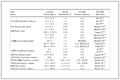
大于0.5×10⁻³ μm2类储层微观模型水驱油特征研究,选取庆阳地区长6储层.样品及水驱油实验结果统计见表 1(其中,驱油效率为4 PV的实验结果).分析发现,大于0.5×10⁻³ μm2类储层驱替特征与0.3×10⁻³ μm2类储层类似.相对于0.3×10⁻³ μm2类储层,大于0.5×10⁻³ μm2类储层最终驱油效率较高(驱油效率为43.12%~55.65%).其原因在于,相同类型储层可动流体百分数与渗透率呈正相关,随储层渗透率的增加可动流体百分数增加(张仲宏等,2012).
|
表 1 微观模型水驱油实验结果统计 Table 1 Statistical analysis of experimental results of microscopic model water flooding |
实验中改变驱替条件(储层物性、驱替压力、加压方式),探讨影响驱油效率的因素.
3.1 储层物性超低渗透砂岩油藏,储层物性是影响驱油效率的首要因素.当物性较差时,注入水无法进入,驱油效率为零;当物性较低时,注入水驱油路线单一,水驱油效率仍然较低;当物性相对较好时,水驱油路线呈网状,驱油效率高(表 1).
3.2 驱替压力无论是超低渗透储层,还是相对较高渗储层,提高驱替压力,驱油效率均呈上升趋势.只是超低渗储层由于孔道细小,粗大孔道较少且连通性差,提高驱替压力不会形成更多的渗流通道,但仍可使注入水由已形成的渗流路径为基础,向周围进入更细小的孔道.当水驱油渗流网络稳定后,无论是超低渗储层,还是相对较高渗储层,提高驱替压力,驱油效率增量减小.因此,提高驱替压力是提高油藏开采效果的重要途径,但对于致密极低渗的超低渗透砂岩油藏储层以提高驱替压力来改善开采效果并不理想(图 7).

|
图 7 驱替压力与驱油效率关系 Figure 7 The relation between the displacement pressure and the displacement efficiency |
水驱油实验发现,渗透率更低的模型组(岩心渗透率<0.3×10⁻³ μm2):注入水驱替过程中,逐渐升压和骤然升压二者的驱油效率相差4%.相对较高渗模型组(岩心渗透率>0.3×10⁻³ μm2):注入水驱替过程中,逐步加压和骤然加压二者之间的驱油效率相差17%.驱替过程中缓慢而逐渐增加驱替压力的模型,驱油效率增幅大,且最终驱油效率也高;骤然增加驱替压力的模型,最终驱油效率增幅小,且最终驱油效率也较低.水驱油过程中采用逐步加压的方式,有利于提高油层(高渗、低渗)的驱油效率.
驱油效果很大程度上取决于其物性(尤其是储层物性分布的均质性).储层物性很差,即使其非均质性很弱,驱替过程中,在一定的驱替压力下,要么驱替水不能进入模型,要么在模型内部形成指进和突进路径,驱替不均匀.在驱替过程中,高渗模型的物性相对于低渗模型好,注入水在高渗模型内部波及面积较广泛,最终驱油效率高;低渗模型物性相对较差,注入水驱替过程中,在驱替压力很高的条件下(有的甚至达到模型的最高承压范围),注入水只进入模型内部孔喉较粗的部分,在模型内部只形成一条注水驱油通道便达到出口,注入水在模型内部的驱油效率很低.
分析影响驱油效率的因素,可以分为内因和外因两部分.内因主要指油藏自身固有特征,包括储层物性(尤其是储层微观孔隙结构所决定的储层微观非均质性)、润湿性、原油黏度等(鞠斌山等,2006 ).外因主要指水驱油条件,包括注水孔隙体积倍数、驱替压力、驱替速度及加压方式等.
4 结论 4.1超低渗透砂岩油藏储层相对渗透率曲线特征表现为:束缚水饱和度高,残余油饱和度高,油水两相共渗区范围窄,驱油效率低.随含水饱和度增加,油相相对渗透率急剧下降,水相相对渗透率上升缓慢,无因次采油指数和油井产量大幅度下降.
4.2超低渗透砂岩油藏驱替特征表现为:最终驱油效率低,随注入倍数增加,采收率和含水率增大.注入倍数为1~2 PV过程中采收率与含水率增幅较大;注入倍数大于3 PV时,采收率和含水率增幅趋于平缓.
4.3超低渗透砂岩油藏影响驱油效率的因素可以分为内因和外因.内因主要包括储集层的非均质性、润湿性等;外因主要指水驱油条件,包括驱替压力、注入速度及加压方式等.
致谢 感谢审稿专家的支持和编辑的辛勤工作.| [] | Chen P, Tao G, Dong M Z, et al. 2013. The effects of the pore throat roughness on the water-oil flow in rock reservoirs[J]. Progress in Geophys., 28(2): 824–829. DOI:10.6038/pg20130232 |
| [] | Deng S, Zuo L, Aydin A, et al. 2015. Permeability characterization of natural compaction bands using core flooding experiments and three-dimensional image-based analysis:Comparing and contrasting the results from two different methods[J]. AAPG Bulletin, 99(1): 27–49. DOI:10.1306/07071413211 |
| [] | Deng X Q, Liu X S, Li S X. 2009. The relationship between compacting history and hydrocarbon accumulating history of the super-low permeability reservoirs in the Triassic Yanchang Formation in the Ordos Basin[J]. Oil & Gas Geology, 30(2): 156–161. |
| [] | Fu J H, Deng X Q, Wang Q, et al. 2017. Compaction and hydrocarbon accumulation of Triassic Yanchang Formation Chang 8 member, Ordos Basin, NW China:Evidence from geochemistry and fluid inclusions[J]. Petroleum Exploration and Development, 44(1): 48–57. DOI:10.11698/PED.2017.01.06 |
| [] | Hao Z X, Fu X Y, Xiao Z L. 2013. Law of pore structure variety in deep section sandstone reservoir during waterflooding development[J]. Progress in Geophys., 28(5): 2597–2604. DOI:10.6038/pg20130539 |
| [] | Hu W, Yang S L, Zhai Y J, et al. 2015. A new optimization and correction method of oil-water phase relative permeability curve[J]. Acta Petrolei Sinica, 36(7): 871–875. DOI:10.7623/syxb201507011 |
| [] | Hu Z W, Li Y, Wang H H, et al. 2014. Pore structure characteristics of Ultra-low permeability reservoirs of Chang 8 oil reservoir set in Zhenyuan area, Ordos Basin[J]. Lithologic Reservoirs, 26(2): 15–20. |
| [] | Ju B S, Fan T L, Wang X D, et al. 2006. Mathematical simulation of the effect of the change in oil viscosity on water drive performance[J]. Earth Science-Journal of China University of Geosciences, 31(3): 378–383. |
| [] | Lü W F, Liu Q J, Zhang Z B, et al. 2012. Measurement of three-phase relative permeabilities[J]. Petroleum Exploration and Development, 39(6): 713–719. |
| [] | Quan H H, Zhu Y S, Zhang H J, et al. 2011. Reservoir pore structure and micro-flow characteristics of waterflooding:A case study from Chang-6 reservoir of Wangyao block in Ansai oilfield[J]. Oil & Gas Geology, 32(6): 952–960. |
| [] | Ren D Z, Sun W, Zhao J Y, et al. 2015. Microscopic waterflooding characteristics of lithologic reservoirs in Ordos basin and its influence factors:taking the Chang 81 reservoir in Huaqing oilfield as an example[J]. Journal of China University of Mining & Technology, 44(6): 1043–1052. DOI:10.13247/j.cnki.jcumt.000357 |
| [] | Wang R F, Sun W. 2010. Main controls for oil displacement efficiency by the micro-model water flooding experiment in Ultra-low permeability sandstone reservoir[J]. Petroleum Geology & Experiment, 32(1): 93–97. |
| [] | Wang W, Zhu Y S, Chen D Y, et al. 2015. Micro-flow characteristics and influencing factors of low permeability reservoir:A case study of Chang 6 reservoir of Jiyuan Area in Ordos Basin[J]. Geological Science and Technology Information, 34(2): 159–164. |
| [] | Wang X Z, Ren L Y. 2016. Advances in theory and practice of hydrocarbon exploration in Yanchang exploration area, Ordos Basin[J]. Acta Petrolei Sinica, 37(S1): 79–86. DOI:10.7623/syxb2016S1008 |
| [] | Yang Z M, Li Z S, Wang X W, et al. 2010. A new method for testing relative permeability of ultra-low permeability reservoirs[J]. Acta Petrolei Sinica, 31(4): 629–632. |
| [] | Zhang H Y, Luan G H, Jiao C Y, et al. 2014. A new method for the calculation of two-phase relative permeability in ultra-low permeability reservoir[J]. Science Technology and Engineering, 14(13): 31–34. |
| [] | Zhang X W, Chen S J, Yao Y T, et al. 2015. Study on start-up pressure of charging for super-low permeability reservoir, upper triassic Yanchang Formation, Ordos Basin[J]. Geological Review, 61(4): 925–934. DOI:10.16509/j.georeview.2015.04.019 |
| [] | Zhang Z, Zhu Y S, Chen Z B, et al. 2012. Micro-flow characteristics and influencing factors of oil displacement efficiency of Chang-6 reservoir in Heshui area[J]. Earth Science Frontiers, 19(2): 176–182. |
| [] | Zhang Z H, Yang Z M, Liu X G, et al. 2012. A grading evaluation method for low-permeability reservoirs and its application[J]. Acta Petrolei Sinica, 33(3): 437–441. |
| [] | Zhang Z H, Zhu J, Yu F, et al. 2016. Reservoir characteristics of thick sandstone and micro-anisotropy of delta front micro-facies:A case study of Chang 6 reservoir in Wucangbu area[J]. Geological Bulletin of China, 2016(2-3): 440–447. |
| [] | Zhao J Y, Fan J M, He Y H, et al. 2015. Optimization of horizontal well injection-production parameters for ultra-low permeable-tight oil production:A case from Changqing Oilfield, Ordos Basin[J]. Petroleum Exploration and Development, 42(1): 68–75. DOI:10.11698/PED.2015.01.08 |
| [] | 陈萍, 陶果, 董明哲, 等. 2013. 岩石孔喉道中表面粗糙度对油水两相流动的影响[J]. 地球物理学进展, 28(2): 824–829. DOI:10.6038/pg20130232 |
| [] | 邓秀芹, 刘新社, 李士祥. 2009. 鄂尔多斯盆地三叠系延长组超低渗透储层致密史与油藏成藏史[J]. 石油与天然气地质, 30(2): 156–161. DOI:10.11743/ogg20090205 |
| [] | 付金华, 邓秀芹, 王琪, 等. 2017. 鄂尔多斯盆地三叠系长8储集层致密与成藏耦合关系——来自地球化学和流体包裹体的证据[J]. 石油勘探与开发, 44(1): 48–57. DOI:10.11698/PED.2017.01.06 |
| [] | 郝振宪, 付晓燕, 肖曾利. 2013. 深层砂岩油藏注水开发储层孔隙结构变化规律[J]. 地球物理学进展, 28(5): 2597–2604. DOI:10.6038/pg20130539 |
| [] | 胡伟, 杨胜来, 翟羽佳, 等. 2015. 油-水相对渗透率曲线优化校正新方法[J]. 石油学报, 36(7): 871–875. DOI:10.7623/syxb201507011 |
| [] | 胡作维, 李云, 王海红, 等. 2014. 鄂尔多斯盆地镇原地区长8油层组超低渗储层孔隙结构特征[J]. 岩性油气藏, 26(2): 15–20. |
| [] | 鞠斌山, 樊太亮, 王晓冬, 等. 2006. 原油粘度变化对水驱油开发动态影响的数学模拟方法[J]. 地球科学——中国地质大学学报, 31(3): 378–383. |
| [] | 吕伟峰, 刘庆杰, 张祖波, 等. 2012. 三相相对渗透率曲线实验测定[J]. 石油勘探与开发, 39(6): 713–719. |
| [] | 全洪慧, 朱玉双, 张洪军, 等. 2011. 储层孔隙结构与水驱油微观渗流特征——以安塞油田王窑区长6油层组为例[J]. 石油与天然气地质, 32(6): 952–960. DOI:10.11743/ogg20110620 |
| [] | 任大忠, 孙卫, 赵继勇, 等. 2015. 鄂尔多斯盆地岩性油藏微观水驱油特征及影响因素——以华庆油田长81油藏为例[J]. 中国矿业大学学报, 44(6): 1043–1052. DOI:10.13247/j.cnki.jcumt.000357 |
| [] | 王瑞飞, 孙卫. 2010. 特低渗透砂岩微观模型水驱油实验影响驱油效率因素[J]. 石油实验地质, 32(1): 93–97. DOI:10.11781/sysydz201001093 |
| [] | 王伟, 朱玉双, 陈大友, 等. 2015. 低渗透油藏微观渗流特征及影响因素研究:以鄂尔多斯盆地姬塬地区长6油层组为例[J]. 地质科技情报, 34(2): 159–164. |
| [] | 王香增, 任来义. 2016. 鄂尔多斯盆地延长探区油气勘探理论与实践进展[J]. 石油学报, 37(S1): 79–86. DOI:10.7623/syxb2016S1008 |
| [] | 杨正明, 李治硕, 王学武, 等. 2010. 特低渗透油田相对渗透率曲线测试新方法[J]. 石油学报, 31(4): 629–632. DOI:10.7623/syxb201004020 |
| [] | 张海勇, 栾国华, 焦春艳, 等. 2014. 一种计算超低渗储层相对渗透率的新方法[J]. 科学技术与工程, 14(13): 31–34. DOI:10.3969/j.issn.1671-1815.2014.13.007 |
| [] | 张潇文, 陈世加, 姚宜同, 等. 2015. 鄂尔多斯盆地上三叠统延长组超低渗储层油气成藏启动压力研究[J]. 地质论评, 61(4): 925–934. DOI:10.16509/j.georeview.2015.04.019 |
| [] | 张章, 朱玉双, 陈朝兵, 等. 2012. 合水地区长6油层微观渗流特征及驱油效率影响因素研究[J]. 地学前缘, 19(2): 176–182. |
| [] | 张振红, 朱静, 余芳, 等. 2016. 三角洲前缘厚层砂岩孔隙结构及微观渗流特征——以吴仓堡地区长6储层为例[J]. 地质通报, 35(2-3): 440–447. |
| [] | 张仲宏, 杨正明, 刘先贵, 等. 2012. 低渗透油藏储层分级评价方法及应用[J]. 石油学报, 33(3): 437–441. DOI:10.7623/syxb201203013 |
| [] | 赵继勇, 樊建明, 何永宏, 等. 2015. 超低渗-致密油藏水平井开发注采参数优化实践——以鄂尔多斯盆地长庆油田为例[J]. 石油勘探与开发, 42(1): 68–75. DOI:10.11698/PED.2015.01.08 |