 2017, Vol. 32


重、磁方法是以地下介质物性差异(密度、磁性)为基础的一种地球物理勘探方法,本身具有成本低、周期短、效果好等特点,已成为查明地质构造、解决固体矿产资源和能源(石油、天然气和煤)勘探、地震及地质灾害预测、环境及工程监测等方面问题不可缺少的重要手段.位场数据处理和转换在快速Fourier变换提出之前主要在空间域进行,从1965年快速Fourier变换(FFT)问世以后,由于频率域位场数据处理和转换有计算公式简单、计算效率高的特点,位场数据处理和转换主要在频率域(波数域)中进行,并取得了很多成果(侯重初和刘秀芳,1978;Nagendra,1984;吴宣志等,1987;朱文孝等,1989;穆石敏,1990).随着信号分析理论的发展与完善,位场数据处理和转换的方法不再局限于Fourier频谱分析的理论,已经发展到小波变换(何继善等,1997;Li and Oldenburg, 1997;李宗杰等,1997)、Hilbert变换(Nabighian,1972;Stanley and Green, 1976;Stanley,1976;Mohan and Sundararajan, 1982;张凤旭等,2005;骆遥等,2011)、Hartley变换(Sundararajan and Brahmam, 1998;Kadirov,2000;魏雅利和骆遥,2010;Al-Garni and Sundararajan, 2012;骆遥,2013;马国庆等,2014)、余弦变换(张凤旭等, 2005a, 2006;刘东甲等,2012;刘繁明等,2013)等信号分析领域中.
离散余弦变换(DCT)是由Ahmed等(1974)提出的,经过几十年的应用与发展,DCT有三种经典的快速算法:B.G.LEE算法(Lee,1984)、AAN算法(Arai et al,1988)和LLM算法(Loeffler et al,1989).在地球物理数据处理中,DCT主要应用于地震数据和图像压缩.在位场数据处理中,2005年张凤旭和张凤琴等利用余弦变换研究密度界面重力异常的正、反演问题,认为余弦变换法反演的常密度单界面理论模型的深度误差小于Fourier变换法反演的界面深度.2006年张凤琴和刘财等利用余弦变换研究了规则形体重力异常频谱特征及反演方法.同年,张凤旭等提出了基于离散余弦变换的匹配滤波方法,提高了重磁异常划分的精确性和可靠性.2007年张凤旭和张凤琴等将DCT应用到位场数据导数转换中,认为其精度大于DFT(离散Fourier变换).2008年张凤旭和张凤琴等提出了基于DCT的Euler法确定断层断点位置的反演方法.2009年,张凤旭等将DCT应用到磁异常化极中,取得了较好的效果.2013年刘繁明等人为了获得高精度全张量磁梯度数据,提出了一种基于离散余弦变换的频率域快速计算方法.虽然有作者认为在位场数据处理和转换中,余弦变换比Fourier变换更具有优势.但刘东甲等人(2012)指出,DCT法的磁异常导数转换精度明显高于DFT法的结论是错误的.因此,对DCT和DFT在位场数据处理和转换方面的对比研究就具有一定意义.
本文通过整理余弦变换和Fourier变换的定义、性质、计算量以及在位场数据处理和转换中的频率响应,并通过理论模型测试和实际资料处理试验来研究余弦变换和Fourier变换在位场数据处理和转换中的优劣.
1 余弦变换和Fourier变换对比(1) 余弦变换和Fourier变换的定义
对于实连续函数f(t),其余弦正变换与逆变换定义为(布隆什坦和谢缅佳也夫,1965):

|
(1) |
对于实连续函数f(x, y),其余弦正变换与逆变换定义为(布隆什坦和谢缅佳也夫,1965):

|
(2) |
对于一维函数f(x)的Fourier变换及其逆变换定义为(布隆什坦和谢缅佳也夫,1965):

|
(3) |
对于二维函数f(x, y)的Fourier变换及其逆变换定义为(布隆什坦和谢缅佳也夫,1965):

|
(4) |
从Fourier变换和余弦换的定义形式对比可以看出,二者定义形式基本相似.余弦正、反变换定义式具有完全相同的核函数,且为实数;而Fourier正、反变换定义式中的核函数互为共轭,且为复数.
(2) 余弦变换和Fourier变换的性质
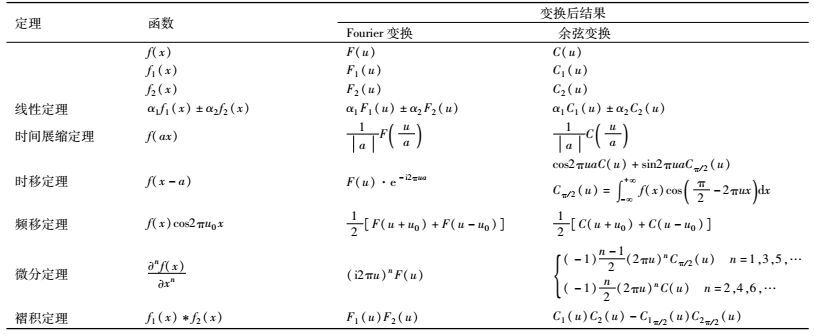
仿照Fourier变换的性质,余弦变换也有其相应的性质.表 1和表 2(布隆什坦和谢缅佳也夫,1965;张凤旭, 2006b, c, d)列出了一维和二维Fourier变换和余弦变换的性质.对比余弦变换和Fourier变换的性质,显然余弦变换的时间展缩性质和褶积性质受到函数奇偶性的影响,微分定理根据阶次的奇偶性具有不同的形式.整体来说,Fourier变换的大部分性质比余弦变换的性质更加简洁.
|
表 1 一维余弦变换和Fourier变换基本性质对比表 Table 1 The contrast table of properties of 1D cosine transform and Fourier transform |
|
|
表 2 二维余弦变换和Fourier变换基本性质对比表 Table 2 The contrast table of properties of 2D cosine transform and Fourier transform |

(3) 余弦变换和Fourier变换快速算法的计算量
设Me表示实乘运算次数,Ae表示实加运算次数(蒋增荣等,1993),则一维快速余弦变换算法的计算量为

|
(5) |
二维快速余弦变换算法的计算量为

|
(6) |
而一维快速Fourier变换算法的计算量为

|
二维快速Fourier变换算法的计算量为:

|
通过快速余弦变换与快速Fourier变换算法的计算量对比可得,实数域快速Fourier变换算法计算量基本是复数域计算量的一半,与快速余弦变换算法的计算量基本相当.
2 基于余弦变换和Fourier变换的位场数据处理和转换频率响应对比这里的位场转换包括位场延拓、各阶混合偏导数转换、重磁异常分量转换和磁异常磁化方向转换.设Ut1(x, y, z)和Ut2(x, y, z)分别为位函数U(x, y, z)在单位矢量t1=(l1, m1, n1)和t2=(l2, m2, n2)方向的位场分量.Us1(x, y, z)和Us2(x, y, z)分别表示同一分量在单位矢量s1=(α1, β1, γ1)和s2=(α2, β2, γ2)磁化方向的磁异常.Ut, s(x, y, z)表示分量方向为t=(l, m, n)和磁化方向为s=(α, β, γ)的磁异常.则有关Fourier变换和余弦变换在位场数据处理和转换中的频率响应对比见表 3和表 4(侯重初和刘秀芳,1978;张凤旭, 2006b, c, d,2007a, b, c)所示.
|
|
表 3 一维余弦变换和Fourier变换在位场数据处理和转换中的频率响应对比表 Table 3 The contrast table of frequency response based on 1D cosine transform and Fourier transform in potential field data processing and transformation |

|
|
表 4 二维余弦变换和Fourier变换在位场数据处理和转换中的频率响应对比表 Table 4 The contrast table of frequency response based on 2D cosine transform and Fourier transform in potential field data processing and transformation |

综上,余弦变换和Fourier变换的位场延拓因子相同,余弦变换的导数因子和方向转换因子要比Fourier变换的复杂.总的来说,在位场数据处理和转换中,Fourier变换的频谱响应公式要比余弦变换的频谱响应公式更加简洁.
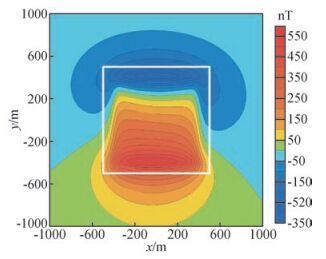
3 模型测试本次试验选取一个直立六面体,其x方向坐标范围为-400~400 m,y方向坐标范围为-400~400 m,z方向(铅垂向下为正)坐标范围为50~850 m,剩余密度为0.7×10³ kg/m3,磁化强度为1.0 A/m,地磁场偏角为5°、倾角为50°.计算面为平面z=0(z坐标方向向下为正),其在x方向上的坐标范围为-1000~1000 m,点距为10 m;在y方向上的坐标范围为-1000~1000 m,点距为10 m.图 1为z=0 m的重力异常平面图,图 2为z=0 m的磁力异常平面图,所有模型测试的扩边方法均采用最小曲率扩边方法(王万银等,2009).

|
图 1 模型重力异常平面图 Figure 1 The plane map of the theoretical model's gravity anomaly |
|
图 2 模型ΔT磁异常平面图 Figure 2 The plane map of the theoretical model's ΔT magnetic anomaly |
(1) 位场延拓测试
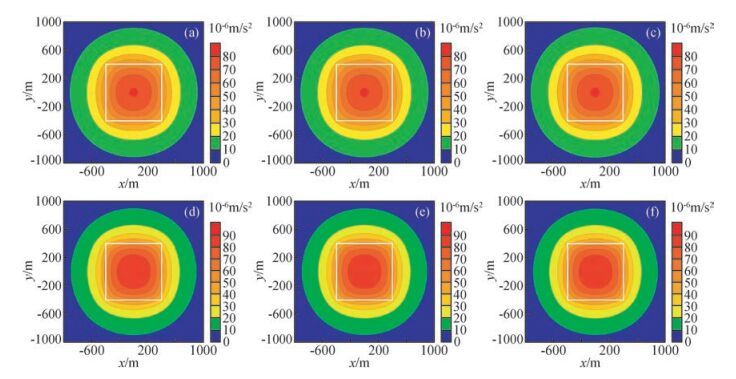
选取平面高度为0 m时的理论重力异常(图 1)为基准,分别把该平面上重力异常向上延拓20 m,向下延拓20 m,得到图 3所示重力异常,从重力异常图中可以看出FCT延拓结果和FFT延拓结果的重力异常图几乎一致.FCT和FFT向上延拓20m的重力异常与该高度的理论重力异常的均方误差分别为0.065×10⁻⁶ m/s2和0.066×10-6 m/s2,FCT和FFT向下延拓20 m的重力异常与该高度的理论重力异常的均方误差分别为0.150×10⁻⁶ m/s2和0.152×10-6 m/s2.从均方误差上可以看出其计算精度相近.就计算量而言,FCT和实数域FFT的计算时间大约分别为0.33 s和0.34 s(计算机配置:内存64 GB,处理器intel(R)Xeon(R)CPU E5-2670 V3@ 2.30 GHz,显卡NVIDIA Quadro K620,下同),因此FCT位场延拓所需计算量与实数域FFT的计算量基本相同.
|
图 3 FCT和FFT重力异常延拓平面图 (a)和(d)分别为高度-20 m和20 m的理论重力异常;(b)和(c)分别为基于FCT和FFT的重力异常向上延拓20 m的结果;(e)和(f)分别为基于FCT和FFT的重力异常向下延拓20 m的结果. Figure 3 The plane map of the continued gravity anomaly based on FCT and FFT (a) and (d) Are the theoretical gravity anomaly in -20 m and 20 m; (b) and (c) Are the continued gravity anomaly based on FCT and FFT in -20 m respectively; (e) and (f) Are the continued gravity anomaly based on FCT and FFT in 20 m respectively. |
(2) 位场导数转换测试
根据图 1所示重力异常换算x,y,z三个方向的导数.图 4为基于FFT和FCT的重力异常导数转换结果.由该图可以看出,FCT和FFT的导数转换结果基本相同.FCT在x,y和z方向的导数转换结果与理论异常导数的均方误差分别为1.50×10⁻⁴ s-2,1.51×10-4 s-2和3.39×10⁻³ s-2,FFT在x,y和z方向的导数转换结果与理论异常导数的均方误差分别为1.51×10⁻⁴ s-2,1.51×10-4 s-2和3.39×10⁻³ s-2.FCT和实数域FFT的导数转换时间(x,y和z方向导数计算时间基本相同)分别为0.34 s和0.34 s.因此FCT在位场导数转换方面所需计算量与FFT的计算量基本相同,而且精度也基本相同.

|
图 4 FCT和FFT重力异常导数转换结果平面图 (a),(b)和(c)分别为x,y和z方向理论导数;(d),(e)和(f)分别为基于FCT的重力异常x,y和z方向导数转换结果;(g),(h)和(i)分别为基于FFT的重力异常x,y和z方向导数转换结果. Figure 4 The plane map of the derivative transformation of gravity anomaly based on FCT and FFT (a), (b) and (c) Are the theoretical derivative of gravity anomaly about x, y and z respectively; (d), (e) and (f) Are the derivative of gravity anomaly based on FCT about x, y and z respectively; (g), (h) and (i) Are the derivative of gravity anomaly based on of FFT about x, y and z respectively. |
(3) 磁异常分量转换和磁化方向转换测试
根据图 2所示磁力异常进行化极处理.图 5为基于FCT和FFT的磁异常化极结果.由图 5可以看出,基于FCT和FFT的磁异常化极结果相近,其均方误差分别为4.393 nT和4.395 nT.就计算量而言,FCT和实数域FFT的计算时间分别为0.34 s和0.35 s.因此FCT在位场分量转换和磁异常磁化方向转换方面所需计算量与FFT的基本相同,转换精度也基本相同.

|
图 5 FCT和FFT磁异常化极结果平面图 (a)为理论化极磁异常; (b)和(c)分别为基于FCT和FFT的化极磁异常. Figure 5 The plane map of the reduction-to-the-pole magnetic anomaly based on FCT and FFT (a)Is the theoretical reduction-to-the-pole magnetic anomaly; (b) and (c) Are the reduction-to-the-pole magnetic anomaly based on FCT and FFT respectively. |
本次实际资料处理选取我国某地调平后的航磁资料(图 6),然后利用FCT方法和FFT方法对该区的实际资料进行处理,从而比较FCT和FFT变换的效果及计算量,实际资料处理扩边方法均采用最小曲率扩边(王万银等,2009).

|
图 6 ΔT磁力异常平面图 Figure 6 The plane map of ΔT magnetic anomaly |
(1) 磁异常解析延拓
分别利用FCT和FFT对上述实际磁异常分别向上延拓300 m和向下延拓300 m(图 7).由该图可以看出,基于FCT和FFT的位场延拓结果基本相同.向上延拓300 m时,FCT方法与FFT方法偏差的均方差为0.0957 nT;向下延拓300 m时,FCT方法与FFT方法偏差的均方差为0.157 nT,这个偏差是由于数值计算误差造成,而不是方法本身造成.就计算量而言,FCT和实数域FFT的计算时间分别为0.32 s和0.32 s.因此FCT和FFT在位场延拓所需的计算量基本相同,其精度也基本相同.

|
图 7 FCT和FFT磁异常延拓平面图 (a)和(b)分别为基于FCT和FFT的磁力异常向上延拓300 m的结果,(c)和(d)分别为基于FCT和FFT的磁力异常向下延拓300 m的结果. Figure 7 The plane map of the continued magnetic anomaly based on FCT and FFT (a) and (b) Are the continued magnetic anomaly based on FCT and FFT in -300 m respectively; (c) and (d) Are the continued magnetic anomaly based on FCT and FFT in 300 m respectively. |
(2) 磁异常导数转换
分别利用FCT和FFT对图 6所示磁异常进行x、y和z方向的导数计算(图 8).由该图可以看出,基于FCT和FFT的位场导数转换结果基本一致,FCT和FFT在x、y和z三个方向偏差的均方差分别为7.27×10⁻⁶ nT/m、5.99×10-6 nT/m和1.44×10-4 nT/m,与本身异常相比,这个偏差可以忽略.就计算量而言,FCT和实数域FFT的计算时间分别为0.34 s和0.34 s.因此FCT和实数域FFT在位场导数转换方面的计算精度基本相同,所需计算量也基本相同.

|
图 8 FCT和FFT磁异常导数转换结果平面图 (a),(b)和(c)分别为基于FCT的x,y和z方向的导数;图(d),(e)和(f)分别为基于FFT的x,y和z方向的导数. Figure 8 The plane map of the derivative transformation of magnetic anomaly based on FCT and FFT (a), (b) and (c) Are the derivative of magnetic anomaly based on FCT about x, y and z respectively; (d), (e) and (f) Are the derivative of magnetic anomaly based on FFT about x, y and z respectively. |
(3) 磁异常化极处理
分别利用FCT和FFT对图 6所示磁异常进行化极处理(图 9).由该图可以看出,基于FCT和FFT的磁异常化极结果基本相同,FCT与FFT化极结果偏差的均方差为0.0396 nT.就计算量而言,FCT和实数域FFT的计算时间分别为0.34 s和0.34 s.因此,FCT和FFT所需计算时间基本相同,其精度也基本相同.

|
图 9 FCT和FFT磁异常化极结果平面图 (a)和(b)分别为FCT、FFT化极磁异常结果图. Figure 9 The plane map of the reduction-to-the-pole magnetic anomaly based on FCT and FFT (a) and (b) Are the reduction-to-the-pole magnetic anomaly based on FCT and FFT respectively. |
综上,FCT和FFT两种方法在实际资料位场延拓、导数转换、分量和磁化方向转换方面的精度基本相同,所需计算量也基本相同.
5 结论及建议 5.1通过整理余弦变换和Fourier变换的定义、性质、快速算法的计算量以及在位场数据处理和转换上的频率响应,对余弦变换和Fourier变换进行对比研究.通过对比认为,余弦变换的性质、频率响应比Fourier变换复杂,余弦变换的快速算法与实数域Fourier变换的快速算法计算量基本相同;通过理论模型测试得出其计算精度基本相同;通过理论模型测试和实际资料处理试验验证了其计算量基本相同.
5.2因此,在位场数据处理和转换中,由于余弦变换比Fourier变换的频率响应复杂,而且其快速算法的计算量和计算精度基本相当,从使用的角度来看,Fourier变换更具有优势.
致谢 感谢论文评审专家和潘作枢教授提出的修改意见,也感谢本文编辑对论文的加工和修改.| [] | Ahmed N, Natarajan T, Rao K R. 1974. Discrete cosine transform[J]. IEEE Trans. Comput, C-23(1): 90–93. DOI:10.1109/T-C.1974.223784 |
| [] | Al-Garni M A, Sundararajan N. 2012. Hartley spectral analysis of self-potential anomalies caused by a 2-D horizontal circular cylinder[J]. Arabian Journal of Geosciences, 5(6): 1341–1346. DOI:10.1007/s12517-011-0285-8 |
| [] | Arai Y, Agui T, Nakajima M. 1988. A fast DCT-SQ scheme for images[J]. Trans. Inst. Electron. Commun. Eng. Japan E, 71(11): 1095–1097. |
| [] | He J S, Wen P L, Xiao B, et al. 1997. Application of wavelet analysis in geophysical prospecting[J]. Transactions of Nonferrous Metals Society of China (in Chinese), 7(4): 14–19. |
| [] | Hou Z C, Liu X F. 1978. Potential field transform of gravity and magnetic data by Fourier transform[J]. Journal of Beijing Normal University (in Chinese)(2): 54–69. |
| [] | Jiang Z R, Zeng Y H, Yu P N. 1993. Fast Algorithm (in Chinese)[M]. Changsha: National University of Defence Technology Press: 87-100. |
| [] | Kadirov F A. 2000. Application of the Hartley transform for interpretation of gravity anomalies in the Shamakhy-Gobustan and Absheron oil-and gas-bearing regions, Azerbaijan[J]. J. Appl. Geophys., 45(1): 49–61. DOI:10.1016/S0926-9851(00)00018-5 |
| [] | Lee B G. 1984. A new algorithm to compute the discrete cosine Transform[J]. IEEE Trans. Acoust., Speech, Signal Process., 32(6): 1243–1245. DOI:10.1109/TASSP.1984.1164443 |
| [] | Li Y G, Oldenburg D W. 1997. Fast inversion of large scale magnetic data using wavelets[C].//1997 SEG Annual Meeting. Dallas, Texas: Society of Exploration Geophysicists. |
| [] | Li Z J, Yang L, Wang Q C. 1997. Applying wavelet transform in potential field data processing[J]. Geophysical Prospecting for Petroleum (in Chinese), 36(3): 70–78. |
| [] | Liu D J, Yu H L, Li H X. 2012. Comment on "Magnetic potential spectrum analysis and calculating method of magnetic anomaly derivatives based on discrete cosine transform"[J]. Progress in Geophysics (in Chinese), 27(5): 2256–2261. DOI:10.6038/j.issn.1004-2903.2012.05.054 |
| [] | Liu F M, Zhang Y F, Qian D, et al. 2013. Full tensor magnetic gradient calculation method based on discrete cosine transform[J]. Journal of Huazhong University of Science and Technology (Nature Science Edition) (in Chinese), 41(8): 68–73. |
| [] | Loeffler C, Ligtenberg A, Moschytz G S. 1989. Practical fast 1-d DCT algorithms with 11 multiplications[C].//Proceedings of 1989 International Conference on Acoustics, Speech, and Signal Processing. Glasgow: IEEE, 2: 988-991. |
| [] | Luo Y, Wang M, Luo F, et al. 2011. Direct analytic signal interpretation of potential field data using 2-D Hilbert transform[J]. Chinese J. Geophys. (in Chinese), 54(7): 1912–1920. DOI:10.3969/j.issn.0001-5733.2011.07.025 |
| [] | Luo Y. 2013. Hartley transform for reduction to the pole[J]. Chinese J. Geophys. (in Chinese), 56(9): 3163–3172. DOI:10.6038/cjg20130929 |
| [] | Ma G Q, Huang D N, Du X J, et al. 2014. Hartley transform in the application of the derivatives of potential field (Gravity and magnetic) Data[J]. Journal of Jilin University (Earth Science Edition) (in Chinese), 44(1): 328–335. |
| [] | Mohan N L, Sundararajan N, Seshagiri R S V. 1982. Interpretation of some two-dimensional magnetic bodies using Hilbert transforms[J]. Geophysics, 47(3): 376–387. DOI:10.1190/1.1441342 |
| [] | Mu S M, Shen N H, Sun Y S. 1990. Application of method of regional geophysical data processing[M]. Changchun: Jilin Science and Technology Publishing. |
| [] | Nabighian M N. 1972. The analytic signal of two-dimensional magnetic bodies with polygonal cross-section: Its properties and use for automated anomaly interpretation[J]. Geophysics, 37(3): 507–512. DOI:10.1190/1.1440276 |
| [] | Nagendra R. 1984. The principle of complex frequency scaling—Applicability in inclined continuation of potential fields[J]. Geophysics, 15(4): 2019–2023. |
| [] | Stanley J M, Green R. 1976. Gravity gradients and the interpretation of the truncated plate[J]. Geophysics, 41(6): 1370–1376. DOI:10.1190/1.1440687 |
| [] | Sundararajan N, Brahmam G R. 1998. Spectral analysis of gravity anomalies caused by slab-like structures: A Hartley transform technique[J]. J. Appl. Geophys., 39(1): 53–61. DOI:10.1016/S0926-9851(97)00041-4 |
| [] | Wang W Y, Qiu Z Y, Liu J L, et al. 2009. The research to the extending edge and interpolation based on the minimum curvature method in potential field data processing[J]. Progress in Geophys, 24(4): 1327–1338. |
| [] | Wei Y L, Luo Y. 2010. 2D potential field transformation based on Hartley transform[J]. Progress in Geophysics (in Chinese), 25(6): 2102–2108. DOI:10.3969/j.issn.1004-2903.2010.06.029 |
| [] | Wu X Z, Liu G H, Xue G Q, et al. 1987. Application of Fourier transform and field spectrum analysis method[M]. Beijing: Surveying and Mapping Publishing. |
| [] | Zhang F Q, Liu C, Zhang F X, et al. 2006. Characteristics and inversion of cosine transform spectrum of gravity anomaly on regular bodies[J]. Computing Techniques for Geophysical and Geochemical Exploration (in Chinese), 28(1): 29–32. |
| [] | Zhang F X, Zhang F Q, Meng L S, et al. 2005a. Using cosine transform for forward modeling and inversion of gravitational anomaly on density interface[J]. Oil Geophysical Prospecting (in Chinese), 40(5): 598–602. |
| [] | Zhang F X, Meng L S, Zhang F Q, et al. 2005b. Calculating normalized full gradient of gravity anomaly using Hilbert transform[J]. Chinese J. Geophys. (in Chinese), 48(3): 704–709. DOI:10.3321/j.issn:0001-5733.2005.03.031 |
| [] | Zhang F X, Meng L S, Zhang F Q, et al. 2006a. Basic characteristics of cosine transform spectrum of gravity potential[J]. Journal of Jilin University (Earth Science Edition)(in Chinese), 36(2): 274–278. |
| [] | Zhang F X, Meng L S, Zhang F Q, et al. 2006b. A new method for spectral analysis of the potential field and conversion of derivative of gravity anomalies: Cosine transform[J]. Chinese J. Geophys. (in Chinese), 49(1): 244–248. DOI:10.3321/j.issn:0001-5733.2006.01.031 |
| [] | Zhang F X, Zhang F Q, Liu C, et al. 2006c. Using matched filtering method based on Cosine transform to separate gravitational and magnetic anomaly[J]. Oil Geophysical Prospecting (in Chinese), 41(2): 216–220. |
| [] | Zhang F X. 2006d. The study of method and technology for high precision data procession of gravity anomalies[M]. Changchun: JIlin university. |
| [] | Zhang F X, Zhang F Q, Meng L S, et al. 2007a. Magnetic potential spectrum analysis and calculating method of magnetic anomaly derivatives based on discrete cosine transform[J]. Chinese J. Geophys. (in Chinese), 50(1): 297–304. DOI:10.3321/j.issn:0001-5733.2007.01.037 |
| [] | Zhang F X, Jiang Z K, Zhang F Q, et al. 2007b. Calculating upward continuation of gravity anomalies using cosine transfrom[J]. Progress in Geophysics (in Chinese), 22(1): 57–62. DOI:10.3969/j.issn.1004-2903.2007.01.007 |
| [] | Zhang F X, Meng L S, Wang S Y, et al. 2007c. Study on characteristics of gravity field of line db1 in periphery of Daqing prospect area by discrete cosine transform[J]. Journal of Jilin University (Earth Science Edition) (in Chinese), 37(5): 1009–1015. |
| [] | Zhang F X, Zhang F Q, Meng L S. 2008. The DCT method of identifying faulted structures[J]. Progress in Geophysics (in Chinese), 23(2): 407–413. |
| [] | Zhang F X, Zhang X Z, Zhang F Q, et al. 2009. Reduction to the pole of magnetic anomalies based on discrete cosine transform[J]. Progress in Geophysics (in Chinese), 24(3): 1019–1026. DOI:10.3969/j.issn.1004-2903.2009.03.028 |
| [] | Zhu W X, Tu W S, Liu T Y. 1989. Processing and interpretation of gravity and Magnetic Data[M]. Wuhan: China University of Geosciences Press. |
| [] | 布隆什坦И Н, 谢缅佳也夫K A. 1965. 数学手册[M]. 罗零, 石峥嵘译. 北京: 高等教育出版社. |
| [] | 何继善, 温佩琳, 肖兵, 等. 1997. 小波分析在地球物理勘探中的应用[J].中国有色金属学报, 7(4): 14–19. |
| [] | 侯重初, 刘秀芳. 1978. 用二维富氏变换进行重磁位场的转换[J].北京师范大学学报:自然科学版(2): 54–69. |
| [] | 蒋增荣, 曾泳泓, 余品能. 1993. 快速算法[M]. 长沙: 国防科技大学出版社. |
| [] | 李宗杰, 杨林, 王勤聪. 1997. 二维小波变换在位场数据处理中的应用试验研究[J].石油物探, 36(3): 70–78. |
| [] | 刘东甲, 余海龙, 李海侠. 2012. 对《基于离散余弦变换的磁位谱分析及磁异常导数计算方法》一文的评论[J].地球物理学进展, 27(5): 2256–2261. DOI:10.6038/j.issn.1004-2903.2012.05.054 |
| [] | 刘繁明, 张迎发, 钱东, 等. 2013. 基于离散余弦变换的全张量磁梯度计算方法[J].华中科技大学学报(自然科学版), 41(8): 68–73. |
| [] | 骆遥, 王明, 罗锋, 等. 2011. 重磁场二维希尔伯特变换——直接解析信号解释方法[J].地球物理学报, 54(7): 1912–1920. DOI:10.3969/j.issn.0001-5733.2011.07.025 |
| [] | 骆遥. 2013. Hartley变换化极[J].地球物理学报, 56(9): 3163–3172. DOI:10.6038/cjg20130929 |
| [] | 马国庆, 黄大年, 杜晓娟, 等. 2014. Hartley变换在位场(重、磁)异常导数计算中的应用[J].吉林大学学报(地球科学版), 44(1): 328–335. |
| [] | 王万银, 邱之云, 刘金兰, 等. 2009. 位场数据处理中的最小曲率扩边和补空方法研究[J].地球物理学进展, 24(4): 1327–1338. |
| [] | 穆石敏, 申宁华, 孙运生. 1990. 区域地球物理数据处理方法及其应用[M]. 长春: 吉林科学技术出版社. |
| [] | 魏雅利, 骆遥. 2010. 基于Hartley变换的剖面位场转换[J].地球物理学进展, 25(6): 2102–2108. DOI:10.3969/j.issn.1004-2903.2010.06.029 |
| [] | 吴宣志, 刘光海, 薛光奇, 等. 1987. 富里叶变换和位场谱分析方法及其应用[M]. 北京: 测绘出版社. |
| [] | 张凤琴, 刘财, 张凤旭, 等. 2006. 规则体重力异常余弦变换谱特征及反演[J].物探化探计算技术, 28(1): 29–32. |
| [] | 张凤旭, 张凤琴, 孟令顺, 等. 2005a. 基于余弦变换的密度界面重力异常正反演研究[J].石油地球物理勘探, 40(5): 598–602. |
| [] | 张凤旭, 孟令顺, 张凤琴, 等. 2005b. 利用Hilbert变换计算重力归一化总梯度[J].地球物理学报, 48(3): 704–709. DOI:10.3321/j.issn:0001-5733.2005.03.031 |
| [] | 张凤旭, 孟令顺, 张凤琴, 等. 2006a. 重力位谱分析及重力异常导数换算新方法-余弦变换[J].地球物理学报, 49(1): 244–248. DOI:10.3321/j.issn:0001-5733.2006.01.031 |
| [] | 张凤旭, 张凤琴, 刘财, 等. 2006b. 基于余弦变换的匹配滤波方法分离重磁异常[J].石油地球物理勘探, 41(2): 216–220. |
| [] | 张凤旭, 孟令顺, 张凤琴, 等. 2006c. 重力位余弦变换谱基本特征[J].吉林大学学报(地球科学版), 36(2): 274–278. |
| [] | 张凤旭. 2006d. 高精度重力异常数据处理方法、技术研究[博士论文]. 长春: 吉林大学. |
| [] | 张凤旭, 张凤琴, 孟令顺, 等. 2007a. 基于离散余弦变换的磁位谱分析及磁异常导数计算方法[J].地球物理学报, 50(1): 297–304. DOI:10.3321/j.issn:0001-5733.2007.01.037 |
| [] | 张凤旭, 姜正奎, 张凤琴, 等. 2007b. 利用余弦变换计算重力异常的向上延拓[J].地球物理学进展, 22(1): 57–62. DOI:10.3969/j.issn.1004-2903.2007.01.007 |
| [] | 张凤旭, 孟令顺, 王世煜, 等. 2007c. 用离散余弦变换(DCT)研究大庆探区外围DB1线重力场特征[J].吉林大学学报(地球科学版), 37(5): 1009–1015. |
| [] | 张凤旭, 张凤琴, 孟令顺. 2008. 识别断裂构造的DCT法[J].地球物理学进展, 23(2): 407–413. |
| [] | 张凤旭, 张兴洲, 张凤琴, 等. 2009. 基于离散余弦变换(DCT)的化磁极方法[J].地球物理学进展, 24(3): 1019–1026. DOI:10.3969/j.issn.1004-2903.2009.03.028 |
| [] | 朱文孝, 屠万生, 刘天佑. 1989. 重磁资料电算处理与解释方法[M]. 武汉: 中国地质大学出版社. |