 2017, Vol. 32


2. 中国科学院地质与地球物理研究所 中国科学院页岩气与地质工程重点实验室, 北京 100029
3. 中国科学院大学, 北京 100049
2. Key Laboratory of Shale Gas and Geoengineering, Institute of Geology and Geophysics, Chinese Academy of Sciences, Beijing 100029, China
3. University of Chinese Academy of Sciences, Beijing 100049, China
预测评估断层发震潜力及其破裂规模,无疑对防震减灾具有重要的参考意义.然而,人们对发震断层及其破裂长度的研究多集中在事后分析.例如,2008年汶川大地震后,诸多学者对其发震构造龙门山断裂带(吴满路等,2010;唐文清等,2012;贺鹏超和沈正康,2014)及其地震破裂带(何宏林等,2008;马保起等,2008;徐锡伟等,2008;周庆等,2008;王萍等,2009)进行了详细研究.目前对断层破裂长度的确定主要有以下方法(周钖元等,1986;沈建文等,1990):(1) 将地表破裂长度视为断层破裂长度;(2) 以Ⅶ度或Ⅷ度区的长轴方向长度作为断层破裂长度;(3) 以余震分布区域的长轴方向长度作为断层破裂长度;(4) 根据震源机制的分析结果确定断层破裂长度.上述方法均是在强震发生后基于地表调查或经验公式获得相关参数.
在未来发震断层预测方面,诸多研究者多采用断层活动性评价或统计分析方法定性地评估某断层的地震危险性.以龙门山断裂带为例,汶川大地震前,唐荣昌等(1991)根据断层活动性与地震关系的研究,认为龙门山断裂带的活动强度低于松潘地区,与其密切相关的最大地震震级为6.5级;白兰香和闻学泽(1994)用概率法分析了龙门山断裂带茂汶-汶川段的长期强震潜势,认为“未来50~100年内该断裂复发强震的危险性为中等及中-高水平,但近几年内发震的可能性较小”;江道崇(1995)通过对龙门山地震带强震时空状态及中等地震活动特点的研究,认为该带所能发生的地震最大为4.0级左右;李传友等(2004)认为“龙门山推覆构造带北段自中更新世开始,活动逐渐变弱,到晚更新世晚期完全停止活动”;余团和曹运江(1999)运用地震活动与断裂构造关系的统计分析探讨龙门山构造带稳定性,认为“该带在相当一段时间内,发生强震的可能性不大”;易桂喜等(2006)利用b值空间分布与地震活动参数分析了龙门山-岷山断裂带的地震活动性,得出“未来不太长的时期内复发大地震的可能性较小”;汶川大地震后,李德威(2008)指出“根据青藏高原下地壳流动过程和强震迁移规律,初步推测未来5~8年(2013-2016年)滇西及滇中地区可能发生8.0级左右地震.应当大力加强鲜水河-安宁河-小江、金沙河-红河、龙陵-澜沧江、嘉黎-高黎贡等活动断层带的三维热异常的系统检测”.再以鲜水河断裂带为例,钱洪等(1988)对鲜水河断裂带潜在震源区进行了划分,认为乾宁断裂具备发生7.0级左右地震的潜势;李天祒(1997)利用历史地震和统计学方法对鲜水河断裂带各段进行了地震危险性评估,认为各段均具有发生6.0~6.5级地震的潜势,未来百年断裂带内地震平均复发间隔约为15年,乾宁断裂未来30年内发生7.0级左右地震的概率为90%;周荣军等(2001)利用历史地震地表破裂、同震位错和古地震等资料,认为鲜水河断裂带乾宁-康定段未来百年均不存在强震复发的可能性;熊探宇等(2010)根据历史地震统计分析,认为未来7.0级左右地震最有可能发生在鲜水河断裂乾宁段.
由上可见,不同研究者对未来发震断层的地震趋势预测结果差异较大,而且与实际震情也有很大出入.究其原因,上述研究主要存在如下问题:(1) 断层能否发生强震与其活动性强弱及历史地震并无直接关系,汶川大地震的发生即是如此;(2) 统计分析方法只能模糊评价断层的地震危险性,并不能准确地预测发震断层.即使能预测,也不能准确确定未来地震震级,更不能预测未来地震断层破裂长度;(3) 强震的发生并不局限于某一条断层,而可能是多条断层围限而成的锁固段破裂所致(图 1).对发震断层的预测,应从锁固段破裂机制与强震孕育规律入手.

|
图 1 标志性地震事件断层破裂长度示意图 Figure 1 A sketch map of fault rupture length for characteristic earthquake events |
鉴于此,本文基于孕震断层多锁固段脆性破裂理论(秦四清等, 2010a, b)与地震事件量级匹配原则(秦四清等,2016b),并结合震例分析,提出了标志性地震事件断层破裂长度预测模型,可为未来发震断层预测提供参考.
1 标志性地震事件断层破裂长度预测模型设某地震区某一锁固段在体积膨胀点发生的标志性地震事件震级为Mc,发震断层Fc长度为Lc;在峰值强度点发生的标志性地震事件震级为Mf,发震断层Ff长度为Lf(图 1),并设

|
(1) |
式中α与β为回归系数.
由式(1) 得:

|
(2) |
Wyss和Brune(1968)、郭增建等(1973)与Mogi(1987)的统计分析表明,通常β≈2,则式(2) 可近似表达为

|
(3) |
需指出的是,地震断层破裂长度一般不小于地表破裂长度,锁固段峰值强度点发生的标志性地震事件通常能产生显著的地表破裂,而其他地震事件即使震级较大,也可能不会产生显著的地表破裂.为简化分析,本文将地表破裂长度视为地震断层破裂长度.
秦四清等(2016b)对地震事件量级匹配原则的研究表明,锁固段在膨胀点和峰值强度点发生的标志性地震事件震级差ΔM≤0.5,则由式(3) 得到γ≥0.56.当ΔMmax=0.5时,破裂长度比的下限值γmin=0.56.主震事件发生前,一般情况下ΔM=0.2,此时对应的γ=0.8.
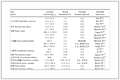
2 实例分析表 1示出了某些地震区ΔM和γ值,可看出理论值相当接近于实际值,下面将进行具体分析.
|
表 1 某些地震区ΔM与γ值 Table 1 The values of ΔM and γ in some seismic zones |

图 2示出了该地震区当前周期经误差修正后标志性地震事件之间的力学联系(秦四清等,2016a),可看出1962年5月21日格尔木东北MS 6.8级地震与1990年4月26日共和西南MS 7.0级地震,分别为该地震区第2锁固段在膨胀点和峰值强度点发生的标志性地震事件.1990年MS 7.0级地震断层破裂长度为60 km(涂德龙,1992),根据郭增建等(1973)的公式计算得1962年MS 6.8级地震断层破裂长度为46 km,则实际值γ=0.77.当ΔM=0.2时,由式(3) 计算得理论值γ=0.8.

|
图 2 格尔木地震区318.5.26 -2015.11.21之间CBS值与时间关系 (数据分析时选取MS≥5.0级地震事件;误差修正已被考虑) Figure 2 Temporal distribution of CBS in the period from 26 May 318 to 21 November 2015 for the Golmud seismic zone (The earthquake events with MS≥5.0 are selected for data analysis. The error correction is also considered) |
图 3示出了该地震区当前周期经误差修正后标志性地震事件之间的力学联系(秦四清等,2016a),可看出180年甘肃高台西MS 7.5级地震与1927年5月23日古浪MS 8.0级地震,分别为该地震区第1锁固段在膨胀点和峰值强度点发生的标志性地震事件,根据郭增建等(1973)的公式计算得180年MS 7.5级地震断层破裂长度为89 km,1927年MS 8.0级地震断层破裂长度为145 km(周俊喜等,1986;杨天锡等,1991),则实际值γ=0.61.当ΔM=0.5时,由式(3) 计算得理论值γ=0.56.1927年MS 8.0级地震与1932年12月25日昌马MS 7.8级地震,分别为该地震区第2锁固段在膨胀点和峰值强度点发生的标志性地震事件.1932年MS 7.8级地震破裂长度为116 km(时振梁等,1974;周俊喜和张生源,1981),则实际值γ=0.8.当ΔM=0.2时,由式(3) 计算得理论值γ=0.8.

|
图 3 古浪地震区180-2015.11.21之间CBS值与时间关系 (数据分析时选取MS≥5.5级地震事件;误差修正已被考虑) Figure 3 Temporal distribution of CBS in the period from 180 to 21 November 2015 for the Gulang seismic zone (The earthquake events with MS≥5.5 are selected for data analysis. The error correction is also considered) |
图 4示出了该地震区当前周期经误差修正后标志性地震事件之间的力学联系(秦四清等,2016b),可看出1870年4月11日巴塘MS 7.3级地震与1948年5月25日理塘MS 7.3级地震,分别为该地震区第1锁固段在膨胀点和峰值强度点发生的标志性地震事件.1870年MS 7.3级地震断层破裂长度为115 km(四川省地震局地震地质队, 1988a),1948年MS 7.3级地震断层破裂长度为120 km(四川省地震局地震地质队, 1988b),则实际值γ=0.96.当ΔM=0时,由式(3) 计算得理论值γ=1.

|
图 4 得荣地震区1128-2015.11.21之间CBS值与时间关系 数据分析时选取MS≥5.75级地震事件;误差修正已被考虑) Figure 4 Temporal distribution of CBS in the period from 1128 to 21 November 2015 for the Derong seismic zone (The earthquake events with MS≥5.75 are selected for data analysis. The error correction is also considered) |
图 5示出了该地震区当前周期经误差修正后标志性地震事件之间的力学联系(秦四清等,2016a),可看出1937年1月7日青海玛多MS 7.8级地震与2008年5月12日汶川MS 8.1地震,分别为该地震区第2锁固段在膨胀点和峰值强度点发生的标志性地震事件.1937年MS 7.8级地震断层破裂长度为180 km(李祥根,2009),2008年MS 8.1级地震断层破裂长度为240 km(李祥根,2009),则实际值γ=0.67.当ΔM=0.3时,由式(3) 计算得理论值γ=0.7.

|
图 5 汶川地震区638.2.14 -2015.11.21之间CBS值与时间关系 (数据分析时选取MS≥5.5级地震事件;误差修正已被考虑) Figure 5 Temporal distribution of CBS in the period from 14 February 638 to 21 November 2015 for the Wenchuan seismic zone (The earthquake events with MS≥5.5 are selected for data analysis. The error correction is also considered) |
由上述分析知,理论计算结果与实际情况较为吻合,据式(3) 可预测未来标志性地震事件的断层破裂长度.表 2示出了对上述地震区未来标志性地震事件断层破裂长度的预测.显然,根据预测的断层破裂长度并考虑地震区的地震构造特征与地震活动性,可判断未来标志性地震事件可能的发震断层,为预测未来发震断层提供参考.
|
|
表 2 上述地震区未来标志性地震事件断层破裂长度预测值 Table 2 The predicted values of fault rupture length for the characteristic earthquake events which will occur in the above-mentioned seismic zones |

本文基于孕震断层多锁固段脆性破裂理论及地震事件量级匹配原则,建立了标志性地震事件的断层破裂长度预测模型,据此可预测未来标志性地震事件的发震断层破裂长度,可为某地震区未来具体发震断层预测提供参考.
致谢 感谢国家自然科学基金资助项目(编号:41572311, 41302233) 对研究工作的资金支持.| [] | Bai L X, Wen X Z. 1994. Seismic potential of long-term strong shock on the Maowen-Wenchuan segment of the Longmenshan fault zone[J]. Earthquake research in Sichuan(3): 51–58. |
| [] | Deng Q D, Ran Y K, Yang X P, et al. 2007. Map of active tectonics in China[M]. Beijing: Seismological Press. |
| [] | Guo Z J, Qin B Y, Xu W Y, et al. 1973. Preliminary study on a modle for the development of the focus of an earthquake[J]. Chinese Journal of Geophysics, 16: 43–48. |
| [] | He H L, Sun Z M, Wang S Y, et al. 2008. Rupture of the MS 8.0 Wenchuan earthquake[J]. Seismology and Geology, 30(2): 359–362. |
| [] | He P C, Shen Z K. 2014. Rupture triggering process of Wenchuan earthquake seismogenic faults[J]. Chinese Journal of Geophysics, 57(10): 3308–3317. DOI:10.6038/cjg20141018 |
| [] | Hou K M, Deng Q D, Liu B C. 1999. Research on tectonic environment and seismogenic mechanism of 1927 Gulang great earthquake[J]. Earthquake Research in China, 15(4): 339–348. |
| [] | Jiang D C. 1995. Research on the seismicity features along the Longmenshan seismic belt[J]. Earthquake research in Sichuan(4): 10–18. |
| [] | Li C Y, Song F M, Ran Y K. 2004. Late Quaternary activity and age constraint of the northern Longmenshan fault zone[J]. Seismology and Geology, 26(2): 248–258. |
| [] | Li D W. 2008. Mechanism and prediction of the Intraplate earthquakes: an example from Wenchuan earthquake in Sichuan province[J]. Geological science and technology information, 27(5): 1–6. |
| [] | Li T T. 1997. The Xianshuihe fault zone and assessment of strong earthquake risk[M]. Sichuan: Science and Technology Press of Sichuan. |
| [] | Li X G. 2009. Seismic tectonic movement in China[M]. Beijing: Seismological Press. |
| [] | Ma B Q, Zhang S M, Tian Q J, et al. 2008. The surface rupture of Wenchuan earthquake (M 8.0)[J]. Quaternary Sciences, 28(4): 513–517. |
| [] | Mogi K. 1987. The relation between the duration of long term precursors and magnitude of subsequent earthquake[J]. Tectonophysics, 142(2-4): 163–172. DOI:10.1016/0040-1951(87)90121-1 |
| [] | Qian H, Allen C R, Luo Z L, et al. 1988. The active characteristics of Xianshuihe fault in Holocene[J]. Earthquake research in China, 4(2): 9–18. |
| [] | Qin S Q, Wang Y Y, Ma P. 2010a. Exponential laws of critical displacement evolution for landslides and avalanches[J]. Chinese Journal of Rock Mechanics and Engineering, 29(5): 873–880. |
| [] | Qin S Q, Xu X W, Hu P, et al. 2010b. Brittle failure mechanism of multiple locked patches in a seismogenic fault system and exploration on a new way for earthquake prediction[J]. Chinese Journal of Geophysics, 53(4): 1001–1014. DOI:10.3969/j.issn.0001-5733.2010.04.025 |
| [] | Qin S Q, Yang B C, Wu X W, et al. 2016a. The identification of mainshock events for some seismic zones in mainland China (Ⅱ)[J]. Progress in Geophysics, 31(1): 115–142. DOI:10.6038/pg20160114 |
| [] | Qin S Q, Yang B C, Xue L, et al. 2016b. The identification of mainshock events for main seismic zones in the Eurasian seismic belt[J]. Progress in Geophysics, 31(2): 559–573. DOI:10.6038/pg20160208 |
| [] | Shen J W, Qiu Y, Zhao Z H. 1990. Rupture length magnitude relationship and fault-rupture model[J]. Chinese Journal of Geophysics, 33(2): 242–248. |
| [] | Shi Z L, Huan W L, Yao G G, et al. 1974. On the fractal zones of Changma earthquake of 1932 and their causes[J]. Chinese Journal of Geophysics, 17(4): 272–287. |
| [] | Seismogeological Team of Sichuan Seismological Bureau. 1988a. 1870 Batang M 7.2 earthquake[J]. Earthquake Research in Sichuan(4): 1–10. |
| [] | Seismogeological Team of Sichuan Seismological Bureau. 1988b. 1948 Litang M 7.3 earthquake[J]. Earthquake Research in Sichuan(4): 26–31+56. |
| [] | Tang R C, Wen D H, Huang Z Z, et al. 1991. The Quaternary activity characteristics of several major active faults in the Songpan-Longmenshan region[J]. Earthquake research in China, 7(3): 64–71. |
| [] | Tang W Q, Zhang Q Z, Liu Y P, et al. 2012. Active faulting along the Longmenshan fault zone after the 8.0 magnitude Wenchuan earthquake in Sichuan[J]. Sedimentary Geology and Tethyan Geology, 32(4): 106–110. |
| [] | Tu D L. 1992. The study on the structural environment and seismogenesis of the Gonghe earthquake 6.9 on April, 26, 1990[J]. Earthquake Research in Plateau, 4(3): 15–22. |
| [] | Wang P, Fu B H, Zhang B, et al. 2009. Relationships between surface ruptures and lithologic characteristics of the Wenchuan MS 8.0 earthquake[J]. Chinese Journal of Geophysics, 52(1): 131–139. |
| [] | Wu M L, Zhang Y Q, Liao C T, et al. 2010. Preliminary results of in-situ stress measurements along the Longmenshan fault zone after the Wenchuan MS 8.0 earthquake[J]. Acta Geologica Sinica, 84(9): 1292–1299. |
| [] | Wyss M, Brune J N. 1968. Seismic moment, stress and source dimensions for earthquakes in the California-Nevada region[J]. Journal of Geophysical Research, 73(14): 4681–4694. DOI:10.1029/JB073i014p04681 |
| [] | Xiong T Y, Yao X, Zhang Y S. 2010. A review on study of activity of Xianshuihe fault zone since the Holocene[J]. Journal of Geomechanics, 16(2): 176–188. |
| [] | Xu X W, Wen X Z, Ye J Q, et al. 2008. The MS 8.0 Wenchuan earthquake surface rupture and its seismogenic structure[J]. Seismology and Geology, 30(3): 597–629. |
| [] | Yang T X, Liu B C, Yao J Y, et al. 1991. Intensity distribution and seismic characteristics of Gulang earthquake with M=8 on May 23, 1927[J]. Northeastern seismological research, 7(1): 59–67. |
| [] | Yi G X, Wen X Z, Wang S W, et al. 2006. Study on fault sliding behaviors and strong-earthquake risk of the Longmenshan-Minshan fault zones from current seismicity parameters[J]. Earthquake Research in China, 22(2): 117–125. |
| [] | Yu T, Cao Y J. 1999. A discussion on stability of the Longmenshan structural belt[J]. Journal of Sichuan Geology, 19(2): 106–110. |
| [] | Zhou J X, Yang T X, Yao J Y, et al. 1986. The fracture belt of Gulang earthquake on May, 23 in 1927 in Gansu province[J]. Northwest seismological journal, 8(3): 114–115. |
| [] | Zhou Q, Xu X W, Yu G H, et al. 2008. Investigation on widths of surface rupture zones of the M 8.0 Wenchaun earthquake, Sichuan province, China[J]. Seismology and Geology, 30(3): 778–788. |
| [] | Zhou R J, He Y L, Huang Z Z, et al. 2001. The slip rate and strong earthquake recurrence interval on the Qianning-Kangding segment of the Xianshuihe fault zone[J]. Acta seismologica sinica, 23(3): 22–29. |
| [] | Zhou Y Y, Su J Y, Wang G J. 1986. Method of estimating the fault rupture length and attenuation rule according to the shape of the intensity line[A](in Chinese), The Third national earthquake science academic conference paper by the Chinese society of earthquake[C]. |
| [] | 白兰香, 闻学泽. 1994. 龙门山断裂带茂汶-汶川段的长期强震潜势[J].四川地震(3): 51–58. |
| [] | 邓起东, 冉勇康, 杨晓平, 等. 2007. 中国活动构造图[M]. 北京: 地震出版社. |
| [] | 郭增建, 秦保燕, 徐文耀, 等. 1973. 震源孕育模式的初步讨论[J].地球物理学报, 16: 43–48. |
| [] | 何宏林, 孙昭民, 王世元, 等. 2008. 汶川MS 8.0地震地表破裂带[J].地震地质, 30(2): 359–362. |
| [] | 贺鹏超, 沈正康. 2014. 汶川地震发震断层破裂触发过程[J].地球物理学报, 57(10): 3308–3317. DOI:10.6038/cjg20141018 |
| [] | 侯康明, 邓起东, 刘百篪. 1999. 对古浪8级大震孕育和发生的构造环境及发震模型的讨论[J].中国地震, 15(4): 339–348. |
| [] | 江道崇. 1995. 龙门山地震带地震活动特征的研究[J].四川地震(4): 10–18. |
| [] | 李传友, 宋方敏, 冉勇康. 2004. 龙门山断裂带北段晚第四纪活动性讨论[J].地震地质, 26(2): 248–258. |
| [] | 李德威. 2008. 大陆板内地震的发震机理与地震预报:以汶川地震为例[J].地质科技情报, 27(5): 1–6. |
| [] | 李天祒. 1997. 鲜水河断裂带及强震危险性评估[M]. 四川: 四川科学技术出版社. |
| [] | 李祥根. 2009. 中国地震构造运动[M]. 北京: 地震出版社. |
| [] | 马保起, 张世民, 田勤俭, 等. 2008. 汶川8.0级地震地表破裂带[J].第四纪研究, 28(4): 513–517. |
| [] | 钱洪, C. R.艾伦, 罗灼礼, 等. 1988. 全新世以来鲜水河断裂的活动特征[J].中国地震, 4(2): 9–18. |
| [] | 秦四清, 王媛媛, 马平. 2010a. 崩滑灾害临界位移演化的指数律[J].岩石力学与工程学报, 29(5): 873–880. |
| [] | 秦四清, 徐锡伟, 胡平, 等. 2010b. 孕震断层的多锁固段脆性破裂机制与地震预测新方法的探索[J].地球物理学报, 53(4): 1001–1014. DOI:10.3969/j.issn.0001-5733.2010.04.025 |
| [] | 秦四清, 杨百存, 吴晓娲, 等. 2016a. 中国大陆某些地震区主震事件判识(Ⅱ)[J].地球物理学进展, 31(1): 115–142. DOI:10.6038/pg20160114 |
| [] | 秦四清, 杨百存, 薛雷, 等. 2016b. 欧亚地震带主要地震区主震事件判识[J].地球物理学进展, 31(2): 559–573. DOI:10.6038/pg20160208 |
| [] | 沈建文, 邱瑛, 赵志贺. 1990. 震级-破裂长度关系与断层破裂模型[J].地球物理学报, 33(2): 242–248. |
| [] | 时振梁, 环文林, 姚国干, 等. 1974. 1932年昌马地震破裂带及其形成原因的初步探讨[J].地球物理学报, 17(4): 272–287. |
| [] | 四川省地震局地震地质队. 1988a. 1870年巴塘7.2级地震[J].四川地震(4): 1–10. |
| [] | 四川省地震局地震地质队. 1988b. 1948年理塘7.3级地震[J].四川地震(4): 26–31+56. |
| [] | 唐荣昌, 文德华, 黄祖智, 等. 1991. 松潘-龙门山地区主要活动断裂带第四纪活动特征[J].中国地震, 7(3): 64–71. |
| [] | 唐文清, 张清志, 刘宇平, 等. 2012. 汶川地震后龙门山断裂带活动特征[J].沉积与特提斯地质, 32(4): 106–110. |
| [] | 涂德龙. 1992. 1990年4月26日共和6.9级地震构造环境及形成原因[J].高原地震, 4(3): 15–22. |
| [] | 王萍, 付碧红, 张斌, 等. 2009. 汶川8.0级地震地表破裂带与岩性关系[J].地球物理学报, 52(1): 131–139. |
| [] | 吴满路, 张岳桥, 廖椿庭, 等. 2010. 汶川地震后沿龙门山断裂带原地应力测量初步结果[J].地质学报, 84(9): 1292–1299. |
| [] | 熊探宇, 姚鑫, 张永双. 2010. 鲜水河断裂带全新世活动性研究进展综述[J].地质力学学报, 16(2): 176–188. |
| [] | 徐锡伟, 闻学泽, 叶建清, 等. 2008. 汶川MS 8.0地震地表破裂带及其发震构造[J].地震地质, 30(3): 597–629. |
| [] | 杨天锡, 刘百篪, 姚俊仪, 等. 1991. 1927年5月23日古浪8级地震烈度分布及地震特征[J].东北地震研究, 7(1): 59–67. |
| [] | 易桂喜, 闻学泽, 王思维, 等. 2006. 由地震活动参数分析龙门山-岷山断裂带的现今活动习性与强震危险性[J].中国地震, 22(2): 117–125. |
| [] | 余团, 曹运江. 1999. 龙门山构造带稳定性探讨[J].四川地质学报, 19(2): 106–110. |
| [] | 周俊喜, 杨天锡, 姚俊仪, 等. 1986. 1927年5月23日甘肃古浪8级地震破裂带的发现[J].西北地震学报, 8(3): 114–115. |
| [] | 周庆, 徐锡伟, 于贵华, 等. 2008. 汶川8.0级地震地表破裂带宽度调查[J].地震地质, 30(3): 778–788. |
| [] | 周荣军, 何玉林, 黄祖智, 等. 2001. 鲜水河断裂带乾宁-康定段的滑动速率与强震复发间隔[J].地震学报, 23(3): 22–29. |
| [] | 周钖元, 苏经宇, 王广军. 1986. 根据等烈度线形状估计断层破裂长度和衰减规律的方法[A]. 中国地震学会第三次全国地震科学学术讨论会论文摘要[C]. |