 2016, Vol. 31


2. 中国地震局地球物理研究所, 北京 100081
2. ake science, China Earthquake Administration, Beijing 100036, China
云南盈江地区位于青藏高原东南边缘,东与川滇块体相接,西北与印度板块相邻,印度板块向东的俯冲带的回卷(trench roll back)给缅甸和云南西部带来了东西向的拉张力(Guzman-Spezidale and Ni,1996;Royden et al.,2008).这些特征反映了这一区域的现代构造应力场特征与其相邻地区明显不同,构造部位所遭受的动力作用过程较为复杂,从而导致强震活动频繁,曾在2008年与2011年发生过两次强震,分别为2008年8月21日MS 5.9、2011年3月10日MS 5.8.研究该区现代构造应力场特征,对揭示青藏高原的演化机制和认识该地区断裂活动与强震孕育环境关系具有重要意义(谢富仁等,2001).
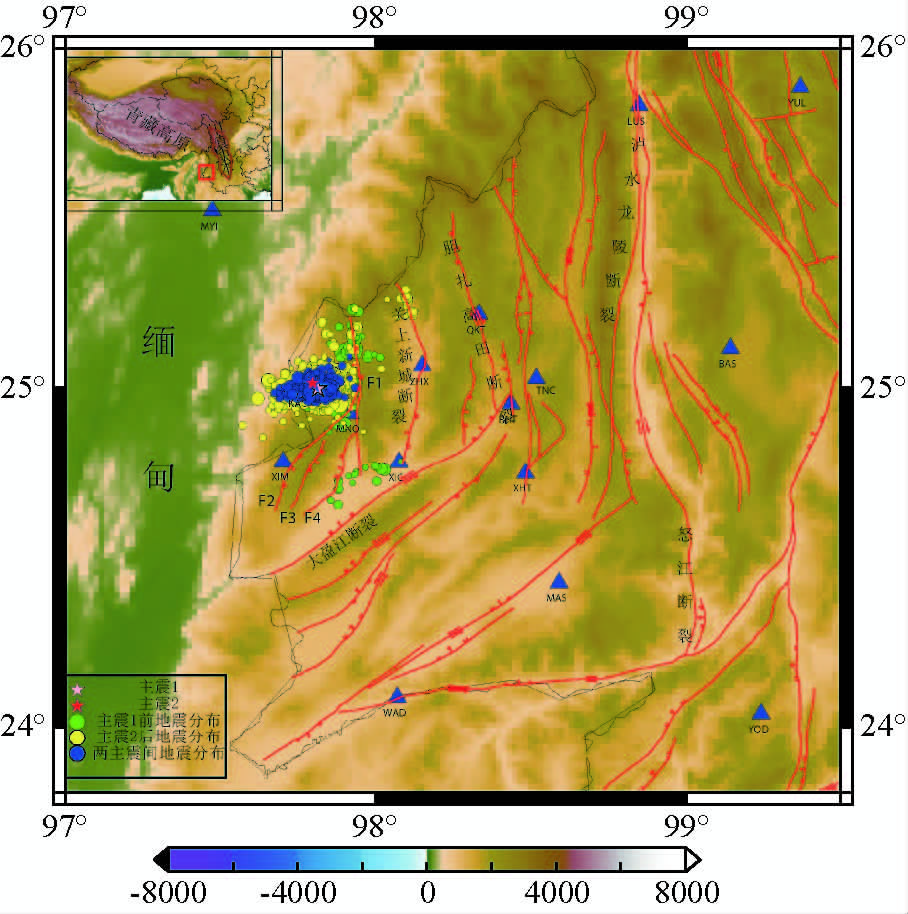
从现象上看,该地区发生的地震震中常位于盆地内部,深度浅,距人口密集区较近,破坏及其严重(房立华等,2012).本文的研究对象是盈江地区2014年发生的两次地震(以下称盈江双震),分别是发生在5月24日的MS 5.6级地震(主震1)和发生在5月30日的MS 6.1级地震(主震2),盈江双震伴随有大量余震发生(许力生等,2014),主要分布在大盈江断裂的北侧(如图 1所示).
|
图 1 双差定位后地震的时空分布规律及区域内主要断裂分布 红色和粉色五角星代表主震1、2的位置,绿色、黄色、蓝色圆形分别代表主震1之前、主震2之后、两主震之间的地震分布.F1:苏典-盈江断裂; F2:勐弄-大石坡断裂; F3: 尖峰山-龙盆断裂; F4:小芒红断裂. Figure 1 Spatial distribution of earthquakes after relocation and the main faults in Yingjiang area Red and pink pentagram represent main shock 1 and 2,green, blue and yellow circles represent earthquakes distribution before main shock 1,after main shock2 and between two main shocks. |
获取孕震层深度地壳介质的动态变化,一直是地震学家追求的目标.地壳介质弹性参数(地震波速、衰减特性、各向异性等)及其变化与介质的物性和应力应变相关,可推测地下介质的动态变化(Birch,1960; Scholz,1968;Gao et al.,1998;Gao and Crampin,2003).早期一些研究表明,大地震前后尾波Q值(Jin and Aki,1986),各向异性(Crampin et al.,1990)等弹性参数存在明显变化(大于10%),然而天然地震震源位置的不确定和仪器误差等极大地影响了这些结果的可靠性.近期的人工可控震源研究表明地震前后地下介质的物性变化非常微弱,远小于10%(Vidale and Li,2003;Crampin et al.,2003).尾波干涉分析方法(Snieder,2003)基于尾波的多次散射特性,能够提取介质的微小变化.地震波干涉研究表明,利用相近台站记录到的发生在同一位置的重复地震波形记录,通过尾波干涉分析可以研究地震前后地下介质弹性参数的细微变化(Schaff and Beroza,2004;Peng and Ben-Zion,2006).大地震前后地下介质的动态变化一定程度上反映了地震的孕育与演化规律,与应力状态变化有关(Gao and Crampin,2008).因此,获取盈江双震期间地壳介质的变化信息,有助于更好地了解该区域强震发生时伴随的地壳介质性质变化和应力状态的变化,从而为青藏高原的地壳形变模式和构造演化规律提供基础参考资料.
本文首先利用盈江地区的震相观测报告,采用双差定位方法(Waldhauser and Ellsworth,2000)对地震进行重新定位,然后利用云南区域台网记录的地震波形资料采用波形互相关的方法寻找该区域满足条件的重复地震,最后利用尾波干涉方法探讨地下介质随时间的变化信息.
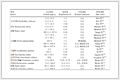
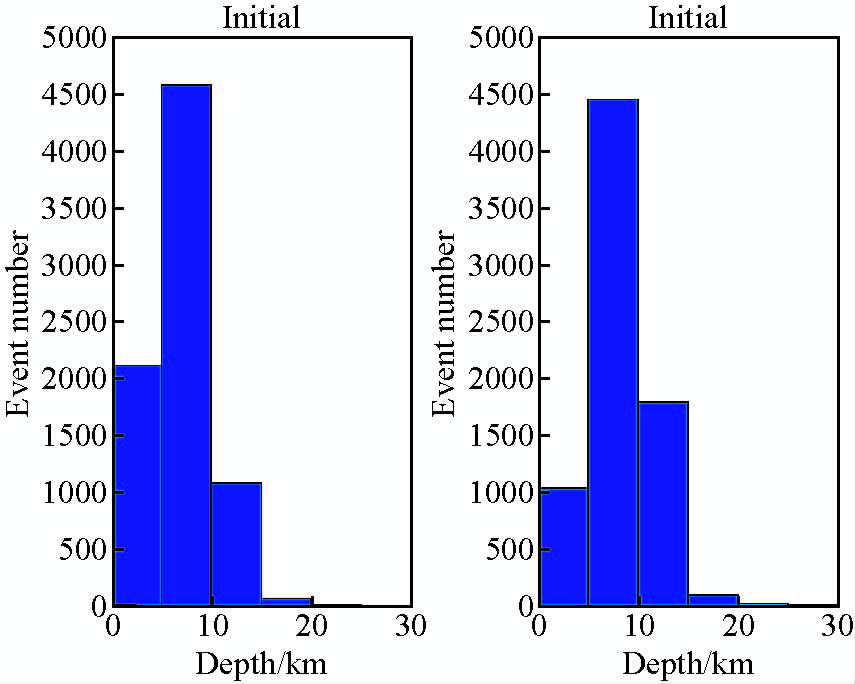
1 双差定位相比基于人工主动源探测(Wang et al.,2008; Niu et al.,2008)和背景噪声格林函数(Sens-Schönfelder and Wegler,2006; Wegler et al.,2006; Stehly et al.,2008)的尾波干涉方法,利用重复地震通过尾波干涉方法研究地壳介质变化不需要耗费大量的财力与物力,且穿透深度可观,更适合用来研究孕震层介质的相关变化(Niu et al.,2003).然而,天然地震定位的不确定性会影响重复地震尾波干涉的结果.为了获取更精确的震源位置,选用由中国地震台网中心提供的2013.01-2014.11云南盈江区域内发生地震(共计10228个)的震相报告数据,利用双差定位程序hypoDD,对满足条件的7818个地震采用LSQR方法迭代6次进行重新定位,其中速度模型采用胡鸿翔等(1986)和张中杰等(2005)的人工地震测深结果作为分层速度模型,主要参数设置如表 1所示,Vp/Vs设定为1.76(房立华等,2012).重新定位后地震(共计7398个)呈现明显的时空分布特征(图 1),大部分地震位于苏典-盈江断裂的西侧和勐弄-大石坡断裂的西北侧,5月24日MS 5.6级地震(主震1)之前,地震主要集中在小芒红断裂的东侧和苏典-盈江断裂的北端,5月24日和5月30日两个主震(主震1和主震2)发生的时间段之间,区域内的地震分布非常集中,并以两个主震位置为中心,5月30日MS 6.1级地震(主震2)之后,地震分布逐渐向西南和东北扩散.双差定位前后地震的深度分布有明显变化,如图二所示,其中双差定位后0~5 KM深度范围内地震数目及所占比率显著减小,10~15 KM深度范围内地震数目和所占比例均明显增多,如表 2所示.
|
表 1 双差定位所采用的速度模型 Table 1 The velocity model used in hypoDD |
|
|
表 2 双差定位前后不同深度范围内的地震数目以及所占比率 Table 2 The number and proportion of earthquakes in different depth range after earthquake relocation |
Rubin(2002)将发生在同一断层同一位置上的一组地震群定义为重复地震,现阶段地震学家普遍认为重复地震的发生由断层内分布的凹凸体在稳定蠕滑加载下发生的重复破裂所引起(Nadeau et al.,1995),可以用来研究断层的滑移速率(Nadeau and McEvilly,1999;李乐等,2013).由于大地震的破裂长度较大,原地再次发送重复破裂的可能性不大,因此重复地震震级较小,一般在3级以下(王伟涛和王宝善,2011).重复地震的震源性质和传播路径基本一致,因此其在同一台站记录的地震图极其相似,同一组重复地震内的波形差异认为是由于介质的变化所引起,因此利用重复地震可以研究地壳介质的波速变化.此外,重复地震也可以用来估算地震台网的定位精度(蒋长胜等,2008).
为了消除噪声和仪器误差等其他干扰,首先对所有事件波形进行去均值,去线性趋势,1~20 Hz带通滤波处理,以便突出直达波和尾波的相关信息.随后选取垂直分量,通过计算波形互相关的方法来挑选重复地震,具体操作如下.
(1) 计算任意两个地震波形在同一台站的互相关,计算起点为P波到时前1 s,计算长度与台站至主震的距离成正比.
(2) 找出至少在多个台站满足相关系数大于等于0.95的地震群事件作为相似地震.
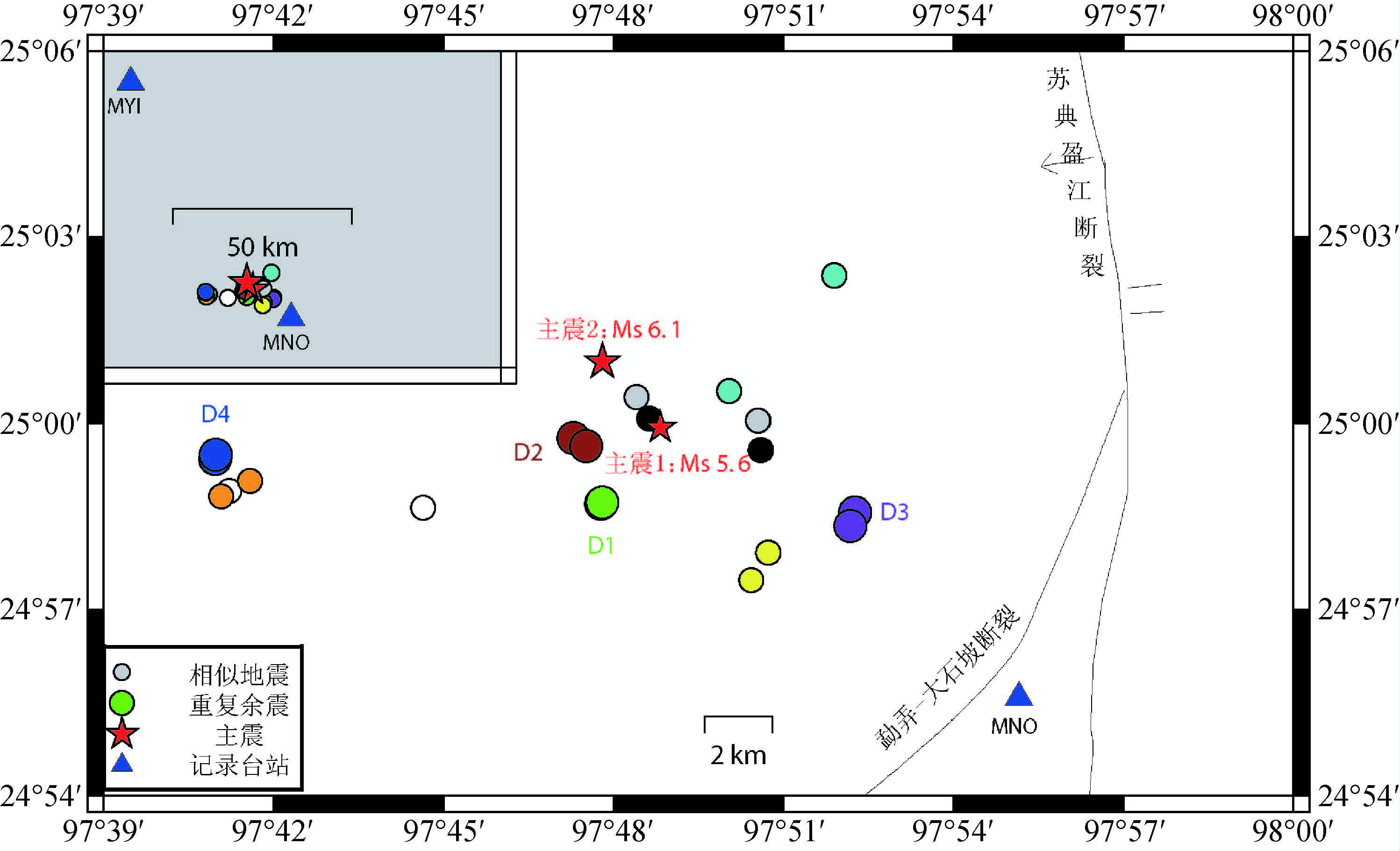
(3) 结合双差定位结果,挑选重复地震.如图 3所示,对于MNO台站,共有10组相似地震(半径较小的圆),其中4组满足重复地震(半径较大的圆)的条件.
|
图 2 双差定位前后地震深度分布直方图 0 ~5 km深度范围内地震数目及所占比例明显减小,10~15 km深度范围内地震数目及所占比例明显增多. Figure 2 Depth histograms of earthquakes before and after relocation Number and proportion of earthquakes decreased in depth range 0~5 km and increased in depth range 10~15 km. |
|
图 3 台站MNO和MYI记录的相似地震和重复地震 同一颜色的圆代表一组相似地震,半径较大的圆为满足条件的重复地震,红色五角星为两个主震的发震位置. Figure 3 Similar earthquakes and repeating earthquakes recorded by MNO and MYI station The same circles represent earthquakes in one similar earthquakes,circles with large radius are the repeating earthquakes which satisfy the conditions,pentagrams in red represent two main shock. |
通过帅选后,满足条件的共有4对重复地震对,均为2014云南盈江双震的余震序列(发震时间均在主震1之后),由MYI与MNO两个台站记录,分别编号为重复地震D1、D2、D3、D4,其具体位置分布如图 3所示.与其他区域研究结果(Peng et al.,2005;Li et al.,2007)不同,该区域并未发现地震事件个数大于2的重复地震群,均为重复地震对事件(Poupinet,1984),且重复地震的复发间隔较短,其中时间间隔最短的为28 min,其相关信息如表 3所示.以上结果或许与部分台站的监测时间起始于主震1后(如MNO台站的监测时间起始于2014年05月25日09:00)有关,也有可能是因为此次双震序列能量较大,相关断层的蠕滑区结构遭受破坏,因而包含事件多的重复地震较少.
|
|
表 3 盈江地震序列中余震的重复地震对 Table 3 Relevant information of repeating earthquakes |
尾波是地震波在地球介质中经过多次散射的结果,对介质有更多的重复采样,从而对介质性质的微小变化更敏感,直达波不能识别的介质微小变化,尾波却可以识别.尾波干涉方法基于这种特性,能够提取震源位置与介质的细微变化,在地震活动、火山喷发、工程应力无损检测、冰川活动等研究领域中都有着很广泛的应用(肖卓和高原,2015),因此试图通过重复地震利用尾波干涉原理研究2014盈江双震及其余震期间地下介质的细微变化.
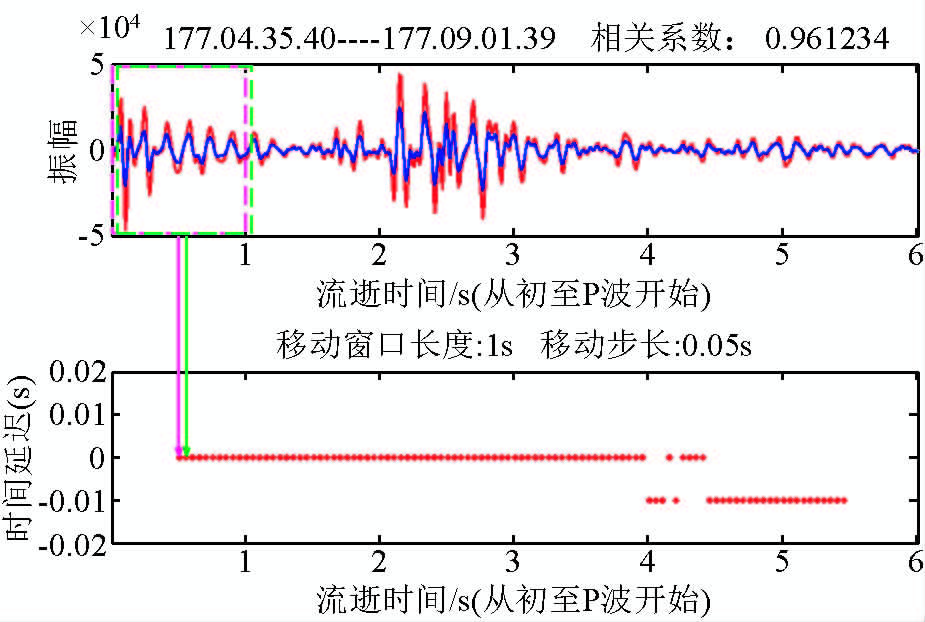
本文采用移动窗口互相关法(Niu et al.,2003;Schaff and Beroza,2004),将发震较早的重复地震当作参考地震,从初至P波到时开始对重复地震对进行尾波干涉分析,尽管这会损失直达P波的走时延迟变化信息,且有可能会减小S波或S波尾波的走时延迟变化,但却能有效减少仪器的计时误差(Rubinstein and Beroza,2004).如图 4所示,其中紫红色矩形框为第一个时间窗口(0~1 s),求出该时间窗口内的走时延迟,将其视为该窗口中心时间(0.5 s)的走时延迟,然后选取一定步长(图 4中步长为0.05 s)移动时间窗口计算走时延迟,图 4中绿色矩形框(0.05~1.05 s)为计算的第二个时间窗口,依此类推即可得走时延迟随流逝时间的变化.因为数据的原始采样率为100 Hz,即可获得的两列波形的走时延迟最小为0.01 s(如果存在),无法识别大于0 s却又小于0.01 s的走时延迟,如图 4b所示,因为波形的高度相似,移动窗口内的走时延迟很有可能小于0.01 s,因此对波形内插的方法提升采样至10000 Hz(Peng and Ben-Zion,2006),以便获取更小的走时延迟.以MNO台站记录到的第四组重复地震为例,如图 8b所示,与原始采样相比,重采样后尾波干涉效果更为明显.经过大量的测试,选取合适的移动窗口长度与移动步长,对重复地震对进行尾波干涉测量,走时延迟计算结果的标准差下限满足Cramer-Rao Lower Bound法则(Quazi,1981;Carter,1987),如公式(1)所示,其中f0为信号主频,B为信号的频宽与主频之比,ρ为两信号的相关性,SNR为信噪比,T为窗口长度,其中f0和B由波形数据控制,因为尾波干涉原理基于路径叠加原理,同一窗口内到达的波的传播路径大致相同,所以窗口长度T不能太长.故测量误差主要取决于信噪比与互相关系数,因选取信噪比及互相关系数较高的尾波段进行尾波干涉测量.当走时延迟τ与流逝时间t(窗口中心时间)成线性变化时,表示介质速度存在变化(Snieder,2006),通过走时延迟的变化,即可求得介质的相对波速变化,公式为

|
(1) |

|
(2) |
|
图 4 移动窗口互相关方法计算两事件的走时延迟 上图为两事件(事件1:177.04.35 .40 ;事件2:177.09.01.39)从初至P波开始的波形对比,其中紫红色和绿色矩形框内分别为第一个和第二个移动时间窗口,两个窗口内两事件的走时延迟分别为紫红色和绿色箭头所示,箭头的起点为窗口的中心时间,即流逝时间;下图为两列波形每个移动窗口内的走时延迟分布,尽管走时延迟在尾波阶段有明显的减小,但因为采样率太低而无法获取0与0.01 s之间的走时延迟,因而不能反映其线性变化趋势,图 5~8中相关信息与此图类似,后文中不再赘述. Figure 4 Calculating time delay of two events by cross correlation using shift window The above figure is the waveform comparison begin with direct p arrival of two repeating earthquakes(event1:177.04.35.40 ;event2:177.09.01.39),the purple and green rectangle box represent the first and second moving window,their delay time are showed by the purple and green arrows,the beginning point of arrows are the center time of moving windowas well as lapsetime;The below figure is the delay time variations in each move window,although delay time has reduced in coda waves,we can’t obtain time delay that between 0 and 0.01 s as well as the linear variation of delay time due to the originally low sample. Some information in Fig. 7~10 are similar to this one,we do not explain any more. |
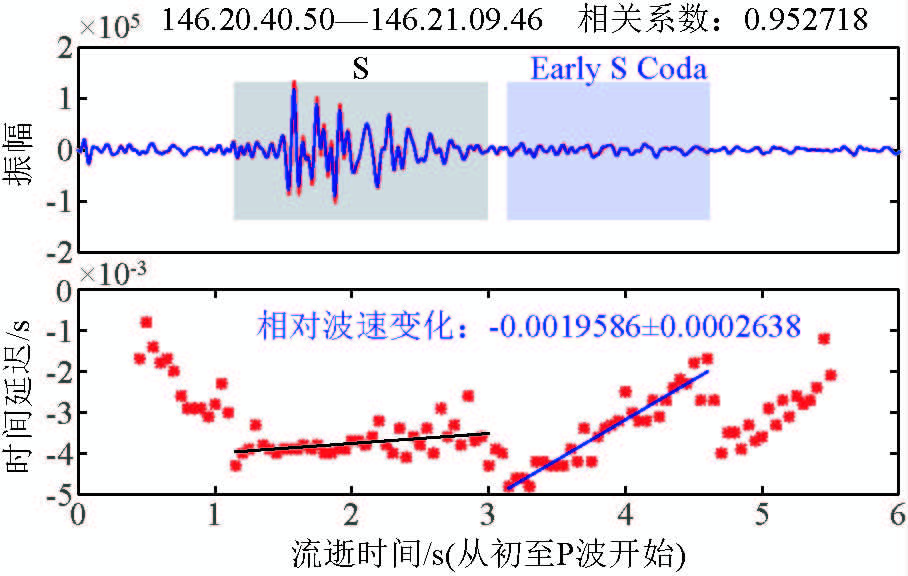
重复地震对D1发生在主震2之前3 d,两个地震事件的时间间隔仅为28 min,对于MNO台站,选取移动窗口长度为0.9 s,移动步长为0.05 s计算重复地震对的走时延迟变化(因为4对重复地震对距离MNO台站均较近,因此对于其他3个重复地震对,采用同样的移动窗口长度和移动步长参与计算),结果如图 5所示,在P波的后续部分(0.5~1.3 s),走时延迟有明显的减小,在S波振幅最大的区域(1.3~2.7 s),走时延迟变化比较稳定,随着时间的流逝,在S波后续尾波段(2.7~4.6 s),走时延迟明显增加,而在4.6~6 s的尾波范围内,走时延迟不再继续增加,呈先减小后增加的变化趋势,且增加的速率与S波后续尾波(3~4.5 s)大致相同.考虑到移动窗口内波形的信噪比、互相关系数和走时延迟的线性变化规律,选用S波后续尾波部分(3~4.5 s)按照公式(2)计算其相对波速变化,得到的波速变化约为1.96‰.而在距离该重复地震较远的MYI台站,走时延迟变化并不明显,其相对波速变化小于1×10⁻³.
|
图 5 重复地震对D1的走时延迟与流逝时间的变化在MNO台站的结果相对波速变化的误差由式一种的CRLB法则给出 Figure 5 Delay time variation as a function of lapse time of repeating earthquake D1 in MNO station Error of relative velocity variations is calculated by CRLB law |
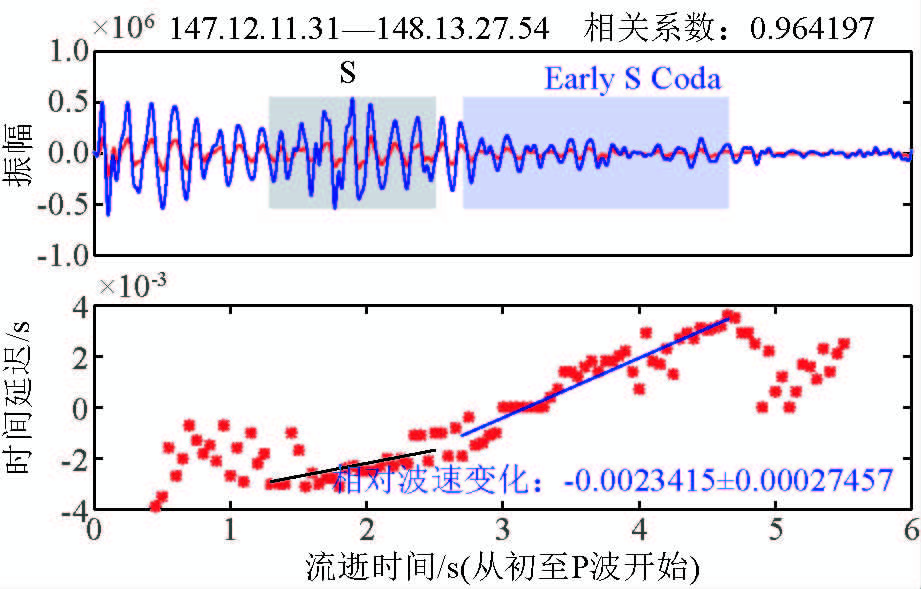
重复地震对D2同样发生在主震2之前,相比于重复地震D1,该地震对的发震时间稍晚,两个地震的时间间隔为25 h,此外在满足条件的4对重复地震中,重复地震对2与两个主震的发震位置距离最近,其在MNO台站的结果如图 6所示.尽管该重复地震对包含的两个地震事件震级略有差距,但其相关系数达到了0.96,在P波的后续部分(0~1.2 s),走时延迟分布较为复杂,走时延迟在S波及其尾波部分(1.2~4.8 s)有明显增加的趋势,且线性程度较好,可能意味着速度的降低,因此选取该部分数据计算相对波速变化,结果大约为2.25‰,在4.8~6 s的尾波范围内,走时延迟不再继续增加,呈先减小后上升的变化.而在远端的MNO台站同样没有发现走时延迟的明显变化.
|
图 6 重复地震对D2的走时延迟与流逝时间的变化在MNO台站的结果 Figure 6 Delay time variation as a function of lapse time of repeating earthquake D2 in MNO station |
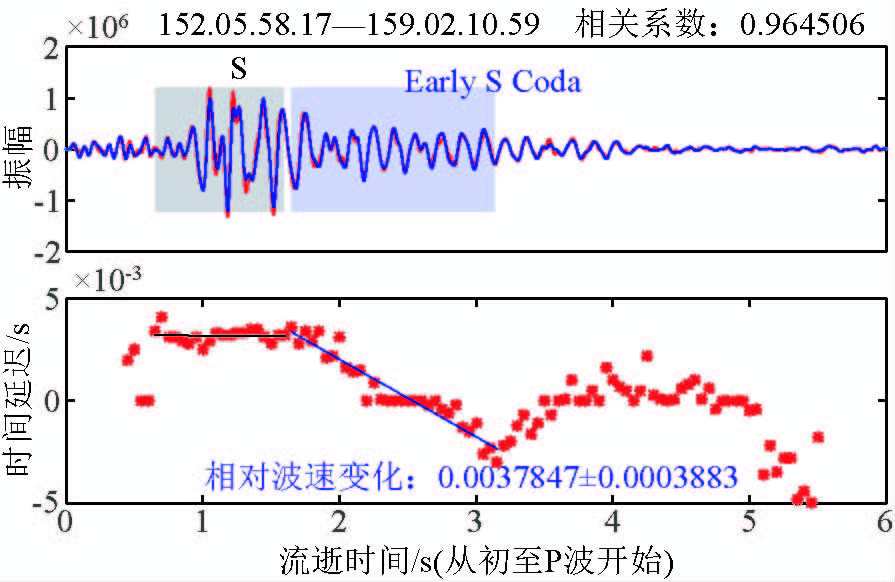
重复地震对D3分别发生在主震2后2 d与主震2后9 d,是所有重复地震中间隔时间最长的地震对,且其距离MNO台站最近.MNO台站的结果如图 7所示,结果显示在P波后续部分(0~0.8 s),走时延迟变化较为复杂,在S波振幅较大部分(0.8~1.6 s),走时延迟基本保持不变,而在S波后续的尾波部分(1.6~3.2 s),走时延迟明显减小,亦即地震波速的增加,选取该部分数据计算相对波速变化,结果约为3.78‰,在3.2~6 s的尾波部分,走时延迟不再继续降低,呈先增加后减小的变化趋势.而在远端的MYI台站依然未见任何明显变化.
|
图 7 重复地震对D3的走时延迟与流逝时间的变化在MNO台站的结果 Figure 7 Delay time variation as a function of lapse time of repeating earthquake D3 in MNO station |
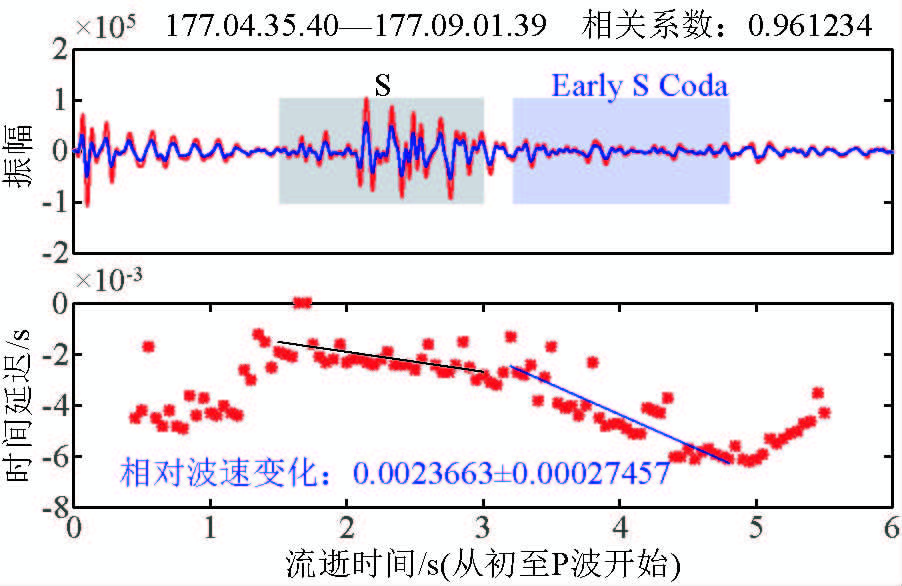
重复地震对D4的两个地震均发生于主震2后约一个月,2个地震的发震间隔约为4 h,是距离MNO台站最远的重复地震对,其在MNO台站的结果如图 8所示.结果显示在P波的后续部分(0.5~1.5 s),走时延迟逐渐增加,而在振幅较大的S波部分(1.5~3.2 s),走时延迟呈小幅度降低趋势,较为稳定,相比于S波(1.5~3.2 s),S波尾波部分(3.2~4.8 s)走时延迟降低的变化更为明显,可能代表地震波速的增加,选取该部分数据计算相对波速变化,结果约为2.37‰,而在5~6 s尾波部分,走时延迟不再减小,呈增加的变化趋势.与其他3个地震对类似,距离较远的MYI台站走时延迟并未出现明显变化.
|
图 8 重复地震对D4的走时延迟与流逝时间的变化在MNO台站的结果 Figure 8 Delay time variation as a function of lapse time of repeating earthquake D4 in MNO station |
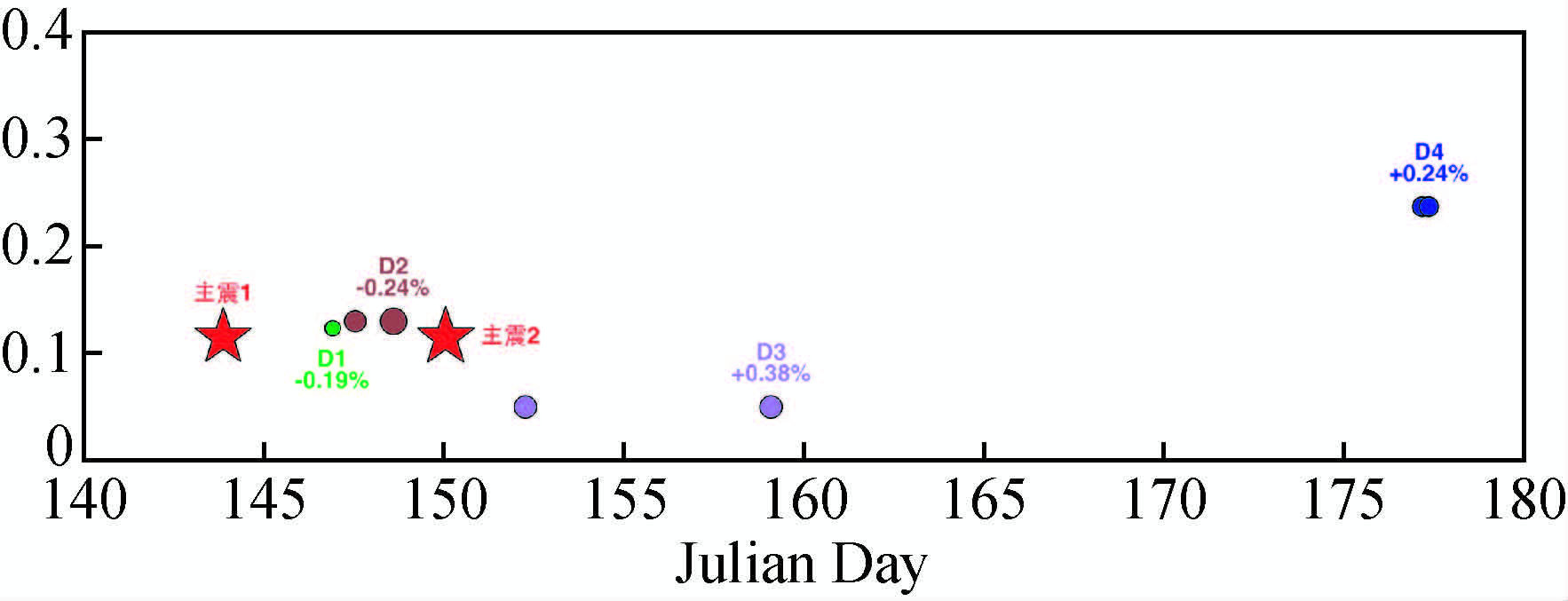
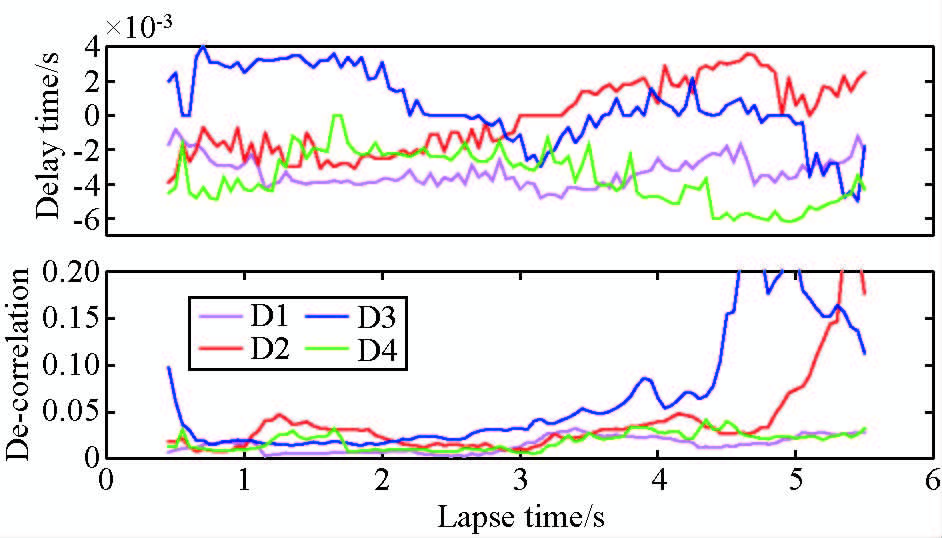
4组重复地震的时空分布(图 9)显示发震时间位于两主震之间的重复地震对(D1,D2)均存在波速降低的变化,发震时间位于两主震之后的重复地震对(D3,D4)结果均显示出波速增加的变化.4组重复地震走时延迟以及不相关系数的分布(图 10)则显示时间间隔较长的两组重复地震(D2,D3)的时间延迟变化较明显,不相关系数较大,且在尾波阶段(4~6 s)不相关系数明显增大,可能表示该时间段介质存在比较明显的变化.
|
图 9 4对重复地震及2次主震的时空分布 横坐标为从2014年1月1日开始计数的天数,纵坐标为重复地震对和主震的发震位置与MNO台站的距离,单位为度,其中红色五角星代表两次主震,相同颜色圆形代表一对重复地震.发震时间在两个主震之间的重复地震D1、D2呈现波速下降的变化,而发震时间在主震2之后的重复地震D3、D4呈现波速上升的变化,其中两事件时间跨度最大且距离MNO台站最近的重复地震D3波速变化最大,约为0.38%. Figure 9 Spatial and temporal distribution of 4 repeating doublets and 2 main shocks Horizontal axis is the Julian day counted from January 1,2014 and vertical axis is the distances between these events and MNO station. The two main shocks are plotted by red pentagrams and circles in the same color represent a repeating doublet. Repeating doublets D1 and D2 show velocity had decreased during the two main shocks and repeating doublets D3 and D4 show velocity had increased after the second main shock. The biggest variation of velocity(about 0.38%)was acquired by repeating doublets D3 which has longest interval time and minimum epicenter distance. |
|
图 10 4对重复地震的走时延迟和不相关系数变化 Figure 10 Variations of delay time and De-correlation |
本文利用云南盈江地区内的重复地震,研究大地震前后该区域地壳介质的相关变化.为了更精确的获取震源位置,首先利用双差定位对该区域内的地震进行重新定位,随后基于波形互相关计算方法并结合双差定位结果,找到了发震时间在主震1之后的4组重复地震,该区域的重复地震均为地震对事件,且重复地震的发震间隔较短.利用尾波干涉原理,通过移动窗口互相关方法计算了重复地震对之间的走时延迟变化.
4.2结果显示,在距离主震较近的MNO台站,所有重复地震的走时延迟均有明显变化.在P波的后续部分,走时延迟变化较为复杂,可能与P波和S波不同的变化规律和PS转换波复杂的震相有关.在S波振幅较大部分,走时延迟变化不大,比较稳定,且相关系数较高,可能与S波在重复地震识别过程中参与互相关计算的高权重有关.在早期的S波尾波部分,走时延迟变化最为明显且较为线性,可能是因地壳介质的地震波速变化所引起.其中发震时间间隔最长且距离台站最近的重复地震的相对波速变化最大,约为千分之三(如图 9所示),而距离主震最近的重复地震走时延迟的变化呈现更好的线性特征,且线性持续时间最长(如图 10所示),可能与主震震源区附近地壳介质更明显的变化有关.在后续的尾波部分,走时延迟先有一个恢复过程,随后呈现与早期S波尾波类似的变化,可能与不同路径上散射体的变化不同有关.在距离主震较远的MYI台站并未监测到走时延迟的明显变化,其变化小于千分之一,与误差接近,可能是因为震源区外的地壳介质变化更加微弱,而尾波干涉结果反映的是整个传播路径上介质变化的平均结果,因而在距离主震较远的台站,这种变化并不明显.
4.3由于在主震1之前没有发现相关的重复地震事件,无法对此次双震震前地壳介质的变化进行研究.如图 9所示,发震时间位于主震2之前的重复地震对D1、D2的尾波干涉结果显示,走时延迟有明显增加,可能意味着地震波速的降低.发震时间位于主震2之后的重复地震对D3、D4,尾波干涉结果显示,走时延迟则呈现减小,这可能意味着地下介质地震波速度的上升,这种现象可能与主震2发生之后地震波速度的恢复过程相关.
4.4本文研究表明利用重复地震记录的尾波干涉分析方法能够监测地下介质的细微变化.然而,重复地震的发生具有时空不确定性,如何获取更多地重复地震数据,将可能是利用尾波干涉方法开展地下介质随应力变化研究需要解决的一个重要问题.
致谢 感谢云南省地震局和中国地震台网中心提供的波形数据、断层数据以及震相报告数据.感谢苏有锦研究员和孙楠为本文以及相关数据提供的帮助,感谢王宝善研究员对本论文提出的宝贵意见.本文使用了SAC、Matlab、GMT软件对数据进行了处理、运算以及相关制图工作,在此对相关人员一并感谢.| [] | Birch F .1960. The velocity of compressional waves in rocks to 10 kilobars:1[J]. J. Geophys. Res., 65 (4) : 1083–1102. DOI:10.1029/JZ065i004p01083 |
| [] | Carter G C .1987. Coherence and time delay estimation[J]. Proc. IEEE, 75 (2) : 236–255. DOI:10.1109/PROC.1987.13723 |
| [] | Crampin S, Booth D C, Evans R, et al .1990. Changes in shear wave splitting at Anza near the time of the North palm springs earthquake[J]. J. Geophys. Res., 95 (B7) : 11197–11212. DOI:10.1029/JB095iB07p11197 |
| [] | Crampin S, Chastin S, Gao Y .2003. Shear-wave splitting in a critical crust:Ⅲ[J]. Preliminary report of multi-variable measurements in active tectonics[J]. J. Appl. Geophys., 54 (3-4) : 265–277. |
| [] | Fang L H, Wu J P, Zhang T Z, et al .2011. Relocation of mainshock and aftershocks of the 2011 Yingjiang Ms5[J]. 8 earthquake in Yunnan. Acta Seismologica Sinica (in Chinese), 33 (2) : 262–267. DOI:10.3969/j.issn.0253-3782.2011.02.013 |
| [] | Gao Y, Crampin S .2003. Temporal variations of shear-wave splitting in field and laboratory studies in China[J]. J. Appl. Geophys., 54 (3-4) : 279–287. DOI:10.1016/j.jappgeo.2003.01.002 |
| [] | Gao Y, Crampin S .2008. Shear-wave splitting and Earthquake forecasting[J]. Terra Nova, 20 (6) : 440–448. DOI:10.1111/ter.2008.20.issue-6 |
| [] | Gao Y, Wang P D, Zheng S H, et al .1998. Temporal changes in shear-wave splitting at an isolated swarm of small earthquakes in 1992 near Dongfang, Hainan Island, southern China[J]. Geophys. J. Inter., 135 (1) : 102–112. DOI:10.1046/j.1365-246X.1998.00606.x |
| [] | Guzman-Spezidale M, Ni J F .1996. Seismicity and Active tectonics of the Western Sudan Arc, The Tectonic Evolution of Asia[M]. New York: Cambridge University Press : 63 -84. |
| [] | Hu H X, Lu H X, Wang C Y, et al .1986. Explosion investigation of the crustal structure in western Yunnan Province[J]. Chinese Journal of Geophysics (in Chinese), 29 (2) : 133–144. |
| [] | Jiang C S, Wu Z L, Li Y T .2008. Estimating the location accuracy of the Beijing Capital Digital Seismograph Network using repeating events[J]. Chinese Journal of Geophysics (in Chinese), 51 (3) : 817–827. DOI:10.3321/j.issn:0001-5733.2008.03.022 |
| [] | Jin A S, Aki K .1986. Temporal change in coda Q before the Tangshan earthquake of 1976 and the Haicheng earthquake of 1975[J]. J. Geophys. Res., 91 (B1) : 665–673. DOI:10.1029/JB091iB01p00665 |
| [] | Li L, Chen Q F, Niu F L, et al .2013. Estimates of deep slip rate along the Xiaojiang fault with repeating microearthquake data[J]. Chinese Journal of Geophysics (in Chinese), 56 (10) : 3373–3384. DOI:10.6038/cjg20131013 |
| [] | Li Y G, Chen P, Cochran E S, et al .2007. Seismic velocity variations on the San Andreas fault caused by the 2004 M6 Parkfield Earthquake and their implications[J]. Earth Plantes Space, 59 : BF03352018. |
| [] | Nadeau R M, Foxall W, McEvilly T V .1995. Clustering and periodic recurrence of microearthquakes on the San Andreas fault at Parkfield, California[J]. Science, 267 (5197) : 503–507. DOI:10.1126/science.267.5197.503 |
| [] | Nadeau R M, McEvilly T V .1999. Fault slip rates at depth from recurrence intervals of repeating microearthquakes[J]. Science, 285 (5428) : 718–721. DOI:10.1126/science.285.5428.718 |
| [] | Niu F L, Silver P G, Daley T M, et al .2008. Preseismic velocity changes observed from active source monitoring at the Parkfield SAFOD drill site[J]. Nature, 454 (7201) : 204–208. DOI:10.1038/nature07111 |
| [] | Niu F L, Silver P G, Nadeau R M, et al .2003. Migration of seismic scatterers associated with the 1993 Parkfield aseismic transient event[J]. Nature, 426 (6966) : 544–548. DOI:10.1038/nature02151 |
| [] | Peng Z G, Ben-Zion Y .2006. Temporal changes of shallow seismic velocity around the Karadere-Düzce branch of the north Anatolian fault and strong ground motion[J]. Pure Appl. Geophys., 163 (2-3) : 567–600. DOI:10.1007/s00024-005-0034-6 |
| [] | Peng Z G, Vidale J E, Marone C, et al .2005. Systematic variations in recurrence interval and moment of repeating aftershocks[J]. Geophys. Res. Lett., 32 (15) : L15301. DOI:10.1029/2005GL022626 |
| [] | Poupinet G, Ellsworth W L, Frechet J .1984. Monitoring velocity variations in the crust using earthquake doublets:An application to the Calaveras Fault, California[J]. J. Geophys. Res:Solid Earth, 89 (B7) : 5719–5731. DOI:10.1029/JB089iB07p05719 |
| [] | Quazi A .1981. An overview on the time delay estimate in active and passive systems for target localization[J]. IEEE Trans. Acoust Speech Signal Process., 29 (3) : 527–533. DOI:10.1109/TASSP.1981.1163618 |
| [] | Royden L H, Burchfiel B C, van der Hilst R D .2008. The geological evolution of the Tibetan Plateau[J]. Science, 321 (5892) : 1054–1058. DOI:10.1126/science.1155371 |
| [] | Rubin A M .2002. Using repeating earthquakes to correct high-precision earthquake catalogs for time-dependent station delays[J]. Bull. Seism. Soc. Amer., 92 (5) : 1647–1659. DOI:10.1785/0120010180 |
| [] | Rubinstein J L, Beroza G C .2004. Evidence for widespread nonlinear strong ground motion in the Mw 6.9 Loma Prieta earthquake[J]. Bull. Seism. Soc. Amer., 94 (5) : 1595–1608. DOI:10.1785/012004009 |
| [] | Schaff D P, Beroza G C .2004. Coseismic and postseismic velocity changes measured by repeating earthquakes[J]. J. Geophys. Res., 109 (B10) : B10302. |
| [] | Scholz C H .1968. Microfracturing and the inelastic deformation of rock in compression[J]. J. Geophys. Res., 73 (4) : 1417–1432. DOI:10.1029/JB073i004p01417 |
| [] | Sens-Schönfelder C, Wegler U .2006. Passive image interferometry and seasonal variations of seismic velocities at Merapi Volcano, Indonesia[J]. Geophys. Res. Lett., 33 (21) : L21302. DOI:10.1029/2006GL027797 |
| [] | Snieder R .2006. The theory of coda wave interferometry[J]. Pure Apply. Geophys., 163 (2-3) : 455–473. DOI:10.1007/s00024-005-0026-6 |
| [] | Stehly L, Campillo M, Froment B, et al .2008. Reconstructing Green's function by correlation of the coda of the correlation (C3) of ambient seismic noise[J]. J. Geophys. Res:Solid Earth, 113 (B11) : B11306. DOI:10.1029/2008JB005693 |
| [] | Vidale J E, Li Y G .2003. Damage to the shallow Landers fault from the nearby Hector Mine earthquake[J]. Nature, 421 (6922) : 524–526. DOI:10.1038/nature01354 |
| [] | Waldhauser F, Ellsworth W L .2000. A double-difference earthquake location algorithm:Method and application to the Northern Hayward Fault, California[J]. Bull. Seism. Soc. Amer., 90 (6) : 1353–1368. DOI:10.1785/0120000006 |
| [] | Wang B S, Zhu P, Chen Y, et al .2008. Continuous subsurface velocity measurement with coda wave interferometry[J]. J. Geophys. Res:Solid Earth, 113 (B12) : B12313. DOI:10.1029/2007JB005023 |
| [] | Wang W T, Wang B S .2011. Review on Study of Repeating Earthquake[J]. Northwestern Seismological Journal (in Chinese), 33 (3) : 305–311. |
| [] | Wegler U, Lühr B G, Snieder R, et al .2006. Increase of shear wave velocity before the 1998 eruption of Merapi volcano (Indonesia)[J]. Geophys. Res. Lett., 33 (9) : L09303. |
| [] | Xiao Z, Gao Y .2015. A review on the theory of coda wave interferometry and its research progress[J]. Acta Seismologica Sinica, 37 (3) : 516–526. DOI:10.11939/jass.2015.03.014 |
| [] | Xie F R, Su G, Cui X F, et al .2001. Modern tectonic stress field in southwestern Yunnan, China[J]. Acta Seismologica Sinica, 23 (1) : 17–23. |
| [] | Xu L S, Yan C, Zhang X, et al .2014. Rupture histories of the 2014 Yingjiang double earthquakes[J]. Chinese Journal of Geophysics (in Chinese), 57 (10) : 3270–3284. DOI:10.6038/cjg20141015 |
| [] | Zhang Z J, Bai Z M, Wang C Y, et al .2005. The crustal structure of Gondawana and Yangtze blocks:An example by wide angel seismic reflection profiling between Menglian and Malong[J]. Science in China (Series D), 48 (11) : 1828–1836. DOI:10.1360/03yd0547 |
| [] | 房立华, 吴建平, 张天中, 等.2012. 2011年云南盈江MS 5[J]. 8地震及其余震序列重定位[J]. 地震学报, 33 (2) : 262–267. DOI:10.3969/j.issn.0253-3782.2911.02.013 |
| [] | 胡鸿翔, 陆涵行, 王椿镛, 等.1986. 滇西地区地壳结构的爆破地震研究[J]. 地球物理学报, 29 (2) : 133–144. |
| [] | 蒋长胜, 吴中良, 李宇彤.2008. 首都圈地区"重复地震"及其在区域地震台网定位精度评价中的应用[J]. 地球物理学报, 51 (3) : 817–827. DOI:10.3321/j.issn:0001-5733.2008.03.022 |
| [] | 李乐, 陈棋福, 钮凤林, 等.2013. 基于重复微震的小江断裂带深部滑动速率研究[J]. 地球物理学报, 56 (10) : 3373–3384. DOI:10.6038/cjg20131013 |
| [] | 王伟涛, 王宝善.2011. 重复地震研究综述[J]. 西北地震学报, 33 (3) : 305–311. |
| [] | 肖卓, 高原.2015. 尾波干涉原理及其应用研究进展综述[J]. 地震学报, 37 (3) : 516–526. DOI:10.11939/jass.2015.03.014 |
| [] | 谢富仁, 苏刚, 崔效锋, 等.2001. 滇西南地区现代构造应力场分析[J]. 地震学报, 23 (1) : 17–23. |
| [] | 许力生, 严川, 张旭, 等.2014. 2014年盈江双震的破裂历史[J]. 地球物理学报, 57 (10) : 3270–3284. DOI:10.6038/cjg20141015 |
| [] | 张中杰, 白志明, 王椿镛, 等.2005. 冈瓦纳型和扬子型地块地壳结构:以滇西孟连-马龙宽角反射剖面为例[J]. 中国科学:D辑, 35 (5) : 387–392. |