 2016, Vol. 31


随着人类对油气能源需求量的增加及科学技术的快速发展,油气勘探开发从陆地走向海洋、从浅水走向深水(杨金华和郭晓霞,2014),深水盆地已然成为全球油气勘探的热点区(朱伟林等,2014).全球深水投资占海上总投资的1/3,深水项目占到全球海上项目的1/4,新增的油气发现量也主要来自海上,尤其是深水(大于500 m)和超深水(大于1500 m).可以说,深水在未来油气产量增长中占有举足轻重的地位(吕建中等,2015).
深水油气勘探开发有着高投入和高风险等特点,在当前低油价背景下,强大的资源潜力和有效的储量探明是保证油气田开发是否存在经济效益的关键.烃源岩作为油气生成的物质基础,其分布和品质的准确预测对于寻找油气聚集带、阐明油气成藏规律和资源量计算都具有重要意义.
目前,常用的烃源岩预测和评价方法有地球化学方法、测井方法和地震方法.地球化学评价和解释技术已基本成熟,但在深水区钻井少,横向采样受到限制,纵向上以有限的分析样本代表整套烃源岩,掩盖了烃源岩的非均匀性.相对于地球化学方法,测井方法可获得纵向连续的烃源岩评价参数(Passey et al, 1990; 许晓宏等, 1998; 张志伟和张龙海, 2000; 徐思煌和朱义清, 2010),但仍代表局部地域信息,无法描述横向非均匀性.深水区烃源岩预测必须依赖具有横向连续性特征的地震资料.
地震预测方法通常使用地震属性和地震相来定性判识烃源岩存在与否及空间分布,定量或半定量预测方法较少,特别缺少对烃源岩有机碳含量(TOC)的预测方法(米立军等,2007;张寒和朱光有, 2007;刘震等, 2007; 顾礼敬等, 2011; Jiang and Spikes, 2016).Løseth等(2011)尝试了利用地震反演进行烃源岩预测.这种思想是走向烃源岩定量预测的一个发展方向,但研究刚刚起步,在不同区域应用中还面临着许多挑战.白云深水区海相烃源岩预测存在目的层钻井资料少,地震资料品质差,地震反演依赖的低频模型求取困难等问题.为解决这些问题,达到烃源岩分布和品质预测的目的,文章建立了一种适应深水区少井条件的井震联合预测烃源岩TOC技术流程.文章结构:首先介绍了工区资料情况和深水区海相烃源岩特征;然后以白云深水区为例重点介绍了井震联合预测烃源岩TOC流程的各个步骤中使用的方法和效果.
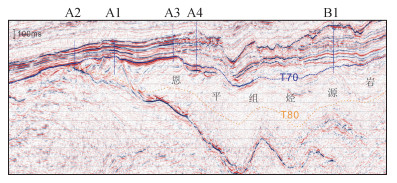
1 研究区资料情况和烃源岩特征研究区位于白云凹陷东部深水区(水深大于500 m) A构造附近,面积近1000 km2,3D地震资料覆盖.图 1为研究区一个联井地震剖面.该区已有商业油气发现(韩利等,2016),恩平组海相烃源岩为该区主力烃源岩(吴景富等2013;李友川等,2014),优质烃源岩分布范围不明.该区5口井钻遇恩平组,但钻遇深度相对于恩平组平均沉积厚度非常小,且仅有B1井有岩样地球化学分析数据.中深层地震资料成像品质差,烃源岩内部成像能量弱,给速度分析和波阻抗反演带来困难.
|
图 1 研究区联井地震剖面 Figure 1 A seismic section pass wells |
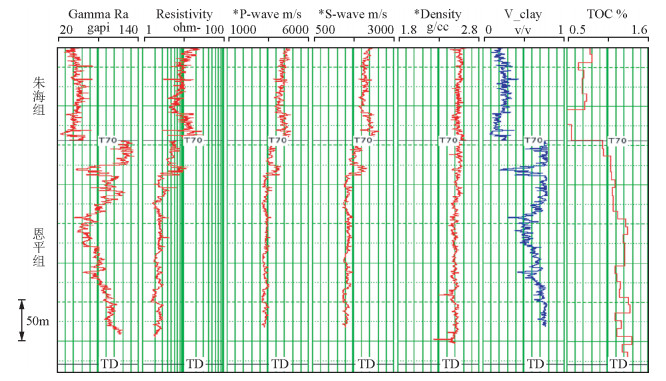
图 2展示了B1井的主要测井曲线和岩石样本TOC数据.从图中可以看到恩平组烃源岩地层与上覆珠海组地层有明显的岩性界面和测井响应差异.恩平组海相泥岩烃源岩具有高伽马、高电阻率(>2 ohmm)、低速度、低密度(2.35~2.53 g/cc)、高泥质含量、高TOC值(%,质量百分比较)等特点,具有典型的泥质烃源岩特征.
|
图 2 B1井测井曲线及岩样TOC数据 Figure 2 Log curves and TOC samples of B1 well |
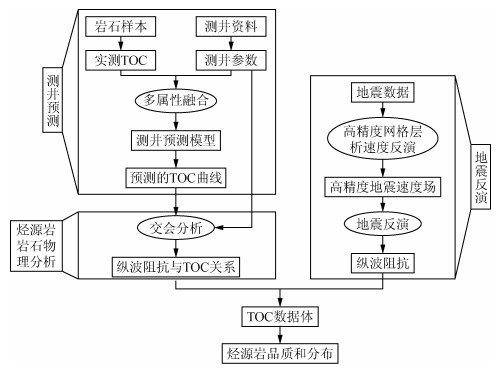
针对深水区钻井资料少、地震资料品质差和低频模型求取困难等特点,文章提出了一种利用井震联合预测烃源岩TOC的技术流程,如图 3所示.首先利用岩石样本实测TOC值和自然伽马、电阻率、声波时差等多种测井参数,通过井上敏感属性分析和多属性融合技术来定量预测单井烃源岩TOC曲线(TOC测井预测);其次通过对测井预测的TOC曲线和井上弹性参数做岩石物理交会分析,建立TOC与纵波阻抗之间的关系(烃源岩岩石物理分析);然后通过对地震数据进行高精度网格层析速度分析得到高精度速度谱,用于地震反演,得到地震纵波阻抗(地震反演);最后基于拟合关系和波阻抗反演结果进行烃源岩TOC预测.
|
图 3 烃源岩TOC预测流程图 Figure 3 A wordflow for the source rocks TOC prediction |
钻井岩样采样率低,实测TOC样本数据少,但通过与TOC有敏感关系的测井参数拟合,可以得到纵向连续的TOC曲线,这个过程称为测井预测TOC曲线.如何选取能够有效预测TOC曲线的敏感属性组合是一个重要问题.文章选用了HRS软件中EMERGE模块中“分步最优”多属性融合方法拟合TOC曲线,步骤如下:
第1步:通过计算和分析误差找到单个最优属性,将其命名为attribute1;
第2步:找到最优的两个属性组合.即与attribute1所有可能的组合中,预测误差最小的那个,记为attribute2;
第3步:同理找到最优的第三个属性组合.
重复这个步骤,直到最后.无论哪些属性被使用,N个属性的预测误差EN总是小于或等于N-1个属性的预测误差EN-1.
通过这种方法,对B1井资料进行了分析,最后选取logRT、DT和Sqrt (GR)三个属性作为敏感属性对TOC进行预测,建立如下线性预测模型:

|
(1) |
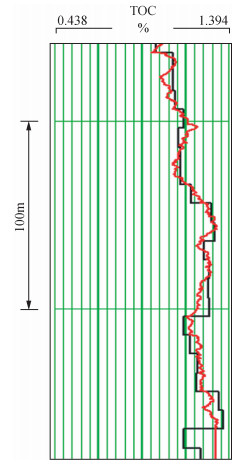
其中,RT代表电阻率;DT代表声波时差;GR代表自然伽马;a,b,c通过数据拟合求出.图 4展示了最后的拟合结果,拟合结果与TOC实测结果相关度为0.85(1为完全吻合),说明预测模型合理.
|
图 4 多属性融合预测TOC曲线结果,拟合相关度0.85 Figure 4 Predicted TOC via multi-attribute fusion technology. The fitting correlation is 0.85 |
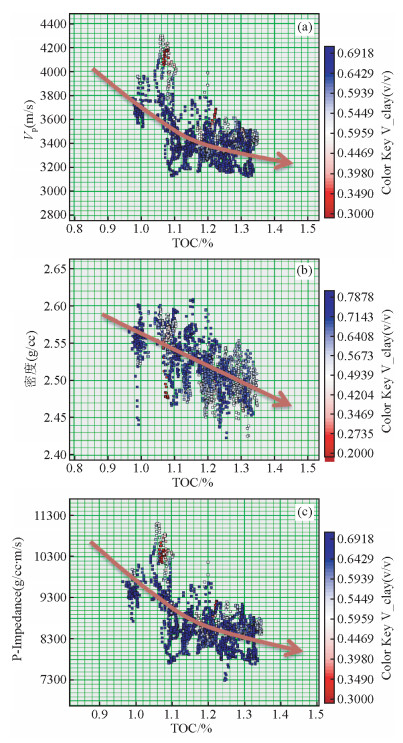
通过测井预测得到纵向连续的TOC曲线后,分别与纵波速度、密度和纵波阻抗三个弹性参数进行岩石物理交会分析,得到如图 5所示关系,色标为泥质含量.纵波速度随TOC含量的增加非线性递减;密度随TOC含量的增加线性递减;纵波阻抗随TOC含量的增加而非线性递减.通过交会结果认为,可通过纵波阻抗预测烃源岩TOC,进而评价烃源岩有机质丰度优劣.根据白云深水区海相烃源岩TOC范围,在该区将烃源岩划分为Ⅰ类(好)烃源岩、Ⅱ类(中等)烃源岩和Ⅲ类(差或非)烃源岩.Ⅰ类烃源岩TOC范围>1%,对应低纵波阻抗(波阻抗 < 9700 g/cc·m/s);Ⅱ类烃源岩TOC范围0.5%~1%,对应中纵波阻抗(9700 < 波阻抗 < 10400);Ⅲ类烃源岩TOC范围 < 0.5%,对应高波阻抗(波阻抗>10400).
|
图 5 B1井烃源岩TOC与(a) P波速度、(b)密度、(c) P波阻抗的交会图 Figure 5 Crossplots of TOC with (a) p-wave, (b) Density and (c) p-wave impedance at well B1 |
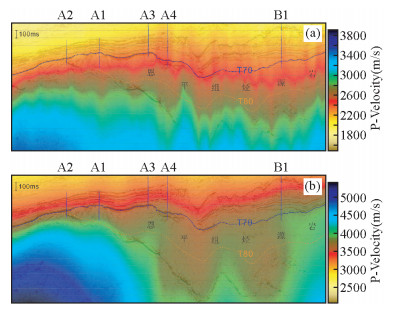
烃源岩岩石物理分析证明可以通过地震波阻抗进行烃源岩TOC预测.反演结果的准确性直接影响着TOC预测的准确性,但深水资料条件使得常规反演方法难以取得好的效果.由于工区钻遇烃源岩层的井少且非常浅,依赖测井数据建立的初始波阻抗模型无法控制目的层,难以用于地震反演.而常规地震扫描速度精度又比较低,中深层地震资料品质差更加重了扫描速度资料的误差.图 6a展示了扫描地震速度与地震记录的叠合图,在中深层扫描速度趋势与地震同相轴揭示的构造匹配较差.
|
图 6 速度模型对比(a)常规速度扫描速度模型(b)高精度网格层析反演速度模型 Figure 6 Comparision of velocity models. (a) Conventional scanning velocity model; (b) High-precision grid tomographic inversion velocity model |
高精度网格层析速度反演方法(李慧等,2013; 潘兴祥等,2013),建立在传统基于层位的层析成像技术上,又充分考虑地震及地质信息,用信噪比、同相轴的连续性、地层倾角及地震资料采集的方位角等多种信息联合反演速度模型.网格层析成像速度建模原理公式见李慧等(2013)文章,基本原则:将成像道集校平,若偏移后的共成像点道集中来自不同炮检距的各道的成像深度之间的误差为零,则偏移速度正确.技术优势:考虑构造倾角因素,得到的速度精度更高,对构造和沉积体刻画更加精细和准确.图 6b展示了高精度网格层析速度反演得到的速度模型与地震剖面的叠合图.与图 6a常规速度扫描结果相比,高精度网格层析速度反演结果更符合构造特征,速度更加合理.
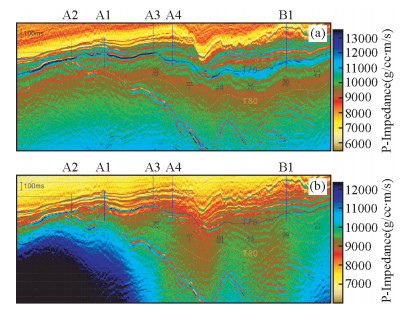
图 7a和b分别展示了使用常规速度模型进行波阻抗反演的结果和使用高精度网格层析反演速度的波阻抗反演结果.对比可见,后者与构造特征更匹配,基底反演的也更加合理.使用高精度网格层析速度进行地震波阻抗反演,无需井约束,适合深水少井情况的烃源岩预测工作.
|
图 7 波阻抗反演结果对比(a)使用常规速度模型结果(b)使用高精度网格层析反演速度模型结果 Figure 7 Comparision of seismic impedance inversion results. (a) Using conventional scanning velocity model; (b) Using high-precision grid tomographic inversion velocity model |
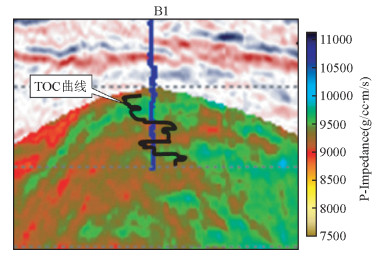
图 8中展示了B1井处纵波阻抗反演结果与测井预测TOC曲线对应关系,低波阻抗对应较高的TOC值(好烃源岩);中波阻抗对应中TOC值(中等烃源岩),波阻抗预测TOC结果与井上预测的TOC曲线匹配较好,验证了井震联合预测方法的有效性.
|
图 8 B1井处波阻抗反演结果与测井预测的TOC曲线匹配关系 Figure 8 Fitting relationship of the seismic impedance inversion result and the well predicted TOC curve |
为了解决深水区烃源岩预测中存在的钻井资料少、地震资料品质差和速度求取困难等实际问题,基于通过纵波阻抗与烃源岩TOC关系进行烃源岩预测的思想,建立了一种适应于少井条件的井震联合预测烃源岩TOC技术流程.包括测井预测TOC曲线、烃源岩岩石物理分析、地震反演和TOC预测等几个步骤.其中,测井预测使用测井多属性融合方法,预测误差小;烃源岩岩石物理交会分析表明纵波阻抗随烃源岩TOC的增加而非线性递减,具备通过纵波阻抗预测烃源岩TOC的基础;使用高精度网格层析速度反演求取速度用于地震反演,结果更加合理,且无需井约束,适合少井情况的反演工作.实际波阻抗反演结果与井上TOC曲线关系匹配较好,验证了井震联合预测方法的有效性.烃源岩预测从定性到定量还有很长的路要走,不同工区也存在着各自的难点问题,文章仅为深水少井条件下海相泥岩烃源岩预测提供了一种思路.
致谢 感谢审稿专家提出的修改意见和编辑部的大力支持!| [] | Gu L J, Xu S Y, Su J, et al .2011. Muddy hydrocarbon source rock prediction and evaluation with seismic data[J]. Natural Gas Geoscience, 22 (3) : 554–560. |
| [] | Han L, Liu C C, Zhang Y M, et al .2016. Seismic spectral decomposition and its application on hydrocarbon detection[J]. Chinese J. Geophys., 59 (3) : 1095–1101. DOI:10.6038/cjg20160329 |
| [] | Jiang M J, Spikes K T .2016. Rock-physics and seismic-inversion based reservoir characterization of the Haynesville Shale[J]. Journal of Geophysics and Engineering, 13 (3) : 220–233. DOI:10.1088/1742-2132/13/3/220 |
| [] | Li H, Cheng D A, Jin J .2013. Velocity model building based on grid tomography[J]. Oil Geophysical Prospecting, 48 (S1) : 12–16. |
| [] | Li Y C, Zhang G C, Fu N .2014. Hydrocarbon zonation and its control facors in Pearl River Mouth basin[J]. China Offshore Oil and Gas, 26 (4) : 8–14. |
| [] | Liu Z, Chang M, Zhao Yang, et al .2007. Method of early prediction on source rocks in basins with low exploration activity[J]. Earth Science Frontiers, 14 (4) : 159–167. DOI:10.1016/S1872-5791(07)60031-1 |
| [] | Løseth H, Wensaas L, Gading M, et al .2011. Can hydrocarbon source rocks be identified on seismic data?[J]. Geology, 39 (12) : 1167–1170. DOI:10.1130/G32328.1 |
| [] | Lü J Z, Guo X X, Yang J H .2015. Development status and trend of deepwater oil-gas exploration and development technology[J]. Oil Drilling & Production Technology, 37 (1) : 13–18. |
| [] | Mi L J, Liu Z, Zhang G C, et al .2007. Early forecast and evaluation study on chief source rock in Baiyun depression[J]. Acta Sedimentologica Sinica, 25 (1) : 139–146. |
| [] | Pan X X, Qin N, Qu Z P, et al .2013. Tomography velocity modeling and application of prestack depth migration[J]. Progress in Geophys., 28 (6) : 3080–3085. DOI:10.6038/pg20130632 |
| [] | Passey Q R, Creaney S, Kulla J B, et al .1990. A practical model for organic richness from porosity and resistivity logs[J]. AAPG Bulletin, 74 (12) : 1777–1794. |
| [] | Wu J F, Yang S C, Zhang G C, et al .2013. Geothermal history and thermal evolution of the source rocks in the deep-water area of the northern South China Sea[J]. Chinese J. Geophys., 56 (1) : 170–180. |
| [] | Xu S H, Zhu Y Q .2010. Well logs response and prediction model for organic carbon content in source rocks-A case study from the source rock of Wenchang Formation in the Pearl Mouth Basin[J]. Petroleum Geology & Experiment, 32 (3) : 290–295. |
| [] | Xu X H, Huang H, Lu S N .1998. A quantitative relationship between well logging information and organic carbon content[J]. Journal of Jianghan Petroleum Institute, 20 (3) : 11–15. |
| [] | Yang J H, G X X .2014. Momentum of worldwide deepwater oil and gas exploration and development[J]. Oil Forum, 5 : 49–55. |
| [] | Zhang H, Zhu G Y .2007. Using seismic and log information to predict and evaluate hydrocarbon source rocks:An example from rich oil depressions in Bohai Bay[J]. Petroleum Exploration and Development, 34 (1) : 55–59. |
| [] | Zhang Z W, Zhang L H .2000. A method of source rock evaluation by well-logging and its application result[J]. Petroleum exploration and development, 27 (3) : 84–87. |
| [] | Zhu W L, Zhong K, Li Y C, et al .2012. Characteristics of hydrocarbon and exploration potential of the northern South China Sea Deep-water Basins[J]. Chin Sci Bull, 57 (20) : 1833–1841. |
| [] | 顾礼敬, 徐守余, 苏劲, 等.2011. 利用地震资料预测和评价烃源岩[J]. 天然气地球科学, 22 (3) : 554–560. |
| [] | 韩利, 刘春成, 张益明, 等.2016. 地震复谱分解技术及其在烃类检测中的应用[J]. 地球物理学报, 59 (3) : 1095–1101. DOI:10.6038/cjg20160329 |
| [] | 李慧, 成德安, 金婧.2013. 网格层析成像速度建模方法与应用[J]. 石油地球物理勘探, 48 (S1) : 12–16. |
| [] | 李友川, 张功成, 傅宁.2014. 珠江口盆地油气分带性及其控制因素[J]. 中国海上油气, 26 (4) : 8–14. |
| [] | 刘震, 常迈, 赵阳, 等.2007. 低勘探程度盆地烃源岩早期预测方法研究[J]. 地学前缘, 14 (4) : 159–167. |
| [] | 吕建中, 郭晓霞, 杨金华.2015. 深水油气勘探开发技术发展现状与趋势[J]. 石油钻采工艺, 37 (1) : 13–18. |
| [] | 米立军, 刘震, 张功成, 等.2007. 南海北部深水区白云凹陷古近系烃源岩的早期预测[J]. 沉积学报, 25 (1) : 139–146. |
| [] | 潘兴祥, 秦宁, 曲志鹏, 等.2013. 叠前深度偏移层析速度建模及应用[J]. 地球物理学进展, 28 (6) : 3080–3085. DOI:10.6038/pg20130632 |
| [] | 吴景富, 杨树春, 张功成, 等.2013. 南海北部深水区盆地热历史及烃源岩热演化研究[J]. 地球物理学报, 56 (1) : 170–180. |
| [] | 徐思煌, 朱义清.2010. 烃源岩有机碳含量的测井响应特征与定量预测模型-以珠江口盆地文昌组烃源岩为例[J]. 石油实验地质, 32 (3) : 290–295. |
| [] | 许晓宏, 黄海平, 卢松年.1998. 测井资料与烃源岩有机碳含量的定量关系研究[J]. 江汉石油学院学报, 20 (3) : 11–15. |
| [] | 杨金华, 郭晓霞.2014. 世界深水油气勘探开发态势及启示[J]. 石油科技论坛, 5 : 49–55. |
| [] | 张寒, 朱光有.2007. 利用地震和测井信息预测和评价烃源岩-以渤海湾盆地富油凹陷为例[J]. 石油勘探与开发, 34 (1) : 55–59. |
| [] | 张志伟, 张龙海.2000. 测井评价烃源岩的方法及其应用效果[J]. 石油勘探与开发, 27 (3) : 84–87. |
| [] | 朱伟林, 钟锴, 李友川, 等.2012. 南海北部深水区油气成藏与勘探[J]. 科学通报, 57 (20) : 1833–1841. |