 2016, Vol. 31


瞬变电磁法(TEM)作为一种快速的电测深方法广泛应用于各种地质勘查领域, 它的优势是能够接收岩矿石的感应二次场, 对低电阻率介质非常敏感, 常用来寻找地下水或良导电矿床等.但感应二次场量值很微弱, 动态范围很大, 致使二、三维反演变得非常困难, 所以目前野外数据处理中仍然使用快速成像和一维反演方法.一维反演方法虽然数学物理方程完备, 但数据反演速度慢、且存在多解性(Marquardt, 1963; Constable et al., 1987; Farquharson et al., 2003; Yin and Hodges, 2007; Vallée and Smith, 2009; 李永兴等, 2010; 强建科等, 2013).而快速成像方法计算速度快, 很容易对野外数据进行处理解释.快速成像方法有:“镜像场源法”或“烟圈理论”(Nabighian, 1979)、等效电流环的方法(Barnett, 1984; Duncan, 1987; Eadie and Staltari, 1987)、最大电流层模型(Fullagar, 1989)、薄板逼近法(Keating and Crossley, 1990; Zhdanov et al., 2002) 、电导率深度转化方法(CDT)(Macnae et al., 1998; Fullagar and Reid, 2001)、自适应波恩近似反演(Christensen, 2003; Guillemoteau et al., 2012) 、假层-半空间模型(Huang and Rudd, 2008)、微分电导成像法(李貅等, 2003; 戚志鹏等, 2015)、剩余纵向电导法(蒋邦远, 2012)、全区视电阻率计算等近似方法(Spies and Eggers, 1986; 白登海等, 2003; 王华军, 2008; 强建科等, 2010)等.蒋邦远(2012) 提出虚拟背景场的思路可以消除背景响应, 突出局部异常, 具有良好的实用效果.
实际工作中, 观测的感应电动势中总是包含有背景(或围岩)感应二次场和异常体感应二次场, 如果能将二者分离, 微弱的异常体感应二次场就会变得非常明显.本文借鉴虚拟背景场的思路, 通过数值模拟的方法, 讨论围岩感应二次场和异常体感应二次场的一些特点及实际分离方法, 并展示对实测数据的推断解释情况, 以丰富和补充现有的近似解释方法.
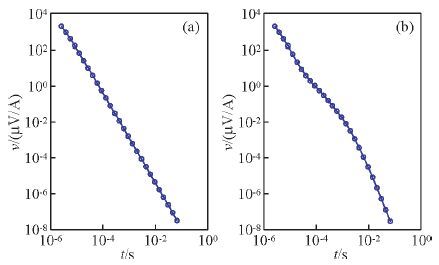
1 相对感应电动势的定义关于相对感应电动势的提出是受正演模拟计算的启发, 即背景场与异常场可以分别计算得出.由于时间域瞬变电磁是一个四维电磁问题, 即随时间变化的三维电磁场问题, 在该问题的2.5D正演模拟算法中(Qiang et al., 2013b), 往往要通过拉氏变换和傅氏变换把四维电磁问题转换为拉氏域和傅氏域二维电磁问题, 再分别求解背景二次场和异常体二次场, 随后再对二者做逆拉氏和逆傅氏变换才能得到地表上真实的感应电动势(或垂直磁场).其中异常场是通过有限单元法求解完成的.模拟结果见图 1, 图 1a、1b分别是背景介质感应电动势和总感应电动势, 其中感应电动势数值大小横跨6个数量级, 微小的异常很难识别, 但如果单独显示感应二次场就有可能很明显.
|
图 1 均匀介质与层状介质模拟结果 (a)电阻率为100 Ω·m均匀半空间感应电动势; (b) 三层介质数值解(ρ1=100 Ω·m、ρ2=10 Ω·m、ρ3=500 Ω·m,h1=50 m、h2=100 m). Figure 1 Simulation results of homogeneous medium and layered medium (a)The induction electromotive force for homogeneous half-space whose resistivity is 100 Ω·m; (b)Numerical Solution of three-layer media(ρ1=100 Ω·m、ρ2=10 Ω·m、ρ3=500 Ω·m, h1=50 m、h2=100 m). |
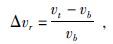
因此, 我们定义剩余感应电动势和相对感应电动势为

|
(1) |
|
(2) |
其中, vt为总体感应电动势, vb为背景介质感应电动势, Δv为剩余感应电动势, 它们的单位经电流归一化后为μV/A, Δvr称为相对感应电动势, 是一个比值, 无单位.
为研究相对感应电动势随深度的变化规律, 引入勘探深度(或视深度)概念ha为(蒋邦远, 1998).

|
(3) |
其中ρ为估计的背景电阻率, t为记录时间, μo为磁导率.
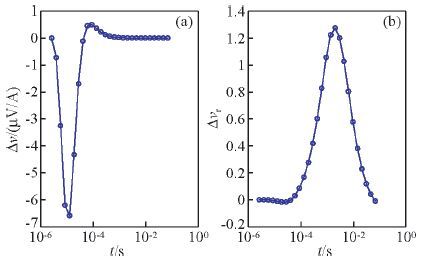
按照公式(1) 、(2) 我们可以得到剩余感应电动势和相对感应电动势(图 2).由于感应电动势的动态范围很大, 在线性坐标下, 剩余感应电动势和相对感应电动势显示出完全不同的异常特征:图 2a显示的“有效异常”大约在时间轴4~50 μs之间, 为负异常, 而图 2b显示的“有效异常”大约在时间轴200~10000 μs之间, 为正异常.仔细分析后发现, 正确的异常位置应该在200~10000 μs之间, 也就说, 相对感应电动势的曲线能够正确反映低阻层的信息, 而剩余感应电动势只是反映了异常出现前的假异常, 但由于其出现的时间早于真异常, 且早期感应电动势远大于中晚期感应电动势, 这种假象曾经被当做真异常出现在多个文献中(王华军, 2001; 熊彬, 2004; 肖明顺, 2008; 梁建刚, 2009).由此看出, 相对感应电动势有背景二次场的参照后, 能够更好地展示瞬变电磁异常的特点, 电阻率越低, 感应量越强.
|
图 2 同一感应电动势不同处理结果对比 (a)剩余感应电动势; (b)相对感应电动势(比值). Figure 2 The contrast of different processing result gotten by the same induced electromotive force (a)The remaining induced electromotive force; (b)The relative induction electromotive force(ratio). |
相对感应电动势方法与传统的视电阻率、纵向电导相比, 方法简单易行, 不会由于复杂的数学变换而产生畸变, 特别适合野外对异常的快速估算处理.
2 计算虚拟背景感应电动势获得相对感应电动势的必要条件是需要知道虚拟背景感应电动势, 或者说首先需要一个近似背景电阻率, 然后通过正演计算(均匀半空间解析解或数值解)即可获得虚拟背景感应电动势.背景电阻率一般可通过收集当地岩矿石电阻率的历史数据, 或通过拟合实测感应电动势数据来获得近似的背景电阻率, 也可用全区视电阻率方法求取表层电阻率作为背景值.
3 虚拟背景感应电动势对相对感应电动势的影响在实际野外复杂地电环境下, 很难确定一个精确的背景电阻率, 这就需要了解背景电阻率对异常特征的影响.我们计算了一组背景电阻率为50 Ω·m、100 Ω·m、200 Ω·m、1000 Ω·m的均匀半空间的感应电动势.计算结果在双对数坐标下有两个特点, 一是感应电动势随时间增加成线性下降, 二是背景电阻率值越小, 其感应电动势越大, 即曲线向上平移.这些特点暗示选取不同背景电阻率时只会引起异常平移而不会改变异常特征.
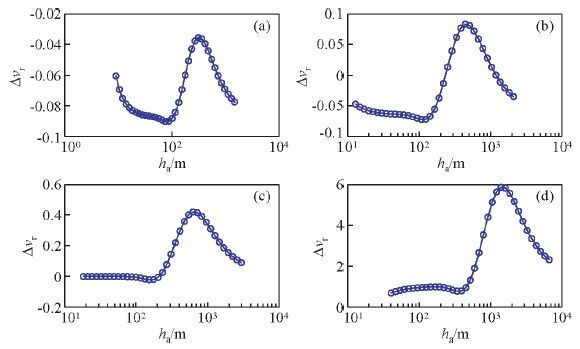
图 3为一个H型层状模型:ρ1=200 Ω·m, ρ2=10 Ω·m, ρ3=200 Ω·m, 各层厚分别为h1=200 m, h2=40 m.分别以50 Ω·m、100 Ω·m、200 Ω·m和1000 Ω·m为背景电阻率计算得到相对感应电动势Δvr随ha的变化曲线.可以看出一下几个特点:
|
图 3 不同背景电阻率对相对感应电动势的影响 (a)背景电阻率50 Ω·m; (b)背景电阻率100 Ω·m; (c)背景电阻率200 Ω·m; (d)背景电阻率1000 Ω·m. Figure 3 The influence of different background resistivity to relative induction electromotive force (a)the background resistivity is 50 Ω·m; (b)the background resistivity is 100 Ω·m; (c)the background resistivity is 200 Ω·m; (d)the background resistivity is 1000 Ω·m. |
(1) 四条相对感应电动势曲线异常明显, 曲线形态变化不大;
(2) 相对感应电动势的数值差别较大, 主要由于背景电阻率选择不同引起的.当估计背景电阻率小于实际第一层电阻率时, 背景的感应量大, 则相对感应电动势出现负值, 当估计背景电阻率大于实际第一层电阻率时, 背景的感应量变小, 则相对感应电动势出现较大正值;
(3) 视深度随着背景电阻率的增大而变深, 主要是视深度的计算公式中使用了背景电阻率的原因;
(4) 当背景电阻率与实际相同或接近时, 可以估计出异常体的顶埋深和其他定性参数.
4 算例及快速数据处理为了能够说明效果, 我们分别对多层介质、二维局部异常体及实测资料进行了计算, 并尝试快速处理数据.解释依据取决于感应电动势相对于虚拟背景感应电动势的大小, 如果相对感应电动势数值是正值, 数值越大, 表明感应场越强, 电阻率越低; 如果相对感应电动势数值是负值, 数值越大, 表明感应场越弱, 电阻率越高.
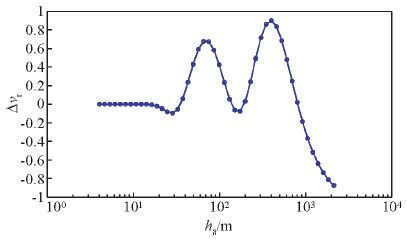
4.1 层状模型模型参数:ρ1=100 Ω·m、ρ2=10 Ω·m、ρ3=500 Ω·m、ρ4=10 Ω·m、ρ5=1000 Ω·m, h1=40 m、h2=5 m、h3=150 m、h4=40 m.依照公式(2) 求出相对感应电动势及视深度, 背景电阻率取为100 Ω·m(图 4).
|
图 4 五层介质相对感应电动势 Figure 4 Relative inductive electromotive force of five-layer mediums |
依照图 4, 我们可以快速得出以下解释:由于相对感应电动势的渐近线接近零值, 可以判断第一层的电阻率大约为100 Ω·m(由试算的背景电阻率获得), 第一层的厚度可以根据曲线快速上升的拐点判断约为30~40 m.根据电阻率越低感应量越大, 判断有两个低阻层三个高阻层, 而且最后一层电阻率远高于第一层的电阻率.对于中间各层的电阻率只能根据第一层的电阻率定性判断相对大小, 无法给出定量的解.对于各低阻层的顶埋深, 可大概判断为最大感应量所对应的视深度.
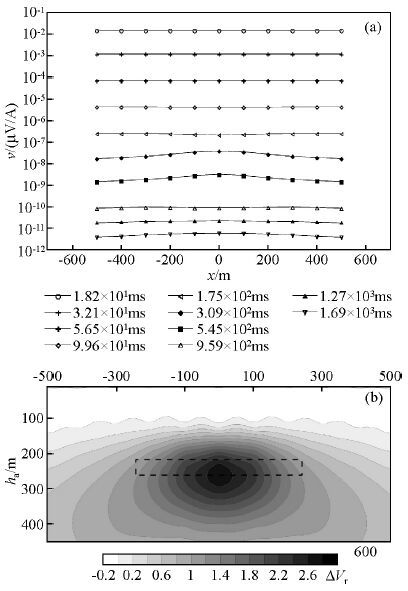
4.2 局部异常体模型模型参数:背景电阻率为200 Ω·m, 良导薄板电阻率为20 Ω·m, 水平长度500 m, 厚度50 m, 顶埋深为200 m.通过2.5D瞬变电磁数值模拟获得地面上11个测点的总感应电动势, 由公式(2) 计算出每个测点的相对感应电动势, 绘制相对感应电动势等值线拟断面图(图 5).
|
图 5 良导薄板上TEM剖面图及断面图 (a)各测点上时间抽道剖面图; (b)相对感应电动势等值线断面图. Figure 5 Profile map and contour profile of TEM on good conductive sheet (a)Profile map of time channel on each measuring point; (b)Contour profile of relative inductive electromotive force. |
从断面图上看出, 相对感应电动势的异常与真实模型吻合较好, 甚至具有反演以后的效果.
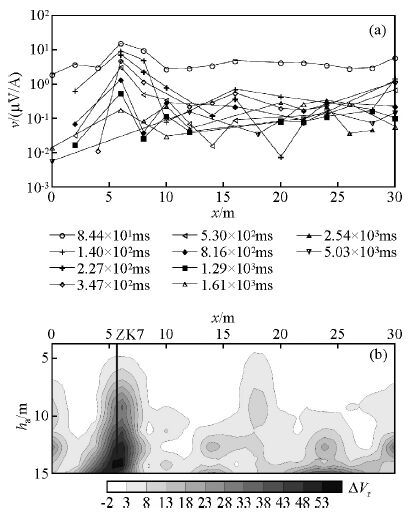
4.3 实测数据应用某水库坝址选址工程, 首先进行了钻探, 发现有些钻孔有溶洞和破碎带存在, 随后开展了面积性的浅层瞬变电磁详查.测区位于河道上, 岩石以白云质砂岩为主, 裂隙发育.共布置5条瞬变电磁测线, 点距2 m, 发射线圈:4 m×4 m(双匝), 接收线圈:1 m×1 m(双匝), 发射电流:8 A.对数据进行相对感应电动势数据转换, 如图 6所示.
|
图 6 某地基勘查实测TEM剖面图和断面图 (a) 各测点上时间抽道剖面图; (b)相对感应电动势等值线断面图. Figure 6 Profile map and contour profile of TEM at actual foundation exploration (a)Profile map of time channel on each measuring point; (b)Contour profile of relative inductive electromotive force. |
图 6a为其中一条测线的时间抽道剖面图, 可以看出, 很多测点二次场衰减很快, 但在里程4.5~7.5 m之间感应量较大, 存在较明显的低电阻率异常, 但这种抽道剖面只能作为定性判断.图 6b是通过计算背景电阻率为50 Ω·m的虚拟背景场得出相对感应电动势, 从图中看出, 在里程4.5~7.5 m之间存在一个相对感应量较强的异常, 我们推测为裂隙发育且含水的破碎带, 随后的钻孔ZK7证实为含泥沙的破碎带, 与瞬变探测结果吻合.
5 结论与建议本文研究了瞬变电磁数据快速处理的方法——相对感应电动势法.对于瞬变电磁法来说, 由于微弱的感应二次磁场动态范围很大, 剩余感应电动势不易直接利用, 否则会得出错误的结论.而相对感应电动势是一个比值, 其大小反映了地质体受激发而产生的电磁感应量的相对大小, 电阻率越低, 电磁感应量就越大.该方法只需对原始数据稍作转换即可完成快速处理, 工作量少, 计算速度快, 可以直观地分析地下介质导电性范围、埋深等, 有较好的实际应用潜力, 能够丰富和补充现有瞬变电磁解释方法.
致谢 感谢审稿专家提出的修改意见和编辑部的大力支持!| [1] | Bai D H, Meju M A, Lu J, et al.2003. Numerical calculation of all-time apparent resistivity for the central loop transient electromagnetic method[J]. Chinese Journal of Geophysics (in Chinese), 46 (5) : 697–704. DOI:10.3321/j.issn:0001-5733.2003.05.018 |
| [2] | Barnett C T.1984. Simple inversion of time-domain electromagnetic data[J]. Geophysics, 49 (7) : 925–933. DOI:10.1190/1.1441738 |
| [3] | Christensen N B.2003. A generic 1-D imaging method for transient electromagnetic data[J]. Geophysics, 67 (2) : 438–447. |
| [4] | Constable S C, Parker R L, Constable C G.1987. Occam's inversion: A practical algorithm for generating smooth models from electromagnetic sounding data[J]. Geophysics, 52 (3) : 289–300. DOI:10.1190/1.1442303 |
| [5] | Duncan A C.1987. Interpretation of down-hole transient EM data using current filaments[J]. Exploration Geophysics, 18 (2) : 36–39. DOI:10.1071/EG987036 |
| [6] | Eadie T, Staltari G.1987. Introduction to downhole electromagnetic methods[J]. Exploration Geophysics, 18 (3) : 247–254. DOI:10.1071/EG987247 |
| [7] | Farquharson C G, Oldenburg D W, Routh P S.2003. Simultaneous 1D inversion of loop-loop electromagnetic data for both magnetic susceptibility and electrical conductivity[J]. Geophysics, 68 (6) : 1857–1869. DOI:10.1190/1.1635038 |
| [8] | Fullagar P K.1989. Generation of conductivity-depth pseudo-sections from coincident loop and in-loop TEM data[J]. Exploration Geophysics, 20 (2) : 43–45. DOI:10.1071/EG989043 |
| [9] | Fullagar P K, Reid J E. 2001. Emax conductivity-depth transformation of airborne TEM data[C]. //15th Conference and Exhibition, ASEG Extended Abstracts. Brisbance, 1-4. |
| [10] | Guillemoteau J, Sailhac P, Behaegel M.2012. Fast approximate 2D inversion of airborne TEM data: Born approximation and empirical approach[J]. Geophysics, 77 (4) : WB89–WB97. DOI:10.1190/geo2011-0372.1 |
| [11] | Huang H P, Rudd J.2008. Conductivity-depth imaging of helicopter-borne TEM data based on a pseudolayer half-space model[J]. Geophysics, 73 (3) : F115–F120. DOI:10.1190/1.2904984 |
| [12] | Jiang B Y.1998. Practical Area Near Magnetic Source Transient Electromagnetic Method Exploration (in Chinese)[M]. Beijing: Geological Publishing House . |
| [13] | Jiang B Y.2012. Defintion of residual longitudinal conductivity ratio——new derived parameter in TEM and 1D inversion characters[J]. Geophysical & Geochemical Exploration (in Chinese), 36 (1) : 59–64. |
| [14] | Keating P B, Crossley D J.1990. The inversion of time-domain airborne electromagnetic data using the plate model[J]. Geophysics, 55 (6) : 705–711. DOI:10.1190/1.1442882 |
| [15] | Li X, Quan H J, Xu A X, et al.2003. Differential coefficient imaging of the longitudinal conductance in the transient electromagnetic sounding[J]. Coal Geology & Exploration (in Chinese), 31 (3) : 59–61. |
| [16] | Li Y X, Qiang J K, Tang J T.2010. A research on 1-D forward and inverse airborne transient electromagnetic method[J]. Chinese Journal of Geophysics (in Chinese), 53 (3) : 751–759. DOI:10.3969/j.issn.0001-5733.2010.03.031 |
| [17] | Liang J G. 2009. The feasibility analysis of transient electromagnetic surveying coalfield goaf (in Chinese)[MSc thesis]. Changsha: Central South University. |
| [18] | Macnae J, King A, Stolz N, et al.1998. Fast AEM data processing and inversion[J]. Exploration Geophysics, 29 (2) : 163–169. DOI:10.1071/EG998163 |
| [19] | Marquardt D W.1963. An algorithm for least-squares estimation of non-linear parameters[J]. Journal of the Society for Industrial and Applied Mathematics, 11 (2) : 431–441. DOI:10.1137/0111030 |
| [20] | Nabighian M N.1979. Quasi-static transient response of a conducting half-space; An approximate representation[J]. Geophysics, 44 (10) : 1700–1705. DOI:10.1190/1.1440931 |
| [21] | Qi Z P, Li X, Guo J L, et al.2015. Fast imaging of correlation stack for airborne TEM based on differential conductance[J]. Progress in Geophysics (in Chinese), 30 (4) : 1903–1911. DOI:10.6038/pg20150451 |
| [22] | Qiang J K, Luo Y Z, Tang J T, et al.2010. The algorithm of all-time apparent resistivity for Airborne Transient Electromagnetic (ATME) survey[J]. Progress in Geophysics (in Chinese), 25 (5) : 1657–1661. DOI:10.3969/j.issn.1004-2903.2010.05.018 |
| [23] | Qiang J K, Zhou J J, Cai H Z. 2013a. Synthetic study of 2.5-D ATEM based on finite element method[C].//NSGAPC Beijing 2013: First Near Surface Geophysics Asia Pacific Conference. Beijing, China: NSGAPC. |
| [24] | Qiang J K, Li Y X, Long J B.2013b. 1-D Occam inversion method for airborne transient electromagnetic data[J]. Computing Techniques for Geophysical and Geochemical Exploration (in Chinese), 35 (5) : 501–505. |
| [25] | Spies B R, Eggers D E.1986. The use and misuse of apparent resistivity in electromagnetic methods[J]. Geophysics, 51 (7) : 1462–1471. DOI:10.1190/1.1442194 |
| [26] | Vallée M A, Smith R S.2009. Application of Occam's inversion to airborne time-domain electromagnetics[J]. The Leading Edge, 28 (3) : 284–287. DOI:10.1190/1.3104071 |
| [27] | Wang H J. 2001. Study on 2.5D forward and inverse method for central loop transient electromagnetic method (in Chinese)[Ph. D. thesis]. Wuhan: China University of Geosciences. |
| [28] | Wang H J.2008. Time domain transient electromagnetism all time apparent resistivity translation algorithm[J]. Chinese Journal of Geophysics (in Chinese), 51 (6) : 1936–1942. |
| [29] | Xiao M S. 2008. Study on 2.5D numerical modeling for transient electromagnetic method by finite-element method with topography (in Chinese)[MSc thesis]. Wuhan: China University of Geosciences. |
| [30] | Xiong B. 2004. Study on 2.5 dimensional forward modeling of large loop transient electromagnetic method and some key techniques in data interpretation (in Chinese)[Ph. D. thesis]. Wuhan: China University of Geosciences. |
| [31] | Yin C C, Hodges G.2007. Simulated annealing for airborne EM inversion[J]. Geophysics, 72 (4) . |
| [32] | Zhdanov M S, Pavlov D A, Ellis R G.2002. Localized S-inversion of time-domain electromagnetic data[J]. Geophysics, 67 (4) : 1115–1125. DOI:10.1190/1.1500372 |
| [33] | 白登海, MejuM A, 卢健, 等.2003. 时间域瞬变电磁法中心方式全程视电阻率的数值计算[J]. 地球物理学报, 46 (5) : 697–704. DOI:10.3321/j.issn:0001-5733.2003.05.018 |
| [34] | 蒋邦远.1998. 实用近区磁源瞬变电磁法勘探[M]. 北京: 地质出版社 . |
| [35] | 蒋邦远.2012. 剩余视纵向电导比定义-TEM新导出参数及一维直接反演特性[J]. 物探化探, 36 (1) : 59–64. |
| [36] | 李貅, 全红娟, 许阿祥, 等.2003. 瞬变电磁测深的微分电导成像[J]. 煤田地质与勘探, 31 (3) : 59–61. |
| [37] | 李永兴, 强建科, 汤井田.2010. 航空瞬变电磁法一维正反演研究[J]. 地球物理学报, 53 (3) : 751–759. DOI:10.3969/j.issn.0001-5733.2010.03.031 |
| [38] | 梁建刚. 2009. 瞬变电磁勘察煤田采空区的可行性分析[硕士论文]. 长沙: 中南大学. |
| [39] | 戚志鹏, 李貅, 郭建磊, 等.2015. 基于微分电导的航空瞬变电磁合成孔径快速成像方法研究[J]. 地球物理学进展, 30 (4) : 1903–1911. DOI:10.6038/pg20150451 |
| [40] | 强建科, 罗延钟, 汤井田, 等.2010. 航空瞬变电磁法的全时域视电阻率计算方法[J]. 地球物理学进展, 25 (5) : 1657–1661. DOI:10.3969/j.issn.1004-2903.2010.05.018 |
| [41] | 强建科, 李永兴, 龙剑波.2013b. 航空瞬变电磁数据一维Occam反演[J]. 物探化探计算技术, 35 (5) : 501–505. |
| [42] | 王华军. 2001. 中心回线瞬变电磁2.5维正反演方法研究[博士论文]. 武汉: 中国地质大学. |
| [43] | 王华军.2008. 时间域瞬变电磁法全区视电阻率的平移算法[J]. 地球物理学报, 51 (6) : 1936–1942. |
| [44] | 肖明顺. 2008. 带地形的瞬变电磁2.5维有限元数值模拟研究[硕士论文]. 武汉: 中国地质大学. |
| [45] | 熊彬. 2004. 大回线瞬变电磁2.5维正演算法及其资料解释方法中若干关键技术研究[博士论文]. 武汉: 中国地质大学. |