 2015, Vol. 30


克拉通是地球表层的重要部分,约占陆地面积的50%(Rudnick and Fountain,1995).典型的克拉通通常具有厚度约200 km的岩石圈,并且密度和热流值相对较低,刚性较高,所以克拉通是地球上相对稳定的地区(朱日祥等,2011).正因为这种稳定性,克拉通才能够保存地球上最古老的物质,从而成为了地质学研究重要且宝贵的地区.
华北克拉通是我国最大最古老的克拉通,从18亿年前克拉通化到早中生代,一直保持相对稳定的状态(Xu,2001;Gao et al.,2002).但从中生代以来,华北克拉通发生了大规模的构造变形和岩浆活动.随着对华北克拉通研究的不断深入,中外科学家发现华北克拉通东部发生了大规模的岩石圈减薄现象(吴福元等,2003).稳定的大陆克拉通遭到破坏对于研究地学的学者来说还是较为罕见的一种现象,因此探究华北克拉通破坏的空间分布以及动力学成因显得尤为重要.
伴随克拉通破坏的大量伸展构造会导致中下地壳物质直接剥露至地表形成典型的变质核杂岩构造,所以利用岩石学和地球化学的方法可以有效的判断华北克拉通破坏大致的空间分布.人们对于华北克拉通破坏最早期的认识就是来自对古生代金伯利岩和中新生代玄武岩及其地幔包裹体的岩石-地球化学研究(朱日祥等,2011).然而,由于沉积盆地缺乏岩石出露以及植被覆盖等因素,岩石学和地球化学方法也会遇到一定的困难.在这种情况下,利用地球物理方法,尤其是大规模地震台阵观测技术,能够更加精确的帮助我们判断华北克拉通破坏的空间分布和动力学成因.从设立“华北克拉通破坏”专项课题以来,中国科学院地质与地球物理研究所、北京大学等单位在华北克拉通范围内布设了大规模的宽频带流动地震台阵(图 1),这对于研究华北克拉通岩石圈厚度变化、壳幔速度间断面形态以及分析克拉通破坏成因提供了大量的科学依据(Zheng et al.,2006,2007,2008a,b,2009; Chen et al.,2006,2009; 朱日祥和郑天愉,2009;Chen and Ai,2009; 唐有彩等,2010;郭震等,2012; 郭慧丽等,2014;刘保金等,2015).
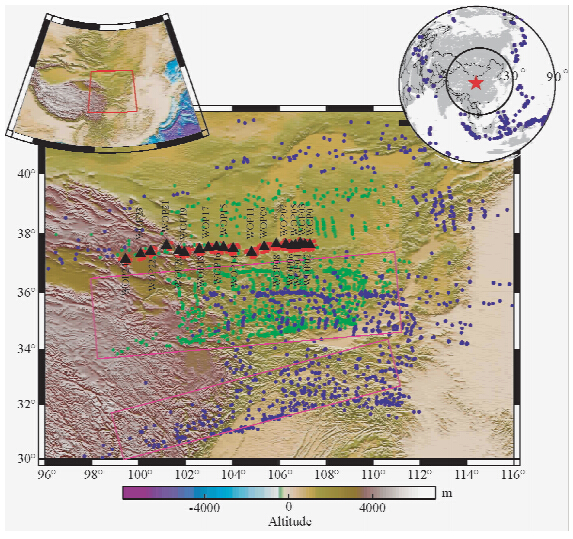 |
图 1 研究区域地质构造背景和台站分布 黑色三角代表台站所在方位,红色、绿色和蓝色圆点分别代表P波接收函数在40 km、410 km、660 km深度处的出射点. 紫色方框表示利用CCP共转换点叠加成像研究410 km和660 km间断面时所使用的出射点.右上角插图为 P波接收函数所用事件全球分布. Fig. 1 Geological background of study area and the distribution of seismic stations Black triangles represent the positions of portable seismic stations. Red, green, and blue points represent the piercing points at 40 km, 410 km, 660 km depth for P-to-S converted phases, respectively. The piercing points in the purple square were used for CCP stacking imaging. The top-right insert illustrates the distribution of selected teleseismic events. |
本文的研究区域位于华北克拉通西部横跨祁连造山带,北京大学于2011年在此区域布设了一条东西方向的流动地震观测台阵.由于所布台阵位于一条横跨华北克拉通地震台阵的末端,有利于研究整个华北克拉通地壳厚度和地幔中速度不连续面的横向变化.同时,由于所布台阵最西端已进入青藏高原板块,对于分析印度板块与欧亚板块碰撞对华北克拉通产生的影响也有一定的帮助.
1 研究数据2010年5月份到2011年5月份,北京大学在华北克拉通西部布设了一条宽频带数字流动观测地震台阵(图 1中黑色三角所示),台阵平均间距约为30 km,近东西走向.台阵东部位于华北克拉通鄂尔多斯块体内,中部横跨祁连山块体,西部位于青藏高原东北缘柴达木块体内部.
随着全球和区域地震台网的建立以及宽频带流动地震观测技术的发展和完善,远震体波接收函数方法已经成为一种研究地壳和上地幔速度结构最常规最有效的方法之一(Langston,1979; Ammon,1991; 徐强和赵俊猛,2008).利用旋转后三分量地震仪的径向记录与垂向记录的反褶积,我们能够得到径向的P波接收函数.提取的P波接收函数代表台站下方介质的脉冲响应,主要包含地壳和上地幔内部速度间断面所产生的Ps一次转换波以及PsPs,PpSs等多次波的信息.利用直达波与转换波之间的到时差,能够帮助我们得到台站下方间断面准确的深度和形态.
在提取P波接收函数之前,首先选取震中距为30°~90°,震级大于5.5级的远震事件,截取初至前15 s和初至后90 s的记录进行0.1~2.5 Hz的带通滤波.然后根据后方位角信息,将原始的三分量转换成垂向,径向和切向的记录.提取P波接收函数所采用的方法为时间域的迭代反褶积(Ligorría and Ammon,1999),该算法随着迭代次数的增加有主到次的提取有用信息,所使用的高斯滤波器宽度为2.5.最后经过挑选得到860条P波接收函数记录.图 1右上角为本文接收函数所用地震事件的全球分布,图 2为各台站接收函数经动校正之后叠加所得的结果,我们可以看到清晰的Ps转换波信号.
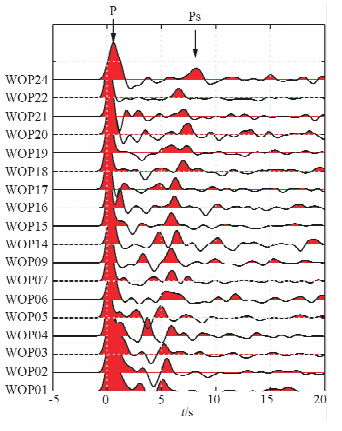 |
图 2 部分台站P波接收函动校正后叠加并归一化结果 纵坐标为台站名,直达P波在Moho面的Ps转换波震相清晰 Fig. 2 Normalized stacked results of receiver functions after moveout-correction at some stations Vertical axis denotes station names. Converted Ps phases can be clearly seen after direct P arrivals. |
利用倾斜叠加的方法(H|κ方法)(Zhu and Kanamori,2000)可以获取单个台站下方的地壳厚度(H)和纵横波速比(κ).该方法假设地壳中只有一层间断面(Moho),远震平面P波在进入地壳时,会有一次和多次转换波产生.当给定一个P波的平均速度(Vp),地壳厚度(H)以及波速比(κ),就可以计算出接收函数的中Ps,PpPs以及PsPs+PpSs等震相的到时.通过在一定范围内扫描H和κ,一次转换波和多次转换波加权能量之和达到最大时所对应的H和κ便为估算的最佳地壳厚度和波速比.研究中给定的P波平均速度为6.3 km/s,Ps,PpPs以及PsPs+PpSs的权重分别为0.7,0.2和0.1.图 3展示了部分台站倾斜叠加的结果.其中WOP01、WOP05台站位于鄂尔多斯块体内部,地壳厚度大约为40~45 km,纵横波速比较低.WOP07和WOP15台站位于祁连山块体和鄂尔多斯块体之间的过度区域,地壳厚度与鄂尔多斯块体内部较为接近,但纵横波速比较大,表示过渡区域地壳部分可能有部分熔融出现.WOP17和WOP19台站位于祁连山块体下方,地壳厚度大约为45~51 km.WOP22和WOP24两个台站位于青藏高原柴达木盆地东北缘,地壳厚度大约58~63 km.
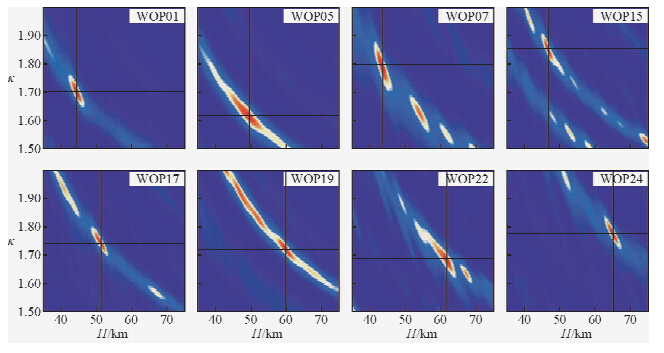 |
图 3 部分台站的倾斜叠加(H|κ)结果 两个相互交叉的黑色实线代表倾斜叠加的能量最大处,即估计的最佳地壳厚度和和纵横波速比. Fig. 3 Slant stacking (H|κ) results of some stations The coordinates of the crossing points of the black lines represent the maximum energy point of the slant stacking, which are the estimations of the Moho depth and  ratio. ratio.
|
倾斜叠加方法主要是针对单个地震台的地震记录进行的,台与台之间的接收函数不存在叠加关系.随着地震观测台阵的不断加密,我们可以采用更加直观精确的共转换点叠加(CCP)成像方法(Dueker and Sheehan,1997,1998; Ai et al.,2003,2005).CCP叠加成像的实质是将动校正处理之后的接收函数投影到地下对应深度的转换点,然后在不同深度上落入一定网格内的转换点所对应的接收函数振幅相叠加.由于在较深的间断面上,P波的入射点较为分散,所以CCP成像是一定范围内平滑的结果.我们所使用的地壳部分的一维速度模型来自对CUB 1.0全球模型的插值结果,地幔部分采用IASP91模型.Moho和上地幔间断面的CCP stacking结果如图 4所示.
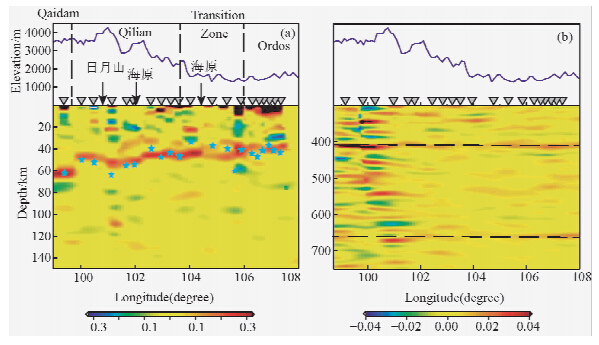 |
图 4 接收函数的共转换点叠加(CCP stacking)成像结果 (a)台站下方Moho面形态;(b)410 km 和660 km深度处间断面形态.颜色代表接收函数振幅的正负极性, (a)中蓝色五角星代表利用倾斜叠加方法(H|κ)得到的Moho面深度,蓝色曲线表示台站高程, 灰色三角代表台站位置,黑色虚线表示不同块体之间的交际处,黑色箭头表示断层位置. Fig. 4 CCP stacking image of P wave receiver functions (a) Topography of Moho; (b) Topography of 410 km and 660 km discontinuities. Image color represents the amplitude polarity, the blue stars denote the Moho depth result from slant stacking method, blue lines denote the elevation and gray triangles represent seismic stations. Black dashed line denotes boundaries of the different blocks and black arrows denote faults. |
地震的偏移成像方法最早用于勘探地震学中,近些年来,很多学者成功地将他应用到了天然地震的观测记录中(Ryberg and Weber,2000; Wilson and Aster,2003; Chen et al.,2009; Chen and Ai,2009; Chen,2010),通过接收函数的偏移成像研究台站下方地壳和上地幔的速度间断面.接收函数偏移成像的目的在于将接收函数包含的由于速度间断面产生的转换波信息投影到地下对应深度的转换点,消除横向非均匀性对地震波传播的影响,恢复地球内部真实的速度结构.相对于共转换点叠加技术,偏移成像并没有层状介质的假设条件,所以能够帮助我们获得更精确的间断面深度和形态.本文采用的接收函数偏移成像方法是基于基尔霍夫积分的深度偏移,同时利用一次转换波和多次波的信息提高对间断面深度的约束能力.偏移过程我们所使用的速度模型与CCP stacking相同,同时我们修正了台站高程的影响.由于偏移技术对于射线分布的密度要求较高,所以我们只对地壳部分进行了成像,结果如图 5所示.
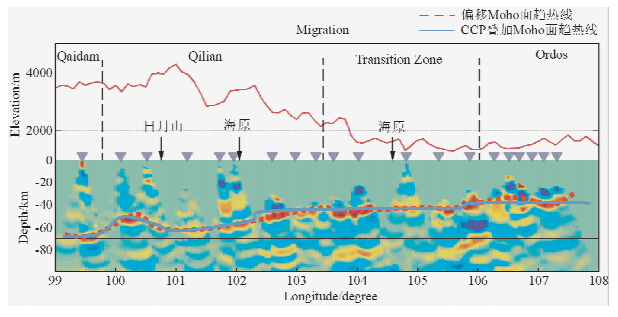 |
图 5 P波接收函数Moho面偏移成像结果 红色曲线代表高程,灰色三角代表台站方位,蓝色实线表示CCP stacking得到的Moho面深度. Fig. 5 P wave receiver functions migration image Red line denotes elevation and gray triangles represent seismic stations.Blue solid line denotes the Moho depth obtained from CCP stacking. Black dashed line denotes boundaries of the different blocks and black arrows denote faults. |
H|κ方法帮助我们勾勒研究区域下方的Moho面的形态.华北克拉通内部Moho面较为平缓,深度大致保持在40 km左右,其中个别台站的H|κ的结果较为异常,可能是由于壳内多次波的干扰所致.祁连造山带(缝合带)下方地壳厚度整体明显加深,并且出现了先厚再薄的弯曲现象.在最西部柴达木地块东北缘青海湖附近的两个台站下方Moho面出现剧烈跳跃.
CCP共转换点叠加和Kirchhoff偏移成像给我们展示了更多Moho面的更多细节.由图 4a和图 5可以看出,Moho的形态与地形大致呈镜像关系.地壳厚度由东向西逐渐增加,通过CCP叠加获得的Moho界面深度与H|κ方法所得的单台平均地壳厚度结果有较好的一致性.
同时我们可以更清楚的看到,位于青海湖附近的WOP23和WOP24两个台站下方Moho出现明显的错断,错断深度大致为12公里.虽然速度模型的误差会导致CCP成像结果出现偏差,但由于两台站间距有限,速度模型对Moho相对深度的影响也是有限的,而且局部低速沉积层的对绝对深度的影响通常小于3 km,不会造成大于10 km的错断.所以我们认为,尽管12 km的错断可能存在误差,但两台站下方的Moho面存在错断应该是一个可靠的观测结果,可能为一个地壳尺度的大断裂.相似的Moho面跳跃在柴达木地块的北缘和南缘也都被观测到(Zhu and Helmberger,1998; Vergne et al.,2002; Shi et al.,2009; Yue et al.,2012).我们观测到的Moho面阶跃位于柴达木地块的东北缘,青藏高原与华北克拉通的交界的祁连山缝合带的下方.由于印度板块向北挤压亚欧板块,青藏高原内部各个块体都存在不同程度的压缩与拉伸.通过GPS的观测可以得到,拉萨地块、羌塘地块以及松潘甘孜地块南北向的压缩率与东西向的拉伸率几乎相同,而柴达木地块南北向的压缩率远远小于东西向的拉伸率,所以我们通常认为柴达木地块是一个刚性地块.而刚性地块通常是用垂直向的增厚来抵消南北向的缩短,这可以用来解释祁连山缝合带以西柴达木地块加厚的地壳.
3.2 上地幔速度间断面上地幔中410 km、660 km间断面通常被认为是橄榄石的相变面(Ita and Stixrude,1992):橄榄石在410 km的温压条件下将会相变为wadsleyite/β-spinel,在660 km深度相变为perovskite和magnesiowüstite(Weidner and Wang,2000).这些相变都由基于克拉伯龙方程的温压条件所控制.而在410 km与660 km深度处相变的克拉伯龙方程的斜率恰好相反,因此,在相同的温度变化下将出现不同方向的弯曲.图 4b是台站下方上地幔的CCP叠加成像结果.结果显示410 km的速度间断面清楚而连续的,整个研究区域的下方都较为平坦.而660 km速度间断面在100°~102°E下方可以看到明显的下凹(约20 km),这种转换带的增厚通常是在冷条件下所形成,如俯冲带(Hirose,2002;Gu et al.,2003; Deuss,2009; Yue et al.,2012; Guo et al.,2014).利用体波层析成像结果我们可以更清楚的观测到高速异常体的俯冲深度,通过其他学者的研究我们可以得知印度板块向欧亚板块俯冲在不同深度上的俯冲前缘(图 6).如图 6f中红色圆圈所示,残留俯冲板块(高速异常体)已经到达或者穿过 了660 km速度间断面的深度,而CCP叠加成像100°~102°E 处所看到转换带增厚可能正是受残留俯冲板块的影响所致.
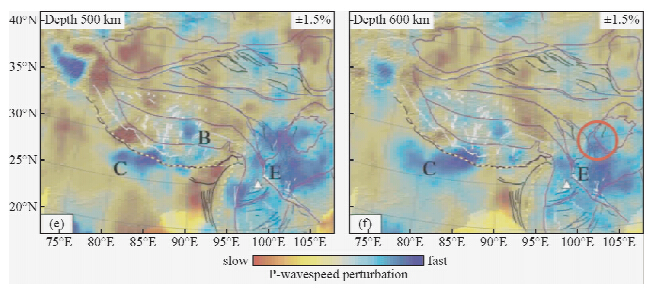 | 图 6 青藏高原下方不同深度处P波速度异常(摘自Li et al., 2008) Fig. 6 P wave velocity anomalies at different depths of the Tibetan Plateau |
致 谢 作者向参与北京大学流动地震的假设、数据采集工作的老师和同学们表示衷心的感谢.本文的研究获得了国家自然科学基金委的资助(NSFC grants: 91128210;90814002).
| [1] | Ai Y S, Zhao D P, Gao X, et al. 2005. The crust and upper mantle discontinuity structure beneath Alaska inferred from receiver functions[J]. Physics of the Earth and Planetary Interiors, 150(4):339-350. |
| [2] | Ai Y S, Zheng T Y, Xu W W, et al. 2003. A complex 660 km discontinuity beneath northeast China[J].Earth and Planetary Science Letters, 212(1-2):63-71. |
| [3] | Ammon C J. 1991. The isolation of receiver effects from teleseismicP waveforms[J]. Bulletin of the Seismological Society of America, 81(6):2504-2510. |
| [4] | Chen L. 2010. Concordant structural variations from the surface to the base of the upper mantle in the North China Craton and its tectonic implications[J].Lithos, 120(1-2):96-115. |
| [5] | Chen L, Ai Y S. 2009. Discontinuity structure of the mantle transition zone beneath the North China Craton from receiver function migration[J].Journal of Geophysical Research:Solid Earth (1978-2012),114(B6). |
| [6] | Chen L, Cheng C, Wei Z G. 2009. Seismic evidence for significant lateral variations in lithospheric thickness beneath the central and western North China Craton[J].Earth and Planetary Science Letters, 286(1-2):171-183. |
| [7] | Chen L, Zheng T Y, Xu W W. 2006. A thinned lithospheric image of the Tanlu Fault Zone, eastern China:Constructed from wave equation based receiver function migration[J]. Journal of Geophysical Research:Solid Earth (1978-2012),111(B9). |
| [8] | Deuss A. 2009. Global observations of mantle discontinuities using SS and PP precursors[J].Surveys in Geophysics, 30(4-5):301-326. |
| [9] | Dueker K G, Sheehan A F. 1997. Mantle discontinuity structure from midpoint stacks of converted P to S waves across the Yellowstone hotspot track[J]. Journal of Geophysical Research:Solid Earth (1978-2012),102(B4):8313-8327. |
| [10] | Dueker K G, Sheehan A F. 1998. Mantle discontinuity structure beneath the Colorado rocky mountains and high plains[J].Journal of Geophysical Research:Solid Earth (1978-2012),103(B4):7153-7169. |
| [11] | Gao S, Rudnick R L, Carlson R W, et al.2002. Re-Os evidence for replacement of ancient mantle lithosphere beneath the North China craton[J].Earth and Planetary Science Letters, 198(3-4):307-322. |
| [12] | Gu Y J, Dziewoński A M, Ekström G. 2003. Simultaneous inversion for mantle shear velocity and topography of transition zone discontinuities[J]. Geophysical Journal International, 154(2):559-583. |
| [13] | Guo Z, Cao Y L, Wang X G, et al.2014.Crust and upper mantle structures beneath Northeast China from receiver function studies[J]. Earthq.Sci., 27(3):265-275, doi:10.1007/s11589-014-0076-x. |
| [14] | Hirose K. 2002. Phase transitions in pyrolitic mantle around 670-km depth:Implications for upwelling of plumes from the lower mantle[J]. Journal of Geophysical Research:Solid Earth (1978-2012),107(B4):ECV 3-1-ECV 3-13. |
| [15] | Ita J, Stixrude L. 1992. Petrology, elasticity, and composition of the mantle transition zone[J]. Journal of Geophysical Research:Solid Earth (1978-2012),97(B5):6849-6866. |
| [16] | Langston C A. 1979.Structure under Mount Rainier, Washington, inferred from teleseismic body waves[J]. Journal of Geophysical Research:Solid Earth (1978-2012),84(B9):4749-4762. |
| [17] | Li C, Van Der Hilst R D, Meltzer A S, et al. 2008. Subduction of the Indian lithosphere beneath the Tibetan Plateau and Burma[J].Earth and Planetary Science Letters, 274(1-2):157-168. |
| [18] | Ligorría J P, Ammon C J. 1999. Iterative deconvolution and receiver-function estimation[J].Bulletin of the Seismological Society of America, 89(5):1395-1400. |
| [19] | Rudnick R L, Fountain D M. 1995. Nature and composition of the continental crust:A lower crustal perspective[J]. Reviews of Geophysics, 33(3):267-309. |
| [20] | Ryberg T, Weber M. 2000.Receiver function arrays:a reflection seismic approach[J].Geophysical Journal International, 141(1):1-11. |
| [21] | ShiD N, Shen Y, Zhao W J, et al. 2009. Seismic evidence for a Moho offset and south-directed thrust at the easternmost Qaidam-Kunlun boundary in the Northeast Tibetan Plateau[J]. Earth and Planetary Science Letters, 288(1-2):329-334. |
| [22] | Vergne J, Wittlinger G, Hui Q, et al. 2002. Seismic evidence for stepwise thickening of the crust across the NE Tibetan plateau[J].Earth and Planetary Science Letters, 203(1):25-33. |
| [23] | Weidner D J, Wang Y B. 1998. Chemical-and Clapeyron-induced buoyancy at the 660 km discontinuity[J].Journal of Geophysical Research:Solid Earth (1978-2012),103(B4):7431-7441. |
| [24] | Wilson D, Aster R. 2003. Imaging crust and upper mantle seismic structure in the southwestern United States using teleseismic receiver functions[J]. The Leading Edge, 22(3):232-237. |
| [25] | Xu Y G.2001.Thermo-tectonic destruction of the archaeanlithospheric keel beneath the sino-korean craton in China:evidence, timing and mechanism[J]. Physics and Chemistry of the Earth, Part A:Solid Earth and Geodesy, 26(9-10):747-757. |
| [26] | Yue H, Chen Y J, Sandvol E, et al. 2012. Lithospheric and upper mantle structure of the northeastern Tibetan Plateau[J].Journal of Geophysical Research:Solid Earth (1978-2012),117(B5). |
| [27] | Zheng T Y, Chen L, Zhao L, et al. 2006. Crust-mantle structure difference across the gravity gradient zone in North China Craton:seismic image of the thinned continental crust[J]. Physics of the Earth and Planetary Interiors, 159(1-2):43-58. |
| [28] | Zheng T Y, Chen L, Zhao L, et al. 2007. Crustal structure across the Yanshan belt at the northern margin of the North China Craton[J].Physics of the Earth and Planetary Interiors, 161(1-2):36-49. |
| [29] | Zheng T Y, Zhao L, Xu W W, et al. 2008b. Insight into modification of North China Craton from seismological study in the Shandong Province[J].Geophysical Research Letters, 35(22). |
| [30] | Zheng T Y, Zhao L, Zhu R X. 2008a. Insight into the geodynamics of cratonic reactivation from seismic analysis of the crust-mantle boundary[J].Geophysical Research Letters, 35(8). |
| [31] | Zheng T Y, Zhao L, Zhu R X. 2009. New evidence from seismic imaging for subduction during assembly of the North China craton[J].Geology, 37(5):395-398. |
| [32] | Zhu L P, Helmberger D V. 1998. Moho offset across the northern margin of the Tibetan Plateau[J]. Science, 281(5380):1170-1172. |
| [33] | Zhu L P, Kanamori H. 2000. Moho depth variation in southern California from teleseismic receiver functions[J]. Journal of Geophysical Research:Solid Earth (1978-2012),105(B2):2969-2980. |
| [34] | 郭慧丽,徐佩芬,张福勤. 2014.华北克拉通及东邻西太平洋活动大陆边缘地区的P波速度结构:对岩石圈减薄动力学过程的探讨[J].地球物理学报, 57(7):2352-2361, doi:10.6038/cjg20140729. |
| [35] | 郭震,唐有彩,陈永顺,等. 2012.华北克拉通东部地壳和上地幔结构的接收函数研究[J].地球物理学报, 55(11):3591-3600,doi:10.6038/j.issn.0001-5733.2012.11.008. |
| [36] | 刘保金,酆少英,姬计法,等. 2015.郯庐断裂带中南段的岩石圈精细结构[J].地球物理学报, 58(5):1610-1621, doi:10.6038/cjg20150513. |
| [37] | 唐有彩,冯永革,陈永顺,等. 2010.山西断陷带地壳结构的接收函数研究[J].地球物理学报, 53(9):2102-2109,doi:10.3969/j.issn.0001-5733.2010.09.010. |
| [38] | 吴福元,葛文春,孙德有,等. 2003.中国东部岩石圈减薄研究中的几个问题[J].地学前缘(中国地质大学,北京), 10(3):51-60. |
| [39] | 徐强,赵俊猛. 2008.接收函数方法的研究综述[J].地球物理学进展, 23(6):1709-1716. |
| [40] | 朱日祥,陈凌,吴福元,等. 2011.华北克拉通破坏的时间,范围与机制[J].中国科学:地球科学, 41(5):583-592. |
| [41] | 朱日祥,郑天愉. 2009.华北克拉通破坏机制与古元古代板块构造体系[J].科学通报, 54(14):1950-1961. |