地球物理学进展  2015, Vol. 30 Issue (6): 2489-2497   PDF    
利用地震震源机制资料和形变场模型估算中国大陆及其邻区的地震矩亏损
李长军1, 任金卫2 , 孟国杰2, 秦姗兰1, 付广裕2, 杨攀新2    
1. 中国地震局第二监测中心, 西安 710054;
2. 中国地震局地震预测研究所, 北京 100036
摘要: 前人利用历史地震资料、第四纪活断层资料和GPS等资料联合反演了中国大陆及其邻区的运动学模型,为分析研究区域的地震危险性提供了基础资料.本文基于前人研究中对7级及其以上大震地震矩使用中存在的问题,详细搜集整理了研究区域47个7级及其以上大震的震源参数、破裂带资料和地表位移资料,并利用这些资料将大震分段.再利用历史地震资料和联合反演的形变场模型估算了研究区域的地震矩亏损,并从中扣除10%的非震形变.最后,根据估算的地震矩亏损结合前人的研究成果讨论了研究区域的地震危险性.结果表明:113年间地震矩亏损较大的区域主要包括喜马拉雅断裂带、天山、阿尔金断裂带、柴达木盆地北缘、青藏高原中南部、鲜水河断裂带南段、安宁河断裂带、则木河断裂带、红河断裂带、龙门山断裂带北段和南段、鄂尔多斯块体周缘、东南沿海和贝加尔裂谷带等,前人的研究结果表明上述部分区域未来存在发生强震的可能.
关键词: 双三次样条函数     地震分段     地震矩亏损和盈余     地震危险性    
Moment deficit of Chinese mainland and its vicinity calculated from focal mechanisms and deformation model
LI Zhang-jun1, REN Jin-wei2 , MENG Guo-jie2, QIN Shan-lan1, FU Guang-yu2, YANG Pan-xin2    
1. Second Crust Monitoring and Application Center, CEA, Xi'an 710054, China;
2. Institute of Earthquake Science, China Earthquake Administration, Beijing 10036, China
Abstract: There are lots of achievements about kinematics of Chinese Mainland and its vicinity determined from historic earthquake data, Quaternary fault rates and geodetic observations, which provide basic data for analysis of Seismic Hazard in study areas. Based on problems in using moment of 47 earthquakes with magnitude greater than or equal to 7.0 in previous study, we collect source parameters, surface ruptures and displacements of these major earthquakes carefully, and divide them into small segmentations with these data gathered. Then we evaluate moment deficit of study areas from historic earthquake data and predicted deformation model, and remove 10 percent of aseismic deformation. Combining with previous results, we analyze the Seismic Hazard of study areas. The results show that there are some areas with large moment deficit, which contain the Himalayan Thrust fault zone, the Tianshan mountains, the Altyn Tagh fault system, the northern Qaidam basin, the central and southern Tibet Plateau, the southern Xianshuihe fault system, the Anninghe fault system, the Zemuhe fault system, the Red river fault system, the southern and northern segments of Longmen shan fault zone. There is also large moment deficit exist around the Ordos block, in southeastern coast of China and the Bakal rift zone. The previous studies show that there may be some potential earthquakes in the near future in parts of areas mentioned above.
Key words: bicubic spline function     earthquake segmentation     moment deficit and surplus     seismic hazard    
0 引言

中国大陆地处印度-欧亚板块碰撞引起的复杂变形区内,地震活动频发.统计表明,全球约有33%的大陆地震发生在中国境内(Zhang et al.,2003).随着社会经济的不断发展和城市化进程的不断加剧,出现了越来越多的人口高密区域.因此,分析中国大陆的地震危险性具有非常重要的意义.

随着GPS(Global Positioning System)等空间大地测量技术的发展,研究中国大陆的变形特征已经有很多研究成果(Jiang and Ma.,2003; Calais et al.,2006; 郑文俊等,2009).但是,前人研究局限于对形变场模型反映的研究区域变形特征的分析,在前人的研究结果中,变形较大的区域存在应变积累,也即为潜在的震源区.然而,GPS数据得到的形变场模型包含瞬时变形、断层蠕滑等非震形变、由已发地震释放的永久形变和震间弹性变形.因此,用大地测量资料分析研究区域的地震危险性,需要扣除已发地震产生的永久形变及其它非震形变.

Holt等(1995)利用历史地震资料反演了中、东亚的速度场;任金卫等(19992002)和Holt等(2000)利用地震资料、GPS等大地测量资料和第四纪活断层资料联合反演了中国大陆及其邻区的应变率场和速度场.上述模型分别从运动学和动力学的角度实际客观地描述了中国大陆及其邻区现今变形特征,为进一步分析该区域的地震危险性提供了基础资料.

本文在任金卫等(2002)的研究基础上,详细搜集整理了1900-2013年间发生在中国大陆及其邻区的4级及其以上历史地震资料,并对其中47个地表破裂带较长(40 km)的大震做了分段.其次,利用历史地震资料、第四纪活断层资料和GPS等大地测量资料联合反演了研究区域的应变率场和速度场.最后,利用历史地震资料和反演的应变率场估算了研究区域的地震矩亏损,为分析研究区域的地震危险性提供参考资料.

1 估算中国大陆及其邻区的剩余应变率和地震矩率 1.1 历史地震资料搜集和整理

首先搜集了1900-2013年间发生在中国大陆及其邻区的1349个4级及其以上历史地震资料(图 1),震源球大小用矩震级(MW)表示.其中,1976-2013年间的地震资料来自哈佛大学全球地震中心矩张量目录(CMT);1964-1976年的历史地震资料通过总结前人的研究成果得到(Chen et al.,1977; Molnar et al.,19831984; Holt et al.,1991a);1900-1964的地震资料主要来自于Molnar等(1984)Anne等(1984)的研究成果.图 1中,1900-2013年间,中国东北、蒙古东部和华南地区地震较少.
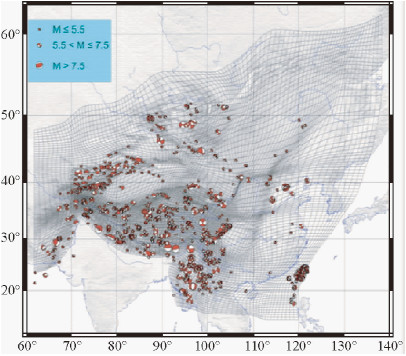
图 1 中国大陆及其邻区地震震源机制 Fig. 1 Focal mechanisms of Chinese mainland and its vicinity
1.2 估算研究区域的剩余应变率和地震矩率

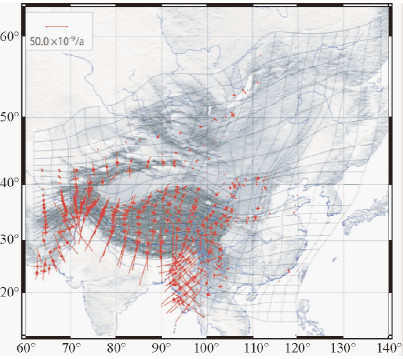
任金卫等(2002)将中国大陆及其邻区划分成不规则的地质构造单元,并结合地震资料、GPS等大地测量资料和第四纪活断层资料,反演了研究区域现今应变率场和速度场.为了减小大震的影响范围和提高反演结果的空间分辨率,本文对网格进行加密,从原来的12×11个增加到96×88个不规则的四边形网格.利用改进的双三次样条方法(Haines et al.,1993; Beaven et al.,2001)反演了中国大陆及其邻区的应变率场(mod图 2),并利用mod估算了模型矩率(0mod)(Haines et al.,1993; Beaven et al.,2001)为

图 2 利用地震资料、第四纪活断层资料和GPS资料联合反演的研究区域的应变率场(单位:10-9/a),图例表示50×10-9/a的拉张应变率 Fig. 2 Strain rate model determined from earthquake data,Quaternary fault rates and GPS observations (units:10-9/a),Legend is 50×10-9/a of tensional strain rate
其中,φφθθφθmod的分量,φ为东向,θ为北向;μ为剪切模量,取3.0×10¹¹dyne.cm-2V为网格的面积乘以孕震厚度(15 km(Holt et al.,1995)).需要指出的是,反演资料中增加了Liang等(2013)的GPS观测结果和荆燕等(2004)总结的活断层资料;反演使用的网格如图 1所示,成图时通过加权平均法估算了较大尺度网格的应变率(图 2)和对应的地震矩率.

利用Kostrov求和公式(Molnar et al.,1984; Kostrov.,1974)(式2)和历史地震资料(图 1)估算各网格的应变率观测值(obs)为

式中,N为各网格的地震总数; T为地震记录的时间尺度(取113年);M0k为第k个地震的标量地震矩;mij为单位矩张量

u为破裂滑动方向的单位矢量,n 为断裂面的单位法向量,由震源走向(θ)、倾角(δ)和滑动角(λ)的三角函数确定,i、j分别取1、2、3,其中1为东向(φ),2为北向(θ),3为垂向.

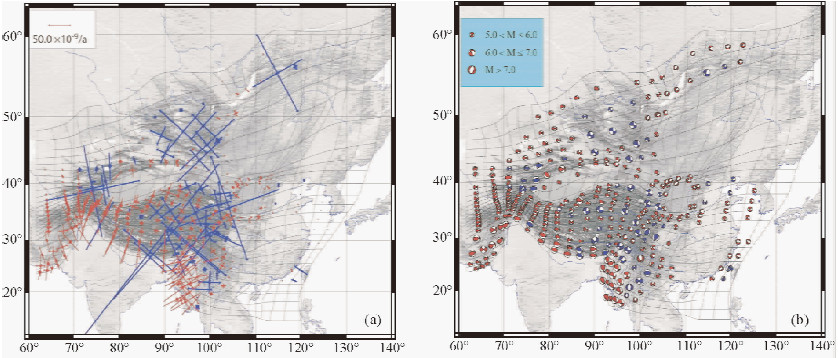
利用式1和obs估算各网格的观测矩率(0obs),则剩余矩率Δ0=0mod-0obs.各网格的剩余应变率张量Δ=mod-obs(图 3a),再利用Δ求地震震源参数(式4~11)(Shentu et al.,1998),则可将Δ0用震源球表示(图 3b).图 3(a,b)中,红色表示地震矩率亏损,即Δ0>0;蓝色为地震矩率盈余,即Δ0 < 0.断层面走向(θ),倾角(δ),滑动角(λ)表示为

其中,

式中,Δφφ、Δθθ和Δφθ为Δ的分量.

图 3 (a)剩余应变率,模型应变率(mod)和应变率观测值(obs)之差. 红色为Δ0>0,蓝色为Δ0<0,图例表示50×10-9/a的拉张应变率. (b)剩余地震矩率.其中,红色表示地震矩率亏损(Δ0>0); 蓝色表示地震矩率盈余(Δ0 < 0) Fig. 3 (a) Residual strain rate from the difference between predicted strain rate (mod) and strain rate observations (obs),in which red represents Δ0>0 and blue represents Δ0 < 0.Legend is 50×10-9/a of tensional strain rate. (b) Residual moment rate,in which red represents moment rate deficit (Δ0>0) and blue represents moment rate surplus (Δ0 < 0)

图 3中的应变率和地震矩率盈余量(蓝色)分布很不合理,主要表现在喜马拉雅逆冲断裂带,东昆仑断裂、海原断裂带和蒙古高原等有大震发生的地区.在喜马拉雅逆冲断裂带,1934年比哈尔-尼泊尔地震的发震断裂为近E-W的逆冲断裂,其地表破裂长度达到200 km以上(Singh and Harsh,1980),然而,图 3所示的盈余量主要分布在震中和其北边的网格,并未按照地震产生的形变带分布.昆仑山口西地震的发震断裂长度达到420 km(Lin et al.,2002),破裂长度至少横穿三个网格,破裂带东段所在的网格却存在较大的地震矩率和应变率亏损.上述不合理性存在的主要原因是估算剩余应变率和地震矩率时,将大震以点源的形式释放,使大震形变分布过于集中而并未按照其破裂带分布,从而使存在大震的网格应变率观测值出现峰值.

2 7级及其以上大震的分段处理和研究区域的地震矩亏损 2.1 7级及其以上大震的分段处理

为了解决2.2中存在的问题,本文将历史地震分为两类:第一类包括所有小于7级和7级以上但地表破裂带较短(40 km,接近于本文网格尺度)的地震;第二类为47个7级及其以上且地表破裂带较长的地震.详细搜集整理了第二类地震的震源参数、地表破裂带和地表位移资料(表 1).根据资料的完整程度将其分成A,B,C三类:A类,震源参数完整且有地表位移观测资料;B类,震源参数相对完整,存在发震断裂和地表破裂带资料,但缺少地表位移观测数据;C类,缺少发震断裂和地表破裂带资料.
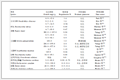
表 1 1900-2013年间中国大陆及其邻区7级及其以上地震资料总结 Table 1 Summary of materials about 47 earthquakes with magnitude greater than or equal to 7.0 in Chinese Mainland and its vicinity between 1900-2013

对A类地震,首先根据地表破裂带展布和本文网格之间的位置关系将破裂带分段,再根据地表位移分布估算各子破裂段的地震矩和矩震级.对缺少地表位移观测资料的B类地震,由于地震地表位移总体呈现中间大、两边小的分布特征,在此假定其服从三角形分布(Martin and Beroza,2000),利用与A类地震相同的分段方法将其分段.C类地震缺少地表位移和破裂带资料,首先,利用经验公式(Wesnousky,2008)估算破裂带长度,假定震源位于破裂带中间,根据走向参数和震源位置确定地表破裂带位置,再利用B类地震的方法分段.地震分段时,由于各破裂子段长度已知,通过调整破裂矩形面宽度,使分段后子地震的地震矩之和与该地震的地震矩观测值保持一致,47个大震的分段结果见图 4.
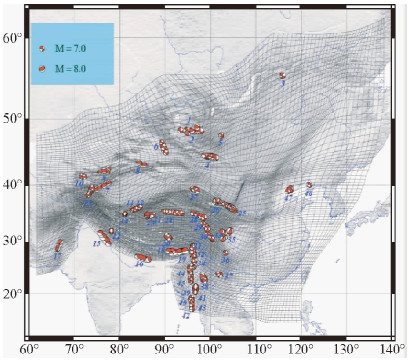
图 4 47个大震子地震的震源机制 Fig. 4 Focal mechanisms of sub earthquakes of 47 major events
2.2 估算研究区域的地震矩亏损

将所有第一类地震和分段处理的第二类地震利用Kostrov求和公式估算各网格的应变率观测值(obs),再根据(2.2)的方法估算各网格的剩余应变率(Δ)和剩余地震矩率(Δ).为了使表述更为清晰,将Δ转化成与地震矩率相关的应变率Δ(式12),如图 5a所示.其中,红色表示地震矩率亏损(即Δ0>0),蓝色表示地震矩率盈余(即Δ0 < 0),公式(11)为

式中,Δφφ,Δθθ,Δφθ为Δ的分量,再利用式(13)估算各网格的地震矩为

式中,T取113年.Wallace(1970)在研究圣安德烈斯断裂的发震间隔时指出至少有10%的长期变形通过蠕滑释放.从M0中扣除10%的蠕滑变形,再估算与M0对应的矩震级MW(式14)和地震震源参数(式4~11),得到地震震源机制如图 5b所示.

图 5 (a)中国大陆及其邻区的剩余应变率(扣除蠕动等非震形变);(b)由图5a的剩余应变率估算的地震矩亏损(红色)和盈余(蓝色) Fig. 5 (a)Residual strain rate of Chinese Mainland and its vicinity (Part of aseismic deformation is removed);(b)Moment deficit (red) and surplus (blue) evaluated from residual strain rate in figure 5a
2.3 结果分析与讨论

图 5a中,应变率亏损较大的区域主要包括喜马拉雅断裂带、天山、阿尔金断裂带、青藏高原中南部、川滇地区、鄂尔多斯块体周缘和东南沿海等区域.在鄂尔多斯块体内部,塔里木盆地,华南块体和中国东北的亏损量相对较小,与该区域较低的构造活动特征(张培震等,2013)一致.图 5b为利用剩余应变率估算的研究区域113年间的地震矩亏损(红色)和盈余(蓝色),其中的地震震源机制反映了相关区域的力学性质,震源球由矩震级大小确定.表 2为研究区域主要活动块体和断裂的地震矩亏损量及对应的矩震级.

表 2 中国大陆及其邻区主要活动地区的地震矩亏损 Table 2 Moment deficit of main active regions in Chinese Mainland and its vicinity

在青藏高原地区,地震矩亏损较大的区域主要位于喜马拉雅断裂带、阿尔金断裂带、柴达木盆地北缘和青藏高原中南部.在低海拔的喜马拉雅逆冲推覆带和祁连山以逆冲型地震为主,而在高原内部以正断和走滑型地震为主,与该区域的构造活动特征一致(张培震等,2013).喜马拉雅逆冲断裂带由于受康格拉地震(1905)、比哈尔-尼泊尔地震(1934)和察隅地震(1950)的影响,该断裂带的东段和中段局部范围内存在较大的盈余,其它大部分地区存在较大的亏损.其中,西段的亏损量为1.03×1028 dyne.cm,相当于矩震级为7.9级的地震;中段的亏损量为3.4×1027 dyne.cm,对应的矩震级为7.6级;东段的喜马拉雅构造结存在3.4×1027 dyne.cm的矩亏损,矩震级为7.6级.西藏中南部的拉萨块体、羌塘块体和巴颜喀拉块体内部均存在地震矩亏损,总亏损量为8.9×1027 dyne.cm,对应的矩震级为7.9级,金戈等(2009)的研究认为拉萨附近存在地震活动的可能.在柴达木块体北缘,地震矩亏损量为2.5×1027 dyne.cm(MW 7.5).阿尔金断裂113年间的地震记录较少,因此该区域存在较大的地震矩亏损,亏损量达到了5.1×1027 dyne.cm(MW 7.7).西秦岭北缘断裂的亏损量为1.1×1027 dyne.cm(MW 7.3),葛伟鹏等(2013)认为该区域现今的形变场是不同活动断裂差异性相对运动、区域内部逆冲挤压和块体旋转共同作用的结果,在西秦岭北缘断裂存在地震危险性.东昆仑断裂存在较大的地震矩盈余,但其东段存在2.5×1026 dyne.cm(MW 6.9)的能量亏损,李正芳等(2012)通过古地震资料的分析研究表明,东昆仑断裂的塔藏段和玛曲段未来百年发生大震的可能性较高.

南北地震带中南段构造活动比较强烈(张培震等,20082013),其地震矩总亏损量为9.7×1027 dyne.cm,主要分布于鲜水河断裂带南段、安宁河断裂带、则木河断裂带、红河断裂带、龙门山断裂北段和南段等区域.图 6反映了该区域地震矩亏损量的分布,其中,鲜水河断裂亏损量为0.72×1027 dyne.cm,安宁河断裂带的亏损量为1.4×1027 dyne.cm,则木河的亏损量为0.95×1027 dyne.cm,红河断裂带的亏损量为5.2×1027 dyne.cm,龙门山断裂带北、南段的亏损量分别为0.39×1027 dyne.cm和0.3×1027 dyne.cm,对应的矩震级分别为MW 7.2、MW 7.4、MW 7.3、MW 7.7、MW 7.0和MW 6.9.冉勇康等(2008)认为,安宁河断裂北端若还处于集群期,最后一期事件的离逝时间为527a,断裂已进入复发期,未来一段时间有发震的可能.徐锡伟等(2005)认为鲜水河断裂南端和安宁河断裂北端为地震危险区.易桂喜等(2008)认为安宁河断裂冕宁附近、则木河断裂西昌附近和鲜水河断裂中南段将是未来大震或强震的震源区.Wang等(2011)的研究表明,红河断裂带存在约7.4级地震矩亏损.易桂喜等(2013)估算了龙门山南段的视应力,结果表明天全至宝兴段应力水平相对较高,具有发生中-强震的条件.此外,在四川盆地南端,本文的结果中存在约6级左右的地震矩亏损,该亏损量可能跟芦山(MW 6.6)地震相关.

图 6 南北地震带中南段地震矩亏损 Fig. 6 Moment deficit in the middle and southern section of North-South seismic belt

鄂尔多斯块体南缘和东缘的亏损量分别为0.74×1027 dyne.cm和0.34×1027 dyne.cm,对应的矩震级分别为MW 7.2和MW 7.0,朱艾斓等(2010)的研究表明鄂尔多斯块体西南缘南东段和南缘自汶川地震以后的地震活动率提高显著而且在其东缘的山西断陷带处于应力增加区,存在发生大震的可能,Wang等(2011)认为南缘的秦岭-大别断裂带为华北和华南块体分界线,该区域的较大的地震矩亏损可以解释为分布于过渡带中的应变能.鄂尔多斯块体北缘和西缘的亏损量分别为0.6×1027 dyne.cm(MW 7.1)和0.76×1027 dyne.cm(MW 7.2),高立新等(2012)的研究表明,鄂尔多斯块体北缘处于低b值高应力积累区域,其西北缘的地震危险趋势进一步加剧.此外,天山的地震矩亏损量为5.1×1027 dyne.cm(MW 7.7),东南沿海的地震矩亏损量为0.9×1027dyne.cm(MW 7.2),贝加尔裂谷带整体经历拉张构造和较大的剪切作用,其地震活动性较高(刁发启等,2009),地震矩亏损量为2.7×1027 dyne.cm(MW 7.6).

本文估算了中国大陆及其邻区113年间的地震矩亏损,为进行研究区域的地震危险性分析和地震中长期预报提供了参考资料.然而,估算结果存在几方面的问题:首先,断裂蠕滑等非震形变极其复杂,因时因地而异(Gratier et al.,2011; 刘冠中等,2013),本文只对其做了粗糙的估计;其次,本文使用的地震目录时间尺度较短,未能包括完整的地震周期,因此,估算结果存在局限性.

3 结论

3.1    本文详细搜集整理了1900-2013年间发生在中国大陆及其邻区的地震资料,对其中的47个大震做了分段.然后,利用地震资料和GPS等资料联合反演了中国大陆及其邻区的运动学模型,在此基础上计算了1900年以来中国大陆及其邻区的地震矩亏损,并从中扣除了10%的非震形变.最后,结合前人研究成果讨论了中国大陆及其邻区的地震危险性.

3.2    结果表明:研究区域存在较大地震矩亏损的地区主要包括喜马拉雅断裂带、天山、阿尔金断裂带、柴达木盆地北缘、青藏高原中南部、鲜水河断裂带南段、安宁河断裂带、则木河断裂带、红河断裂带、龙门山断裂带北段和南段、鄂尔多斯块体周缘、东南沿海和贝加尔裂谷带等.前人研究表明上述部分区域未来存在发生强震的可能.然而,由于非震形变的复杂性和地震数据的不完备性,若要更准确的分析研究区域的地震危险性,就需要更准确的估算各个断裂带的非震形变,完善历史地震和古地震资料.

致 谢 感谢闻学泽老师对本文工作提出意见和建议.A. J. Haines为本研究提供了反演程序,本文使用的画图软件为GMT软件,其中的底图来自USGS提供的GTOPO30数据,作者在此一并表示感谢.
参考文献
[1] Abdrakhmatov, K Y, Aldazhanov S A, 1996. Relatively recent construction of the Tien Shan inferred from GPS measurements of present-day crustal deformation rates[J]. Nature, 384:450-453.
[2] Anne Yvonne, P. Tapponnier, P. Molnar. 1984. Active faulting and tectonics of Burma and surrounding regions[J]. J. Geophys. Res, 89(B1):453-472.
[3] Beaven J, Haines A J. 2001. Contemporary horizontal velocity and strain rate fields of the Pacific-Australian plate boundary zone through New Zealand[J]. J. Geophys. Res, 106(B1):741-770.
[4] Bingming, Shen-Tu, Holt W E, Haines A J. 1998. Contemporary deformation kinematics of the western United States plate boundary determined from earthquake moment tensors[J]. J. Geophys. Res, 103(B8):18087-18117.
[5] Calais E, Dong L, Wang M, et al. 2006. Continental deformation in Asia from a combined GPS solution[J]. Geophysical Research Letters, 33(24):1-6.
[6] Chen, W P, P Molnar. 1977. Seismic moments of major earthquakes and the average rate of slip in central Asia[J]. J. Geophys. Res, 82(20):2945-2969.
[7] Diao F Q, Xiong X, Zheng Y, et al. 2009. Crustal strain field of the Mongolia-Balkal rift zone and its geodynamic implications[J]. Progress in Geophys. (in Chinese), 24(4):1243-1251.
[8] Gao L X, Dai Y, Jia N. 2012. Analysis of seismicity around Ordos block[J]. J. of Institute of Disaster Prevention, 14(4):70-79.
[9] Ge W P, Wang M, Shen Z K, et al. 2013. Interseismic kinematics and deformation patterns on the upper crust of Qaidam-Qilianshan block[J]. Chinese J. Geophys. (in Chinese), 56(9):2994-3010.
[10] Haines A J, Holt W E. 1993. A procedure for obtaining the complete horizontal motions within zones of distributed deformation from the inversion of strain rate data[J]. J. Geophys Res, 98(B7):12057-12082.
[11] Holt W E, Chaot-Rooke N, X. Le Pichon, et al. 2000. Velocity field in Asia inferred from Quaternary fault slip rates and GPS observations[J]. J. Geophys. Res., 105(B8):19185-19209.
[12] Holt W E, J. F. Ni, Wallace T C, et al. 1991a. The active tectonics of the Eastern Himalayan Syntaxis and surrounding regions[J]. J. Geophys. Res, 96:14595-14632.
[13] Holt W E, LI M, Haines A J. 1995. Earthquake strain rates and instantaneous relative motions within central and eastern Asia[J]. Geophys. J. Int, 122:569-593.
[14] J. P. Gratier, J. Richard. 2011. Aseismic sliding of active faults by pressure solution creep:Evidence from the San Andreas Fault Observatory at Depth[J]. Geology, 39(12):1131-1134.
[15] Jiang Z S, Ma Z J. 2003. Horizontal strain field and tectonic deformation of the china mainland inferred from GPS measurements[J]. Chinese J.Geophys., 46(3):506-515.
[16] Jin G, Chen Y S, Basang C R. 2009. Investigation of local earthquakes in the Lhasa region[J]. Chinese J.Geophys. (in Chinese), 52(12):3020-3026.
[17] Jing Y, Ren J W. 2004. Late Quaternary crustal deformation field in Chinese continent and its adjacent regions inferred from active fault data[J]. Seismology and Geology, 26(1):71-89.
[18] Kostrov V V. 1974. Seismic moment, and energy of earthquakes, and the seismic flow of rock (in Russian)[J]. Izv. Acd. Sci. USSR Phy. Solid Earth, 1:23-44.
[19] Li Z J, Ren J W, Meng G J, et al. 2014. Deformation Model inverted from Focal Mechanism Data in and around Chinese Mainland[J]. Earthquake, 34(3):1-12.
[20] Li Z F, Zhou B G, Ran H L. 2012. Strong earthquake risk assessment of eastern segment on the East Kunlun fault in the next 100 years based on paleo-earthquake data[J]. Chinese J. Geophys. (in Chinese), 55(9):3051-3065.
[21] Liang S, Gan W J, Shen C Z, et al. 2013. Three-dimensional velocity field of present-day crustal motion of the Tibetan Plateau derived from GPS measurements[J]. J. Geophys. Res, 118:1-11.
[22] Lin A M, Fu B H, Guo J M, et al. 2002. Co-seismic surface ruptures produced by the 2001 Ms 8. 1 Central Kunlun (China) earthquake[J]. Science, 296:2015-2017.
[23] Liu G Z, Ma J, Zhang H X, et al. 2013. Study on activity features of Xianshuihe fault zone with fault creep and short baseline observation for the last 20 years[J]. Chinese J. Geophys. (in Chinese), 56(3):878-891.
[24] Martin P M, Beroza C. 2000. Source Scaling Properties from Finite-Fault-Rupture Models[J]. Bulletin of the Seismological Society of America, 90(3):604-615.
[25] Molnar P, Chen W P. 1983. Focal depths and fault plane solutions of earthquakes under the Tibetan Plateau[J]. J. Geophys Res, 88(B2):1180-1196.
[26] Molnar P, Deng Q D. 1984. Faulting associated with large earthquakes and the average rate of deformation in central and eastern Asia[J]. J. Geophys. Res, 89(B7):6203-6227.
[27] Ran Y K, Chen L C, Cheng J W, et al. 2008. Late Quaternary surface deformation and strong earthquake ruptures in Northern Mianning, Anninghe fault zone[J]. Science in China(D series), 38(5):543-554.
[28] Ren J W. 2002. Contemporary kinematics of Chinese Mainland inversed from GPS observations[J]. Chinese J.Geophys. (in Chinese), 45(Suppl):123-135.
[29] Ren J W, Holt W E, Shentu B M, et al. 1999. Deformation Kinematics of Central-Southeast Asia and Its Dynamics. Active faults research (7)[M]. Beijing:Seismological Press, 109-146.
[30] Shen, Z K, Zhao C, Yin A. 2000. Contemporary crustal deformation in east Asia constrained by Global Positioning System measurements[J]. J. Geophys. Res, 105:5721-5734.
[31] Singh D D, Harsh K.Gupta. 1980. Source dynamics of two great earthquakes of the Indian subcontinent[J]. Bulletin of the Seismological Society of America, 70(3):757-773.
[32] Wallace R E. 1970. Earthquake Recurrence Intervals on the San Andreas Fault[J]. Geological Society of America Bulletin, 81:2875-2890.
[33] Wang H, Liu M, Cao J L, et al. 2011. Slip rates and moment deficits on major active faults in mainland china[J]. J. Geophys. Res, 116(B02405):1-17.
[34] Wang Q, Zhang P Z, Freymueller J T, et al. 2001. Present-Day Crustal Deformation in China constrained by Global Positioning System Measurements[J]. Science, 294:574-577.
[35] Wesnousky S G. 2008. Displacement and Geometrical Characteristics of Earthquake Surface Ruptures:Issues and Implications for Seismic-Hazard Analysis and the Process of Earthquake Rupture[J]. Bulletin of the Seismological Society of America, 98(4):1609-1632.
[36] Xu X W, Zhang P Z, Wen X Z, et al. 2005. Ruptures of active tectonics and recurrence behaviors of strong earthquakes in the western Sichuan province and its adjacent regions[J]. Seismology and geology, 27(5):446-461.
[37] Yi G X, Wen X Z, Su Y J. 2008. Study on the potential strong-earthquake risk for the eastern boundary of the Sichuan-Yunnan active faulted-block, China[J]. Chinese J. Geophys. (in Chinese), 51(6):1719-1725.
[38] Yi G X, Wen X Z, Xin H, et al. 2013. Stress state and major-earthquake risk on the southern segment of the Longmen Shan fault zone[J]. Chinese J. Geophys. (in Chinese), 56(4):1112-1120.
[39] Zhang P Z. 2008. Contemporary tectonic deformation, strain partitioning and dynamics in the western Sichuan province, eastern Tibet[J]. Science in China(D series), 38(9):1041-1056.
[40] Zhang P Z, Deng Q D. 2003. Active tectonic blocks and strong earthquakes in the continent of china[J]. Science in China, 46(Supp):13-24.
[41] Zhang P Z, Deng Q D, Zhang Z Q, et al. 2013. Active faults, earthquake hazards and associated geodynamic processes in continental China (in Chinese)[J]. Scientia Sinica Terrae, 43:1607-1620.
[42] Zheng W J, Zhang P Z, Yuan D Y, et al. 2009. Deformation on the northern of the Tibetan plateau from GPS measurements and geologic rates of Late Quaternary along the major fault[J]. Chinese J.Geophys. (in Chinese), 52(10):2491-2508.
[43] Zhu A L, Xie C D, Xu X W, et al. 2010. The relationship between the seismicity of Ordos block and stress triggering from Wenchuan earthquake[J]. Earth Science Frontiers, 17(5):206-214.
[44] 刁发启,熊熊,郑勇,等. 2009.蒙古-贝加尔裂谷区地壳应变场及其地球动力学涵义[J].地球物理学进展, 24(4):1243-1251.
[45] 高立新,戴勇,贾宁. 2012.鄂尔多斯块体周缘地震活动特征分析.防灾科技学院学报[J]. 14(4):70-79.
[46] 葛伟鹏,王敏,沈正康,等. 2013.柴达木-祁连山地块内部震间上地壳块体运动特征与变形模式研究[J].地球物理学报, 56(9):2994-3010.
[47] 金戈,陈永顺,巴桑次仁. 2009.拉萨地区及其周边的地震活动性研究[J].地球物理学报, 2009, 52(12):3020-3026.
[48] 荆燕,任金卫. 2004.利用活断层资料模拟中国大陆及其邻区晚第四纪地壳变形场[J].地震地质, 26(1):71-89.
[49] 李长军,任金卫,孟国杰,等. 2014.利用强震震源机制解资料反演中国大陆及其邻区的形变场模型[J].地震,34(3):1-12.
[50] 李正芳,周本刚,冉洪流. 2012.运用古地震数据评价东昆仑断裂带东段未来百年的强震危险性[J].地球物理学报, 55(9):3051-3065.
[51] 刘冠中,马瑾,张鸿旭,等. 2013.二十年来蠕变和短基线观测反映的鲜水河断裂带活动特征[J].地球物理学报, 56(3):878-891.
[52] 冉永康,陈立春,程建武,等. 2008.安宁河断裂冕宁以北晚第四纪地表变形与强震破裂行为[J].中国科学D辑:地球科学, 38(5):543-554.
[53] 任金卫, Holt W E,申屠炳明,等. 1999.中亚及东南亚变形运动学及其动力学问题[M].活动断裂研究(7).北京:地震出版社, 109-146.
[54] 任金卫. 2002.利用GPS结果反演中国大陆及其邻区现在构造变形运动[J].地球物理学报, 45(增刊):123-135.
[55] 徐锡伟,张培震,闻学泽,等. 2005.川西及其邻近地区活动构造基本特征与强震复发模型[J].地震地质, 27(5):446-461.
[56] 易桂喜,闻学泽,苏有锦. 2008.川滇活动地块东边界强震危险性研究[J].地球物理学报, 51(6):1719-1725.
[57] 易桂喜,闻学泽,辛华,等. 2013.龙门山断裂带南段应力状态与强震危险性研究[J].地球物理学报, 56(4):1112-1120.
[58] 张培震. 2008.青藏高原东缘川西地区的现今构造变形、应变分配与深部动力过程[J].中国科学D辑:地球科学, 38(9):1041-1056.
[59] 张培震,邓起东,张竹琪,等. 2013.中国大陆的活动断裂、地震灾害及其动力过程[J].中国科学D辑:地球科学, 43(10):1607-1620.
[60] 郑文俊,张培震,袁道阳,等. 2009. GPS观测及断裂晚第四纪滑动速率所反映的青藏高原北部变形[J].地球物理学报, 52(10):2491-2508.
[61] 朱艾斓,解朝娣,徐锡伟,等. 2010.鄂尔多斯块体周缘地区近期地震活动性与汶川地震应力触发作用的关系[J].地学前缘(中国地质大学(北京);北京大学), 17(5):206-214.