 2015, Vol. 30


地壳中断层带是流体活动的重要场所,流体被认为是影响地震孕育成核、断层扩展以及震后断层愈合等过程的重要因素(Morrow et al.,1981; Sibson,1992; Rice,1992; Caine et al.,1996; Evans et al.,1997; Faulkner and Rutter,2003),具体主要表现在以下几方面.
(1)较高的流体压力可以明显降低有效正应力. 尤其对于逆冲型强震,通常认为地震成核时的流体压力要大于或等于静岩压力(Sibson et al.,1988).
(2)同震快速摩擦生热使流体产生热压效应,促进地震 滑动弱化及断层扩展(Sibson,1973;Wibberley and Shimamoto,2005).
(3)水-岩反应生成摩擦系数较低的黏土等层状硅酸盐矿物,导致断层强度降低(Wintsch et al.,1995); 热水条件下的实验研究也表明流体的存在会改变断层岩的摩擦滑动行为(He et al.,2007; 任凤文和何昌荣,2014; 路珍和何昌荣,2014).
(4)可溶性矿物溶解,并导致活动性强的元素被带走,造成物质流失. 另外,沉淀的流体矿物及水-岩反应的新生矿物胶结、愈合裂隙,导致震后断层强度逐渐恢复,渗透性逐渐下降,同时孔隙流体压力逐渐积累(Brantley et al.,1990; Evans and Chester,1995; Polak et al.,2003).
近年来,大量相关研究工作逐渐开展,例如在孕育强震的活动断层带上进行钻探,观测地震断层带的流体活动过程及其孕震信息(Doan et al.,2006; Fujimoto et al.,2007; Xue et al.,2013); 在实验室高温高压条件下进行模拟实验研究(Evans et al.,1997; Morrow et al.,2001; Wibberley and Shimamoto,2003; Giger et al.,2007; 杨晓松等,2014)等; 此外,流体的交代蚀变及断层滑动等作用也会对断层岩留下印记,研究断层带的内部结构、断层岩矿物蚀变特征及物质组成与变化规律也可以捕捉到流体作用的相关信息(Chester et al.,1993; Goddard and Evans,1995; Solum et al.,2006). 本文介绍了有关这些方面的研究进展,总结了流体在地震周期性活动过程中所产生的一系列岩石物理化学效应及其对地震过程的影响.
1 断层带流体存在及来源研究表明地壳中广泛存在着流体,并且近年来有关地壳中流体与构造作用及地震活动关系的研究逐渐引起科学家们的重视. 浅层地壳中流体的存在已有大量直接证据,如前苏联的科拉半岛深钻,德国的KTB深钻(张泽明,1998)等都发现了流体的存在. 另外地球物理结果显示,断层带在孕震深度内存在大量流体(Zhao et al.,1996). 断层带中大量发育的热液矿物脉体、流体包裹体等也表明断层带中普遍存在着流体(Sibson et al.,1975; Cox,1995). 稳定同位素研究表明地壳断层带内的流体主要是大气降水及沉积孔隙水(Kerrich et al.,1984; Kerrich and Kamineni,1988; Gudmundsson et al.,2001; Fujimoto et al.,2007),例如,在Nojima断层带中发现了多期重复性的地表水和海水渗透到深部断层带中的现象(Lin et al.,2003). 稳定氧同位素研究Snake Range拆离断层(Lee et al.,1984),Bitterroot拆离断层(Kerrich and Hyndman,1986)等均表明有大气降水渗透到断层带中. 此外地球演化过程中形成的流体(成岩、岩浆和变质作用过程排出的流体及幔源流体等)也是断裂带流体的重要来源,如San Andreas断层带中检测到来自地幔上涌到浅部断裂带的流体(Kennedy et al.,1997)及变质流体(Pili et al.,2011). 同一断层带中的流体也可能有多方面来源,如对Chelungpu断层带裂隙中的碳酸盐岩脉体研究表明,流体来源可能包括浅部的大气降水及深部上涌的富含硫化物的流体(Wang et al.,2010). 对死海转换断层的研究也表明流体主要来自于大气降水和沉积孔隙水,并含有深部流体作用的痕迹(Janssen et al.,2005). 断层带内不同来源的流体可能与周期性地震破裂导致的多期次流体渗入或上涌有关(Sibson,1992).
2 断层带渗透性与断层愈合 2.1 断层带渗透性断层带在空间上的结构、粒度分布及矿物成分影响着断层的渗透性及流体分布. 大量横跨断层带的调查和分析结果显示,断层带主要由断层核部,两侧的破碎带及较完整的围岩组成(Caine et al.,1996). 断层核部通常发育断层泥、超碎裂岩等; 两侧破碎带通常发育角砾岩、碎裂岩及破裂的原岩等(地表露头(Anderson et al.,1983; Chester et al.,1993; Isaacs et al.,2007; Chen et al.,2013b),钻探岩芯(Tanaka et al.,2001; Holdsworth et al.,2011; Li et al.,2013)). 在实际断层中也并非上述所有单元都会存在,而且各部分之间没有绝对的尺度关系. 如Faulkner等(2010)所总结的那样,断层带可能是单核模式或者由多个核部或次级断层带所组成. 对断层岩的粒度分析表明,断层岩普遍具有向断层核部粒度逐渐降低的特征(Marrett et al.,1999; Storti et al.,2003,Billi,2007; 陈建业和杨晓松,2014). 另外,靠近断层核部方向,粘土矿物含量逐渐增加(Vrolijk and vander Pluijm,1999). 研究显示跨断层的粒度分布及粘土矿物含量与渗透率分布特征具有对应关系,即核部较细的粒度分布特征及较高的粘土含量对应着较低的渗透率(e.g. Chen et al.,2013c).
断层核部是位移累积最多的地方,可能包括断层主滑移面,未固结的断层泥或者细角砾岩等(Caine et al.,1996). 实验研究表明断层泥通常具有最低的渗透率(Faulkner and Rutter,2000,2003; Tanikawa and Shimamoto,2009a; 段庆宝等,2014; 段庆宝和杨晓松,2014),矿物沉淀胶结以及定向压实等作用会使断层核部的渗透率和孔隙度下降(Goddard and Evans,1995),从而使核部起到阻碍流体运动的作用. 断层破碎带通常发育有次级断层、脉体、裂隙及节理等构造,而且破碎带的破裂密度通常较围岩要高很多(Chester et al.,1993),因此破碎带渗透性较两侧围岩及核部均偏高,比断层泥要高出2~4个数量级(图 1a). 这种分布规律决定了流体更容易在断层泥和两侧围岩所夹的破碎带内流动. 另外由于遭受强烈的定向剪切作用,断层泥的渗透率也会表现出宏观的各向异性(Morrow et al.,1981),垂直断层面方向渗透率要低于平行方向,即流体更倾向于平行断层面方向迁移. 陈建业和杨晓松(2012)详细统计了当前已有的断层带渗透率实验数据. 横跨断层带的渗透性结构大多表现为“通道/障碍体”的二元系统Caine等(1996),渗透率在断层剖面上的分布近似呈“M”型(图 1a)(Lockner et al.,2000; Mizoguchi et al.,2008; 陈建业等,2011).
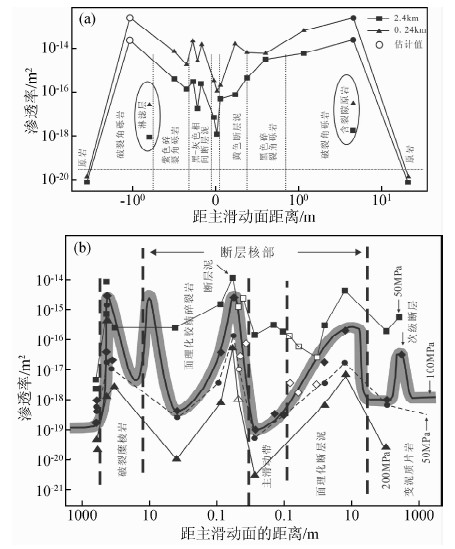 |
图 1 典型的断层带渗透性结构 (a)汶川地震断层带渗透性结构(据陈建业等,2011);(b)日本中央构造带渗透性结构(据Wibberley and Shimamoto,2003) Fig. 1 Typical fault zone permeability structure (a)Permeability structure of Wenchuan earthquake fault zone(Chen et al.,2011);(b)Permeability structure of Median Tectonic Line of Japan(Wibberley and Shimamoto,2003). |
另外断层带不同深度的渗透性可能存在差异. 断层带浅部的渗透性主要控制着地震破裂的动态扩展及同震效应,如热压作用(Sibson,1973,Wibberley and Shimamoto,2005)等. 而深部的渗透性,尤其是孕震深度的实验结果对认识流体在地震的孕育及发生等过程中的作用具有重要意义. 从浅部到深部,断层岩的类型由未固结状态的断层泥、角砾岩等组合逐渐转化为固结状态的碎裂岩、糜棱岩等(Sibson,1977; Anderson et al.,1983),随着断层岩类型的改变,其渗透性也会逐渐发生变化. 如日本的中央构造带(Wibberley and Shimamoto,2003),断层带内有多个断层泥带及次级断层并发育有碎裂岩、糜棱岩等较深部形成的断层岩. 渗透率实验显示跨断层的渗透率结果表现出较大的变化(图 1b),断层主滑动带的渗透率和碎裂岩的渗透率最低,而断层泥的渗透率则相对偏高. 这与浅部地壳断层带渗透性结构存在一定差别. 因此,断层的渗透性结构在不同构造域可能不一样. 目前已经积累了一定数量的浅部地壳断层带的渗透性数据. 对断层带浅部的渗透性结构有了一定的认识. 但对断层深部孕震深度的渗透性研究还相对较少.
2.2 断层愈合在震后及间震期内,由于流体的作用,同震破裂产生的裂隙可能会逐渐愈合,并且随着裂隙的逐渐愈合断层带的渗透性也随之改变. 近年来,许多科学家开始关注断层带的渗透性随时间的演化过程,期望寻找出震后断层带的渗透性变化规律并对震后断层愈合和地震周期性过程提供约束. 日本1995年Kobe地震之后,科学家们在Nojima断层带上分别于1997年、2000年和2003年进行了三次注水试验(Kitagawa et al.,2002,2007),三次测量到的渗透率均逐渐下降(图 2a,b). 2008年汶川地震以后,科学家们在WFSD-1号孔(Li et al.,2013)内进行了连续的渗透率观测(Xue et al.,2013),检测到了渗透率逐渐下降的过程(图 2c). 这些结果表明震后断层带的裂隙在逐渐愈合,断层强度逐渐恢复.
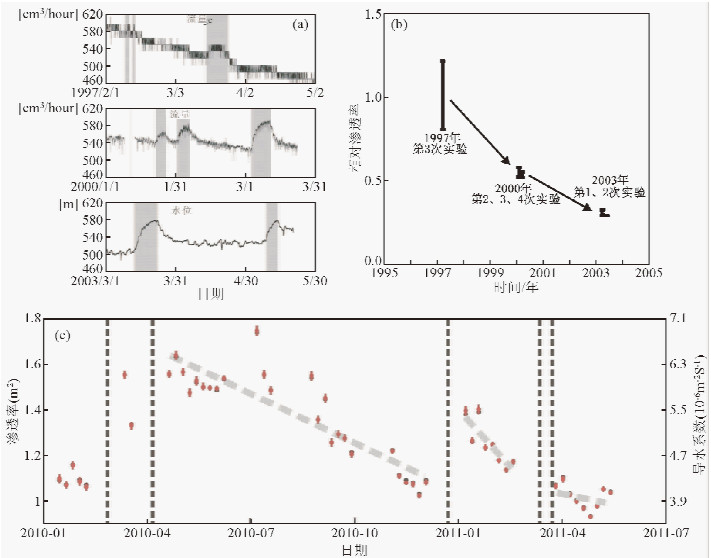 |
图 2 钻孔原位渗透率结果 (a)Nojima断层钻孔注水流量及水位监测结果(据Kitagawa et al.,2007);(b)Nojima断层钻孔注水渗透率结果(据Kitagawa et al.,2007);(c)WFSD-1孔连续渗透率观测结果(据Xue et al.,2013),竖虚线表示余震. Fig. 2 In-situ borehole permeability measurements The observation results of fluid flux and water level(a),and permeability(b)from water injection experiment on Nojima fault(Kitagawa et al.,2007);(c)Continous permeability measurement results in WFSD-1(Xue et al.,2013),the dashed lines denote the aftershocks. |
另外许多学者也在实验室内高温高压条件下开展了愈合实验研究(Brantley et al.,1990; Olsen et al.,1998; Kato et al.,2003; Polak et al.,2003; Uehara and Shimamoto,2004). Giger等(2007)采用石英粉末热压样品进行的实验表明渗透率随愈合时间快速下降,而且实验温度越高渗透率下降越快(图 3). Morrow等(2001)研究了含裂隙的花岗岩样品的愈合及渗透率下降过程,他们检测到了裂隙表面新形成的粘土矿物,并总结出了渗透率随时间下降的指数关系: k=c(10-rt),其中k是渗透率,c是常数,t是时间,r是渗透率下降速率. 基于加载差应力模拟断层破裂过程的实验表明,渗透率与破裂过程密切相关(Lockner et al.,2000; Tenthorey et al.,2003; Yasuhara et al.,2006). 岩石在刚开始破裂前,其渗透性会有一个缓慢上升的过程,当差应力达到破裂失稳的临界值时,由于岩石扩容、裂隙开启等导致断层带渗透性迅速上升(Tenthorey and Gerald,2006; Mitchell and Faulkner,2008),当保持围压及差应力恒定一段时间后渗透率会逐渐下降(Olsen et al.,1998; Gratier,2011),表明进入裂隙愈合阶段(图 4).
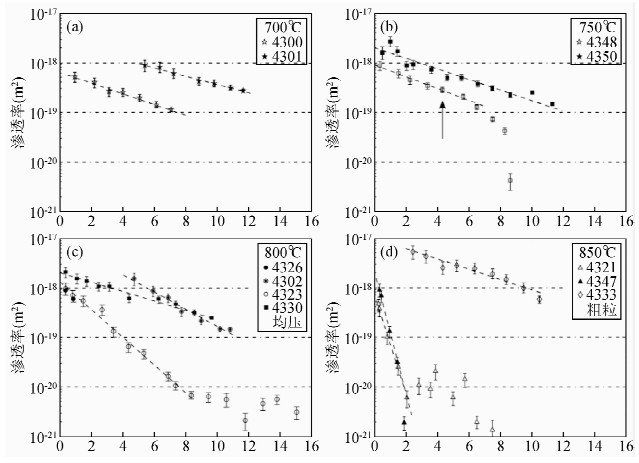 | 图 3 石英断层泥高温高压下愈合实验结果(据Giger et al.,2007)实验围压为250 MPa,孔隙流体压力为150 MPa,虚线代表拟合结果. 渗透率随愈合时间呈指数衰减关系. Fig. 3 Permeability evolution of quartz gouge as a function of temperature and time(Giger et al.,2007)All experiments were performed at confining pressure of 250 MPa and pore pressure of 150 MPa. The dashed lines indicate the exponential best fit to the relevant data sets. |
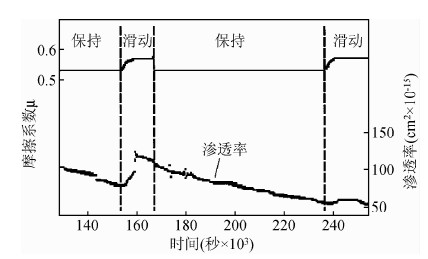 | 图 4 渗透率随应力加载实验结果(据Olsen et al.,1998)实验加载速率为0.05 μm/s,温度为250 ℃,孔隙压力为10 MPa. Fig. 4 Permeability and loading data for a typical hold period(Olsen et al.,1998)Loading episodes were performed at a constant displacement rate of 0.05 μm/s. The Experimental temperature was 250 ℃ and the pore fluid pressure was 10 MPa. |
上述野外观测与实验室研究都表明震后及间震期断层带内裂隙在逐渐愈合. 断层带的裂隙愈合机制主要有溶解-沉淀、重结晶及压溶等作用(张媛媛和周永胜,2012; Gratier et al.,2014). 地壳中,从深部塑性变形带到脆韧性转换带到脆性域深度,裂隙的主要愈合机制也会有一定变化. 同震破裂造成断层浅部脆性域大量裂隙开启,深部热液流体上涌,流体中的矿物质沉淀、析出形成脉体并愈合裂隙,因此脆性域内的主要愈合机制包括矿物的溶解-沉淀,热液流体矿物析出结晶(Whitmeyer and Wintsch,2005)等作用. 在脆塑性转换带内,水-岩反应更加强烈,断层岩中的主要矿物发生蚀变并生成一些弱矿物导致断层强度降低的同时也会使断层逐渐愈合(Wintsch et al.,1995),并且在这一区域内,压溶及重结晶等作用逐渐开始起主导作用(Gratier et al.,2002). 另外,应变速率较高的情况下,更有利于动态重结晶对裂隙的愈合. 高温高压实验研究表明,石英的动态重结晶作用是震后快速蠕变时期脆塑性转化带内裂隙愈合的重要机制之一(韩亮等,2013). 在塑性变形域内,断层带裂隙愈合主要通过变形导致的压溶、沉淀以及重结晶作用实现(张媛媛和周永胜,2012).
3 流体活动对断层带物质成分的改造 3.1 流体活动导致的断层带矿物组成变化粘土矿物是断层岩,尤其是断层泥,的主要矿物组成部分. 粘土矿物在很大程度上控制着断层带的强度及物理性质(Wu et al.,1975; Anderson et al.,1983; Kerrich et al.,1984; Vrolijk and van der Pluijm,1999). 断层带中的粘土矿物大多是水-岩相互作用的产物(Vrolijk and van der Pluijm,1999; Solum et al.,2006). 研究发现靠近断层核部,其粘土矿物含量通常明显增多. 例如,对SAFOD岩芯样品的XRD分析表明,在3067 m深度的断层带附近粘土矿物的总含量高达62%~69%(Solum et al.,2006). 对日本Nojima断层钻探岩芯样品的分析发现钻孔中不同深度的三个破碎带内岩石普遍发生蚀变,矿物成分分析表明除了一些来自于围岩的矿物(如石英、长石和黑云母等)外,还发现了一些与热液蚀变有关的新生矿物,如高岭石、辉沸石、铁白云石及菱铁矿等(Matsuda et al.,2004). 研究者对Chelungpu断层(Isaacs et al.,2007; Kuo et al.,2012)以及汶川地震断层(Chen et al.,2013b; Si et al.,2014)的研究也都发现了靠近断层面附近粘土矿物总量异常增多的现象.
控制断层带内水-岩反应过程及其产物的因素主要是围岩类型、流体成分和温、压条件. 围岩中的矿物蚀变分解可以改变流体成分,进而影响水-岩反应过程及其产物. 对断层带的矿物成分分布规律分析表明碳酸盐岩相关的断层带矿物成分变化主要与碳酸盐矿物(如方解石,白云石)的分解有关(Sulem and Famin,2009; Chen et al.,2013b; Collettini et al.,2013). 围岩为碎屑沉积岩的断层带主要受长石及碳酸盐矿物的蚀变影响(Isaacs et al.,2007; Caine and Minor,2009). 而对于花岗质的断层带,其主滑动面附近的矿物组成(包括粘土矿物)主要与长英质等矿物的蚀变分解相关(Chester et al.,1993; Goddard and Evans,1995; Tanaka et al.,2001).
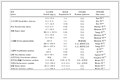
表 1中总结了部分断层带的围岩类型及断层核部的主要矿物和粘土矿物组合. 可以看出断层核部除了具有富集粘土矿物的特征外,围岩类型对断层带内水-岩反应及矿物组合也有重要控制作用. 例如,Chelungpu断层南投钻孔的围岩是砂岩及砾岩等,其断层带粘土矿物含量变化特征是相对富集高岭石和伊利石,长石含量相应减少(Chen et al.,2007); Chelungpu断层地表断层带内的粘土矿物组合主要是蒙脱石、高岭石、伊利石及少量的绿泥石(Isaacs et al.,2007). San Andreas断层带的围岩主要包括花岗质岩石、蛇纹岩及沉积岩等,断层带内富集的主要是含镁的粘土矿物,如绿泥石、绿/蒙混层、皂石、滑石及利蛇纹石等(Solum and van Der Pluijm,2004; Solum et al.,2006; Schleicher et al.,2009,2012; Holdsworth et al.,2011; Lockner et al.,2011). 对Alpine断层带的研究也发现类似的结果(Warr and Cox,2001; Boulton et al.,2012). 汶川地震断裂带(映秀-北川断层)在什邡金河磷矿露头的上盘为花岗岩及基性岩脉体,下盘为白云岩,断层带内含有大量的绿泥石. 而当该断层切穿砂岩及碳酸盐岩时(如赵家沟、八角庙、深溪沟等剖面),断层带内的粘土矿物主要是伊利石、伊/蒙混层等,绿泥石含量相对较少(表 1).
|
表 1 断层带围岩及粘土矿物组合统计表 * 代表从围岩到断层核部含量增加; # 代表从围岩到断层核部含量减少. Qz, 石英; Cal, 方解石; Dol, 白云石; Plg, 斜长石; Bio, 黑云母; Ank, 铁白云石; Sep, 蛇纹石; I, 伊利石; S, 蒙脱石; I/S, 伊/蒙混层; Chl, 绿泥石; Kao, 高岭石; Ms, 白云母. Table 1 Statics of host rocks and clay patterns in fault zone * Content increases from host rocks to fault core; # Content decrease from host rocks to fault core. Qz, quartz; Cal, calcite; Dol, dolomite; Plg, plagioclase; Bio, biotite; Ank, ankerite; Sep, serpentine; I, illite; S, smectite; I/S, mixed layer of illite and smectite; Chl, chlorite; Kao, kaolinite; Ms, muscovite. |
粘土矿物按八面体中阳离子容量可以划分为二八面体型(2/3配位被阳离子占据)和三八面体型(配位全被2价阳离子占据),二八面体型主要包括伊利石、蛭石和蒙脱石等,三八面体型主要是绿/蒙混层、柯绿泥石及含Mg的皂石等(Wu,1978). Haines和vander Pluijm(2012)系统研究了美国科迪勒拉低角度正断层17个地表破碎带的粘土矿物特征发现,围岩由长英质矿物组成的断层带内新生的粘土矿物主要是1Md型伊利石或富含伊利石的伊/蒙混层. 围岩为云母片岩的断层带也有类似的结果(Solum and van Der Pluijm,2009),另外研究者对碎屑沉积岩断层带的研究也表明断层带内的新生粘土矿物主要是伊利石和伊/蒙混层(Solum et al.,2005; Chen et al.,2007). 在这种环境中,碎裂蚀变的云母、长石等矿物为形成伊利石提供了K+. 而当围岩中或者流体中含Mg时,断层带内的新生矿物主要是三八面体的绿泥石、绿/蒙混层及皂石等(图 5)(Warr and Cox,2001; Matsuda et al.,2004; Surace et al.,2011; Boulton et al.,2012; Haines and van der Pluijm,2012).
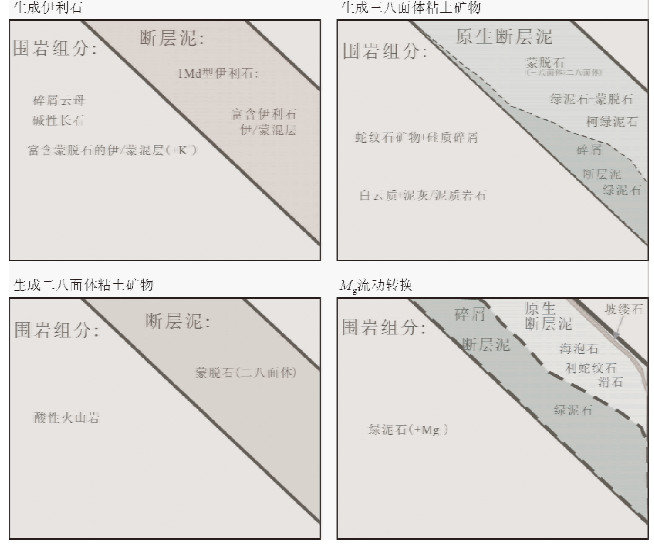 | 图 5 不同围岩断层带内粘土矿物组合示意图(据Haines and van der Pluijm,2012) Fig. 5 Schematic figures showing clay mineral patterns in fault zone with different wall rocks(Haines and van der Pluijm,2012) |
Wintsch等(1995)将花岗质断层带的水-岩反应体系归纳划分为三类: 水控体系,岩控体系和富镁体系,并用流体活度关系图做了描述(图 6). 水控体系中,相对酸性的大气降水渗透到断层带中,会使流体pH值降低,其成分将会落在高岭石的区域内(图 6a),为了达到化学平衡长石将被溶解,并首先沉淀出高岭石,然后是白云母. 这一体系中水/岩比值越大,越有利于上述反应的进行. 在岩控体系中,由于水/岩比值较低,水-岩反应会对流体成分产生较强的影响. 水-岩反应及离子的表面交换会产生碱性氢氧化物和高pH值,这种情况下层状硅酸盐矿物将溶解,并生成长石. 因此随着反应的进行,层状硅酸盐矿物逐渐减少,断裂带岩石的强度将增大. 而在富镁体系中,岩控体系的低级变质组合条件下,钾长石和绿泥石更易于同时沉淀,而在较高级变质过程中,钾长石和绿泥石组合则被白云母和黑云母组合所替代. 因此,在富镁岩石中,无论是水控还是岩控体系,都将有层状硅酸盐矿物不断生成(图 6b). 总结已有研究,断层带内长石蚀变分解形成粘土矿物的流体-岩石反应可能主要包括:
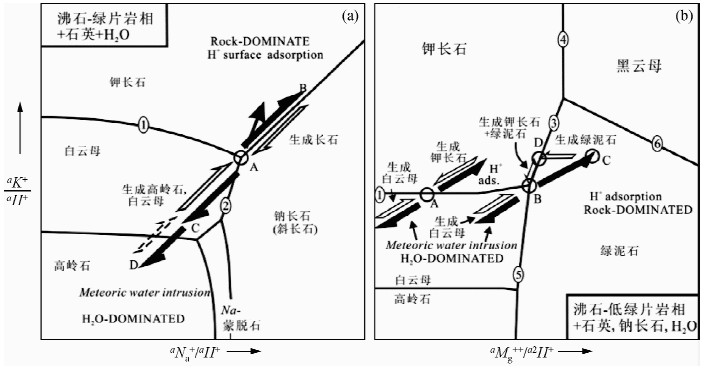 | 图 6 流体反应活度图(据Wintsch et al.,1995)(a)水控体系和岩控体系流体反应图;(b)富镁条件下的流体反应图. Fig. 6 Aqueous activity diagrams(Wintsch et al.,1995)(a)Aqueous activity diagram under water- and rock-dominated system;(b)Aqueous activity diagram under Mg-rich system. |
斜长石+H2O+H+→高岭石+Na++H4SiO4 (Garrels and Christ,1965; Goddard and Evans,1995)
钾长石+H2O+2H+→高岭石+H4SiO4+K+ (Garrels and Christ,1965)
钾长石+H+→云母+SiO2+K+ (Wintsch et al.,1995)
高岭石+SiO2+K+→蒙脱石+H2O+H+ (Goddard and Evans,1995)
斜长石+(Fe,Mg)2++(Fe,Al)3++H2O→绿泥石+SiO2+Na++H+ (杨献忠等,2002)
蒙脱石+(K+,Al3+)→伊利石+(Ca2+,Mg2+)+SiO2+H2O(Pusch and Karnland ,1996)
3.2 流体活动导致的断层带化学成分变化流体在断裂带中运移并参与水-岩反应,造成断裂带化学组成发生变化. 水-岩反应过程中可溶性矿物溶解导致活动性强的元素被流体带走,而相对稳定的元素则留在了断层带中. 这些反应过程持续进行,改变了断层带的地球化学组成,并造成断层带物质流失(Goddard and Evans,1995; Chen et al.,2007,2013b). 根据对断层岩的主量和微量元素地球化学分析,元素在断层带中的行为基本可以划分为两类. 一种是与原岩相比发生亏损(D-型),一种是与原岩相比而发生富集(R-型)的(Tanaka et al.,2001). R-型元素主要是一些高场强元素,这些元素在流体-岩石反应过程中基本不会被带走,因此这些元素通常在断层中富集. D-型元素大多是流体活动性较强的元素,断层岩中的矿物蚀变分解后这些元素通常被流体所带走,表现为相对亏损的特征.
在不同的断层带中其主量元素和微量元素的相对亏损与富集规律存在差别. 碳酸盐岩断层带中亏损的元素多是CaO,CO2等元素,碎屑沉积岩及结晶岩系中亏损的多是长石等相关的碱土类元素. 例如,对Nojima花岗质断层带钻探岩芯的研究显示,断层带内SiO2,K2O,Na2O,Rb,Pb等元素发生较大亏损,一些高场强元素及H2O+和CO2等富集(Tanaka et al.,2001; Matsuda et al.,2004). 分析表明绝大多数元素与H2O+之间存在着明显的正相关或者负相关关系,暗示流体活动控制着断层带的元素行为(Matsuda et al.,2004). 对San Andreas断层带地表几个花岗质断层剖面的研究也同样显示,其流失的元素主要包括Na2O,Al2O3,SiO2,K2O等与长石相关的一些元素(Evans and Chester 1995; Goddard and Evans,1995). 对汶川地震断层带化学组成的研究表明,当围岩为碳酸盐岩时,其流失的元素主要为CaO、MgO、CO2 及一些微量元素(Chen et al.,2013b). 围岩为碎屑沉积岩的断层带流失的元素主要是碳酸盐岩矿物及长石等主要矿物相关的元素(Chen et al.,2007; Isaacs et al.,2007; Schleicher et al.,2009). 不同原岩的断层带内元素变化规律与矿物变化规律具有较好的一致性.
在分析断层带元素迁移时,通常认为TiO2,P2O5,MnO和Zr是最稳定的元素,其次是Al2O3,V及Nb等元素,这些元素通常表现为R-型. 因此通过采用这些稳定元素作为标记,可以评估断层岩所发生的元素迁移程度(Gresens,1967; Grant,1986; O’Hara and Blackburn,1989). 基于这一方法,许多断层带均检测到了不同程度的物质流失. 如对Chelungpu断层钻探岩芯的检测结果显示,断层带不同部位的体积流失量介于13.3%~41.8%之间(Chen et al.,2007); Nojima断层的质量流失量介于13%~65%之间(Tanaka et al.,2001); San Andreas 断层的质量流失量介于17%~58%之间(Schleicher et al.,2009); 汶川地震断层带核部的体积流失量介于83%~93%之间(Chen et al.,2013b). 另外,这些研究也表明断层核部的流失量普遍较破碎带的流失量偏高,其原因一方面是断层核部物质粒度相对较小且经历了较强的水-岩相互作用过程,另一方面是同震摩擦升温对核部可能有较大影响(如矿物热分解等). 断层带内物质流失反映的是断层整个活动历史中水-岩相互作用及物质迁入、迁出的综合结果.
3.3 流体活动导致的断层带同位素成分变化由于经历了流体的淋滤及水-岩相互作用等过程,断层岩的同位素成分也会发生变化. 稳定同位素(δ13C、δ18O)地球化学能够提供流体的来源、水岩比以及水-岩相互作用的基本信息(Kirschner and Kennedy,2001; Pili et al.,2002,2011). 断层带内角砾岩颗粒与流体相互作用程度较小,一般具有与围岩相近的组成. 基质和脉体的同位素组成可能会有较大的变化,而且大多数脉体主要由流体直接沉淀形成,因此脉体很大程度上代表了流体的原始同位素组成(Losh,1997).
研究者对许多断层带的碳和氧同位素分析结果均显示从围岩到断层带逐渐增强的流体活动过程. 例如,对San Andreas断层带的分析结果显示(图 7),碳酸盐岩脉体矿物的δ18O 值介于28‰到15‰间,δ13C值介于5‰到-7‰间,变化值总体显示从围岩到脉体再到破碎基质逐渐降低的趋势,表明向断层核部流体作用逐渐增强(Pili et al.,2002). 对TCDP钻孔样品的分析表明,断层带内的碳酸盐岩脉体的δ18O值介于10‰到20‰之间,胶结物和围岩介于12‰到22‰之间,角砾介于12‰到30‰之间. 碳酸盐岩脉体的δ13C值介于-13‰到-2‰之间,胶结物和围岩介于-11‰到-1‰之间,角砾介于-10‰到-2‰之间. 碳酸盐岩脉体样品的δ18O值随着深度的增加表现出增大的趋势,并且与破裂密度也有较一致的对应关系. 进一步的模拟计算表明δ18O变化主要是由于18O含量相对较低的大气降水及18O含量相对较高的深源流体综合作用导致的. δ13C的分馏特征一定程度上受有机质碳的影响,其综合分布特征也表明流体来源不是单一的(Wang et al.,2010). 对映秀-北川断层的同位素分析结果显示,角砾岩颗粒的同位素结果明显有别于基质以及脉体,前者δ13C值大于-4‰. 角砾岩颗粒、基质以及脉体的δ13C呈现明显的下降趋势. 在断层泥附近发育的脉体具有最低的δ13C和δ18O值(δ13C=-8.0‰和δ18O=19‰). 角砾岩颗粒的δ18O 值(19.7‰~27.8‰)也要大于基质和脉体(19‰~21‰). 造成同位素差异的原因主要是外来流体进入断层,导致脉体矿物沉淀和基质的胶结. 沉淀的流体和角砾岩颗粒进一步相互作用,一定程度上改变了其同位素组成(Chen et al.,2013b). 基于质量守恒的模拟计算结果显示角砾岩颗粒和大气降水间的相互作用可以用来解释角砾岩基质和脉体的同位素特征(Chen et al.,2013b).
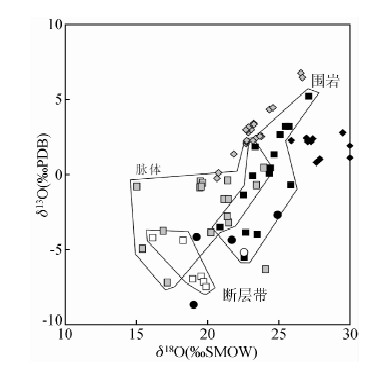 | 图 7 San Andreas断层带围岩、断层带及脉体的δ13C、δ18O同位素分析结果(据Pili et al.,2002) Fig. 7 Stable isotope compositions(δ13C and δ18O)of veins,fault rocks and host rocks from San Andreas Fault zone(Pili et al.,2002) |
另外一些断层带的研究结果显示,跨断层样品(即围岩及不同粒度的断层岩)的δ18O值没有明显变化,可能是由于水-岩相互作用程度较低并没有使同位素发生系统变化(Hayman,2006). 部分研究也显示断层带中局部位置的脉体与围岩的同位素值基本相同(Janssen et al.,2005),这表明流体可能在局部的封闭系统内与围岩达到了平衡,并且脉体可能是围岩经过压溶作用所形成的(Kenis et al.,2000).
4 流体活动的同震效应 4.1 同震热压作用在地震破裂的初始阶段,由于快速摩擦升温导致孔隙流体压力迅速上升,如果此时断层泥的渗透率足够低,瞬间升高的孔隙流体压力无法在很短时间内释放就会造成断层滑动弱化,这一过程称为同震热压作用(Sibson,1973; Andrews,2002; Wibberley and Shimamoto,2005). 热压作用被认为是一种重要的同震滑动弱化机制.
近些年的研究表明,热压作用在一些大地震过程中均有发生,如集集地震(Tanikawa and Shimamoto,2009b; Tanikawa et al.,2009),神户地震(Mizoguchi et al.,2008),汶川地震(Chen et al.,2013a,c)等. 对一些断层带的渗透性实验研究也表明大多数都具备热压作用发生所要求的低渗条件(Lockner et al.,2000; Wibberley and Shimamoto,2003; Uehara and Shimamoto,2004). 热压作用的发生会带来一系列效应,如导致更大的滑动弱化距离(Noda and Shimamoto,2005; Rice,2006),模拟计算结果表明热压作用会使滑动弱化距离达到地震学水平(Mizoguchi et al.,2008). 热压作用还会促进同震断层扩展,导致更大的峰值滑动速率以及破裂速度(Bizzarri and Cocco,2006). 研究还表明,在一条断层带的不同位置热压作用会存在差异. 有迹象显示热压作用与同震地表滑移量具有一致性,即渗透性较低的位置热压作用较强,相应的同震地表滑移量也较大(Chen et al.,2013a,c). Tanikawa和Shimamoto(2009b)模拟并比较了Chelungpu断层南段和北段热压作用,其结果也显示同震热压作用与滑移量具有一定对应关系.
4.2 同震水-岩相互作用同震摩擦升温也会导致矿物成分发生变化,主要是粘土矿物转化、矿物分解、脱水(气)等. 许多断层带都有同震粘土矿物转化的现象,其中蒙脱石向伊利石转化是最普遍的. 在合适的流体参与下,蒙脱石在温度约100~150 ℃范围内即可向伊/蒙混层或伊利石方向转化(Saffer and Marone,2003). 对TCDP钻孔中集集地震断层滑动带的分析显示,黑色断层泥的高岭石和蒙脱石的含量明显低于周围岩石,而伊利石含量相对增加,暗示了伊利石化过程的发生(Hirono et al.,2008). 对Chelungpu断层多个地表露头的分析结果也表明断层带内粘土矿物发生了伊利石化(Isaacs et al.,2007). 磁化率分析结果表明集集地震的同震温度达到了400 ℃以上(Mishima et al.,2006),足以促进伊利石化过程. 汶川地震断层带中也发现了同震伊利石化的现象(Chen et al.,2013b).
同震矿物转化的一个不可忽视的附加效应就是脱水. 蒙脱石向伊利石转化的反应会生成水(Roland and Ola,1996),同震升温也会使得蒙脱石的层间水脱出. 纯蒙脱石断层泥的摩擦滑动实验表明300~400 ℃温度范围内时蒙脱石的结构水开始脱出(马胜利和嶋本利彦,1995). 另外,高速摩擦实验证实了同震蛇纹石脱水(Hirose and Bystricky,2007; Lin et al.,2013)、石膏脱水(Brantut et al.,2011)及碳酸盐矿物分解释放CO2 (Hirono et al.,2006; Mishima et al.,2006; Han et al.,2007)等现象. 野外调查也印证了这些过程(Sulem and Famin,2009; Viti and Hirose,2010; Collettini et al.,2013)的发生. 矿物脱水或脱气对同震动力学过程有重要影响,这些流体的加入会进一步增强热压效应. Hirono等(2008)模拟了集集地震断层的蒙脱石和高岭石同震脱水及蒙脱石的伊利石化过程,结果显示,蒙脱石层间水99%脱出仅需要3.6 s. 高岭石脱羟基需要8.6 s,蒙脱石的脱羟基作用较慢,需要5.4×10⁷ s. 蒙脱石的伊利石化在1.58×10⁸ s时间内(集集地震发生到TCDP钻探)仍未完成. 表明同震期间蒙脱石和高岭石所含的水可以全部脱出,而蒙脱石向伊利石转化则是一个相对漫长的过程. 对汶川地震断层带中蒙脱石脱水可能造成的弱化效应进行估计显示,如果蒙脱石脱去一层水,则在3 km深度下由于脱水可能造成约6.5 MPa的孔隙压上升,如果脱三层层间水,那么这个值将会上升到17.5 MPa(Chen et al.,2013b).
此外,同震快速摩擦生热导致流体温度上升,使得同震水-岩反应快速进行. 该过程对断层核部的矿物及化学成分变化产生显著影响. 对TCDP钻探岩芯的研究表明,集集地震断层带的微量元素及同位素发生了明显的变化. 钻孔中三个不同深度的断层带中Sr元素均发生了明显富集,而Li,Rb,Cs和87Sr/86Sr则发生了不同程度的亏损,Ti,La,Sm和Pb基本没有变化,但是Pb同位素比值明显降低(Ishikawa et al.,2008). 高温水-岩反应实验表明,当温度大于300 ℃以上时Sr,Li,Rb,Cs等这些元素通常不稳定,很容易被流体带走,而Ti,La和Sm元素基本不会发生变化(You et al.,1996; James et al.,2003). 因此,Chelungpu断层带中这些微量元素变化及同位素分馏被解释为同震升温快速水岩反应所导致的(Ishikawa et al.,2008). 进一步的模拟研究显示,如果同震摩擦温度达到350 ℃以上,上述检测到的微量元素变化与同位素分馏可以在10 s内完成(Ishikawa et al.,2008). 基于类似的方法对Shimanto增生楔断层带(Hamada et al.,2011; Honda et al.,2011),Nankai海槽断层带(Hirono et al.,2014),日本中央构造带(Ishikawa et al.,2014)以及阿拉斯加Kodiak断层(Yamaguchi et al.,2014)的研究都得到了类似的结果. 另外同震水-岩相互作用也可以导致一些其他同位素异常,如汞同位素(Zhang et al.,2014).
5 地震周期中流体压力演化及其动力学意义地震活动具有周期性特征(Sibson,1982),在地震的周期性破裂、热液流体注入及裂隙愈合等过程中,断层带的流体压力也会随之演化(图 8). 断层带流体压力的变化具有重要的动力学意义. 主要表现在如下两个相互对立的过程,一是同震破裂导致流体压力释放,断层强度恢复; 二是随着断层愈合,高压流体逐渐积累并导致有效压力降低,促进断层失稳. 许多证据可以证明断层带高孔隙流体压力的存在. 如断层带中广泛发育的水压张裂形成的脉体(Sibson et al.,1975; Cox,1995). 大规模低角度逆冲推覆构造发育的一种解释是断层中存在高压流体(Hubbert and Rubey,1959). 另外SAFOD的异常低的热流值表明断层带具有异常低的摩擦强度,这无法用断层中存在低摩擦系数的断层泥来解释,却可以用断层带中存在高压流体来很好地说明(Rice,1992). 对龙门山断裂带糜棱岩样品的傅里叶红外光谱水含量分析表明,变形越强的样品水含量越高,暗示越靠近断层中心流体含量越高(韩亮等,2013). 基于糜棱岩中流体包裹体的研究表明,龙门山断裂带接近脆塑性转换带深度条件下局部可能存在接近静岩压力的高压流体,断层带内的高压流体被认为是触发高角度逆断层滑动和汶川地震发生的主要机制(周永胜和何昌荣,2009; 周永胜等,2014). 另外,一些断层带的观测结果也表明高压流体(水或气)是引起余震的重要因素(Nur and Booker,1972; Bosl and Nur,2002; Miller et al.,2004).
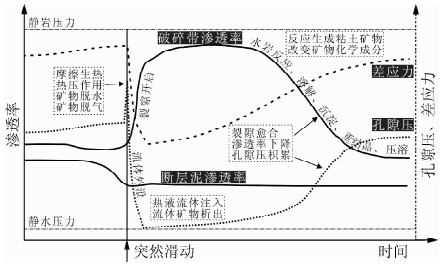 | 图 8 地震周期中断层带渗透性、孔隙流体压力及差应力演化示意图 图中实线代表一个地震周期中渗透率随时间的变化,对应左侧坐标轴; 两条虚线分别代表差应力和孔隙压力的变化情况,对应右侧坐标轴. Fig. 8 Schematic diagram illustrating the evolution of permeability,pore pressure and differential stress during a seismic cycle The solid lines represent the variation trend of permeability of the fault zone during a seismic cycle,corresponding to the left axis; the dashed lines,corresponding to the right axis,represent the variation trend of differential stress and pore pressure,respectively. |
关于断层中高压流体的形成及其触发地震机制,研究者在一些野外地质调查及应力分析的基础上分别提出了不同的理论模型,归纳起来主要有以下五种:
1)Byerlee(1993)的流体室模型. 该模型认为断层带内的水-岩反应、矿物的溶解-沉淀及压溶作用在胶结微裂隙的同时,形成大小不等、相互孤立且饱含流体的“流体室”,在构造变形作用下,封闭在流体室中的流体压力会因压缩而显著上升,甚至超过静岩压力. 持续进行的构造剪切作用可导致流体室水压致裂,高压室的流体向低压室或围岩流动,并可能触发地震.
2)Gudmundsson(1999)的应力下降模型. 该模型认为裂隙中脉体的侵入会改变断层带的局部正应力场,并产生短时间的应力障碍,在应力障碍作用下形成超静水压力甚至静岩压力的流体.
3)Rice(1992)的连续流动模型则认为断层带深部接近塑性区域的深度存在着超静岩压力的流体向上不断注入断层带中,当注入到断层带中的流体大于外泄流体总量时,断层带内则可以维持高压流体.
4)Gold和Soter(1984)的流体域模型认为,当深部岩石中饱含足够多的水,并且含水的裂隙和孔隙互相连通时,这一局部区域就会形成流体域,然后由于浮力的作用流体域会沿断层带上升,在上升过程中可能导致岩石破裂或水压致裂而发生地震.
5)Sibson(1981,1992)的断层阀门模型认为在断层带深部存在大量流体,由于地震破裂作用导致流体被周期性的驱动上升到断层带内. 这一过程中地震如同是开启流体上涌的阀门. Cox(1995)进一步完善了断层阀模型. 需要指出的是上述模型均是理论推导的结果.
近年来,随着观测技术与实验技术的提高,大量野外观测和实验研究逐渐开展,并得到了许多认识. 在野外及钻孔中观测到了地震前后流体压力的变化(Bosl and Nur.,2002; Kitagawa et al.,2006; Kinoshita et al.,2014),震后断层渗透性逐渐降低(Kitagawa et al.,2002,2007; Xue et al.,2013),孔隙流体压力逐渐积累(Hammerschmidt et al.,2013)及地下水或气体异常(黄辅琼等,2000,2002; King et al.,2006; Shi et al.,2013; Lai et al.,2014)等现象. 实验室内基于加载差应力模拟断层失稳滑动的研究表明,岩石在破裂之前渗透性会随着差应力积累而缓慢上升(Tenthorey and Gerald,2006; Hirose and Hyman,2008),当差应力接近临界值时,断层失稳滑动及岩石的扩容等作用导致断层渗透性瞬间升高(Mitchell and Faulkner,2008),震前流体高压降为静水压. 高温高压下的模拟实验表明间震期流体矿物溶解-沉淀、重结晶及压溶等作用会使裂隙逐渐愈合(Brantley et al.,1990; Olsen et al.,1998; Lockner et al.,2000; Morrow et al.,2001; Kato et al.,2003; Polak et al.,2003; Giger et al.,2007),随着愈合程度逐渐增高流体压力又随之积累(Lockner et al.,2000; Tenthorey et al.,2003; Uehara and Shimamoto,2004; Yasuhara et al.,2006; Gratier,2011). 综合这些研究结果,地震周期过程中断层带的流体压力、渗透率及差应力变化情况可以总结为图 8所示的示意图. 相应的一个地震周期内流体-断层相互作用过程可以由如下几个阶段描述.
1)同震阶段: 快速摩擦升温导致流体产生热压效应,矿物受热分解脱水、脱气进一步提高热压作用强度,造成同震滑动弱化. 另外,同震破碎作用造成断层带渗透性提高,导致流体外泄,震前积累的孔隙流体压力下降.
2)震后阶段: 热液流体上涌,并且由于压力降低导致热液矿物沉淀、析出形成脉体,胶结并愈合裂隙; 热液流体的渗入一定程度上也影响了断层带的矿物成分和同位素组成.
3)间震阶段: 持续的水-岩反应导致矿物蚀变分解,生成大量摩擦系数较低的粘土矿物. 流体渗透的同时带走可溶性元素,造成断层带物质流失. 此外,沉淀的流体矿物、新生矿物等填充并胶结裂隙,重结晶、压溶等作用使裂隙逐渐愈合导致渗透性下降,流体压力逐渐积累.
6 结论断层带是地壳中流体活动的重要场所,地震的周期性活动过程中始终伴随着流体的作用. 同震破裂导致大量流体注入到断层带中,渗透到断层带中的流体一方面会改变断层带的物理与力学性质,另一方面流体的存在也会导致断层带的物质组成发生变化. 本文总结了流体在断层带及地震过程中所产生的物理化学效应,主要有如下几点:
(1)地震破碎及流体的溶蚀等作用使得断层核部粒度降低、渗透性下降,跨断层的渗透性结构呈现出“通道/障碍体”的二元系统. 核部的低渗特性为封闭高压流体及同震热压作用等提供物理基础.
(2)水-岩反应使得矿物发生蚀变、分解,生成大量摩擦系数较低的层状硅酸盐矿物,造成断层强度降低. 流体渗透的过程中也会改变断层带的化学成分及同位素组成,水-岩反应发生的同时造成大量可溶性元素被带走,导致断层带大量物质流失. 另外,断层带内的蚀变产物除了受流体成分影响外,主要受围岩类型所控制.
(3)同震快速摩擦生热导致断层带内流体产生热压效应,同时含水矿物的同震脱水及碳酸盐岩矿物脱气等作用进一步增强热压作用,导致同震滑动弱化.
(4)震后及间震期流体矿物沉淀、水-岩反应、重结晶及压溶等作用胶结并逐渐愈合裂隙导致渗透率下降,同时流体压力逐渐积累,直至下次地震破裂. 周期性地震活动过程使得断层带的渗透性和流体压力表现为此消彼长的交替性变化过程.
致 谢 感谢审稿专家提出的修改与指导意见.| [1] | Anderson J L, Osborne R H, Palmer D F. 1983. Cataclastic rocks of the San Gabriel fault-an expression of deformation at deeper crustal levels in the San Andreas fault zone[J]. Tectonophysics, 98(3-4):209-251. |
| [2] | Andrews D J. 2002. A fault constitutive relation accounting for thermal pressurization of pore fluid[J]. J. Geophys. Res., 107(B12):2363, doi:10.1029/2002JB001942. |
| [3] | Billi A. 2007. On the extent of size range and power law scaling for particles of natural carbonate fault cores[J]. Journal of Structural Geology, 29(9):1512-1521. |
| [4] | Bizzarri A, Cocco M. 2006. A thermal pressurization model for the spontaneous dynamic rupture propagation on a three-dimensional fault:1. Methodological approach[J]. J. Geophys. Res., 111:B05303, doi:10.1029/2005JB003862. |
| [5] | Bosl W J, Nur A. 2002. Aftershocks and pore fluid diffusion following the 1992 Landers earthquake[J]. Journal of Geophysical Research:Solid Earth (1978-2012), 107(B12), ESE 17-1. |
| [6] | Boulton C, Carpenter B M, Toy V G, et al. 2012. Physical properties of surface outcrop cataclastic fault rocks, Alpine Fault, New Zealand[J]. Geochemistry, Geophysics, Geosystems, 13, doi:10.1029/2011GC003872. |
| [7] | Brantley S L, Evans B, Hickman S H, et al. 1990. Healing of microcracks in quartz:Implications for fluid flow[J]. Geology, 18(2):136-139. |
| [8] | Brantut N, Han R, Shimamoto T, et al. 2011. Fast slip with inhibited temperature rise due to mineral dehydration:Evidence from experiments on gypsum[J]. Geology, 39(1):59-62. |
| [9] | Byerlee J D. 1993. Model for episodic flow of high-pressure water in fault zones before earthquakes[J]. Geology, 21(4):303-306. |
| [10] | Caine J S, Evans J P, Forster C B. 1996. Fault zone architecture and permeability structure[J]. Geology, 24(11):1025-1028. |
| [11] | Caine J S, Minor S A. 2009. Structural and geochemical characteristics of faulted sediments and inferences on the role of water in deformation, Rio Grande Rift, New Mexico[J]. Geological Society of America Bulletin, 121(9-10):1325-1340. |
| [12] | Chen J Y, Yang X S. 2012. Permeability of earthquake faults[J]. Earth Science Frontiers (in Chinese), 19(4):30-40. |
| [13] | Chen J Y, Yang X S. 2014. Characteristics of particle size distribution of the Wenchuan earthquake fault zone:insights for cataclastic mechanisms[J]. Seismology and Geology (in Chinese), 36(2):368-379. |
| [14] | Chen J Y, Yang X S, Dang J X, et al. 2011. Internal structure and permeability of Wenchuan earthquake fault[J]. Chinese Journal of Geophysics (in Chinese), 54(7):1805-1816, doi:10.3969/j.issn.0001-5733.2011.07.014. |
| [15] | Chen J Y, Yang X S, Duan Q B, et al. 2013a. Importance of thermochemical pressurization in the dynamic weakening of the Longmenshan fault during the 2008 Wenchuan earthquake:inferences from experiments and modeling[J]. J. Geophys. Res., 118(8):4145-4169. |
| [16] | Chen J Y, Yang X S, Ma S L, et al. 2013b. Mass removal and clay mineral dehydration/rehydration in carbonate-rich surface exposures of the 2008 Wenchuan Earthquake fault:geochemical evidence and implications for fault zone evolution and coseismic slip[J]. Journal of Geophysical Research:Solid Earth, 118(2):474-496. |
| [17] | Chen J Y, Yang X S, Yao L, et al. 2013c. Frictional and transport properties of the 2008 Wenchuan Earthquake fault zone:Implications for coseismic slip-weakening mechanisms[J]. Tectonophysics, 603:237-256. |
| [18] | Chen W D, Tanaka H, Huang H J, et al. 2007. Fluid infiltration associated with seismic faulting:Examining chemical and mineralogical compositions of fault rocks from the active Chelungpu fault[J]. Tectonophysics, 443(3-4):243-254. |
| [19] | Chester F M, Evans J P, Biegel R L. 1993. Internal structure and weakening mechanisms of the San Andreas fault[J]. Journal of Geophysical Research:Solid Earth, 98(B1):771-786. |
| [20] | Collettini C, Viti C, Tesei T, et al. 2013. Thermal decomposition along natural carbonate faults during earthquakes[J]. Geology, 41(8):927-930. |
| [21] | Cox S F. 1995. Faulting processes at high fluid pressures:An example of fault valve behavior from the Wattle Gully Fault, Victoria, Australia[J]. Journal of Geophysical Research:Solid Earth, 100(B7):12841-12859. |
| [22] | Dang J X, Zhou Y S, Han L, et al. 2012. X-Ray diffraction analysis result of co-seismic fault gouge in carbon mudstone at outcrops of Bajiaomiao and Shenxigou in Hongkou[J]. Seismology and Geology (in Chinese), 34(1):17-27. |
| [23] | Doan M L, Brodsky E E, Kano Y, et al. 2006. In situ measurement of the hydraulic diffusivity of the active Chelungpu Fault, Taiwan[J]. Geophysical Research Letters, 33(16):L16317, doi:10.1029/2006GL026889. |
| [24] | Duan Q B, Yang X S. 2014. Experimental studies on gas and water permeability of fault rocks from the rupture of the 2008 Wenchuan earthquake, China[J]. Science China Earth Sciences, 57(11):2825-2834, doi:10.1007/s11430-014-4948-7. |
| [25] | Duan Q B, Yang X S, Chen J Y. 2014. Gas permeability and Klinkenberg effect of fault rocks[J]. Seismology and Geology (in Chinese), 36(4):964-975. |
| [26] | Evans J P, Chester F M. 1995. Fluid-rock interaction in faults of the San Andreas system:Inferences from San Gabriel fault rock geochemistry and microstructures[J]. Journal of Geophysical Research, 100(B7):13007-13013. |
| [27] | Evans J P, Forster C B, Goddard J V. 1997. Permeability of fault-related rocks, and implications for hydraulic structure of fault zones[J]. J. Struc. Geol., 19(11):1393-1404. |
| [28] | Faulkner D R, Jackson C A L, Lunn R J, et al. 2010. A review of recent developments concerning the structure, mechanics and fluid flow properties of fault zones[J]. Journal of Structural Geology, 32(11):1557-1575. |
| [29] | Faulkner D R, Rutter E H. 2000. Comparisons of water and argon permeability in natural clay-bearing fault gouge under high pressure at 20℃[J]. J. Geophys. Res., 105(B7):16415-16426. |
| [30] | Faulkner D R, Rutter E H. 2003. The effect of temperature, the nature of the pore fluid, and subyield differential stress on the permeability of phyllosilicate-rich fault gouge[J]. J. Geophys. Res., 108(B5):2227, doi:10.1029/2001JB001581. |
| [31] | Fujimoto K, Ueda A, Ohtani T, et al. 2007. Borehole water and hydrologic model around the Nojima fault, SW Japan[J]. Tectonophysics, 443(3-4):174-182. |
| [32] | Garrels R M, Christ C L. 1965. Solutions, Minerals and Equilibria[M]. New York:Harper and Row, 325-370. |
| [33] | Giger S B, Tenthorey E, Cox S F, et al. 2007. Permeability evolution in quartz fault gouges under hydrothermal conditions[J]. Journal of Geophysical Research:Solid Earth, 112(B7):B07202, doi:10.1029/2006JB 004828. |
| [34] | Goddard J V, Evans J P. 1995. Chemical changes and fluid-rock interaction in faults of crystalline thrust sheets, northwestern Wyoming, U.S.A.[J]. Journal of Structural Geology, 17(4):533-547. |
| [35] | Gold T, Soter S. 1984. Fluid ascent through the solid lithosphere and its relation to earthquakes[J]. Pure and Applied Geophysics, 122(2-4):492-530. |
| [36] | Grant J A. 1986. The isocon diagram; a simple solution to Gresens' equation for metasomatic alteration[J]. Economic Geology, 81(8):1976-1982. |
| [37] | Gratier J P. 2011. Fault permeability and strength evolution related to fracturing and healing episodic processes (years to millennia):the role of pressure solution[J]. Oil & Gas Science and Technology, 66(3):491-506. |
| [38] | Gratier J P, Favreau P, Renard F, et al. 2002. Fluid pressure evolution during the earthquake cycle controlled by fluid flow and pressure solution crack sealing[J]. Earth, Planets and Space, 54(11):1139-1146. |
| [39] | Gratier J P, Renard F, Vial B. 2014. Postseismic pressure solution creep:Evidence and time-dependent change from dynamic indenting experiments[J]. Journal of Geophysical Research:Solid Earth, 119(4):2764-2779. |
| [40] | Gresens R L. 1967. Composition-volume relationships of metasomatism[J]. Chemical Geology, 2:47-65. |
| [41] | Gudmundsson A. 1999. Fluid overpressure and stress drop in fault zones[J]. Geophysical Research Letters, 26(1):115-18. |
| [42] | Gudmundsson A, Berg S S, Lyslo K B, et al. 2001. Fracture networks and fluid transport in active fault zones[J]. Journal of Structural Geology, 23(2-3):343-353. |
| [43] | Haines S H, van der Pluijm B A. 2012. Patterns of mineral transformations in clay gouge, with examples from low-angle normal fault rocks in the western USA[J]. Journal of Structural Geology, 43:2-32. |
| [44] | Hamada Y, Hirono T, Ishikawa T. 2011. Coseismic frictional heating and fluid-rock interaction in a slip zone within a shallow accretionary prism and implications for earthquake slip behavior[J]. Journal of Geophysical Research:Solid Earth, 116(B1), doi:10.1029/2010JB007730. |
| [45] | Hammerschmidt S, Davis E E, Kopf A. 2013. Fluid pressure and temperature transients detected at the Nankai Trough Megasplay Fault:results from the SmartPlug borehole observatory[J]. Tectonophysics, 600:116-133. |
| [46] | Han L, Zhou Y S, Yao W M. 2013. A simulating experimental study on crack healing and the formation of high pore fluid pressure in faults of middle crust[J]. Chinese Journal of Geophysics (in Chinese), 56(1):91-105. |
| [47] | Han R, Shimamoto T, Hirose T, et al. 2007. Ultralow friction of carbonate faults caused by thermal decomposition[J]. Science, 316(5826):878-881. |
| [48] | Hayman N W. 2006. Shallow crustal fault rocks from the Black Mountain detachments, Death Valley, CA[J]. Journal of Structural Geology, 28(10):1767-1784. |
| [49] | He C R, Wang Z L, Yao W M. 2007. Frictional sliding of gabbro gouge under hydrothermal conditions[J]. Tectonophysics, 445(3-4):353-362. |
| [50] | Hickman S, Sibson R, Bruhn R. 1995. Introduction to special section:Mechanical involvement of fluids in faulting[J]. J. Geophys. Res., 100(B7):12831-12840. |
| [51] | Hirono T, Fujimoto K, Yokoyama T, et al. 2008. Clay mineral reactions caused by frictional heating during an earthquake:An example from the Taiwan Chelungpu fault[J]. Geophysical Research Letters, 35(16):L16303. |
| [52] | Hirono T, Ikehara M, Otsuki K, et al. 2006. Evidence of frictional melting from disk-shaped black material, discovered within the Taiwan Chelungpu fault system[J]. Geophysical Research Letters, 33:L19311, doi:10.1029/2006GL027329. |
| [53] | Hirono T, Ishikawa T, Masumoto H, et al. 2014. Re-evaluation of frictional heat recorded in the dark gouge of the shallow part of a megasplay fault at the Nankai Trough[J]. Tectonophysics, 626:157-169. |
| [54] | Hirose T, Bystricky M. 2007. Extreme dynamic weakening of faults during dehydration by coseismic shear heating[J]. Geophys. Res. Lett., 34:L14311, doi:10.1029/2007GL030049. |
| [55] | Hirose T, Hayman N W. 2008. Structure, permeability, and strength of a fault zone in the footwall of an oceanic core complex, the Central Dome of the Atlantis Massif, Mid-Atlantic Ridge, 30°N[J]. Journal of Structure Geology, 30(8):1060-1071. |
| [56] | Holdsworth R E, Van Diggelen E W E, Spiers C J, et al. 2011. Fault rocks from the SAFOD core samples:implications for weakening at shallow depths along the San Andreas Fault, California[J]. Journal of Structural Geology, 33(2):132-144. |
| [57] | Honda G, Ishikawa T, Hirono T, et al. 2011. Geochemical signals for determining the slip-weakening mechanism of an ancient megasplay fault in the Shimanto accretionary complex[J]. Geophys. Res. Lett., 38(6):L06310, doi:10.1029/2011GL046722. |
| [58] | Huang F Q, Chi G C, Xu G M, et al. 2000. Research on the response anomalies of subsurface fluid in mainland monitoring network to the Nantou earthquake with MS 7. 6[J]. Earthquake (in Chinese), 20(z1):119-125. |
| [59] | Huang F Q, Deng Z H, Gu J P, et al. 2002. Research of the field of subsurface fluid anomalies before the Zhangbei earthquake[J]. Earthquake (in Chinese), 22(4):114-122. |
| [60] | Hubbert M K, Rubey W W. 1959. Role of fluid pressure in mechanics of overthrust faulting I. Mechanics of fluid-filled porous solids and its application to overthrust faulting[J]. Geological Society of America Bulletin, 70(2):115-166. |
| [61] | Isaacs A J, Evans J P, Song S R, et al. 2007. Structural, mineralogical, and geochemical characterization of the Chelungpu thrust fault, Taiwan[J]. Terrestrial, Atmospheric and Oceanic Sciences, 18(2):183-221. |
| [62] | Ishikawa T, Tanimizu M, Nagaishi K, et al. 2008. Coseismic fluid-rock interactions at high temperatures in the Chelungpu fault[J]. Nature Geoscience, 1(10):679-683. |
| [63] | Ishikawa T, Hirono T, Matsuta N, et al. 2014. Geochemical and mineralogical characteristics of fault gouge in the Median Tectonic Line, Japan:evidence for earthquake slip[J]. Earth, Planets and Space, 66:36. |
| [64] | James R H, Allen D E, Seyfried W E Jr. 2003. An experimental study of alteration of oceanic crust and terrigenous sediments at moderate temperatures (51 to 350℃):Insights as to chemical processes in near-shore ridge-flank hydrothermal systems[J]. Geochim. Cosmochim. Acta, 67(4):681-691. |
| [65] | Janssen C, Romer R L, Hoffmann-Rothe A, et al. 2005. The role of fluids in faulting deformation:a case study from the Dead Sea Transform (Jordan)[J]. Int. J. Earth Sci., 94(2):243-255. |
| [66] | Kato A, Sakaguchi A, Yoshida S, et al. 2003. Permeability measurements and precipitation sealing of basalt in an ancient exhumed subduction-zone fault[J]. Bull. Earthq. Res. Inst. Univ., 78:83-89. |
| [67] | Kenis I, Muchez P H, Sintubin M, et al. 2000. The use of a combined structural, stable isotope and fluid inclusion study to constrain the kinematic history at the northern Variscan front zone (Bettrechies, northern France)[J]. J. Struct. Geol., 22(5):589-602. |
| [68] | Kennedy B M, Kharaka Y K, Evans W C, et al. 1997. Mantle fluids in the San Andreas fault system, California[J]. Science, 278(5341):1278-1281. |
| [69] | Kerrich R, Hyndman D. 1986. Thermal and fluid regimes in the Bitterroot lobe-Sapphire block detachment zone, Montana:Evidence from 18O/16O and geologic relations[J]. Geological Society of America Bulletin, 97(2):147-155. |
| [70] | Kerrich R, La Tour T, Willmore L. 1984. Fluid participation in deep fault zones:Evidence from geological, geochemical, and 18O/16O relations[J]. Journal of Geophysical Research:Solid Earth, 89:4331-4343. |
| [71] | Kerrich R, Kamineni D C. 1988. Characteristics and chronology of fracture-fluid infiltration in the Archean, Eye Dashwa Lakes pluton, Superior Province:evidence from H, C, O-isotopes and fluid inclusions[J]. Contributions to Mineralogy and Petrology, 99(4):430-445. |
| [72] | King C Y,Zhang W,Zhang Z C. 2006. Earthquake-induced groundwater and gas changes[J]. Pure and Applied Geophysics, 163(4):633-645. |
| [73] | Kinoshita C, Kano Y, Ito H. 2014. Change of Permeability Caused by 2011 Tohoku Earthquake Detected from Pore Pressure Monitoring[Z]. AOGS abstract, SE09-A004. |
| [74] | Kirschner D L, Kennedy L A. 2001. Limited syntectonic fluid flow in carbonate-hosted thrust faults of the Front Ranges, Canadian Rockies, inferred from stable isotope data and structures[J]. J.Geophys.Res.,106(B5):8827-8840,doi:10.1029/2000JB900414. |
| [75] | Kitagawa Y, Fujimori K, Koizumi N. 2002. Temporal change in permeability of the rock estimated from repeated water injection experiments near the Nojima fault in Awaji Island, Japan[J]. Geophysical Research Letters, 29(10):1483, doi:10.1029/2001GL014030. |
| [76] | Kitagawa Y, Fujimori K, Koizumi N. 2007. Temporal change in permeability of the Nojima fault zone by repeated water injection experiments[J]. Tectonophysics, 443(3-4):183-192. |
| [77] | Kitagawa Y, Koizumi N, Takahashi M, et al. 2006. Changes in groundwater levels or pressures associated with the 2004 earthquake off the west coast of northern Sumatra (M 9. 0)[J]. Earth, Planets and Space, 58(2):173-179. |
| [78] | Kuo L W, Song S R, Yeh E C, et al. 2012. Clay mineralogy and geochemistry investigations in the host rocks of the Chelungpu fault, Taiwan:Implication for faulting mechanism[J]. Journal of Asian Earth Sciences, 59:208-218. |
| [79] | Lai G J, Ge H K, Xue L, et al. 2014. Tidal response variation and recovery following the Wenchuan earthquake from water level data of multiple wells in the nearfield[J]. Tectonophysics, 619-620:115-122. |
| [80] | Lee D E, Friedman I, Gleason J D. 1984. Modification of δD values in eastern Nevada granitoid rocks spatially related to thrust faults[J]. Contributions to Mineralogy and Petrology, 88(3):288-298. |
| [81] | Li H B, Wang H, Xu Z Q, et al. 2013. Characteristics of the fault-related rocks, fault zones and the principal slip zone in the Wenchuan Earthquake Fault Scientific Drilling Project Hole-1(WFSD-1)[J]. Tectonophysics, 584:23-42. |
| [82] | Lin A, Tanaka N, Uda S, et al. 2003. Repeated coseismic infiltration of meteoric and seawater into deep fault zones:a case study of the Nojima fault zone, Japan[J]. Chemical Geology, 202(1-2):139-153. |
| [83] | Lin A M, Takano S, Hirono T, et al. 2013. Coseismic dehydration of serpentinite:Evidence from high-velocity friction experiments[J]. Chemical Geology, 344:50-62. |
| [84] | Lockner D, Naka H, Tanaka H, et al. 2000. Permeability and strength of core samples from the Nojima fault of the 1995 Kobe earthquake[C].//Proceedings of the international workshop on the Nojima fault core and borehole data analysis. US Geol. Sur., 22-23. |
| [85] | Lockner D A, Morrow C, Moore D, et al. 2011. Low strength of deep San Andreas fault gouge from SAFOD core[J]. Nature, 472(7341):82-85. |
| [86] | Losh S. 1997. Stable isotope and modeling studies of fluid-rock interaction associated with the Snake Range and Mormon Peak detachment faults, Nevada[J]. The Geological Society of America Bulletin, 109(3):300-323. |
| [87] | Lu Z, He C R. 2014. The frictional strength and stability of biotite under hydrothermal conditions[J]. Chinese Journal of Geophysics (in Chinese), 57(4):1123-1132, doi:10.6038/cjg20140410. |
| [88] | Ma S L, Shimamoto T. 1995. Effect of dehydration of montmorillonite on constitutive behavior of friction[J]. Seismology and Geology (in Chinese), 17(4):289-304. |
| [89] | Marrett R, Ortega O J, Kelsey C M. 1999. Extent of power-law scaling for natural fractures in rock[J]. Geology, 27(9):799-802. |
| [90] | Matsuda T, Omura K, Ikeda R, et al. 2004. Fracture-zone conditions on a recently active fault:Insights from mineralogical and geochemical analyses of the Hirabayashi NIED drill core on the Nojima fault, southwest Japan, which ruptured in the 1995 Kobe earthquake[J]. Tectonophysics, 378(3-4):143-163. |
| [91] | Miller S A, Collettini C, Chiaraluce L, et al. 2004. Aftershocks driven by a high-pressure CO2 source at depth[J]. Nature, 427(6976):724-727. |
| [92] | Mishima T, Hirono W, Soh S, et al. 2006. Thermal history estimation of the Taiwan Chelungpu fault using rock-magnetic methods[J]. Geophys. Res. Lett., 33(23):L23311, doi:10.1029/2006GL028088. |
| [93] | Mitchell T M, Faulkner D R. 2008. Experimental measurements of permeability evolution during triaxial compression of initially intact crystalline rocks and implications for fluid flow in fault zones[J]. Journal of Geophysical Research:Solid Earth, 113(B11), doi:10.1029/2008JB005588. |
| [94] | Mizoguchi K, Hirose T, Shimamoto T, et al. 2008. Internal structure and permeability of the Nojima fault, southwest Japan[J]. Journal of Structural Geology, 30(4):513-524. |
| [95] | Morrow C A, Moore D E, Lockner D A. 2001. Permeability reduction in granite under hydrothermal conditions[J]. Journal of Geophysical Research:Solid Earth, 106(B12):30551-30560. |
| [96] | Morrow C A, Shi L Q, Byerlee J D. 1981. Permeability and strength of San Andreas fault gouge under high pressure[J]. Geophys. Res. Lett., 8(4):325-328. |
| [97] | Noda H, Shimamoto T. 2005. Thermal pressurization and slip-weakening distance of a fault:An example of the Hanaore fault, southwest Japan[J]. Bulletin of the Seismological Society of America, 95(4):1224-1233. |
| [98] | Nur A, Booker, J R. 1972. Aftershocks caused by pore fluid flow?. Science, 175(4024):885-887, doi:10.1126/science.175.4024.885. |
| [99] | O'Hara K, Blackburn W H. 1989. Volume-loss model for trace-element enrichments in mylonites[J]. Geology, 17(6):524-527. |
| [100] | Olsen M P, Scholz C H, Léger A. 1998. Healing and sealing of a simulated fault gouge under hydrothermal conditions:Implications for fault healing[J]. Journal of Geophysical Research:Solid Earth, 103(B4):7421-7430. |
| [101] | Pili é, Kennedy B M, Conrad M E, et al. 2011. Isotopic evidence for the infiltration of mantle and metamorphic CO2-H2O fluids from below in faulted rocks from the San Andreas Fault system[J]. Chem. Geol., 281(3-4):242-252. |
| [102] | Pili é, Poitrasson F, Gratier J P. 2002. Carbon-oxygen isotope and trace element constraints on how fluids percolate faulted limestones from the San Andreas Fault system:partitioning of fluid sources and pathways[J]. Chemical Geology, 190(1-4):231-250. |
| [103] | Polak A, Elsworth D, Yasuhara H, et al. 2003. Permeability reduction of a natural fracture under net dissolution by hydrothermal fluids[J]. Geophysical Research Letters, 30(20), doi:10.1029/2003GL017575. |
| [104] | Pusch R, Karnland O. 1996. Physico/chemical stability of smectite clays[J]. Engineering Geology, 41(1-4):73-85. |
| [105] | Ren F Y, He C R. 2014. An experimental study of frictional sliding of granitic mylonite under hydrothermal conditions[J]. Chinese Journal of Geophysics (in Chinese), 57(3):877-883, doi:10.6038/cjg20140317. |
| [106] | Rice J R. 1992. Fault stress states, pore pressure distributions, and the weakness of the San Andreas fault[J]. International Geophysics, 51:475-503. |
| [107] | Rice J R. 2006. Heating and weakening of faults during earthquake slip[J]. J. Geophys. Res., 111:B05311, doi:10.1029/2005JB004006. |
| [108] | Saffer D M, Marone C. 2003. Comparison of smectite-and illite-rich gouge frictional properties:Application to the updip limit of the seismogenic zone along subduction megathrusts[J]. Earth Planet. Sci. Lett., 215(1-2):219-235. |
| [109] | Schleicher A M, Tourscher S N, van der Pluijm B A, et al. 2009. Constraints on mineralization, fluid-rock interaction, and mass transfer during faulting at 2-3 km depth from the SAFOD drill hole[J]. Journal of Geophysical Research:Solid Earth, 114, doi:10.1029/2008JB006092. |
| [110] | Schleicher A M, van der Pluijm B A, Warr L N. 2012. Chlorite-smectite clay minerals and fault behavior:new evidence from the San Andreas Fault Observatory at Depth (SAFOD) core[J]. Lithosphere, 4(3):209-229. |
| [111] | Shi Z M, Wang G C, Liu C L. 2013. Co-seismic groundwater level changes induced by the May 12, 2008 Wenchuan earthquake in the near field[J]. Pure and Applied Geophysics, 170(11):1773-1783. |
| [112] | Si J L, Li H B, Kuo L W, et al. 2014. Clay mineral anomalies in the Yingxiu-Beichuan fault zone from the WFSD-1 drilling core and its implication for the faulting mechanism during the 2008 Wenchuan earthquake (Mw 7. 9)[J]. Tectonophysics, 619-620:171-178. |
| [113] | Sibson R H. 1973. Interactions between temperature and pore-?uid pressure during earthquake faulting and a mechanism for partial or total stress relief[J]. Nature, 243(126):66-68, doi:10.1038/physci243066a0. |
| [114] | Sibson R H, Moore J M, Rankin A H. 1975. Seismic pumping-a hydrothermal fluid transport mechanism[J]. Journal of the Geological Society, 131(6):653-659. |
| [115] | Sibson R H. 1977. Fault rocks and fault mechanisms[J]. Journal of the Geological Society, 133(3):191-213. |
| [116] | Sibson R H. 1981. Fluid flow accompanying faulting:field evidence and models[J]. Earthquake Prediction, 4:593-603. |
| [117] | Sibson R H. 1982. Fault zone models, heat flow, and the depth distribution of earthquakes in the continental crust of the United States[J]. Bulletin of the Seismological Society of America, 72(1):151-163. |
| [118] | Sibson R H. 1992. Implications of fault-valve behaviour for rupture nucleation and recurrence[J]. Tectonophysics, 211(1-4):283-293. |
| [119] | Sibson R H, Robert F, Poulsen H. 1988. High-angle reverse faults, fluid-pressure cycling, and mesothermal gold-quartz deposits[J]. Geology, 16(6):551-555. |
| [120] | Solum J G, Hickman S H, Lockner D A, et al. 2006. Mineralogical characterization of protolith and fault rocks from the SAFOD main hole[J]. Geophysical Research Letters, 33, doi:10.1029/2006GL027285. |
| [121] | Solum J G, van Der Pluijm B A. 2004. Phyllosilicate mineral assemblages of the SAFOD Pilot Hole and comparison with an exhumed segment of the San Andreas Fault System[J]. Geophysical Research Letters, 31:L15S19, doi:10.1029/2004GL019909. |
| [122] | Solum J G, van der Pluijm B A. 2009. Quantification of fabrics in clay gouge from the Carboneras fault, Spain and implications for fault behavior[J]. Tectonophysics, 475(3-4):554-562. |
| [123] | Solum J G, van der Pluijm B A, Peacor D R. 2005. Neocrystallization, fabrics and age of clay minerals from an exposure of the Moab Fault, Utah[J]. Journal of Structural Geology, 27(9):1563-1576. |
| [124] | Storti F, Billi A, Salvini F. 2003. Particle size distributions in natural carbonate fault rocks:insights for non-self-similar cataclasis[J]. Earth and Planetary Science Letters, 206(1-2):173-186. |
| [125] | Sulem J, Famin V. 2009. Thermal decomposition of carbonates in fault zones:Slip-weakening and temperature-limiting effects[J]. Journal of Geophysical Research:Solid Earth, 114(B3), doi:10.1029/2008JB006004. |
| [126] | Surace I R, Clauer N, Thélin P, et al. 2011. Structural analysis, clay mineralogy and K-Ar dating of fault gouges from Centovalli Line (Central Alps) for reconstruction of their recent activity[J]. Tectonophysics, 510(1-2):80-93. |
| [127] | Tanaka H, Fujimoto K, Ohtani T, et al. 2001. Structural and chemical characterization of shear zones in the freshly activated Nojima fault, Awaji Island, southwest Japan[J]. Journal of Geophysical Research, 106(B5):8789-8810. |
| [128] | Tanikawa W, Sakaguchi M, Hirono T, et al. 2009. Transport properties and dynamic processes in a fault zone from samples recovered from TCDP Hole B of the Taiwan Chelungpu Fault Drilling Project[J]. Geochemistry, Geophysics, Geosystems, 10(4), doi:10.1029/2008GC002269. |
| [129] | Tanikawa W, Shimamoto T. 2009a. Comparison of Klinkenberg-corrected gas permeability and water permeability in sedimentary rocks[J]. International Journal of Rock Mechanics and Mining Sciences, 46(2):229-238. |
| [130] | Tanikawa W, Shimamoto T. 2009b. Frictional and transport properties of the Chelungpu fault from shallow borehole data and their correlation with seismic behavior during the 1999 Chi-Chi earthquake[J]. Journal of Geophysical Research:Solid Earth, 114(B1), doi:10.1029/2008JB005750. |
| [131] | Tenthorey E, Cox S F, Todd H F. 2003. Evolution of strength recovery and permeability during fluid-rock reaction in experimental fault zones[J]. Earth and Planetary Science Letters, 206(1-2):161-172. |
| [132] | Tenthorey E, Gerald J D F. 2006. Feedbacks between deformation, hydrothermal reaction and permeability evolution in the crust:Experimental insights[J]. Earth and Planetary Science Letters, 247(1-2):117-129. |
| [133] | Uehara S I, Shimamoto T. 2004. Gas permeability evolution of cataclasite and fault gouge in triaxial compression and implications for changes in fault-zone permeability structure through the earthquake cycle[J]. Tectonophysics, 378(3-4):183-195. |
| [134] | Viti C, Hirose T. 2010. Thermal decomposition of serpentine during coseismic faulting:Nanostructures and mineral reactions[J]. Journal of Structural Geology, 32(10):1476-1484. |
| [135] | Vrolijk P, van der Pluijm B A. 1999. Clay gouge[J]. Journal of Structural Geology, 21(8-9):1039-1048. |
| [136] | Wang P L, Wu J J, Yeh E C, et al. 2010. Isotopic constraints of vein carbonates on fluid sources and processes associated with the ongoing brittle deformation within the accretionary wedge of Taiwan[J]. Terra Nova, 22(4):251-256. |
| [137] | Warr L N, Cox S. 2001. Clay mineral transformations and weakening mechanisms along the Alpine Fault, New Zealand[J]. Geological Society, London, Special Publications, 186(1):85-101. |
| [138] | Whitmeyer S J, Wintsch R P. 2005. Reaction localization and softening of texturally hardened mylonites in a reactivated fault zone, central Argentina[J]. J. Meta. Geology, 23(6):411-424. |
| [139] | Wibberley C A J, Shimamoto T. 2003. Internal structure and permeability of major strike-slip fault zones:the Median Tectonic Line in Mie Prefecture, Southwest Japan[J]. Journal of Structural Geology, 25(1):59-78. |
| [140] | Wibberley C A J, Shimamoto T. 2005. Earthquake slip weakening and asperities explained by thermal pressurization[J]. Nature, 436(7051):689-692. |
| [141] | Wintsch R P, Christoffersen R, Kronenberg A K. 1995. Fluid-rock reaction weakening of fault zones[J]. Journal of Geophysical Research, 100(B7):13021-13013. |
| [142] | Wu F T. 1978. Mineralogy and physical nature of clay gouge[J]. Pure and Applied Geophysics, 116(4):655-689. |
| [143] | Wu F T, Blatter L, Roberson H. 1975. Clay gouges in the San Andreas fault system and their possible implications[J]. Pure and Applied Geophysics, 113(1):87-95. |
| [144] | Xue L, Li H B, Brodsky E E, et al. 2013. Continuous permeability measurements record healing inside the Wenchuan Earthquake Fault Zone[J]. Science, 340(6140):1555-1559. |
| [145] | Yamaguchi A, Ishikawa T, Kato Y, et al. 2014. Fluid-rock interaction recorded in black fault rocks in the Kodiak accretionary complex, Alaska[J]. Earth, Planets and Space, 66:58. |
| [146] | Yang X S, Chen J Y, Duan Q B, et al. 2014. Geochemical and petrophysical responses to fluid processes within seismogenic fault zones:Implications from mineralogical, petro-chemical and petrophysical data[J]. Seismology and Geology (in Chinese), 36(3):862-881. |
| [147] | Yang X Z, Yang Z L, Tao K Y, et al. 2002. Formation temperature of chlorite in oil-bearing basalt[J]. Acta Mineralogica Sinica (in Chinese), 22(4):365-370. |
| [148] | Yasuhara H, Polak A, Mitani Y, et al. 2006. Evolution of fracture permeability through fluid-rock reaction under hydrothermal conditions[J]. Earth and Planetary Science Letters, 244(1-2):186-200. |
| [149] | You C F, Castillo P R, Gieskes J M, et al. 1996. Trace element behavior in hydrothermal experiments:Implications for fluid processes at shallow depths in subduction zones[J]. Earth Planet. Sci. Lett., 140(1-4):41-52. |
| [150] | Zhang L, Liu Y W, Guo L S, et al. 2014. Isotope geochemistry of mercury and its relation to earthquake in the Wenchuan Earthquake Fault Scientific Drilling Project Hole-1(WFSD-1)[J]. Tectonophysics, 619-620:79-85. |
| [151] | Zhang Y Y, Zhou Y S. 2012. The strength and deformation mechanisms of brittle-plastic transition zone, and the effects of strain rate and fluids[J]. Seismology and Geology (in Chinese), 34(1):172-194. |
| [152] | Zhang Z M. 1998. Study of crustal fluid in the Germany continental scientific deep drilling program[J]. Geological Science and Technology Information (in Chinese), 17(2):7-12. |
| [153] | Zhao D P, Kanamori H, Negishi H, et al. 1996. Tomography of the source area of the 1995 Kobe earthquake:Evidence for fluids at the hypocenter?[J]. Science, 274(5294):1891-1894. |
| [154] | Zhou Y S, He C R. 2009. The rheological structures of crust and mechanics of high-angle reverse fault slip for Wenchuan Ms8. 0 earthquake[J]. Chinese Journal of Geophysics (in Chinese), 52(2):474-484. |
| [155] | Zhou Y S, Han L, Jing C, et al. 2014. The rheological structures of brittle-plastic transition in Longmenshan fault zone and seismogenic mechanism of Wenchuan earthquake[J]. Seismology and Geology (in Chinese), 36(3):882-895. |
| [156] | 陈建业,杨晓松,党嘉祥,等. 2011.汶川地震断层带结构及渗透率[J].地球物理学报, 54(7):1805-1816, doi:10.3969/j.issn.0001-5733.2011.07.014. |
| [157] | 陈建业,杨晓松. 2012.地震断层的渗透性[J].地学前缘, 19(4):30-40. |
| [158] | 陈建业,杨晓松. 2014.汶川地震断裂带粒度分布特征:对地震碎裂机制的约束[J].地震地质, 36(2):368-379. |
| [159] | 党嘉祥,周永胜,韩亮,等. 2012.虹口八角庙-深溪沟炭质泥岩同震断层泥的X射线衍射分析结果[J].地震地质, 34(1):17-27. |
| [160] | 段庆宝,杨晓松. 2014.汶川地震断层岩气体和液体渗透率实验研究[J].中国科学:地球科学, 44(10):2274-2284. |
| [161] | 段庆宝,杨晓松,陈建业. 2014.断层岩气体渗透率及Klinkenberg效应[J].地震地质, 36(4):964-975. |
| [162] | 韩亮,周永胜,姚文明. 2013.中地壳断层带内微裂隙愈合与高压流体形成条件的模拟实验研究[J].地球物理学报, 56(1):91-105. |
| [163] | 黄辅琼,迟恭财,徐桂明,等. 2000.大陆地下流体对台湾南投7. 6级地震的响应研究[J].地震, 20(z1):119-125. |
| [164] | 黄辅琼,邓志辉,顾瑾平,等. 2002.张北地震地下流体异常场的研究[J].地震, 22(4):114-122. |
| [165] | 路珍,何昌荣. 2014.热水条件下黑云母断层泥的摩擦强度与稳定性[J].地球物理学报, 57(4):1123-1132, doi:10.6038/cjg20140410. |
| [166] | 马胜利,嶋本利彦. 1995.蒙脱石的脱水作用对断层摩擦本构行为的影响[J].地震地质, 17(4):289-304. |
| [167] | 任凤文, 何昌荣. 2014. 热水条件下花岗质糜棱岩的摩擦滑动实验研究 [J]. 地球物理学报, 57(3): 877-883, doi: 10.6038/cjg20140317. |
| [168] | 杨晓松, 陈建业, 段庆宝,等. 2014. 地震断层带流体作用的岩石化学-物理响应—来自矿物学、岩石化学、岩石物理学启示 [J]. 地震地质, 36(3): 862-881. |
| [169] | 杨献忠, 杨祝良, 陶奎元,等. 2002. 含油玄武岩中绿泥石的形成温度 [J]. 矿物学报, 22(4): 365-370. |
| [170] | 张泽明. 1998. 德国大陆科学钻探的地壳流体研究 [J]. 地质科技情报, 17(2): 7-12. |
| [171] | 张媛媛, 周永胜. 2012. 断层脆塑性转化带的强度与变形机制及其流体和应变速率的影响 [J]. 地震地质, 34(1): 172-194. |
| [172] | 周永胜, 何昌荣. 2009. 汶川地震区的流变结构与发震高角度逆断层滑动的力学条件 [J]. 地球物理学报, 52(2): 474-484. |
| [173] | 周永胜, 韩亮, 靖晨,等. 2014. 龙门山断层脆-塑性转化带流变结构与汶川地震孕震机制 [J]. 地震地质, 36(3): 882-895. |