 2015, Vol. 30


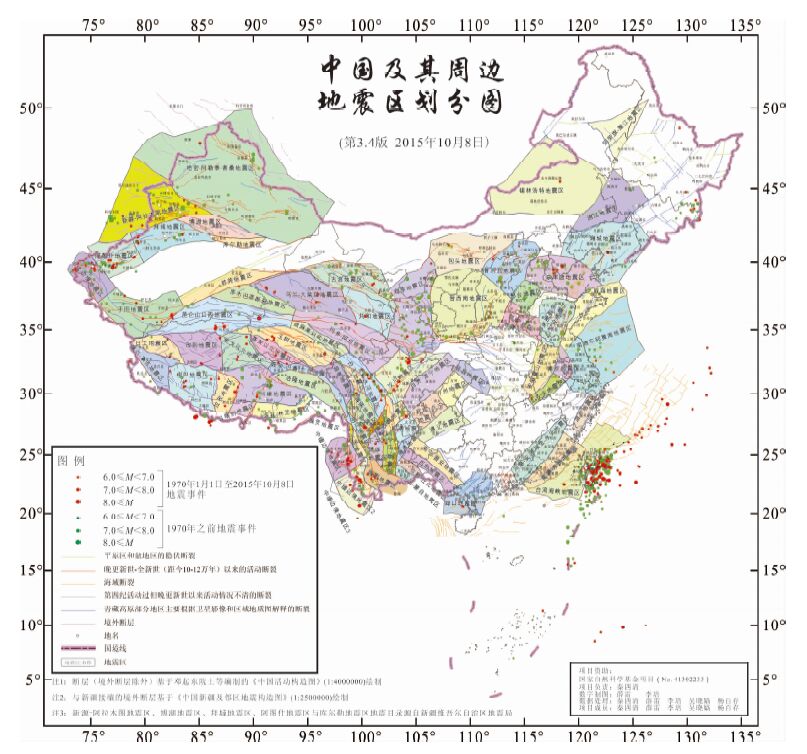
台湾海峡地区位于欧亚板块与菲律宾板块接触地带,构造活动强烈,强震频发.秦四清等(2011,2014a)曾对台湾地区划分了南投和花莲-台东地震区,并分析了其地震趋势.由于该地区处于板块交界附近,囿于当时认识水平,未从板内与板间地震区分界角度考虑这两个地震区的边界厘定.根据秦四清等(2015a,b)提出的板间与板内地震区分界原则,将花莲-台东地震区归属新划定的台湾岛-菲律宾群岛板间地震区合理;对原南投地震区需重新厘定其边界.与3.3版《中国及其周边地震区划图》(秦四清等,2015c)相比,新编制的3.4版区划图(图 1)剔除了花莲-台东地震区,重命名原南投地震区为台湾海峡地震区,地震区总数为78个.
|
图 1 中国及其周边地震区划分图(3.4版) Fig. 1 Division map of seismic zones in China and its adjacent areas(Version 3.4) |
本文基于孕震断层多锁固段脆性破裂理论(秦四清等,2010a,c),从强震孕育周期界定与主震事件判识角度,分析台湾海峡地震区的地震趋势.
1 最小有效性震级确定方法对某正确划分的地震区,影响CBS(Cumulative Benioff Strain)监测值与预测值精度的因素有:(1)地震目录参数精度;(2)地震目录完整性;(3)非锁固段破裂信息,如相对软弱介质破裂导致的地震事件.对第1个因素,可通过提升地震监测技术水平加以解决;对第2个因素,依据秦四清等(2014a)提出的最小完整性震级(Mc)确定方法已解决;对第3个因素,亟需提出新的解决方法.
由于锁固段是一种非均匀地质体,其微观介质参数(如强度)呈不均匀分布.当锁固段变形尚未演化至膨胀点时,破裂呈现均匀、随机的空间分布特征,其破裂过程可能含有大量的非锁固段(相对软弱介质)破裂信息;当锁固段变形至膨胀点时,破裂空间分布逐渐由无序向有序转化,呈现应变局部化特征,膨胀点至峰值强度点之间发生的地震事件应主要为锁固段破裂信息.
诸多学者(谢和平和陈至达,1989;谢和平,1992;易顺民和唐辉明,1999;高峰等,1999)的研究表明,在一定时空尺度范围内,岩石破裂呈现自相似特征.秦四清等(2013,2014c,e)进一步指出,大震孕育过程中锁固段破裂在几何和物理方面均呈现自相似特征,且发现“1.48”是描述不同尺度锁固段破裂自相似特征的一个普适常数;在膨胀点至峰值强度点之间,破裂呈现高度的物理自相似行为.
Gutenberg and Richter(1950)提出的震级-频度关系表达式为

G-R关系中b值本质上反映岩石介质的非均匀性特征,是表征地震活动性分维的指标(蒋海昆和刁守中,1995),其值可利用无标度区间线性段的斜率确定(闻学泽等,2007).我们认为,对特定地震区进行数据处理时,G-R关系无标度区间的下限值Mv可作为提取锁固段本身破裂信息的阈值,并定义为最小有效性震级.
我们对震例的分析表明,一般可选取第1个锁固段膨胀点(Sc)与峰值强度点(Sf (1))之间的地震目录进行分析,确定最小有效性震级Mv.若Sc~Sf(1)之间数据较少,可选取Sc~Sf(2)之间的地震目录确定Mv.如此,可依次类推.
考虑到实际数据处理时,无标度线性段下限是一个范围,很难给出一个定值,需根据秦四清等(2010a)提出的临界应变表达式(2)确定最优Mv值.

基于上述方法,确定Mv的具体步骤如下:
1 )根据上述原则选择数据区间,绘制震级-频度分布曲线;
2)进行线性拟合,给出Mv参考区间;
3 )在该区间内进行试算,以符合式(2)效果最佳为目标确定最优Mv值.
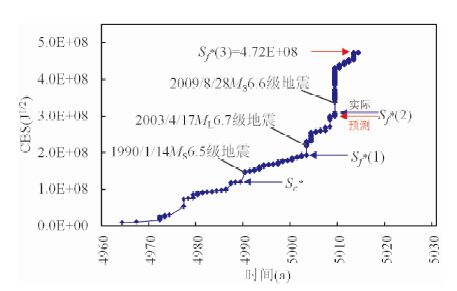
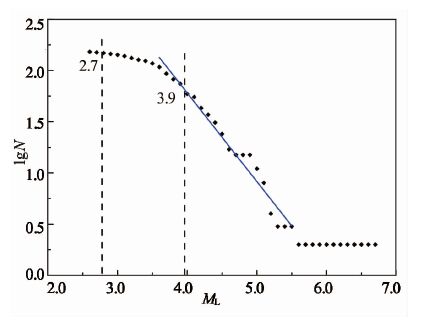
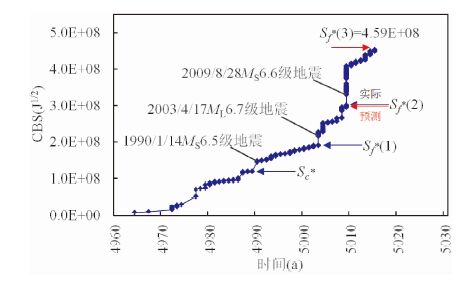
以秦四清等(2010b,2014f)曾分析的乌兰-大柴旦地震区为例,当时数据处理时未考虑Mv,2014年3月12日该区CBS监测值已略超临界值(图 2),而预测中的强(大)震尚未发生.根据上述方法,选择该区第2孕育周期Sc~Sf(1)之间的地震目录进行分析(图 3),确定Mv的参考区间为[2.7,3.9],依据式(2)得出该区最优Mv值为ML3.0.考虑Mv后的CBS图示于图 4,截止到2015年8月23日,该区CBS监测值约为4.54E+08J1/2,略低于临界值4.59E+08J1/2,预计中短期发震.对该区震情分析表明,考虑Mv与否,会影响我们对发震时间窗口的判断.
|
图 2 乌兰-大柴旦地震区1964.3.16-2014.3.12之间CBS值与时间关系(第2孕育周期) (横坐标对应的时间减去3000年为实际年份;误差修正已被考虑) Fig. 2 Temporal distribution of CBS in the period from 16 March 1964 to 12 March 2014 for the Wulan-Dachaidan seismic zone(2nd seismogenic period) (The real time is the value on the horizontal axis minus 3000 years. The error correction is also considered.) |
|
图 3 乌兰-大柴旦地震区1990.1.14-2003.4.17之间震级-频度关系(第2周期)
(数据选取区间为Sc~Sf(1);虚线对应参考区间上下限值) Fig. 3 The relation between magnitude and frequency in the period from 14 January 1990 to 17 April 2003 for the Wulan-Dachaidan seismic zone(2nd seismogenic period) (The earthquake events between Sc and Sf(1)are selected for data analysis. The dotted lines denote the reference range of upper and lower bounds.) |
|
图 4 乌兰-大柴旦地震区1964.3.16-2015.8.23之间CBS值与时间关系(第2孕育周期) (数据分析时选取ML≥3.0级地震事件;横坐标对应的时间减去 3 000年为实际年份;误差修正已被考虑) Fig. 4 Temporal distribution of CBS in the period from 16 March 1964 to 23 August 2015 for the Wulan-Dachaidan seismic zone(2nd seismogenic period) (The earthquake events with ML≥3.0 are selected for data analysis. The real time is the value on the horizontal axis minus 3 000 years. The error correction is also considered.) |
计算CBS值时考虑Mv,既能有效提取锁固段本身破裂信息,又能减少因历史地震目录不完整导致的预测值和实际值之间的误差.因此,分析某一地震区震情时,可用Mv替代Mc.
2 台湾海峡地震区震情分析台湾海峡地震区地震构造图示于图 5.分析该区大震孕育过程及其未来震情时,地震目录引自国家地震科学数据共享中心(CEDC:http://data.earthquake.cn/data, 数据获取日期为2015年8月25日),数据为研究时段所有地震事件.

|
图 5 台湾海峡地震区地震构造图(地震目录源自CEDC) Fig. 5 Seismotectonic map of the Taiwan Strait seismic zone(The earthquake catalogue is obtained from CEDC) |
为减小CBS预测值与实际值之间的误差,数据分析时考虑了最小有效性震级Mv.数据处理时,先把不同的震级标度统一换算为地方震级ML(秦四清等,2014b),然后依次计算地震矩、地震能量、Benioff应变与CBS值.
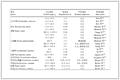
台湾海峡地震区曾发生9次MS≥7.0级地震,列于表 1.以下分析表明,该地震区至少已经历两轮孕育周期,目前处于第3孕育周期.
|
表 1 台湾海峡地震区MS≥7.0级地震事件 Table 1 The earthquake events with MS≥7.0 in the Taiwan Strait seismic zone |
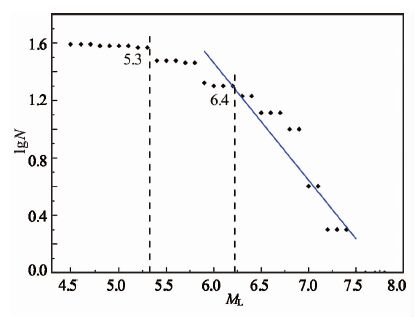
图 6a示出了该区第1周期的震级-频度关系,根据上述方法得出Mv值为ML 6.0.
|
图 6a 台湾海峡地震区1792.8.9-1910.4.12之间震级-频度关系(第1周期)
(数据选取区间为Sc~Sf(2);虚线对应参考区间上下限值) Fig. 6a The relation between magnitude and frequency in the period from 9 August 1792 to 12 April 1910 for the Taiwan Strait seismic zone(1st seismogenic period) (The earthquake events between Sc and Sf(2)are selected for data analysis. The dotted lines denote the reference range of upper and lower bounds.) |
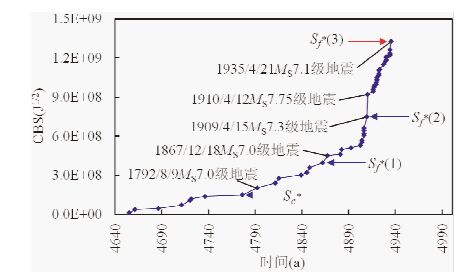
图 6b示出了该地震区第1孕育周期经误差修正后标志性地震事件之间的力学联系,根据1792年8月9日台湾嘉义MS 7.0级地震发生前的CBS值,可较准确地连续预测到基隆东北海域1867年12月18日MS 7.0级地震与1910年4月12日MS 7.75级地震的临界CBS值.对1910年大震,宋治平等(2011)给出的震级值为mB7.75级,国际地震中心(ISC)给出的震级值为MS 7.8级,根据秦四清等(2014d)提出的地震参数修订原则,认为该震为MS 7.75级合理.如此,假设该震是主震事件,则主震与余震释放能量之和约为4.00E+16J, 略低于震前该地震区积累能量(约为4.14E+16J),推测是由于该区1910年大震前某些地震事件震级测定值精度偏低所致,故可判断1910年大震为主震事件.需指出的是,1909年4月15日台北MS 7.3级地震,是主震前的一次显著性foreshock事件;1935年4月21日台中MS 7.1级地震是主震后的一次大余震事件. 该余震发生后,标志着该地震区第3锁固段已发生宏观破裂.
|
图 6b 台湾海峡地震区1644.7.30-1935.4.21之间CBS值与时间关系(第1孕育周期) (数据分析时选取ML≥6.0级地震事件;横坐标对应的时间减去 3 000年为实际年份;误差修正已被考虑) Fig. 6b Temporal distribution of CBS in the period from 30 July 1644 to 21 April 1935 for the Taiwan Strait seismic zone(1st seismogenic period) (The earthquake events with ML≥6.0 are selected for data analysis. The real time is the value on the horizontal axis minus 3000 years. The error correction is also considered.) |
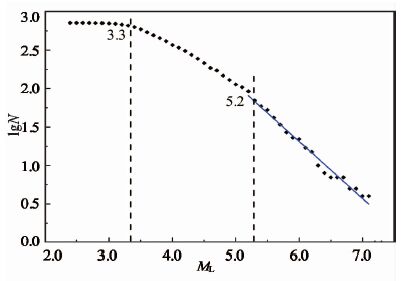
图 7a示出了该区第2周期的震级-频度关系,根据上述方法得出Mv值为ML 4.0.
|
图 7a 台湾海峡地震区1941.12.17-1999.9.20之间震级-频度关系(第2周期) (数据选取区间为Sc~Sf(2);虚线对应参考区间上下限值) Fig. 7a The relation between magnitude and frequency in the period from 17 December 1941 to 20 September 1999 for the Taiwan Strait seismic zone(2nd seismogenic period) (The earthquake events between Sc and Sf(2)are selected for data analysis. The dotted lines denote the reference range of upper and lower bounds.) |
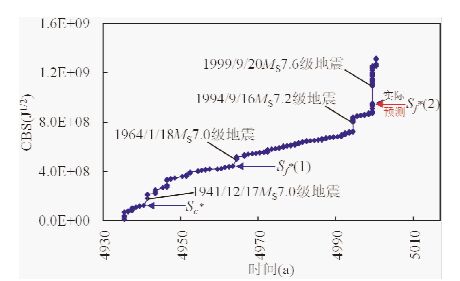
图 7b示出了该地震区第2孕育周期经误差修正后标志性地震事件之间的力学联系.需说明的是,对1999年台湾南投大震,CEDC给出的震级值为MS 7.0级,宋治平等(2011)给出的震级值为M7.7级,美国国家地震信息中心(NEIC)给出的震级值为MS 7.7级.根据秦四清等(2014d)提出的地震参数修订原则,认为1999年南投大震为MS 7.6级合理.根据1941年12月17日台湾嘉义MS 7.0级地震发生前的CBS值,可较准确地连续预测到1964年1月18日高雄MS 7.0级地震与1999年9月20日南投MS 7.6级地震的临界CBS值.假设该MS 7.6级地震为主震事件,则主震与余震释放能量之和约为2.10E+16J, 与震前该地震区积累能量(2.14E+16J)基本相当,故可判断该MS 7.6级地震是主震事件.需指出的是,1994年9月16日台湾海峡MS 7.2级地震,是主震前的一次显著性preshock事件.
|
图 7b 台湾海峡地震区1935.4.21-2000.7.28之间CBS值与时间关系(第2孕育周期) (数据分析时选取ML≥4.0级地震事件;横坐标对应的时间减去3000年为实际年份;误差修正已被考虑) Fig. 7b Temporal distribution of CBS in the period from 21 April 1935 to 28 July 2000 for the Taiwan Strait seismic zone(2nd seismogenic period) (The earthquake events with ML≥4.0 are selected for data analysis. The real time is the value on the horizontal axis minus 3000 years. The error correction is also considered.) |
类比该区前两轮孕育周期大震活动性可看出,1)标志性地震事件震级值相近;2)主震事件发生前,均发生了MS 7.2~7.3级foreshock或preshock事件;3)该区是一个MS 7.6~7.75级地震危险区.
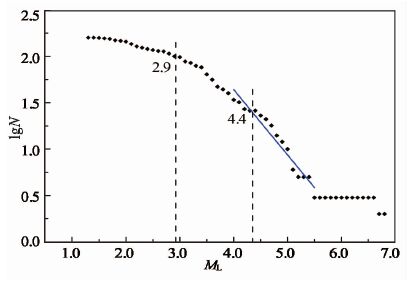
2.3 第3孕育周期图 8a示出了该区第3周期的震级-频度关系,根据上述方法得出Mv值为ML 4.0.
|
图 8a 台湾海峡地震区2010.3.4-2013.6.2之间震级-频度关系(第3周期)
(数据选取区间为Sc~Sf(1);虚线对应参考区间上下限值) Fig. 8a The relation between magnitude and frequency in the period from 4 March 2010 to 2 June 2013 for the Taiwan Strait seismic zone(3rd seismogenic period). (The earthquake events between Sc and Sf(1)are selected for data analysis. The dotted lines denote the reference range of upper and lower bounds.) |
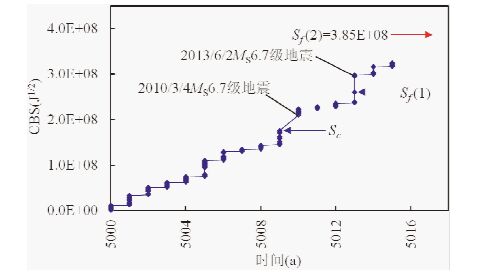
图 8b示出了该地震区第3孕育周期标志性地震事件之间的力学联系.可看出2010年3月4日台湾高雄MS 6.7级地震与2013年6月2日南投MS 6.7级地震,分别是第1锁固段在膨胀点和峰值强度点的标志性事件.根据秦四清等(2014c)提出的主震事件判识原则,判断该区当前孕育周期存在第2锁固段,当被加载至峰值强度点时,应有更大地震发生.
|
图 8b 台湾海峡地震区2000.7.29-2015.8.25之间CBS值与时间关系(第3孕育周期) (数据分析时选取ML≥4.0级地震事件;横坐标对应的时间减去3000年为实际年份) Fig. 8b Temporal distribution of CBS in the period from 29 July 2000 to 25 August 2015 for the Taiwan Strait seismic zone(3rd seismogenic period). (The earthquake events with ML≥4.0 are selected for data analysis. The real time is the value on the horizontal axis minus 3000 years.) |
截止到2015年8月25日,该地震区CBS监测值约为3.24E+08J1/2,远离临界值3.85E+08J1/2.对该地震区未来震情预测结果如下:震级:MS 7.0级;震中位置:北纬24.2°,东经121.2°;震源深度:10~20 km;发震时间窗口:长期.预计向临界状态演化过程中,该地震区还将发生不超过MS 6.5级的preshock事件.我们将跟踪该区地震活动性动态,期望对震中位置和发震时间窗口有更准确的判断.
3 结 论为有效提取锁固段本身破裂信息,本文提出了最小有效性震级确定方法,并将其应用到台湾海峡地震区,效果良好.从孕育周期界定与主震事件判识角度,分析了台湾海峡地震区未来地震趋势,结果表明:该区已至少经历两轮孕育周期,是一个MS 7.6~7.75级地震危险区;该区目前处于第3孕育周期,未来将发生MS 7.0级地震.
致 谢 感谢国家自然科学基金资助项目(编号:41302233)对研究工作的资金支持.
| [1] | Gao F, Xie H P, Wu J B. 1999. Fractal analysis of the relation between rock damage and rock fragmentation. Chinese Journal of Rock Mechanics and Engineering, 18(5): 497-502. |
| [2] | Gutenberg R C, Richter F. 1950. Seismicity of the earth and associated phenomena. Journal of Geophysical Research, 55(1): 97-98. |
| [3] | Jang H K, Diao S Z. 1995. A seismic activity model with fractal structure and preliminary discussion on the relationship between fractal dimension D and b values. Earthquake Science, 17(4): 524-527. |
| [4] | Qin S Q, Xu X W, Hu P, et al. Brittle failure mechanism of multiple locked patches in a seismogenic fault system and exploration on a new way for earthquake prediction. Chinese Journal of Geophysics (in Chinese), 2010a, 53(4):1001-1014. |
| [5] | Qin S Q, Xue L, Huang X, et al. 2010b. Prediction of strong earthquakes in the Qinghai, Gansu and Ningxia regions. Progress in Geophysic (in Chinese), 25(4):1168-1174 |
| [6] | Qin S Q, Xue L, Wang Y Y, et al. 2010c. Further verifications on the brittle failure theory of multiple locked patches along a seismogenic fault system and discussions on some science issues. Progress in Geophysic (in Chinese), 25(3):749-758 |
| [7] | Qin S Q, Xue L, Huang X, et al. 2011. A forward prediction of strong earthquakes in the Xinjiang and its border regions, the Inner Mongolia region, and certain regions of east China, south China and Taiwan.Progress in Geophysic (in chinese), 26(1):21-31, doi:10.3969/j.issn.1004-2903.2011.01.002. |
| [8] | Qin S Q, Li G L, Xue L, et al. 2013. Reanalysis of the future earthquake situation for some seismic zones in the region of Southwest China. Progress in Geophysic (in Chinese), 28(5): 2407-2432, doi:10.6038/pg20130521. |
| [9] | Qin S Q,Li G L,Xue L,et al. 2014a. Analysis of the future earthquake situation for some seismic zones in the northeast China,north China and Taiwan. Progress in Geophysic (in Chinese), 29(2):0535-0554, doi:10.6038/pg20140210. |
| [10] | Qin S Q, Xue L, Li P, et al. 2014b. Analysis on the seismogenic processes of large or great earthquakes for some seismic zones abroad based on the brittle failure theory of multiple locked patches(I). Progress in Geophys (in Chinese), 29(4): 1541-1554, doi:10.6038/pg20140408. |
| [11] | Qin S Q, Li P, Xue L, et al. 2014c. The definition of seismogenic period of strong earthquakes for some seismic zones in southwest China. Progress in Geophysic (in Chinese), 29(4):1526-1540, doi: 10.6038/pg20140407. |
| [12] | Qin S Q, Li P, Xue L, et al. 2014d. Proposition on amending some seismic parameters of the China historical earthquake catalogue. Progress in Geophys (in Chinese), 29(6): 2534-2537,doi: 10.6038/pg20140609. |
| [13] | Qin S Q, Li P, Xue L, et al. 2014e. Analysis of the future earthquake situation for some seismic zones in the east China,south China and southwest China. Progress in Geophysic (in Chinese), 29(3): 1033-1045, doi:10.6038/pg20140307. |
| [14] | Qin S Q, Li G L, Xue L, et al. 2014f. Analysis of the future earthquake situation for some seismic zones in the northwest China and Tibet. Progress in Geophys (in Chinese), 29(3): 1046-1067, doi: 10.6038/pg20140308. |
| [15] | Qin S Q, Li P, Xue L, et al. 2015a. A prospective prediction of great earthquakes for the Circum -Pacific seismic belt.Progress in Geophys (in Chinese), 30(2): 540-558, doi: 10.6038/pg20150210. |
| [16] | Qin S Q,Li P,Xue L,et al. 2015b. A prospective prediction of major earthquakes for the Eurasian seismic belt(I):Interplate seismogenic zones.Progress in Geophys (in Chinese),30(3):1124-1140,doi:10.6038/pg20150317 . |
| [17] | Qin S Q, Li P, Xue L, et al. 2015c. Methods for determining seismic risk level. Progress in Geophys (in Chinese), 30(4): 1653-1659, doi: 10.6038/pg20150418. |
| [18] | Song Z P, Zhang G M, Liu J. 2011. Global Earthquake Catalog(in Chinese). Beijing:Seismological Press. |
| [19] | Wen X Z, Xu X W, Long F et al. 2007. Frequency-magnitude relationship medols for assesment of max mum magnitude of potential earthquakes on moderately and weakly active faults in eastern China mainland. Seismology and Geology, 29(2): 236-253. |
| [20] | Xie H P, Chen Z D. 1989. The fractal effect of irregular geometry on crack bifurcation of rock materials. Chinese Journal of Theoretical and Applied Mechanics, 21(5): 613-618. |
| [21] | Xie H P. 1992. Fractal geometry and its application to rock and soil materials. Chinese Journal of Geotechnical Engineering, 14(1): 14-24. |
| [22] | Yi S M, Tang H M. 1999. The fractal characteristics of fracture of dam foundation rock under triaxial compression in the three gorges project. Rock and Soil Mechanics. 20(3): 24-28. |
| [23] | 高峰, 谢和平, 巫静波. 1999. 岩石损伤和破碎相关性的分形分析. 岩石力学与工程学报, 18(5): 497-502. |
| [24] | 蒋海昆, 刁守中. 1995. 一个具有分形结构的地震活动性模型及分形维数D与b值之间关系的初步讨论. 地震学报, 17(4): 524-527. |
| [25] | 秦四清, 徐锡伟, 胡平, 等. 孕震断层的多锁固段脆性破裂机制与地震预测新方法的探索. 地球物理学报, 2010a, 53(4): 1001-1014. |
| [26] | 秦四清, 薛雷, 黄鑫, 等. 2010b. 青海、甘肃与宁夏地区未来大地震预测分析. 地球物理学进展, 25(4): 1168-1174 . |
| [27] | 秦四清, 薛雷, 王媛媛, 等. 2010c. 对孕震断层多锁固段脆性破裂理论的进一步验证及有关科学问题的讨论. 地球物理学进展, 25(3): 749-758. |
| [28] | 秦四清, 薛雷, 黄鑫, 等. 2011. 新疆与其边境地区、内蒙古地区及华东、华南与台湾部分地区未来强震预测.地球物理学进展, 26(1): 21-31, doi: 10.3969/j.issn.1004-2903.2011.01.002. |
| [29] | 秦四清, 李国梁, 薛雷等. 2013. 中国西南地区某些地震区未来震情研判. 地球物理学进展,28(5): 2407-2432, doi:10.6038/pg20130521. |
| [30] | 秦四清, 李国梁, 薛雷, 等. 2014a. 东北、华北与台湾地区某些地震区地震趋势分析. 地球物理学进展, 29(2): 535-554, doi: 10.6038/pg20140210. |
| [31] | 秦四清, 薛雷, 李培, 等. 2014b. 国外某些地震区大地震孕育过程分析(I). 地球物理学进展, 29(4): 1541-1554, doi: 10.6038/pg20140408. |
| [32] | 秦四清, 李培, 薛雷, 等. 2014c. 中国西南地区某些地震区强震孕育周期界定. 地球物理学进展, 29(4): 1526-1540, doi: 10.6038/pg20140407. |
| [33] | 秦四清, 李培, 薛雷, 等. 2014d. 中国历史地震目录某些地震参数修订建议.地球物理进展, 29(6): 2534-2537: doi: 10.6038/pg20140609. |
| [34] | 秦四清, 李培, 薛雷等. 2014e. 华东、华南与西南地区某些地震区地震趋势分析. 地球物理学进展, 29(3): 1033-1045, doi: 10.6038/pg20140307 . |
| [35] | 秦四清,李国梁,薛雷,等. 2014f. 西北与西藏地区某些地震区地震趋势分析. 地球物理学进展, 29(3): 1046-1067, doi: 10.6038/pg20140308. |
| [36] | 秦四清, 李培, 薛雷, 等. 2015a.环太平洋地震带巨震预测. 地球物理学进展, 30(2): 540-558, doi: 10.6038/pg20150210. |
| [37] | 秦四清, 李培, 薛雷, 等. 2015b. 欧亚地震带大震预测(I):板间地震区. 地球物理学进展,30(3): 1124-1140, doi: 10.6038/pg20150317. |
| [38] | 秦四清, 李培, 薛雷, 等. 2015c. 地震危险性等级确定方法. 地球物理学进展, 30(4): 1653-1659, doi: 10.6038/pg20150418. |
| [39] | 宋治平, 张国民,刘杰, 等. 2011. 全球地震目录. 北京: 地震出版社. |
| [40] | 闻学泽, 徐锡伟, 龙锋, 等. 2007. 中国大陆东部中-弱活动断层潜在地震最大震级评估的震级-频度关系模型. 地震地质, 29(2): 236-253. |
| [41] | 谢和平, 陈至达. 1989. 岩石类材料裂纹分叉非规则性几何的分形效应. 力学学报, 21(5):613-618. |
| [42] | 谢和平. 1992. 分形几何及其在岩土力学中的应用. 岩土工程学报, 14(1): 14-24. |
| [43] | 易顺民, 唐辉明. 1999. 三轴压缩条件下三峡坝基岩石破裂的分形特征. 岩土力学, 20(3): 24-28. |