 2015, Vol. 30


一直以来,大家普遍认为中国大陆岩石圈在中生代以来主要表现为西部增厚和东部减薄的不同动力学演化特征. 但是通过地热学相关理论计算得到中国东部华北克拉通渤海湾盆地和鄂尔多斯盆地中、新生代的不同地质时期的岩石圈厚度,发现岩石圈并不像岩石学家、地球物理学家等认为的“渤海湾盆地仅在中生代遭受过一次岩石圈破坏或减薄(Gao et al.,2004; Zhang et al.,2005; Zheng et al.,2005; Xu,2007; Chen,2009)和鄂尔多斯盆地中生代至今没有遭受破坏或减薄,仍保留着克拉通的稳定性(朱日祥等,2011; 邓晋福等,1996)”那样,而是渤海湾盆地岩石圈经历了中生代和新生代两次减薄事件(左银辉等,2013; Zuo et al.,2013; Qiu et al.,2014),鄂尔多斯盆地岩石圈也在白垩纪遭受了较大的减薄(焦亚先等,2013). 塔里木盆地中、新生代主要地质时期的岩石圈厚度的研究相对较少,尤其是从地热学角度研究岩石圈演化的文献仍为空白. 盆地热演化与深部热动力学条件密切相关,盆地热历史为揭示深部动力学过程提供了时间和空间上的连续信息,在地球动力学研究中具有不可替代的作用.
关于塔里木盆地现今“热”岩石圈厚度前人做过一些研究(Wang,1996; 王良书等,1996; 汪洋等,2001). 王良书等研究表明,“热”岩石圈厚度在沙漠低隆之下为95 km,向塔北隆起加深至112 km,向若羌凹陷加深至108 km,总的分布规律表现为在中央隆起区,“热”岩石圈厚度小,为100 km左右,而在边缘坳陷为120~150 km(王良书等,1996).
本文通过地热学相关理论,通过沉积盆地的热历史来恢复塔里木盆地4口典型井(图 1)中、新生代主要地质时期的“热”岩石圈厚度,研究成果可以为塔里木盆地地球动力学等基础研究提供依据.
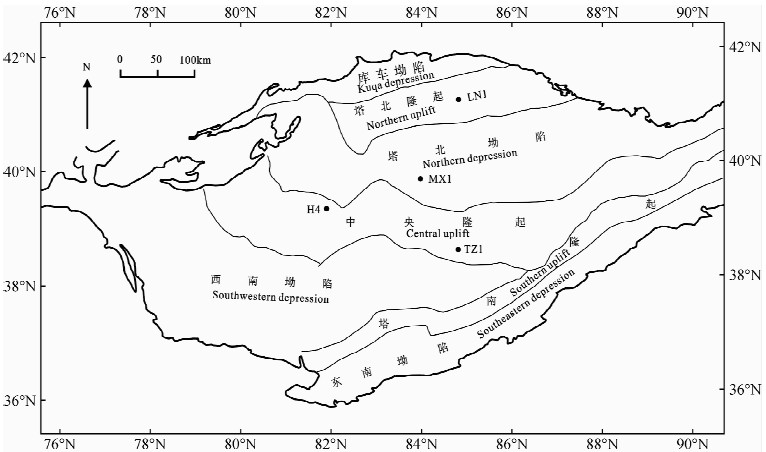 | 图 1 塔里木盆地构造单元划分及井位分布图Fig. 1 Structural units in the Tarim basin and distribution of wells |
塔里木盆地是中国最大的内陆盆地,位于天山山脉和昆仑山脉之间. 南北最宽处520 km,东西最长处1400 km. 面积约40×104 km2. 该盆地是一个在太古界、元古界古老变质基底之上发育起来的复合、叠合盆地,也是中国重要的含油气盆地之一. 包括库车坳陷、塔北隆起、塔北坳陷、中央隆起、西南坳陷、东南隆起和东南坳陷六个一级构造单元(图 1). 盆地先后经历了塔里木、库鲁克塔格、加里东、海西、印支、喜山等多期构造运动. 在这些构造运动的影响下,塔里木盆地自震旦纪至今,经历了震旦纪—奥陶纪的克拉通边缘坳拉槽阶段、志留纪—泥盆纪的周缘前陆盆地阶段、石炭纪—二叠纪的克拉通边缘坳陷和克拉通内裂陷阶段、三叠纪的前陆盆地阶段、侏罗纪—古近纪的断陷盆地阶段和新近纪—第四纪的再生前陆盆地阶段.盆地中发育震旦系与奥陶系海陆交互相-海相地层、志留系—泥盆系海相-海陆交互地层、石碳系—下二叠统海相-陆相地层、上二叠系—三叠系陆相地层、侏罗系—白垩系陆相地层以及新生界海相-陆相地层(贾承造和魏国齐,2002; 何登发等,2005).
2 方法与原理2.1 “热”岩石圈厚度计算原理“热”岩石圈指以热传导方式进行热传递的岩石圈层,其下为以热对流为主的软流圈(Morgan,1984). 确定古地表热流后,依据一维稳态热传导方程(式1)即可得到不同地质时期岩石圈内的地温随深度的分布曲线,它们与地幔绝热线或玄武岩固相线的交点所处的深度即为“热”岩石圈厚度(图 2).公式为

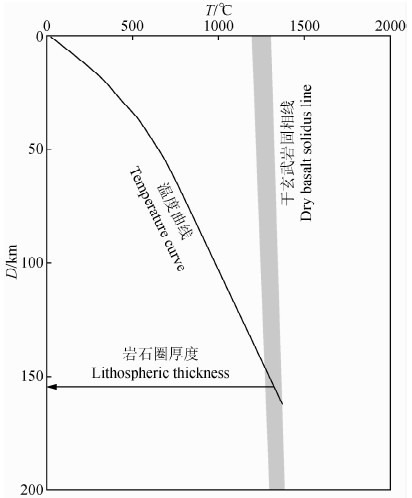 | 图 2 “热”岩石圈厚度的地热学计算方法Fig. 2 Calculation method of “thermal” lithospheric thickness in the Geothermics |
有些学者采用单一判别依据获取“热”岩石圈厚度(Rudnick et al.,1998; Hu and Wang,2000),而臧绍先等(2002)和Artemieva和Mooney(2001)采取两条绝热线分别作为“热”岩石圈底面温度的上限T1和下限T2的判据(式2,式3):

(1)地质参数
在计算不同地质时期的壳幔热流及深部温度时,需要以下地质参数: 地层分层数据、地壳厚度及各层系的岩性资料等. 塔里木盆地地壳结构分为四个构造层: 沉积盖层、上地壳、中地壳和下地壳(图 3),沉积盖层进一步划分和岩性资料参考塔里木油田的钻井资料.
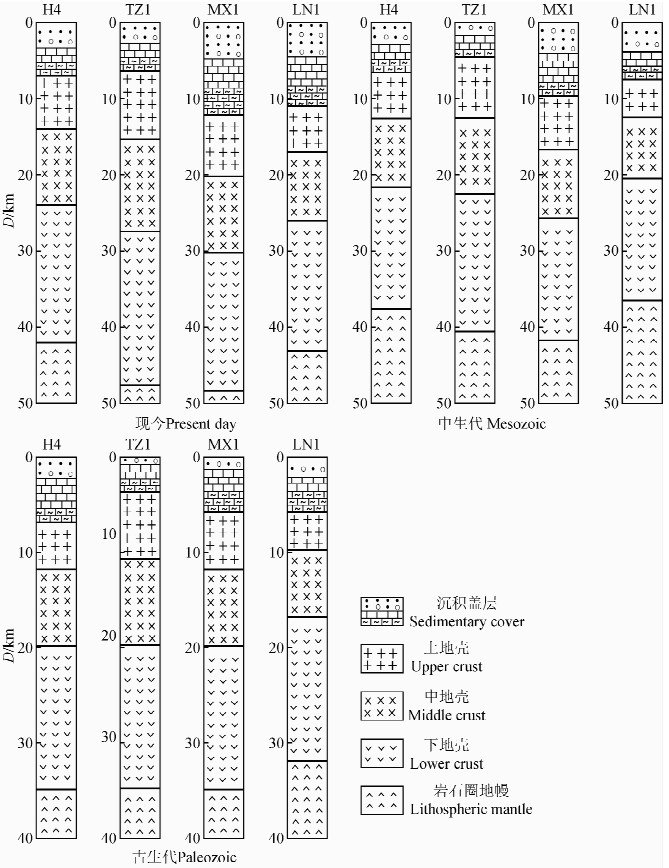 | 图 3 塔里木盆地典型井主要地质时期的地壳结构
沉积盖层的厚度和详细分层参考塔里木油田钻井资料; 现今地壳结构和厚度参考文献资料(蔡学林等,2007; 刘绍文等,2003; 徐鸣洁等,2005); 中生代和古生代地壳结构主要根据塔里木盆地构造演化的研究成果(贾承造等,1995; 何登发等,2005)得到. Fig. 3 Crustal structure model of the Tarim basin The thickness of sedimentary cover and detailed layering data referred to drilling data of the Tarim oilfield; the present-day crustal layers referred to the references(Cai et al.,2007; Liu et al.,2003; Xu et al.,2005); the Mesozoic and Paleozoic crustal layers were obtained on the basis of tectonic evolution in the basin(Jia et al.,1995; He et al.,2005). |
(2)岩石热物性参数
岩石热物性参数主要包括生热率(A)和热导率(K),其中沉积盖层的生热率采用文献值(王良书等,1996; 邱楠生,2002)(表 1),沉积盖层以下地壳生热率采用指数衰减模型公式为

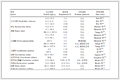 | 表 1 塔里木盆地构造层岩石生热率和热导率 Table 1 Rock heat generation rate and thermal conductivity of each structural layer in the Tarim basin |
但Ketcham(1996)认为此模型不能使用在整个地壳,否则将低估中、下地壳的生热率,因此,仅假定上地壳内生热率分布满足上述指数关系,而中、下地壳的生热率假定为常数,分别为0.29 μW/m3,0.18 μW/m3(刘绍文等,2003; 邱楠生,2002). 岩石圈地幔生热率取常数,为0.03 μW/m3(Rudnick et al.,1998).
沉积盖层热导率采用文献值(王良书等,1996; 邱楠生,2002)(表 1). 地壳深部热导率目前还不能直接测试,各结构层的热导率可以根据其与温度的关系(式5)获得:

上、中、下地壳及岩石圈地幔的K0分别取2.3 W/m·K、2.5 W/m·K、2.5 W/m·K(刘绍文等,2003)和3.4 W/m·K(Morgan,1984),c分别取0.001、0、0和-0.00025. 地质历史时期及现今地表温度取15 ℃. 此外,盆地热流演化史也是“热”岩石圈厚度计算的重要参数,详见下文. 另外,在计算中,地质历史时期中的各构造层的生热率Ai(t)和热导率Ki(t)采用现今对应值.
(3)中生代以来热演化史
塔里木盆地热历史的研究主要依据古温标方法(邱楠生,2002; 周中毅和潘长春,1992; 潘长春等,1996; 解启来和周中毅,2002; Qiu et al.,2012a,b; 任战利等,2009; 于靖波等,2010; 常健等,2011),少数学者应用盆地动力学模型来研究热历史(李成等,2000). 总的来说,中生代以来热演化史表现为一个缓慢降温过程,但各构造单元的热演化存在差异(Qiu et al.,2012). 本文选择的4口典型井的主要地质时期的地温梯度,前人做了详细的研究(周中毅和潘长春,1992; 潘长春等,1996; 解启来和周中毅,2002),在计算主要地质时期的“热”岩石圈厚度时,需将这些古地温梯度利用式6转化为古地表热流(表 2).

| | 表 2 典型井主要地质时期的地表热流值 Table 2 The surface heat flow values of the typical wells in the main geologic periods |
这次主要计算了塔北隆起的LN1井、塔中隆起的H4井和TZ1井及满加尔坳陷的MX1井等4口典型井主要地质时期的岩石圈厚度(图 4). 根据计算结果和塔里木盆地构造演化绘制了塔里木盆地主要井区岩石圈演化图(图 5),图中显示中生代早期岩石圈厚度较薄,仅为57~62 km,平均为59 km,与当时高热流背景相对应. 在中生代时期塔里木盆地岩石圈厚度变化不大,直到古近纪中晚期,岩石圈快速增厚,到现今厚度达到104~159 km,平均为134 km. 但不同井 区的岩石圈演化存 在一定的差异,塔中隆起的H4井和TZ1井演化相似,但TZ1井的岩石圈厚度比H4井薄. 古近纪中晚期开始,塔中隆起的H4井和塔北隆起的LN1井和满加尔坳陷的MX1井岩石圈厚度快速增加,而塔中隆起的TZ1井增加最小.
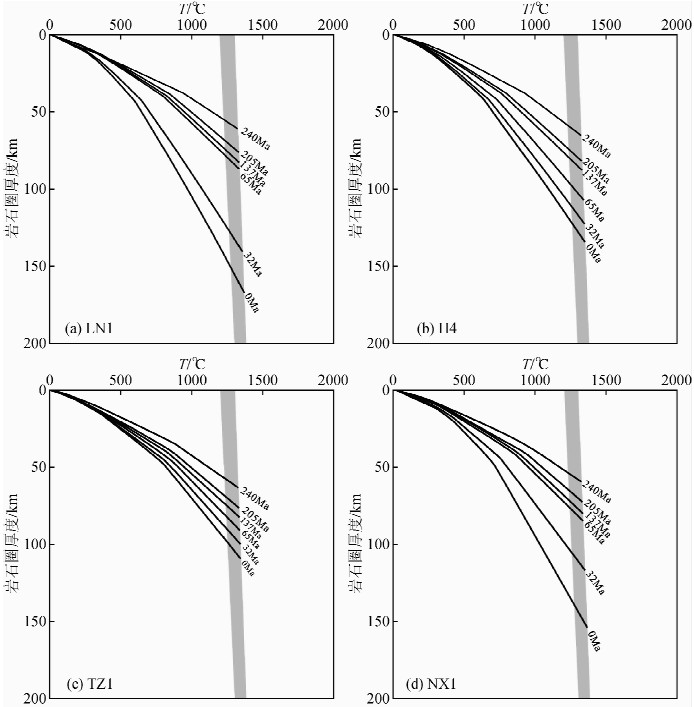 | 图 4 典型井区主要地质时期“热”岩石圈厚度Fig. 4 “Thermal” lithospheric thickness of the typical wells in the main geologic periods |
| 图 5 典型井区“热”岩石圈演化图
虚线为岩石圈演化的平均趋势.Fig. 5 “Thermal” lithospheric thickness evolution of the typical wells The dashed line is the average “thermal” lithospheric thickness evolution. |
4.1 与塔里木盆地自中生代以来岩石圈厚度逐渐增加相比,东部渤海湾盆地出现在白垩纪和古近纪两期岩石圈减薄高峰(图 6). 不同的岩石圈厚度演化过程揭示中国大陆东西部受不同的地球动力学控制. 渤海湾盆地形成于中、新生代西太平洋俯冲的弧后拉张应力环境,先后在白垩纪和古近纪裂陷构造作用强烈,裂谷盆地发育; 地壳被拉张而减薄,地幔物质上涌,从而带来大量的深部热量,岩石圈底部发生明显热扰动,导致岩石圈减薄.
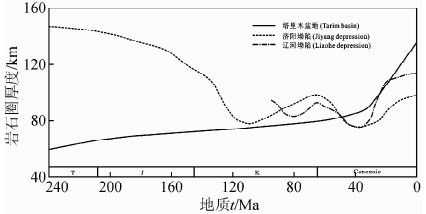 | 图 6 渤海湾盆地和塔里木盆地中生代以来“热”岩石圈厚度演化对比
济阳和辽河坳陷的“热”岩石圈厚度演化成果参考文献资料(Zuo et al.,2013; Qiu et al.,2014)Fig. 6 Comparison between the “thermal” lithospheric thickness evolution in the Bohai Bay Basin and Tarim Basin since the Mesozoic The results of the “thermal” lithospheric thickness evolution in the Jiyang and Liaohe depressions referred to the references(Zuo et al.,2013; Qiu et al.,2014). |
4.2 西部塔里木盆地,二叠纪时塔里木盆地发生了迄今最后一次大规模的岩浆活动,因古特提斯洋向塔里木板块的俯冲,盆地处于强烈活动的裂谷阶段,现今盆地内广泛分布该时期的岩浆岩. 其中部分Fe含量极高,较一般的洋中脊玄武岩富铁,指示形成的高压环境,反应其深源和地幔柱源; 稀土元素分析显示源区为石榴石和二辉橄榄岩,接近原始地幔特征(张招崇等,2005; 余星等,2009; Li et al.,2009); 它们的地球化学特征意味着地幔物质参与了近地表的岩浆活动. 二叠纪塔里木盆地地幔物质上涌,地壳减薄、张裂,导致“热”岩石圈厚度较薄.
4.3 中生代伊始继承了古生代末期热流值高、“热”岩石圈较薄的特征. 中生代初期塔里木板块南缘古特提斯洋向北持续俯冲,三叠纪盆地整体仍处于挤压环境,三叠纪晚期塔里木板块和羌塘地体的碰撞拼合结束了塔里木板块边缘漫长的活动大陆边缘演化历史及多期的碰撞造山作用,塔里木盆地成为欧亚大陆内部具有较刚性的稳定克拉通基底的沉积盆地,侏罗纪—渐新世期间盆地处于碰撞后的板内构造发展阶段(贾承造和魏国齐,2002). 自侏罗纪塔里木处于碰撞造山后的热沉降阶段,岩石圈逐渐软化,地壳发生伸展,岩石圈缓慢增厚. 中生代塔里木盆地进入稳定地壳热演化阶段,热流和地温梯度都比较稳定(何登发等,2005). 塔里木盆地的热演化结果表明,中生代该盆地就开始进入稳定的“冷盆”演化阶段,出现高强度的岩石圈. 此时开始,塔里木板块为相对冷的刚性板块,变形较弱,相对稳定,体现出整体变形的刚性特点,岩石圈厚度逐渐增大(图 6).
4.4 中、新生代对塔里木盆地影响最为显著的构造运动是自始新世开始的印度板块与欧亚板块及其随后持续的汇聚作用,其对塔里木盆地的影响主要发生在盆地与周缘造山带相接部位(贾承造,2004a,b). 在强烈的碰撞挤压的远程效应作用下,塔里木盆地及周缘处在区域挤压环境,导致昆仑山、阿尔金山和天山等造山带快速隆升,甚至盆地内部也再次发生明显的隆起. 周缘造山带的隆升剥蚀为塔里木盆地带来了大量的沉积物源,且持续挤压使盆地周缘造山带向盆地方向产生大规模的“A”型俯冲,形成一系列逆掩冲断岩体; 在前陆堆积的沉积载荷和冲断岩体的构造载荷共同作用下,地壳挠曲变形,岩石圈增厚(贾承造,2004a,b). 这与本次研究成果表现出“热”岩石圈厚度自始新世迅速增厚的特征相一致.
致 谢 感谢中国石油大学(北京)邱楠生教授在计算不同地质历史时期的"热"岩石圈厚度工作中的指导.| [1] | Artemieva I A, Mooney W D. 2001. Thermal thickness and evolution of Precambrian lithosphere: A global study[J]. J. Geophys. Res., 106(B8): 16387-16414. |
| [2] | Cai X L, Zhu J S, Cao J M, et al. 2007. 3D structure and dynamic types of the lithospheric crust in continental China and its adjacent regions[J]. Geology in China (in Chinese), 34(4): 543-557. |
| [3] | Chang J, Qiu N S, Zuo Y H, et al. 2011. The new evidence on tectonic uplift in Kepingtage area, Tarim, China: Constraints from (U-Th)/He ages[J]. Chinese J. Geophys. (in Chinese), 54(1): 163-172, doi: 10.3969/j.issn.0001-5733.2011.01.017. |
| [4] | Chen L. 2009. Lithospheric structure variations between the eastern and central North China Craton from S- and P-receiver function migration[J]. Physics of the Earth and Planetary Interiors, 173(3-4): 216-227. |
| [5] | Deng J F, Zhao H L, Mo X X, et al. 1996. Continental Roots-Plume Tectonics of China: Key to the Continental Dynamics (in Chinese)[M]. Beijing: Geological Publishing House. |
| [6] | Gao S, Rudnick R L, Yuan H L, et al. 2004. Recycling lower continental crust in the North China Craton[J]. Nature, 432(7019): 892-897. |
| [7] | He D F, Jia S Z, Li D S, et al. 2005. Formation and evolution of polycyclic superimposed Tarim basin[J]. Oil & Gas Geology (in Chinese), 26(1): 64-77. |
| [8] | Hu S B, Wang J Y. 2000. Heat flow, deep temperature and thermal structure across the orogenic belts in Southeast China[J]. Journal of Geodynamics, 30(4): 461-473. |
| [9] | Jia C Z, Wei G Q. 2002. Tectonic characteristics and oil and gas in Tarim basin[J]. Chinese Science Bulletin (in Chinese), 47(Suppl.): 1-8. |
| [10] | Jia C Z. 2004a. Plate Tectonics and Continental Dynamics in Tarim Basin (in Chinese) [M]. Beijing: Petroleum Industry Press. |
| [11] | Jia C Z. 2004b. Mesozoic and Cenozoic Tectonic Characteristics and Oil and Gas in Tarim Basin (in Chinese) [M]. Beijing: Petroleum Industry Press. |
| [12] | Jia S C, Wei G Q, Yao H J, et al. 1995. Basin Tectonic Evolution and Regional Structural Geology (in Chinese) [M]. Beijing: Petroleum Industry Press. |
| [13] | Jiao Y X, Qiu N S, Li W Z, et al. 2013. The Mesozoic-Cenozoic evolution of lithospheric thickness in the Ordos basin constrained by geothermal evidence[J]. Chinese J. Geophys. (in Chinese), 56(9): 3051-3060, doi: 10.6038/cjg20130918. |
| [14] | Jie Q L, Zhou Z Y. 2002. Kerogen pyrolysis kinetics simulating experiment used to study low Paleozoic paleotemperature in Tarim basin[J]. Earth Science-Journal of China University of Geoscience (in Chinese), 27(6): 767-769. |
| [15] | Ketcham R A. 1996. Distribution of heat-producing elements in the upper and middle crust of southern and west central Arizona: Evidence from the core complexes[J]. Journal of Geophysical Research, 101(B6): 13611-13632. |
| [16] | Li C, Wang L S, Guo S P, et al. 2000. Thermal evolution in Tarim basin[J]. Acta Petrolei Sinica (in Chinese), 21(3): 13-17. |
| [17] | Li[a3] Z L, Chen H L, Song B, et al. 2011. Temporal evolution of the Permian large igneous province in Tarim Basin in northwestern China[J]. Journal of Asian Earth Sciences, 42(5): 917-927. |
| [18] | Liu S W, Wang L S, Li C, et al. 2003. Lithospheric thermo-rheological structure and Cenozoic thermal regime in the Tarim basin, Northwest China[J]. Science in China (Series D) (in Chinese), 33(9): 852-863. |
| [19] | Morgan P. 1984. The thermal structure and thermal evolution of the continental lithosphere[J]. Physics and Chemistry of the Earth, 15: 107-193. |
| [20] | Pan C C, Zhou Z Y, Fan S F, et al. 1996. Thermal history of Tarim basin[J]. Bulletin of Mineralogy, Petrology and Geochemistry (in Chinese), 15(3): 150-152, 177. |
| [21] | Pasquale V, Cabella C, Verdoya M. 1990. Deep temperatures and lithospheric thickness along the European geotraverse[J]. Tectonophysics, 176(1-2): 1-11. |
| [22] | Qiu N S. 2002. Characters of thermal conductivity and radiogenic heat production rate in basins of northwest China [J]. Chinese Journal of Geology (in Chinese), 37(2): 196-206. |
| [23] | Qiu N S, Chang J, Zuo Y H, et al. 2012a. Thermal evolution and maturation of Lower Paleozoic source rocks in the Tarim Basin, Northwest China[J]. AAPG Bulletin, 96(5): 789-821. |
| [24] | Qiu N S, Chang J, Li W Z, et al. 2012b. New evidence on the Neogene uplift of South Tianshan: Constraints from the (U-Th)/He and AFT ages of borehole samples of the Tarim basin and implications for hydrocarbon generation[J]. International Journal of Earth Sciences, 101(6): 1625-1643. |
| [25] | Qiu N S, Zuo Y H, Chang J, et al. 2014. Geothermal evidence of Meso-Cenozoic lithosphere thinning in the Jiyang sub-basin, Bohai Bay Basin, eastern North China Craton[J]. Gondwana Research, 26(3-4): 1079-1092. |
| [26] | Ren Z L, Xiao H, Han W, et al. 2009. Research on basin-mountain tectonic-thermal history of Kongquehe Slope and Kuruketag uplift[J]. Journal of Northwest University (Natural Science Edition) (in Chinese), 39(3): 510-516. |
| [27] | Rudnick R L, McDonough W F, O’Connell R J. 1998. Thermal structure, thickness and composition of continental lithosphere[J]. Chemical Geology, 145(3-4): 395-411. |
| [28] | Wang J Y. 1996. Geothermics in China[M]. Beijing: Seismological Press. |
| [29] | Wang L S, Li C, Shi Y S. 1995. Distribution of terrestrial heat flow density in Tarim basin, Western China[J]. Acta Geophysica Sinica (in Chinese), 38(6): 855-856. |
| [30] | Wang L S, Li C, Yang C. 1996. The lithospheric thermal structure beneath Tarim basin, Western China[J]. Acta Geophysica Sinica (in Chinese), 39(6): 794-803. |
| [31] | Wang Y, Wang J Y, Xiong L P, et al. 2001. Lithospheric geothermics of major geotectonic units in China mainland[J]. Acta Geosicientia Sinica (in Chinese), 22(1): 17-22. |
| [32] | Xu M J, Wang L S, Zhong K, et al. 2005. Features of gravitational and magnetic fields in the Tarim basin and basement structure analysis[J]. Geological Journal of China Universities (in Chinese), 11(4): 585-592. |
| [33] | Xu Y G. 2007. Diachronous lithospheric thinning of the North China Craton and formation of the Daxin’anling-Taihangshan gravity lineament[J]. Lithos, 96(1-2): 281-298. |
| [34] | Yu J B, Zhang J, Shi B P. 2010. A study on tectono-thermal evolution history of Bachu uplift in Tarim basin[J]. Chinese J. Geophys. (in Chinese), 53(10): 2396-2404, doi: 10.3969/j.issn.0001-5733.2010.10.013. |
| [35] | Yu X, Chen H L, Yang S F, et al. 2009. Geochemical features of Permian basalts in Tarim Basin and compared with Emeishan LIP[J]. Acta Petrologica Sinica (in Chinese), 25(6): 1492-1498. |
| [36] | Zang S X, Liu Y G, Ning J Y. 2002. Thermal Structure of the Lithosphere in North China[J]. Chinese Journal of Geophysics (in Chinese), 45(1): 56-66. |
| [37] | Zhang H F, Sun M, Zhou X H, et al. 2005. Geochemical constraints on the origin of Mesozoic alkaline intrusive complexes from the North China Craton and tectonic implications[J]. Lithos, 81(1-4): 297-317. |
| [38] | Zhang Z C, Wang F S, Hao Y L, et al. 2005. A geochemical comparison between the Emeishan and Siberian large igneous provinces and its petrogenetic implications[J]. Acta Petrologica Et Mineralogica (in Chinese), 24(1): 12-20. |
| [39] | Zheng J P, Griffin W L, O’Reilly S Y, et al. 2005. Late Mesozoic-Eocene mantle replacement beneath the eastern North China Craton: Evidence from the Paleozoic and Cenozoic peridotite xenoliths[J]. International Geology Review, 47(5): 457-472. |
| [40] | Zhou Z Y, Pan C C. 1992. Paleotemperature Analysis Methods and Their Application in Sedimentary Basins (in Chinese)[M]. Guangzhou: Guangzhou Science and Technology Press. |
| [41] | Zhu R X, Chen L, Wu F Y, et al. 2011. Timing, scale and mechanism of the destruction of the North China Craton[J]. )Sci. China (Earth Sci., 54(6): 789-797. |
| [42] | Zuo Y H, Qiu N S, Pang X Q, et al. 2013. Geothermal evidence of the Mesozoic and Cenozoic lithospheric thinning in the Liaohe depression[J]. Journal of Earth Science, 24(4): 529-540. |
| [43] | Zuo Y H, Qiu N S, Chang J, et al. 2013. Meso-Cenozoic lithospheric thermal structure in the Bohai Bay Basin[J]. Acta Geologica Sinica (in Chinese), 87(2): 145-153. |
| [44] | 蔡学林, 朱介寿, 曹家敏,等. 2007. 中国大陆及邻区岩石圈地壳三维结构与动力学型式[J]. 中国地质, 34(4): 543-557. |
| [45] | 常健, 邱楠生, 左银辉,等. 2011. 塔里木柯坪塔格地区构造抬升的新证据—来自(U-Th)/He年龄的约束[J]. 地球物理学报, 54(1): 163-172, doi: 10.3969/j.issn.0001-5733.2011.01.017. |
| [46] | 邓晋福, 赵海玲, 莫宣学,等. 1996. 中国大陆根-柱构造—大陆动力学的钥匙[M]. 北京: 地质出版社. |
| [47] | 何登发, 贾承造, 李德生,等. 2005. 塔里木多旋回叠合盆地的形成与演化[J]. 石油与天然气地质, 26(1): 64-77. |
| [48] | 贾承造, 魏国齐. 2002. 塔里木盆地构造特征与含油气性[J]. 科学通报, 47(增刊): 1-8. |
| [49] | 贾承造. 2004a. 塔里木盆地板块构造与大陆动力学[M]. 北京: 石油工业出版社. |
| [50] | 贾承造. 2004b. 塔里木盆地中新生代构造特征与油气[M]. 北京: 石油工业出版社. |
| [51] | 贾承造, 魏国齐, 姚慧君,等. 1995. 盆地构造演化与区域构造地质[M]. 北京: 石油工业出版社. |
| [52] | 焦亚先, 邱楠生, 李文正,等. 2013. 鄂尔多斯盆地中-新生代岩石圈厚度演化—来自地热学的证据[J]. 地球物理学报, 56(9): 3051-3060, doi: 10.6038/cjg20130918. |
| [53] | 解启来, 周中毅. 2002. 利用干酪根热解动力学模拟实验研究塔里木盆地下古生界古地温[J]. 地球科学—中国地质大学学报, 27(6): 767-769. |
| [54] | 李成, 王良书, 郭随平,等. 2000. 塔里木盆地热演化[J]. 石油学报, 21(3): 13-17. |
| [55] | 刘绍文, 王良书, 李成,等. 2003. 塔里木北缘岩石圈热-流变结构及其地球动力学意义[J]. 中国科学(D辑), 33(9): 852-863. |
| [56] | 潘长春, 周中毅, 范善发,等. 1996. 塔里木盆地热历史[J]. 矿物岩石地球化学通报, 15(3): 150-152, 177. |
| [57] | 邱楠生. 2002. 中国西北部盆地岩石热导率和生热率特征[J]. 地质科学, 37(2): 196-206. |
| [58] | 任战利, 肖晖, 韩伟,等. 2009. 孔雀河斜坡与库鲁克隆起构造-热演化史研究[J]. 西北大学学报(自然科学版), 39(3): 510-516. |
| [59] | 王良书, 李成, 施央申. 1995. 塔里木盆地大地热流密度分布特征[J]. 地球物理学报, 38(6): 855-856. |
| [60] | 王良书, 李成, 杨春. 1996. 塔里木盆地岩石层热结构特征[J]. 地球物理学报, 39(6): 794-803. |
| [61] | 汪洋, 汪集旸, 熊亮萍,等. 2001. 中国大陆主要地质构造单元岩石圈地热特征[J]. 地球学报, 22(1): 17-22. |
| [62] | 徐鸣洁, 王良书, 钟锴,等. 2005. 塔里木盆地重磁场特征与基底结构分析[J]. 高校地质学报, 11(4): 585-592. |
| [63] | 于靖波, 张健, 史保平. 2010. 塔里木盆地巴楚隆起区构造-热演化历史研究[J]. 地球物理学报, 53(10): 2396-2404, doi: 10.3969/j.issn.0001-5733.2010.10.013. |
| [64] | 余星, 陈汉林, 杨树锋,等. 2009. 塔里木盆地二叠纪玄武岩的地球化学特征及其与峨眉山大火成岩省的对比[J]. 岩石学报, 25(6): 1492-1498. |
| [65] | 臧绍先, 刘永刚, 宁杰远. 2002. 华北地区岩石圈热结构的研究[J]. 地球物理学报, 45(1): 56-66. |
| [66] | 张招崇, 王福生, 郝艳丽,等. 2005. 峨眉山大火成岩省和西伯利亚大火成岩省地球化学特征的比较及其成因启示[J]. 岩石矿物学杂志, 24(1): 12-20. |
| [67] | 周中毅, 潘长春. 1992. 沉积盆地古地温测定方法及其应用[M]. 广州: 广州科技出版社. |
| [68] | 朱日祥, 陈凌, 吴福元,等. 2011. 华北克拉通破坏的时间、范围与机制[J]. 中国科学(地球科学), 41(5): 583-592. |
| [69] | 左银辉, 邱楠生, 常健,等. 2013. 渤海湾盆地中、新生代岩石圈热结构研究[J]. 地质学报, 87(2): 145-153. |