 2015, Vol. 30


2. 吉林大学地球科学学院, 长春 130061;
3. 中海油研究总院, 北京 100027
2. College of Earth Sciences, Jilin University, Changchun 130061, China;
3. Exploration Department of CNOOC China Ltd., Beijing 100027, China
南海位于欧亚板块、印-澳板块以及太平洋-菲律宾板块相互作用部位,是研究西太平洋地区基底结构、板块相互作用、边缘海构造演化及地球动力学机制的理想场所(图 1;Hall,1996,2002).古生代以来,南海地区经历了特提斯和太平洋两大构造域,是由欧亚大陆边缘微板块和从冈瓦纳大陆裂离向北漂移的微板块经过多次聚合、分离而形成的复杂构造区,断裂构造发育,性质多样,基底构造单元具有不同的构造属性(姚伯初,1994;Metcalfe,1998,2006,2011).
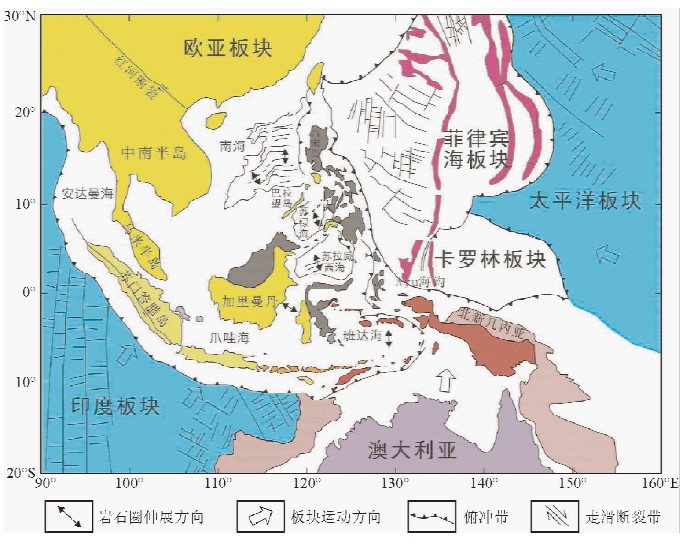
近年来,南海地球物理研究基本上明晰了区域构造特征及陆缘性质.学者们通过磁性基底反演、多道地震、重磁异常以及地热与岩石层流变学等研究,认为南海北部、南部陆缘均应以非火山型构造属性为主(郝天珧等,2009),南海南、北为共轭大陆边缘的观点也越来越得到认可,提出了相应的陆缘伸展模式(吴世敏等,2005;赵明辉等,2011;夏少红等,2011;郝天珧等,2011;Dong et al.,2014)和海底扩张模式(李家彪等,2011),并分析了南、北陆缘地壳结构异同及其拉张减薄的变化特征(夏少红等,2014),以及对南海莫霍面起伏特征与海盆、海沟、岛弧以及沉积盆地等构造单元之间的关系进行了研究(秦静欣等,2011).另外,基于不同的研究资料、侧重点以及划分依据的不同,导致南海断裂构造体系研究存在一定的差别(金庆焕和李唐根,2000;宋海斌等,2002;刘昭蜀等,2002),对于基底断裂位置、延伸以及性质等仍具有不同的认识.
南海前新生代基底构造单元的划分制约对构造演化的认识.自20世纪80年代末,一些研究者陆续开展了相关研究.如金庆焕(1989)以不同时期形成的地壳块体作为构造基本单元,将南海及邻域划分为华南元古宙微板块区等7个微板块区,不同性质的34个地块(带);龚再升和李思田(1997)将南海作为一个亚板块,其中又分为东沙地块、西沙地块、南海海盆和南沙地块4个三级构造单元;刘昭蜀等(2002)将南海陆缘地堑系划分为5个二级构造单元及24个三级构造单元;宋海斌等(2002)认为南海海域主体可划分为南海北缘、中西沙、南沙以及南海海盆四块.刘海龄等(2004)将南海海域前新生代基底划分为6 个区.姚伯初(2006)将南海作为东亚圈体的一个二级构造单元,即“南海圈块”,并且进一步划分出4个三级块体.从目前的研究结果来看,有些划分方案将海陆人为分离,海域与围区陆地脱节,较少考虑到海域与围区陆地基底构造属性的联系与区别;有些划分方案的依据则不清楚,构造单元的边界性质不明确;曾母地块的构造属性存在较大的争议.
因此,为了全面的了解南海地区前新生代基底构造特征,本文在前人划分的基础之上,综合水深、重力、磁力以及地震等地球物理数据研究南海断裂构造体系以及划分前新生代基底构造单元,该结果将揭示南海地区前新生代基底构造格局特征及构造属性,有助于进一步了解南海地区构造演化过程.
1 地质构造背景南海前新生代基底构造格局经历了古南海消亡和新南海扩张构造演化过程.近四十年来,国内外学者对南海构造演化进行了持续的研究.众多学者对南海形成演化的动力学机制提出了不同的观点,如弧后扩张模式(Karig,1971;Ben-Avraham and Uyeda,1973;郭令智等,1983)、古南海俯冲拖曳模式(Holloway,1982;Taylor and Hayes,1980,1983; Hall,1996)、“碰撞-挤出-拉张”模式(Tapponnier et al.,1990;Briais et al.,1993;Leloup et al.,2001)、“地幔柱活动”和“地幔上涌”模式(Tamaki,1995;Flower et al.,1998;龚再升和李思田,1997)、东亚陆缘右行裂解模式(周蒂等,2002)以及Morley模式(Morley,2002).另外也提出了不同的南海扩张模式(Karig,1971;Ben-Avraham and Uyeda,1973;Taylor and Hayes,1983;Ru and Pigott,1986;Briais et al.,1989,1993;Barckhausen and Roeser,2004;Hsu et al.,2004;姚伯初等,2004;Cullen et al.,2010;Li and Song,2012).可见,南海具有复杂的演化历史,单一模型很难全面解释其时空演化.目前被多数学者所接受的观点是南海在伸展作用下,受欧亚板块、印度板块、澳大利亚板块、太平洋板块和菲律宾等板块运动的影响,先后发生陆内裂谷、陆间裂谷和大洋裂谷作用,并形成了裂谷、海盆、挤压、走滑等多种地质构造现象的小洋盆(姚伯初,2006).南海地区晚古生代-新生代的构造演化与已消亡的古南海密切相关(鲁宝亮等,2014),而且由于新生代的海底扩张致使前新生代基底发生了大规模的水平位移,以及南海前新生代基底埋深较大,钻入基底的钻井深度较浅以及地震采集和参数处理技术等因素的影响,都加大了基底结构及构造的研究难度,制约了基底构造属性及其对新生代盆地影响等研究.
2 南海断裂构造体系特征结合前人研究成果,本文通过对水深、钻井、重力、磁力(南海属于低纬度地区,受斜磁化影响严重,对磁异常采用了变磁化方向自适应滤波化极技术进行了处理)以及5.2万公里地震剖面等资料综合处理与解释研究(图 2),进一步明确了南海区域断裂构造特征(图 3~5图).南海断裂十分发育,由于四周陆缘性质各异,即南海北部陆缘拉张、南部陆缘挤压、西部陆缘走滑以及东部陆缘俯冲导致形成不同方向、不同级别和不同类型的断裂构造.按断裂展布方向大致可分为NE-NEE向、NW向和近SN向3组;按断裂切割深度,则可分为岩石圈断裂、地壳断裂、基底断裂;从断裂的力学性质来讲,可分为拉张、挤压、走滑断裂.作为基底构造单元的重要边界,区域大断裂等不但控制了南海基底分布,还控制了其上覆新生代沉积盆地的形成演化,具有重要的构造涵义.
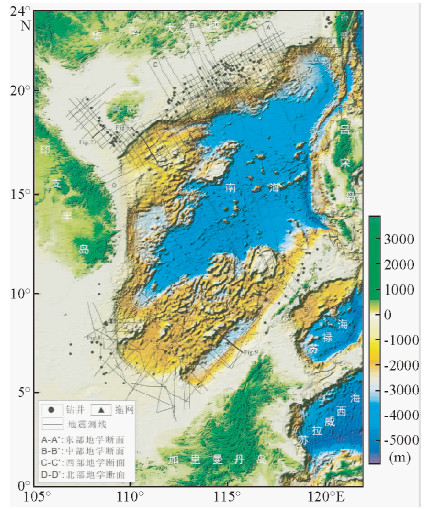 | 图 2 南海地形特征及地震、钻井分布.水深数据来自 Smith and Sand well,1997 Fig. 2 Topographical map of the South China Sea and the location of seismic profiles and wells. Bathymetric data are from Smith and Sand well,1997 |
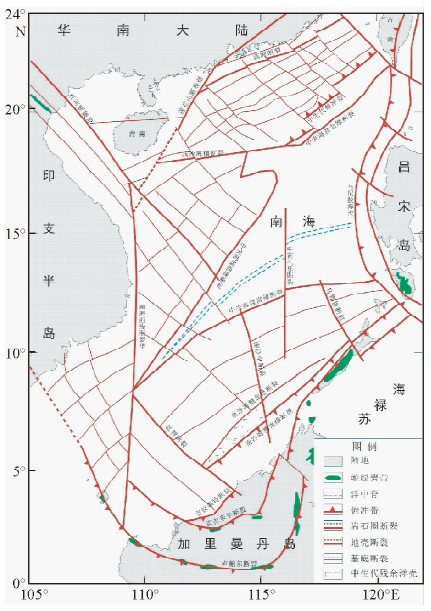 | 图 3 南海及其邻区主要断裂分布图.蛇绿岩分布来自Hutchison,1975,1989,2010a Fig. 3 Map of Major faults in the South China Sea and its adjacent area. Ophiolite distributions are from Hutchison,1975,1989,2010a |
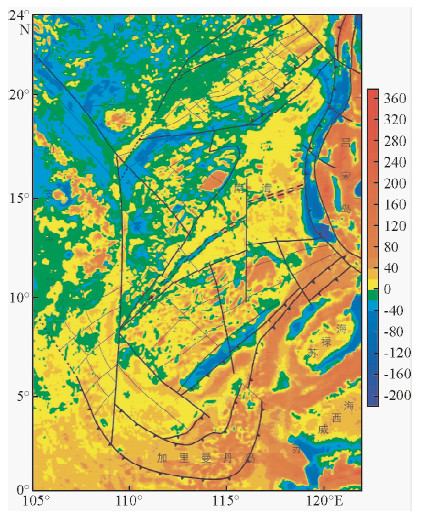 | 图 4 南海自由空间重力异常与区域断裂分布图. 重力资料来自Sand well and Smith,2009 Fig. 4 Distribution of free air gravity anomaly and major faults in South China Sea. Gravity data are from Sand well and Smith,2009 |
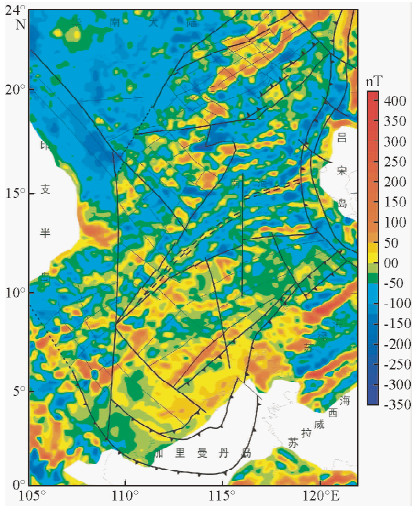 | 图 5 南海区域化极磁异常与区域断裂分布图. 磁异常资料据CCOP,1996 Fig. 5 Distribution of RTP magnetic anomaly and major faults in South China Sea. Magnetic anomaly data are from CCOP,1996 |
南海北部断裂主要表现为NE-NNE和NW向两组断裂(图 3).红河断裂带、莲花山断裂带、滨海断裂带、西沙海槽断裂、南海北部俯冲增生带等岩石圈或地壳断裂均具有重要的构造分界涵义,控制着华南大陆边缘的构造格局.晚白垩世,太平洋俯冲带大幅度向东后撤,致使中国东南部普遍处于拉张环境,发生陆缘张裂,形成了NE-NEE向张性断裂(图 6).广泛发育于南海北部陆缘,控制了陆缘盆地南北分带的构造格局.NW向断裂在东南沿海陆地发育,主要表现为剪切性质,根据南海北部盆地的地质演化历史来看,NW 向断裂具有长期活动性,早期的NW向断裂比NE向断裂形成时间要早,NW向断裂主要表现为晚期的活动断裂.晚白垩世印度板块沿NNE方向俯冲于欧亚板块之下,产生强烈的挤压;同时西太平洋发生俯冲带后撤,使欧亚大陆东南边缘发生弧后扩张.在这两大构造域的共同作用,东亚陆缘的应力场由左行压扭变为右行张扭,导致NW向断裂发生继承性活动,错断了NE、NEE向断裂,形成了东西分块的基底构造特征(鲁宝亮等,2011).
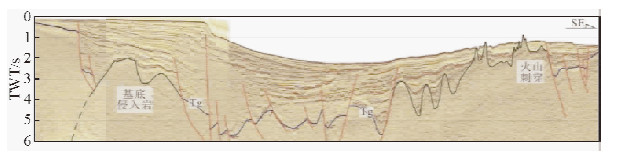 | 图 6 南海北部陆缘断裂构造特征(位置见图 2) Fig. 6 Characteristic of faults in Northern South China Sea continental margin. See Fig. 2 for profile location |
红河断裂带是印支地块与华南之间的一条走滑断裂带(图 3),其发育于云南哀牢山-红河构造混杂岩带.该带发育大量的蛇绿混杂岩,代表了三叠纪时期印支地块与华南的俯冲缝合边界(Tapponnier et al.,1982;Leloup et al.,1995;Zhong et al.,1990;Liu et al.,2012),发育了典型的糜棱岩,为左行韧性剪切带(Zhong et al.,1990).红河断裂带从云南经越南北部至红河口入海后,沿莺歌海盆地向东南延伸到海南岛南部海域.由于强烈的走滑拉分,形成了莺歌海盆地巨厚的新生代沉积物,使得断裂两侧基底埋深厚度差巨大(图 7),这也表现出了红河断裂带作为华南大陆与印支地块构造分界线的特征.
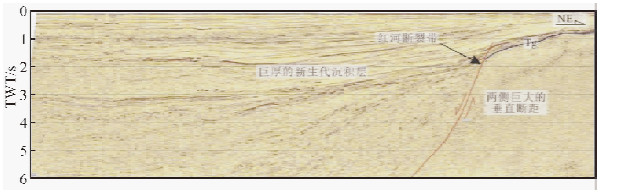 | 图 7 莺歌海盆地中红河断裂带的巨大垂直断距(位置见图 2) Fig. 7 Huge vertical fault throw of Red River Fault in Yinggehai Basin.see Fig. 2 for profile location |
Tapponnier等(1982,1986)提出的“渐进挤出模式”中印支地块的顺时针旋转和其南东挤出逃逸很好的解释了红河断裂带的长距离左行走滑,该观点并得到了广泛的赞同(Leloup et al.,1995,2001,2007;Rangin et al.,1995;Zhang et al.,2006; Zhu et al.,2009).因此,印度板块与华南的碰撞压挤,造成印支地块的南东向挤出,并产生顺时针旋转;先期存在的古缝合带(哀牢山构造带)沿构造薄弱部位重新活动,形成大型的走滑韧性剪切带,即红河断裂带.
莲花山断裂带是条斜贯粤东地区的NE向断裂(图 3),属丽水-海丰断裂的西南段.该断裂带向南可能延续到海南岛东部与红河断裂相交,组成北部湾盆地和珠江口盆地的分界线(姚伯初,2006),是中新生代中国东南部西太平洋活动区和太平洋构造体制强烈叠加改造区的重要分界线(舒良树和周新民,2002; 舒良树等,2004).
滨海断裂带往东经珠江口盆地北界至台湾海峡中部,再往东进入东海,总体走向NE(图 3),在磁异常上表现为一条剧烈变化负磁异常带,磁异常的分区特征揭示了前新生代沉积基底的分块性,剧烈变化负磁异常是被压扭性断裂构造强烈复杂化了的变质岩、混合岩、混合花岗岩及火山岩的综合反映(费鼎,1983).地震反射资料显示垂直断距逾1000 m,断裂带活动已波及上地幔,是发育于华南加里东褶皱带内部的断裂带(姚伯初,2006).
南海北部中生代俯冲增生带(图 3)在布格重力异常水平总梯度峰值(Zhou et al.,2006)、地学断面(姚伯初,2006)、广角地震(阎贫和刘海龄,2002)、P波地壳速度结构(李家彪,2008)以及深反射地震(Zhou et al.,2006)均具有明显的响应特征,揭示了南海北部存在的中生代俯冲增生带.南海北部高磁异常带(图 5)是与中生代俯冲增生带相伴的火山弧的反映,与晚中生代古太平洋向东亚陆缘的俯冲有关(Zhou et al.,2006;胡登科等,2008).
2.2 南海西部断裂构造南海西部断裂主要以SN向南海西缘断裂带及其NE向的分支断裂组成,大约沿印支半岛以东200 m水深线分布,东西两侧地形地貌特征明显不同.南海西缘断裂带以西印支半岛陆架狭窄,断裂以东陆坡陡峭,地貌反差强烈,水深从陆架200 m突变至2000 m,垂直落差达2000 m以上(图 2).南海西缘断裂带位于明显的重力梯级带上(图 4),而在航磁异常图上表现为串珠状磁异常沿断裂带分布(图 5),是为沿断裂带形成的侵入岩的反映.在地震剖面上表现为负花状构造(图 8),指示了南海西缘断裂带的张剪性构造特征.
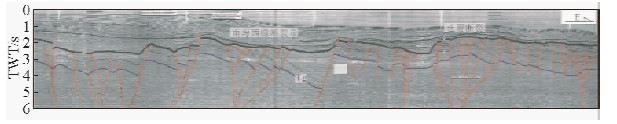 | 图 8 南海西部陆缘断裂构造特征(位置见图 2) Fig. 8 Characteristic of faults in Western South China Sea continental margin. See Fig. 2 for profile location |
中-西沙地区与越南东部陆缘在重磁异常、沉积发育史方面存在着一定的差异性,它们之间存在一个不连续的地质界线(Liu et al.,2006 ;Fyhn et al.,2009),断裂带附近伴有玄武岩岩浆喷发,表明断裂切割较深.因此,认为南海西缘断裂带是印支地块的东部边界断裂.同时,南海西缘断裂带也是南海的西部边界,它形成于印支地块挤出旋转和南海扩张期间,调节印支地块与南海之间的差异运动(孙龙涛等,2006).
2.3 南海南部断裂构造南海南部主要发育NE向,NW向以及向南突出的弧形等三组断裂(图 3),其发育伴随着古南海的消亡与新南海的扩张,具有多期次活动特征.晚白垩世至中始新世末期,由于太平洋板块俯冲,东亚陆缘由挤压转变为拉张的构造环境,印度-澳大利亚板块先后背离南极大陆向北漂移、南沙地块裂离华南大陆以及南海扩张等事件,致使古南海洋壳被动地向南斜向消减于西婆罗洲地块之下(Hutchison,1989).NE向构造以南沙海槽南缘断裂、南沙海槽北缘断裂为主(图 9);NW向构造以廷贾断裂(图 8)、南沙中断裂、乌鲁根断裂为主;弧形构造在南部非常醒目,以主卢帕尔、武吉米辛等缝合带为主,并与其间的俯冲增生系共同组成了南海南部弧形构造(图 3).
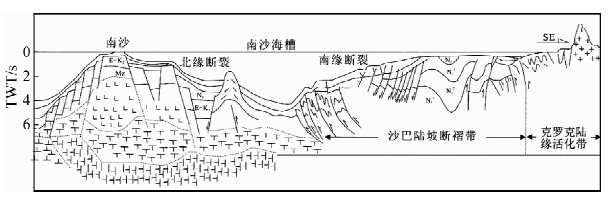 | 图 9 南沙海槽地震剖面解释结果(位置见图 2;据张殿广等,2009) Fig. 9 Interpretation of the profile of Nansha Trough.(See Fig. 2 for profile location. After Zhang et al.,2009) |
南海东部断裂主要指台湾-吕宋岛弧褶皱带断裂系,渐新世时,太平洋板块的运动方向从NNW向转成NWW向,使陆缘扩张的前缘受到太平洋板块的近EW向的挤压俯冲作用,形成NNE和NNW向的两组X型剪切断裂,产生近SN向的锯齿状断裂.
以位于吕宋岛弧和南海中央海盆之间近SN向的马尼拉海沟为主要特征,总体呈现向西凸出的弧形.马尼拉海沟是板块俯冲边界,是菲律宾板块和东亚大陆板块的分界线,形态清晰,是南海唯一的一个海沟(Pautot et al.,1986;Huang et al.,2001).
2.5 南海中部断裂构造南海中部构造以洋盆边缘断裂、转换断层以及洋中脊为主要特征(图 3).中央海盆西缘断裂为中央海盆与西北部陆坡的边界,断裂带的西侧为过渡性地壳,东侧为大洋型地壳,断裂带两侧水深、重磁场均有明显差异.中央海盆南缘断裂为中央海盆与南沙地块的分界线,被多条NW向断裂切割,断裂带向西南延伸与中央海盆西缘断裂带交汇,中央海盆的洋壳也向西南呈楔形尖灭.中央海盆北缘断裂走向为NE向,为中央海盆与华南地块南缘的边界.SN向的中南-礼乐断裂分隔了中央次海盆和西南次海盆,是一条贯穿洋盆的转换断裂.
3 南海区域基底构造格局以及构造属性 3.1 基底构造格局在区域断裂研究基础上,综合考虑南海地区地壳类型、构造层序列、沉积建造以及变质作用特征(表 1),以地块拼接带(蛇绿岩带、蛇绿混杂岩带及扩张边缘带)作为二级构造单元的分界线,以主要的走滑断裂作为三级构造单元的分界线,将南海地区划分为8个二级构造单元(包含苏禄海洋盆).其中,华夏古陆划分出4个三级构造单元,南沙地块划分出5个三级构造单元(图 10).
|
表 1 南海及邻区基底构造层特征 Table 1 Characteristics of basement tectonic layer of South China Sea and its adjacent areas |
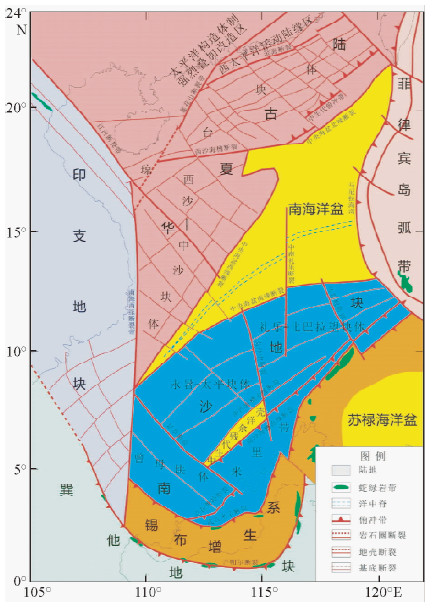 | 图 10 南海区域基底构造单元划分图 Fig. 10 Basement structural units of South China Sea area |
华夏古陆与印支地块具有相似的构造层序列、沉积建造和变质作用特征,说明其基底性质相近,反映了前新生代所处的构造古地理环境类似,构造属性属于游离在古特提斯多岛洋的微地块,地块的克拉通化的程度较高,形成时代较早;
南沙-北巴拉望地块与南华夏古陆具有完全不同的构造层、沉积建造和变质作用,具有完全不同的演化历史.南沙-北巴拉望地块与巽他地块均没有发现前震旦纪结晶基底,但都具有前晚石炭世的浅变质褶皱基底,均存在石炭纪-二叠纪浅海相碳酸盐岩沉积,并且在二叠纪末期都发育大陆边缘(滑塌堆积、浊流沉积)沉积.而侏罗纪-白垩纪都发育弧盆体系,新生代都处于俯冲、碰撞环境,说明两者基底性质相近,演化历程也相近,其构造属性属于游离在古特提斯多岛洋的一个微地块;
中沙-西沙地块具有前震旦纪结晶基底,来自于华夏古陆,而中沙-西沙地块、印支地块与巽他地块、南沙-北巴拉望地块在构造层特征、岩性特征具有明显区别.推测巽他地块与南沙-北巴拉望地块早古生代可能来自于冈瓦纳大陆北缘,晚古生代向北运移到昌宁-孟连、文冬-劳勿带,晚古生代以来具有亲华夏古陆特征,即早古生代分别来自不同的大陆;
巽他地块北侧的锡布增生系与印支地块北界的红河-黑河蛇绿岩带形成时代完全不同,巽他地块具有与印支地块不同的构造层、沉积建造、变质作用及其演化历史,因此巽他地块构造属性不同于印支地块,应属于漂浮在特提斯多岛洋中一个相对独立的地块.
4 结论与建议 4.1 结 论本文集合水深、重力、磁力以及地震等地球物理数据研究南海区域断裂构造体系,在此基础之上,综合各个地块构造层特征、地壳类型以及蛇绿岩带,对前新生代基底构造单元进行了划分,该结果将有助于进一步了解南海地区基底构造格局以及揭示前新生代构造演化过程.主要取得了以下几点认识:
(1)进一步明确了南海区域断裂构造特征及其性质.古生代以来南海地区受控于特提斯和太平洋两大构造域影响,导致区内板块汇聚与分离,不同时期南海构造应力环境各异,形成了性质不同的四周陆缘,致使北部陆缘主要为拉张型断裂,南部陆缘为挤压型断裂,西部陆缘为走滑型断裂,而东部陆缘则为海沟俯冲型断裂,以NE-NEE向、NW向和近SN向3组走向为主.
(2)在区域断裂构造研究基础上,明晰了南海前新生代基底构造单元特征.以地块拼接带(蛇绿岩带、蛇绿混杂岩带及扩张边缘带)作为二级构造单元的分界线,以主要的走滑断裂作为三级构造单元的分界线,将南海及其围区划分出8个二级构造单元以及9个三级构造单元.
(3)南海地区基底构造单元受控于特提斯和太平洋两大构造域,在不同时期具有不同的构造属性,显示出不同的构造层序、沉积建造以及变质作用.
4.2 建 议据目前的研究程度,南海北部陆缘基底构造属性已较为明确(Sun et al.,2014),但南海南部陆缘地质、地球物理资料的缺乏,该地区基底研究仍然受到很大的制约,推测成分较大.南海地质构造复杂,涉及众多(微)板块的聚合与分离.因此,要正确理解南海地区基底构造演化,下步研究需从大南海角度出发,抓主要板块级缝合带,关注以下几个问题:①大南海地区莫霍面、磁性基底及居里面等深部结构与构造特征;②基底的物质组成;③基底形成演化与特提斯域的关系;④基底的形成演化与太平洋域的关系;⑤基底的形成演化与古南海消亡以及新南海扩张的关系.另外,还需考虑苏禄海以及苏拉威西海的扩张对新生代南海南部构造演化的影响.
致 谢 感谢孙晓猛教授在研究过程中给予的技术指导和帮助.| [1] | Barckhausen U, Roeser H A. 2004. Seafloor spreading anomalies in the South China Sea revisited [A]. //Clift P, Kuhnt W, Wang P, et al. eds. Continent-Ocean Interactions within East Asian Marginal Seas. Geophysics Monograph Series, 149: 121-125. |
| [2] | Ben-Avraham Z, Uyeda S. 1973. The evolution of the China Basin and the mesozoic paleogeography of Borneo [J]. Earth and Planetary Science Letters, 18(2): 365-376. |
| [3] | Briais A, Tapponnier P, Pautot G. 1989. Constraints of Sea Beam data on crustal fabrics and seafloor spreading in the South China Sea [J]. Earth and Planetary Science Letters, 95(3-4): 307-320. |
| [4] | Briais A, Patriat P, Tapponnier P. 1993. Updated interpretation of magnetic anomalies and seafloor spreading stages in the South China Sea: implications for the Tertiary tectonics of Southeast Asia [J]. Journal of Geophysics Research, 98(B4): 6299-6328. |
| [5] | Cullen A, Reemst P, Henstra G, et al. 2010. Rifting of the South China Sea: new perspectives [J]. Petroleum Geoscience, 16(3): 273-282. |
| [6] | Dong D D, Wu S G, Li J B, et al. 2014. Tectonic contrast between the conjugate margins of the South China Sea and the implication for the differential extensional model[J]. Science China: Earth Sciences, 57(6): 1415-1426. |
| [7] | Fei D. 1983. On the structural feature and the oceanization in the north part of South China Sea [J]. Chinese Journal of Geophysics (in Chinese), 26(5): 459-467. |
| [8] | Flower M F J, Tamaki K, Hoang N. 1998. Mantle extrusion: a model for dispersed volcanism and DUPAL-like asthenosphere in East Asia and the western Pacific[C].// Flower M F J, Chun S L, Lo C H, et al. eds. Mantle Dynamics and Plate Interactions in East Asia. AGU, Geodynamics Series, 27: 67-88. |
| [9] | Fyhn M B W, Boldreel L O, Nielsen L H. 2009. Geological development of the Central and South Vietnamese margin: Implications for the establishment of the South China Sea, Indochinese escape tectonics and Cenozoic volcanism [J]. Tectonophysics, 478(3-4): 184-214. |
| [10] | Geological Survey of Japan and Coordinating Committee for Coastal and Offshore Geoscience Programmes in East and Southeast Asia(CCOP). 1996. Magnetic Anomaly Map of East Asia 1:4000000[CD]. CD-ROM version, digital geosciences map 2(P-1). |
| [11] | Gong Z S, Li S T. 1997. Continental margin basin analysis and hydrocarbon accumulation of the northern South China Sea (in Chinese) [M]. Beijing: Science Press. |
| [12] | Guo L Z, Shi Y S, Ma R S. 1983. On the formation and evolution of the mesozoic-cenozoic active continental margin and island arc tectonics of the western Pacific ocean[J]. Acta Geologica Sinica (in Chinese), 1: 11-21. |
| [13] | Hall R. 1996. Reconstructing Cenozoic SE Asia [A].// Hall R, Blundell Deds. Tectonic Evolution of Southeast Asia, Geol. Soc. Sp. Pub., 106: 153-184. |
| [14] | Hall R. 2002. Cenozoic geological and plate tectonic evolution of SE Asia and the SW Pacific: computer-based reconstructions, model and animations [J]. Journal of Asian Earth Sciences, 20(4): 353-431. |
| [15] | Hao T Y, Xu Y, Zhao B M, et al. 2009. Geophysical research on distribution features of magnetic basements in the South China Sea[J]. Chinese J. Geophys. (in Chinese), 52(11): 2763-2774. |
| [16] | Hao T Y, Xu Y, Sun F L, et al. 2011. Integrated geophysical research on the tectonic attribute of conjugate continental margin of South China Sea[J]. Chinese J. Geophys. (in Chinese), 54(12): 3098-3116, doi: 10.3969/j.issn.0001-5733.2011.12.011. |
| [17] | Holloway N H. 1982. North Palawan Block, Philipins-Its relation to Asian mainland and role in evolution of South China Sea [J]. AAPG Bulletin, 66(9): 1355-1383 |
| [18] | Hsu S K, Yeh Y C, Doo W B, et al. 2004. New bathymetry and magnetic lineations identifications in the northernmost South China Sea and their tectonic implications. Marine Geophysical Researches, 25(1-2): 29-44. |
| [19] | Hu D K, Zhou D, Wu X J, et al. 2008. Origin of high magnetic anomaly belt in northeastern South China Sea as indicated by geophysical inversion[J]. Journal of Tropical Oceanography (in Chinese), 27(1): 32-37. |
| [20] | Huang C Y, Xia K Y, Yuan P B, et al. 2001. Structural evolution from Paleogene extension to Latest Miocene-Recent arc-continent collision offshore Taiwan, comparison with on land geology[J]. Journal of Asian of Earth Sciences, 19(5): 619-639. |
| [21] | Hutchison C S. 1975. Ophiolite in Southeast Asia [J]. Geological Society of America Bulletin, 86(6): 797-806. |
| [22] | Hutchison C S. 1989. Geological evolution of South-east Asia. Oxford monographs on geology and geophysics [M]. Oxford: Clarendon Press. |
| [23] | Hutchison C S. 1994. Gondwana and Cathaysian blocks, paleotethys sutures and Cenozoic tectonics in South-east Asia [J]. Geologische Rundschau, 83(2): 388-405. |
| [24] | Hutchison C S. 2004. Marginal basin evolution: the southern South China Sea [J]. Marine and Petroleum Geology, 21(9): 1129-1148. |
| [25] | Hutchison C S. 2010a. Oroclines and paleomagnetism in Borneo and South-East Asia [J]. Tectonophysics, 496(1-4): 53-67. |
| [26] | Hutchison C S. 2010b. What are the Spratly Islands? [J]. Journal of Asian Earth Sciences, 39(5): 371-385. |
| [27] | Hutchison C S. 2010c. The north-west Borneo trough [J]. Marine Geology, 271(1-2): 32-43. |
| [28] | Jin Q H. 1989. Geology and Hydrocarbon Resources of the South China Sea (in Chinese) [M]. Beijing: Geological Press. |
| [29] | Jin Q H, Li T G. 2000. Regional geologic tectonics of the Nansha Sea area[J]. Marine Geology & Quaternary Geology (in Chinese), 20(1): 1-8. |
| [30] | Karig D E. 1971. Origin and development of marginal basins in the western Pacific [J]. Journal of Geophysics Research, 76(11): 2542-2561. |
| [31] | Leloup P H, Lacassin R, Tapponnier P, et al. 1995. The Ailao Shan-Red River shear zone (Yunnan, China), Tertiary transform boundary of Indochina[J]. Tectonophysics, 251(1-4): 3-10, 13-84. |
| [32] | Leloup P H, Arnaud N, Lacassin R, et al. 2001. New constraints on the structure, thermochronology, and timing of the Ailao Shan-Red River shear zone, SE Asia [J]. Journal of Geophysical Research, 66(B4): 1083-6732. |
| [33] | Leloup P H, Tapponnier P, Lacassin R. 2007. Discussion on the role of the Red River shear zone, Yunnan and Vietnam, in the continental extrusion of SE Asia[J]. Journal of the Geological Society, London, 164, 1253-1260. |
| [34] | Li C F, Song T R. 2012. Magnetic recording of the Cenozoic oceanic crustal accretion and evolution of the South China Sea basin [J]. Chinese Science Bulletin, 57(24): 3165-3181. |
| [35] | Li J B. 2008. Evolution of China’s marginal seas and its effect of natural resources (in Chinese) [M]. Beijing: Ocean Press. |
| [36] | Li J B, Ding W W, Gao J Y, et al. 2011. Cenozoic evolution model of the sea-floor spreading in South China Sea: new constraints from high resolution geophysical data[J]. Chinese J. Geophys. (in Chinese), 54(12): 3004-3015, doi: 10.3969/j.issn.0001-5733.2011.12.003. |
| [37] | Liu B M, Xia B, Li X X, et al. 2006. Southeastern extension of the Red River fault zone (RRFZ) and its tectonic evolution significance in western South China Sea [J]. Science in China Series D: Earth Sciences, 49(8): 839-850. |
| [38] | Liu H L, Yan P, Zhang B Y, et al. 2004. Pre-Cenozoic basements of the South China Sea and eastern tethyan realm[J]. Marine Geology & Quaternary Geology (in Chinese), 24(1): 15-28. |
| [39] | Liu J L, Tran M -D, Tang Y, et al. 2012. Permo-Triassic granitoids in the northern part of the Truong Son belt, NW Vietnam: Geochronology, geochemistry and tectonic implications[J]. Gondwana Research, 22(2): 628-644. |
| [40] | Liu Z S, Zhao H T, Fan S Q, et al. 2002. Geology of South China Sea (in Chinese) [M]. Beijing: Science Press. |
| [41] | Lu B L, Wang P J, Zhang G C, et al. 2011. Basement structures of an epicontinental basin in the northern South China Sea and their significance in petroleum prospect [J]. Acta Petrolei Sinica (in Chinese), 32(4): 580-587. |
| [42] | Lu B L, Wang P J, Liang J S, et al. 2014. Structural properties of paleo-south China Sea and their relationship with the tethys and paleo-pacific tectonic domain [J]. Journal of Jilin University (Earth Science Edition) (in Chinese), 44(5): 1441-1450. |
| [43] | Metcalfe I. 1998. Palaeozoic and Mesozoic geological evolution of the SE Asian region: multidisciplinary constraints and implications for biogeography [A].// Hall R, Holloway J eds. Biogeography and Geological Evolution of SE Asia[M]. Leiden, The Netherlands: Backhuys Publishers,25-41. |
| [44] | Metcalfe I. 2006. Palaeozoic and Mesozoic tectonic evolution and palaeogeography of East Asian crustal fragments: The Korean Peninsula in context [J]. Gondwana Research, 9(1-2): 24-46. |
| [45] | Metcalfe I. 2011. Tectonic framework and Phanerozoic evolution of Sundaland [J]. Gondwana Research, 19(1): 3-21. |
| [46] | Morley C K. 2002. A tectonic model for the Tertiary evolution of strike-slip faults and rift basins in SE Asia [J]. Tectonophysics, 347(4): 189-215. |
| [47] | Pautot G, Rangin C, Briais A, et al. 1986. Spreading direction in the central South China Sea[J]. Nature, 321(6066): 150-154. |
| [48] | Qin J X, Hao T Y, Xu Y, et al. 2011. The distribution characteristics and the relationship between the tectonic units of the Moho depth in South China Sea and adjacent areas[J]. Chinese J. Geophys. (in Chinese), 54(12): 3171-3183, doi: 10.3969/j.issn.0001-5733.2011.12.017. |
| [49] | Rangin C, Klein M, Roques D, et al. 1995. The Red River fault system in the Tonkin Gulf, Vietnam [J]. Tectonophysics, 243(3-4): 209-222. |
| [50] | Ru K, Pigott J. 1986. Episodic rifting and subsidence in the South China Sea[J]. AAPG Bulletin, 70(6): 1136-1155. |
| [51] | Sandwell D T, Smith W H F. 2009. Global marine gravity from retracked Geosat and ERS-1 altimetry: Ridge Segmentation versus spreading rate [J]. Journal of Geophysics Research, 114(B1), doi: 10.1029/2008JB006008. |
| [52] | Shu L S, Zhou X M. 2002. Late Mesozoic tectonism of southeast China [J]. Geological Review (in Chinese), 48(3): 249-260. |
| [53] | Shu L S, Zhou X M, Deng P, et al. 2004. Geological features and tectonic evolution of Meso-Cenozoic basins in southeastern China[J]. Geological Bulletin of China (in Chinese), 23(9-10): 876-884. |
| [54] | Smith W H F, Sandwell D T. 1997. Global seafloor topography from satellite altimetry and ship depth soundings [J]. Science, 277(5334): 1956-1962. |
| [55] | Song H B, Hao T Y, Jiang W W, et al. 2002. Researches on geophysical field characteristics and basement fault system of South China Sea[J]. Progress in Geophysics (in Chinese), 17(1): 24-34, doi: 10.3969/j.issn.1004-2903.2002.01.003. |
| [56] | Sun L T, Sun Z, Zhan W H, et al. 2006. Western fault zone of South China Sea and its physical simulation evidences[J]. Acta Oceanologica Sinica (in Chinese), 28(3): 64-71. |
| [57] | Sun X M, Zhang X Q, Zhang G C, et al. 2014. Texture and tectonic attribute of Cenozoic basin basement in the northern South China Sea[J]. Science China Earth Sciences, 2014, 57(6): 1199-1211. |
| [58] | Tamaki K. 1995. Upper mantle extrusion tectonics of Southeast Asia and formation of the western Pacific back-arc basins[C].// Workshop: Cenozoic Evolution of the Indochina Peninsula, Hanoi/Do son, Abstract with Program, 89.. |
| [59] | Tapponnier P, Peltzer G, Le Dain A Y, et al. 1982. Propagating extrusion tectonics in Asia: New insights from simple experiments with plasticine [J]. Geology, 10(12): 611-616. |
| [60] | Tapponnier P, Peltzer G, Armijo R. 1986. On the mechanics of the collision Between India and Asia [J]. Journal of the Geological Society, 19: 113-157. |
| [61] | Tapponnier P, Lacassin R, Leloup P H, et al. 1990. The Ailao Shan/Red River metamorphic belt: Tertiary left-lateral shear between Indochina and South China [J]. Nature, 243(6257): 431-437. |
| [62] | Taylor B, Hayes D E. 1980. The tectonic evolution of the South China Sea basin [A].// Hay D E ed. The Tectonics and Geologic Evolution of Southeast Asian Seas and Islands[M]. American Geophysical Union Monograph, 23: 89-104. |
| [63] | Taylor B, Hayes D E. 1983. Origin and history of the South China Sea basin [A].// Hay D E ed. The Tectonic and Geologic Evolution of Southeast Asia Seas and Islands, Part 2[M]. American Geophysical Union Monograph, 27: 23-56. |
| [64] | Williams P R, Johnston C R, Almond R A, et al. 1988. Late cretaceous to early tertiary structural elements of west Kalimantan[J]. Tectonophysics, 148(3-4): 279-297. |
| [65] | Wu S M, Yang T, Zhou D, et al. Discussion on the extension model for the conjugate continental margin of South China Sea[J]. Geological Journal of China Universities (in Chinese), 11(1): 105-110. |
| [66] | Xia S H, Qiu X L, Zhao M H, et al. 2011. Crustal structure and features in the conjugate margins of South China Sea[J]. Earth Science—Journal of China University of Geosciences (in Chinese), 36(5): 877-885. |
| [67] | Xia S H, Guo X W, Huang H B, et al. 2014. Geophysical features of lithosphere and tectonic boundaries in the South China Sea[J]. Chinese J. Geophys. (in Chinese), 57(12): 3957-3967, doi: 10.6038/cjg20141209. |
| [68] | Yan P, Liu H L. 2002. Analysis on deep crust sounding results in northern margin of South China Sea[J]. Journal of Tropical Oceanography (in Chinese), 21(2): 1-12. |
| [69] | Yao B C. 1994. The geological memoir of South China Sea surveyed jointly by China & USA(in Chinese)[M]. |
| [70] | Yao B C, Wan L, Wu N Y. 2004. Cenozoic plate tectonic activities in the Great South China Sea area[J]. Geology in China (in Chinese), 31(2): 113-122. |
| [71] | Yao B C. 2006. Three-dimensional structure of lithosphere and its evolution in the South China Sea (in Chinese) [M]. Beijing: Geological Press. |
| [72] | Zhang D G, Zhan W H, Yao Y T, et al. 2009. Preliminary analysis of the activity of the Nansha Trough fault zone[J]. Marine Science Bulletin (in Chinese), 28(6): 70-77. |
| [73] | Zhang J J, Zhong D L, Sang H Q, et al. 2006. Structural and geochronological evidence for multiple episodes of Tertiary deformation along the AilaoShan-Red River Shear Zone, Southeastern Asia, since the Paleocene [J]. ACTA Geologica Sinica, 80(1): 79-96. |
| [74] | Zhao M H, Qiu X L, Xu H L, et al. 2011. Deep seismic surveys in the Southern South China Sea and contrast on its conjugate margins[J]. Earth Science—Journal of China University of Geosciences (in Chinese), 36(5): 823-830. |
| [75] | Zhong D L, Tapponnier P, Wu H W, et al. 1990. Large scale strike slip fault: the major structure of intracontinental deformation after collision[J]. Chinese Science Bulltin, 35(4): 304-309. |
| [76] | Zhou D, Chen H Z, Wu S M, et al. 2002. Opening of the South China Sea by dextral splitting of the East Asian continental margin[J]. Acta Geologica Sinica (in Chinese), 76(2): 180-190. |
| [77] | Zhou D, Wang W Y, Wang J L, et al. 2006. Mesozoic subduction-accretion zone in northeastern South China Sea inferred from geophysical interpretations [J]. Science in China Series D Earth Sciences, 49(5): 471-482. |
| [78] | Zhu M Z, Graham S, McHargue T. 2009. The Red River Fault zone in the Yinggehai Basin, South China Sea[J]. Tectonophysics, 476(3-4): 397-417. |
| [79] | 费鼎. 1983. 南海北部区域构造和陆壳向洋壳的转化[J]. 地球物理学报, 26(5): 459-467. |
| [80] | 龚再升, 李思田. 1997. 南海北部大陆边缘盆地分析与油气聚集[M]. 北京: 科学出版社.. |
| [81] | 郭令智, 施央申, 马瑞士. 1983. 西太平洋中、新生代活动大陆边缘和岛弧构造的形成及演化[J]. 地质学报, 1: 11-21. |
| [82] | 郝天珧, 徐亚, 赵百民,等. 2009. 南海磁性基底分布特征的地球物理研究[J]. 地球物理学报, 52(11): 2763-2774. |
| [83] | 郝天珧, 徐亚, 孙福利,等. 2011. 南海共轭大陆边缘构造属性的综合地球物理研究[J]. 地球物理学报, 54(12): 3098-3116, doi: 10.3969/j.issn.0001-5733.2011.12.011. |
| [84] | 胡登科, 周蒂, 吴湘杰,等. 2008. 南海东北部高磁异常带成因的地球物理反演研究[J]. 热带海洋学报, 27(1): 32-37. |
| [85] | 金庆焕. 1989. 南海地质与油气资源[M]. 北京: 地质出版社.. |
| [86] | 金庆焕, 李唐根. 2000. 南沙海域区域地质构造[J]. 海洋地质与第四纪地质, 20(1): 1-8. |
| [87] | 李家彪. 2008. 中国边缘海形成演化与资源效应[M]. 北京: 海洋出版社.. |
| [88] | 李家彪, 丁巍伟, 高金耀,等. 2011. 南海新生代海底扩张的构造演化模式: 来自高分辨率地球物理数据的新认识[J]. 地球物理学报, 54(12): 3004-3015, doi: 10.3969/j.issn.0001-5733.2011.12.003. |
| [89] | 刘海龄, 阎贫, 张伯友,等. 2004. 南海前新生代基底与东特提斯构造域[J]. 海洋地质与第四纪地质, 24(1): 15-28. |
| [90] | 刘昭蜀, 赵焕庭, 范时清,等. 2002. 南海地质[M]. 北京: 科学出版社.. |
| [91] | 鲁宝亮, 王璞珺, 张功成,等. 2011. 南海北部陆缘盆地基底结构及其油气勘探意义[J]. 石油学报, 32(4): 580-587. |
| [92] | 鲁宝亮, 王璞珺, 梁建设,等. 2014. 古南海构造属性及其与特提斯和古太平洋构造域的关系[J]. 吉林大学学报(地球科学版), 44(5): 1441-1450. |
| [93] | 秦静欣, 郝天珧, 徐亚,等. 2011. 南海及邻区莫霍面深度分布特征及其与各构造单元的关系[J]. 地球物理学进展, 54(12): 3171-3183, doi: 10.3969/j.issn.0001-5733.2011.12.017. |
| [94] | 舒良树, 周新民. 2002. 中国东南部晚中生代构造作用[J]. 地质论评, 48(3): 249-260. |
| [95] | 舒良树, 周新民, 邓平,等. 2004. 中国东南部中、新生代盆地特征与构造演化[J]. 地质通报, 23(9-10): 876-884. |
| [96] | 宋海斌, 郝天珧, 江为为,等. 2002. 南海地球物理场特征与基底断裂体系研究[J]. 地球物理学进展, 17(1): 24-34, doi: 10.3969/j.issn.1004-2903.2002.01.003. |
| [97] | 孙龙涛, 孙珍, 詹文欢,等. 2006. 南海西部断裂系研究及其物理模拟实验证据[J]. 海洋学报, 28(3): 64-71. |
| [98] | 吴世敏, 杨恬, 周蒂,等. 2005. 南海南北共轭边缘伸展模型探讨[J]. 高校地质学报, 11(1): 105-110. |
| [99] | 夏少红, 丘学林, 赵明辉,等. 2011. 南海共轭大陆边缘地壳结构及其类型特征[J]. 地球科学——中国地质大学学报, 36(5): 877-885. |
| [100] | 夏少红, 郭兴伟, 黄海波,等. 2014. 南海岩石层及边界构造的地球物理特征[J]. 地球物理学报, 57(12): 3957-3967, doi: 10.6038/cjg20141209. |
| [101] | 阎贫, 刘海龄. 2002. 南海北部陆缘地壳结构探测结果分析[J]. 热带海海洋学报, 21(2): 1-12. |
| [102] | 姚伯初. 1994. 中美合作调研南海地质专报[M]. 北京: 中国地质大学出版社.. |
| [103] | 姚伯初, 万玲, 吴能友. 2004. 大南海地区新生代板块构造活动[J]. 中国地质, 31(2): 113-122. |
| [104] | 姚伯初. 2006. 中国南海海域岩石圈三维结构及演化[M]. 北京: 地质出版社.. |
| [105] | 张殿广, 詹文欢, 姚衍桃,等. 2009. 南沙海槽断裂带活动性初步分析[J]. 海洋学报, 28(6): 70-77. |
| [106] | 赵明辉, 丘学林, 徐辉龙,等. 2011. 南海南部深地震探测及南北共轭陆缘对比[J]. 地球科学——中国地质大学学报, 36(5): 823-830. |
| [107] | 周蒂, 陈汉宗, 吴世敏,等. 2002. 南海的右行陆缘裂解成因[J]. 地质学报, 76(2): 180-190. |