 2015, Vol. 30


 , YANG Hai-yan
 , LIU Shao-guang, XU Zheng-yu, DONG Meng-meng, DENG Ju-zhi, ZHANG Hua, TANG Hong-zhi
瞬变电磁技术是国内外发展较快的一种物探技术之一,从20世纪90年代开始国内已逐步将瞬变电磁技术应用于矿产普查、地下水勘查、石油勘探等领域.
瞬变电磁法(Transient electromagnetic methods)缩写为TEM,是一种建立在电磁感应原理上的时间域人工源电磁探测方法.它利用不接地回线(磁源)或接地回线(电偶源)向地下发送一次脉冲场(常称为一次场),在其激发下,地下地质体中激励的感应涡流将产生随时间变化的感应电磁场(常称为二次场).由于二次场包含有地下地质体丰富的地电信息,在一次脉冲磁场的间歇期间,利用线圈或接地电极观测二次场(或称响应场)通过对这些响应信息的提取与分析,从而达到探测地下地质体的目的.
地面瞬变电磁法的常用回线装置包括多种,如:同一回线,重叠回线,中心回线和大定源回线,“8”字形回线等,对于多数回线装置,很多文献对已经做了明确阐述,并说明了其特性.而有关于“8”字形回线装置的研究,文献涉及尚少.蒋邦远教授在《实用近区磁源瞬变电磁法勘探》中指出,“8”字形回线对噪声的抑制有一定作用(蒋邦远,1998);中国矿业大学刘英也对“8”字形回线做了研究,指出“8”字形回线对大倾角陡峭构造的探测效果良好,异常形态为单一峰值,形态简单(刘英,2009);李国才基于MAXWEII软件对“8”字形回线进行了仿真模拟,得出结论:“8”字形回线在纵向产生的磁通密度比比方形回线峰值更大,能量分布更集中,具有更强的聚焦能力(李国才等,2013).
本文作者为了了解“8”字形回线装置的特点,就常用的同一回线和“8”字形回线进行了实验对比,并同一工作区域进行实地探测工作.
1 基本原理
在导电率为δ、导磁率为μ的均匀各向同性大地表面敷设面积为S的矩形发射回线,在回线中供以阶跃脉冲电流I,I满足以下条件:

在电流断开之前(t<0时),发射电流在回线周围与大地空间中建立起一个稳定的磁场;在t=0时,将电流突然断开,由该电流产生的磁场也立即消失.一次磁场的这一剧烈变化通过空气和地下电介质传至回线周围的大地中,并在大地中激发出感应电流以维持发射电流断开之前存在的磁场,使空间的磁场不会即刻消失.
由于介质的欧姆损耗,这一感应电流将迅速衰减,由它产生的磁场也随之衰减,这种迅速衰减的磁场又在其周围的地下介质中感应出新的强度更弱的涡流.这一过程继续下去,直至大地的欧姆损耗将磁场能量消耗完毕为止,伴随这一过程存在的电磁场便是大地的瞬变电磁场.利用接受线圈在地表接受所产生的瞬变电磁场,并得到其包含的地质信息,以达到勘探地下地质体的目的(Nabighian and Macnae,1979,蒋邦远,1998).
对于同一回线,其收发线圈为同一个线圈.在均匀半空间的电动势相应为

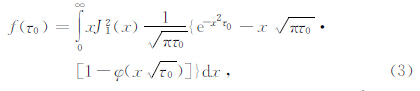
 τ/(σμ0a2)—综合参数(无量纲),J1(x)— 一阶一类贝塞尔函数,μ0—4π×10-7 H/m.
在τ0≥3时, ,为晚期,则晚期的感应电动势表达式为



误差函数:

对于偶极—偶极方式,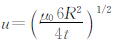 ,而“8”字形回线,收发距为回线边长a,取R=a.则 V(t)表达式变为

取晚期道用二分法进行视电阻率计算.
2 实验过程
2.1 装置介绍
同一回线是指发射回线和接收回线使用的是同一正方形线圈,如图 1所示;“8”字形回线是在同一回线基础上“扭转”而成,如图 2所示.
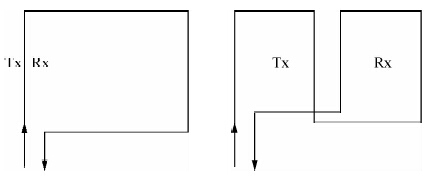 | 图 1 同一回线装置 Fig. 1 Single loop |
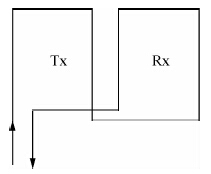 | 图 2 “8”字形回线装置 Fig. 2 Type of “8” loop |
实验中,在野外选择良好的实验场地,要求场地周围没有明显的铁质管线等干扰物的存在,布置一条测线,点距40 m.两种装置均水平铺设于地面,逐点测量.
2.2 实验参数设置
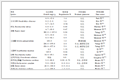
仪器为澳大利亚产的Terra TEM瞬变电磁仪.参数设置如表 1:
|
表 1 线圈边长为20 m时参数设置 Table 1 Parameter Settings when the coil is 20 meters length |
3.1 同点响应对比
对实测数据使用Matlab编程处理.图 3为同一回线在一个点上的响应曲线,图 4为“8”字形回线在相同点上的响应曲线.二者均绘制于双对数坐标下.
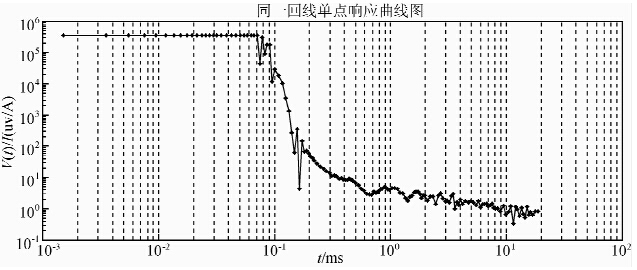 | 图 3 方形回线在一点上的实测瞬变数据 Fig. 3 The transient data of the single loop |
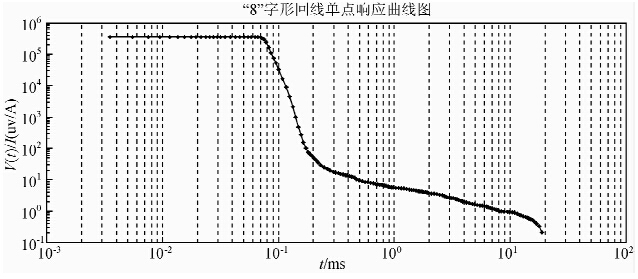 | 图 4 “8”字形回线在相同点上实测瞬变数据 Fig. 4 The transient data of the type of “8” loop |
图中,纵坐标表示瞬变电磁法的电压对时间的归一化响应,单位μV/A,横坐标表示的延时,单位是ms,对比可知,在整个延时中,“8”字形回线的实测曲线更加光滑.同一回线实测曲线有更大的跳跃,特别是在晚延时段,同一回线装置所得数据更加跳跃,而“8”字形回线则更加平滑.这是因为晚期信号微弱,从而导致的信号不稳定.这说明在晚期信号微弱的情况下,“8”字形回线具有更加好的分辨能力和抗干扰能力. 图 3
3.2 同线响应对比对同线的数据质量进行了对比.设计的测线线长为1400 m,点距为40 m.保持装置及参数不变,对线上各点分别采用同一回线和“8”字形回线沿同一测线进行测量,对数据用Matlab编程处理并成图.
采用三点滤波方法对数据进行处理,滤波公式为

图 5是同一回线滤波前后响应曲线对比图,图 6是“8”字形回线滤波前后响应曲线对比图.均绘制于双对数坐标下.
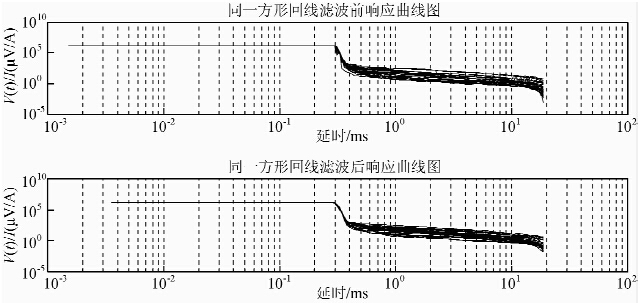 | 图 5 同一回线在一条测线上滤波前后的响应曲线 Fig. 5 The response curve of single loop of a line |
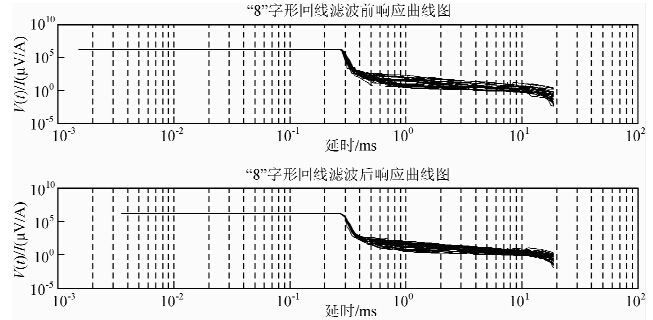 | 图 6 “8”字形回线在一条测线上滤波前后的响应曲线 Fig. 6 The response curve of the type of “8” loop of a line |
以上两图在滤波前二者并无明显差异,在晚延时的响应均有小幅度的跳跃,该现象在个别点上的反应尤其明显,“8”字形回线并没有明显的优势.这说明外界干扰信号过大时,回线装置的改变只能相对减少其影响,不能绝对地克服这种干扰.对比滤波后的两幅图,在同一条测线上“8”字形回线比同一回线在晚延时“收缩”更加紧密.表明滤波后的“8”字形回线数据质量更好.
图 7和图 8是同一侧线上采用不同装置得到多测道剖面图.整体上,二者的基本形态类似,对异常的位置反应也一致.图 9和图 10是两种装置下所得数据的视电阻率断面图,对比二者,可以看出:二者对异常的位置以及规模反应一致,和多测道剖面图也有良好的对应.对测点距离为200~300 m 左右、深度约75 m的高阻异常以及沿测线方向800 m处的高阻异常都能识别.探测深度方面,二者并没有太大的差异.只是在浅层区域,“8”字形回线获得的干扰信息比同一回线装置更多.
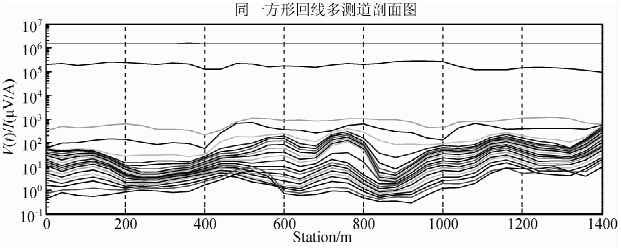 | 图 7 同一回线多测道剖面图 Fig. 7 The profile of the single loop |
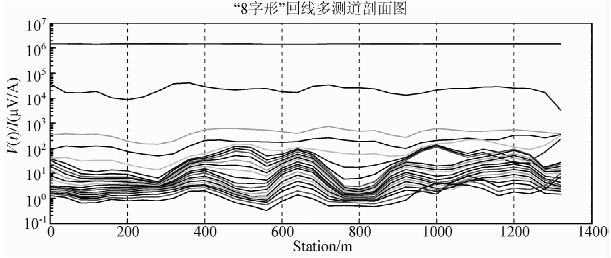 | 图 8 “8”字形回线多测道剖面图 Fig. 8 The profile of the type of “8” loop |
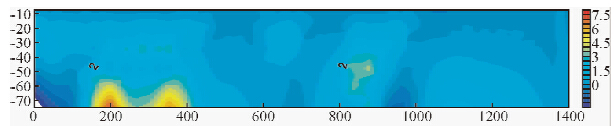 | 图 9 同一回线视电阻率断面图 Fig. 9 The apparent resistivity profile of single loop |
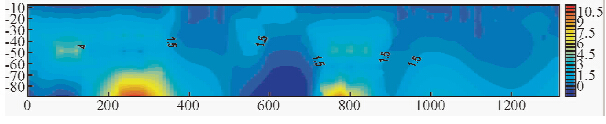 | 图 10 “8”字形回线视电阻率断面图 Fig. 10 The apparent resistivity profile of the type of “8” loop |
“8”字形回线数据处理结果对地下异常范围的反映比同一回线明显.计算出的视电阻率比同一回线稍大.
4 应用实例
江西某地区,地质环境复杂,选择该区域为实际工作地方.设计中参考当地地质资料,将测线垂直于地下一接触带布置,线长920 m,点距40 m.使用“8”字形回线逐点测量,并记录干扰.测量完成后,进行数据处理并解释.
图 11是在工作地区使用“8”字形回线的探测结果,可以看出,在测线方向100~500 m,深度在70~100 m之间的高阻异常反映的十分明显,而且形态简单.根据地质资料,在延测线方向100~300 m之间确有一高阻接触带.这说明“8”字形回线的实际探测结果是可信的.而在其他电阻率差异比较小的区域,探测的结果不是很理想.这表明“8”字形回线对视电阻率和围岩相差不大的异常体探测效果较差.在视电阻率与围岩相差比较大的异常体或者具有深大断裂构造的的区域,可以考虑使用“8”字形回线.
 | 图 11 江西某地区瞬变电磁法“8”字形回线视电阻率断面图 Fig. 11 The apparent resistivity profile of the type of “8” loop in workplace in Jiangxi |
通过对同一回线和“8”字形回线的多方面的对比研究,得到如下结论:
(1)“8”字形回线比同一回线有更好的信噪比.
(2)同一回线在弱信号的识别和抗干扰能力上不如“8”字形回线.特别是在晚延时的信号,“8”字形回线有更好的识别能力和稳定性.
(3)关断时间的长短决定着浅层信息分辨能力的大小,但是在关断时间相同的情况下,同一回线比“8”字形回线有更好的分辨能力,能获得更加丰富的浅层地质信息,获得的干扰信息也更少.因此在浅层探测时,同一回线效果更好.
(4)在围岩和异常体电阻率相差较大的地质条件下,同一回线对异常反应不如“8”字形回线明显,因此在进行深部大构造的探测或在异常体和围岩电阻率差异明显的地区工作时可以考虑使用“8”字形回线.
致 谢 感谢审者和编辑的辛勤工作!
| [1] | Bai D H, Meju M A, Lu J et al. 2003. Numerical calculation of all-time apparent resistivity for the central loop transient electromagnetic method[J]. Chinese Journal of Geophysics (in Chinese), 46(5): 697-704, doi: 10.3321/j.issn:0001-5733.2003.05.018. |
| [2] | Carrasquilla A A G, Ulugergerli E. 2006. Evaluation of the transient electromagnetic geophysical method for stratigraphic mapping and hydrogeological delineation in Campos Basin, Brazil[J]. Revista Brasileira de Geofísica, 24(3): 175-184. |
| [3] | Chen S D, Lin J, Zhang S. 2012. Effect of transmitter current waveform on TEM response[J]. Chinese Journal of Geophysics (in Chinese), 55(2): 709-716. doi: 10.6038/j.issn.0001-5733.02.035. |
| [4] | Di Q Y, Fang G Y, Zhang Y M. 2013. Research of the Surface Electromagnetic Prospecting (SEP) system[J]. Chinese Journal of Geophysics (in Chinese), 56(11): 3629-3639, doi: 10.6038/cjg20131104. |
| [5] | Ding Y F, Bai D H, Xu C. 2012. A rapid algorithm for calculating time domain transient electromagnetic responses of a large fixed rectangular loop on the half space[J]. Chinese Journal of Geophysics (in Chinese), 55(6): 2087-2096, doi: 10.6038/j.issn.0001-5733.2012.06.030. |
| [6] | Du Q F. 2008. The data preprocessing, and the inversion interpretation system of the work device of the transient electromagnetic method (in Chinese) [Ph. D. thesis]. Beijing: China University of Geosciences (Beijing). |
| [7] | Fitterman D V, Stewart M T. 1986. Transient electromagnetic sounding for groundwater[J]. Geophysics, 51(4): 995-1005. |
| [8] | He J S. 1997. Development and prospect of electrical prospecting method[J]. Acta Geophysica Sinica (in Chinese), 40(S1): 308-316. |
| [9] | Ji Y J, Lin J, Yu S B, et al. 2006. A study on solution of transient electromagnetic response during transmitting current turn-off in the ATTEM system[J]. Chinese Journal of Geophysics (in Chinese), 49(6): 1884-1990, doi: 10.3321/j.issn:0001-5733.2006.06.038. |
| [10] | Ji Y J, Lin J, Wang Z. 2007. Analysis and numerical removing of distortion in transient electromagnetic receiver device for shallow sounding [J]. Progress in Geophysics (in Chinese), 22(1): 262-267. |
| [11] | Jiang B Y. 1998. Practical Area Near Magnetic Source Transient Electromagnetic Method Prospecting(in Chinese) [M]. Beijing: Geology Publishing House. |
| [12] | Li G C, Xu Y K, Zhao Z T et al. 2013. Simulation and analysis of 8-shaped coils structure for electromagnetic transmitter based on MAXWELL[J] Science Technology and Engineering (in Chinese), 13(35): 10481-10484. |
| [13] | Li J H, Zhu Z Q, Liu S C, et al. 2011. 3D numerical simulation for the transient electromagnetic field excited by the central loop based on the vector finite-element method[J]. Journal of Geophysics and Engineering, 8(4): 560-567. |
| [14] | Li J H, Zhu Z Q, Zeng S H et al. 2012. The forward modeling calculation of Transient electromagnetic method[J]. Progress in Geophysics (in Chinese), 27(4): 1393-1400. |
| [15] | Li J H, Hu X Y, Zeng S H. et al. 2013. Three-dimensional forward calculation for loop source transient electromagnetic method based on electric field Helmholtz equation[J]. Chinese Journal of Geophysics (in Chinese), 56(12): 4256-4267, doi: 10.6038/cjg20131228. |
| [16] | Liu Y. 2009. The advantages and disadvantages comparison among tem different loop[J]. Equipment for Geophysical Prospecting (in Chinese), 19(5): 325-327, 345. |
| [17] | Nabighian M N, Macnae J. 1979. Quasi-static transient response of a conducting half-space-an approximate representation[J]. Geophysics, 44(10): 1700-1705. |
| [18] | Nabighian M N, Macnae J C. 1988. Time domain electromagnetic prospecting methods[C]. // Nabighian M N ed. Electromagnetic Methods in Applied Geophysics[M]. Vol. 2, Part A, Chapter 6, 427-520. |
| [19] | Niu Z L. 2007. Principle of Electromagnetic Method in Time Domain (in Chinese) [M]. Changsha: Central South University Press. |
| [20] | Shi X X, Yan S, Chen M S. 2009. Improvement for interpretation of central loop transient electromagnetic method [J].Chinese Journal of Geophysics (in Chinese), 52(7): 1931-1936, doi: 10.3969/j.issn.00015733.2009.07.029. |
| [21] | Spies B R. 1975. The dual loop configuration of the transient electromagnetic method[J] Geophysics, 40(6): 1051-1057. |
| [22] | Sun H F, Li X, Li S C, et al. 2013. Three-dimensional FDTD modeling of TEM excited by a loop source considering ramp time [J]. Chinese Journal of Geophysics (in Chinese), 56(3): 1049-1064, doi: 10.6308/cjg.20130333. |
| [23] | Wang H J, Luo Y Z. 2003. Algorithm od a 2.5 dimensional finite element method for transient electromagnetic with a central loop[J]. Chinese Journal of Geophysics (in Chinese), 46(6): 855-862. |
| [24] | Wang H J. 2008. Time domain transient electromagnetism all time apparent resistivity translation algorithm[J]. Chinese Journal of Geophysics (in Chinese), 51(6): 1936-1942. |
| [25] | Wang H J, Luo Y Z. 2003. Algorithm od a 2.5 dimensional finite element method for transient electromagnetic with a central loop[J]. Chinese Journal of Geophysics (in Chinese), 46(6): 855-862. |
| [26] | Xue G Q, Li X, Di Q Y. 2007. The progress of TEM in theory and application[J]. Chinese Journal of Geophysics (in Chinese), 22(4): 1195-1120, doi: 10.3969/j.issn.1004-2903.2007.04.026. |
| [27] | Xue G Q, Wang H Y, Yan S, et al. Time-domain Green function solution for transient electromagnetic field [J]. Chinese Journal of Geophysics (in Chinese), 57(2): 671-678, doi: 10.6308/cjg.20140230. |
| [28] | Yan S, Chen M S, Fu J M. 2002. Direct Time-domain numerical analysis of transient electromagnetic fields [J]. Chinese Journal of Geophysics (in Chinese), 45(2): 275-284, doi: 10.3321/j.issn:0001-5733.2002.02.014. |
| [29] | Yan S, Shi X X, Chen M S. 2009. The probing depth of transient electromagnetic field method[J]. Chinese Journal of Geophysics (in Chinese), 52(6): 1583-1591. |
| [30] | Yan S, Chen M S, Fu J M. 2002. Direct Time-domain numerical analysis of transient electromagnetic fields [J]. Chinese Journal of Geophysics (in Chinese), 45(2): 275-284, doi: 10.3321/j.issn:0001-5733.2002.02.014. |
| [31] | Yang H Y, Yue J H. 2008. Research on response calculation and correction technique of turn-off current in the transient electromagnetic method [J]. Progress in Geophysics (in Chinese), 23(6): 1947-1952. |
| [32] | Yang H Y, Yue J H. 2013. Kernelfunction algorithm of all-time apparent resistivity used in underground transient electromagnetic method[J]. Journal of China University of Mining & Technology (in Chinese), 42(1): 83-87. |
| [33] | Yin J K, Yan S, Chen M S. 2007. Small transmitter loop device and its application in transient electromagnetic method[J]. Coal Geology & Exploration (in Chinese), 35(3): 66-68. |
| [34] | Zhang H, Cao J, Sun H. 2010. The analysis and research of transient electromagnetic configuration of small Multi-turn coincident loop [J]. Seismology and Geology (in Chinese), 32(1): 90-97. |
| [35] | Zhang S T, Zhang H, Yang H Y, et al. 2013. A comparative study of transient electromagnetic devices of small Multi-turn loop [J]. Geophysical and Geochemical Exploration (in Chinese), 37(5): 843-847. |
| [36] | 白登海, Maxwell A Meju, 卢健,等. 2003. 时间域瞬变电磁法中心方式全程视电阻率的数值计算[J]. 地球物理学报, 46(5): 697-704, doi: 10.3321/j.issn:0001-5733.2003.05.018. |
| [37] | 陈曙东, 林君, 张爽. 2012. 发射电流波形对瞬变电磁响应的影响[J]. 地球物理学报, 55(2): 709-716. doi: 10.6038/j.issn.0001-5733.2012.02.035. |
| [38] | 底青云, 方广有, 张一鸣. 2013. 地面电磁探测系统(SEP)研究[J]. 地球物理学报, 56(11): 3629-3639, doi: 10.6038/cjg20131104. |
| [39] | 丁艳飞, 白登海, 许诚. 2012. 均匀半空间表面大定源瞬变电磁响应的快速算法[J]. 地球物理学报, 55(6): 2087-2096, doi: 10.6038/j.issn.0001-5733.2012.06.030. |
| [40] | 杜庆丰. 2008. 瞬变电磁法工作装置、数据预处理及反演解释系统[博士论文]. 北京: 中国地质大学(北京). |
| [41] | 何继善. 1997. 电法勘探的发展和展望[J]. 地球物理学报, 40(增刊): 308-316. |
| [42] | 蒋邦远. 1998. 实用近区磁源瞬变电磁法勘探[M]. 北京: 地质出版社. |
| [43] | 嵇艳鞠, 林君, 于生宝,等. 2006. ATTEM系统中电流关断期间瞬变电磁场响应求解的研究[J]. 地球物理学报, 49(6): 1884-1990, doi: 10.3321/j.issn:0001-5733.2006.06.038. |
| [44] | 嵇艳鞠, 林君, 王忠. 2007. 瞬变电磁接收装置对浅层探测的畸变分析与数值剔除[J]. 地球物理学进展, 22(1): 1262-1267. |
| [45] | 李国才, 徐亚昆, 赵振廷,等. 2013. 基于MAXWELL的瞬变电磁“8”字形发射线圈仿真分析[J]. 科学技术与工程, 13(35): 10481-10484. |
| [46] | 李建慧, 朱自强, 曾思红,等. 2012. 瞬变电磁法正演计算进展[J]. 地球物理学进展, 27(4): 1393-1400. doi: 10.6308/j.issn.1004-2903.2012.04.013. |
| [47] | 李建慧, 胡祥云, 曾思红,等. 2013. 基于电场Helmholtz方程的回线源瞬变电磁法三维正演[J]. 地球物理学报, 56(12): 4256-4267, doi: 10.6038/cjg20131228. |
| [48] | 刘英. 2009. 浅析瞬变电磁法不同回线装置的优缺点[J]. 物探装备, 19(5): 325-327, 345. |
| [49] | 牛之琏. 2007. 时间域电磁法原理[M]. 长沙: 中南大学出版社. |
| [50] | 朴化荣. 1990. 电磁测深法原理[M]. 北京: 地质出版社. |
| [51] | 石显新. 2005. 瞬变电磁法勘探中的低阻层屏蔽问题研究[博士论文]. 北京: 煤炭科学研究总院. |
| [52] | 石显新, 闫述, 陈明生. 2009. 瞬变电磁法中心回线装置资料解释方法的改进[J].地球物理学报, 52(7): 1931-1936, doi: 10.3969/j.issn.00015733.2009.07.029. |
| [53] | 孙怀凤, 李貅, 李术才,等. 2013. 考虑关断时间的回线源激发TEM三维时域有限差分正演[J]. 地球物理学报, 56(3): 1049-1064. doi: 10.6308/cjg.20130333. |
| [54] | 王华军, 罗延钟. 2003. 中心回线瞬变电磁法2.5维有限单元算法[J]. 地球物理学报, 46(6): 855-862. |
| [55] | 王华军. 2008. 时间域瞬变电磁法全区视电阻率的平移算法[J]. 地球物理学报, 51(6): 1936-1942. |
| [56] | 薛国强, 李貅, 底青云. 2007. 瞬变电磁法理论与应用研究进展[J]. 地球物理学进展, 22(4): 1195-1120, doi: 10.3969/j.issn.1004-2903.2007.04.026. |
| [57] | 薛国强, 王贺元,闫述,等. 2014. 瞬变电磁场时域格林函数解[J]. 地球物理学报, 57(2): 671-678. doi: 10.6308/cjg.20140230. |
| [58] | 闫述, 陈明生, 傅君眉. 2002. 瞬变电磁场的直接时域数值分析[J]. 地球物理学报, 45(2): 275-284, doi: 10.3321/j.issn:0001-5733.2002.02.014. |
| [59] | 闫述, 石显新, 陈明生. 2009. 瞬变电磁法的探测深度问题[J]. 地球物理学报, 52(6): 1583-1591. |
| [60] | 杨海燕, 岳建华. 2008. 瞬变电磁法中关断电流的响应计算与校正方法研究[J]. 地球物理学进展, 23(6): 1947-1952. |
| [61] | 杨海燕, 邓居智, 张华,等. 2010. 矿井瞬变电磁法全空间视电阻率解释方法研究[J]. 地球物理学报, 53(3): 651-656. doi: 10.3969/j.issn.0001-5733. |
| [62] | 杨海燕, 岳建华. 2013. 地下瞬变电磁法全区视电阻率核函数算法[J]. 中国矿业大学学报, 42(1): 83-87. |
| [63] | 阴建康, 闫述, 陈明生. 2007. 瞬变电磁法小发射回线探测装置及其应用[J]. 煤田地质与勘探, 35(3): 66-68. |
| [64] | 张华, 曹军, 孙海. 2010. 瞬变电磁法多匝重叠小回线装置实验研究[J]. 地震地质, 32(1): 90-97. |
| [65] | 张淑婷, 张华, 杨海燕,等. 2013. 瞬变电磁法多匝小回线装置实验对比[J]. 物探与化探, 37(5): 843-847. |