 2014, Vol. 29


2. 湖南科技大学土木工程学院, 湘潭 411201;
3. 广西煤炭地质局, 柳州 545005
2. Hunan University of Science and Technology; Xiangtan 411201, China;
3. Guangxi Bureau of Coal Geology, Liuzhou 545005, China
桥梁中的大型预应力构件,如箱梁、T梁和空心板在预制过程中,如果管道堵塞、压浆方法不当、灌浆材料或施工中存在疏忽等,都会导致管道中产生空隙.空隙的存在对钢绞线腐蚀提供可能,钢绞线一旦腐蚀,将直接影响到桥梁的建设质量和安全运营(葛双成等,2013).因此,对波纹管注浆情况进行检测至关重要.
在波纹管注浆质量检测方面,国内外许多人做了比较重要的工作:Bungey等最早使用探地雷达对塑料波纹管注浆质量进行检测(Bungey等,1991;Bungey等,1997);Giannopoulos等用物理模拟和数值模拟证实可以用探地雷达可以检测出缺陷(Giannopoulos等,2002);Conner使用中心频率为900 MHz(Conner,2004),Conner等使用中心频率1500 MHz天线成功检测到波纹管中存在的缺陷(Conner等,2006).徐美庚等和杨天春等使用探地雷达对T梁梁肋中波纹管注浆情况做过研究(徐美庚等,1999年;杨天春等,2009);殷习军等、王渊等在实践中使用中心频率900 MHz天线和袁新顺等使用中心频率为1500 MHz天线对箱梁中波纹管进行检测(殷习军和王修勇,2007;王渊和何旭辉,2008;袁新顺等2009).
综上所述,探地雷达在对预应力箱梁和T梁梁肋中波纹管注浆质量进行过大量研究,但对T梁梁板中波纹管中注浆情况研究却很少.预应力板中塑料波纹管与预应力梁中塑料波纹管相比,塑料波纹管横截面更小,T梁梁肋中波纹管的形状一般为圆形,而梁板中波纹管为扁平形.本文通过数值模拟和现场检测试验对探地雷达检测预应力梁板塑料波纹管注浆饱满度的理论研究和实践都具有重要作用. 1 探地雷达工作原理
探地雷达工作原理(王建民等,2002;于景兰和王春和,2003;周杨等,2003;白朝旭等,2007;卢成明等,2007;王亮等, 2008,方宏远和林皋,2013)是使用频率为n MHz~n GHz的电磁波,通过发射天线向介质发射宽频带短脉冲电磁波,电磁波在介质中沿特定的方向传播,当遇到介电常数不同的分界面或目标物时发生反射,由介质表面的接收天线接收,根据接收到雷达波的波形,振幅强度和时间变化特征推测界面和目的物(见图 1).
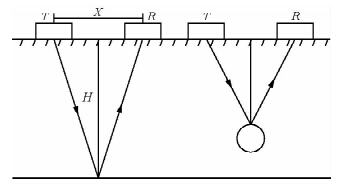 | 图 1 探地雷达原理示意图Fig. 1 Sketch of GPR principle |
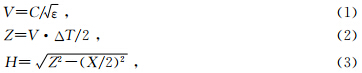
电磁波在特定介质中的传播速度V是不变的,因此根据探地雷达记录上的地面反射波与目的物反射波的时间差Δ T,即可根据下式算出目的物的埋藏深度:
根据电磁学理论,当电磁波在地下介质传播时,遇到不同电介质的分界面时,由于上下界面的电磁性差异,将发生反射和折射(见图 2),电磁波的反射系数(张先武等,2013)为

由式(4)可知,反射系数的大小与两侧介电常数的差异存在一定的关系,同时雷达反射波的振幅大小与反射系数成正比,因此,当相邻介质的相对介电常数差异越大,反射系数就越大,反射振幅就越大,反射界面也就越容易识别;当相邻介质的相对介电常数差异越小,反射系数越小,反射振幅就越小,反射界面越不容易识别.
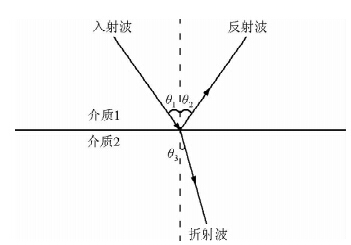 | 图 2 电磁波在介质1与介质2的界面上的反射与折射Fig. 2 Reflection and refraction of electromagnetic wave between medium 1 and medium 2 |
凡是电磁现象的研究自然离不开经典的Maxwell方程组,时域有限差分法(戴前伟等,2004;戴前伟等,2005;吴小平等,2006;冯德山等,2006;冯德山和戴前伟,2008;田钢等,2011;李静等,2011;丁亮等,2012;冯德山等,2012;郭立等,2012;冯德山等,2014;傅磊等,2014;张先武等,2014)正是从Maxwell两个旋度方程出发,建立计算时域电磁场的数值方法,在无源区域,Maxwell方程的两个旋度为

其中: E 为电场强度(V/m);μ为相对磁导率(H/m); H 为磁场强度(A/m);t为时间(s);σm为等效磁导率(W/m);σ为电导率(S/m).
按照Yee氏网格剖分,利用中心差商,二维TM电磁波的时域有限差分方程,即探地雷达的正演模拟方程为
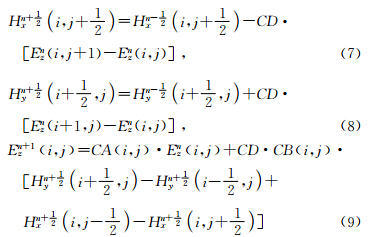
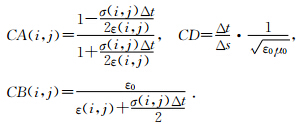
TE电磁波的有限差分方程与TM电磁波形式上相似,可以通过类似的方式得到或通过两种波存在的对偶关系得到. 2.2 数值模型
为了使研究更加简单,将波纹管的扁平形简化为长方形,模型的尺寸是按照下文中所采用实测中梁板尺寸设计.
模型见图 3,该模型为厚度0.11 m,宽度1.2 m的矩形混凝土,深度0.02 m处均匀分布有11根内径为8 mm的钢筋.混凝土的相对介电常数为6,相对磁导率为1.0,电导率为0.01 S/m.混凝土内设置了4根塑料波纹管,波纹管经简化后为宽5 cm,厚2 cm的矩形,各波纹管同一水平面上,顶面深度为0.5 m,底面深度为0.7 m,各波纹管中心位置距边0.25 m、0.45、0.75 m和0.95 m,其中心设置有1 cm宽,厚度为6 mm的钢绞线,塑料波纹管的相对介电常数为6.5.4根预应力波纹管中,第一根模拟注浆饱满,后三根分别模拟钢绞线顶部没有注浆、底部没有注浆,完全没有注浆.
 | 图 3 模型示意图Fig. 3 Sketch of model |
探地雷达二维正演模拟所采用参数如下:探地雷达中心频率为2.6 GMHz;边界吸收条件为完全匹配层PML,其中吸收层厚度取8个网格;激励源采用Richer源波;网格的空间步长为0.0001 m,采样步长为0.005 m,采样点数为220,总采样时间为4.0 e-9 s. 2.3 模拟结果分析
经过探地雷达二维正演模拟得到的模拟成果图(见图 4).图中在采样点500,存在11条双曲线,在采道中呈均匀分布,该双曲线为模型中钢筋反应;在采样点1000至采样点1500,采道0-68中存在 四条双曲线形强反射信号,为钢绞线和空洞的反应,其中,第一条双曲线以采道9为中心,其反射信号强度较其他三条双曲线较弱;第二条双曲线强反射信号位于采道15~35,顶部位于采样点1000,该强反射信号为钢绞线顶部未 注浆空洞产生的;第三条双曲线强反射信号位于采道35~50,顶部位于采样点1250,该强反射信号为钢绞线底部未注浆空洞产生的;第四条双曲线强反射号位于采道55~65,双曲线顶部位于采样点1000,其反射强度整体较强,其为整体未注浆产生的;且有缺陷的在采样点2500后图形比较凌乱.
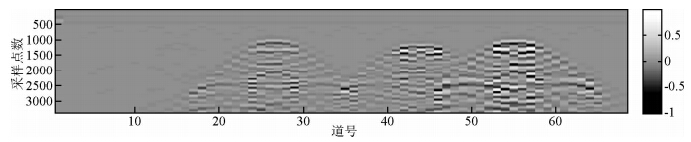 | 图 4 模拟剖面图Fig. 4 Profile of simulation section map |
吉茶高速公路某桥采用预制T梁结构,边梁梁长 30.1 m,中梁梁长30.0 m,高2 m,宽0.5 m,其中,板厚 0.11 m,宽度1.2 m.梁板中预应力钢绞线孔道采用长径5 cm,短径2 cm的扁平塑料波纹管,塑料波纹管在梁板中的分布如图 5所示.
 | 图 5 梁板中塑料波纹管示意图Fig. 5 Sketch of plastic corrugated pipe in prestressed deck |
检测使用JL-BPAC(A)桥梁预应力钢绞线孔道压浆质量检测仪检测和美国劳雷公司生产的SIR-3000探地雷达,其雷达天线的中心频率为2.6 GHz;验证使用美国绍尔岩芯钻机,其钻孔外径2 cm.
根据预应力孔道在梁板中的分布情况,通过JL-BPAC(A)桥梁预应力钢绞线孔道压浆质量检测仪检测,确定预应力板存在的缺陷区域,然后在该区域内垂直于注浆孔道方向布设间距为0.1 m雷达测线,确定缺陷位置,使用钻孔进行验证. 3.2 检测结果及验证
本次共完成对吉茶高速某桥30块梁板的检测,为了区别各块梁板,将梁板进行如下编号:根据梁板的五块一列的特点,从大里程往小里程,将梁板行数编号为1~6;面向小里程,从左至右将列梁数板编号为1~5;将大编号和小编号结合就得到每块梁板的编号,如3-1即为从大里程往小里程数第3行梁板,面向小里程数第1块.其中,每块梁板内波纹管按照面向小里程,从左至右分别编号为N1~N4.对梁板检测时,每块梁板长度方向最大里程定义为0 m.
根据探地雷达检测结果显示,本次检测共检测到两块梁板中波纹管中注浆存在问题:梁板3-1在18.2 m处,N1波纹管未注浆,N3底部注浆不饱满;梁板5-2在2.5 m处 N1未注浆、N3底部不饱满和N4顶部注浆不饱满.其雷达剖面见图 6和图 7.其他波纹管注浆基本饱满,雷达图像未发现明显异常.
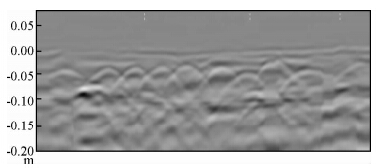 | 图 6 板3-1 18.2 m处雷达剖面Fig. 6 GPR profile located at 18.2 m on the deck 3-1 |
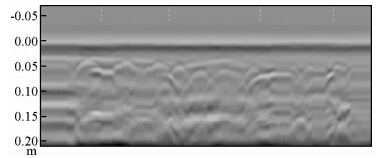 | 图 7 板5-2 2.5 m处雷达扫描图Fig. 7 GPR profile located at 2.5 m on the deck 5-2 |
图 6中梁板3-1中N1波纹管,深度0.07 m处具有强反射信号,其更深的底部波形较凌乱,推测为未注浆;N3波纹管,深度0.09 m处存在强反射信号,推测钢绞线底部注浆不饱满,存在空腔,其他波纹管未出现明显异常,注浆基本饱满.图 7中梁板5-2中N1和N3波纹管,深度0.06 m处存在较宽的强反射信号,更深的底部波形较凌乱,推测为未注浆或注浆不饱满;N4波纹管,深度0.06 m处存在强反射信号,推测为注浆不饱满,N2波纹管未出现明显异常,推测注浆基本饱满.分别对梁板3-1中N1和梁板5-2中N3、N4在探地雷达扫描图中存在异常处进行钻孔验证,验证结果见图 8,梁板3-1中N1为未注浆,梁板5-2中N3为注浆未注浆,梁板5-2中N4注浆不饱满,与推测结果基本吻合.
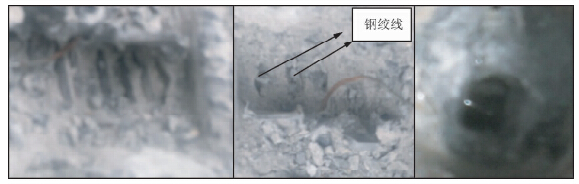 | 图 8 验证照片Fig. 8 photos of verification |
结合探地雷达二维正演模拟、现场检测和钻孔验证结果表明:利用探地雷达2.6 GHz天线对预应力板中扁平塑料波纹管注浆质量进行探测是可行的;使用2.6 GHz可以检测到11 cm混凝土板中塑料波纹管注浆情况.
| [1] | Bai Z X, Liu Y, Lu Q, et al. 2007. The reflection imagine characteristics of electromagnetic wave on different target[J]. Progress in Geophysics (in Chinese), 22(5): 1552-1557, doi: 10.3969/j.issn.1004-2903.2007.05.031. |
| [2] | Bungey J H, Millard S G, Shaw M R. 1991. Use of sub-surface radar for structural assessment of in-situ concrete[J]. A. C. I. Special Public, 128: 497-514. |
| [3] | Bungey J H, Shaw M R, Millard S G, et al. 1997. The influence of concrete composition upon radar test results[J]. Insight, 39(7): 474-478. |
| [4] | Conner J M. 2004. Detection of tendons and voids in grouted ducts using ground-penetrating radar[C]. //Master of Science thesis, Department of Civil & Environmental Engineering, Washington State University. |
| [5] | Conner J M, Pollock D G, Khaleghi B. 2006. Detection of simulated voids in grouted ducts using groundpenetrating radar[C]. //Proceedings of the 2006 Concrete Bridge Conference, Portland Cement Association. |
| [6] | Dai Q W, Feng D S, Wang Q L, et al. 2004. The apply of finite difference time domain method in the Ground Penetrating Radar(GPR) two-dimension forward simulate[J]. Progress in Geophysics (in Chinese), 19(4): 898-902, doi: 10.3969/j.issn.1004-2903.2004.04.033. |
| [7] | Dai Q W, Feng D S, He J S. 2005. The application of Kirchhoff 's migration method in the image processing of the ground penetrating radar forward simulate[J]. Progress in Geophysics (in Chinese), 20(3): 849-853, doi: 10.3969/j.issn.1004-2903.2005.03.044. |
| [8] | Ding L, Han B, Liu R Z, et al. 2012. Inversion imaging method for concrete non-destructive testing based on GPR [J]. Chinese Journal of Geophysics (in Chinese), 55(1): 317-326, doi: 10.6038/j.issn.0001-5733.2012.01.032. |
| [9] | Fang H Y, Li G. 2013. Simulation of GPR wave propagation in complicated geoelectric model using symplectic method[J]. Chinese Journal of Geophysics (in Chinese), 56(2): 653-659, doi: 10.6038/cjg20130229. |
| [10] | Feng D S, Dai Q W, He J S, et al. 2006. Finite difference time domain method of GPR forward simulation [J]. Progress in Geophysics (in Chinese), 21(2): 630-636, doi: 10.3969/j.issn.1004-2903.2006.02.046. |
| [11] | Feng D S, Dai Q W. 2008. Application of the multi-resolution time domain method in three dimensional forward simulation of ground penetrating radar[J]. Progress in Geophysics (in Chinese), 23(5): 1621-1625. |
| [12] | Feng D S, Chen C S, Wang H H. 2012. Finite element method GPR forward simulation based on mixed boundary condition [J]. Chinese Journal of Geophysics (in Chinese), 55(11): 3774-3785, doi: 10.6038/j.issn.0001-5733.2012.11.024. |
| [13] | Feng D S, Chen J W, Wu Q. 2014. A hybrid ADI-FDTD subgridding scheme for efficient GPR simulation of dispersion media[J]. Chinese Journal of Geophysics (in Chinese), 57(4): 1322-1334, doi: 10.6038/cjg20140429. |
| [14] | Fu L, Liu S X, Liu L B, et al. 2014. Airborne ground penetrating radar numerical simulation and reverse time migration[J]. Progress in Geophysics (in Chinese), 57(5): 1636-1646, doi: 10.6038/cjg20140526. |
| [15] | Ge S C, Zhao Y H, Chen Y G, et al. 2013. Detection and analysis of potential failure zone of Qiantang river seawall after the new railway bridge construction[J]. Progress in Geophysics (in Chinese), 28(4): 2148-2154, doi: 10.6038/pg20130460. |
| [16] | Giannopoulos A, Macintyre P, Rodgers S, et al. 2002. GPR detection of voids in post-tensioned concrete bridge beams[C]. //Ninth International Conference on Ground Penetrating Radar (GPR2002). International Society for Optics and Photonics, 376-381. |
| [17] | Guo L, Cui X H, Chen J. 2012. Sensitive factors analysis in using GPR for detecting plant roots based on forward modeling[J]. Progress in Geophysics (in Chinese), 27(4): 1754-1763, doi: 10.6038/j.issn.1004-2903.2012.04.057. |
| [18] | Li J, Zeng Z F, Wu F S, et al. 2010. Study of three dimension high-order FDTD simulation for GPR[J]. Chinese Journal of Geophysics (in Chinese), 53(4): 974-981, doi: 10.3969/j.issn.0001-5733.2010.04.022. |
| [19] | Lu C M, Qin Z, Zhu H L, et al. 2007. Practical methods for detection of concealed cracks in highway pavement using ground penetration radar data[J]. Progress in Geophysics (in Chinese), 50(5): 1558-1568. |
| [20] | Tian G, Lin J X, Wang B B, et al. 2011. Simulation and analysis reflections interference from above surface objects of ground penetrating radar[J]. Chinese Journal of Geophysics (in Chinese), 54(10): 2639-2651, doi: 10.3969/j.issn.0001-5733.2011.10.021. |
| [21] | Wang J M, Liu C, Yang B J. 2002. The Application of Ground Penetrating Radar for Seismic Exploration in Bayanchagan area[J]. Progress in Geophysics (in Chinese), 17(4): 745-752. |
| [22] | Wang L, Li Z W, Wang X B. 2008. A study of Gedogical Radar to cavern detection and physical analogue[J]. Progress in Geophysics (in Chinese), 23(1): 280-283. |
| [23] | Wang Y, He X H. 2008. Application of GPR in the density of grouting quality inspection of precast Segmental box beam[J]. Shan Xi Architecture (in Chinese), 34(16): 14-15. |
| [24] | Wu X P, He J S, Liu J X. 2006. The effect of the electromagnetic wave's impedance transform to the results of the ground - probing -radar[J]. Progress in Geophysics (in Chinese), 21(1): 251-255. |
| [25] | Xu M G, Yin N J, Yang M J. 1999. A new nondestructive testing technology of concrete bridge[J]. China Railway Science (in Chinese), 20(3): 63-70. |
| [26] | Yang T C, Yi W J, Lu G Y. 2009. Experimental study of nondestructive testing for grouting quality in prestressed concrete T-beam[J]. Journal of Vibration Engineering (in Chinese), 19(3): 411-415. |
| [27] | Yin X J, Wang X Y. 2007. Application of Geological Radar in Testing Grouting compactness of Subsection Beam[J]. Urban Roads Bridges & Flood Control (in Chinese), (2): 103-105. |
| [28] | Yu J L, Wang C H. 2003. Estimation of EM wave velocity in detecting underground target by GPR[J]. Progress in Geophysics (in Chinese), 18(3): 477-480. |
| [29] | Yuan X S, Shui Z H, Wang G M, et al. 2009. Application of ground penetrating aadar in box-girders web plate detecting[J]. Nondestructive Testing (in Chinese), 31(5): 412-414. |
| [30] | Zhang X W, Gao Y Z, Fang G Y. 2013. Application of generalized S transform with lowpass filtering to layer recognition of ground penetrating radar[J]. Chinese Journal of Geophysics (in Chinese), 56(1): 309-316, doi: 10.6038/cjg20130132. |
| [31] | Zhang X W, Gao Y Z, Fang G Y. 2014. An inverse filtering method for removing the wavelet attenuation and dispersion of Ground Penetrating Radar data[J]. Chinese Journal of Geophysics (in Chinese), 57(3): 932-938, doi: 10.6038/cjg20140322. |
| [32] | Zhou Y, Leng Y B, Zhao S L. 2003. Research progress in GPR technology applied in pavement testing[J]. Progress in Geophysics (in Chinese), 18(3): 481-486, doi: 10.3969/j.issn.1004-2903.2003.03.024. |
| [33] | 白朝旭, 刘洋, 鹿琪,等. 2007. 高频电磁波在不同目标体上反射图像特征研究[J]. 地球物理学进展, 22(5): 1552-1557, doi: 10.3969/j.issn.1004-2903.2007.05.031. |
| [34] | 戴前伟, 冯德山, 王启龙,等. 2004. 时域有限差分法在地质雷达二维正演模拟中的应用[J]. 地球物理学展, 19 (4): 898-902, doi: 10.3969/j.issn.1004-2903.2004.04.033. |
| [35] | 戴前伟, 冯德山, 何继善. 2005. Kirchhoff偏移法在探地雷达正演图像处理中的应用[J]. 地球物理学进展, 20 (3): 849-853, doi: 10.3969/j.issn.1004-2903.2005.03.044. |
| [36] | 丁亮, 韩波, 刘润泽,等. 2012. 基于探地雷达的混凝土无损检测反演成像方法[J]. 地球物理学报, 55(1): 317-326, doi: 10.6038/j.issn.0001-5733.2012.01.032. |
| [37] | 方宏远, 林皋. 2013. 基于辛算法模拟探地雷达在复杂地电模型中的传播[J]. 地球物理学报, 56(2): 653-659, doi: 10.6038/cjg20130229. |
| [38] | 冯德山, 戴前伟, 何继善,等. 2006. 探地雷达GPR正演模拟的时域有限差分实现[J]. 地球物理学进展, 21(2): 630-636, doi: 10.3969/j.issn.1004-2903.2006.02.046. |
| [39] | 冯德山, 戴前伟. 2008. 探地雷达时域多分辨法(MRTD)三维正演模拟[J]. 地球物理学进展, 23(5): 1621-1625. |
| [40] | 冯德山, 陈承申, 王洪华. 2012. 基于混合边界条件的有限单元法GPR正演模拟[J]. 地球物理学报, 55(11): 3774-3785, doi: 10.6038/j.issn.0001-5733.2012.11.024. |
| [41] | 冯德山, 陈佳维, 吴奇. 2014. 混合ADI—FDTD亚网格技术在探地雷达频散媒质中的高效正演[J]. 地球物理学报, 57(4): 1322-1334, doi: 10.6038/cjg20140429. |
| [42] | 傅磊, 刘四新, 刘澜波,等. 2014. 机载探地雷达数值模拟及逆时偏移成像[J]. 地球物理学报, 57(5): 1636-1646, doi: 10.6038/cjg20140526. |
| [43] | 葛双成, 赵永辉, 陈永根,等. 2013. 新桥建设后钱塘江海塘安全隐患探测与分析[J]. 地球物理学进展, 28(4): 2148-2154, doi: 10.6038/pg20130460. |
| [44] | 郭立, 崔喜红, 陈晋. 2012. 基于GprMax正演模拟的探地雷达根系探测敏感因素分析[J]. 地球物理学进展, (4): 1754-1763, doi: 10.6038/j.issn.1004-2903.2012.04.057. |
| [45] | 李静, 曾昭发, 吴丰收,等. 2010. 探地雷达三维高阶时域有限差分法模拟研究[J]. 地球物理学报, 53(4): 974-981, doi: 10.3969/j.issn.0001-5733.2010.04.022. |
| [46] | 卢成明, 秦臻, 朱海龙,等. 2007. 探地雷达检测公路结构层隐含裂缝实用方法研究[J]. 地球物理学进展, 50(5): 1558-1568. |
| [47] | 田钢, 林金鑫, 王帮兵,等. 2011. 探地雷达地面以上物体反射干扰特征模拟和分析[J]. 地球物理学报, 54(10): 2639-2651, doi: 10.3969/j.issn.0001-5733.2011.10.021. |
| [48] | 王建民, 刘财, 杨宝俊. 2002. 地质雷达技术在巴彦查干地区地震勘探中的应用[J]. 地球物理学进展, 17(4): 745-752. |
| [49] | 王亮, 李正文, 王绪本. 2008. 地质雷达探测岩溶洞穴物理模拟研究[J]. 地球物理学进展, 23(1): 280-283. |
| [50] | 王渊, 何旭辉. 2008. 地质雷达在节段梁顶预应力孔道压浆中的应用[J]. 山西建筑, 34(16): 14-15. |
| [51] | 吴小平, 何继善, 柳建新. 2006. 电磁波的阻抗变换作用对地质雷达探测效果的影响[J]. 地球物理学进展, 21(1): 251-255. |
| [52] | 徐美庚, 殷宁骏, 杨梦蛟,等. 1999. 一种新的混凝土桥梁无损检测技术[J]. 中国铁道科学, 20(3): 63-70. |
| [53] | 杨天春, 易伟健, 鲁光银,等. 2009. 预应力T梁束孔管道压浆质量的无损检测试验研究[J]. 振动工程学报, 19(3): 411-415. |
| [54] | 殷习军, 王修勇. 2007. 地质雷达在节段梁注浆密实度检测中的应用[J]. 城市道桥与防洪, (2): 103-105. |
| [55] | 于景兰, 王春和. 2003. 探地雷达探测地下目标时的波速估计[J]. 地球物理学进展, 18(3): 477-480. |
| [56] | 袁新顺, 水中和, 王桂明,等. 2009. 探地雷达在箱梁腹板检测中的应用[J]. 无损检测, 31(5): 412-414. |
| [57] | 张先武, 高云泽, 方广有. 2013. 带有低通滤波的广义S变换在探地雷达层位识别中的应用[J]. 地球物理学报, 56(1): 309-316, doi: 10.6038/cjg20130132. |
| [58] | 张先武, 高云泽, 方广有. 2014. 消除探地雷达数据的子波衰减和频散的反滤波方法[J]. 地球物理学报, 57(3): 932-938, doi: 10.6038/cjg20140322. |
| [59] | 周杨, 冷元宝, 赵圣立. 2003. 路用探地雷达的应用技术研究[J]. 地球物理学进展, 18(3): 481-486, doi: 10.3969/j.issn.1004-2903.2003.03.024. |