 2014, Vol. 29


2. 中国科学院大学地球科学学院, 北京 100049
2. College of Earth Science, University of Chinese Academy of Sciences, Beijing 100049, China
人类可以通过望远镜、人造卫星和深空探测器等手段,来探索遥远的外层空间,然而却不能直接深入地球内部,即使是目前最深的超深钻所达深度也不及13km.迄今为止,人们对于地球深部的认知主要通过以下途径(谢鸿森等,2001; Gillan et al., 2006):地球物理探测、地球化学方法、高温高压实验和理论模拟计算.地球物理探测具有先导性,其提供的地球内部众多物理参数成为实验的基础和约束条件,但却不能给出物质组成方面的具体信息.地球化学分析揭示了各圈层的成分信息,可以通过直接采样的方法来分析地球浅层物质成分,但对地幔及更深的部分,只能根据地表出露的矿物、岩石和宇宙化学模式来间接估计,而且还必须同时符合地球物理模型.高温高压实验则是可以获得典型物质的物性数据,并与地球物理探测结果比较,来验证这些物质是否符合地球物理模型,从而约束了地球内部的物质成分,另外在高温高压下合成一些物质也可能成为候选成分.理论模拟计算既可以实现那些在实验室很难或无法完成的极端条件下物质特性分析,又能结合地球物理观测资料、实验数据与数学物理方法,来模拟地球的热力学状态、动力学过程等,但理论计算结果的可靠性最终还要依靠实验验证.
根据地球物理探测,特别是地震学探测方面的结果,人们陆续构建了Jeffreys-Bullen地球模型、PREM模型(Dziewonski and Anderson, 1981)、IASP91模型(Kennett and Engdahl, 1991)和AK135模型(Kennett et al., 1995)等.这些模型呈现了一维的地球内部层圈结构,为人们认识地球内部提供了重要参数.但其仅仅是平均的描述,对于形态具有横向变化的圈层间界面则不足以进行描述和相关属性分析.
位于地幔过渡带(Mantle Transition Zone,MTZ)顶面上方的低速层是近20年来固体地球物理学领域的一个重要发现.1994年,Revenaugh and Sipkin首次报道了日本海、黄海之下的330km附近S波低速异常,并认为可能是位于410km间断面之上的含熔体层,该层可能处于负浮力状态.至今,全球其它区域也陆续发现了该深度附近存在有低速层.该低速层的相关研究对于认识地球精细结构、地幔对流模式、地球内部物质运移和地球演化等方面有着非常重要的意义.有地震学家为了使此低速异常与410km间断面区分,将对应的震相称为350km震相(Vinnik and Farra, 2007;Tauzin et al., 2010; Vinnik et al., 2010),而为了论述的方便,本文将其统称为MTZ顶面低速层. 1 MTZ顶面低速层简介 1.1 MTZ顶面低速层的发现
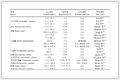
MTZ顶面低速层的发现经历了一个较长的过程.虽然在之前的大尺度地震学研究中,已发现部分地区MTZ顶面之上存在有波速急剧降低现象(van der Hilst and Seno, 1993),但把该现象单独提出来论述并突出其地球动力学意义,则是开始于Revenaugh and Sipkin(1994)的探测.之后,在全球其他区域也陆续发现,其中一些是对少数台站的资料进行分析处理,也有利用遍布全球的台站资料,同时对多个地区的上地幔结构进行探测,并且在其中的很多地方都发现了MTZ顶面之上的低速层(Vinnik and Farra, 2007;Vinnik et al., 2010)(见表 1).Tauzin等(2010)对其所获全球性观测结果进行了分类,分别为已观测到、可能有和未观测到三个级别,这为进一步深入研究指明了方向.
|
表 1 不同地区MTZ顶面低速层的特征 Table 1 The features of the LVZ atop the MTZ for various regions |
由于与410 km间断面在深度上非常接近,MTZ顶面低速层会不会是410 km附近信号的误差,或者其上方的间断面所产生的干扰?为此,需要排除以上两方面的影响,来确定该低速层的可信性.首先,此低速层对应震相与410 km间断面震相相关性较差,且410 km以下也未观测到相似振幅的对称边瓣,这排除了410 km震相的干扰(Tauzin et al., 2010).另外,与上地幔间断面相比,混响往往表现出更大的深度变化,而实际观测的该信号深度变化为±24 km,若成因是多次混响,那么该信号所代表的间断面必然起伏非常平缓,但已知地幔顶部200 km内的几个间断面均未呈现此特征(Tauzin et al., 2010). 1.2 MTZ顶面低速层的特征 1.2.1 构造位置
目前,已观测到的MTZ顶面低速层所处的构造位置主要集中于两类:俯冲带地区和大陆克拉通地区.
位于俯冲带地区的MTZ顶面低速层,又可以按照与俯冲板片的相对位置分为板上和板下两类(Bagley et al., 2009):
(1)位于板上的,如黄海和日本海(Revenaugh and Sipkin, 1994),中国东北(周元泽和臧绍先,2001; Vinnik and Farra, 2007; 田有等,2011; 张风雪等,2013)、南海(瞿辰等,2007; 王晨阳和黄金莉,2012),美国西北部(Song et al., 2004),墨西哥东部(Gao et al., 2006),塔斯曼海和珊瑚海(Courtier and Revenaugh, 2007),落基山脉北部(Jasbinsek and Dueker, 2007),北美西南部(Jasbinsek et al., 2010),加利福尼亚(Vinnik et al., 2010)以及加拿大西北部(Schaeffer and Bostock, 2010)等;
(2)位于板下的,如本州板片(Obayashi et al., 2006; Bagley et al., 2009).
位于大陆克拉通地区的有:Kaapvaal克拉通(Vinnik and Farra, 2002; Vinnik et al., 2003; Vinnik and Farra, 2007),非洲东北部Afar地区(Chevrot et al., 1999),西伯利亚通古斯盆地(Vinnik and Farra, 2002; Vinnik and Farra, 2007),阿拉伯板块(Vinnik et al., 2003)、华北克拉通(张学民等,2006)和印度地盾(Oreshin et al., 2011)等.在观测到 MTZ顶面低速层的克拉通地区,通常发育有大火成岩省(Large igneous provinces,LIPs).然而属于该范畴的一些地区并没有发现该低速层,其可能原因是该低速层的横向尖灭或大陆岩石圈裂解的破坏作用(Vinnik and Farra, 2007).
还有一些MTZ顶面低速层的构造背景较为特别,既未过于远离俯冲带,又同时发育有LIPs.该类型地区主要集中于北美西部,如美国西北部(Song et al., 2004)和加利福尼亚(Vinnik et al., 2010).以该地区由Columbia River溢流玄武岩所组成的LIPs为例,传统上认为其是典型的地幔柱(Camp and Ross, 2004),而最新的研究却表明其可能受控于俯冲Farallon板片的扩散破裂(Liu and Stegman, 2012).如果最新结果更为合理的话,那么该类型低速层应是仍与板片俯冲过程有关.
1.2.2 深度和厚度范围
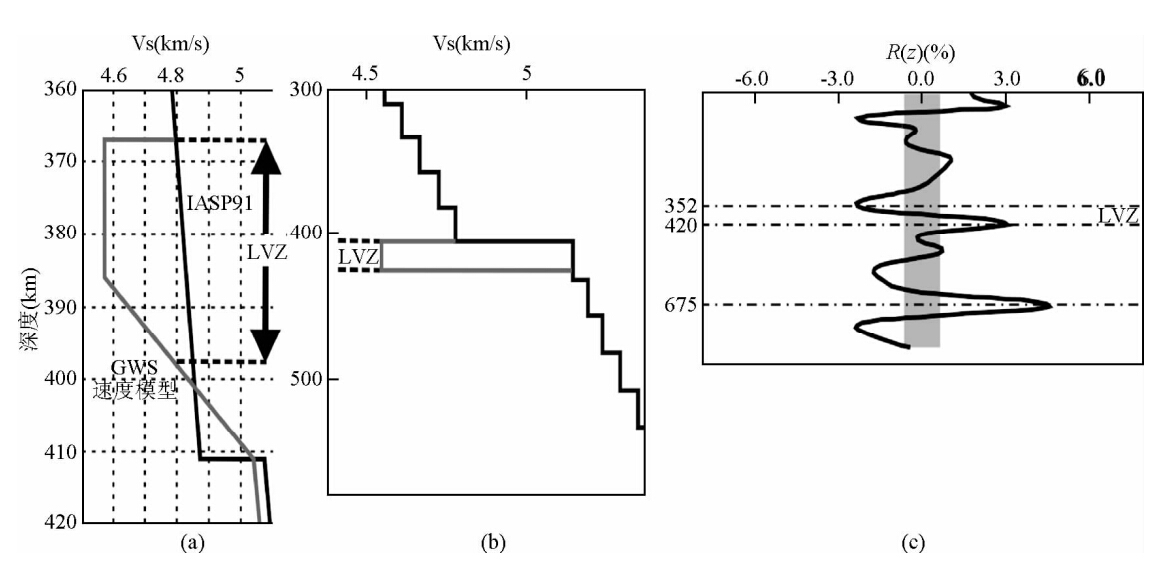
对于此低速层深度和厚度范围的界定,因地震学处理方法和研究震相的不同,而有所差异(见图 1).低速层顶部的深度表征了低速层深度,不同地区的平均深度有所差异,范围从330 km(Revenaugh and Sipkin, 1994)到380 km(Jasbinsek et al., 2010)(见表 1),同一地区也会出现横向变化(Vinnik and Farra, 2007).关于深度,其可能代表了含水碳酸盐熔体上移的上限或该类熔体与周围地幔由正浮力到负浮力的转换点(Courtier and Revenaugh, 2007),也有认为是干的大陆地幔根与湿的下伏地幔的界面(Vinnik et al., 2003).厚度则为从顶部到底部之间的距离.不同地震学方法得出的厚度范围从20 km(Song et al., 2004)到100 km(Revenaugh and Sipkin, 1994)(见表 1).
 | 图 1 MTZ顶面低速层的范围
资料来源:(a)Jasbinsek et al., 2010,(b)Song et al., 2004,(c)Courtier and Revenaugh, 2007,略有修改. Vs:横波速度;GWS:全球波形叠加;IASP91:速度模型;R(z):反射系数. Fig. 1 The range of the low velocity zone(LVZ)atop the MTZ Data source:(a)Jasbinsek et al., 2010,(b)Song et al., 2004,(c)Courtier and Revenaugh, 2007,slightly modified. Vs: shear wave velocity,GWS:Global Waveform Stack,IASP91:velocity model,R(z):reflection coefficient. |
来自地震学、高温高压实验和地球动力学等方面的相关研究表明,导致该低速层的可能原因包括部分熔融作用、热异常和各向异性等.
2.1 部分熔融作用 2.1.1 部分熔融作用对波速的影响
实验结果表明,熔体的存在可以显著地降低地震波速度(Sato et al., 1989; 周文戈等,1999; 白武明等,2000;马麦宁等,2002; 蒋玺等,2007; 彭伟等,2012),此外数值模拟研究也得出了类似的结果(Hammond and Humphreys, 2000; Takei,2002; Hier-Majumder and Abbott, 2010).熔体对地震波速度的影响,体现在熔体分数和矿物颗粒间熔体的分布形态.熔体分数越大,地震波速度衰减的越明显(Williams and Garnero, 1996).固-液二面角(θ)是描述熔体形态的重要参数,其反应了固体被液体润湿的程度.θ越小,润湿程度越高,液体越容易连通,反之,越不容易连通(Waff and Bulau, 1979; 周永胜等,2003; 侯渭等,2004; 周平等,2006).与孤立的熔体囊相比,具较小二面角的熔体连通性更好,空间分布更为广泛,因而降低波速的现象更为明显(Williams and Garnero, 1996; Blackman and Kendall, 1997; Hier-Majumder and Courtier, 2011).
影响θ大小的因素很多,主要源于熔体的化学成分差异(Yoshino et al., 2005).在较低压力条件下(≤3 GPa)进行的部分熔融实验研究表明(见图 2):无水玄武质熔体对应的θ为30°~40°(Waff and Bulau, 1979),含水玄武质熔体对应的均值为28°±3°(Mei et al., 2002),Kohlstedt(1992)总结了玄武质熔体对应的θ范围为20°~50°;对于大颗粒和低熔体分数的情况,局部的范围可达0°~10°(Cmíral et al., 1998);碳酸盐熔体与橄榄石之间的θ较小,其对应范围为25°~30°,且对成分不敏感(Watson et al., 1990),但这对于较低分数(0.05wt%)的碳酸盐化地幔熔体来说,仍是可以连通起来的(Minarik and Watson, 1995).从以上的研究可以看出熔体是可以连通起来的,从而能对整体岩石物性产生影响.虽然Stocker和Gordon(1975)指出当熔体完全地润湿颗粒边界时(θ=0°),对力学性质的影响才明显,但θ会随着压力的升高而降低,在大于7~8 GPa压力条件下,甚至可为0°(Yoshino et al., 2007)(见图 3).而MTZ顶面所对应的压力为13~14 GPa(Lee et al., 2010),可以满足较小(0°~10°)的条件.Hier-Majumder和Courtier(2011)综合考虑了熔体分数(1~1.1vol%)和熔体形态(θ=25°~30°)对波速的影响,由此计算出的速度异常即可与所选地区的地震学观测结果能较好的吻合.于是在更小的θ情况下,仅更少的熔体分数就能满足要求,也更容易实现.
 | 图 2 二面角随熔体类型的变化(P≤3 GPa) 数据来源:无水玄武质熔体引自Waff and Bulau(1979),含水玄武质熔体引自Mei et al.(2002),玄武质熔体(总)引自Kohlstedt(1992),碳酸盐熔体引自Watson et al.(1990). Fig. 2 Dihedral angle variation with different compositional melt(P≤3 GPa) Data source: anhydrous basaltic melt from Waff and Bulau (1979),hydrous basaltic melt from Mei et al.(2002),the whole basaltic melt from Kohlstedt(1992),carbonate melt from Watson et al.(1990). |
 | 图 3 Mg2SiO4-H2O体系中固-液二面角随压力变 化(引自Yoshino et al., 2007,略有修改) 实验温度为1200 ℃,分析误差小于5 ℃.γsl:固-液界面的 单位面积表面能,γss:固-固边界的单位面积表面能. n.d.:二面角未确定,但小于10°.Fig. 3 Dihedral angles in the forsterite-H2O system as a function of pressure(from Yoshino et al., 2007,slightly modified) Experimental temperature is 1200 ℃ and the analytical error is less than 5 ℃.γsl: solid-liquid interfacial energy per unit area,γss:grain boundary energy per unit area. n.d.:not determined,but less than 10°. |
诱发部分熔融作用的因素很多,如挥发分、温度高异常等.其中挥发分是重要的影响因素,这里主要介绍挥发分中的水和二氧化碳在部分熔融过程中所起的作用.
作为典型的挥发分,水对地幔岩石的部分熔融作用有着巨大影响,其能够降低熔体黏度、增大熔融程度、改变熔体成分和密度等(Hirose and Kawamoto, 1995; Hirth and Kohlstedt, 1996; Litasov and Ohtani, 2002),尤其是可以使固相线温度降低数百摄氏度(Hirth and Kohlstedt, 1996),促进部分熔融作用的发生.
关于脱水诱发的部分熔融作用,进而导致低速层的形成,较为经典的模型是由Bercovici and Karato(2003)提出的“过渡带水过滤器模型(transition-zone water-filter model)”.该模型认为:与上地幔(橄榄石α相,<1200 ppm H2O)相比,MTZ中矿物集合体的储水能力(橄榄石β相,24000 ppm H2O;橄榄石γ相,27000 ppm H2O)要明显高的多(Kohlstedt et al., 1996);当缓慢上升的MTZ物质穿过410 km间断面时,其会从β相主导集合体转化为α相主导集合体;如果β相含水量处于或超过α相储水能力的话,那么当上升地幔物质转化为α相时,就会处于水饱和或过饱和状态;在410 km深度条件下,环境温度大约为1800 K(Schubert et al., 2001),这高于Mg2SiO4-MgSiO3-H2O体系的共结点或橄榄岩的湿固相线(Inoue,1994; Kawamoto et al., 1996),因而水饱和或过饱和的上升地幔可能在穿过410 km间断面时发生部分熔融作用(Young et al., 1993; Kawamoto et al., 1996);根据熔体-固体密度反转点(Density crossover)可能存于MTZ之上(Stolper et al., 1981; Ohtani et al., 1995),可以假设410 km深度所形成的熔体,其密度高于周围上地幔固体矿物,但却低于MTZ矿物(Ohtani et al., 1995; Ohtani and Maeda, 2001),于是这些熔体会积聚并陷落在410 km之上;含熔体层就可能在地震学上表现为低速层.该模型还有另一个推论,即由于橄榄石的水溶解度随温度的升高而增加(Zhao et al., 2004),瓦兹利石和林伍德石的水溶解度则随着温度的升高而降低(Ohtani et al., 2000; Williams and Hemley, 2001),所以穿过MTZ的热地幔柱物质(~2100 K)储水能力会下降,进而在经历向橄榄石转变时可能处于不饱和状态,抑制了脱水部分熔融作用.于是在与地幔柱有关的地区,MTZ顶面低速层就可能不发育或很薄(<10 km).这显然与大量的地震学观测结果不符,观测结果表明发育地幔柱的克拉通地区有厚度可达60 km的该低速层(Vinnik and Farra, 2002,2007; Vinnik et al., 2003).可能原因是该模型对地幔柱物质的温度估计得过高(Vinnik and Farra, 2007),抑或其他低熔融温度物质(如碳酸盐)的参与(Presnall and Gudfinnsson, 2005).
二氧化碳作为另一种重要的挥发份,其对部分熔融作用的影响,类似于存储于名义无水矿物中的水(Dalton and Presnall, 1998).虽然二氧化碳能进入主要地幔矿物的数量极少(<1 ppm)(Keppler et al., 2003),但仍可能主要以碳酸盐矿物的形式存在于上地幔和地幔过渡带中.早期研究多集中于二氧化碳与浅部上地幔低速层之间的关系(Green,1972; Eggler,1976; Wyllie and Huang, 1976),最近的研究关注了深部上地幔条件下两者之间的联系(Dasgupta et al,2004; Dasgupta and Hirschmann, 2006).伴随着上地幔的对流作用,上升的碳酸盐化榴辉岩可以在约400 km深度开始熔融,并会以榴辉岩+熔体的形式稳定存在至280 km深度附近(Dasgupta et al,2004).类似的,在洋中脊下方的条件下,上升的碳酸盐化橄榄岩开始熔融于约330 km深度(Dasgupta and Hirschmann, 2006).以上的实验研究表明,在MTZ顶面的条件下,二氧化碳的参与可以诱发部分熔融作用,进而可能导致地震波速度降低的现象.
2.2 热异常
高温高压实验研究表明,温度对波速的影响体现在两个方面:温度升高既可以使物质本身的波速降低(Sato et al., 1988),又能促进部分熔融作用的发生,进而降低波速.热异常能否成为产生MTZ顶面低速层的原因,可能与其所处的构造背景有关.另外由于橄榄石α-β相变的Clapeyron斜率为正,温度升高将使之变深,因而410 km间断面深度变化可以用来辨别热异常的存在(Katsura et al., 2004).
在大陆克拉通地区,由于具有弥散的特征,单纯的热异常很难解释低速异常只是局限在狭窄的深度范围内,同时对于年龄约为200 Ma的岩浆热事件而言,热异常程度(~150 K)也显得过高(Vinnik and Farra, 2007).对于俯冲带的板上类型,若为温度高异常为单一成因,那么就需要约400 K的温度增加,这会导致410 km间断面深度下降近40 km(Revenaugh and Jordan, 1991),但实际观测结果却是410 km间断面的起伏不超过5 km(Revenaugh and Sipkin, 1994).而在俯冲带的板下位置,以本州俯冲带为例,Obayashi et al.(2006)通过对比观测波形与合成波形后,发现既有低速异常也有410 km间断面的下降(~26 km),后者表明热成因可能占主导地位.但由于地震层析成像结果代表的是真实值的模糊图像,其结果(-1.5%)往往要小于真实异常值,而由均方根残差曲线推测出的温度异常(200 K)不能满足真实值的要求,因而还需要熔体的参与.其对部分熔融作用的描述与“过渡带水过滤器”模型相似,但同时强调了热异常的影响.Honda et al.(2007)将前者发现的低速异常仅归因于热异常,并利用简单的二维和三维数值流动模型来研究热异常的分布和成因,指出古老地幔柱残留的热物质在俯冲板片的夹带作用下持续向下运移,而进一步的运移则受到了410 km间断面的阻挡,因而在该深度附近积聚.但该模型未指出热物质是否含熔体,也没有考虑水的影响.Bagley et al.(2009)通过分析多次ScS混响震相也发现了类似的低速层,但410 km间断面深度的降低幅度较小(~10 km),这既限制了热异常的程度,也因为含水条件下410 km间断面深度变浅(Chen et al., 2002; Smyth and Frost, 2002)而暗示了水的存在.但由于该地区位于板片下方向海一侧,获得充足水量的机制尚未提出,因而在此低速层是原位熔融结果的假设下,就必然需要温度与水的共同作用.
热异常成因方面的争议主要在于对热异常来源的分歧.Honda et al.(2007)认为热物质起源于浅部而向下运移.Obayashi et al.(2006)和Bagley et al.(2009)则认为是区域尺度对流产生的热上涌,即热物质来自深部.同一地区的板片形态学研究结果表明板片呈平坦状停滞在660 km间断面附近(Fukao et al., 2001).该形态说明了海沟的迁移(Christensen,1996),这可能会削弱向下的夹带作用,同时又促进了热物质的上涌.层析成像结果表明在此低速层下方的下地幔区域还存在着另一个低速层(Obayashi et al., 2006),这又为热物质上涌的可能性提供了证据.
2.3 各向异性
地幔的各向异性,在微观上表现为矿物晶体的定向排列,而在宏观上则表现为大尺度的分层或定向的板、墙(Anderson,2007).各向异性对地震波速度变化有很大的影响,可以造成波速降低的现象.如果其成因是各向异性,那么可能意味着在如此窄的深度范围内需要有几个百分数量级的方位各向异性.然而到目前为止,还没有数据支持该深度附近这个量级的各向异性(Vinnik et al., 2003).同时也由于在较大方位角范围内的震相叠加,可以消除方位各向异性的影响.面波研究表明,径向各向异性的强度通常会随着深度的增加而减弱(Montagner and Tanimoto, 1991; Visser et al., 2008),而显著的上地幔各向异性只出现在300 km以内(Montagner,1998).Karato(1992)研究表明220 km深度附近矿物的流变机制从各向异性的位错蠕变转变为各向同性的扩散蠕变,因而在此深度以下的上地幔很难发育广泛的显著各向异性.由以上分析可知,各向异性成因可能性不大抑或不能起主导作用.
综上所述,部分熔融成因似乎更为合理,而在俯冲带向海地区则还可能有热异常的参与,但仍有许多细节不甚清楚.下文将基于部分熔融成因做进一步的分析和讨论. 3 问题与讨论 3.1 熔体层稳定存在的机理
熔体层的稳定性对于其能否长久存在,并持续地影响地球内部的物质分布与迁移有着至关重要的作用(Youngs and Bercovici, 2009).熔体层的稳定性机理主要体现在两个方面,一为熔体会在该深度处于重力稳定状态,而集聚成层;另一为熔体生成与消耗之间的质量平衡(见图 4)(Leahy and Bercovici, 2007).熔体层重力稳定的动力学因素主要源于密度差,在410 km间断面的温度压力条件下,熔体密度可能大于上地幔主要矿物的密度,而小于MTZ主要矿物的密度(Bercovici and Karato, 2003).与固体相比,熔体更容易被压缩,因此随着压力的增加会出现密度反转点,即熔体密度开始大于其对等物固体相密度,而干硅酸盐熔体重于其对应固相的压力条件恰好相当于上地幔底部(Agee and Walker, 1988; Agee,2008).尽管水的加入会降低熔体密度,但水含量较低的熔体仍能稳定地存在于MTZ之上(Matsukage et al., 2005; Sakamaki et al., 2006).
 | 图 4 熔体的产生与消耗(引自Leahy and Bercovici, 2007,略有修改) Fig. 4 The production and consumption of melt atop the MTZ(from Leahy and Bercovici, 2007,slightly modified) |
熔体的生成在前文中已经有了比较详细的介绍,这里不再赘述.熔体的消耗可以通过俯冲板片夹带和粘性夹带向下再循环到MTZ中(Bercovici and Karato, 2003; Leahy and Bercovici, 2007),也可以由于熔体冷却而发生分异,其中一部分向上迁移.板片夹带是指当熔体迁移到相对冷的俯冲板片附近时,结晶出的硅酸盐被向下夹带,其反映的是热效应(Bercovici and Karato, 2003).在抵达板片之前,熔体会脱离源区,横穿很大的区域.该区域的温度代表了周围地幔温度,要高于板片温度,那么板片夹带的机制就不再适用.该区域相当于一个由板片驱动的粘性边界层,当熔体在其内水平输运时,会释放出过量的水,水又会诱发周围地幔的熔融反应,进而导致了熔体层水平传播,这也是粘性夹带的机理(Leahy and Bercovici, 2007).从部分熔融层排泄出的富挥发分流体,则会随着熔体结晶向上迁移,进而成为交代作用者和金伯利岩的可能原始来源(Revenaugh and Sipkin, 1994);这些流体甚至可能在达到岩石圈底部时,冷却成为富水的辉长质薄层,从而构成了岩石圈-软流圈边界层(Karato,2012).
以上模型仅是针对俯冲带附近地区,能够较好地结合了地震学观测现象和高温高压实验研究结果,而对于远离俯冲带的克拉通地区尚没有比较理想的模型. 3.2 熔体层计算厚度与实际观测厚度的不一致性
如前文所述,对于MTZ顶面低速层的厚度,尽管地震学观测结果变化范围较大,但都在20 km以上.但基于熔体层稳定性的考虑,无论是从相平衡(Hirschmann et al., 2006)还是从流体力学(Leahy and Bercovici, 2007)而估算出的厚度,其范围从3m(Leahy and Bercovici, 2007)到10 km(Bercovici and Karato, 2003),均小于10 km量级.显然观测结果与计算结果两者之间存在着较大的差别.
对低速层100%熔体层而非含熔体层的模型简化不能完全解释如此大的差别,因而需要增厚机制来调和矛盾(Courtier and Revenaugh, 2007):
(1)熔体的分布形态.0°二面角状态下,熔体膜能够近乎完全地浸润颗粒边界,同时表面张力抵消了熔体的负浮力而使少量熔体滞留(Hier-Majumder et al., 2006).
(2)部分熔融作用发生的位置.如果上地幔物质整体储水能力随深度逐渐增加的话,那么当向上对流的地幔物质穿过橄榄石β-α转换区时,其含水量可能低于410 km深度的水饱和度,并不会立即诱发熔融,而是在继续向上的过程中随着水溶解度的降低,含水量超过饱和度时诱发熔融作用,熔融深度以下的低速现象可能是负浮力熔体的聚集或更富水的上升地幔物质所生产熔体的残留.
(3)水与碳酸盐协同作用.含水熔体密度大于上地幔典型矿物集合体(Matsukage et al., 2005; Sakamaki et al., 2006),但碳酸盐熔体则小于(Dobson et al., 1996),从而能抵消含水熔体的负浮力.这样伴随碳酸盐化地幔持续地部分熔融作用,二者的混合熔体就可能向上移,从而增大了部分熔融层的厚度.在二面角为0°的情况下,相应的波速异常程度要大于观测结果(Courtier and Revenaugh, 2007),因而大于0°但数值较小的二面角可能更符合实际要求.与机制(2)相比,如果地幔物质在穿过β-α相变区域时,就处于水过饱和状态,而随着继续上升的过程中储水能力逐渐减小,会长期处于过饱和状态,从而使部分熔融作用发生在更大的区域.
3.3 对地幔对流模式的约束
地幔对流的模式主要有两类:分层地幔对流和全地幔对流.地球化学方面的证据表明大洋中脊玄武岩(MORB)高度亏损不相容元素,而洋岛玄武岩(OIB)则相对富集这些元素,因而他们可能来自于不同的储库.这需要分层地幔对流,来确保相互分离、独立的地幔储库之间不被对流作用而均一化,而660 km间断面常作为分界面(Hofmann,1997).地震学和地球动力学的研究却表明板片俯冲能穿透660 km界面甚至可达核幔边界(van der Hilst and Seno, 1993),发源于核幔边界超级地幔柱也可上达地表(McNamara and Zhong, 2005),因而倾向于全地幔对流.
为了调和不同观测事实之间的矛盾,尽管已经有一些新机制被提出,如布丁(团块)模型(Becker et al., 1999)和拉瓦灯模型(McNutt,1999),但Bercovici and Karato(2003)提出了一个可供选择的“过渡带水过滤模型”,能够较好了解释在全地幔对流模型下化学成分分层的机制.如前文所述,来自深部地幔的物质上升穿过410 km间断面,部分熔融作用发生的同时也过滤出不相容元素.过滤后的亏损固相物质继续上升,成为MORB的来源,而残留的富集熔体则在自身重力和板片拖曳作用下返回深部地幔.在发生部分熔融作用的区域,如果水含量过高的话,可能降低熔体密度使其不能稳定存在,从而起不到过滤作用.但对于地幔柱和太古代地幔的情况,由于高温抑制了过滤作用,分别形成了较富集的OIB和大陆地壳.于是,如果发生过滤作用的话,OIB源就转变为MORB源.
3.4 对上地幔层圈耦合的影响
发现有MTZ顶面低速层的克拉通地区,也往往同时发育有大范围的大陆溢流玄武岩(Vinnik and Farra, 2007).考虑到风化侵蚀和向上运移可能的非垂直性等的影响,MTZ顶面低速层区与LIPs在空间范围上的吻合程度会更高.这些LIPs所在的板块自中生代岩浆事件以来,其古位置到新位置之间的距离至少可达2000 km(Vinnik and Farra, 2007),同时地震学研究结果反映是目前的地球内部状况,因而如果我们认为二者之间存在某种成因联系,那么可以做出如下推测:MTZ顶面低速层会随着板块一起运动,也即岩石圈与下伏上地幔是耦合的.类似的推论也来自于南美洲Parana溢流玄武岩(137~127 Ma)之下的上地幔层析成像结果(VanDecar et al., 1995).同时,如果410 km间断面顶上的低速层为低粘度层,那么就可能导致410 km间断面上和下两部分地幔之间的解耦.虽然这与岩石圈和下伏地幔之间解耦的传统观点不符,但却与大陆构造圈(Jordan,1975)的概念相一致.当然,这种上地幔的层圈耦合模式也可能只存在于一部分大陆地区,并不一定具有全球性.
4 结语及展望
对地球内部的结构、成分组成和物质分布迁移等方面的探索是固体地球物理学研究的重要组成部分.MTZ顶面低速层不仅使我们对地球内部精细结构有了新认识,同时也为诸多地球内部问题的解决打开了一扇窗户.经过近20年的发展,对MTZ顶面低速层的研究取得了巨大进展,也推动了地震学、地球化学、高温高压实验和数值模拟等多个地球科学相关分支学科的发展,但目前仍有一些问题值得做深入的研究:
(1)与该低速层相关的大地电磁研究较少,仅Toffelmier and Tyburczy(2007)在美国西南部观测到了高导现象,尚未见到其他存在此低速层的地区有类似的大地电磁结果.
(2)熔体上升过程中的分异作用还不十分清楚.
(3)除水和CO2以外其他挥发分(如K,Na,S)的作用.
(4)固-熔间的分离迁移过程是否仅依赖密度差异,其他如熔体的黏度系数和表面张力等因素是否也有影响,还需要做进一步研究.
致 谢 在本文撰写中,得到了魏东平教授、周元泽副教授、周文戈研究员和黄晓葛副研究员等老师提出的宝贵意见,在此表示衷心感谢.
| [1] | Agee C B, Walker D. 1988. Static compression and olivine flotation in ultrabasic silicate liquid[J]. Journal of Geophysical Research, 93(B4): 3437-3449, doi: 10. 1029/Jb093ib04p03437. |
| [2] | Agee C B. 2008. Static compression of hydrous silicate melt and the effect of water on planetary differentiation[J]. Earth and Planetary Science Letters, 265(3-4): 641-654, doi: 10. 1016/j. epsl. 2007. 11. 010. |
| [3] | Anderson D L. 2007. New theory of the Earth [M]. Cambridge: Cambridge University Press: 256. |
| [4] | Bagley B, Courtier A, Revenaugh J. 2009. Melting in the deep upper mantle oceanward of the Honshu slab [J]. Physics of the Earth and Planetary Interiors, 175(3-4): 137-144, doi: 10. 1016/j. pepi. 2009. 03. 007. |
| [5] | Bai W M, Ma M N, Liu J L. 2000. Testing study on elastic wave velocity and electrcial conductivity of crustal rock[J]. Chinese Journal of Rock Mechanics and Engineering (in Chinese), 19(S1): 899-904. |
| [6] | Becker T W, Kellogg J B, O’Connell R J. 1999. Thermal constraints on the survival of primitive blobs in the lower mantle[J]. Earth and Planetary Science Letters, 171(3): 351-365, doi: 10. 1016/S0012-821x(99)00160-0. |
| [7] | Bercovici D, Karato S. 2003. Whole-mantle convection and the transition-zone water filter[J]. Nature, 425(6953): 39-44, doi: 10. 1038/nature01918. |
| [8] | Blackman D K, Kendall J M. 1997. Sensitivity of teleseismic body waves to mineral texture and melt in the mantle beneath a mid-ocean ridge [J]. Philosophical Transactions of the Royal Society of London. Series A: Mathematical, Physical and Engineering Sciences, 355(1723): 217-231, doi: 10. 1098/rsta. 1997. 0007. |
| [9] | Camp V E, Ross M E. 2004. Mantle dynamics and genesis of mafic magmatism in the intermontane Pacific Northwest[J]. Journal of Geophysical Research, 109(B8): B08204, doi: 10. 1029/2003jb002838. |
| [10] | Chen J, Inoue T, Yurimoto H, et al. 2002. Effect of water on olivine-wadsleyite phase boundary in the (Mg, Fe)2SiO4 system[J]. Geophysical Research Letters, 29(18): 22-1-22-4, doi: 10. 1029/2001gl014429. |
| [11] | Chevrot S, Vinnik L, Montagner J P. 1999. Global-scale analysis of the mantle Pds phases[J]. Journal of Geophysical Research, 104(B9): 20203-20219, doi: 10. 1029/1999jb900087. |
| [12] | Christensen U R. 1996. The influence of trench migration on slab penetration into the lower mantle[J]. Earth and Planetary Science Letters, 140(1-4): 27-39, doi: 10. 1016/0012-821x(96)00023-4. |
| [13] | Cmíral M, Geral J, Faul U H, et al. 1998. A close look at dihedral angles and melt geometry in olivine-basalt aggregates: a TEM study[J]. Contributions to Mineralogy and Petrology, 130(3-4): 336-345, doi: 10. 1007 /s004100050369. |
| [14] | Courtier A M, Revenaugh J. 2007. Deep upper-mantle melting beneath the Tasman and Coral Seas detected with multiple ScS reverberations[J]. Earth and Planetary Science Letters, 259(1-2): 66-76, doi: 10. 1016/j. epsl. 2007. 04. 027. |
| [15] | Dalton J A, Presnall D C. 1998. Carbonatitic melts along the solidus of model lherzolite in the system CaO-MgO-Al2O3-SiO2-CO2 from 3 to 7 GPa[J]. Contributions to Mineralogy and Petrology, 131(2-3): 123-135, doi: 10. 1007/s004100050383. |
| [16] | Dasgupta R, Hirschmann M M, Withers A C. 2004. Deep global cycling of carbon constrained by the solidus of anhydrous, carbonated eclogite under upper mantle conditions[J]. Earth and Planetary Science Letters, 227(1-2): 73-85, doi: 10. 1016/j. epsl. 2004. 08. 004. |
| [17] | Dasgupta R, Hirschmann M M. 2006. Melting in the Earth’s deep upper mantle caused by carbon dioxide[J]. Nature, 440(7084): 659-662, doi: 10. 1038/nature04612. |
| [18] | Dobson D P, Jones A P, Rabe R, et al. 1996. In-situ measurement of viscosity and density of carbonate melts at high pressure[J]. Earth and Planetary Science Letters, 143(1-4): 207-215, doi: 10. 1016/0012-821x(96)00139-2. |
| [19] | Dziewonski A M, Anderson D L. 1981. Preliminary reference Earth model[J]. Physics of the Earth and Planetary Interiors, 25(4): 297-356, doi: 10. 1016/0031-9201(81)90046-7. |
| [20] | Eggler D H. 1976. Does CO2 cause partial melting in the low-velocity layer of the mantle?[J]. Geology, 4(2): 69-72, doi: 10. 1130/0091-7613(1976)4<69: dccpmi>2. 0. co;2. |
| [21] | Fee D, Dueker K. 2004. Mantle transition zone topography and structure beneath the Yellowstone hotspot[J]. Geophysical Research Letters, 31(18): L18603, doi: 10. 1029/2004gl020636. |
| [22] | Fukao Y, Widiyantoro S, Obayashi M. 2001. Stagnant slabs in the upper and lower mantle transition region[J]. Reviews of Geophysics, 39(3): 291-323, doi: 10. 1029/1999rg000068. |
| [23] | Gao W, Matzel E, Grand S P. 2006. Upper mantle seismic structure beneath eastern Mexico determined from P and S waveform inversion and its implications[J]. Journal of Geophysical Research, 111(B8): B08307, doi: 10. 1029 /2006jb004304. |
| [24] | Gillan M, Alfe D, Brodholt J, et al. 2006. First-principles modelling of Earth and planetary materials at high pressures and temperatures[J]. Reports on Progress in Physics, 69(8): 2365-2441, doi: 10. 1088/0034-4885/ 69/8/R03. |
| [25] | Green H. 1972. A CO2 charged asthenosphere[J]. Nature, 238(79): 2-5, doi: 10. 1038/physci238002a0. |
| [26] | Hammond W C, Humphreys E D. 2000. Upper mantle seismic wave velocity: Effects of realistic partial melt geometries[J]. Journal of Geophysical Research-Solid Earth, 105(B5): 10975-10986, doi: 10. 1029/2008jb 005662. |
| [27] | Hier-Majumder S, Ricard Y, Bercovici D. 2006. Role of grain boundaries in magma migration and storage[J]. Earth and Planetary Science Letters, 248(3): 735-749, doi: 10. 1016/j. epsl. 2006. 06. 015. |
| [28] | Hier-Majumder S, Abbott M E. 2010. Influence of dihedral angle on the seismic velocities in partially molten rocks[J]. Earth and Planetary Science Letters, 299(1): 23-32, doi: 10. 1016/j. epsl. 2010. 08. 007. |
| [29] | Hier-Majumder S, Courtier A. 2011. Seismic signature of small melt fraction atop the transition zone[J]. Earth and Planetary Science Letters, 308(3-4): 334-342, doi: 10. 1016/j. epsl. 2011. 05. 055. |
| [30] | Hirose K, Kawamoto T. 1995. Hydrous partial melting of lherzolite at 1 GPa: The effect of H2O on the genesis of basaltic magmas[J]. Earth and Planetary Science Letters, 133(3): 463-473, doi: org/10. 1016/0012-821X (95)00096-U. |
| [31] | Hirschmann M M, Withers A C, Aubaud C. 2006. Petrologic structure of a hydrous 410 km discontinuity// Jacobsen S D, van der Lee S. Earth’s Deep Water Cycle[M]. Washington DC: American Geophysical Union Geophysical Geophysical Monograph Series: 277-287, doi: 10. 1029/168gm21. |
| [32] | Hirth G, Kohlstedt D L. 1996. Water in the oceanic upper mantle: implications for rheology, melt extraction and the evolution of the lithosphere[J]. Earth and Planetary Science Letters, 144(1): 93-108, doi: 10. 1016/0012 -821x(96)00154-9. |
| [33] | Hofmann A. 1997. Mantle geochemistry: the message from oceanic volcanism[J]. Nature, 385(6613): 219-229, doi: 10. 1038/385219a0. |
| [34] | Honda S, Morishige M, Orihashi Y. 2007. Sinking hot anomaly trapped at the 410 km discontinuity near the Honshu subduction zone, Japan[J]. Earth and Planetary Science Letters, 261(3): 565-577, doi: org/10. 1016 /j. epsl. 2007. 07. 028. |
| [35] | Hou W, Zhou W G, Xie H S, et al. 2004. The morphology of melt(and fluid) in intergranular pores of rock under high temperature and high pressure and some development of experiment studies of this branch[J]. Advance in Earth Sciences (in Chinese), 19(5): 767-773. |
| [36] | Inoue T. 1994. Effect of water on melting phase relations and melt composition in the system Mg2SiO4-MgSiO3-H2O up to 15 GPa[J]. Physics of the Earth and Planetary Interiors, 85(3-4): 237-263, doi: 10. 1016/0031-9201(94)90116-3. |
| [37] | Jasbinsek J J, Dueker K. 2007. Ubiquitous low-velocity layer atop the 410-km discontinuity in the northern Rocky Mountains[J]. Geochemistry, Geophysics, Geosystems, 8(10): Q10004, doi: 10. 1029/2007gc001661. |
| [38] | Jasbinsek J J, Dueker K G, Hansen S M. 2010. Characterizing the 410 km discontinuity low-velocity layer beneath the LA RISTRA array in the North American Southwest[J]. Geochemistry, Geophysics, Geosystems, 11(3): Q03008, doi: 10. 1029/2009gc002836. |
| [39] | Jiang X, Xie H S, Zhou W G, et al. 2007. Measurement of elastic wave velocities in rock glasses up to 900 ℃ at 1. 0 GPa and their geophysical implications[J]. Earth Science Frontiers (in Chinese), 14(3): 158-164. |
| [40] | Jordan T H. 1975. The continental tectosphere[J]. Reviews of Geophysics, 13(3): 1-12, doi: 10. 1029/RG013i003 p00001. |
| [41] | Karato S. 1992. On the Lehmann discontinuity[J]. Geophysical Research Letters, 19(22): 2255-2258, doi: 10. 1029/ 92gl02603. |
| [42] | Karato S. 2012. On the origin of the asthenosphere[J]. Earth and Planetary Science Letters, 321-322: 95-103, doi. org/10. 1016/j. epsl. 2012. 01. 001. |
| [43] | Katsura T, Yokoshi S, Song M S, et al. 2004. Thermal expansion of Mg2SiO4 ringwoodite at high pressures[J]. Journal of Geophysical Research: Solid Earth, 109(B12): B12209, doi: 10. 1029/2004jb003094. |
| [44] | Kawamoto T, Hervig R L, Holloway J R. 1996. Experimental evidence for a hydrous transition zone in the early Earth’s mantle[J]. Earth and Planetary Science Letters, 142(3-4): 587-592, doi: 10. 1016/0012-821x(96)00113-6. |
| [45] | Kennett B, Engdahl E. 1991. Traveltimes for global earthquake location and phase identification[J]. Geophysical Journal International, 105(2): 429-465, doi: 10. 1111/j. 1365-246X. 1991. tb06724. x. |
| [46] | Kennett B, Engdahl E, Buland R. 1995. Constraints on seismic velocities in the Earth from traveltimes[J]. Geophysical Journal International, 122(1): 108-124, doi: 10. 1111/j. 1365-246X. 1995. tb03540. x. |
| [47] | Keppler H, Wiedenbeck M, Shcheka S S. 2003. Carbon solubility in olivine and the mode of carbon storage in the Earth’s mantle[J]. Nature, 424(6947): 414-416. |
| [48] | Kohlstedt D, Keppler H, Rubie D. 1996. Solubility of water in the α, β and γ phases of (Mg, Fe)2SiO4[J]. Contributions to Mineralogy and Petrology, 123(4): 345-357, doi: org/10. 1007/s004100050161. |
| [49] | Kohlstedt D L. 1992. Structure, rheology and permeability of partially molten rocks at low melt fractions // Morgan J P, Blackman D K, Sinton J M. Mantle Flow and Melt Generation at Mid-Ocean Ridges[M]. Washington DC: American Geophysical Union Geophysical Monograph Series, 71: 103-121, doi: 10. 1029/GM071p0103. |
| [50] | Leahy G M, Bercovici D. 2007. On the dynamics of a hydrous melt layer above the transition zone[J]. Journal of Research, 112(B7): B07401, doi: 10. 1029/2006jb004631. |
| [51] | Lee CTA, Luffi P, H?ink T, et al. 2010. Upside-down differentiation and generation of a ‘primordial’ lower mantle[J]. Nature, 463(7283): 930-933, doi: 10.1038/Nature08824. |
| [52] | Litasov K, Ohtani E. 2002. Phase relations and melt compositions in CMAS-pyrolite-H2O system up to 25 GPa[J]. Physics of the Earth and Planetary Interiors, 134(1-2): 105-127, doi: 10. 1016/S0031-9201(02)00152-8. |
| [53] | Liu L, Stegman D R. 2012. Origin of Columbia River flood basalt controlled by propagating rupture of the Farallon slab[J]. Nature, 482(7385): 386-389, doi: 10. 1038/Nature10749. |
| [54] | Ma M N, Bai W M, Wu X Y. 2002. Study on elastic wave velocities of Crustal rocks under high temperature and high pressure conditions[J]. Progress in Geophysics (in Chinese), 17(4): 684-689. |
| [55] | Matsukage K N, Jing Z, Karato S. 2005. Density of hydrous silicate melt at the conditions of Earth’s deep upper mantle[J]. Nature, 438(7067): 488-491, doi: 10. 1038/Nature04241. |
| [56] | McNamara A K, Zhong S. 2005. Thermochemical structures beneath Africa and the Pacific Ocean[J]. Nature, 437(7062): 1136-1139, doi: 10. 1038/Nature04066. |
| [57] | McNutt M. 1999. Earth science: The mantle’s lava lamp[J]. Nature, 402(6763): 739-740, doi: 10. 1038/45416. |
| [58] | Mei S, Bai W, Hiraga T, et al. 2002. Influence of melt on the creep behavior of olivine-basalt aggregates under hydrous conditions[J]. Earth and Planetary Science Letters, 201(3-4): 491-507, doi: 10. 1016/S0012-821X(02) 00745-8. |
| [59] | Minarik W G, Watson E B. 1995. Interconnectivity of carbonate melt at low melt fraction[J]. Earth and Planetary Science Letters, 133(3-4): 423-437, doi: 10. 1016/0012-821x(95)00085-Q. |
| [60] | Montagner J P, Tanimoto T. 1991. Global upper mantle tomography of seismic velocities and anisotropies[J]. Journal of Geophysical Research, 96(B12): 20337-20351, doi: 10. 1029/91jb01890. |
| [61] | Montagner J P. 1998. Where can seismic anisotropy be detected in the Earth’s mantle? In boundary layers[J]. Pure and Applied Geophysics, 151(2-4): 223-256, doi: 10. 1007/978-3-0348-8777-9_2. |
| [62] | Obayashi M, Sugioka H, Yoshimitsu J, et al. 2006. High temperature anomalies oceanward of subducting slabs at the 410-km discontinuity[J]. Earth and Planetary Science Letters, 243(1-2): 149-158, doi: 10. 1016/j. epsl. 2005. 12. 032. |
| [63] | Ohtani E, Nagata Y, Suzuki A, et al. 1995. Melting relations of peridotite and the density crossover in planetary mantles[J]. Chemical Geology, 120(3): 207-221, doi: 10. 1016/0009-2541(94)00139-Y. |
| [64] | Ohtani E, Mizobata H, Yurimoto H. 2000. Stability of dense hydrous magnesium silicate phases in the systems Mg2SiO4-H2O and MgSiO3-H2O at pressures up to 27 GPa[J]. Physics and Chemistry of Minerals, 27(8): 533-544, doi: 10. 1007/s002690000097. |
| [65] | Ohtani E, Maeda M. 2001. Density of basaltic melt at high pressure and stability of the melt at the base of the lower mantle[J]. Earth and Planetary Science Letters, 193(1): 69-75, doi: 10. 1016/S0012-821x(01)00505-2. |
| [66] | Oreshin S, Vinnik L, Kiselev S, et al. 2011. Deep seismic structure of the Indian shield, western Himalaya, Ladakh and Tibet[J]. Earth and Planetary Science Letters, 307(3-4): 415-429, doi: org/10. 1016/j. epsl. 2011. 05. 016. |
| [67] | Peng W, Huang X G, Bai W M. 2012. The role of water and melt on the low velocity and high conductivity zones in the upper mantle[J]. Progress in Geophysics (in Chinese), 27(5): 1970-1980, doi: 10. 6038/j. issn. 1004-2903. 2012. 05. 018. |
| [68] | Presnall C, Gudfinnsson G H. 2005. Carbonate-rich melts in the oceanic low-velocity zone and deep mantle[J]. Special Papers-Geological Society of America, 388: 207-216. |
| [69] | Qu C, Zhou H L, Zhao D P. 2007. Deep structure beneath the west margin of Philippine Sea Plate and South China Sea from P and S wave travel time tomography[J]. Chinese J. Geophys. (in Chinese), 50(6): 1757-1768. |
| [70] | Revenaugh J, Jordan T H. 1991. Mantle layering from ScS reverberations: 1. Waveform inversion of zeroth-order reverberations[J]. Journal of Geophysical Research: Solid Earth, 96(B12): 19749-19762, doi: 10. 1029/ 91jb01659. |
| [71] | Revenaugh J, Sipkin S. 1994. Seismic evidence for silicate melt atop the 410-km mantle discontinuity[J]. Nature, 369(6480): 474-476, doi: 10. 1038/369474a0. |
| [72] | Sakamaki T, Suzuki A, Ohtani E. 2006. Stability of hydrous melt at the base of the Earth’s upper mantle[J]. Nature, 439(7073): 192-194, doi: 10. 1038/Nature04352. |
| [73] | Sato H, Sacks I S, Murase T, et al. 1988. Attenuation of compressional waves in peridotite measured as a function of temperature at 200 MPa[J]. Pure and Applied Geophysics, 128(1-2): 433-447, doi: 10. 1007/Bf01772608. |
| [74] | Sato H, Sacks I, Murase T, et al. 1989. Qp-melting temperature relation in peridotite at high pressure and temperature: Attenuation mechanism and implications for the mechanical properties of the upper mantle[J]. Journal of Geophysical Research: Solid Earth, 94(B8): 10647-10661, doi: 10. 1029/Jb094ib08p10647. |
| [75] | Schaeffer A, Bostock M. 2010. A low-velocity zone atop the transition zone in northwestern Canada[J]. Journal of Geophysical Research, 115(B6): B06302, doi: 10. 1029/2009jb006856. |
| [76] | Schubert G, Turcotte D L, Olson P. 2001. Mantle Convection in the Earth and Planets[M]. Cambridge: Cambridge University Press: 84. |
| [77] | Smyth J R, Frost D J. 2002. The effect of water on the 410-km discontinuity: An experimental study[J]. Geophysical Research Letters, 29(10): 123-1-123-4, doi: 10. 1029/2001gl014418. |
| [78] | Song T R A, Helmberger D V, Grand S P. 2004. Low-velocity zone atop the 410-km seismic discontinuity in the northwestern United States[J]. Nature, 427(6974): 530-533, doi: 10. 1038/Nature02231. |
| [79] | Stocker R, Gordon R. 1975. Velocity and internal friction in partial melts[J]. Journal of Geophysical Research, 80(35): 4828-4836, doi: 10. 1029/Jb080i035p04828. |
| [80] | Stolper E, Walker D, Hager B H, et al. 1981. Melt segregation from partially molten source regions: the importance melt density and source region size[J]. Journal of Geophysical Research B, 86(B7): 6261-6271, doi: 10. 1029/ Jb086ib07p06261. |
| [81] | Takei Y. 2002. Effect of pore geometry on Vp/Vs: From equilibrium geometry to crack[J]. Journal of Geophysical Research: Solid Earth, 107(B2): ECV 6-1-ECV 6-12, doi: 10. 1029/2001jb000522. |
| [82] | Tauzin B, Debayle E, Wittlinger G. 2010. Seismic evidence for a global low-velocity layer within the Earth’s upper mantle[J]. Nature Geoscience, 3(10): 718-721, doi: 10. 1038/Ngeo969. |
| [83] | Tian Y, Liu C, Feng X. 2011. P-wave velocity structure of crust and upper mantle in Northeast China and its control on the formation of mineral and energy[J]. Chinese J. Geophys. (in Chinese), 54(2): 407-414, doi: 10. 3969/j. issn. 0001-5733. 2011. 02. 017. |
| [84] | Toffelmier D A, Tyburczy J A. 2007. Electromagnetic detection of a 410-km-deep melt layer in the southwestern United States[J]. Nature, 447(7147): 991-994, doi: 10. 1038/Nature05922. |
| [85] | Van der Hilst R, Seno T. 1993. Effects of relative plate motion on the deep structure and penetration depth of slabs below the Izu-Bonin and Mariana island arcs[J]. Earth and Planetary Science Letters, 120(3-4): 395-407, doi: org/10. 1016/0012-821X(93)90253-6. |
| [86] | VanDecar J C, James D E, Assumpo M. 1995. Seismic evidence for a fossil mantle plume beneath South America and implications for plate driving forces[J]. Nature, 378(6552): 25-31, doi: 10. 1038/378025a0. |
| [87] | Vinnik L, Green R, Nicolaysen L, et al. 1996. Deep seismic structure of the Kaapvaal craton[J]. Tectonophysics, 262(1-4): 67-75, doi: 10. 1016/0040-1951(96)00012-1. |
| [88] | Vinnik L, Farra V. 2002. Subcratonic low-velocity layer and flood basalts[J]. Geophysical Research Letters, 29(4): 1-1-15-4, doi 10. 1029/2001gl014064. |
| [89] | Vinnik L, Kumar M R, Kind R, et al. 2003. Super-deep low-velocity layer beneath the Arabian plate[J]. Geophysical Research Letters, 30(7): 1415, doi: 10. 1029/2002gl016590. |
| [90] | Vinnik L, Farra V. 2007. Low S velocity atop the 410-km discontinuity and mantle plumes[J]. Earth and Planetary Science Letters, 262(3-4): 398-412, doi: 10. 1016/j. epsl. 2007. 07. 051. |
| [91] | Vinnik L, Ren Y, Stutzmann E, et al. 2010. Observations of S410p and S350p phases at seismograph stations in California[J]. Journal Geophysical Research, 115 (B5): B05303, doi: 10. 1029/2009jb006582. |
| [92] | Visser K, Trampert J, Lebedev S, et al. 2008. Probability of radial anisotropy in the deep mantle[J]. Earth and Science Letters, 270(3): 241-250, doi: org/10. 1016/j. epsl. 2008. 03. 041. |
| [93] | Waff H, Bulau J. 1979. Equilibrium fluid distribution in an ultramafic partial melt under hydrostatic stress conditions[J]. Journal of Geophysical Research, 84(B11): 6109-6114, doi: 10. 1029/Jb084ib11p06109. |
| [94] | Wang C Y, Huang J L. 2012. Mantle transition zone structure around Hainan by receiver function analysis[J]. Chinese J. Geophys. (in Chinese), 55(4): 1161-1167, doi: 10. 6038/j. issn. 0001-5733. 2012. 04.012. |
| [95] | Watson E B, Brenan J M, Baker D R. 1990. Distribution of fluids in the continental mantle// Menzies M A. Continental mantle[M]. Oxford: Clarendon Press: 111-125. |
| [96] | Williams Q, Garnero E J. 1996. Seismic evidence for partial melt at the base of Earth’s mantle[J]. Science, 273(5281): 1528-1530, doi: 10. 1126/science. 273. 5281. 1528. |
| [97] | Williams Q, Hemley R J. 2001. Hydrogen in the deep Earth[J]. Annual Review of Earth and Planetary Sciences, 29(1): 365-418, doi: 10.1146/annurev.earth.29.1.365. |
| [98] | Wittlinger G, Farra V. 2007. Converted waves reveal a thick and layered tectosphere beneath the Kalahari super-craton[J]. Earth and Planetary Science Letters, 254(3-4): 404-415, doi: 10. 1016/j. epsl. 2006. 11. 048. |
| [99] | Wyllie P J, Huang W L. 1976. Carbonation and melting reactions in the system CaO-MgO-SiO2-CO2 at mantle pressures with geophysical and petrological applications[J]. Contributions to Mineralogy and Petrology, 54(2): 79-107, doi: 10. 1007/bf00372117. |
| [100] | Xie H S, Hou W, Zhou W G, et al. 2001. Deep earth exploration and high-pressure research[J]. Physics (in Chinese), 30(3): 145-148. |
| [101] | Yoshino T, Takei Y, Wark D A, et al. 2005. Grain boundary wetness of texturally equilibrated rocks, with implications for seismic properties of the upper mantle[J]. Journal of Geophysical Research, 110(B8): B08205, doi: 10. 1029/2004jb003544. |
| [102] | Yoshino T, Nishihara Y, Karato S. 2007. Complete wetting of olivine grain boundaries by a hydrous melt near the mantle transition zone[J]. Earth and Planetary Science Letters, 256(3): 466-472, doi: org/10. 1016/j. epsl. 2007. 02. 002. |
| [103] | Young T E, Green H W, Hofmeister A M, et al. 1993. Infrared spectroscopic investigation of hydroxyl in β- (Mg, Fe)2SiO4 and coexisting olivine: implications for mantle evolution and dynamics[J]. Physics and Chemistry of Minerals, 19(6): 409-422, doi: 10. 1007/bf00202978. |
| [104] | Youngs B A R, Bercovici D. 2009. Stability of a compressible hydrous melt layer above the transition zone[J]. Earth and Planetary Science Letters, 278(1-2): 78-86, doi: 10. 1016/j. epsl. 2008. 11.024. |
| [105] | Zhang F X, Wu Q J, Li Y H. 2013. The traveltime tomography study by teleseismic P wave data in the Northeast China area[J]. Chinese Journal Geophysics (in Chinese), 56(8): 2690-2700, doi: 10. 6038/cjg20130818. |
| [106] | Zhang X M, Diao G L, Zhao Y P, et al. 2006. Study on mantle shear wave velocity structures in North China[J]. Chinese J. Geophys. (in Chinese), 49(6): 1709-1719. |
| [107] | Zhao Y H, Ginsberg S, Kohlstedt D. 2004. Solubility of hydrogen in olivine: dependence on temperature and iron content[J]. Contributions to Mineralogy and Petrology, 147(2): 155-161, doi: 10. 1007/s00410-003-0524-4. |
| [108] | Zhou P, Yang X S, Wang D J. 2006. The morphology of melt and its influence on petrophysics and mechanics[J]. Progress in Geophysics (in Chinese), 21(3): 790-797. |
| [109] | Zhou W G, Xie H S, Zhao Z D, et al. 1999. Compressional wave velocity and phase transformation for andesite at room temperature to 1160 ℃[J]. Earth Science (in Chinese), 24(3): 261-264. |
| [110] | Zhou Y S, He C R, Sang Z N, et al. 2003. Melt characters of partial melted gabbro under plastic deformation condition[J]. Chinese J. Geophys. (in Chinese), 46(4): 482-487. |
| [111] | Zhou Y Z, Zang S X. 2001. Mantle discontinuities beneath the station MDJ and HIA and its implications[J]. Chinese J. Geophys. (in Chinese), 44(6): 761-773. |
| [112] | 白武明, 马麦宁, 柳江琳. 2000. 地壳岩石波速和电导率实验研究[J]. 岩石力学与工程学报, 19(增): 899-904. |
| [113] | 侯渭, 周文戈, 谢鸿森,等. 2004. 高温高压岩石粒间熔体(和流体)形态学及其研究进展[J]. 地球科学进展, 19(5): 767-773. |
| [114] | 蒋玺, 谢鸿森, 周文戈,等. 2007. 1. 0 GPa、高温下岩石熔融玻璃的弹性波速测量及其地球物理意义[J]. 地学前缘, 14(3): 158-164. |
| [115] | 马麦宁, 白武明, 伍向阳. 2002. 10. 6-1. 5 GPa、室温-1200 ℃条件下青藏高原地壳岩石弹性波速特征[J]. 地球物理学进展, 17(4): 684-689. |
| [116] | 彭伟, 黄晓葛, 白武明. 2012. 上地幔低速高导层成因的探讨-水和熔体的作用[J]. 地球物理学进展, 27(5): 1970-1980, doi: 10. 6038/j. issn. 1004-2903. 2012. 05.018. |
| [117] | 瞿辰, 周蕙兰, 赵大鹏. 2007. 使用纵波和横波走时层析成像研究菲律宾海板块西边缘带和南海地区的深部结构[J]. 地球物理学报, 50 (6): 1757-1768. |
| [118] | 田有, 刘财, 冯晅. 2011. 中国东北地区地壳、上地幔速度结构及其对矿产能源形成的控制作用[J]. 地球物理学报, 54(2): 407-414, doi: 10. 3969/j. issn. 0001-5733. 2011. 02. 017. |
| [119] | 王晨阳, 黄金莉. 2012. 应用接收函数方法研究海南及其邻区地幔转换带结构[J]. 地球物理学报, 55(4): 1161-1167, doi: 10. 6038/j. issn. 0001-5733. 2012. 04. 012. |
| [120] | 谢鸿森, 侯渭, 周文戈,等. 2001. 地球深部探索与高压研究[J]. 物理, 30(3): 145-148. |
| [121] | 张风雪, 吴庆举, 李永华. 2013. 中国东北地区远震P波走时层析成像研究[J]. 地球物理学报, 56(8): 2690-2700, doi: 10. 6038/cjg20130818. |
| [122] | 张学民, 刁桂苓, 赵英萍,等. 2006. 华北地区深部地幔剪切波速度结构研究[J]. 地球物理学报, 49(6): 1709-1719. |
| [123] | 周平, 杨晓松, 王多君. 2006. 熔体形态学及其对岩石物理和力学性质的影响[J]. 地球物理学进展, 21(3): 790-797. |
| [124] | 周文戈, 谢鸿森, 赵志丹,等. 1999. 2. 0 GPa、室温至1160 ℃条件下安山岩纵波速度与相变[J]. 地球科学, 24(3): 261-264. |
| [125] | 周永胜, 何昌荣, 桑祖南,等. 2003. 在塑性变形过程中辉长岩部分熔融的熔体特征[J]. 地球物理学报, 46(4): 482-487. |
| [126] | 周元泽, 臧绍先. 2001. 牡丹江和海拉尔台下方地幔间断面结构及推论[J]. 地球物理学报, 44(6): 761-773. |