 2021, Vol. 64


2. 吉林省地震局, 长春 130000
2. Jilin Earthquake Agency, Changchun 130000, China
中国东北地区主要包括吉林、辽宁、黑龙江省,及内蒙古自治区部分地区,属于兴蒙复合造山带东段,东临西太平洋边缘海(李锦轶,1998).研究表明,东北地区由多个微陆块拼合形成(Şengör et al,1993;Şengör and Natal′in,1996;任纪舜等,1999;Wu et al., 2007;Tang et al., 2013;许文良等,2013;徐备等,2014;Zhou et al., 2015;林阿兵等,2018),主要拼合过程发生在古生代及中生代,微陆块间的相互作用经历了多个复杂的地质时期,包括碰撞拼合、拉伸、裂解再闭合等过程(许文良等,2019).这些综合作用控制了东北地区现今许多地质现象的形成与演化,如大小兴安岭隆起带,盆地岩石圈减薄、深大断裂活动、深源地震活动、火山岩浆活动等(图 1),很多方面一直以来都是相关领域的研究热点(邓晋福等,1994;李志安和闰义,2000;车自成等,2002;吴福元和孙德有,1999;Wu et al., 2003;黄忠贤等,2009;葛荣峰等,2010).新生代以来,西太平洋板块的俯冲后撤对东北地区地质构造及演化过程产生了显著影响.近年来,根据远震与近震体波资料的联合成像结果,结合全球及东亚区域的对比分析,一些研究者提出太平洋板块深俯冲至东北地区下方,并以“平躺着”的方式滞留在地幔转换带中,之上存在大规模的地幔低速结构,称之为“大地幔楔(Big Mantle Wedge,BMW)”模型(Zhao,2004;Lei and Zhao, 2005;Zhao et al., 2007;Lei et al., 2013;雷建设等,2018).一些体波成像结果(Zhou and Clayton, 1990;Van Der Hilst et al., 1991;Zhao,2004;Lei and Zhao, 2006;Huang and Zhao, 2006;Wei et al., 2012;Chen et al., 2015, 2017;张风雪等,2013)显示在长白山下方地幔转换带之上存在明显的P波低速异常,而地幔转换带中则对应高速异常,低速异常区可能是由于滞留板块导致上覆地幔发生部分熔融所致,是长白山火山岩浆的主要来源.Huang和Zhao(2006)根据在整个中国地区大尺度下的体波层析成像结果推断,太平洋板块从千岛海沟、日本海沟开始向中国东北地区下方俯冲,俯冲板块在500~600 km深的地幔转换带内发生停滞并向西延伸,板块滞留的前端可能已到达大兴安岭-太行山重力梯度带.吴建平等(2009)利用面波层析成像和远震接收函数方法对长白山地区的地壳上地幔速度结构进行了研究.结果表明:长白山火山区附近存在岩石圈减薄、上地幔软流圈增厚以及上地幔S波速度降低等与上地幔高温物质有关的现象,它表明长白山的岩浆系统一直延伸到上地幔软流圈范围.

|
图 1 研究区的地形及构造简图 红色三角代表火山,绿色实心圆表示深震,红色细实线为主要活动断层,灰色粗线为华北克拉通与松嫩地块拼合带. Fig. 1 Topography and tectonic framework of the study area The red triangle represents the volcano, the green solid circle represents the deep earthquake, and the red fine solid lines show the main active faults, gray bold solid lines show continents amalgamation zone between North China plate and Songnen block. |
然而,以上研究结果均基于介质各向同性的假定.事实上,许多地区的地震学研究表明介质内部可能存在各向异性(Cholet and Richard, 1954;Hagedoorn,1954;Uhrig and Van Melle,1995;Kleyn,1956;Hess,1964;Raitt et al., 1969;Francis,1969).剪切波分裂观测研究进一步证实了地球内部普遍存在各向异性矿物,导致体波波速存在分层或优选方向的特点(Savage,1999;Helbig and Thomsen, 2006;Maupin and Park, 2007),即波的传播速度与传播方向有关.Eberhart-Phillips和Henderson(2004)参考剪切波分裂理论,在传统的三维各向同性速度反演基础上,考虑了速度随射线方位角的变化,将各向异性参数与速度扰动同作为未知参数,并给出了对各向异性参数扰动微分偏导数的求解方法.对新西兰马尔伯勒地区进行的各向异性联合反演结果显示,各向异性在脆性地壳、黏性下地壳、地幔及俯冲带中均普遍存在,并发现剪切应变大的区域各向异性更加显著.一些研究显示,上地幔中的各向异性主要由各向异性矿物晶体的定向排列导致,如橄榄石、斜方辉石晶体等造成(Christensen and Lundquist, 1982;Nicolas and Christensen, 1987;Zhang and Karato, 1995;Tommasi,1998;Park and Levin, 2002;OkayaandMcEvilly,2003),进一步的结果还发现地幔流动可能是导致这种定向排列的主要因素之一(Hess,1964;Bamford,1997;Hirahara and Ishikawa, 1984;Hirahara,1988;Hearn,1996;Smith and Ekström,1999;Eberhart-Phillips and Henderson, 2004).Wang和Zhao(2008)在Zhao等(Zhao et al., 1992b;Zhao and Hasegawa, 1993)三维各向同性层析成像方法基础上,应用大量区域地震的初至P波到时,获得了日本东北地区高分辨率的各向异性层析成像结果,论证了火山山前地区下方的快波方向可能与壳幔边界处的地幔物质流动有关.
我国东北地区的各向异性研究目前尚少,尤其是考虑具有纵向分辨能力的体波各向异性研究,不同研究结果之间也存在一定的差异与解释分歧.SKS研究结果显示,东北地区各向异性快波方向(FVD)以NW-SE向为主(Liu et al., 2008;Li and Niu, 2010;Li et al., 2017;Chen et al., 2017).Wei等(2015)在大区域尺度下,利用大量区域地震体波到时,反演了N10°-50°,E120°-150°区域内的速度扰动变化及各向异性分布,由于受地震及台站分布的限制,其结果在我国东北地区的横向分辨率较差,但整体的P波快波速度方向具有NW-SE向特征.Guo等(2016)基于NECESSArray台阵记录的瑞雷和勒夫面波资料,侧重分析了东北地区地壳内的面波各向异性特征,结果显示松辽盆地北部地区与南部地区存在差异,北部比南部的各向异性强度更大,在长白山火山区及大兴安岭地区下方则发现较弱的各向异性.Du等(2019)利用近震Pn波到时资料,对东北地壳及莫霍面附近上地幔区域的平均各向异性水平进行了估计,结果显示长白山地区普遍存在近W-E向的FVD,松辽盆地存在近N-S向的FVD,而大兴安岭一带则呈现NE向FVD展布.从这些研究可以看到,东北地区的各向异性分布存在较强的横向不均匀性,且不同数据、不同方法得到的各向异性分布存在一定的差异.总体来看,大兴安岭、松辽盆地、长白山地区各自具有不同特征,各向异性分布与重力梯级带、地势特点存在一定的相关性,岩石圈内部的各向异性还与深大断裂及块体拼合带有关.对这些各向异性空间分布特征的分析研究有助于提高对西太平洋板块俯冲深部动力学过程的认识.
然而,无论是剪切波分裂结果,还是特定震相的分析结果,都难以较好的获得各向异性随深度变化的完整图像.尽管面波各向异性研究可以获得随深度变化的各向异性特征,但其纵向分辨率随深度增加而明显降低.体波具有较短的波长,体波各向异性层析成像可以提供分辨率更高的深部各向异性图像(Wei et al., 2015).本文采用远震体波各向异性层析成像方法,使用NECESSArray台阵129个台站的观测数据,获得了东北地区(N39°-49°,E118°-132°)横向分辨率1°×1°,垂向分辨率约100 km的上地幔P波速度扰动及各向异性空间分布图像,结合已有的一些研究结果探讨了其构造意义,为长白山火山和阿尔山火山的成因机制,松辽盆地下方热物质上涌及深部动力学过程等提供了新的地球物理学依据.
1 数据筛选与预处理各向异性是指介质的物理性质(速度、吸收系数等)随方向而产生变化.地震各向异性通常特指波速与传播方向的依赖关系,它与波传播路径上的温度、压力及矿物岩性有关.体波走时各向异性层析成像则是指在各向同性的走时方程组中加入各向异性参数作为未知数进行联合反演,最终得到速度扰动及各向异性参数的空间分布.本研究中,基于Barclay等(1998)、Eberhart-Phillips和Henderson等(2004)给出的体波各向异性层析成像基本理论,参考了Wang和Zhao(2008, 2013)的研究方法及思路,在Zhao等(1992a, b, 1994)的远震各向同性成像程序基础上,进一步修改了反演计算模块,引入各向异性参数进行联合反演.
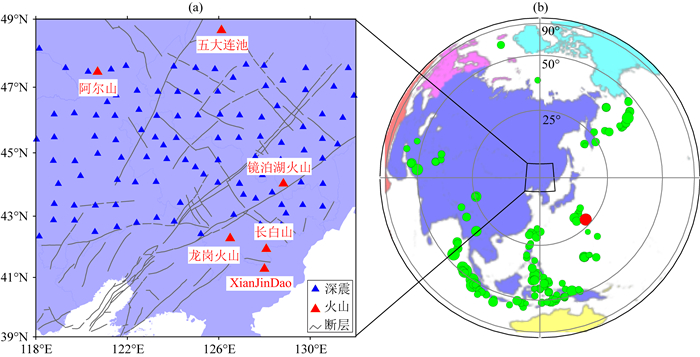
研究使用的远震波形资料来自2009-2011年期间在中国东北地区布设的NECESSArray台阵,该台阵数据来自IRIS DMC,包含129个宽频带地震台站(图 2左).根据台站分布及远震射线的深部覆盖特征,研究区范围选定为N39°-49°,E118°-132°.研究区包含我国吉林、辽宁、黑龙江省的大部分地区、内蒙古东部,以及朝鲜半岛北部地区.
|
图 2 研究区域台阵分布及筛选后的远震震中分布 (a) 地震台阵分布;(b) 绿色圆点为远震震中位置,其大小与震级大小有关. Fig. 2 Epicenter distribution of the selected teleseismic events and seismic array in study area The left map shows the distribution of seismic array.The green dot is the epicenter of teleseismicevent, and the size of the dot is related to the magnitude of event. |
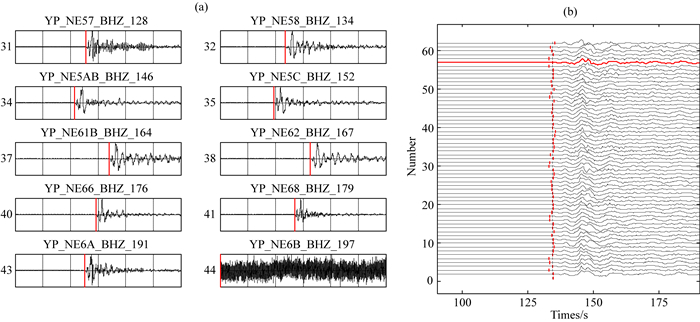
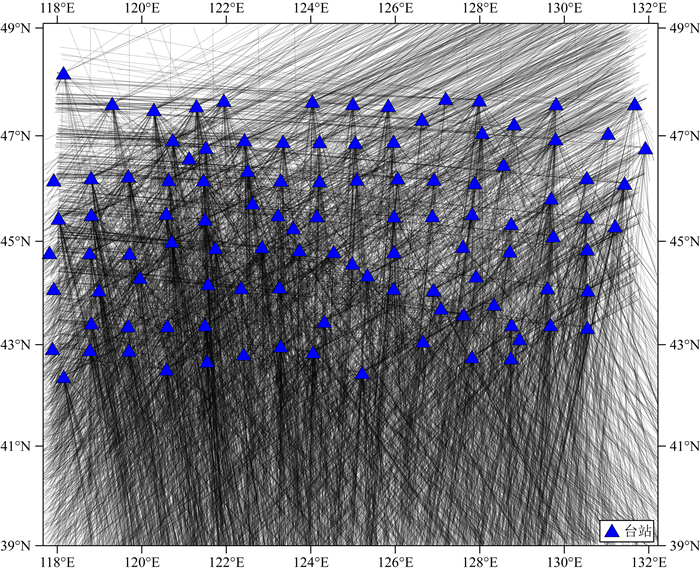
我们首先对2009-2011年间全球MS5.7以上远震数据进行了严格的筛选,筛选原则如下:(1) 选择P波到时尽可能清晰的波形资料,记录清晰的台站数至少大于10个;(2)震中距分布范围25°~90°;(3) 尽可能保证各个方位都有地震分布,以保障各向异性反演所需要的射线方位角覆盖.根据这些原则,我们最终挑选出了129个台站记录到的154个远震事件(图 2b).对这些事件,我们首先采用Kalkan(2016)给出的方法和程序进行P波到时自动拾取.该方法将地震记录转换为带有粘滞阻尼的单自由度振子的响应,通过计算获得较为光滑的粘滞阻尼耗能曲线,根据信号起始时刻能量曲线接近0的特点确定P波初至到时.相对于传统的长短窗平均振幅比方法(STA/LTA),该方法不依赖于步长与阈值的设定,对于信噪比较低的波形资料也具有良好的效果.在此基础上,截取初至到时前后一定时间段内的波形,选用高信噪比的P波作为参考波形,与其它台站的波形进行互相关计算,最终获取各个台站的P波到时.图 3展示了2010年12月21日日本小笠原群岛MS7.4地震(N26.90°,E143.70°,图 2红色圆点)的部分P波绝对到时自动拾取结果,以及波形相关后的对齐情况.在拾取中,我们进一步结合人工检查,对有错误的结果重新手动拾取或直接删除(如图 3中YP_NE_6B_BHZ_197台).最终,我们拾取到的准确的P波到时数据共计有9526个,射线分布如图 4所示.可见,在所选研究区范围内,射线分布较为密集,基本满足进行反演成像的覆盖要求.
|
图 3 日本小笠原群岛M7.4地震P波到时自动拾取结果及波形相关后对齐情况 (a) 红竖线为自动拾取的P波到时位置; (b) 红色短线为自动拾取结果,黑色短线为互相关修正后的到时,红色波形为参考波形. Fig. 3 Auto-picked P-wave arrival time of Bonin island, Japan M7.4 earthquake, in Dec 21, 2010 and alignment of waves (a) Red lines are the position of the auto-picked P-wave arrival time; (b) Red lines are auto-picked P-wave arrival time, black lines are corrected P-wave arrival after correlation, red wave is reference wave. |
|
图 4 研究区内射线路径分布 蓝色三角形表示地震台站,黑线表示射线. Fig. 4 Distribution of ray path in the study area The blue triangle is the seismic station, and the black line is the seismic ray. |
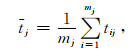
由于远震事件震源不在研究区内,因此在利用远震进行层析成像时需尽可能减小震源处以及研究区之外的传播介质对走时的影响.Zhao等(1994)采用一种计算相对走时残差的方式,即用某一台站i的绝对残差减去所有台站对某一事件j的到时残差平均值.远震理论走时采用IASPEI91模型计算,理论到时等于发震时刻加理论走时,相对走时残差可表示为

|
(1) |
其中
|
(2) |
mj表示接收到地震j的台站总数.
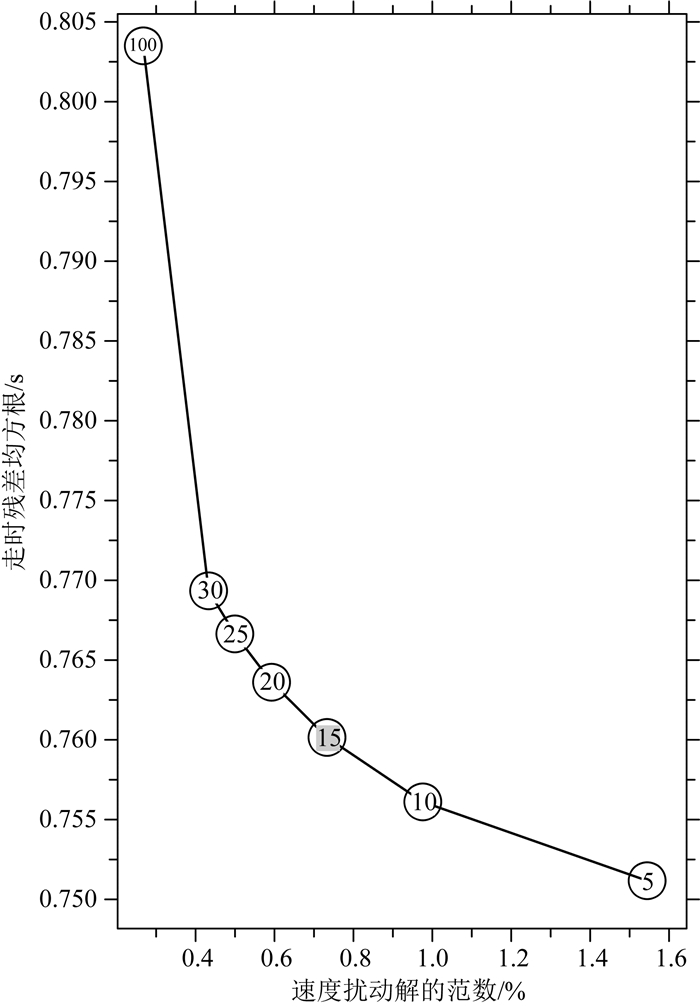
2 分辨率检验在最小二乘反演中,阻尼系数对最终结果具有较大影响.阻尼系数通过约束未知数在期望值附近变化,从而达到使方程快速收敛的效果,因此阻尼系数越大,未知数靠近期望值的程度越大,即反演结果越平滑.但通常情况下,期望值与真实值有一定差距,阻尼系数增加通常会导致反演的拟合走时残差增大.在实际应用中,不同的数据资料往往需要选择不同的最佳阻尼系数.这里我们分别采用阻尼系数值5、10、15、20、25、30、100进行反演对比,通过对速度扰动模型的平滑度(解的范数)和走时残差均方根之间的折中平衡(图 5),最终确定最佳阻尼系数为15.通过计算发现,该阻尼系数下,包含有各向异性参数的反演走时残差均方根约为0.76,而在相同参数条件下仅考虑各向同性的反演,其残差均方根约为0.82.
|
图 5 速度扰动解的范数与走时残差均方根折中曲线 Fig. 5 The tradeoff curve for the norm of velocity perturbations versus the root-mean-square traveltime residuals |
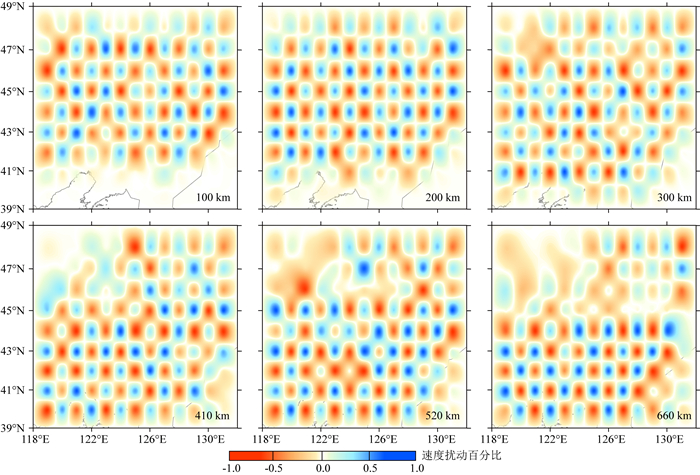
根据上文筛选的数据,采用棋盘格检测板方法对成像分辨率进行了检验.通过对研究区(N39°-49°,E118°-132°)采用多种不同间隔进行网格化测试,最终发现采用经纬度间隔步长为1°×1°时,可以获得对各向异性参数的良好分辨.检测板测试步骤如下:将研究区按一定的经纬度步长和非均匀深部间隔建立3D网格点,深度划分为100 km、200 km、300 km、410 km、520 km、660 km.选用IASPEI91模型给每个网格点的初始速度赋值,然后间隔地加上±1%的初始扰动量,同时每个格点给予一个初始各向异性快波方位角参数ψ为±45°、各向异性幅度α=1%.在该模型下进行快速三维射线追踪,计算出理论到时,以该到时作为虚拟的“观测到时”,然后再以初始速度扰动为0、各向异性参数为0进行反演.图 6、7分别展示了速度扰动和各向异性参数(包括各向异性幅度、快波速度方向FVD)在各深度上的横向检测结果,以蓝、红两色分别代表正、负速度扰动,蓝色短线表示各向异性信息,短线长短表示各向异性幅度,短线方位角表示快波速度方向FVD.结果显示,随深度的增加,速度扰动反演分辨率较好的区域逐渐向南迁移,这是由于所选的远震事件在研究区东侧及南侧分布更集中所致.在不同深度,研究区内大部分区域能获得较好的速度扰动分辨,其中整个松辽盆地下方在100~300 km范围具有很好的分辨率;大兴安岭地区在100~300 km整体分辨率较好,410 km以下,北部地区逐渐变差;长白山地区在200~660 km深度范围内均具有良好的分辨能力.各向异性的检测结果(包括各向异性幅度与FVD)与速度扰动的检测结果基本上呈正相关,即在速度扰动成像分辨率较好的区域内,各向异性反演结果也较好.
|
图 6 速度扰动棋盘格分辨率检测结果. 各层的深度示于每个图的右下角 Fig. 6 The results of the checkboard resolution test for velocity perturbation. The layer depth is shown at the bottom right corner of each map |

|
图 7 方位各向异性的棋盘格检测结果 Fig. 7 The results of the checkboard resolution test for azimuthal anisotropy |
图 8给出了沿不同纬度垂直剖面内的分辨率测试结果.图中短线表示水平面上的方位各向异性FVD和大小,竖线表示NS方向,横线表示EW方向.可以看出,大部分区域具有较好的各向异性分辨能力,且南部地区比北部地区分辨率好,中部区域分辨率最佳,这与来自南部方向的射线更加密集有关.总的看来,正负相间的速度扰动的分辨能力似乎比各向异性的分辨率能力稍好.

|
图 8 速度扰动及各向异性垂向分辨率测试 Fig. 8 Vertical checkboard resolution test for velocity perturbation and azimuthal anisotropy |
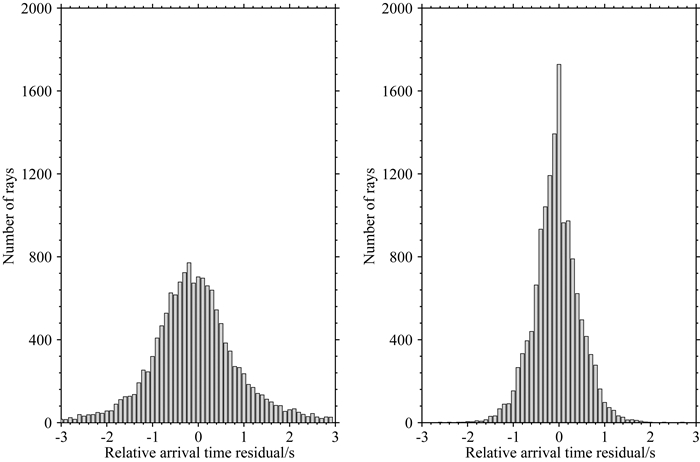
图 9给出了反演前后所有射线的相对走时残差分布.反演前大部分残差分布在[-2,2]之间,反演后大部分分布在[-1,1]之间,且在0值附近明显集中,这说明含有各向异性参数A、B的反演模型,明显减少了观测走时与理论走时之间的残差.
|
图 9 反演前后走时残差统计分布 Fig. 9 The statistic of the relative traveltime residuals before and after inversion |
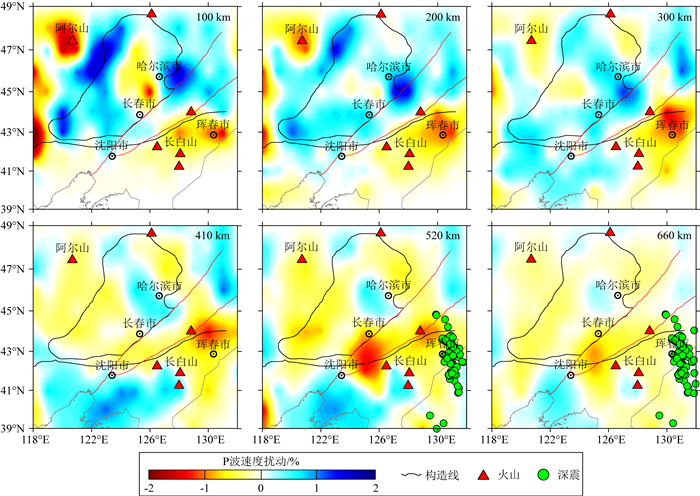
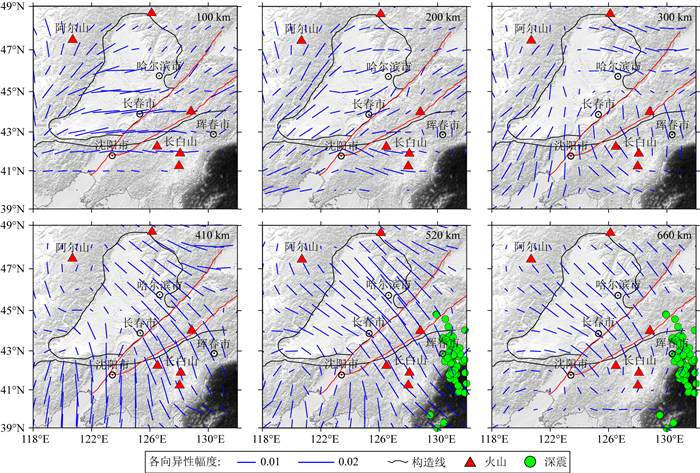
图 10和图 11给出了采用各向异性远震层析成像方法获得的东北地区不同深度的P波速度扰动及各向异性参数分布图.根据速度扰动和各向异性的横向不均匀特征,以及前人对该地区的认识,将研究区分为三个子区域分别讨论,由北至南依次是阿尔山火山及邻近地区、松辽盆地及周边地区、长白山火山区.
|
图 10 东北地区远震P波各向异性层析成像速度扰动结果 Fig. 10 P-wave anisotropy tomography results for velocity perturbation, NE China |
|
图 11 东北地区远震P波各向异性层析成像各方位向异性分布结果 Fig. 11 P-wave anisotropy tomography results for azimuthal anisotropy, NE China |
阿尔山火山区下方存在一个明显的低速异常柱状体(图 10),从100 km深度一直延伸至410 km以下的地幔转换带中.300 km以下,阿尔山地区下方的低速异常幅度降低,在410 km以下与松辽盆地下方的低速异常合并为一个范围较大的弱低速异常区.各向异性结果揭示(图 11),在100~300 km,阿尔山地区东西两侧的快波速度方向FVD分布略有差异,东侧沿大兴安岭一带呈NE向展布,与大兴安岭长轴走向及兴安地块-松嫩地块的古地块拼合带(林阿兵等,2018;许文良等,2019)走向一致,西侧靠近海拉尔盆地地区则呈NNW向展布.300~410 km,在火山区正下方各向异性幅值降低.410 km以下,各向异性FVD与整个区域的NW向各向异性分布相一致.
在松辽盆地下方,速度扰动异常呈现高速为主,高低速混合分布的特点,与远震各向同性的成像结果接近(张风雪等,2013).在100~200 km深度范围内,盆地中央存在一个直径约200 km、近圆形的低速异常,它被沿盆地周缘的高速异常环绕(图 10).200 km以下,低速异常逐渐变得不明显,盆地内部整体以高速异常为主.各向异性结果揭示(图 11),在100 km深度上下,盆地南侧及盆地中部的FVD以近E-W向为主,盆地东北部地区FVD呈现出NE-SW向特征.这一分布形态与盆地南侧的华北克拉通-松嫩地块拼合带(Meng,2003;许文良等,2019)的走向及一系列NE走向的深大断裂带一致(邓起东,2007).410km以下,松辽盆地内部各向异性FVD逐渐旋转为NW-SE向,与SKS的快波极性方向一致(Liu et al., 2008;Li and Niu, 2010,Li et al., 2017;Chen et al., 2017).
长白山火山区下方存在明显的低速异常,且一直延伸至地幔转换带附近,在410 km以下,低速异常特征逐渐减弱.在长白山东北方向的珲春附近,200~410 km深度存在明显的低速异常集中,但在上地幔过渡带内部(410~660 km)随深度的增加逐渐减弱消失.在长白山西北方长春以南地区下方520~660 km之间,出现一个低速异常集中区(图 10),该结果与远震各向同性的成像结果类似(张风雪等,2013; 张风雪和吴庆举2019).各向异性结果显示,在100~200 km深度,长白山火山区周边的快波速度方向主要为近E-W向(图 11),Pn波各向异性研究也发现了类似结果(Du and Lei, 2019).300 km以下,火山区正下方FVD表现为NW-SE向分布,并一直延伸至地幔转换带中,与SKS的极性方向一致.520~660 km之间,长白山东北侧,镜泊湖火山东侧,也是东北深源地震发生的区域,FVD局部呈现出NNE向且幅值较低的分布特征.
4 讨论对阿尔山地区的地质研究显示,阿尔山地区下方有广泛的玄武质岩浆活动(刘若新等,1985;白志达等, 2005, 2012;樊祺诚等, 2008, 2011;赵勇伟,2010; 赵永伟和樊琪诚2012;Su et al., 2011).层析成像及接收函数结果显示,阿尔山地区下方存在低速异常(张风雪等,2013;李英康等,2014;潘佳铁等,2014;Hou et al., 2015).但目前对于该区下方岩浆的深部热源供给及运移情况的研究认识仍处在讨论阶段.大地电磁测深相关研究发现该区下方岩石圈内存在低阻异常(汤吉等,2006;Liang et al., 2015;梁宏达等,2016),进一步的高精度结果显示这些大规模的低阻异常呈“拱桥式”分布特征(韩江涛等,2018b),认为阿尔山地区的火山岩浆作用与山地两侧盆地,即海拉尔盆地、松辽盆地下方的软流圈热物质上涌并在该区岩石圈内发生汇聚有关.但地球化学证据表明大兴安岭地区玄武岩的源区含有来自深部地幔的古老的橄榄岩质原始地幔组分(薛笑秋等,2019),暗示该地区的热物质补给可能具有更深的来源.Huang和Zhao(2006)研究认为,水平滞留在东北地区下方的太平洋板块的前端已到达大兴安岭-太行山重力梯度带,影响了大兴安岭地区的深部热物质活动.根据本文速度扰动反演结果显示的低速异常深度范围,我们推测阿尔山火山区下方热物质活动可能一直延伸至地幔转换带中,且与松辽盆地下方的热物质具有共同的深部补给源.在100~300 km深度范围内,阿尔山东侧的FVD呈NE向展布,与构造走向及块体拼合带的空间展布高度相关,表明该地区域内的各向异性可能与板块拼合过程中岩石圈的挤压变形有关.西侧的NNW向FVD则可能与盆地后期的伸展运动有关.410 km,阿尔山下方各向异性的低幅值表明这一区域主要以物质的垂向运移为主.综合来看,我们推测阿尔山地区下方存在来自深部的垂向热物质运移通道,其形成机制可能与滞留板块前端的深部动力学过程有关.
松辽盆地的地质研究显示,新生代以来,太平洋俯冲板片向东回撤,上覆板块沿回撤方向垮塌导致伸展变形(Ren et al., 2002;Schellart and Lister, 2005;余中元等,2016).东北地区岩石圈从挤压环境到拉张环境的转变,导致岩石圈根发生拆沉、裂解作用,并伴随着软流圈热物质的上涌(汤吉等,2006;刘国兴等,2006;蔡学林等,2007;张广成等,2013;张风雪等,2013;潘佳铁等,2014;李英康等,2014;He and Santosh, 2016).大地电磁测深结果(韩江涛等,2018a)显示松辽盆地地区岩石圈厚度在最薄处仅45 km左右,并暗示软流圈并非传统的垂直上涌,而是具有更复杂的蘑菇状形态.根据本文反演结果推断,松辽盆地下方100~200 km的低速异常很可能与高温热物质上涌有关,上涌的热物质破坏了盆地中部的岩石圈根,发生拆沉、裂解,并导致了多期岩浆的侵入作用和变质作用,而盆地周缘古老的冷的岩石圈则被保留下来,最终形成了高速异常环绕着低速异常分布的特征.这种构造演化的模式还能够很好地解释松辽盆地中央隆起带的结构特征、潜山分布及盆地中央丰富的油气藏环境的动力来源.P波各向异性快波方向揭示,盆地南部及中部地区200 km之上主要为E-W向,东侧则逐渐转为NE向,推测这种分布特征受到E-W向古地块拼合带及NE向的深大断裂的共同控制,地幔物质发生了沿块体拼合带走向及断裂走向的剪切变形,进而导致了矿物晶体的定向排列.SKS研究结果显示,东北地区东部各向异性优势方向展布总体接近NW-SE向(Liu et al., 2008;Li and Niu, 2010,Li et al., 2017;Chen et al., 2017).本文结果显示在300 km以下FVD逐渐转为NW向,据此推测SKS的NW-NE向的快波方向可能源自较大的深度,与太平洋板块NW向俯冲及其在上地幔过渡带滞留等有关.
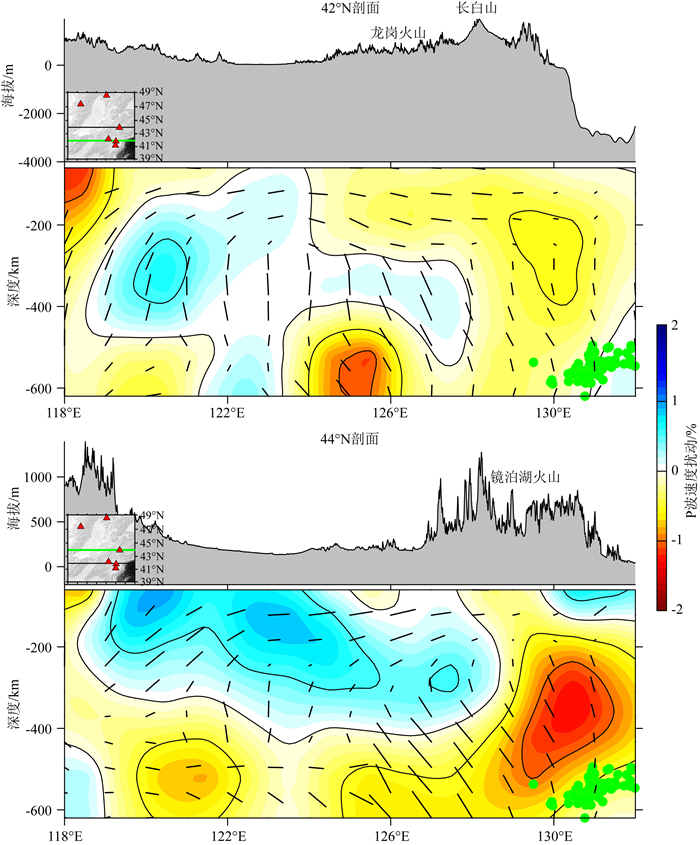
有关长白山火山的成因仍然存在争论.一种观点认为,太平洋板块在中国东北地区下方地幔转换带中水平滞留脱水,导致了长白山及五大连池火山区下方、滞留板块上方的上地幔中发生局部熔融和岩浆向上运移(Zhao,2004;Lei and Zhao, 2005;Zhao et al., 2007;Lei et al., 2013;雷建设等,2018),进而形成火山.一些成像结果显示在滞留板块上方的地幔中往往存在明显的低速异常,而滞留板块内显示高速特征,暗示了这些板内火山并非来自深处的热点所致,表现出一种由板块深部俯冲与滞留作用导致的弧后火山特点(Zhou and Clayton, 1990;Van Der Hilst et al., 1991;Zhao,2004;Lei and Zhao, 2006;Huang and Zhao, 2006;Wei et al., 2012;Chen et al., 2015, 2017).但也有一些结果发现在地幔转换带中存在局部的低速异常(Tang et al., 2014, Guo et al., 2018, 张风雪和吴庆举,2019),结合接收函数(Liu et al., 2015)的研究结果,认为长白山火山区深部岩浆活动与来自深部的地幔热柱有关,和太平洋板块俯冲的关系不大.另一方面,地质与地球化学证据均表明(马晗瑞,2016;徐义刚等,2018),滞留在长白山地区下方的俯冲板块发生过深部脱水.而在日本地区的一些研究还发现,俯冲带深部的脱水作用往往会导致局部低速异常(Nakahigashi et al., 2015;Zhao,2017).本文的研究结果显示,在520~660 km深度范围内,长白山西北方确实存在一个显著的局部低速异常(图 10,12),但各向异性结果揭示,在该区域内的方位各向异性幅值没有发生明显变化,且FVD只发生了小幅度的转向,整体依然保持统一的NW向特征,这表明该区域内的地幔物质运移依然以横向为主.若假设该区域内存在来自深部的大尺度垂直上升的地幔热柱,则在上涌热物质的中心,由于物质运移以垂向为主,理论上,方位各向异性的幅值应该较低,FVD也会产生更复杂的变化.另外,沿N42°的剖面结果也显示(图 12),该低速异常并未突破地幔转换带410 km边界与上方低速区联通.综合分析,我们推测该区域内的地幔物质可能以横向运移为主,低速异常则是受到板块深部脱水作用的影响,而并非来自深部的地幔热柱所致.
|
图 12 沿N42°、N44°速度扰动及各向异性剖面结果 图中绿色点为区域内深源地震,短实线表示各向异性,线方向表示各向异性方位FVD,长度表示幅度相对大小. Fig. 12 Profile result of velocity perturbation and azimuthal anisotropy along N42°, N44° Green points are deep earthquakes; Black lines are azimuthal anisotropy. |
地质研究显示,东北地区由多个微陆块拼合形成(Şengör et al., 1993;Sengor and Natal′in,1996;任纪舜等,1999;Wu et al., 2007;Tang et al., 2013;许文良等,2013;徐备等,2014;Zhou et al., 2015;林阿兵等,2018),其中,华北克拉通与松嫩地块的拼合过程最后完成且规模最大,拼合带沿N43°呈近E-W向展布(图 1).本研究的结果显示,长白山地区下方100 km、200 km的FVD整体与该拼合带走向一致,在阿尔山地区及松辽盆地周缘岩石圈内部的各向异性特征也存在类似现象,这进一步证实了岩石圈内部的各向异性通常与地表地质与构造相关(Zhao et al., 2016),受岩石圈最后一次形变影响(Silver and Chan, 1991;Silver et al., 2001).300 km以下,长白山火山正下方FVD逐渐转为NW-SE向分布,并一直延伸至地幔转换带中.一些研究认为,大洋板块的俯冲会带动上覆地幔物质沿俯冲方向发生局部流动,造成橄榄石矿物晶体α轴沿俯冲方向定向排列,在此方向上P波的传播速度最快(Sandvol and Ni, 1997;Fisher et al., 2000;Jung and Karato, 2001;Jung et al., 2009;Reyners and Eberhart-Phillips, 2009;Huang et al., 2011),由此往往产生与俯冲方向一致的FVD分布.因此我们推断,这些深部的NW向FVD很可能与太平洋板块的西向俯冲作用有关.在镜泊湖火山东侧存在一个低速异常,且FVD发生了局部转向,这一区域恰好也是东北深源地震发生区(图 10、图 11、图 12).沿N44°的垂直剖面结果显示(图 12),深震展布形态与低速异常区的边缘形态及板块俯冲角度相一致.近期的研究认为,深震聚簇附近的板块表现出板片折曲的特征,深震集中区主要分布在板块弯折区上方(胡桂等,2019).对日本地区的一些研究还发现,在俯冲带碰撞区,即大洋板块发生强烈弯折及变质作用的区域,各向异性特征往往也会发生变化(Healy et al., 2009;Wang and Zhao, 2008, 2010, 2012, 2013, 2017;Cheng et al., 2011;Huang et al., 2011).这可能暗示,镜泊湖火山东侧520~660 km的各向异性变化也与太平洋板块在深部发生弯折有关,但本文由于受地震观测台站分布的限制,难以获得俯冲板块在地幔过渡带内的完整图像,未来仍需要进行更完善的地震观测和成像研究,以便判定这一深部物理模型的可靠性.
5 结论(1) 阿尔山火山区下方存在柱状低速异常,可一直延伸至410 km的地幔转换带附近,表明阿尔山火山活动源自软流圈之下的地幔深处.100~300 km内,阿尔山地区东西两侧具有不同的各向异性分布,分析认为与古地块拼合及盆地后期的伸展变形有关.410 km以下,阿尔山地区下方的低速异常与松辽盆地下方低速异常相通,且各向异性具有一致的NW向特征,推测二者可能具有共同的热源供给,且与太平洋板块前端的深部动力学过程有关.
(2) 在松辽盆地地区,速度扰动呈现以高速为主,中心区域100~200 km深度存在低速异常,结合已有研究,认为这种特征可能与软流圈热物质上涌有关.在100 km深度,盆地南侧及中部地区的各向异性FVD为近E-W向,而东北部地区则呈现NE-SW向展布,其整体分布与E-W走向的华北克拉通-松嫩地块拼合带及一些NE走向的深大断裂带的空间展布相似,推断该区域岩石圈及其下方附近的各向异性可能受到古地块拼合及深大断裂的共同影响.410 km以下,盆地内FVD整体转为NW-SE向分布,与SKS结果接近,表明SKS快波方向可能源自较大的深度,推测与太平洋板块的西向俯冲作用有关.
(3) 在长白山火山区下方,各向异性结果显示,100~200 km,快波速度方向FVD总体为近E-W向分布,推测与华北克拉通-松嫩地块的拼合作用有关.300 km以下,FVD逐渐转为NW-SE向特征,推测与太平洋板块的西向俯冲及其上方的地幔物质流动有关.在520~660 km范围,长白山西北方发现了一个低速异常集中区,但方位各向异性的幅值较大,且FVD依然保持整体NW向的一致性特征,推测该区域内的低速异常与来自深部的地幔热柱关系不大,可能与板块的深部脱水作用有关.
致谢 感谢两位审稿专家提出的宝贵意见和建议.本文采用的各向同性成像程序源自赵大鹏的层析成像程序,在此向他深表谢意.研究中使用了吉林省地震局提供的东北地区深源地震目录资料及活动断裂数据,在此表示感谢.
Bai Z D, Tian M Z, Wu F D, et al. 2005. Yanshan, Gaoshan-two active volcanos of the volcanic cluster inArshan, Inner Mongolia. Earthquake Research in China (in Chinese), 21(1): 113-117. |
Bai Z D, Tan Q W, Xu G L, et al. 2012. Late Quaternary volcanic activity and neotectonics in the eastern Inner Mongolia. Acta Petrologica Sinica (in Chinese), 28(4): 1099-1107. |
Bamford D. 1997. Pn velocity anisotropy in a continental upper mantle. Geophysical Journal International, 49(1): 29-48. |
Barclay A H, Toomey D R, Solomon S C. 1998. Seismic structure and crustal magmatism at the mid-Atlantic ridge, 35 N. Journal of Geophysical Research: Solid Earth, 103(B8): 17827-17844. DOI:10.1029/98JB01275 |
Cai X L, Zhu J S, Cao J M, et al. 2007. Three-dimensional tectonics of lithosphere and mantle dynamics of East AsiaWest Pacific. Earth Science Frontiers (in Chinese), 14(3): 21-38. |
Chen C X, Zhao D P, Tian Y, et al. 2017. Mantle transition zone, stagnant slab and intraplate volcanism in Northeast Asia. Geophysical Journal International, 209(1): 68-85. |
Chen M, Niu F L, Liu QY, et al. 2015. Multiparameter adjoint tomography of the crust and upper mantle beneath East Asia: 1. Model construction and comparisons. Journal of Geophysical Research: Solid Earth, 120(3): 1762-1786. DOI:10.1002/2014JB011638 |
Cheng B, Zhao D P, Zhang G W. 2011. Seismic tomography and anisotropy in the source area of the 2008 Iwate-Miyagi earthquake (M7.2). Physics of the Earth and Planetary Interiors, 184(3-4): 172-185. DOI:10.1016/j.pepi.2010.11.006 |
Cholet J, RichardM. 1954. A test on elastic anisotropy measurement at Berriane(North Sahara). Geophysical Prospecting, 2(3): 232-246. DOI:10.1111/j.1365-2478.1954.tb01289.x |
Christensen NI, Lundquist S M. 1982. Pyroxene orientation within the Upper Mantle. GSA Bulletin, 93(4): 279-288. DOI:10.1130/0016-7606(1982)93<279:POWTUM>2.0.CO;2 |
Deng J F, Mo X X, Zhao H L, et al. 1994. Lithosphere root/de-rooting and activation of the east China continent. Geoscience (in Chinese), 8(3): 349-356. |
Deng Q D, Ran Y K, Yang X P, et al. 2007. Map of Active Tectonics in China (in Chinese). Beijing: Seismological Press.
|
Du M F, Lei J S. 2019. Pn anisotropic tomography of Northeast China and its implications to mantle dynamics. Journal of Asian Earth Sciences, 171: 334-347. DOI:10.1016/j.jseaes.2018.08.033 |
Eberhart-Phillips D, Henderson C M. 2004. Including anisotropy in 3-D velocity inversion and application to Marlborough, NewZealand. Geophysical Research Letters, 156(2): 237-254. |
Fan Q C, Sui J L, Zhao Y W, et al. 2008. Preliminary study on garnet peridotite xenolith of Quaternary volcanic rocks in middle Daxing′an Mountain range. Acta Petrologica Sinica (in Chinese), 24(11): 2563-2568. |
Fan Q C, Zhao Y W, Li D M, et al. 2011. Studies on Quaternary volcanism stages of Halaha river and Chaoer river area in the Great Xing'an Range: Evidence from K-Ar dating and volcanic geology features. Acta Petrologica Sinica (in Chinese), 27(10): 2827-2832. |
Fischer K M, Parmentier E M, Stine A R, et al. 2000. Modeling anisotropy and plate-driven flow in the Tonga subduction zone back arc. Journal of Geophysical Research: Solid Earth, 105(B7): 16181-16191. DOI:10.1029/1999JB900441 |
Francis T J G. 1969. Generation of seismic anisotropy in the upper mantle along the mid-oceanic ridges. Nature, 221(5176): 162-165. DOI:10.1038/221162b0 |
Ge R F, Zhang Q L, Wang L S, et al. 2010. Tectonic evolution of Songliao basin and the prominent tectonic regime transition in eastern China. Geological Review (in Chinese), 56(2): 180-195. |
Gu Q P, Ding Z F, Kang Q Q, et al. 2016. Pn wave velocity and anisotropy in the middle-southern segment of the Tan-Lu fault zone and adjacent region. Chinese Journal of Geophysics (in Chinese), 59(2): 504-515. DOI:10.6038/cjg20160210 |
Guo Z, ChenY J, NingJ Y, et al. 2016. Seismic evidence of on-going sublithosphere upper mantle convection for intra-plate volcanism in Northeast China. Earth and Planetary Science Letters, 433: 31-43. DOI:10.1016/j.epsl.2015.09.035 |
Guo Z, Wang K, Yang Y J, et al. 2018. The origin and mantle dynamics of quaternary intraplate volcanism in Northeast China from joint inversion of surface wave and body wave. Journal of Geophysical Research: Solid Earth, 123(3): 2410-2425. DOI:10.1002/2017JB014948 |
Hagedoorn J G. 1954. A practical example of an anisotropic velocity-layer. Geophysical Prospecting, 2(1): 52-60. DOI:10.1111/j.1365-2478.1954.tb01279.x |
Han J T, Guo Z Y, Liu W Y, et al. 2018a. Deep dynamic process of lithosphere thinning in Songliao basin. Chinese Journal of Geophysics (in Chinese), 61(6): 2265-2279. DOI:10.6038/cjg2018L0155 |
Han J T, Wang T Q, Liu W Y, et al. 2018b. Deep "Arch-bridge" Magmatic system of the Aershan volcanic group and its stability analysis. Seismology and Geology (in Chinese), 40(3): 590-610. |
He C S, Santosh M. 2016. Seismic tomographic evidence for upwelling mantle plume in NE China. Physics of the Earth and Planetary Interiors, 254: 37-45. DOI:10.1016/j.pepi.2016.03.007 |
Healy D, ReddyS M, TimmsN E, et al. 2009. Trench-parallel fast axes of seismic anisotropy due to fluid-filled cracks in subducting slabs. Earth and Planetary Science Letters, 283(1-4): 75-86. DOI:10.1016/j.epsl.2009.03.037 |
Hearn T M. 1996. Anisotropic Pn tomography in the Western United States. Journal of Geophysical Research: Solid Earth, 101(B4): 8403-8414. DOI:10.1029/96JB00114 |
Helbig K, Thomsen L. 2006. 75-plus years of anisotropy in exploration and reservoir seismics: A historical review of concepts and methods, Geophysics, 70, 9ND-23ND. Geophysics, 71(1): 9N. |
Hess H H. 1964. Seismic anisotropy of the uppermost mantle under oceans. Nature, 203(4945): 629-631. DOI:10.1038/203629a0 |
Hirahara K, Ishikawa Y. 1984. Travel-time inversion for three-dimensional P-wave Velocity Anisotropy. Journal of Physics of the Earth, 32(3): 197-218. DOI:10.4294/jpe1952.32.197 |
Hirahara K. 1988. Detection of three-dimensional velocity anisotropy. Physics of the Earth and Planetary Interiors, 51(1-3): 71-85. DOI:10.1016/0031-9201(88)90025-8 |
Hou H S, Wang H Y, Gao R, et al. 2015. Fine crustal structure and deformation beneath the Great Xing′an Ranges, CAOB: Revealed by deep seismic reflection profile. Journal of Asian Earth Sciences, 113: 491-500. DOI:10.1016/j.jseaes.2015.01.030 |
Hu G, Li J, Han G J. 2019. Characteristics and origin of deep earthquake clusters beneath Northwest Pacific and Tonga subduction zone. Chinese Journal of Geophysics (in Chinese), 62(8): 3004-3016. DOI:10.6038/cjg2019N0148 |
Huang J L, Zhao D P. 2006. High-resolution mantle tomography of China and surrounding regions. Journal of Geophysical Research: Solid Earth, 111(B9): B09305. DOI:10.1029/2005JB004066 |
Huang Z C, Wang L S, Zhao D P, et al. 2011. Seismic anisotropy and mantle dynamics beneath China. Earth and Planetary Science Letters, 306(1-2): 105-117. DOI:10.1016/j.epsl.2011.03.038 |
Huang Z X, Xu Y, Hao T Y, et al. 2009. Surface wave tomography of lithospheric structure in the seas of east China. Chinese Journal of Geophysics (in Chinese), 52(3): 653-662. |
Jung H, Karato S I. 2001. Water-induced fabric transitions in olivine. Science, 293(5534): 1460-1463. DOI:10.1126/science.1062235 |
Jung H, Mo W, Green H W. 2009. Upper mantle seismic anisotropy resulting from pressure-induced slip transition in olivine. Nature Geoscience, 2(1): 73-77. DOI:10.1038/ngeo389 |
Kalkan E. 2016. An automatic P-phase arrival-time picker. Bulletin of the Seismological Society of America, 106(3): 971-986. DOI:10.1785/0120150111 |
Kleyn A H. 1956. On seismic wave propagation in anisotropic media with applications in the Betun area, South Sumatra. Geophysical Prospecting, 4(1): 56-69. DOI:10.1111/j.1365-2478.1956.tb01396.x |
Lei J S, Zhao D P. 2005. P-wave tomography and origin of the Changbai intraplate volcano in Northeast Asia. Tectonophysics, 397(3-4): 281-295. DOI:10.1016/j.tecto.2004.12.009 |
Lei J S, Zhao D P. 2006. Global P-wave tomography: On the effect of various mantle and core phases. Physics of the Earth and Planetary Interiors, 154(1): 44-69. DOI:10.1016/j.pepi.2005.09.001 |
Lei J S, Xie F R, Fan Q C, et al. 2013. Seismic imaging of the deep structure under the Chinese volcanoes: An overview. Physics of the Earth and Planetary Interiors, 224: 104-123. DOI:10.1016/j.pepi.2013.08.008 |
Lei JS, Zhao DP, Xu YG, et al. 2018. Is there a gap in the stagnant Pacific slab in the mantle transition zone under the Changbaishan volcano?. Acta Petrologica Sinica (in Chinese), 34(1): 13-22. |
Li J, Niu F L. 2010. Seismic anisotropy and mantle flow beneath northeast China inferred from regional seismic networks. Journal of Geophysical Research: Solid Earth, 115(B12). DOI:10.1029/2010JB007470 |
Li J Y. 1998. Some new ideas on tectonics of NE China and its neighboring areas. Geological Review (in Chinese), 44(4): 339-347. |
Li S L, Guo Z, Chen Y J. 2017. Complicated 3D mantle flow beneath Northeast China from shear wave splitting and its implication for the Cenozoic intraplate volcanism. Tectonophysics, 709: 1-8. DOI:10.1016/j.tecto.2017.04.015 |
Li Y K, Gao R, Yao Y T, et al. 2014. The crust velocity structure of Da Hinggan Ling orgenic belt and the basins on both sides. Progress in Geophysics (in Chinese), 29(1): 73-83. DOI:10.6038/pg20140110 |
Li Z A, Run Y. 2000. Dynamic study on orogenic belt-Basin systems in Northeast China. Geotectonica et Metallogenia (in Chinese), 24(1): 31-37. |
Liang H D, Gao R, Hou H S, et al. 2015. Lithospheric electrical structure of the Great Xing′an Range. Journal of Asian Earth Sciences, 113: 501-507. DOI:10.1016/j.jseaes.2015.01.026 |
Liang H D, Gao R, Hou H S, et al. 2016. Deep electrical structure beneath the Da Hinggan Ling and the junction zone with adjacent basins and their tectonic relationship at a lithospheric scale. Chinese Journal of Geophysics (in Chinese), 59(5): 1696-1704. DOI:10.6038/cjg20160514 |
Lin A B, Zheng J P, Pan S K. 2018. Nature and processes of microcontinents: Primary derivation for the heterogeneity of lithospheric mantle beneath northeastern China. Acta Petrologica Sinica (in Chinese), 34(1): 143-156. |
Liu G X, Zhang X Z, Yang B J, et al. 2006. Electrical structures of the lithosphere along the Jiamusi massif and its eastern edge. Chinese Journal of Geophysics (in Chinese), 49(2): 598-603. |
Liu K H, Gao S S, Gao Y, et al. 2008. Shear wave splitting and mantle flow associated with the deflected Pacific slab beneath northeast Asia. Journal of Geophysical Research: Solid Earth, 113(B1): B01305. DOI:10.1029/2007JB005178 |
Liu R X, Fan Q C, Sun J Z. 1985. Study on garnet lherzolite xenoliths from eastern China. Acta Petrologica Sinica (in Chinese), 1(4): 24-33. |
Liu Z, Niu F L, Chen Y J, et al. 2015. Receiver function images of the mantle transition zone beneath NE China: New constraints on intraplate volcanism, deep subduction and their potential link. Earth and Planetary Science Letters, 412: 101-111. DOI:10.1016/j.epsl.2014.12.019 |
Luo J H, Che Z C, Li J L. 2000. Structural features of the Jurassic basins in western China and middle Asia. Scientia Geologica Sinica (in Chinese), 35(4): 404-413. |
Ma H R. 2016. Study on origin of the Tianchi Volcano, Changbaishan [Ph. D. thesis] (in Chinese). Changchun: Jilin University.
|
Maupin V, Park J. 2007. Theory and observations-wave propagation in anisotropic media. Treatise on Geophysics, 1: 289-321. DOI:10.1016/B978-044452748-6.00007-9 |
Meng Q R. 2003. What drove late Mesozoic extension of the northern China-Mongolia tract?. Tectonophysics, 369(3-4): 155-174. DOI:10.1016/S0040-1951(03)00195-1 |
Nakahigashi K, Shinohara M, Yamada T, et al. 2015. Deep slab dehydration and large-scale upwelling flow in the upper mantle beneath the Japan Sea. Journal of Geophysical Research: Solid Earth, 120(5): 3278-3292. DOI:10.1002/2014JB011781 |
Nicolas A, Christensen N I. 1987. Formation of anisotropy in upper mantle peridotites -A review. //FuchsK, FroidevauxC eds. Composition, Structure and Dynamics of the Lithosphere-Asthenosphere System. Washington DC: Geodynamics Series, 16(1): 111-123.
|
Okaya D A, McEvilly T. 2003. Elastic wave propagation in anisotropic crustal material possessing arbitrary internal tilt. Geophysical Journal International, 153(2): 344-358. DOI:10.1046/j.1365-246X.2003.01896.x |
Pan J T, Li Y H, Wu Q J, et al. 2014. 3-D S-wave velocity structure of crust and upper-mantle beneath the northeast China. Chinese Journal of Geophysics (in Chinese), 57(7): 2077-2087. DOI:10.6038/cjg20140705 |
Park J, Levin V. 2002. Seismic anisotropy: Tracing plate dynamics in the mantle. Science, 296(5567): 485-489. DOI:10.1126/science.1067319 |
Qiang Z Y, Wu Q J. 2015. Upper mantle anisotropy beneath the north of northeast China and its dynamic significance. Chinese Journal of Geophysics (in Chinese), 58(10): 3540-3552. DOI:10.6038/cjg20151010 |
Raitt R W, Shor G G Jr, Francis T J G, et al. 1969. Anisotropy of the Pacific upper mantle. Journal of Geophysical Research, 74(12): 3095-3109. DOI:10.1029/JB074i012p03095 |
Ren J S, Niu B G, Liu Z G. 1999. Soft collision, superposition orogeny and polycyclic suturing. Earth Science Frontiers (in Chinese), 6(3): 85-93. |
Ren J Y, Tamaki K, Li S T, et al. 2002. Late Mesozoic and Cenozoic rifting and its dynamic setting in Eastern China and adjacent areas. Tectonophysics, 344(3-4): 175-205. DOI:10.1016/S0040-1951(01)00271-2 |
Reyners M, Eberhart-Phillips D. 2009. Small earthquakes provide insight into plate coupling and fluid distribution in the Hikurangi subduction zone, New Zealand. Earth and Planetary Science Letters, 282(1-4): 299-305. DOI:10.1016/j.epsl.2009.03.034 |
Sandvol E, Ni J. 1997. Deep azimuthal seismic anisotropy in the southern Kurile and Japan subduction zones. Journal of Geophysical Research: Solid Earth, 102(B5): 9911-9922. DOI:10.1029/96JB03489 |
Savage M K. 1999. Seismic anisotropy and mantle deformation: what have we learned from shear wave splitting?, 37(1): 65-106. Reviews of Geophysics, 37(1): 65-106. DOI:10.1029/98RG02075 |
Schellart W P, Lister G S. 2005. The role of the East Asian active margin in widespread extensional and strike-slip deformation in East Asia. Journal of the Geological Society, London, 162(11): 959-972. |
Şengör AMC, Natal′in BA, Burtman VS. 1993. Evolution of the Altaid tectonic collage and Palaeozoic crustal growth in Eurasia. Nature, 364(6435): 299-307. DOI:10.1038/364299a0ryType=xml&restype=unixref&xml=|J. Control. Release||119||143|2007||| |
Şengör AMC, Natal′in BA. 1996. Paleotectonics of Asia: fragments of a synthesis. //Yin A, Harrison TM eds. The Tectonic Evolution of Asia. New York: Cambridge University Press, 486-640.
|
Silve P G, Chan W W. 1991. Shear wave splitting and subcontinental mantle deformation. Journal of Geophysical Research: Solid Earth, 96(B10): 16429-16454. DOI:10.1029/91JB00899 |
Silver P G, Gao S S, Liu K H, et al. 2001. Mantle deformation beneath southern Africa. Geophysical Research Letters, 28(13): 2493-2496. DOI:10.1029/2000GL012696 |
Smith G P, Ekström G. 1999. A global study of Pn anisotropy beneath continents. Journal of Geophysical Research: Solid Earth, 104(B1): 963-980. DOI:10.1029/1998JB900021 |
Su B X, Zhang H F, Tang Y J, et al. 2011. Geochemical syntheses among the cratonic, off-cratonic and orogenic garnet peridotites and their tectonic implications. International Journal of Earth Sciences, 100(4): 695-715. DOI:10.1007/s00531-010-0527-0 |
Tang J, Zhao G Z, Wang J J, et al. 2006. Study of the form ationme chanism forvolcanism in Northeast China based on deep electric structure. Acta Petrologica Sinica (in Chinese), 22(6): 1503-1510. |
Tang J, Xu W L, Wang F, et al. 2013. Geochronology and geochemistry of Neoproterozoic magmatism in the Erguna Massif, NE China: Petrogenesis and implications for the breakup of the Rodinia supercontinent. Precambrian Research, 224: 597-611. DOI:10.1016/j.precamres.2012.10.019 |
Tang Y C, Obayashi M, Niu F L, et al. 2014. Changbaishan volcanism in Northeast China linked to subduction-induced mantle upwelling. Nature Geoscience, 7(6): 470-475. DOI:10.1038/ngeo2166 |
Tian Y, LegendreC P, Zhou T, et al. 2017. High resolution anisotropic phase velocity tomography of Northeast China and its implication. Chinese Journal of Geophysics (in Chinese), 60(5): 1659-1675. DOI:10.6038/cjg20170505 |
Tommasi A. 1998. Forward modeling of the development of seismic anisotropy in the upper mantle. Earth and Planetary Science Letters, 160(1-2): 1-13. DOI:10.1016/S0012-821X(98)00081-8 |
Uhrig L F, Van MelleF A. 1955. Velocity anisotropy in stratified media. Geophysics, 20(4): 774-779. DOI:10.1190/1.1438185 |
Van Der Hilst R, Engdahl R, Spakman W, et al. 1991. Tomographic imaging of subducted lithosphere below Northwest Pacific island arcs. Nature, 353(6339): 37-43. DOI:10.1038/353037a0 |
Wang C Y, Shi P Y, Li J, et al. 2019. Lithology logging interpretation and application of the shallow metamorphic rock in the basement of the ancient central uplift belt of Songliao Basin. Petroleum Geology & Oilfield Development in Daqing (in Chinese), 39(2): 125-132. DOI:10.19597/j.issn.1000-3754.201904012 |
Wang J, Zhao D P. 2008. P-wave anisotropic tomography beneath Northeast Japan. Physics of the Earth and Planetary Interiors, 170(1-2): 115-133. DOI:10.1016/j.pepi.2008.07.042 |
Wang J, Zhao D P. 2010. Mapping P-wave anisotropy of the Honshu arc from Japan Trench to the back-arc. Journal of Asian Earth Sciences, 39: 396-407. DOI:10.1016/j.jseaes.2010.04.009 |
Wang J, Zhao D P. 2012. P wave anisotropic tomography of the Nankai subduction zone in Southwest Japan. Geochemistry, Geophysics, Geosystems, 13(5): Q05017. DOI:10.1029/2012GC004081 |
Wang J, Zhao D P. 2013. P-wave tomography for 3-D radial and azimuthal anisotropy of Tohoku and Kyushu subduction zones. Geophysical Journal International, 193(3): 1166-1181. DOI:10.1093/gji/ggt086 |
Wang J, Zhao D P, Yao Z X. 2017. Seismic anisotropy evidence for dehydration embrittlement triggering intermediate-depth earthquakes. Scientific Reports, 7: 2613. DOI:10.1038/s41598-017-02563-w |
Wang Q, Huang J L, Liu Z K, et al. 2018. Pn velocity and anisotropy of uppermost mantle beneath East China and adjacent regions. Chinese Journal of Geophysics (in Chinese), 61(7): 2750-2759. DOI:10.6038/cjg2018L0397 |
Wei W, Xu J D, Zhao D P, et al. 2012. East Asia mantle tomography: New insight into plate subduction and intraplate volcanism. Journal of Asian Earth Sciences, 60: 88-103. DOI:10.1016/j.jseaes.2012.08.001 |
Wei W, Zhao D P, Xu J D, et al. 2015. P and S wave tomography and anisotropy in Northwest Pacific and East Asia: Constraints on stagnant slab and intraplate volcanism. Journal of Geophysical Research: Solid Earth, 120(3): 1642-1666. DOI:10.1002/2014JB011254 |
Wu F Y, Sun D Y. 1999. The Mesozoic magmatism and lithospheric thinning in eastern China. Journal of Changchun University of Science and Technology (in Chinese), 29(4): 313-318. |
Wu F Y, Walker R J, Ren X W, et al. 2003. Osmium isotopic constraints on the age of lithospheric mantle beneath northeastern China. Chemical Geology, 196(1): 107-129. |
Wu F Y, Yang J H, Lo C H, et al. 2007. The Heilongjiang group: a Jurassic Accretionary complex in the Jiamusi massif at the western pacific margin of northeastern China. Island Arc, 16(1): 156-172. DOI:10.1111/j.1440-1738.2007.00564.x |
Wu J P, Ming Y H, Su W, et al. 2009. S-wave velocity structure beneath Changbaishan Tianchi volcano inferred from receiver function. Seismology and Geology (in Chinese), 31(4): 584-597. |
Xu B, Zhao P, Bao Q Z, et al. 2014. Preliminary study on the pre-Mesozoic tectonic unit division of the Xing-Meng Orogenic Belt (XMOB). Acta Petrologica Sinica (in Chinese), 30(7): 1841-1857. |
Xu W L, Wang F, Pei F P, et al. 2013. Mesozoic tectonic regimes and regional ore-forming background in NE China: Constraints from spatial and temporal variations of Mesozoic volcanic rock associations. Acta Petrologica Sinica (in Chinese), 29(2): 339-353. |
Xu W L, Sun C Y, Tang J, et al. 2019. Basement nature and tectonic evolution of the Xing′An-mongolian orogenic belt. Earth Science (in Chinese), 44(5): 1620-1646. |
Xu Y G, Li H Y, Hong L B, et al. 2018. Generation of Cenozoic intraplate basalts in the big mantle wedge under eastern Asia. Science China Earth Sciences, 61(7): 869-886. DOI:10.1007/s11430-017-9192-y |
Xue X Q, Chen L H, Liu J Q, et al. 2019. Primordial Peridotitic Mantle Component in Asthenosphere beneath Northeast China: Geochemical Evidence from Cenozoic Basalts of Greater Khingan Range. Earth Science (in Chinese), 44(4): 1143-1164. |
Yu Z Y, Zhang P Z, Yan W, et al. 2016. Late Holocene average recurrence interval of great Earthquakes of Shangzhi part of the Yilan-Yitong fault zone, NE China: constraints from paleo-earthquakes and historical written records. Seismology and Geology (in Chinese), 38(4): 844-861. |
Zhang F X, Wu Q J, Li Y H. 2013. The traveltime tomography study by teleseismic P wave data in the Northeast China area. Chinese Journal of Geophysics (in Chinese), 56(8): 2690-2700. DOI:10.6038/cjg20130818 |
Zhang F X, Wu Q J. 2019. The upper mantle velocity variations and its implications for the volcanism nearby the north edge of Songliao Basin. Chinese Journal of Geophysics (in Chinese), 62(8): 2918-2929. DOI:10.6038/cjg2019M0665 |
Zhang G C, Wu Q J, Pan J T, et al. 2013. Study of crustal structure and Poisson ratio of NE China by H-K stack and CCP stack methods. Chinese Journal of Geophysics (in Chinese), 56(12): 4084-4094. DOI:10.6038/cjg20131213 |
Zhang S Q, Karato S I. 1995. Lattice preferred orientation of olivine aggregates deformed in the simple shear. Nature, 375(6534): 774-777. DOI:10.1038/375774a0 |
Zhao D P, HasegawaA, HoriuchiS. 1992a. Tomographic imaging of P and S wave velocity structure beneath northeastern Japan. Journal of Geophysical Research: Solid Earth, 97(B13): 19909-19928. DOI:10.1029/92JB00603 |
Zhao D P, HoriuchiS, HasegawaA. 1992b. Seismic velocity structure of the crust beneath the Japan Islands. Tectonophysics, 212(3-4): 289-301. DOI:10.1016/0040-1951(92)90296-I |
Zhao D P, HasegawaA. 1993. P wave tomographic imaging of the crust and upper mantle beneath the Japan Islands. Journal of Geophysical Research: Solid Earth, 98(B3): 4333-4353. DOI:10.1029/92JB02295 |
Zhao D P, HasegawaA, KanamoriH. 1994. Deep structure of Japan subduction zone as derived from local, regional, and teleseismic events. Journal of Geophysical Research: Solid Earth, 99(B11): 22313-22329. DOI:10.1029/94JB01149 |
Zhao D P. 2004. Global tomographic images of mantle plumes and subducting slabs: Insight into deep Earth dynamics. Physics of the Earth and Planetary Interiors, 146(1-2): 3-34. DOI:10.1016/j.pepi.2003.07.032tal/newsAction!complexQuery.action?journalTitle=石油地质与工程&year=2014&firstpage=5&issue=02 |
Zhao D P, Maruyama S, Omori S. 2007. Mantle dynamics of Western Pacific and East Asia: Insight from seismic tomography and mineral physics. Gondwana Research, 11(1-2): 120-131. DOI:10.1016/j.gr.2006.06.006 |
Zhao D P, Yu S, Liu X. 2016. Seismic anisotropy tomography: New insight into subduction dynamics. Gondwana Research, 33: 24-43. DOI:10.1016/j.gr.2015.05.008 |
Zhao D P. 2017. Big mantle wedge, anisotropy, slabs and earthquakes beneath the JapanSea. Physics of the Earth and Planetary Interiors, 270: 9-28. DOI:10.1016/j.pepi.2017.06.009 |
Zhao Y W. 2010. Study on geology and geochemistry of quaternary volcanoes in the Da Hinggan Ling mountains[Ph. D. thesis] (in Chinese). Beijing: Institute of Geology, China Earthquake Administrator.
|
Zhao Y W, Fan Q C. 2012. Mantle sources and magma genesis of Quaternary volcanic rocks in the Halaha River and Chaoer River area, Great Xing′an Range. Acta Petrologica Sinica (in Chinese), 28(4): 1119-1129. |
Zhao Y W, Fan Q C, Li N, et al. 2017. Study on volcanic geology characteristics and magma feeding fractures of Late Quaternary volcanoes in Dalinor volcanic field, Inner Mongolia. Acta Petrologica Sinica (in Chinese), 33(1): 127-136. |
Zhou H W, Clayton R W. 1990. P and S wave travel time inversions for subducting slab under the island arcs of the Northwest Pacific. Journal of Geophysical Research: Solid Earth, 95(B5): 6829-6851. DOI:10.1029/JB095iB05p06829 |
Zhou J B, Wang B, Wilde S A, et al. 2015. Geochemistry and U-Pb zircon dating of the Toudaoqiao blueschists in the Great Xing′an Range, northeast China, and tectonic implications. Journal of Asian Earth Sciences, 97: 197-210. DOI:10.1016/j.jseaes.2014.07.011 |
白志达, 田明中, 武法东, 等. 2005. 焰山、高山-内蒙古阿尔山火山群中的两座活火山. 中国地震, 21(1): 113-117. DOI:10.3969/j.issn.1001-4683.2005.01.012 |
白志达, 谭庆伟, 许桂玲, 等. 2012. 内蒙东部晚第四纪火山活动与新构造. 岩石学报, 28(4): 1099-1107. |
蔡学林, 朱介寿, 曹家敏, 等. 2007. 东亚西太平洋岩石圈三维结构及其地幔动力学. 地学前缘, 14(3): 21-38. DOI:10.3321/j.issn:1005-2321.2007.03.002 |
车自成, 刘良, 罗金海. 2002. 中国及其邻区区域大地构造学. 北京: 科学出版社.
|
邓晋福, 莫宣学, 赵海玲, 等. 1994. 中国东部岩石圈根/去根作用与大陆"活化"--东亚型大陆动力学模式研究计划. 现代地质, 8(3): 349-356. |
邓起东, 冉永康, 杨晓平, 等. 2007. 中国活动构造图. 北京: 地震出版社.
|
樊祺诚, 隋建立, 赵勇伟, 等. 2008. 大兴安岭中部第四纪火山岩中石榴石橄榄岩捕虏体的初步研究. 岩石学报, 24(11): 2563-2568. |
樊祺诚, 赵勇伟, 李大明, 等. 2011. 大兴安岭哈拉哈河-绰尔河第四纪火山分期: K-Ar年代学与火山地质特征. 岩石学报, 27(10): 2827-2832. |
葛荣峰, 张庆龙, 王良书, 等. 2010. 松辽盆地构造演化与中国东部构造体制转换. 地质论评, 56(2): 180-195. |
韩江涛, 郭振宇, 刘文玉, 等. 2018a. 松辽盆地岩石圈减薄的深部动力学过程. 地球物理学报, 61(6): 2265-2279. DOI:10.6038/cjg2018L0155 |
韩江涛, 王天琪, 刘文玉, 等. 2018b. 阿尔山火山群深部"拱桥式"岩浆系统及其稳定性分析. 地震地质, 40(3): 590-610. |
胡桂, 李娟, 韩光洁. 2019. 西北太平洋和汤加俯冲地区深震特殊聚簇的特性及成因探究. 地球物理学报, 62(8): 3004-3016. DOI:10.6038/cjg2019N0148 |
黄忠贤, 胥颐, 郝天珧, 等. 2009. 中国东部海域岩石圈结构面波层析成像. 地球物理学报, 52(3): 653-662. |
雷建设, 赵大鹏, 徐义刚, 等. 2018. 长白山火山下方地幔转换带中滞留的俯冲太平洋板块存在空缺吗?. 岩石学报, 34(1): 13-22. |
李锦轶. 1998. 中国东北及邻区若干地质构造问题的新认识. 地质论评, 44(4): 339-347. DOI:10.3321/j.issn:0371-5736.1998.04.002 |
李英康, 高锐, 姚聿涛, 等. 2014. 大兴安岭造山带及两侧盆地的地壳速度结构. 地球物理学进展, 29(1): 73-83. DOI:10.6038/pg20140110 |
李志安, 闰义. 2000. 中国东北造山带-盆地系统动力学研究. 大地构造与成矿学, 24(1): 31-37. DOI:10.3969/j.issn.1001-1552.2000.01.005 |
梁宏达, 高锐, 侯贺晟, 等. 2016. 大兴安岭与两侧盆地结合地带深部电性结构与岩石圈尺度构造关系. 地球物理学报, 59(5): 1696-1704. DOI:10.6038/cjg20160514 |
林阿兵, 郑建平, 潘少逵. 2018. 微陆块属性及过程: 我国东北地区岩石圈地幔性质差异之根本. 岩石学报, 34(1): 143-156. |
刘国兴, 张兴洲, 杨宝俊, 等. 2006. 佳木斯地块及东缘岩石圈电性结构特征. 地球物理学报, 49(2): 598-603. DOI:10.3321/j.issn:0001-5733.2006.02.037 |
刘若新, 樊祺诚, 孙建中. 1985. 中国几个地方的石榴石二辉橄榄岩捕虏体研究. 岩石学报, 1(4): 24-33. DOI:10.3321/j.issn:1000-0569.1985.04.003 |
马晗瑞. 2016. 长白山天池火山成因研究[博士论文]. 长春: 吉林大学.
|
潘佳铁, 李永华, 吴庆举, 等. 2014. 中国东北地区地壳上地幔三维S波速度结构. 地球物理学报, 57(7): 2077-2087. DOI:10.6038/cjg20140705 |
任纪舜, 牛宝贵, 刘志刚. 1999. 软碰撞、叠覆造山和多旋回缝合作用. 地学前缘, 6(3): 85-93. DOI:10.3321/j.issn:1005-2321.1999.03.008 |
汤吉, 赵国泽, 王继军, 等. 2006. 基于地下电性结构探讨中国东北活动火山形成机制. 岩石学报, 22(6): 1503-1510. |
吴福元, 孙德有. 1999. 中国东部中生代岩浆作用与岩石圈减薄. 长春科技大学学报, 29(4): 313-318. |
吴建平, 明跃红, 苏伟, 等. 2009. 长白山火山区壳幔S波速度结构研究. 地震地质, 31(4): 584-597. DOI:10.3969/j.issn.0253-4967.2009.04.002 |
徐备, 赵盼, 鲍庆中, 等. 2014. 兴蒙造山带前中生代构造单元划分初探. 岩石学报, 30(7): 1841-1857. |
许文良, 王枫, 裴福平, 等. 2013. 中国东北中生代构造体制与区域成矿背景: 来自中生代火山岩组合时空变化的制约. 岩石学报, 29(2): 339-353. |
许文良, 孙晨阳, 唐杰, 等. 2019. 兴蒙造山带的基底属性与构造演化过程. 地球科学, 44(5): 1620-1646. |
徐义刚, 李洪颜, 洪路兵, 等. 2018. 东亚大地幔楔与中国东部新生代板内玄武岩成因. 中国科学: 地球科学, 48(7): 825-843. |
薛笑秋, 陈立辉, 刘建强, 等. 2019. 中国东北软流圈地幔中的原始橄榄岩质地幔: 来自大兴安岭地区新生代玄武岩的地球化学证据. 地球科学, 44(4): 1143-1164. |
余中元, 张培震, 闵伟, 等. 2016. 依兰-伊通断裂带尚志段晚全新世以来的强震复发间隔: 来自古地震与历史文献的约束. 地震地质, 38(4): 844-861. DOI:10.3969/j.issn.0253-4967.2016.04.004 |
张风雪, 吴庆举, 李永华. 2013. 中国东北地区远震P波走时层析成像研究. 地球物理学报, 56(8): 2690-2700. DOI:10.6038/cjg20130818 |
张风雪, 吴庆举. 2019. 松辽盆地北缘的上地幔速度结构及该区火山成因探讨. 地球物理学报, 62(8): 2918-2929. DOI:10.6038/cjg2019M0665 |
张广成, 吴庆举, 潘佳铁, 等. 2013. 利用H-K叠加方法和CCP叠加方法研究中国东北地区地壳结构与泊松比. 地球物理学报, 56(12): 4084-4094. DOI:10.6038/cjg20131213 |
赵勇伟. 2010. 大兴安岭第四纪火山地质与地球化学研究[博士论文]. 北京: 中国地震局地质研究所.
|
赵勇伟, 樊祺诚. 2012. 大兴安岭哈拉哈河-绰尔河第四纪火山岩地幔源区与岩浆成因. 岩石学报, 28(4): 1119-1129. |