 2020, Vol. 63


Chapman和Ferraro(1930)在研究磁暴现象中发现并讨论了地球磁层的极尖区.从位形上来看,极尖区是磁层中呈现出一个漏斗状结构区域,它将磁层磁场分为向阳面的磁场与被阳面的磁场这两个区域(Heikkila, 1985; Russell, 2000).极尖区被认为是允许太阳风的质量、动量和能量可以不需要横穿地球磁力线而直接进入磁层的重要窗口(Zong et al., 2004; Zhang et al., 2005, 2007; Shen et al., 2011; Shi et al., 2013).极尖区不但是研究磁重联(例如,Dungey, 1961; Lockwood and Smith, 1994; Fu et al., 2016, 2017)和通量传输事件(Russell and Elphic, 1979)特征的重要区域,也是研究电离层重离子外流的关键区域(Yu and Ridley, 2013),还是研究太阳风离子和外逸层的中性粒子进行电荷交换的重要区域(Robertson et al., 2006; Fujimoto et al., 2007; Kuntz et al., 2015).行星际磁场与地球磁场之间的相互作用不但对磁层和电离层有着重要影响,也被认为是太阳风等离子体和能量注入磁层和在磁层内输运的主要机制(Fu and Sun, 2016; Liu, 2016; Liu et al., 2016; Lv and Liu, 2018; Shi et al., 2009; Xiao et al., 2018; Zhang et al., 2018).
Heikkila和Winningham(1971)通过ISIS-1卫星首次观测到极尖区,随后Frank(1971)通过IMP-5卫星也观测到了极尖区.随着时间推移,更多可以用于研究极尖区的卫星(例如,Viking,DMSP,Polar和Cluster等)被发射.通过分析这些卫星观测数据,研究人员发现极尖区从电离层高度(例如,Newell and Meng, 1988; Woch and Lundin, 1992; Tao et al., 2018)到磁层顶高度(Haerendel et al., 1978; Farrell and Van Allen, 1990)这大尺度的径向距离范围内都发现了太阳风等离子体.利用Viking (Aparicio et al., 1991),Cluster(Lavraud et al., 2004)和Polar (Walsh et al., 2016)卫星数据的统计研究都发现极尖区的等离子体密度要大于邻近磁层区域的密度,并且与太阳风密度成正比关系.Walsh等(2016)还发现极尖区密度和太阳风密度的比值与径向距离有一定的相关性.
磁层顶磁重联被认为是太阳风等离子体进入极尖区的重要方式(Dungey, 1961; Lockwood and Smith, 1994).极尖区附近的磁力线向外延展形成磁层顶,当沿着磁层顶发生磁重联时,磁层的磁力线与磁鞘内的磁力线相互连接,受到磁重联能量冲击的太阳风等离子体沿着新打开的磁力线自由地流进极尖区.在观测上,可以利用极尖区内的离子成分(Shelley et al., 1976; Kremser et al., 1995; Perry et al., 2000)以及离子飞行时间效应(Rosenbauer et al., 1975; Reiff et al., 1977)等特征来判别太阳风进入极尖区的情况.极尖区内的离子成分会包含源于太阳风的He++以及其他的重离子.由于离子飞行时间效应,极尖区的离子密度表现出明显的结构化特征.当日侧磁层顶(即低纬)发生稳定磁重联时,极尖区在低纬边界会出现密度峰值,密度会随纬度增加而减小(Escoubet et al., 2008; Pitout et al., 2009).当夜侧磁层顶(即高纬)发生稳定磁重联时,极尖区在高纬边界会出现密度峰值.当磁层顶出现瞬态磁重联或者多点磁重联时,极尖区将会出现多个密度耗散过程,并经常表现成能谱的覆盖现象.这些极尖区密度的结构化特征可以为研究磁层顶磁重联的位置和重联率(例如, Lockwood and Smith, 1989, 1994; Newell and Meng, 1991;Escoubet et al., 1992; Lockwood, 1995; Trattner et al., 1998)提供非常有价值的信息,而极尖区密度的大小则是研究太阳风进入极尖区条件的重要支撑信息,这也将是本工作的研究重点.
本文将利用Cluster卫星的C3数据,选取2001—2009年间的高密度极尖区穿越事件进行统计研究,以分析研究哪些条件有利于这些高密度极尖区事件的形成以及哪些条件有助于太阳风高效地进入极尖区.这些研究结果将有助于我们更好地理解太阳风是如何进入极尖区从而影响地球磁层.
1 数据与方法Cluster卫星计划是2000年由欧空局(ESA)发射的,是首次由四颗卫星形成四面体结构的卫星计划.Cluster的卫星以近地点约为4RE远地点约为19RE的轨道运行.Cluster卫星在一年中的轨道平面内固定地覆盖地球空间主要的等离子体区域,包括太阳风、弓激波、磁层顶、极尖区以及磁尾等.Cluster卫星具有高时间分辨率的离子以及磁场数据(https://csa.esac.esa.int/csa-web/),本文的离子数据来自于C3卫星上搭载的CIS(Cluster Ion Spectrometry)探测仪(Rème et al., 2001),磁场和卫星位置信息来源于其搭载的FGM(Flux Gate Magnetometer)探测仪.行星际磁场(IMF)以及太阳风参数数据则来源于OMNI网站(http://cdaweb.gsfc.nasa.gov/).
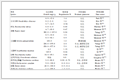
关于极尖区的定义和判别,在研究不同问题时对其选取标准也不尽相同.本文结合先前的研究(Zhou et al., 2000; Guo et al., 2013; Wang et al., 2014; Xiao et al., 2018)以及本研究实际给出了一个极尖区判别标准:相对磁层,极尖区离子能谱显著变宽并与磁鞘的能谱非常相似;在高高度极尖区时,为了防止将磁鞘错判为极尖区,极尖区离子整体流速应小于150 km·s-1.由此条件我们利用Cluster C3卫星离子数据选取了2001—2009年间的470个各高度(2RE~9RE)上的北半球极尖区穿越事件.极尖区的离子密度(NCusp)的典型值一般在1~10 cm-3范围之内,本文中将NCusp的最大值Max(NCusp)大于40 cm-3的事件定义为高密度极尖区,依此条件共找到了28个此类事件.表 1给出了这28个极尖区穿越事件对应的穿越时间、Max(NCusp)、MLT、偶极倾角(Dipole Tilt)、太阳风密度(NSW)以及C3卫星位置等参数.其中MLT、偶极倾角、NSW和C3卫星位置是取与Max(NCusp)所对应时刻的值.本文中如果没有特别说明,所有物理量都是在GSM坐标下展示.
|
表 1 2001—2009年间北半球28个高密度极尖区穿越事件 Table 1 28 high-density cusp crossing events in the northern hemisphere during 2001—2009 |
通过分析这28个高密度极尖区穿越事件,发现可以利用极尖区边界离子流速将这些事件分为三类:
第一类是日侧(低纬)磁层顶发生磁重联(L-R)事件,该类事件的判别条件是在极尖区的赤道向边界(EqB)附近出现高速地向流并且|Vz|>100 km·s-1.2007年4月22日04:34—05:06的极尖区穿越事件是典型的L-R事件,图 1(a1—e1)分别展示了该穿越事件的离子谱分布、离子数密度、离子速度、卫星位置以及对应行星际磁场条件.图 1a1中的离子谱分布显示,当卫星在04:34时从夜侧磁层进入极尖区后离子能谱开始逐渐地变宽(从低能到高能延展的耗散过程),这是由于离子飞行时间效应(磁鞘沉降离子由于不同的场向速度导致到达低高度极尖区的时间不同)引起的,符合日侧磁层磁重联的极尖区观测结果(例如,Lockwood and Smith, 1994;Connor et al., 2012),对应的离子数密度(图 1b1)也开始逐渐地变高,而离子流速则相对平稳(图 1c1,|Vx| < 20 km·s-1,|Vy| < 20 km·s-1, |Vz| < 30 km·s-1).该事件的Max(NCusp)≈110 cm-3在05:02时的EqB附近出现并伴随着高速的离子流(|Vx|>100 km·s-1,|Vz|>100 km·s-1).Cluster卫星在05:06时从极尖区进入日侧磁层,离子能谱变窄并主要集中在高能部分,离子数密度陡降至0.3 cm-3左右.图 1e1显示该期间的IMF是南向(IMF Bz < -2 nT)的,满足发生日侧磁层顶磁重联的外部IMF条件.

|
图 1 三类典型事例高数密度极尖区:日侧磁层顶磁重联事件(2007-04-22 04:34—05:06,a1—e1),夜侧磁层顶磁重联事件(2005-03-16 08:01—08:54,a2—e2)以及没有磁层顶磁重联事件(2006-08-27 06:42—06:50,a3—e3) 图中从上而下分别为离子谱分布、离子数密度、离子速度、卫星位置以及对应行星际磁场. Fig. 1 Three typical cases of high-density cusp crossing: dayside magnetopause reconnection event (2007-04-22 04:34—05:06, a1—e1), nightside magnetopause reconnection event (2005-03-16 08:01—08:54, a2—e2) and no magnetopause reconnection event (2006-08-27 06:42—06:50, a3—e3) From the top to the bottom are the ion spectrum distribution, ion number density, ion velocity, satellite position and the corresponding interplanetary magnetic field. |
第二类是夜侧(高纬)磁层顶发生磁重联(H-R)事件,该类事件的判别条件是在极尖区的极向边界(PoB)附近出现高速地向流并且|Vz|>100 km·s-1.这里选取典型的H-R事件是2005年3月16日08:01—08:54的极尖区穿越事件.图 1(a2—e2)同(a1—e1),分别展示了该穿越事件的离子谱分布、离子数密度、离子速度、卫星位置以及对应行星际磁场条件.结合离子谱分布、数密度以及速度,可以发现Cluster卫星在08:01时从夜侧磁层进入极尖区后离子能谱突然变宽,对应的离子数密度也急剧增高,并在08:25时附近出现该事件的离子数密度极大值Max(NCusp)≈43 cm-3.该事件在PoB附近出现了高速地向的离子流(|Vz|>100 km·s-1),随后离子高速流和数密度还出现了不连续现象以及多个明显的从高能向低能延展的耗散过程(cusp steps),这可能是由磁层顶出现瞬态磁重联或者多点磁重联引起的(例如, Lockwood and Smith, 1989, 1994; Newell and Meng, 1991;Escoubet et al., 1992; Lockwood, 1995; Trattner et al., 1998),而在EqB附近离子流速相对较低且平稳.Cluster卫星在08:54时从极尖区进入日侧磁层,离子能谱陡然变窄并主要集中在高能部分,离子数密度陡降至0.2 cm-3左右.图 1e2显示了该期间北向的IMF(IMF Bz>5 nT),这有利于夜侧磁层顶发生磁重联.
第三类是磁层顶没有磁重联发生(N-R)的事件,该类事件的判别条件是在极尖区的离子流速相对较低(|Vz| < 50 km·s-1)且整体平稳.2006年8月27日06:42—06:50的极尖区穿越事件是典型的N-R事件.该穿越事件的离子谱分布、离子数密度、离子速度、卫星位置以及对应行星际磁场条件分别由图 1(a3—e3)表示.结合离子谱分布、数密度以及速度,可以非常清晰地显示出这次极尖区穿越的过程:Cluster卫星在06:42时由日侧磁层进入极尖区,离子能谱由主要集中在高能部分(>104 eV)变成非常宽的能量分布(101~2×10³ eV),离子数密度也由0.5 cm-3逐渐增加并在06:42时附近出现极大值Max(NCusp)≈ 76 cm-3,而离子流速相对较小且平稳(|Vx| < 20 km·s-1,|Vy| < 20 km·s-1, |Vz| < 30 km·s-1);Cluster卫星在06:50时由极尖区进入夜侧磁层,离子数密度陡降至0.1 cm-3以下.离子谱分布显示该极尖区事件穿越过程中并没有出现明显的高能到低能或低能到高能的耗散过程.图 1e3显示该穿越事件的IMF是显著北向(IMF Bz>3 nT)的,结合极尖区内平稳低流速的离子特性可以判断该事件是没有发生磁层顶磁重联的N-R事件.
按照上述分类标准,可以将选取的28个高密度极尖区穿越事件分为15个L-R事件、3个H-R事件以及10个N-R事件.发现H-R事件发生次数显著小于另外两种事件,尤其是同为磁层顶磁重联的L-R事件,我们猜测这可能是由于磁鞘内的离子流与H-R产生的极尖区方向的离子流是反向的,这阻碍了H-R产生的离子流进入极尖区,而L-R事件情况与之相反,从而导致H-R事件发生次数显著低于L-R事件.先前的研究(Aparicio et al., 1991; Lavraud et al., 2004; Walsh et al., 2016)发现极尖区的等离子体密度与太阳风密度(NSW)成比例关系.为了探究NSW对高密度极尖区事件的具体影响,图 2a展示了2001—2009年NSW大小的分布情况,统计发现NSW < 10 cm-3的概率为0.9,也就是说绝大多数情况下NSW是小于10 cm-3的,所以本文就将NSW>10 cm-3作为判别高太阳风密度的标准.图 2b展示了Max(NCusp)与NSW的对应关系(其中,红色五星代表H-R,黑色星花代表N-R,蓝色圆圈代表L-R),可以发现二者并没有明显的正比关系.但是发现这28个高密度极尖区穿越事件中有20个事件的Max(NCusp)对应的NSW是大于10 cm-3的,并且这20个事件包含了全部的10个N-R事件,其他8个Max(NCusp)对应NSW小于10 cm-3的事件都是磁层顶磁重联事件(7个L-R事件和1个H-R事件).也就是说,高太阳风密度对形成高密度极尖区事件有显著的作用,尤其是对N-R事件;而磁层顶磁重联的高密度极尖区事件(尤其是L-R事件)的形成可以不依赖高太阳风密度.

|
图 2 (a) 2001—2009年太阳风数密度NSW的分布情况;(b)高数密度极尖区穿越事件的最大数密度Max(NCusp)与NSW的对应关系 Fig. 2 (a) The distribution of the solar wind density from 2001 to 2009; (b) The relationship between the maximum density of high-density cusp and the solar wind density |
图 3a—3d分别表示高数密度极尖区事件对应的MLT与NSW、Max(NCusp)、Max(NCusp)/NSW以及偶极倾角的关系.这28个事件主要集中在MLT=12附近(在11<MLT<13范围内共有20个事件),发生在MLT<11与MLT>13的事件分别为6个和2个.通过图 3a可以发现对于N-R事件而言,离MLT=12越远要观测到高密度极尖区事件就需要越高的太阳风密度,我们猜测这可能的原因是Max(NCusp)/NSW会随着|MLT-12|的增大而减小,图 3c证明了这一猜测的正确性.而磁层顶磁重联(L-R和H-R)事件并没有类似的变化规律,这可能是在这两种条件下太阳风进入极尖区方式不同引起的.这里将Max(NCusp)大于100 cm-3的事件定义为超高密度极尖区事件,28个事件中有5个是超高密度极尖区事件(图 3b),其中包含4个L-R事件和1个N-R事件.三个类型高密度极尖区事件的Max(NCusp)平均值的比值约为L-R:H-R:N-R≈80:50:59,L-R事件的Max(NCusp)的平均值更高,N-R事件的次之,H-R事件的最低.这表明与H-R和N-R情况相比,L-R情况更容易形成高密度极尖区.那这是否是因为L-R情况下有更高的NSW或者Max(NCusp)/NSW呢?从之前的图 2b和图 3a的分析可以表明,在L-R情况下的NSW不是最高的,甚至会出现非常低的情况,所有L-R事件具有较高Max(NCusp)不是由NSW引起的.而对于Max(NCusp)/NSW,图 3c展示了高密度极尖区事件的Max(NCusp)/NSW与对应的MLT的关系,通过计算发现L-R事件的Max(NCusp)/NSW的平均值最高,H-R事件的次之,N-R事件的最低,三者具体的比值为L-R:H-R:N-R≈7.7:5.4:3.8.也就是说与没有磁层顶磁重联发现的情况相比,发生磁层顶磁重联时较低的太阳风密度就可以诱发形成高密度极尖区,并且L-R比H-R可以在更低的太阳风密度条件下形成高密度极尖区.所以L-R情况更容易形成高密度极尖区的一个重要原因是其具有较高的Max(NCusp)/NSW.图 3d展示了这三类高密度极尖区事件的偶极倾角与对应的MLT的关系,发现这28个事件中有24个事件是对应着正的偶极倾角并且这24个事件包含了全部的10个N-R事件,只有4个事件(2个H-R和2个L-R)是对应着负的偶极倾角,所以偶极倾角被认为是形成高密度极尖区事件的重要影响因素.下面我们将具体分析偶极倾角与高密度极尖区的关系.

|
图 3 高数密度极尖区事件的MLT与对应的NSW(a),Max(NCusp)(b),Max(NCusp)/NSW(c),偶极倾角(d)的关系 Fig. 3 Relationship between MLT and (a) NSW, (b) Max(NCusp), (c) Max(NCusp)/NSW, (d) dipole tilt |
图 4展示了高数密度极尖区事件对应的偶极倾角与Max(NCusp)以及Max(NCusp)/NSW的关系.从图 4a可以看出5个超高密度极尖区事件都发生在正偶极倾角一侧,并且正偶极倾角一侧的Max(NCusp)的平均值(约为72 cm-3)要显著高于负偶极倾角一侧的(约为52.5 cm-3),也就说正偶极倾角不但更容易形成高密度极尖区事件而且形成的高密度极尖区事件的密度往往更高.从图 4b可以发现L-R事件和N-R事件的Max(NCusp)/NSW有随着偶极倾角的增加而增加的趋势,并且相同的偶极倾角情况下L-R事件的Max(NCusp)/NSW要高于N-R事件的.也就是对于北半球极尖区而言,偶极倾角越大,太阳风越容易进入极尖区.

|
图 4 高密度极尖区事件偶极倾角与对应的Max(NCusp) (a),Max(NCusp)/NSW(b)的关系 Fig. 4 Relationship between dipole tilt and (a) Max(NCusp) and (b) Max(NCusp)/NSW |
本文利用Cluster卫星数据,选取了2001—2009年间的28个高密度极尖区穿越事件进行统计研究,分析研究了哪些条件有利于高密度极尖区事件的形成以及哪些外部条件有利于太阳风高效地进入极尖区.为了细化研究,我们将这28个高密度极尖区穿越事件分成磁层顶磁重联事件(L-R和H-R)和非磁层顶磁重联(N-R)事件.通过研究发现:
(1) 高太阳风密度对形成高密度极尖区事件有显著的作用,尤其是对N-R事件;而发生磁层顶磁重联的高密度极尖区事件(尤其是L-R事件)的形成可以不依赖高太阳风密度.
(2) 对于N-R事件而言,离MLT=12越远要观测到高密度极尖区事件就需要越高的太阳风密度,这是因为Max(NCusp)/NSW会随着|MLT-12|的增大而减小.而磁层顶磁重联(L-R和H-R)事件并没有发现类似的变化规律,这可能是由于在这两种条件下太阳风进入极尖区方式不同引起的.
(3) 与H-R和N-R情况相比,L-R情况更容易形成高密度极尖区,并且发现这不是因为L-R情况下有更高的NSW而是因为具有更高的Max(NCusp)/NSW.
(4) 绝大多数(86%)高密度极尖区事件都发生在正偶极倾角条件下,并且L-R事件和N-R事件的Max(NCusp)/NSW都具有随着偶极倾角的增加而增大的趋势,但是相同的偶极倾角情况下L-R事件的Max(NCusp)/NSW要高于N-R事件的.也就是对于北半球极尖区而言,偶极倾角越大,太阳风越容易进入极尖区.
综上所述,通过分析观测到的28个高密度极尖区事件,我们发现较小的|MLT-12|(20个高密度极尖区事件都发生在11<MLT<13范围内,约占总数的71%),较高的太阳风密度(20个高密度极尖区事件对应的NSW都大于10 cm-3,约占总数的71%),低纬发生磁层顶磁重联(15个高密度极尖区事件都是L-R事件,约占总数的54%)以及正偶极倾角(24个高密度极尖区事件对应着正偶极倾角,约占总数的86%)都是观测到高密度极尖区事件的有利条件.利用这4个条件,我们从470个极尖区事件中共找到5个符合全部4个条件的事件,发现这5个事件全部为高密度极尖区事件(相关事件在表 1中被粗黑体标记).而低纬磁层顶磁重联以及大的正偶极倾角被认为是太阳风高效地进入极尖区的重要条件.这些研究结果有助于我们更进一步地理解太阳风进入极尖区的物理机制.
致谢 感谢CSA(Cluster Science Archive)提供了Cluster卫星数据(https://csa.esac.esa.int/csa-web/),以及OMNI(http://cdaweb.gsfc.nasa.gov/)提供了行星际磁场(IMF)数据和太阳风参数数据.
Aparicio B, Thelin B, Lundin R. 1991. The polar cusp from a particle point of view:A statistical study based on Viking data. Journal of Geophysical Research:Space Physics, 96(A8): 14023-14031. DOI:10.1029/90JA01075 |
Chapman S, Ferraro V C A. 1930. A new theory of magnetic storms. Nature, 126(3169): 129-130. DOI:10.1038/126129a0 |
Connor H J, Raeder J, Trattner K J. 2012. Dynamic modeling of cusp ion structures. Journal of Geophysical Research:Space Physics, 117(A4): A04203. DOI:10.1029/2011JA017203 |
Dungey J W. 1961. Interplanetary magnetic field and the auroral zones. Physical Review Letters, 6(2): 47-48. DOI:10.1103/PhysRevLett.6.47 |
Escoubet C P, Smith M F, Fung S F, et al. 1992. Staircase ion signature in the polar cusp:A case study. Geophysical Research Letters, 19(17): 1735-1738. DOI:10.1029/92GL01806 |
Escoubet C P, Berchem J, Bosqued J M, et al. 2008. Effect of a northward turning of the interplanetary magnetic field on cusp precipitation as observed by Cluster. Journal of Geophysical Research:Space Physics, 113(A7): A07S13. DOI:10.1029/2007JA012771 |
Farrell W M, Van Allen J A. 1990. Observations of the Earth's polar cleft at large radial distances with the Hawkeye 1 Magnetometer. Journal of Geophysical Research, 95(A12): 20945-20958. DOI:10.1029/JA095iA12p20945 |
Frank L A. 1971. Plasma in the Earth's polar magnetosphere. Journal of Geophysical Research, 76(22): 5202-5219. DOI:10.1029/JA076i022p05202 |
Fu H S, Cao J B, Vaivads A, et al. 2016. Identifying magnetic reconnection events using the FOTE method. Journal of Geophysical Research:Space Physics, 121(2): 1263-1272. DOI:10.1002/2015JA021701 |
Fu H S, Vaivads A, Khotyaintsev Y V, et al. 2017. Intermittent energy dissipation by turbulent reconnection. Geophysical Research Letters, 44(1): 37-43. DOI:10.1002/2016GL071787 |
Fu S Y, Sun W J. 2016. Models of the Earth's plasmapause position. Science China Earth Sciences, 59(4): 871-872. DOI:10.1007/s11430-016-5266-z |
Fujimoto R, Mitsuda K, McCammon D, et al. 2007. Evidence for solar-wind charge-exchange X-Ray emission from the earth's magnetosheath. Progress of Theoretical Physics Supplement, 169: 71-74. DOI:10.1143/PTPS.169.71 |
Guo J G, Shi J K, Cheng Z W, et al. 2013. Variation of dependence of the cusp location at different altitude on the dipole tilt. Chinese Science Bulletin, 58(28-29): 3541-3545. DOI:10.1007/s11434-013-5831-1 |
Haerendel G, Paschmann G, Sckopke N, et al. 1978. The frontside boundary layer of the magnetosphere and the problem of reconnection. Journal of Geophysical Research:Space Physics, 83(A7): 3195-3216. DOI:10.1029/JA083iA07p03195 |
Heikkila W J, Winningham J D. 1971. Penetration of magnetosheath plasma to low altitudes through the dayside magnetospheric cusps. Journal of Geophysical Research, 76(4): 883-891. DOI:10.1029/JA076i004p00883 |
Heikkila W J. 1985. Definition of the Cusp.//Holtet J A, Egeland A eds. The Polar Cusp. Dordrecht: Springer Netherlands, 387-395.
|
Kremser G, Woch J, Mursula K, et al. 1995. Origin of energetic ions in the polar cusp inferred from ion composition measurements by the Viking satellite. Annales Geophysicae, 13(6): 595-607. DOI:10.1007/s00585-995-0595-9 |
Kuntz K D, Collado-Vega Y M, Collier M R, et al. 2015. The solar wind charge-exchange production factor for hydrogen. The Astrophysical Journal, 808(2): 143. DOI:10.1088/0004-637X/808/2/143 |
Lavraud B, Fedorov A, Budnik E, et al. 2004. Cluster survey of the high-altitude cusp properties:A three-year statistical study. Annales Geophysicae, 22(8): 3009-3019. DOI:10.5194/angeo-22-3009-2004 |
Liu W L, Tu W C, Li X L, et al. 2016. On the calculation of electric diffusion coefficient of radiation belt electrons with in situ electric field measurements by THEMIS. Geophysical Research Letters, 43(3): 1023-1030. DOI:10.1002/2015GL067398 |
Liu W L. 2016. Kinetic features of bursty bulk flows and dipolarization fronts. Science China Earth Sciences, 59(12): 2463-2464. DOI:10.1007/s11430-016-0175-8 |
Lockwood M, Smith M F. 1989. Low-altitude signatures of the cusp and flux transfer events. Geophysical Research Letters, 16(8): 879-882. DOI:10.1029/GL016i008p00879 |
Lockwood M, Smith M F. 1994. Low and middle altitude cusp particle signatures for general magnetopause reconnection rate variations:1. Theory. Journal of Geophysical Research:Space Physics, 99(A5): 8531-8553. DOI:10.1029/93JA03399 |
Lockwood M. 1995. Overlapping cusp ion injections:An explanation invoking magnetopause reconnection. Geophysical Research Letters, 22(9): 1141-1144. DOI:10.1029/95GL00811 |
Lv X, Liu W L. 2018. Measurements of convection electric field in the inner magnetosphere. Science China Technological Sciences, 61(12): 1866-1871. DOI:10.1007/s11431-017-9200-6 |
Newell P T, Meng C I. 1988. The cusp and the cleft/boundary layer:Low-altitude identification and statistical local time variation. Journal of Geophysical Research:Space Physics, 93(A12): 14549-14556. DOI:10.1029/JA093iA12p14549 |
Newell P T, Meng C I. 1991. Ion acceleration at the equatorward edge of the cusp:Low altitude observations of patchy merging. Geophysical Research Letters, 18(10): 1829-1832. DOI:10.1029/91GL02088 |
Perry C H, Grande M, Zurbuchen T H, et al. 2000. Use of Fe charge state changes as a tracer for solar wind entry to the magnetosphere. Geophysical Research Letters, 27(16): 2441-2444. DOI:10.1029/2000GL003780 |
Pitout F, Escoubet C P, Klecker B, et al. 2009. Cluster survey of the mid-altitude cusp-Part 2:Large-scale morphology. Annales Geophysicae, 27(5): 1875-1886. DOI:10.5194/angeo-27-1875-2009 |
Rème H, Aoustin C, Bosqued J M, et al. 2001. First multispacecraft ion measurements in and near the Earth's magnetosphere with the identical Cluster ion spectrometry (CIS) experiment. Annales Geophysicae, 19(10-12): 1303-1354. |
Reiff P H, Hill T W, Burch J L. 1977. Solar wind plasma injection at the dayside magnetospheric cusp. Journal of Geophysical Research, 82(4): 479-491. DOI:10.1029/JA082i004p00479 |
Robertson I P, Collier M R, Cravens T E, et al. 2006. X-ray emission from the terrestrial magnetosheath including the cusps. Journal of Geophysical Research:Space Physics, 111(A12): A12105. DOI:10.1029/2006JA011672 |
Rosenbauer H, Grünwaldt H, Montgomery M D, et al. 1975. Heos 2 plasma observations in the distant polar magnetosphere:The plasma mantle. Journal of Geophysical Research, 80(19): 2723-2737. DOI:10.1029/JA080i019p02723 |
Russell C T, Elphic R C. 1979. ISEE observations of flux transfer events at the dayside magnetopause. Geophysical Research Letters, 6(1): 33-36. DOI:10.1029/GL006i001p00033 |
Russell C T. 2000. The polar cusp. Advances in Space Research, 25(7-8): 1413-1424. DOI:10.1016/S0273-1177(99)00653-5 |
Shelley E G, Sharp R D, Johnson R G. 1976. He++ and H+ flux measurements in the day side cusp:Estimates of convection electric field. Journal of Geophysical Research, 81(13): 2363-2370. DOI:10.1029/JA081i013p02363 |
Shen C, Dunlop M, Ma Y H, et al. 2011. The magnetic configuration of the high-latitude cusp and dayside magnetopause under strong magnetic shears. Journal of Geophysical Research:Space Physics, 116(A9): A09228. DOI:10.1029/2011JA016501 |
Shi Q Q, Zong Q G, Zhang H, et al. 2009. Cluster observations of the entry layer equatorward of the cusp under northward interplanetary magnetic field. Journal of Geophysical Research:Space Physics, 114(A12): A12219. DOI:10.1029/2009JA014475 |
Shi Q Q, Zong Q G, Fu S Y, et al. 2013. Solar wind entry into the high-latitude terrestrial magnetosphere during geomagnetically quiet times. Nature Communications, 4(1): 1466. DOI:10.1038/ncomms2476 |
Tao D, Liu W L, Ma Y D. 2018. Plasma perturbations in the coexisting environment of VLF transmitter emission, lightning strokes and seismic activity. Science China Technological Sciences, 61(5): 678-686. DOI:10.1007/s11431-017-9069-y |
Trattner K J, Coates A J, Fazakerley A N, et al. 1998. Overlapping ion populations in the cusp:polar/TIMAS results. Geophysical Research Letters, 25(10): 1621-1624. DOI:10.1029/98GL01060 |
Walsh B M, Niehof J, Collier M R, et al. 2016. Density variations in the Earth's magnetospheric cusps. Journal of Geophysical Research:Space Physics, 121(3): 2131-2142. DOI:10.1002/2015JA022095 |
Wang T Y, Cao J B, Fu H S, et al. 2014. Turbulence in the Earth's cusp region:The k-filtering analysis. Journal of Geophysical Research:Space Physics, 119(12): 9527-9542. DOI:10.1002/2014JA019997 |
Woch J, Lundin R. 1992. Magnetosheath plasma precipitation in the polar cusp and its control by the interplanetary magnetic field. Journal of Geophysical Research:Space Physics, 97(A2): 1421-1430. DOI:10.1029/91JA02487 |
Xiao C, Liu W L, Shen C, et al. 2018. Study on the curvature and gradient of the magnetic field in earth's cusp region based on the magnetic curvature analysis method. Journal of Geophysical Research:Space Physics, 123(5): 3794-3805. DOI:10.1029/2017JA025028 |
Yu Y Q, Ridley A J. 2013. Exploring the influence of ionospheric O+ outflow on magnetospheric dynamics:dependence on the source location. Journal of Geophysical Research:Space Physics, 118(4): 1711-1722. DOI:10.1029/2012JA018411 |
Zhang D J, Liu W L, Li X L, et al. 2018. Observations of impulsive electric fields induced by interplanetary shock. Geophysical Research Letters, 45(15): 7287-7296. DOI:10.1029/2018GL078809 |
Zhang H, Fritz T A, Zong Q G, et al. 2005. Stagnant exterior cusp region as viewed by energetic electrons and ions:A statistical study using Cluster Research with Adaptive Particle Imaging Detectors (RAPID) data. Journal of Geophysical Research:Space Physics, 110(A5): A05211. DOI:10.1029/2004JA010562 |
Zhang H, Dunlop M W, Zong Q G, et al. 2007. Geometry of the high-latitude magnetopause as observed by Cluster. Journal of Geophysical Research:Space Physics, 112(A2): A02204. DOI:10.1029/2006JA011774 |
Zhou X W, Russell C T, Le G, et al. 2000. Solar wind control of the polar cusp at high altitude. Journal of Geophysical Research:Space Physics, 105(A1): 245-251. DOI:10.1029/1999JA900412 |
Zong Q G, Fritz T A, Zhang H, et al. 2004. Triple cusps observed by Cluster-Temporal or spatial effect?. Geophysical Research Letters, 31(9): L09810. DOI:10.1029/2003GL019128 |