 2020, Vol. 63


2. 中国科学院大学地球科学学院, 北京 100049;
3. 中国科学院地质与地球物理研究所, 岩石圈演化国家重点实验室, 北京 100029;
4. 中国科学院地球科学研究院, 北京 100029;
5. 中国科学院青藏高原地球科学卓越创新中心, 北京 100101;
6. 广东省地震局, 广州 510070
2. University of Chinese Academy of Sciences, Beijing 100049, China;
3. State Key Laboratory of Lithospheric Evolution, Institute of Geology and Geophysics, Chinese Academy of Sciences, Beijing 100029, China;
4. Institutions of Earth Science, Chinese Academy of Sciences, Beijing 100029, China;
5. CAS Center for Excellence in Tibetan Plateau Earth Sciences, Beijing 100101, China;
6. Guangdong Earthquake Agency, Guangzhou 510070, China
活动断裂带是现今仍处于活动状态的断层系统,与地震等地质灾害的发生紧密相关,对城市和公共安全直接造成威胁(邓起东等, 2003).对主要地震带的地震活动特性深入研究,有助于查明断层活动习性,为防震减灾工作提供重要的理论依据,具有十分重要的社会意义.中小地方震的空间分布与发震断层的深部形态密切相关,通过地震定位和震源机制测算研究中小震地震空间分布是分析断层活动性、探测隐伏断层、确定地壳形变的有效方法(张广伟等, 2011).类似的研究已经在南加州(Hauksson et al., 2012)、南温哥华岛岛弧(Li et al., 2018)和俄克拉荷马(McNamara et al., 2015)等地区开展,成功获得了当地的活动断裂带精细形态及地震活动特征.
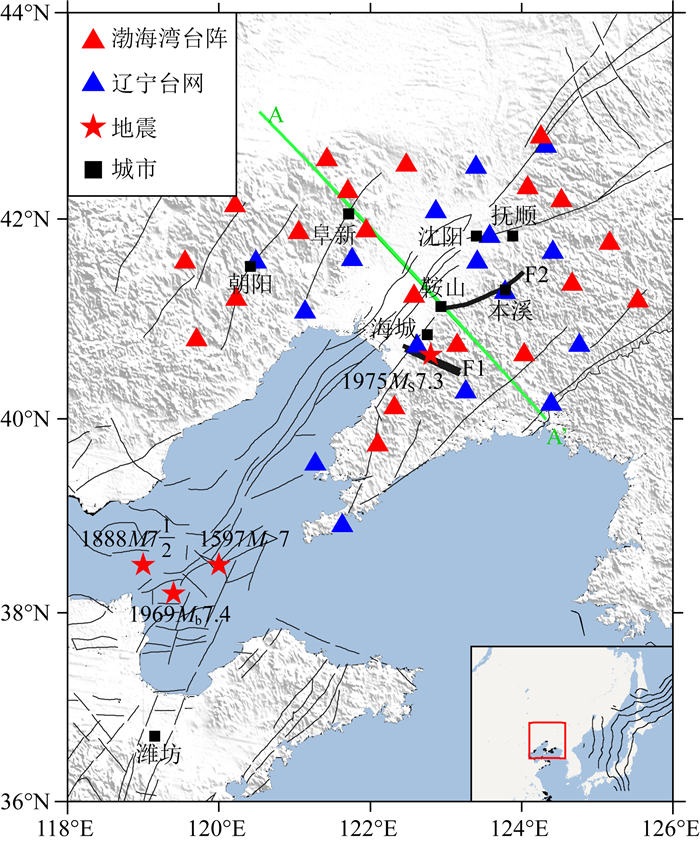
北北东走向的郯庐断裂带是中国东部最主要的活动断裂带之一,全长约2400 km(朱光等, 2004).根据构造演化和地震活动,郯庐断裂带分为四段(Min et al., 2013).其中,渤海湾段南起山东潍坊,经渤海湾北至辽宁沈阳(Zhang et al., 2015);历史上发生过多次强震(图 1),包括1597年的M>7地震(高山泰等, 2003)、1888年M71/2地震(薛志照, 1993)和1969年渤海湾Mb7.4地震(苗庆杰等, 2010).特别是郯庐断裂渤海湾北段于1975年发生MS7.3海城地震.高度的地震危险性使得该区域倍受地球科学家的关注,展开了一系列的地球物理研究工作.接收函数成像揭示该段断裂下方莫霍面错断,可能表明该断裂深达岩石圈地幔(Zheng et al., 2015).GPS速度场分布(Wang et al., 2014; Zhao et al., 2015)、地壳剪切波分裂(太龄雪等, 2009)和三维黏弹性有限元数值模拟(Li and Hou, 2019)等研究结果都显示郯庐断裂渤海湾北段地壳处于北北西-南南东向的拉伸状态,与海城地震震源机制解一致(邓起东等, 1976).
|
图 1 研究区发震构造与地震台站分布图 红色和蓝色三角分别表示渤海湾流动地震台阵和辽宁省地震台网的台站.黑线表示断裂带,其中黑粗线表示海城河断裂(F1)和太子河断裂(F2).正方形表示主要城市,绿线AA′表示剖面位置,红色五角星表示历史强震.右下角子图的红框给出了研究区的地理位置. Fig. 1 Tectonic setting of the study region and distribution of seismic stations Red and blue triangles mark the seismic stations of Bohai Bay seismic Array and Liaoning Provincial seismic network, respectively. Black lines denote faults. Black thick lines represent the Haichenghe Fault (F1) and the Taizihe Fault (F2). Squares denote cities of Liaoning Province. The green line is profile AA′. Red stars denote historical strong earthquakes. The red box in the inset in lower right is study area. |
郯庐断裂渤海湾北段断层体系错综复杂,前人研究大部分聚焦在海城地震发震断层——海城河断裂,对此区域的其他断裂研究较少.由于辽宁固定台站分布稀疏,小震检测能力有限,区域地震目录可能存在缺失.基于流动和固定地震台站组成的相对密集台网,本文重新检测截取地震事件,使用Hypoinverse 2000(Klein, 2002)和双差定位方法(Waldhauser and Ellsworth, 2000)定位区域地震.通过研究中小震活动空间分布和震源机制解,从整体上理解郯庐断裂渤海湾北段地震活动的时空分布特征及其与构造应力场的关系.
1 数据本文使用的地震数据为渤海湾流动地震台阵和辽宁省地震台网(图 1)2005年5月至2006年4月的连续波形记录.其中,渤海湾流动地震台阵由中国科学院地质与地球物理研究所地震台阵实验室所布设的20个宽频带流动地震台站组成,台阵设计兼顾了固定地震台站空间分布.辽宁省地震台网由16个台站组成.组合的观测台阵共包含36个台站,平均台站间距达到40 km,空间分布比较均匀,观测系统地震监测能力与定位精度预期高于辽宁地震台网.
2 研究方法 2.1 地震检测和精确定位本文采用了LTA/STA地震检测方法从连续数据中识别可能的地震事件(Stevenson, 1976; 梁晓峰, 2009; 金戈和陈永顺, 2009),该方法简单、高效,被广泛应用在地震速报和地震预警的事件识别中(刘翰林和吴庆举,2017;陈安国和高原,2019).其中,短窗长度设定为10 s,长窗长度为60 s,事件触发阈值为STA与LTA的比值等于3.0.本研究从检测结果中删除了全球5级以上地震;同时为了避免人类活动噪声的误识,设定被8个以上地震台站记录的备选事件进入人工复核处理流程.最后,对筛选出的地震事件人工确认并手动拾取P波初动到时.考虑到滤波会影响地震波形态,进而影响到时拾取精度,在拾取到时时,只对初动信噪比低的事件数据使用频带0.1~10 Hz的4阶巴特沃斯带通滤波器进行滤波拾取,在定位时赋予此类到时数据较低权重.
本文使用Hypoinverse2000程序(Klein, 2002)对事件进行绝对定位反演.该程序原理可简单描述如下:
假设地震事件震源位置为(x0, y0, z0),发震时刻t0,第i个地震台站的观测到时为ti,理论走时为Ti,则走时残差为

|
(1) |
设定反演目标函数为
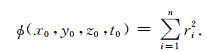
|
(2) |
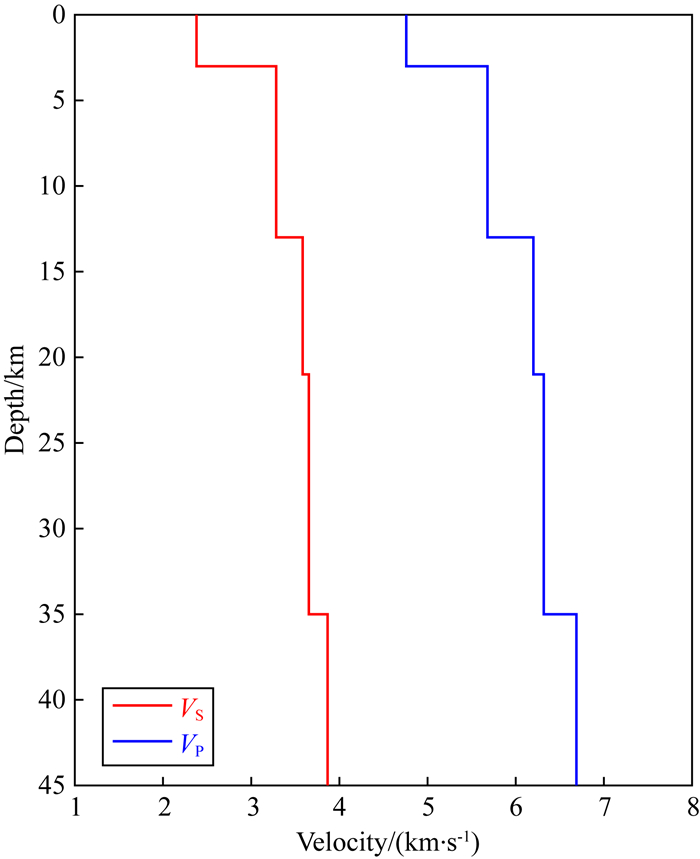
通过线性反演即可求解事件位置与发震时刻.定位所用一维地壳P波速度模型由前人基于GT5标准挑选地震事件采用MessyGA算法反演后取平均获得(张岭等, 2005),S波速度则使用统一的波速比1.73由P波速度计算获得(图 2).
|
图 2 地震定位所用的速度模型 蓝线表示P波速度模型,红线表示S波速度模型. Fig. 2 Velocity model used in earthquake relocation Blue and red lines represent the P and S wave velocity models, respectively. |
初步定位结果再通过双差定位方法(Waldhauser and Ellsworth, 2000)进行重定位.假设事件对两个事件i和j, 到台站k的走时分别为tki和tkj,双差可定义为

|
(3) |
obs是观测走时差,cal是理论走时差.该方法将相距较近的事件组成事件对,事件对间距远小于事件对到台站的距离,可认为两个事件的射线路径几乎相同,利用事件对的相对走时差能够有效减小输入速度模型对定位精度的影响.此外,基于ML=log(A)μ)+R(Δ) (Havskovand Ottemöller, 2010)测量了重定位的小震震级,其中,Aμ表示两个水平分量最大位移的算数平均值;Δ表示震中距,R(Δ)表示量规函数,其值来自严尊国等(1992)对我国东部地区近震量规函数的研究.
2.2 震源机制解本文采用gCAP方法求解震源参数(Zhu and Helmberger, 1996; Zhu and Ben-Zion, 2013).传统P波初动方法要求台站分布较好且不能反演震源深度和震级;gCAP方法不仅克服了上述缺点,而且对速度模型精度要求不高(郑勇等, 2009; Xie et al., 2017).该方法从宽频带地震信号中截取体波和面波部分,使用网格搜索方法拟合波形相位,获得最优的震源机制解和深度.本研究中,体波和面波波形分别使用带宽为0.3~1 Hz和0.1~0.4 Hz的4阶巴特沃斯带通滤波器压制噪声,速度模型与定位反演所用模型相同.
3 结果和讨论 3.1 双差定位误差分析本文人工拾取了72275条P波初至到时,使用Hypoinverse2000方法定位了780个地震事件,进一步使用双差定位方法重定位,得到了546个事件位置.定位结果平均均方根走时残差从绝对定位的0.84 s降低到双差定位的0.08 s.重定位的546个地震震级主要集中在1~2级(图 3).

|
图 3 震级-频度分布 Fig. 3 Magnitude-frequency distribution |
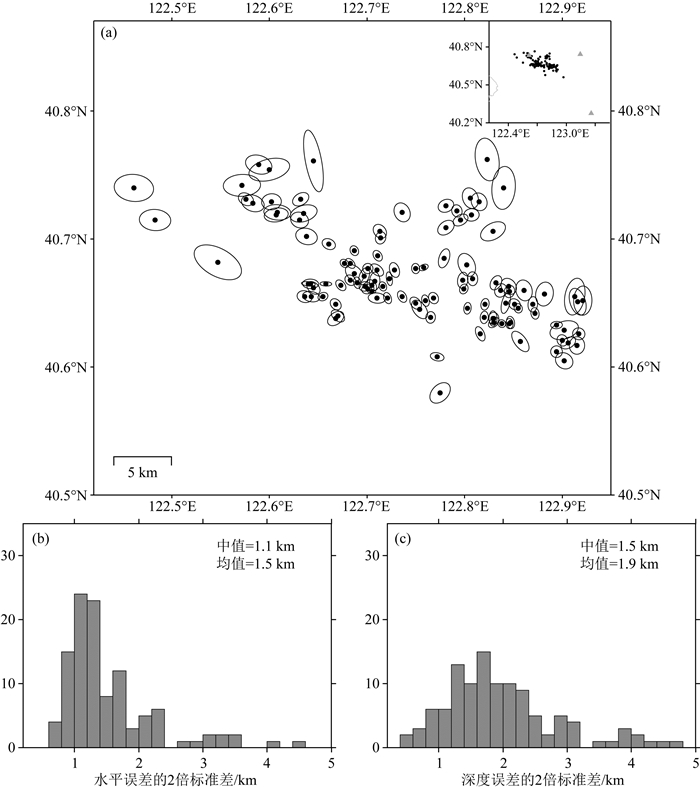
由于共轭梯度方法给出的定位误差估计不准确(Waldhauser and Ellsworth, 2000; Waldhauser, 2001),本文使用自助法分析双差定位误差(Efron, 1994; Hardebeck, 2013; 姜金钟等, 2016; Jiang et al., 2019).给速度模型添加±5%的随机扰动,选取双差定位中第1丛的110次地震作为已知震源位置的“理论地震”,分别计算理论走时,并添加标准差为0.175 s的随机震相拾取误差,再进行双差定位.将上述过程重复400次,获得每个“理论地震”位置的水平误差和深度误差.图 4给出了该丛地震的定位误差,以两倍标准差作为定位误差,双差定位的平均水平误差和深度误差分别为1.5 km和1.9 km,水平和深度最大误差均不超过5 km.
|
图 4 “理论地震”双差定位的误差分析 (a)双差定位震中分布及95%置信水平的误差椭圆分布;(b)水平方向误差统计直方图;(c)垂直方向误差统计直方图. Fig. 4 The hypoDD location errors of "synthetic" events (a) The distribution of relocated epicenters and 95% confidence ellipses of relocation errors; (b)The histogram of horizontal errors; (c) The histogram of vertical errors. |
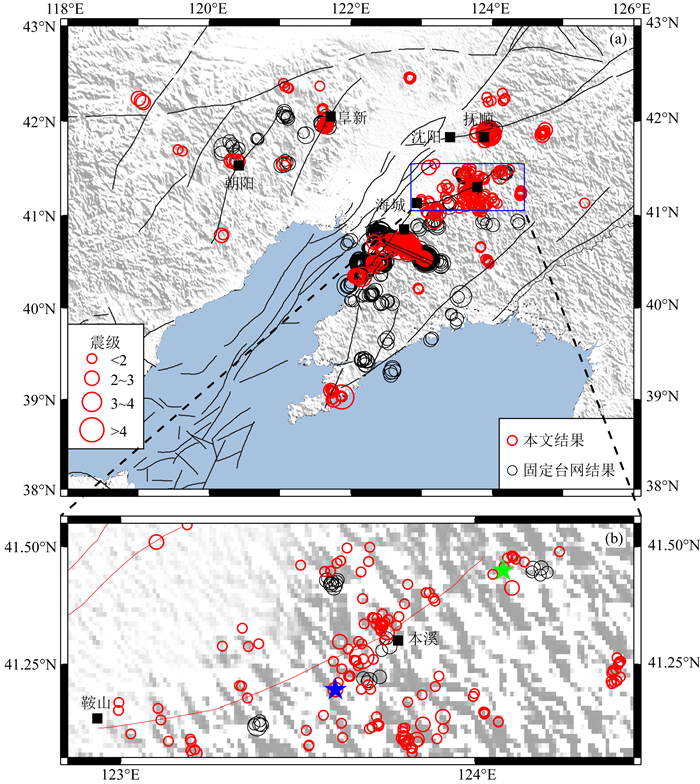
震中分布表明郯庐断裂渤海湾北段地震活动空间分布不均匀,主要特征如下(图 5a):(1)穿过下辽河盆地,北东走向的郯庐主断裂带上几乎没有地震发生;(2)主断裂带西侧的辽西地区地震较少,呈团簇状分布;(3)主断裂带以东地震密集,沿海城河等次级断裂呈条带状分布;(4)抚顺附近地震呈团簇状分布,可能与采矿活动有关.上述震中分布特征与该区域前人定位结果基本一致(李铁等, 2005; 刘财等, 2014; Zheng et al., 2018).
|
图 5 双差定位结果 (a)红色圆圈表示本文定位结果,黑色圆圈表示利用辽宁省地震台网25年数据(1981—2005)双差定位结果(Zheng et al., 2018),太子河断裂区域用蓝色方框圈出;(b)太子河断裂区域地震活动分布,蓝色和绿色五角星分别表示图 6a、b地震震中位置. Fig. 5 Results of double-difference relocation (a) Red circles denote the relocated earthquakes by this study and black circles denote the relocated epicenters using the 25-year data(1981—2005)of Liaoning Province seismic network (Zheng et al., 2018). The Taizihe fault region is shown in blue box; (b) An enlarged view of the Taizihe fault region in (a). The blue and green stars show the earthquakes in Figs. 6a and 6b, respectively. |
除了海城河断裂带,沿太子河断裂带地震也呈团簇状密集分布(图 5).太子河断裂是一条出露的正断层,走向北东向,倾向北西向,倾角50°~85°,全长约90 km(雷清清等, 2008),该断裂属于晚更新世-全新世的活动断裂(马宗顺和张正曙, 1994),地表可见破碎宽度约10 m(钟以章等, 1981).本研究定位的太子河断裂地震明显多于重定位后的辽宁地震台网目录(1981—2005年,ML>2.4;Zheng et al., 2018;图 5b).沿太子河断裂两侧10 km内有71个地震事件,约占研究区地震事件的13%,而辽宁地震台网目录中发生在太子河断裂附近的地震事件有2个.图 6a给出了其中一个地震的波形,本文定位和地震目录给出该事件的发震时刻分别为2006年04月10日22时35分04秒和2006年04月10日22时35分03秒,震中位置分别为经度123.61°、纬度41.20°和经度123.68°、纬度41.23°,ML分别为2.5和2.6.对太子河断裂地震的波形逐一检查,发现这些地震信噪比较高且初动较清晰,并且基本都被辽宁省地震台网记录到(图 6b).此外,本文获得的太子河断裂附近的地震震级主要在ML0.92~2.77之间,同时期的地震目录记录的震级最小的地震为ML0.8,本文定位的太子河附近的71个地震震级在地震目录的震级范围内,因此这种差异可能不是台网监测能力不足导致的.本文结果显示沿太子河断裂地震活动频繁,建议加强对该断裂的地震监测和地质调查.

|
图 6 太子河断裂区域地震波形图 (a)图中地震事件出现在公开的区域地震目录中,其震中位置为图 5b中蓝色五角星;(b)图中地震事件未出现在公开的区域地震目录中,其震中位置为图 5b中绿色五角星.红色波形表示渤海湾流动地震台阵数据,黑色波形表示辽宁省地震台网数据. Fig. 6 Earthquake waveforms in the Taizihe fault region (a) Vertical-component waveforms of the earthquake reported in the public catalog. The location of earthquake is shown as a blue star in Fig. 5b; (b) Vertical-component waveforms of the earthquake are not reported in the public catalog. The location of earthquake is shown as a green star in Fig 5b. The red and black waveforms represent the data from Bohai Bay seismic Array and Liaoning seismic network, respectively. |
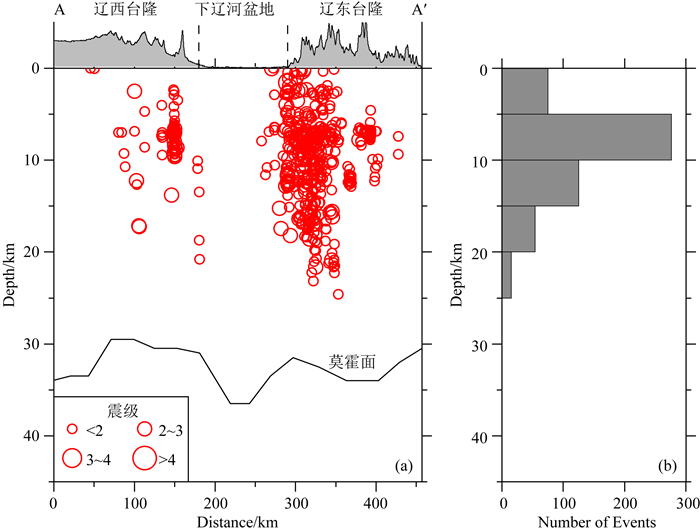
研究区震源分布在0~25 km深度范围,90%的地震集中发生在16 km以浅(图 7),与前人研究结果基本一致(刘财等, 2014; Zheng et al., 2018).对地震密集分布的海城河断裂和太子河断裂两侧10 km范围内的地震进行分析(图 8),大部分地震都发生在冷而脆的上地壳;海城河断裂81%的地震震源深度在15 km以浅(图 8b),太子河断裂70.4%的地震发生在15 km以浅(图 8c).接收函数方法获得海城河断裂和太子河断裂的莫霍面深度在32~35 km(Ai and Shen, 2011),因此,震源深度分别为21.2 km和23.2 km的海城河断裂东南端的1574号地震事件, 太子河断裂本溪附近的457号地震事件发生在中下地壳.
|
图 7 地震深度分布和地震深度统计柱状图 (a)沿AA′剖面(图 1)的震源深度分布,红色圆圈表示地震,黑线表示莫霍面(Zheng et al., 2015);(b)地震深度统计柱状图. Fig. 7 Earthquake focal depth distribution and focal depth histogram (a) Earthquake focal depth distribution along profile AA′ in Fig. 1. The red circles represent earthquakes and the black line marks the Moho (Zheng et al., 2015); (b) The histogram shows the distribution of relocated event depth. |

|
图 8 海城河和太子河断裂地震分布 (a)海城河和太子河断裂地震分布,红色和洋红色圆圈表示地震,黑色方块表示城市,绿色点表示大地热流测量点的位置,黄色五角星分别表示457号和1574号地震位置;(b)沿海城河断裂的BB′剖面(图 8a)地震深度分布;(c)沿太子河断裂的CC′剖面(图 8a)地震深度分布. Fig. 8 Earthquake distribution along the Haichenghe fault and the Taizihe fault (a) Red and magenta circles denote earthquakes, black squares denote the cities, green dots denote the heat flow site, and yellow stars denote the earthquake No.1574 and 457; (b) Earthquake focal depth distribution along profile BB′ in Fig. 8a; (c) Earthquake focal depth distribution along profile CC′ in Fig. 8a. |
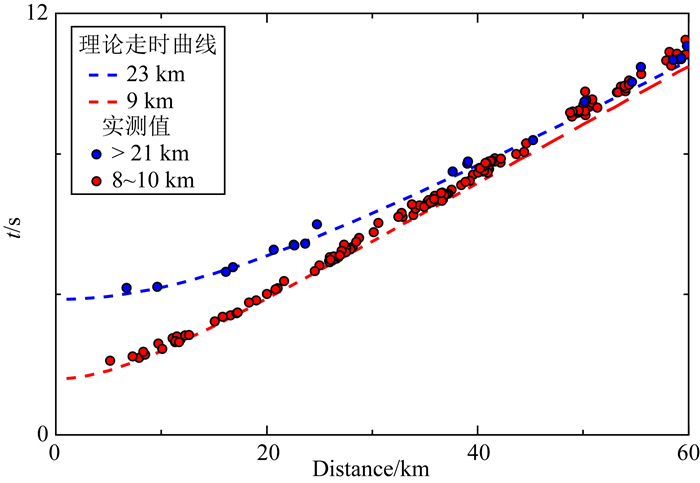
本文通过走时曲线对震源深度进行分析以确定其可靠性.因为小震面波不发育,较难用gCAP方法拟合最佳深度.此外,小地震能量有限,较难获得清晰的sPg、sPmP、sPn等深度震相.457号和1574号地震初至波形清楚(图 9),观测走时与震源深度大于20 km的理论走时曲线相一致(图 9、10),而与震源深度在8~10 km的P波走时曲线相差较大(图 10),说明了震源深度定位可靠.

|
图 9 457号地震和1574号地震的P波走势曲线 蓝色点表示不同台站观测的457号地震的P波走时,红色点表示不同台站观测的1574号地震的P波走时.蓝色虚线和红色虚线分别表示震源深度在23.2 km和21.2 km时的理论走时曲线.波形长度是P波初至前0.5 s和之后2 s,波形上方给出对应台站名. Fig. 9 Traveltime-distance curves of P waves for earthquakes No.457 and No.1574 Blue and red dots denote the observed travetime data for earthquake No.457 and No.1574 by different seismic stations, respectively. Blue and red dashed lines represent the synthetic Traveltime-distance curves with focal depths 23.2 km and 21.2 km, respectively. The length of the waveform is 0.5 s before the arrival time of the P wave and 2 seconds after. The station names above them. |
|
图 10 P波时距曲线图 蓝色虚线和红色虚线分别表示震源深度是23 km和9 km时的理论走时曲线,蓝色圆点表示震源深度大于21 km时的实际地震事件的走时数据,红色圆点表示震源深度在8~10 km深度的地震事件的走时数据. Fig. 10 Traveltime-distance curves of P waves Blue and red dashed lines represent the synthetic Traveltime-distance curves with focal depths 23 and 9 km, respectively. Blue dots denote the observed travetime-distance data with focal depth larger than 21 km. Red dots denote the he observed travetime-distance data with focal depth at 8~10 km. |
通常大陆地震一般发生在上地壳,中下地壳地震较少;中下地壳地震指示孕震层厚度增加,而孕震层厚度同温度和地壳介质成分相关(Jackson, 2002).根据大地热流测量值估算457和1574号地震震源深度处温度分别为559 ℃和530 ℃,高于通常孕震层底界的温度.两处温度分别按大地热流值71.4 mW·m-2和72 mW·m-2(姜光政等, 2016;图 8a),根据一维稳态热传导方程T(z)=T0+

当中下地壳温度较高情况下,地震的发生指示其特殊岩石组成.岩石物理实验表明,当中下地壳由无水麻粒岩(Mackwell et al., 1998;Jackson et al., 2004)组成时,地震也能发生在中下地壳.此外,渤海湾盆地的孕震层厚度也可达约25 km(Dong et al., 2018),不同岩石组成的应力包络曲线分析认为中下地壳为无水辉绿岩,与贝加尔裂谷的屈服应力包络相似(Déverchère et al., 2001).而美国加州不同区域孕震层底界的深度差异可能指示中下地壳镁铁质成份发挥了重要作用(Bonner et al., 2003).基于海城河和太子河断裂的中地壳地震深度和温度,推测该区域中下地壳由干燥的镁铁质岩石组成.
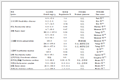
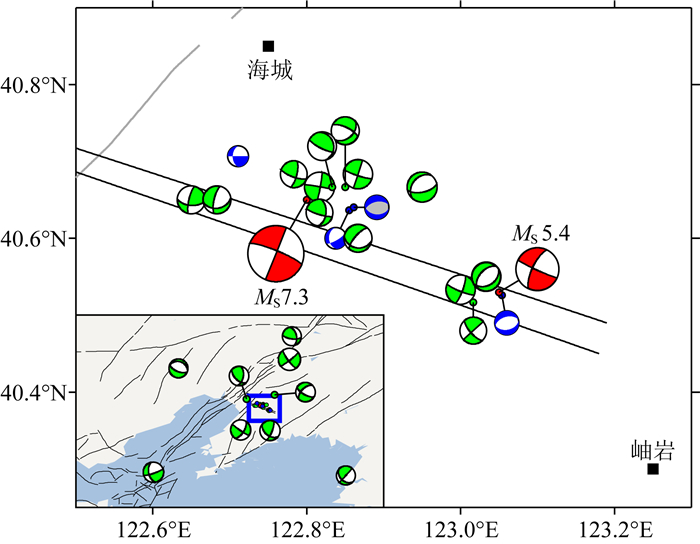
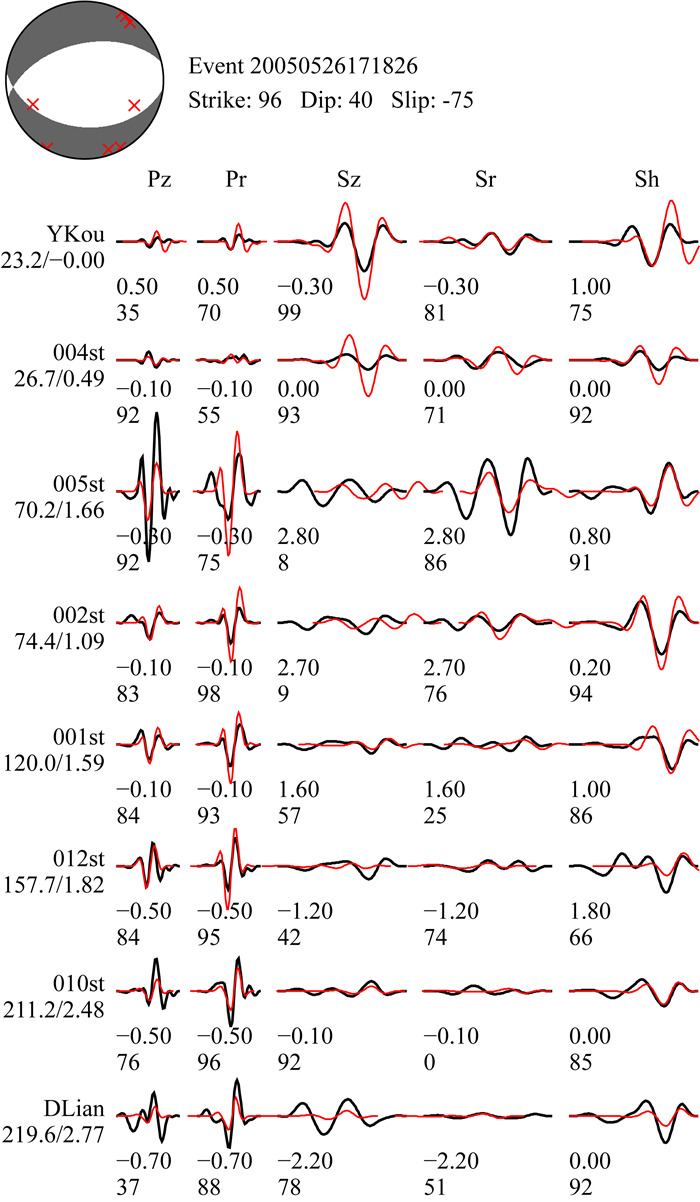
3.4 震源机制解使用gCAP方法反演了研究区信噪比高的小震震源机制解.受面波不发育等诸多因素影响,最终仅获得海城河断裂附近4个地震的可信震源机制解(表 1和图 11),两个为走滑型,两个为正断型.其中2005年5月26日地震事件的理论与观测波形拟合图如图 12所示,大部分观测波形的拟合相关系数大于70%.本文还统计了1975年MS7.3海城地震、1999年MS5.4岫岩地震以及2001~2007年辽宁地区震源机制解(数据来自国家地震科学数据共享中心) (图 11).沿海城河断裂带震源机制解以走滑和正断型为主,也存在少量逆断型,表明研究区构造应力场主压应力方向为北东东向,垂直于北西走向的海城河断裂,与岫岩台下方地壳的剪切波快波偏振方向一致(太龄雪等, 2009),也与辽宁地区的应力测量以及GPS观测结果基本一致(Wang et al., 2014; Zhao et al., 2015; 丰成君等, 2017).
|
表 1 地震震源机制解 Table 1 Focal mechanism solutions |
|
图 11 研究区地震震源机制解统计图 本研究的震源机制解结果用蓝色震源球表示,1975年MS7.3海城地震、1999年MS5.4岫岩地震震源机制解用红色震源球表示以及2001年至2007年研究区的震源机制解(数据来自国家地震科学数据共享中心)用绿色震源球表示.蓝灰色震源球为图 12中地震事件震源机制.插图给出了研究区所以震源机制解的位置,蓝框内是海城断裂区. Fig. 11 Focal mechanism solutions in study region Focal mechanism solutions resolved by this study are shown as blue focal spheres. 1973 MS7.3 Haicheng earthquake and 1999 MS5.4 Xiuyan earthquake are shown as red focal sphere, and the green focal spheres represent the focal mechanism solutions provided by China Earthquake Datacenter from 2001 to 2007. The blue-gray focal sphere is the focal mechanism solution shown in Fig. 12. All the locations of focal mechanism solutions are shown in the inset map and the blue box outlines the Haichenghe fault region. |
|
图 12 2005年5月26日事件的震源机制解与波形数据拟合图 左侧文字显示台站名,震中距(km)和波形整体时移量(s).红线表示理论地震图,黑线表示观测地震图,地震图下方数字表示理论与观测地震图的相位差(s)和相关系数.该事件在图 11中用蓝灰震源球表示. Fig. 12 Focal mechanism solutions and comparison between synthetic and observed waveforms of the 26 May 2005 event Letters on the left are station name, epicentral distance and shift time, respectively. The red lines denote the synthetics and the black lines denote observes. The numbers below each trace are relative time shift (s) and cross correlation coefficient. The focal mechanisms are shown as blue-gray focal sphere in Fig. 11. |
联合固定台网和流动台阵的相对密集地震观测数据,本文检测、重新拾取并重定位了郯庐断裂渤海湾北段发生的546个中小地震的震源位置,并反演获得了其中4个地震的震源机制解;在此基础上,对该地区中小地震活动开展研究,结论如下:
(1) 研究区地震活动分布不均匀,主断裂带地震不活跃,而其东侧的次级断裂——海城河和太子河断裂小地震频发,且沿断层呈密集条带状分布;首次发现太子河断裂频繁的小地震活动.
(2) 海城河和太子河断裂地震集中发生在15 km以浅,但存在中下地壳地震,最大震源深度分别可达21.2 km和23.2 km;根据地表热流估算该深度的温度可达500~600 ℃,结合岩石物理实验,推测该地区中下地壳由干燥的镁铁质岩石组成.
(3) 震源机制解结果揭示研究区主压应力方向为北东东向,与现今构造应力场的主压应力方向基本一致,造成沿北西西走向的海城断裂易发生走滑和正断型地震.
致谢 感谢中国科学院地质与地球物理研究所地震台阵探测实验室(doi:10.12129/IGGSL.Data.Observation, http://www.seislab.cn/)和辽宁省地震局为本研究提供的连续波形数据,感谢金戈博士为本研究提供地震检测代码,感谢香港中文大学朱高华、云南省地震局姜金钟博士在本研究过程中提供的帮助,感谢中国科学院地质与地球物理研究所王朱亭在温度计算中给予的帮助.数据处理与绘图使用到SAC(seismic Analysis Code)和GMT4(Wessel and Smith, 1998), 理论时距曲线的计算使用到Taup(Crotwell et al., 1999)软件包.
Ai Y S, Shen Z Y. 2011. Crust and upper mantle structure beneath Bohai Sea inferred from receiver function study. Earthquake Science, 24(1): 35-43. DOI:10.1007/s11589-011-0767-5 |
Bonner J L, Blackwell D D, Herrin E T. 2003. Thermal constraints on earthquake depths in California. Bulletin of the Seismological Society of America, 93(6): 2333-2354. DOI:10.1785/0120030041 |
Chen A G, Gao Y. 2019. Developments of research on earthquake detection methods. Progress in Geophysics (in Chinese), 34(3): 853-861. DOI:10.6038/pg2019CC0098 |
Crotwell H P, Owens T J, Ritsema J. 1999. The TauP toolkit:flexible seismic travel-time and ray-path utilities. Seismological Research Letters, 70(2): 154-160. DOI:10.1785/gssrl.70.2.154 |
Deng Q D, Wang T M, Li J G, et al. 1976. A discussion on source model of haicheng earthquake. Scientia Geologica Sinica (in Chinese), (3): 3-12. |
Deng Q D, Xu X W, Zhang X K, et al. 2003. Methods and techniques for surveying and prospecting active faults in urban areas. Earth Science Frontiers (in Chinese), 10(1): 93-104. DOI:10.3321/j.issn:1005-2321.2003.01.012 |
Déverchère J, Petit C, Gileva N, et al. 2001. Depth distribution of earthquakes in the Baikal rift system and its implications for the rheology of the lithosphere. Geophysical Journal International, 146(3): 714-730. DOI:10.1046/j.0956-540x.2001.1484.484.x |
Dong Y B, Ni S D, Yuen D A, et al. 2018. Crustal rheology from focal depths in the North China Basin. Earth and Planetary Science Letters, 497: 123-138. DOI:10.1016/j.epsl.2018.06.018 |
Efron B. 1994. Missing data, imputation, and the bootstrap. Journal of the American Statistical Association, 89(426): 463-475. DOI:10.1080/01621459.1994.10476768 |
Feng C J, Zhang P, Meng J, et al. 2017. In situ stress measurement at deep boreholes along the Tanlu fault zone and its seismological and geological significance. Progress in Geophysics (in Chinese), 32(3): 946-967. DOI:10.6038/pg20170302 |
Gao S T, Yu X M, Zhu D Q, et al. 2003. The vibration event of october 6, 1597 in eastern China is a strong deep earthquake. Acta Seismologica Sinica (in Chinese), 25(3): 324-330. DOI:10.3321/j.issn:0253-3782.2003.03.011 |
Hardebeck J L. 2013. Geometry and earthquake potential of the Shoreline fault, central California. Bulletin of the Seismological Society of America, 103(1): 447-462. DOI:10.1785/0120120175 |
Hauksson E, Yang W Z, Shearer P M. 2012. Waveform relocated earthquake catalog for southern California (1981 to June 2011). Bulletin of the Seismological Society of America, 102(5): 2239-2244. DOI:10.1785/0120120010 |
Havskov J, Ottemöller L. 2010. Routine Data Processing in Earthquake Seismology:With Sample Data, Exercises and Software. Dordrecht: Springer. DOI:10.1007/978-90-481-8697-6_10
|
Jackson J A. 2002. Strength of the continental lithosphere:Time to abandon the jelly sandwich?. GSA Today, 12(9): 4-10. DOI:10.1130/1052-5173(2002)012<0004:SOTCLT>2.0.CO;2 |
Jackson J A, Austrheim H, McKenzie D, et al. 2004. Metastability, mechanical strength, and the support of mountain belts. Geology, 32(7): 625-628. DOI:10.1130/G20397.1 |
Jiang G Z, Gao P, Rao S, et al. 2016. Compilation of heat flow data in the continental area of China (4th edition). Chinese Journal of Geophysics (in Chiense), 59(8): 2892-2910. DOI:10.6038/cjg20160815 |
Jiang J Z, Fu H, Chen Q F, et al. 2016. Characteristics of seismicity of the Xiaowan reservoir in an area of active tectonics from double-difference relocation analysis. Chinese Journal of Geophysics (in Chinese), 59(7): 2468-2485. DOI:10.6038/cjg20160713 |
Jiang J Z, Li J, Fu H. 2019. Seismicity analysis of the 2016 MS5.0 Yunlong Earthquake, Yunnan, China and its tectonic implications. Pure and Applied Geophysics, 176(3): 1225-1241. DOI:10.1007/s00024-018-2067-7 |
Jin G, Che Y S, Basing C R. 2009. Investigation of local earthquakes in the Lhasa region. Chinese Journal of Geophysics (in Chinese), 52(12): 3020-3026. DOI:10.3969/j.issn.0001-5733.2009.12.011 |
Klein F W. 2002. User's guide to HYPOINVERSE-2000, a Fortran program to solve for earthquake locations and magnitudes. US Geological Survey. DOI:10.3133/ofr02171 |
Lei Q Q, Liao X, Dong X Y, et al. 2008. Main active faults and their seismic activities in Liaoning Province. Technology for Earthquake Disaster Prevention (in Chinese), 3(2): 111-125. DOI:10.3969/j.issn.1673-5722.2008.02.002 |
Li G, Liu Y J, Regalla C, et al. 2018. Seismicity relocation and fault structure near the Leech River fault zone, southern Vancouver island. Journal of Geophysical Research:Solid Earth, 123(4): 2841-2855. DOI:10.1002/2017JB015021 |
Li J, Hou G T. 2019. Stress development in heterogeneous lithosphere:insights into earthquake initiation in the Tan-Lu Fault Zone. Tectonophysics, 750: 329-343. DOI:10.1016/j.tecto.2018.11.018 |
Li T, Cai M F, Zuo Y, et al. 2005. Features of focal mechanisms of mining-induced earthquakes:a case study of the Fushun Laohutai coal mine, Liaoning Province. Geological Bulletin of China (in Chinese), 24(2): 136-144. DOI:10.3969/j.issn.1671-2552.2005.02.006 |
Liu C, Zheng Q, Tian Y, et al. 2014. Study on the Activity of the Earthquakes of Haicheng Region in Liaoning Province. Journal of Jilin University:Earthquake Science Edition (in Chinese), 44(4): 1348-1356. DOI:10.13278/j.cnki.jjuese.201404303 |
Liu H L, Wu Q J. 2017. Developments of research on earthquake detection and seismic phases picking. Progress in Geophysics (in Chinese), 32(3): 1000-1007. DOI:10.6038/pg20170308 |
Mackwell S J, Zimmerman M E, Kohlstedt D L. 1998. High-temperature deformation of dry diabase with application to tectonics on Venus. Journal of Geophysical Research:Solid Earth, 103(B1): 975-984. DOI:10.1029/97JB02671 |
Ma Z S, Zhang Z S. 1994. Active features of Taizi river fault and relation between them and earthquake. Seismological Research of Northeast China (in Chinese), 10(3): 80-86. DOI:10.13693/j.cnki.cn21-1573.1994.03.010 |
McNamara D E, Benz H M, Herrmann R B, et al. 2015. Earthquake hypocenters and focal mechanisms in central Oklahoma reveal a complex system of reactivated subsurface strike-slip faulting. Geophysical Research Letters, 42(8): 2742-2749. DOI:10.1002/2014GL062730 |
Miao Q J, Zhou C Y, Ma Y X, et al. 2010. A review of researches on 1969 Bohai Mb7.4 Earthquake. North China Earthquake Sciences, 28(1): 8-15. DOI:10.3969/j.issn.1003-1375.2010.01.002 |
Min W, Liu Y G, Jiao D C, et al. 2013. Evidence for Holocene activity of the Yilan-Yitong fault, northeastern section of the Tan-Lu fault zone in Northeast China. Journal of Asian Earth Sciences, 67-68: 207-216. DOI:10.1016/j.jseaes.2013.02.031 |
Rao S, Jiang G Z, Gao Y J, et al. 2016. The thermal structure of the lithosphere and heat source mechanism of geothermal field in Weihe Basin. Chinese Journal of Geophysics (in Chinese), 59(6): 2176-2190. DOI:10.6038/cjg20160622 |
Stevenson P R. 1976. Microearthquakes at Flathead Lake, Montana:A study using automatic earthquake processing. Bulletin of the Seismological Society of America, 66(1): 61-80. |
Tai L X, Gao Y, Shi Y T, et al. 2009. A study of shear-wave splitting in the crust by Liaoning Telemetry Seismic Network of China. Seismology and Geology (in Chinses), 31: 401-414. DOI:10.3969/j.issn.0253-4967.2009.03.003 |
Waldhauser F, Ellsworth W L. 2000. A double-difference earthquake location algorithm:method and application to the northern Hayward Fault, California. Bulletin of the Seismological Society of America, 90(6): 1353-1368. DOI:10.1785/0120000006 |
Waldhauser F. 2001. HypoDD: A computer program to compute double-difference earthquake locations. USGS Open File Rep, 01-113.
|
Wang W, Wang D J, Zhao B, et al. 2014. Horizontal crustal deformation in Chinese Mainland analyzed by CMONOC GPS data from 2009-2013. Geodesy and Geodynamics, 5(3): 41-45. DOI:10.3724/sp.j.1246.2014.03041 |
Wessel P, Smith W H F. 1998. New, Improved version of Generic Mapping Tools released. Eos, 79(47): 579-579. DOI:10.1029/98EO00426 |
Xie Z J, Zheng Y, Liu C L, et al. 2017. An integrated analysis of source parameters, seismogenic structure, and seismic hazards related to the 2014 MS6.3 Kangding earthquake, China.. Tectonophysics, 712-713: 1-9. DOI:10.1016/j.tecto.2017.04.030 |
Xue Z Z, 19 93. 1993. Analysis and textual research of Bohai earthquake swarms in 1888. Seismological Research of Northeast China, 9(3): 51-59. DOI:10.13693/j.cnki.cn21-1573.1993.03.009 |
Yan Z G, Li P L, Xue J R. 1992. Study on Calibration Function of Local Magnitude ML in China. Earthquake Research In China (in Chinses), 8(4): 76-91. |
Zhang J D, Hao T Y, Dong S W, et al. 2015. The structural and tectonic relationships of the major fault systems of the Tan-Lu fault zone, with a focus on the segments within the North China region. Journal of Asian Earth Sciences, 110: 85-100. DOI:10.1016/j.jseaes.2014.11.011 |
Zhang G W, Lei J S, Xie F R, at al. 2011. Precise relocation of small earthquakes occurred in North China and its tectonic implication. Acta Seismologica Sinica (in Chinese), 33(6): 699-714. DOI:10.3969/j.issn.0253-3782.2011.06.001 |
Zhang L, Liu J S, Hao T Y. 2005. Inverse crustal P-wave velocity model of Bohai bay basin and its adjacent area by using messy GA with Ground-Truth data. Progress in Geophysics (in Chinese), 20(1): 186-197. DOI:10.3969/j.issn.1004-2903.2005.01.033 |
Zhang R H, Wu J X, Zhang W X. 1991. Terrestrial Heat Flow and Thermal Structure of the Lithosphere in South Liaoning. Earthquake Research In China (in Chinese), 7(3): 11-24. |
Zhao B, Huang Y, Zhang C H, et al. 2015. Crustal deformation on the Chinese mainland during 1998-2014 based on GPS data. Geodesy and Geodynamics, 6(1): 7-15. DOI:10.1016/j.geog.2014.12.006 |
Zheng Q, Liu C, Tian Y, et al. 2018. Seismic imaging of the middle and upper crust by double-difference tomography:the Haicheng earthquake (MS7.3) in Liaoning Province. Applied Geophysics, 15(1): 125-136. DOI:10.1007/s11770-018-0662-0 |
Zheng T Y, He Y M, Yang J H, et al. 2015. Seismological constraints on the crustal structures generated by continental rejuvenation in northeastern China. Scientific Reports, 5: 14995. DOI:10.1038/srep14995 |
Zhong Y Z, Jiang Y Q, Han D Z. 1981. Discussion on the induced seismicity in Shen Wo reservoir area, Liaoning province. Seismology and Geology (in Chinese), 3(4): 59-68. |
Zhu G, Wang D X, Liu G S, et al. 2004. Evolution of the Tan-Lu fault zone and its responses to plate movements in west Pacific basin. Chinese Journal of Geology (in Chinses), 39(1): 36-49. DOI:10.3321/j.issn:0563-5020.2004.01.005 |
Zhu L P, Ben-Zion Y. 2013. Parametrization of general seismic potency and moment tensors for source inversion of seismic waveform data. Geophysical Journal International, 194(2): 839-843. DOI:10.1093/gji/ggt137 |
Zhu L P, Helmberger D V. 1996. Advancement in source estimation techniques using broadband regional seismograms. Bulletin of the Seismological Society of America, 86(5): 1634-1641. |
陈安国, 高原. 2019. 微震识别方法研究进展. 地球物理学进展, 34(3): 853-861. DOI:10.6038/pg2019CC0098 |
邓起东, 王挺梅, 李建国, 等. 1976. 关于海城地震震源模式的讨论. 地质科学, (3): 3-12. |
邓起东, 徐锡伟, 张先康, 等. 2003. 城市活动断裂探测的方法和技术. 地学前缘, 10(1): 93-104. DOI:10.3321/j.issn:1005-2321.2003.01.012 |
丰成君, 张鹏, 孟静, 等. 2017. 郯庐断裂带及邻区深孔地应力测量与地震地质意义. 地球物理学进展, 32(3): 946-967. DOI:10.6038/pg20170302 |
高山泰, 于岫嵋, 朱大庆, 等. 2003. 1597年10月6日中国东部的振动事件是一次深源强震. 地震学报, 25(3): 324-330. DOI:10.3321/j.issn:0253-3782.2003.03.011 |
姜光政. 2017.中国东北地区大地热流测量与岩石圈热结构[博士论文].北京: 中国科学院大学.
|
姜光政, 高堋, 饶松, 等. 2016. 中国大陆地区大地热流数据汇编(第四版). 地球物理学报, 59(8): 2892-2910. DOI:10.6038/cjg20160815 |
姜金钟, 付虹, 陈棋福. 2016. 位于构造活跃区的小湾水库地震活动特征——基于地震精定位的分析. 地球物理学报, 59(7): 2468-2485. DOI:10.6038/cjg20160713 |
金戈, 陈永顺, 巴桑次仁. 2009. 拉萨地区及其周边的地震活动性研究. 地球物理学报, 52(12): 3020-3026. DOI:10.3969/j.issn.0001-5733.2009.12.011 |
雷清清, 廖旭, 董晓燕, 等. 2008. 辽宁省主要活动断层与地震活动特征分析. 震灾防御技术, 3(2): 111-125. DOI:10.3969/j.issn.1673-5722.2008.02.002 |
李铁, 蔡美峰, 左艳, 等. 2005. 采矿诱发地震的震源机制特征——以辽宁省抚顺市老虎台煤矿为例. 地质通报, 24(2): 136-144. DOI:10.3969/j.issn.1671-2552.2005.02.006 |
梁晓峰. 2009.藏南地区地震定位和有限频体波走时层析成像[博士论文].北京: 北京大学.
|
刘财, 郑确, 田有, 等. 2014. 辽宁海城及其邻区地震活动性研究. 吉林大学学报(地球科学版), 44(4): 1348-1356. DOI:10.13278/j.cnki.jjuese.201404303 |
刘翰林, 吴庆举. 2017. 地震自动识别及震相自动拾取方法研究进展. 地球物理学进展, 32(3): 1000-1007. DOI:10.6038/pg20170308 |
马宗顺, 张正曙. 1994. 太子河断裂的活动特征及其与地震的关系. 东北地震研究, 10(3): 80-86. DOI:10.13693/j.cnki.cn21-1573.1994.03.010 |
苗庆杰, 周翠英, 马玉香, 等. 2010. 1969年渤海7.4级地震研究述评. 华北地震科学, 28(1): 8-15. DOI:10.3969/j.issn.1003-1375.2010.01.002 |
饶松, 姜光政, 高雅洁, 等. 2016. 渭河盆地岩石圈热结构与地热田热源机理. 地球物理学报, 59(6): 2176-2190. DOI:10.6038/cjg20160622 |
太龄雪, 高原, 石玉涛, 等. 2009. 辽宁区域地震台网的地壳剪切波分裂研究. 地震地质, 31(3): 401-414. DOI:10.3969/j.issn.0253-4967.2009.03.003 |
薛志照. 1993. 1888年渤海地震震群的考证与分析. 东北地震研究, 9(3): 51-59. DOI:10.13693/j.cnki.cn21-1573.1993.03.009 |
严尊国, 李普丽, 薛军蓉. 1992. 中国近震震级量规函数研究. 中国地震, 8(4): 76-91. |
张广伟, 雷建设, 谢富仁, 等. 2011. 华北地区小震精定位及构造意义. 地震学报, 33(6): 699-714. DOI:10.3969/j.issn.0253-3782.2011.06.001 |
张岭, 刘劲松, 郝天珧. 2005. 利用Ground-Truth资料和Messy GA方法反演渤海湾盆地及其邻区地壳P波速度模型. 地球物理学进展, 20(1): 186-197. DOI:10.3969/j.issn.1004-2903.2005.01.033 |
张汝惠, 武冀新, 张晚霞. 1991. 辽宁南部的大地热流及岩石圈热结构. 中国地震, 7(3): 11-24. |
郑勇, 马宏生, 吕坚, 等. 2009. 汶川地震强余震(MS ≥ 5.6)的震源机制解及其与发震构造的关系. 中国科学D辑:地球科学, 39(4): 413-426. |
钟以章, 蒋玉谦, 韩殿中. 1981. 辽宁参窝水库地震问题的讨论. 地震地质, 3(4): 59-68. |
朱光, 王道轩, 刘国生, 等. 2004. 郯庐断裂带的演化及其对西太平洋板块运动的响应. 地质科学, 39(1): 36-49. DOI:10.3321/j.issn:0563-5020.2004.01.005 |