 2020, Vol. 63


2. 南方海洋科学与工程广东省实验室(珠海), 珠海 519082;
3. 广东省地震局, 广州 510070
 , SHEN XuZhang1,2
 , ZHENG WenJun1,2, QIAN YinPing3, ZHANG DongLi1,2, WANG WenTian1,2, LI XiaoLin1,2
2. Southern Marine Science and Engineering Guangdong Laboratory(Zhuhai), Zhuhai 519082, China;
3. Earthquake Administration of Guangdong Province, Guangzhou 510070, China
鄂尔多斯地块西部与青藏高原和阿拉善地块接壤,由于印度板块向北俯冲和太平洋板块向西俯冲的相互作用,鄂尔多斯地块及其周缘地区受到不同的构造应力作用,形成了块体内部相对稳定而周缘地震活动强烈的特征(Xu et al., 2001).受青藏高原与扬子板块的共同影响,鄂尔多斯西南缘发育了一系列活动断裂(邓起东等,1999),控制着该地区的构造格局和地震活动,该区域深部结构研究对于理解地块之间的相互作用模式及物质运移等科学问题具有重要意义.
近年来,前人对鄂尔多斯地块及其周缘进行了大量地球物理研究,取得了对该区域深部结构认识的众多重要成果.深地震测深研究认为鄂尔多斯地壳结构简单,壳体内部不发育低速层,平均波速较高(Teng et al., 2013;Jia et al., 2014;张先康等,2003;李英康等,2014);地震体波层析成像研究认为鄂尔多斯地壳上地幔速度结构具有明显的横向不均一性(许忠淮等,2003;毛慧慧等,2016);大地电磁研究获得了这一区域深部电性结构模型(赵国泽等,2010),并发现鄂尔多斯北部地壳及上地幔存在低阻体及低速异常,认为这一区域存在软流圈物质上涌(Dong et al., 2014;李晨晶等,2017);背景噪声反演也取得了关于这一区域的地壳上地幔速度结构成果(Li et al., 2014;陈强森等,2013).由于鄂尔多斯地块位于华北克拉通西部,人们通常认为鄂尔多斯地块位于稳定克拉通内,没有遭到明显的破坏,但以上部分结果显示鄂尔多斯北部地壳、上地幔存在低速体(Tian et al., 2011;Dong et al., 2014;李晨晶等,2017),因此关于鄂尔多斯地块深部结构更多参数的研究对于了解不同构造环境下大陆地壳的形成和演化过程具有十分重要的意义.
前人研究工作由于受到观测资料限制,在研究区域的完整覆盖度、观测资料的密集程度等方面都存在一些难以克服的困难,导致研究结果难以从很高精度上全面反映鄂尔多斯地块的一些主要地壳结构特征.近年来,“中国地震科学台阵探测-南北地震带北段”项目(喜马拉雅二期台阵),在鄂尔多斯西部和青藏高原东北缘布设了600多个流动宽频带地震仪,对该区域进行了一个良好的覆盖,且台站分布均匀.该项目提供了大量高质量观测地震资料,为深部结构的研究创造了良好条件.基于这些资料,已有研究者利用接收函数(Wang et al., 2017)、层析成像(郭慧丽等,2017;高翔等,2018)和S波分裂等方法(常利军等,2016),对整个台阵所在区域的深部结构进行了研究,得到了该区域深部速度结构及各向异性等重要特征.但是这些研究中缺乏对Moho面性质更为详细的分析.
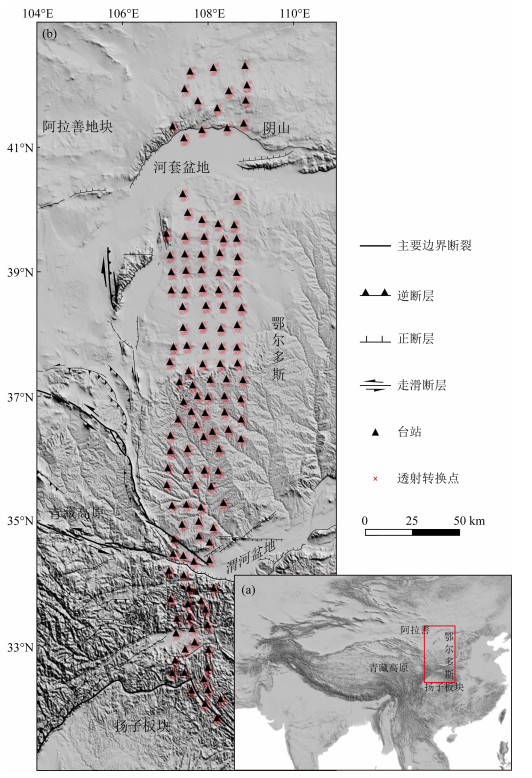
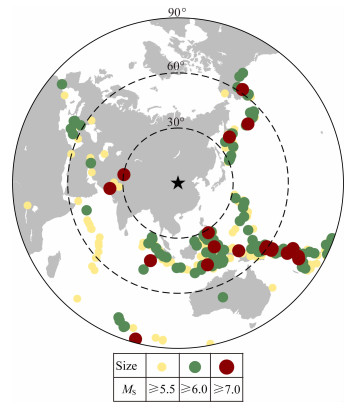
本文选择南北向分布且横穿鄂尔多斯地块西部范围内的129个流动台站远震波形资料(图 1),利用P-S一次转换波和多次波到时,确定南北向横跨鄂尔多斯地块剖面的地壳厚度与波速比分布,文中所利用的远震事件如图 2所示.同时,利用单台速度-密度跃变(δβ-δρ)扫描叠加方法(钱银苹和沈旭章,2017)确定了Moho面速度和密度跃变.结合以上结果,对鄂尔多斯地块的深部结构和动力学过程进行了探讨.
|
图 1 研究区构造背景与台站分布 黑色三角形为台站,红色十字为PMs震相透射转换点,黑色线为断层. Fig. 1 The tectonic background of the study area and the distribution of seismic station The black triangles represent stations; The red crosses represent the piercing points of PMs; The black lines represent faults. |
|
图 2 地震事件震中分布图 Fig. 2 Epicenters distribution of earthquake events |
2013年9月至2016年6月,中国地震局地球物理研究所于中国南北地震带北段布设了676个宽频带流动台站,由于台阵覆盖了鄂尔多斯西部地区,本文使用该项目中呈线性分布的129个流动宽频带台阵记录的远震波形记录进行研究,该线性台阵横跨了鄂尔多斯地块到扬子板块.选取台阵工作期间记录的MS≥5.5、震中距为30°~95°的265866条远震记录,并根据记录事件波形的信噪比对资料进行了初选,选择了高信噪比及清晰的波形记录.对数据进行滤波、去毛刺、去均值、去线性趋势和波形尖灭等处理,根据方位角将波形三分量(N-E-Z)旋转到R-T-Z坐标上,截取P波之前20 s和之后120 s的波形资料,在时间域通过迭代反褶积计算了P波接收函数(Ligorria and Ammon, 1999).计算过程中选取α为1的高斯滤波器,剔除了明显存在异常的接收函数,最终得到20267条高质量接收函数用于研究.
1.2 研究方法远震P波接收函数主要分析地壳及上地幔间断面引起的P-S转换波,是用于探测地壳和上地幔深部结构最有效的天然地震学方法之一(Langston, 1979;Ammon et al., 1990).Zhu和Kanamori(2000)提出的H-κ搜索叠加方法,在网格搜索基础上通过大量接收函数一次波与多次波幅度叠加确定Moho面深度和波速比,是目前接收函数中最为常用的一种技术.H-κ搜索叠加方法主要利用了接收函数一次波与多次波的到时信息,较为稳定可靠,然而接收函数上的一次波与多次波除了到时信息外,还包含幅度信息,它主要受界面速度跃变、密度跃变及各向异性等因素影响(Owens et al., 1984;Ammon et al., 1990;Julià et al., 2000).由于观测仪器精度以及其他影响幅度信息的因素较多,利用幅度信息进行的研究相对较少(Niu and James, 2002;Julià, 2007).钱银苹和沈旭章(2017)提出了速度-密度跃变(δβ-δρ)扫描叠加方法,利用接收函数幅度信息确定Moho面速度和密度跃变,并应用于青藏高原东北缘地壳结构研究,本文将利用接收函数到时以及幅度信息对鄂尔多斯西部及其邻区地壳结构进行更精密的研究.
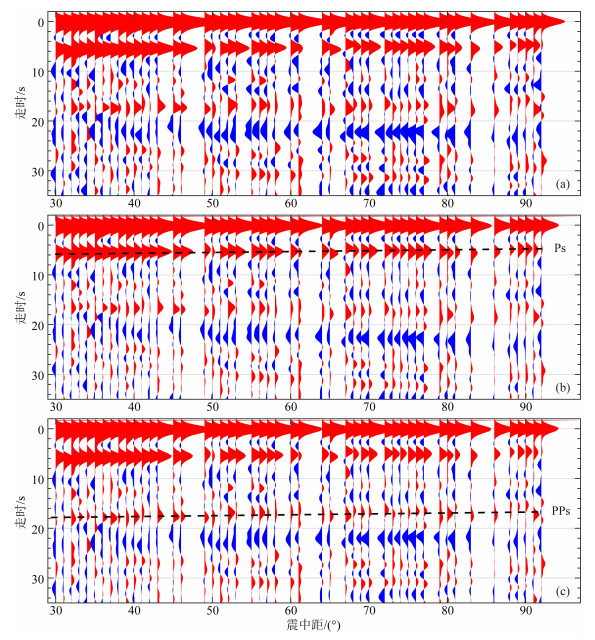
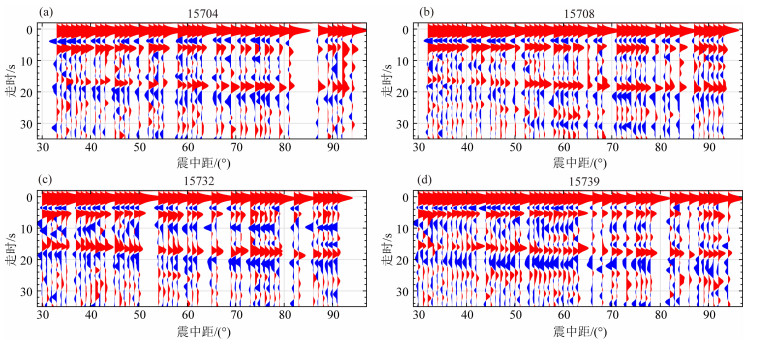
由于不同接收函数对应的震中距和震源深度不同,对应的P波射线参数p也不相同,导致P-S转换波的走时发生变化,因此需要根据震中距和震源深度对接收函数到时进行校正.在利用接收函数研究深部结构时,主要会用到Ps转换波、PPs和PSs多次波,为了突出不同震相,会针对不同震相的不同射线参数的接收函数进行校正.如图 3所示,其中图 3a显示了未经过校正的不同震中距接收函数叠加,图 3b显示了针对Ps震相进行的校正叠加,图 3c显示了针对PPs震相进行的校正叠加.以Ps校正为例,参考IASP91模型(Kennett and Engdahl, 1991)计算得到的不同深度Pds(d代表位于d km深度的间断面)震相到时,将所有接收函数校正到65°震中距,将30°~95°震中距的接收函数均匀分配到66个震中距单元内,将每个单元内校正后的接收函数进行叠加,经过叠加后Pds震相得到加强,图 4为15704、15708、15732和15739四个台站下方接收函数对Ps震相经过震中距校正后叠加的结果.
|
图 3 台站61035下方的接收函数 (a)接收函数震中距校正前叠加结果;(b)接收函数对Ps震相进行震中距校正后叠加结果;(c)接收函数对PPs震相进行震中距校正后叠加结果. Fig. 3 Receiver functions from the station 61035 (a) Receiver functions stacks before the epicentral distance correction; (b) Receiver functions stacks after the epicentral distance correction according to the Ps phase; (c) Receiver functions stacks after the epicentral distance correction according to the PPs phase. |
|
图 4 部分台站下方接收函数叠加结果 Fig. 4 Receiver functions stacks from some stations |
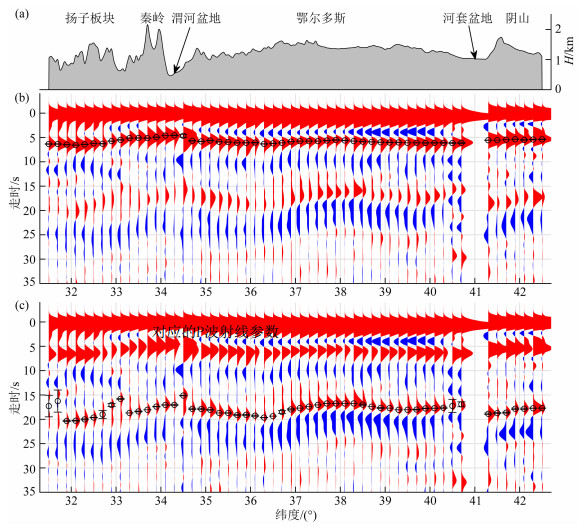
为探测横跨鄂尔多斯地块南北向上地壳结构的显著特征,我们根据Pms震相(假定Moho深度为35 km)的透射转换点位置(如图 1所示),将31°N—43°N的剖面均分为60个单元格.将每个单元内的所有接收函数根据透射转换点进行叠加,图 5b和图 5c分别显示了沿着整个剖面对Ps和PPs震相进行震中距校正后叠加的接收函数.
|
图 5 接收函数根据透射转换点叠加的剖面 图中黑色符号为到时及误差标记.(a)地形图;(b)对Ps校正叠加后的接收函数剖面;(c)对PPs校正叠加后的接收函数剖面. Fig. 5 Stacking profile of receiving functions based on the location of piercing points The black symbols in the figure are arrival time and error bar. (a) Topography; (b) Stacking profile of receiving functions after Ps phase correction; (c) Stacking profile of receiving functions after PPs phase correction. |
根据Snell定律,接收函数中Moho面转换震相Ps以及两个后至震相PpPs和PpSs+PsPs的到时可以共同约束地壳厚度与波速比κ(κ=Vp/Vs)(Zhu and Kanamori, 2000).为了保证结果的稳定性和准确性,对于一次波与多次波震相到时误差较大的数据,计算地壳厚度与波速比时将不使用.参考IASP91模型给定的平均Vp为6.1 km·s-1,且采用统计学中常用的Bootstrap方法(Efron and Tibshirani, 1998)来确定地壳厚度和波速比误差.
由于不同台站的仪器响应、数据质量及布设条件不同,导致不同台站下接收函数幅度影响因素各不相同,为了提高接收函数幅度提取的准确性,选取一次波与多次波都清晰稳定的台站,对单个台站进行幅度的叠加搜索.根据速度-密度跃变(δβ-δρ)扫描叠加方法,在δβ(0~40%)和δρ(0~30%)组成的空间进行搜索,搜索步长为1%,不同震中距的振幅观测值(Aobs)和理论值(Asyn)之间的差别,用misfit(δβ, δρ)表示:

|
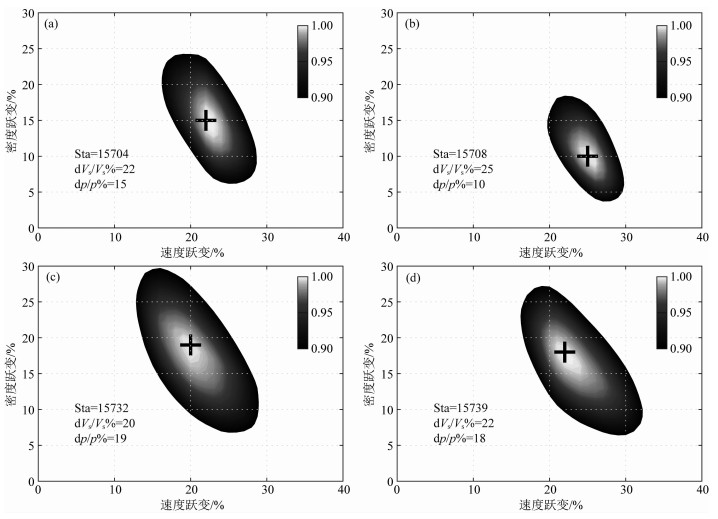
A1、A2和A3分别为震相Ps、PpPs和PpSs+PsPs的幅度,ωi为权重因子(ω1+ω2+ω3=1), 当misfit(δβ, δρ)最小时,对应的速度跃变δβ和密度跃变δρ为最优解(∂β=(β2-β1)/β1,∂ρ=(ρ2-ρ1)/ρ1,下标1(2)表示界面上(下)层),15704、15708、15732和15739台站下方的Moho面速度和密度跃变扫描结果如图 6所示.本文主要利用Ps、PpPs和PpSs+PsPs三种震相(至少保证有两个非常清晰的震相)的幅度来对速度和密度跃变进行约束,因此需要挑选一次波与多次波都比较清晰的台站进行计算,表 1显示了符合条件台站的计算结果.
|
图 6 部分台站下方速度和密度跃变扫描结果 Fig. 6 Grid searching results of S-wave velocity and density contrasts of some stations |
|
表 1 台站下方速度及密度跃变结果 Table 1 S-wave velocity and density contrast of stations |
前人利用地球物理方法对鄂尔多斯地块及其周缘地区进行了大量的研究,得到鄂尔多斯地壳厚度为37.8~49.3 km(Pan and Niu, 2011;Teng et al., 2013;Jia et al., 2014;Wang et al., 2017;Li et al., 2017;李英康等,2014),秦岭下方地壳厚度为37~51 km(Wang et al., 2014a),渭河盆地下方地壳厚度为30~39km(姚志祥等,2014;贾萌等,2015),基于流动台阵的接收函数结果认为鄂尔多斯地块北缘到河套盆地存在2~3 km的Moho抬升,阴山造山带地壳厚度为38.8~48 km(Tian et al., 2011;Wang et al., 2014a).Li等(2017)的接收函数、Rayleigh波频散研究以及其他研究(Pan and Niu, 2011;Wang et al., 2016;Wang et al., 2017)中也显示鄂尔多斯南部地壳较厚.然而也存在一些不同的观点,Wang等(2014a)认为鄂尔多斯南部比北部薄~3 km,导致这一差异的原因可能为早期研究区观测资料覆盖稀疏,观测数据信噪比低,结果分辨率不够高.
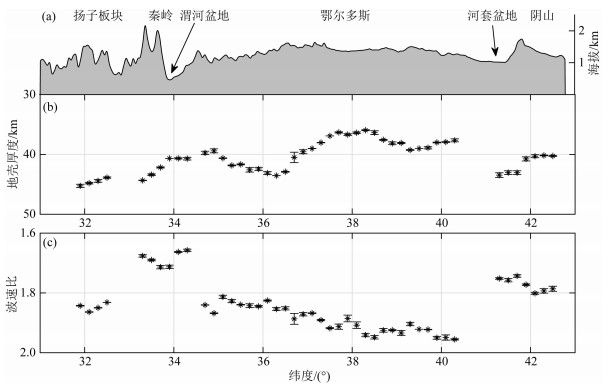
和前人研究相比,利用一条完整的宽频带流动台阵资料自南向北横穿了整个鄂尔多斯,系统完整显示了地壳厚度的变化特征.根据本文研究得到关于鄂尔多斯地块及其周缘地区地壳厚度的结果(图 7b),鄂尔多斯地壳厚度为36~42.7 km,可以看到,鄂尔多斯内部地壳厚度并不是完全一致的,而是在中部36.5°N及38°N分段.鄂尔多斯南部平均地壳厚度为41.4±1.3 km,鄂尔多斯中部及北部地壳较薄为37.7±1.7 km,自南向北中部地区地壳逐渐减薄至36 km,随后北部地区地壳逐渐增厚.本文将对扬子板块北缘—渭河盆地、鄂尔多斯南部、鄂尔多斯中部、鄂尔多斯北部以及河套盆地—阴山造山带五个部分进行讨论,每个区段内地壳厚度变化都相对连续.
|
图 7 根据接收函数得到的地壳厚度与波速比 (a)地形图;(b)地壳厚度;(c)波速比. Fig. 7 Crustal thickness and velocity ratio from receiver functions (a) Topography; (b) Crustal thickness; (c) Velocity ratio. |
可以看到,在扬子板块和秦岭—渭河盆地之间的Moho面有一个明显的抬升,在地壳构造边界附近的地壳厚度有显著的变化.从扬子板块北缘到渭河盆地,地壳厚度为40.8~45.6 km,变化幅度相对较大,其中从秦岭到渭河盆地有明显的抬升,秦岭下方地壳厚度为43.2±0.9 km,而渭河盆地地壳减薄至40.8±0.3 km.鄂尔多斯南部地壳厚度向北逐渐增厚,变化相对比较平稳,而在36.5°N附近有明显的下凹.鄂尔多斯中部地壳厚度向北逐渐减薄,在38°N处存在极值(36 km)之后逐渐增厚,并且Moho面在北缘与河套盆地相邻处轻微抬升.河套盆地—阴山造山带地壳厚度为40.2~43.4 km,存在自南向北抬升的趋势,总体上变化平缓,相比鄂尔多斯北缘地壳增厚约3 km.
2.2 波速比、速度和密度跃变及地壳组分讨论前人已经对不同大陆地壳岩石性质进行研究(Christensen, 1996),提出当岩石分别为长英质、中性、铁镁质时,其对应的波速比为低(κ≤1.76)、中等(1.76<κ≤1.81)和高(1.81<κ≤1.86).以前的研究在青藏高原东北缘中、下地壳观测到明显的低速异常,认为秦岭—渭河盆地可能是青藏高原软流圈物质向东挤出的通道(Chang et al., 2011;Li et al., 2011;Yu and Chen, 2016).长期以来,鄂尔多斯地块被认为是稳定的太古代克拉通(An and Shi, 2006),中生代到新生代岩石圈发生减薄作用,华北克拉通东部以薄地壳为特征(吴福元等,2003;朱日祥等,2011),而鄂尔多斯并未遭受到复杂的破坏,铁镁质下地壳也许是华北克拉通形成时保存下来的(Wang et al., 2014a).前人的层析成像、接收函数及大地电磁结果(Tian et al., 2011;Dong et al., 2014;李晨晶等,2017;郭慧丽等,2017;高翔等,2018)认为鄂尔多斯北缘上地幔存在低速异常,而这个低速异常很有可能是上地幔物质在河套盆地下方上涌的结果.Tian等(2011)认为这一区域地幔物质上涌是太平洋板块俯冲引起的,而高翔等(2018)的层析成像结果显示,块体之间的碰撞及岩石圈的拆离是导致这一区域地幔物质上涌的主要原因.
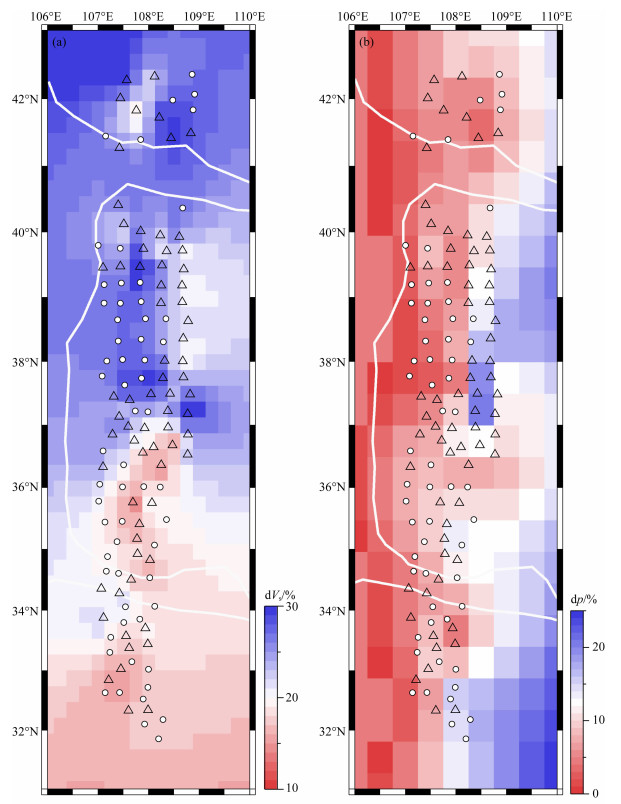
总体上看(图 7c),波速比在秦岭—渭河盆地(1.66~1.72)以及河套盆地—阴山造山带(1.75~1.79)明显较小,在渭河盆地下方存在最小值为1.66,秦岭下方平均波速比为1.70.低波速比表明这些地区的地壳主要包括长英质酸性岩石,这个结果也与这个地区地壳和上地幔低密度异常吻合(Wang et al., 2014b).此外,与扬子板块及鄂尔多斯南部相比,秦岭及渭河盆地下方速度跃变相对较大(17%~23%),密度跃变相对较小为4%~10%(61031台站下方存在异常小值为2%)(图 8).秦岭下方地壳厚度相对较薄,我们推断这些地区可能发生地壳拆沉而导致铁镁质下地壳正在变薄或消失,低波速比表明中、下地壳并不存在局部熔融,拆沉的下地壳是导致密度跃变相对较小的主要原因.
|
图 8 研究区的(a)速度跃变与(b)密度跃变结果 三角形为用于计算速度和密度跃变的台站;白色圆圈为无法用于计算速度和密度跃变的台站;白色线为块体边界. Fig. 8 (a) S-wave velocity contrasts and (b) density contrasts in the study The triangles are the stations used to calculate the velocity and density contrasts; The white circles are the stations that cannot be used to calculate the velocity and density contrasts; The white lines represent boundary of blocks. |
秦岭—渭河盆地两侧波速比都相对较高,扬子板块北缘与鄂尔多斯南部平均波速比都为1.84,鄂尔多斯南部速度跃变为14%~23%,密度跃变为7%~14%.Yu和Chen(2016)在SKS波分裂研究中推断鄂尔多斯西南缘古老的克拉通岩石圈正在被青藏高原热的软流圈取代.但从图 7可以看到鄂尔多斯南部地壳并未达到部分熔融状态,所以可能有两种解释,一是岩石圈物质被青藏高原软流圈物质取代只发生在鄂尔多斯西南缘,并没有进一步深入到鄂尔多斯地壳内部;二是鄂尔多斯南部高波速比与青藏高原东北缘向东北方向运动时受到鄂尔多斯刚性块体阻挡而形成的地壳增厚有关.前人在青藏高原东北缘中、下地壳观测到明显的低速异常和低泊松比(Bao et al., 2013;Li et al., 2014;Wang et al., 2017),认为青藏高原东北缘不存在向东北方向逃逸的下地壳流.此外我们可以明显看到鄂尔多斯南部比北部厚~3.7 km,因此鄂尔多斯南部的厚地壳和高波速比,可能是青藏高原的挤压增厚导致.
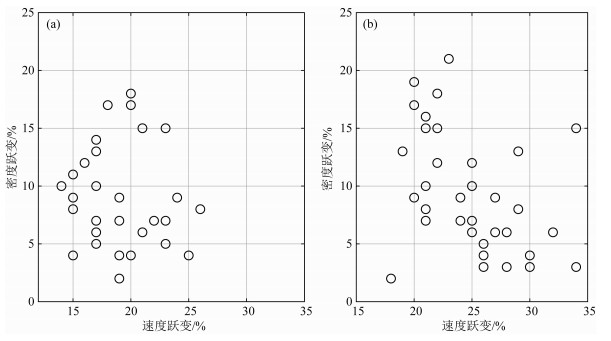
鄂尔多斯南部到北部波速比逐渐增大,变化相对连续,从1.82上升至1.96,而鄂尔多斯北部地区波速比基本上大于1.87,达到了部分熔融状态.鄂尔多斯中部到北部速度跃变比南部明显增大(图 8a),鄂尔多斯中部约37.5°N附近存在速度及密度跃变的极大值((26.5±3.5)%和21%),北部速度跃变为19%~29%(15713台站存在异常大值为34%),密度跃变从北到南逐渐增大(3%~18%),变化较大.根据得到的69个速度和密度跃变结果,本文以37°N为界做了速度密度跃变关系图(图 9),从图 9a并未发现有明显线性关系,可能是由于研究区南部构造差异且构造活动相对复杂造成.而根据图 9b可以看到速度与密度跃变近似呈反比关系,当发生部分熔融时,速度跃变相对增大,而密度跃变相对减小,因此我们推断鄂尔多斯北部下地壳可能发生部分熔融,导致波速比增大、较大的速度跃变和相对较小的密度跃变.根据前人研究,河套盆地下方存在上涌的地幔物质,层析成像结果(Huang et al., 2009;Jiang et al., 2013;郭慧丽等,2017)也显示在鄂尔多斯北缘及河套盆地下地壳和上地幔存在相对较小的S波速度,因此很有可能这个上涌的地幔物质已经自北向南侵入鄂尔多斯北部地壳内,导致鄂尔多斯北部波速比和速度跃变明显增大,地幔物质与地壳物质的融合导致了密度跃变的减小,且目前这个侵入的上地幔物质可能到38°N附近停止.此外,Wang等(2017)的接收函数的沉积层厚度研究中认为,鄂尔多斯存在约0~3 km的沉积层,西北偏厚,东南偏薄,我们在鄂尔多斯北部台站下方的接收函数剖面中也观察到了类似的结果,因此鄂尔多斯中部到北部较大波速比可能是地幔物质向南侵入和沉积层共同导致的结果.
|
图 9 速度与密度跃变关系图 (a)台站位置小于37°N;(b)台站位置大于37°N. Fig. 9 Relationship between S-wave velocity and density contrasts (a) For the stations with latitude less than 37°N; (b) For the stations with latitude larger than 37°N. |
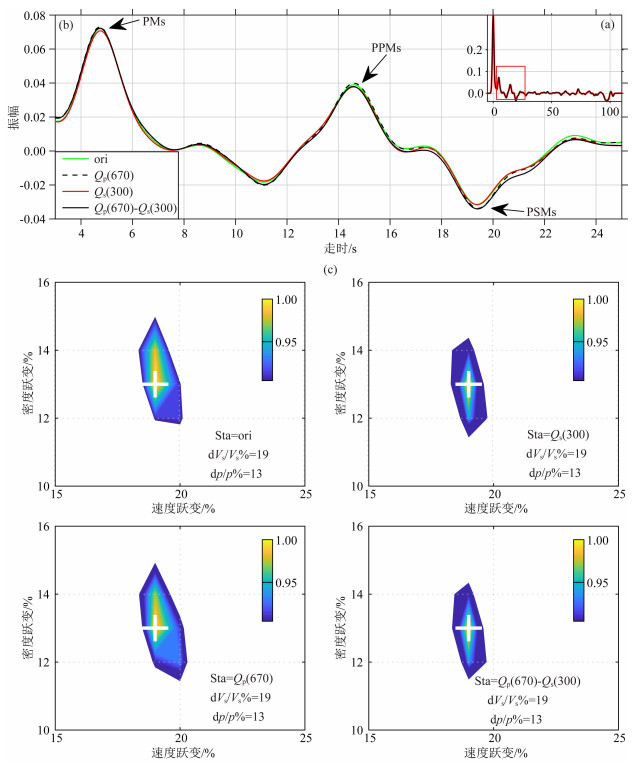
为了测试Q值影响,我们针对四个模型进行了数值实验,模型中地壳Q值如表 2所示(原文预设模型中地壳衰减系数为Qp=1340,Qs=600,δβ=19.2%,δρ=13.7%),根据IASP91模型并利用yaseis程序(Ma, 2013)计算得到各参数下的接收函数,并利用速度-密度跃变(δβ-δρ)扫描叠加方法计算不同模型中的速度和密度跃变.图 10b显示不同Q值模型,接收函数一次波和多次波幅度存在一定差异,但是速度-密度跃变扫描叠加方法得到的结果中(图 10c),速度和密度跃变基本与预设模型一致(如表 2所示).主要原因为当Qp或Qs改变时,接收函数一次波与多次波幅度同时发生变化,因此对速度和密度跃变扫描叠加结果不产生明显影响.
|
图 10 不同模型下的接收函数和速度密度跃变 (a)和(b)接收函数;(c)速度和密度跃变扫描结果. Fig. 10 Synthetic receiver functions, S-wave velocity and density contrasts of different models (a) and (b) Synthetic receiver functions; (c) Grid searching results of S-wave velocity and density contrasts. |
|
|
表 2 不同Q值对应的速度与密度跃变结果 Table 2 The results of S-wave velocity and density contrasts according to different Q values |
本文利用远震P波接收函数一次波与多次波到时及幅度信息,获得了鄂尔多斯西部及其邻区的地壳厚度、波速比、速度和密度跃变,结合前人在这一区域的其他研究成果,得到以下结论:
秦岭及渭河盆地下方具有相对较薄的地壳及较小的波速比.薄地壳和低波速比表明这些地区的地壳主要包括长英质酸性岩石,速度跃变相对较大(17%~23%),密度跃变相对较小,暗示着这些地区可能发生地壳拆沉导致铁镁质下地壳变薄,低波速比表明中、下地壳并不存在局部熔融,青藏高原东北缘不存在向秦岭方向逃逸的下地壳流.
根据结果可以在36.5°N和38°N将鄂尔多斯地块分为三个部分.鄂尔多斯南部平均地壳厚度为41.4±1.3 km.鄂尔多斯南部地壳比中部及北部厚约3.7 km,速度跃变相对较小,密度跃变为7%~14%,鄂尔多斯南部的厚地壳和高波速比,可能为青藏高原的挤压增厚导致.
鄂尔多斯中部及北部地壳较薄为37.7±1.7 km,鄂尔多斯北部地区波速比基本上大于1.87,达到了部分熔融状态,速度跃变明显较大,密度跃变明显较小.由此推测鄂尔多斯北部下地壳可能发生部分熔融,并且这个部分熔融可能到38°N附近停止.鄂尔多斯中部到北部较大波速比可能是下地壳熔融与沉积层共同导致的结果.
地壳Q值改变导致接收函数一次波和多次波幅度存在一定差异,但对速度和密度跃变扫描叠加结果不产生明显影响.
致谢 数据由“中国地震科学探测台阵数据中心”(http://www.chinarraydmc.cn/)提供;本文绘图及数据处理用到的主要地震学软件为SAC(http://ds.iris.edu/ds/nodes/d-mc/forms/sac/)、GMT(Wessel and Smith, 1995)等, 在此一并表示谢意;感谢中山大学地球科学与工程学院张逸鹏博士和许斌斌博士对论文写作的帮助,感谢审稿人对本文的建设性意见.
Ammon C J, Randall G E, Zandt G. 1990. On the nonuniqueness of receiver function inversions. Journal of Geophysical Research, 95(B10): 15303-15318. DOI:10.1029/JB095iB10p15303 |
An M J, Shi Y L. 2006. Lithospheric thickness of the Chinese continent. Physics of the Earth and Planetary Interiors, 159(3-4): 257-266. DOI:10.1016/j.pepi.2006.08.002 |
Bao X W, Song X D, Xu M J, et al. 2013. Crust and upper mantle structure of the North China Craton and the NE Tibetan Plateau and its tectonic implications. Earth and Planetary Science Letters, 369-370: 129-137. DOI:10.1016/j.epsl.2013.03.015 |
Chang L J, Wang C Y, Ding Z F. 2011. Upper mantle anisotropy in the Ordos Block and its margins. Science China Earth Sciences, 54(6): 888-900. DOI:10.1007/s11430-010-4137-2 |
Chang L J, Ding Z F, Wang C Y. 2016. Upper mantle anisotropy beneath the northern segment of the north-south tectonic belt in China. Chinese Journal of Geophysics (in Chinese), 59(11): 4035-4047. DOI:10.6038/cjg20161109 |
Chen Q S, Bao X W, Xu S B, et al. 2013. The crustal velocity structure of the ordos block and its southern edge revealed from the ambient seismic noise extraction. Geological Journal of China Universities (in Chinese), 19(3): 504-512. DOI:10.16108/j.issn.1006-7493.2013.03.012 |
Christensen N I. 1996. Poisson's ratio and crustal seismology. Journal of Geophysical Research:Solid Earth, 101(B2): 3139-3156. DOI:10.1029/95JB03446 |
Deng Q D, Cheng S P, Min W, et al. 1999. Discussion on Cenozoic tectonics and dynamics of ordos block. Journal of Geomechanics (in Chinese), 5(3): 13-21. DOI:10.3969/j.issn.1006-6616.1999.03.003 |
Dong H, Wei W B, Ye G F, et al. 2014. Three-dimensional electrical structure of the crust and upper mantle in Ordos Block and adjacent area:Evidence of regional lithospheric modification. Geochemistry, Geophysics, Geosystems, 15(6): 2414-2425. DOI:10.1002/2014GC005270 |
Efron B, Tibshirani R J. 1998. An Introduction to the Bootstrap. Boca Raton: Chapman & Hall.
|
Gao X, Guo B, Chen J H, et al. 2018. Rebuilding of the lithosphere beneath the western margin of Ordos:Evidence from multiscale seismic tomography. Chinese Journal of Geophysics (in Chinese), 61(7): 2736-2749. DOI:10.6038/cjg2018L0319 |
Guo H L, Ding Z F, Xu X M. 2017. Upper mantle structure beneath the northern South-North Seismic Zone from teleseismic traveltime data. Chinese Journal of Geophysics (in Chinese), 60(1): 86-97. DOI:10.6038/cjg20170108 |
Huang Z X, Li H Y, Zheng Y J, et al. 2009. The lithosphere of North China Craton from surface wave tomography. Earth and Planetary Science Letters, 288(1-2): 164-173. DOI:10.1016/j.epsl.2009.09.019 |
Jia M, Wang X G, Li S L, et al. 2015. Crustal structures of Ordos block and surrounding regions from receiver functions. Progress in Geophysics (in Chinese), 30(6): 2474-2481. DOI:10.6038/pg20150605 |
Jia S X, Wang F Y, Tian X F, et al. 2014. Crustal structure and tectonic study of North China Craton from a long deep seismic sounding profile. Tectonophysics, 627: 48-56. DOI:10.1016/j.tecto.2014.04.013 |
Jiang M M, Ai Y S, Chen L, et al. 2013. Local modification of the lithosphere beneath the central and western North China Craton:3-D constraints from Rayleigh wave tomography. Gondwana Research, 24(3-4): 849-864. DOI:10.1016/j.gr.2012.06.018 |
Julià J, Ammon C J, Herrmann R B, et al. 2000. Joint inversion of receiver function and surface wave dispersion observations. Geophysical Journal of the Royal Astronomical Society, 143(1): 99-112. DOI:10.1046/j.1365-246x.2000.00217.x |
Julià J. 2007. Constraining velocity and density contrasts across the crust-mantle boundary with receiver function amplitudes. Geophysical Journal International, 171(1): 286-301. DOI:10.1111/j.1365-2966.2007.3502.x |
Kennett B L N, Engdahl E R. 1991. Travel times for global earthquake location and phase identification. Geophysical Journal International, 105(2): 429-465. DOI:10.1111/j.1365-246X.1991.tb06724.x |
Langston C A. 1979. Structure under Mount Rainier, Washington, inferred from teleseismic body waves. Journal of Geophysical Research:Solid Earth, 84(B9): 4749-4762. DOI:10.1029/jb084ib09p04749 |
Li C J, Bai D H, Xue S, et al. 2017. A magnetotelluric study of the deep electric structure beneath the Ordos Block. Chinese Journal of Geophysics (in Chinese), 60(5): 1788-1799. DOI:10.6038/cjg20170515 |
Li J, Wang X J, Niu F L. 2011. Seismic anisotropy and implications for mantle deformation beneath the NE margin of the Tibet plateau and Ordos plateau. Physics of the Earth and Planetary Interiors, 189(3-4): 157-170. DOI:10.1016/j.pepi.2011.08.009 |
Li X F, Li H Y, Shen Y, et al. 2014. Crustal velocity structure of the Northeastern Tibetan plateau from ambient noise surface-wave tomography and its tectonic implications. Bulletin of the Seismological Society of America, 104(3): 1045-1055. DOI:10.1785/0120130019 |
Li Y H, Wang X C, Zhang R Q, et al. 2017. Crustal structure across the NE Tibetan Plateau and Ordos Block from the joint inversion of receiver functions and Rayleigh-wave dispersions. Tectonophysics, 705: 33-41. DOI:10.1016/j.tecto.2017.03.020 |
Li Y K, Gao R, Mi S X, et al. 2014. The Characteristics of crustal velocity structure for Liupan Mountain-Ordos basin in the northeastern margin of Qinghai-Xizang (Tibet) Plateau. Geological Review (in Chinese), 60(5): 1147-1157. DOI:10.16509/j.georeview.2014.05.020 |
Ligorria J P, Ammon C J. 1999. Iterative deconvolution and receiver-function estimation. Bulletin of the Seismological Society of America, 89(5): 1395-1400. |
Ma Y L. 2013. YASEIS:Yet Another computer program to calculate synthetic seismograms for a spherically multi-layered Earth model.//EGU General Assembly. Vienna:EGU, 15:5596.
|
Mao H H, Lei J S, Teng J W, et al. 2016. Teleseismic P-wave tomography of the upper mantle along the north-south profile under the northern Ordos basin. Chinese Journal of Geophysics (in Chinese), 59(6): 2056-2065. DOI:10.6038/cjg20160612 |
Niu F L, James D E. 2002. Fine structure of the lowermost crust beneath the Kaapvaal craton and its implications for crustal formation and evolution. Earth and Planetary Science Letters, 200(1-2): 121-130. DOI:10.1016/s0012-821x(02)00584-8 |
Owens T J, Zandt G, Taylor S R. 1984. Seismic evidence for an ancient rift beneath the Cumber land Plateau, Tennessee:A detailed analysis of broadband teleseismic P waveforms. Journal of Geophysical Research:Solid Earth, 89(B9): 7783-7795. DOI:10.1029/JB089iB09p07783 |
Pan S Z, Niu F L. 2011. Large contrasts in crustal structure and composition between the Ordos plateau and the NE Tibetan plateau from receiver function analysis. Earth and Planetary Science Letters, 303(3-4): 291-298. DOI:10.1016/j.epsl.2011.01.007 |
Qian Y P, Shen X Z. 2017. The approach and application of constraining velocity and density contrasts across the Moho using receiver functions. Chinese Journal of Geophysics (in Chinese), 60(8): 2980-2992. DOI:10.6038/cjg20170807 |
Teng J W, Zhang Z J, Zhang X K, et al. 2013. Investigation of the Moho discontinuity beneath the Chinese mainland using deep seismic sounding profiles. Tectonophysics, 609: 202-216. DOI:10.1016/j.tecto.2012.11.024 |
Tian X B, Teng J W, Zhang H S, et al. 2011. Structure of crust and upper mantle beneath the Ordos Block and the Yinshan Mountains revealed by receiver function analysis. Physics of the Earth and Planetary Interiors, 184(3-4): 186-193. DOI:10.1016/j.pepi.2010.11.007 |
Wang C Y, Sandvol E, Zhu L, et al. 2014a. Lateral variation of crustal structure in the Ordos block and surrounding regions, North China, and its tectonic implications. Earth and Planetary Science Letters, 387: 198-211. DOI:10.1016/j.epsl.2013.11.033 |
Wang Q, Niu F L, Gao Y, et al. 2016. Crustal structure and deformation beneath the NE margin of the Tibetan plateau constrained by teleseismic receiver function data. Geophysical Journal International, 204(1): 167-179. DOI:10.1016/j.tecto.2013.11.002 |
Wang W L, Wu J P, Fang L H, et al. 2017. Sedimentary and crustal thicknesses and Poisson's ratios for the NE Tibetan Plateau and its adjacent regions based on dense seismic arrays. Earth and Planetary Science Letters, 462: 76-85. DOI:10.1016/j.epsl.2016.12.040 |
Wang X F, Fang J, Hsu H. 2014b. Three-dimensional density structure of the lithosphere beneath the North China Craton and the mechanisms of its destruction. Tectonophysics, 610: 150-158. DOI:10.1016/j.tecto.2013.11.002 |
Wessel P, Smith W H. 1995. New version of the generic mapping tools. Eos, Transactions American Geophysical Union, 76(33): 326-329. DOI:10.1029/95eo00198 |
Wu F Y, Ge W C, Sun D Y, et al. 2003. Discussions on the lithospheric thinning in eastern China. Earth Science Frontiers (in Chinese), 10(3): 51-60. DOI:10.3321/j.issn:1005-2321.2003.03.004 |
Xu J, Gao Z W, Song C Q. 2001. Newly generated seismotectonic zones in north china and its regional seismotectonic framework. Scientia Geologica Sinica, 10(3): 159-168. |
Xu Z H, Wang S Y, Pei S P. 2003. Lateral variation of Pn velocity beneath northeastern marginal region of Qingzang plateau. Acta Seismologica Sinica (in Chinese), 25(1): 24-31. DOI:10.3321/j.issn:0253-3782.2003.01.003 |
Yao Z X, Wang C Y, Zeng R S, et al. 2014. Crustal structure in western Qinling tectonic belt and its adjacent regions deduced from receiver functions. Acta Seismologica Sinica (in Chinese), 36(1): 1-19. DOI:10.3969/j.issn.0253-3782.2014.01.001 |
Yu Y, Chen Y J. 2016. Seismic anisotropy beneath the southern Ordos block and the Qinling-Dabie orogen, China:Eastward Tibetan asthenospheric flow around the southern Ordos. Earth and Planetary Science Letters, 455: 1-6. DOI:10.1016/j.epsl.2016.08.026 |
Zhang X K, Li S L, Wang F Y, et al. 2003. Differences of crustal structures in Northeastern edge of Tibet Plateau, Ordos and Tangshan earthquake region in North China-results of deep seismic sounding. Seismology and Geology (in Chinese), 25(1): 51-60. DOI:10.3969/j.issn.0253-4967.2003.01.006 |
Zhao G Z, Zhan Y, Wang L F, et al. 2010. Electric structure of the crust beneath the Ordos Fault Block. Seismology and Geology (in Chinese), 32(3): 345-359. DOI:10.3969/j.issn.0253-4967.2010.03.001 |
Zhu L P, Kanamori H. 2000. Moho depth variation in southern California from teleseismic receiver functions. Journal of Geophysical Research:Solid Earth, 105(B2): 2969-2980. DOI:10.1029/1999JB900322 |
Zhu R X, Chen L, Wu F Y, et al. 2011. Timing, scale and mechanism of the destruction of the North China Craton. Science China Earth Sciences, 54(6): 789-797. DOI:10.1007/s11430-011-4203-4 |
常利军, 丁志峰, 王椿镛. 2016. 南北构造带北段上地幔各向异性特征. 地球物理学报, 59(11): 4035-4047. DOI:10.6038/cjg20161109 |
陈强森, 鲍学伟, 徐树斌, 等. 2013. 利用背景噪声反演鄂尔多斯块体及其南缘地区地壳速度结构. 高校地质学报, 19(3): 504-512. DOI:10.16108/j.issn.1006-7493.2013.03.012 |
邓起东, 程绍平, 闵伟, 等. 1999. 鄂尔多斯块体新生代构造活动和动力学的讨论. 地质力学学报, 5(3): 13-21. DOI:10.3969/j.issn.1006-6616.1999.03.003 |
高翔, 郭飚, 陈九辉, 等. 2018. 地幔上涌对鄂尔多斯西缘岩石圈的改造:来自远震多尺度层析成像的证据. 地球物理学报, 61(7): 2736-2749. DOI:10.6038/cjg2018L0319 |
郭慧丽, 丁志峰, 徐小明. 2017. 南北地震带北段的远震P波层析成像研究. 地球物理学报, 60(1): 86-97. DOI:10.6038/cjg20170108 |
贾萌, 王显光, 李世林, 等. 2015. 鄂尔多斯块体及周边区域地壳结构的接收函数研究. 地球物理学进展, 30(6): 2474-2481. DOI:10.6038/pg20150605 |
李晨晶, 白登海, 薛帅, 等. 2017. 鄂尔多斯地块深部岩石圈电性结构研究. 地球物理学报, 60(5): 1788-1799. DOI:10.6038/cjg20170515 |
李英康, 高锐, 米胜信, 等. 2014. 青藏高原东北缘六盘山-鄂尔多斯盆地的地壳速度结构特征. 地质论评, 60(5): 1147-1157. |
毛慧慧, 雷建设, 滕吉文. 2016. 鄂尔多斯盆地北缘南北向剖面上地幔远震P波层析成像. 地球物理学报, 59(6): 2056-2065. DOI:10.6038/cjg20160612 |
钱银苹, 沈旭章. 2017. 接收函数确定Moho面速度和密度跃变的方法研究及应用. 地球物理学报, 60(8): 2980-2992. DOI:10.6038/cjg20170807 |
吴福元, 葛文春, 孙德有, 等. 2003. 中国东部岩石圈减薄研究中的几个问题. 地学前缘, 10(3): 51-60. DOI:10.3321/j.issn:1005-2321.2003.03.004 |
许忠淮, 汪素云, 裴顺平. 2003. 青藏高原东北缘地区Pn波速度的横向变化. 地震学报, 25(1): 24-31. DOI:10.3321/j.issn:0253-3782.2003.01.003 |
姚志祥, 王椿镛, 曾融生, 等. 2014. 利用接收函数方法研究西秦岭构造带及其邻区地壳结构. 地震学报, 36(1): 1-19. DOI:10.3969/j.issn.0253-3782.2014.01.001 |
张先康, 李松林, 王夫运, 等. 2003. 青藏高原东北缘、鄂尔多斯和华北唐山震区的地壳结构差异——深地震测深的结果. 地震地质, 25(1): 51-60. DOI:10.3969/j.issn.0253-4967.2003.01.006 |
赵国泽, 詹艳, 王立凤, 等. 2010. 鄂尔多斯断块地壳电性结构. 地震地质, 32(3): 345-359. DOI:10.3969/j.issn.0253-4967.2010.03.001 |
朱日祥, 陈凌, 吴福元, 等. 2011. 华北克拉通破坏的时间、范围与机制. 中国科学:地球科学, 41(5): 583-592. DOI:10.1007/s11430-011-4203-4 |