 2019, Vol. 62


2. 中国地质大学(北京)地球物理与信息技术学院, 北京 100083
2. School of Geophysics and Information Technology, China University of Geosciences, Beijing 100083, China
自晚中生代以来由于太平洋板块西向俯冲,中国东北地区岩石圈经历过多期挤压和拉张的演化过程.在白垩纪之前,东北地区由于太平洋板块俯冲形成安第斯型边界,并受到燕山造山运动挤压形成抬升的高原,但在150~140 Ma前,隆升的高原开始坍塌,逐渐形成由挤压变形到拉张变形的构造转换(Wang et al., 2006).该区地处中亚造山带东缘,被西伯利亚板块、华北克拉通和西太平洋板块所包围,主要包括大兴安岭造山带、小兴安岭造山带、松辽盆地、佳木斯地块、长白山造山带和燕山造山带(图 1).区内大范围分布的晚中生代A-型花岗岩和碱性岩表明存在拉张作用(Wu et al., 2005),这种拉张作用可能是晚白垩纪第三纪大兴安岭火山带和松辽盆地形成的重要原因之一.研究区内广泛发育新生代板内活火山,如长白山火山、龙岗火山、镜泊湖火山和五大连池火山以及诺敏河火山群、哈拉哈火山群和阿巴嘎火山群,这些火山形成三个火山带,即长白山火山带、小兴安岭火山带和大兴安岭火山带.对于火山(群)的形成机制,不同研究者有着不同的科学认识.有学者认为岩石圈减薄引起地幔物质上涌造成了大兴安岭地区上地幔减压熔融和火山活动(Niu, 2005),也有研究学者认为太平洋板块后撤引起俯冲的太平洋板块下方的热物质沿地幔转换带的板块空缺上升至上地幔形成(Tang et al., 2014),还有研究者认为深俯冲的太平洋板块在地幔转换带内的滞留脱水和热物质上涌形成的“大地幔楔”等动力学过程是形成我国东北地区板内火山的重要原因(Lei and Zhao, 2005, 2006; Zhao et al., 2009; Lei et al., 2013; 雷建设等, 2018).板内火山形成机理的不同认识说明,需要利用更丰富的地震资料和更有效的数据处理方法开展进一步研究,以深入探讨太平洋板块俯冲、岩石圈变形和板内火山成因及其相互作用关系.

|
图 1 东北地区及周边区域构造图 NSGL,南北重力梯度带;Great Xing′an range Orogenic Belt,大兴安岭造山带;Lesser Xing′an range Orogenic Belt,小兴安岭造山带;SLB,松辽盆地;Jiamusi Massif,佳木斯地块;Changbaishan Orogenic Belt,长白山造山带;Yanshanian Orogenic Belt,燕山造山带;Sanjiang basin,三江盆地;Hailar basin,海拉尔盆地;Erlian basin,二连盆地;Bohai Bay basin,渤海湾盆地;CBV,长白山火山;LGV,龙岗火山;JPHV,镜泊湖火山;WDLCV,五大连池火山;NMHV,诺敏河火山群;HLHV,哈拉哈火山群;ABGV,阿巴嘎火山群;DTV,大同火山;NCC,华北克拉通;Siberia Craton,西伯利亚克拉通;West Pacific Plate,西太平洋板块;F1和F2,郯庐断裂的两个分支;白色虚线和数字是俯冲太平洋板片等深线和板片上界面深度;灰色虚线所示区域为不同的构造块体;白色三角表示火山. Fig. 1 Tectonic map of NE China and surrounding region NSGL, North South Gravity Lineament; SLB, Songliao basin; CBV, Changbaishan volcano; LGV, Longgang volcano; JPHV, Jingpohu volcano; WDLCV, Wudalianchi volcano; NMHV, Nuominhe volcanic group; HLHV, Halaha volcanic group; ABGV, Abaga volcanic group; DTV, Datong volcano; NCC, North China Craton; F1 and F2, two branches of the Tanlu fault zone; white dashed lines with numbers are the depth of the upper boundary of the subducting Pacific slab; the areas within the gray dashed lines show different tectonic blocks; white triangles denote volcanoes. |
地震波在各向异性介质中传播时会分裂成快波和慢波,当前我们利用快波偏振方向(φ)和快慢波时间延迟(δt)来表达各向异性的方向和强度.研究表明,上地幔介质各向异性主要是地幔物质构造形变导致的橄榄石晶格优势取向造成(Hess, 1964; Nicolas and Christensen, 1987; Christensen, 1984).在简单剪切形变条件下,橄榄岩的快波方向趋向于与最大剪切应力方向平行,而在纯剪切形变条件下橄榄岩快波方向将平行于岩石最大拉伸方向(Savage and Silver, 1993; Silver, 1996).在干燥、高应变率和简单剪切条件下,快波偏振方向与地幔软流圈物质流动方向一致.另外,快慢波时间延迟还与各向异性层厚度有关,因此利用φ和δt这两个分裂参数可以对稳定陆内区域、板块俯冲带和构造拉张区域开展各向异性研究(Li and Niu, 2010).郑斯华和高原(1994)早在20世纪90年代研究了中国数字地震台网宽频带地震记录的SKS震相的剪切波分裂现象,并对中国大陆岩石圈的方位各向异性进行了探讨;Liu等(2008)利用剪切波分裂方法,得到了中国北部地区的10个固定台站的各向异性分裂参数,并对每个台站的结果进行了对比分析,结果表明中国东北地区东部E-W向各向异性来源于太平洋俯冲板块中亚稳态橄榄石晶体的定向排列,西部地区近N-S向各向异性还可能受到地幔流动的影响;Li和Niu(2010)通过对2005—2008年129个区域地震台站资料进行计算,获得了东北地区各向异性的强度和快波偏振方向,认为中国东北地区NW-SE向各向异性是由残留在岩石圈中的古老拉张变形所引起;强正阳和吴庆举(2015)通过分析架设在中国东北地区北部的147个流动和固定台站的SKS波形数据,得到的结果表明东北地区东西两侧具有不同的各向异性分布;Chen等(2017)利用2009—2011年127个NECESSArray流动地震台站的波形资料进行剪切波分裂分析,得出了松辽盆地及其邻区的各向异性结果.虽然前人对中国大陆包括东北地区的地幔各向异性特征开展过一些研究工作(如丁志峰和曾融生, 1996; 姜枚等, 2001; 罗艳等, 2004; 常利军等, 2008, 2009, 2012; 王椿镛等, 2007, 2014; 高原等, 2010; Shi et al., 2012; 王琼等, 2013; 于勇等, 2016; Qiang et al., 2017),但由于前人工作中所用资料的台站运行时间较短和台站数量较少等原因,难以获得较为可靠的各向异性特征,因此制约了东北地区深部动力学过程的认识.
本研究通过收集东北地区布设的尽可能多的流动地震台站观测资料和长达九年的固定地震台站观测到的SKS远震波形资料,深入开展研究区地幔各向异性研究,以认识东北火山活动机制和板块俯冲的深部动力过程.由于流动台站的增加,在空间上对固定台站起到了很好的补充作用,使得研究区台站分布更加均匀,从而能给出东北地区更为精细的地幔各向异性特征,以更好理解研究区的深部动力学过程.
1 资料与方法本研究所用资料包括两部分,一部分是中国地震区域台网数据管理中心2008—2016年东北地区207个固定地震台站观测资料(郑秀芬等, 2009),另一部分是IRIS (Incorporated Research Institutions for Seismology,美国地震学研究联合会)网站上127个NECESSArray流动地震台站的波形资料(Chen et al., 2017).图 2a给出了研究区内这些台站的空间分布,由图可知松辽盆地及周边的流动台站对固定台站在空间上有很好的补充,使得台站分布更加均匀.选取震中距在83°~180°范围内、震级≥5.5级的1069个远震事件(图 2b),这些事件相对于中国东北有着很好的方位角覆盖,主要分布在东太平洋俯冲带、印度洋和大西洋中脊等地区.

|
图 2 研究区台站位置(a)和远震事件震中分布图(b) (a)固定台站和流动台站分别用三角和方形表示,红色三角和红色方形表示文中提到的台站位置; (b)圆圈大小和颜色分别表示震级大小和震源深度,红色星号表示研究区中心位置. Fig. 2 Distribution of seismic stations in the study area (a) and Epicenter distribution of teleseismic events (b) (a) The permanent and temporary stations are represented by triangles and squares, respectively, the red triangles and red squares denote the stations showed in the paper; (b) The size and color of the circle represent event magnitude and focal depth, respectively, and the red asterisk denotes the center of the study area. |
本研究使用SC方法(最小切向能量网格搜索法)(Silver and Chan, 1991)获得中国东北地区各台站下方的各向异性结构特征.该方法通过计算不同方位的单个事件从而确定各向异性参数及其误差.对于同一台站记录到多个远震事件,则该台站下方的各向异性参数可通过叠加处理.SKS波分裂技术是研究上地幔各向异性的重要方法之一.由于SKS波近垂直入射到地表被台站所接收,因此它在水平方向上有着较高的空间分辨率,但在垂直方向却有着较低的分辨能力.然而,由于地壳厚度相对岩石圈厚度要薄得多,因此通常认为SKS波分裂主要由上地幔矿物晶体的优势排列引起.在各向同性介质中,SKS波在穿过核幔边界时,由P波转换为S波.这里的S波只有径向分量(SV波),没有切向分量(SH波).如果地幔中存在各向异性介质,则SKS波分裂成一对偏振方向正交的快、慢波.SKS波在到达地震台站时,其快波偏振方向记为φ,快、慢波之间到时差记为δt,这组参数(φ, δt)用于描述上地幔各向异性.由于SKS波在进入各向异性层前,切向能量值为零,因此在经过各向异性层后如果能找到某对值(φ, δt),并对观测记录校正,使切向能量Et(φ, δt)最小,则这对值作为我们求解的该台站下方介质的各向异性参数.
在对台站记录进行SKS分裂分析时,将直角坐标系中的东西向和南北向的波形转换到射线坐标系中的径向和切向上,若切向能量明显则存在各向异性,说明SKS波在传播路径上遇到各向异性介质层并发生分裂,此时质点运动轨迹由原来的线性偏振变为椭圆偏振.远震SKS波的周期为10 s左右,多数研究结果显示中国东北地区地幔快、慢波到时差为1~2 s左右(Liu et al., 2008; 常利军等, 2009; Li and Niu, 2010; 强正阳和吴庆举, 2015),因此本研究在较大的(φ, δt)范围内进行搜索,φ的搜索范围为(-90°, 90°),其步长为1°,t的搜索范围为(0, 3 s),其步长为0.05 s.对不同的(φ, δt)重建的理论地震图中的Et值画出等值线,从中找到最小值,即在所有可能值(φ, δt)范围内找到切向能量最小的那对值,作为S波分裂参数的解,其解的误差的估计用F-试验的置信区域来表示,置信度一般为95%.图 3给出了YIL(46.48°N, 129.29°E)固定台站和NE85(46.18°N, 120.64°E)流动台站(图 2a)SKS分裂的计算过程,可以看出经过各向异性校正后的地震记录,其切向分量变得很小,质点的运动轨迹也由椭圆变成了近乎直线,且校正后的快、慢波起始相位也变得基本一致,则说明利用该方法可获得东北地区各向异性分裂参数.

|
图 3 SKS分裂计算过程 (a—d) YIL固定地震台站分裂计算过程:(a)初始(original)和修正后(corrected)的径向(R)和切向(T)SKS波;(b)左图为修正前的快(红)和慢(黑)波,右图为修正后的快(红)和慢(黑)波;(c)左图为修正前SKS波质点振动图,右图为修正后SKS波质点振动图;(d)切向能量等值线图,其中叉号代表最优分裂参数;(e—h) NE85流动地震台站分裂计算过程,与(a—d)所示的YIL固定台站类似. Fig. 3 SKS splitting analysis process (a—d) The splitting analysis process of YIL permanent seismic station: (a) the original and corrected radial (R) and transverse (T) SKS seismograms; (b) left map is the original fast (red) and slow (black) waves, and right map is the corrected fast (red) and slow (black) waves; (c) left map is the original SKS particle motion pattern, and right map is the corrected SKS particle motion pattern; (d) contour map of transverse energy, where the cross represents the optimal splitting parameters; (e—h) The same as (a—d) but for NE85 temporary seismic station. |
对于记录到多个远震事件的地震台站下方的各向异性的求取主要采用以下方式.首先,利用SC方法获得单个事件各向异性参数及其误差,然后用叠加分析方法(Vinnik et al., 1989)对多个远震事件得到的该台站下方各向异性参数结果进行处理.具体地讲,假设某一台站有N个不同反方位的地震事件,那么每个事件由网格搜索获得的(φ, δt)则对应一个切向能量等值线图,将每一个切向能量图用同一最小切向能量作归一化处理,再将N个事件的切向能量进行求和,这样就获得一个新的切向能量图.采用类似的网格搜索技术,则可获得该台站下方最终的各向异性参数与误差估计.研究结果表明,对于不同方位事件的不同信噪比的远震SKS波,这种方法能够提高结果的可靠性(王椿镛等, 2007; 常利军等, 2009).
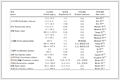
2 结果分析本研究利用上述方法获得了334个固定和流动台站的29832对分裂参数,去除掉快慢波时间延迟小于0.4 s的弱各向异性结果以及无效的分裂参数,最终得到243个台站的有效分裂结果,详见图 4和表 1.图 5和图 6分别展示了整个研究区和不同构造块体的各向异性快波偏振方向和快慢波时间延迟的分布情况,其中快波偏振方向为沿着正北向顺时针旋转的角度.通过分析,东北地区平均快慢波时间延迟为0.9 s,平均分裂方向为N77°W,但不同构造块体还存在着不同的各向异性特征.

|
图 4 研究区内固定台站(蓝色)和流动台站(红色)各向异性结果 短线的方向为各向异性的快波偏振方向,圆圈的大小与快慢波时间延迟成正比,黑色箭头表示绝对板块运动(APM)的方向(Li and Niu, 2010),A表示大兴安岭造山带,B表示松辽盆地,C表示佳木斯地块与长白山造山带,D表示燕山造山带. Fig. 4 Anisotropic results of permanent stations (blue) and temporary stations (red) in the study area The direction of the short line is anisotropic fast wave polarization direction, and the size of the circle is proportional to the delay time, black arrow denotes the direction of absolute plate motion (APM) (Li and Niu, 2010), A denotes the Great Xing′an range Orogenic Belt, B denotes the Songliao basin, C denotes the Jiamusi Massif and Changbaishan Orogenic Belt, D denotes the Yanshanian Orogenic Belt. |
|
表 1 中国东北地区固定和流动台站SKS有效分裂结果 Table 1 The SKS effective splitting results of permanent and temporary seismic stations beneath NE China |

|
图 5 研究区各向异性快波偏振方向(a)和快慢波时间延迟(b)的台站数分布直方图 Fig. 5 The histogram of anisotropic fast wave polarization direction (a) and the delay time (b) in the study area |

|
图 6 不同构造块体的各向异性快波偏振方向(蓝色)和快慢波时间延迟(红色)的台站数分布直方图 Fig. 6 The histogram of anisotropic fast wave polarization direction (blue) and the delay time (red) in different tectonic blocks |
为了定量了解本研究结果的可靠性,我们将本研究中固定台站和流动台站的各向异性结果分别与Li和Niu(2010)及Chen等(2017)的结果进行对比.首先以10°和0.2 s为一组,对相同台站各向异性快波方向(图 7a)和快慢波时间延迟(图 7b)的差值进行了统计.结果表明,对于77个固定台站,各向异性快波方向最大差值达56°,为DDO(40.15°N, 124.39°E)台,该台站前人(Li and Niu, 2010)与本文中用到的地震事件数分别为7和3,多数台站的差值在20°以内,其中分布在0°~10°和11°~20°之间的台站数分别为45和18,占总数的58.4%和23.4%,快慢波时间延迟的差值则集中分布在0.5 s以内;而流动台站的差值相对较大,快波方向差值最大的台站为NE86(46.17°N, 121.46°E),达到73°,但多数台站差值在40°以内,快慢波时间延迟差在0.5 s以内的台站数为49,占总数63的77.8%.对于流动地震台站,不同研究者获得的各向异性结果与固定地震台站存在较大差别,这可能与流动台站观测时间较短和记录到的地震波形质量难以与固定台站相比有关.为进一步证实本研究结果的可靠性,我们选取了两个固定台站BJT(40.02°N, 116.17°E)和MDJ(44.62°N, 129.59°E)(图 2a)与前人结果进行对比(表 2和表 3),由表 2可知本研究获得的BJT台站研究结果与使用事件数量较多(30个以上)的Liu等(2008)和Luo等(2004)的结果在快波方向上均仅相差4°,快慢波时间延迟的差值也分别为0.2 s和0.1 s,均小于误差,不仅说明地震数量越多结果越稳定,也说明我们的研究结果较为可靠.另外,还可以看到除个别使用资料事件数较少的研究结果(Zheng and Gao, 1994)与本研究结果较为接近外,其他使用事件数较少的研究结果(Li and Niu, 2010; Zhao and Zheng, 2005; Iidaka and Niu, 2001; 刘希强等, 2001)均与本研究结果存在较大差别,可能说明事件数对于研究结果起着一定作用.表 3展示出MDJ台站结果与前人研究结果的对比,也可以看出与表 2展示的BJT相类似的认识,即所用事件数越多,台站各向异性结果越稳定.

|
图 7 本研究结果与前人研究结果的快波偏振方向(a)和快慢波时间延迟(b)差值的台站数分布直方图 蓝色表示固定台站与Li和Niu(2010)的差值结果,红色表示流动台站与Chen等(2017)的差值结果. Fig. 7 Differences between present and previous studies in the fast wave polarization direction (a) and delay time (b) Blue colors denote the results from permanent seismic stations in the present and previous (Li and Niu, 2010) studies, whereas red colors denote the results from the temporary stations in the present and previous (Chen et al., 2017) studies. |
|
|
表 2 BJT(40.02°N, 116.17°E)台站本研究结果与前人结果对比 Table 2 Comparison of the present results with previous studies of BJT (40.02°N, 116.17°E) station |
|
|
表 3 MDJ(44.62°N, 129.59°E)台站本研究结果与前人结果对比 Table 3 Comparison of the present results with previous studies of MDJ (44.62°N, 129.59°E) station |
大兴安岭造山带北部的各向异性快波方向自北向南由NNE-SSW向转变为NNW-SSE向,在中部以NW-SE向为主,而南部的各向异性快波方向自北而南由NE-SW向逐渐转变为近E-W向,这些研究结果与前人(Li and Niu, 2010)在大多数台站的研究结果具有较好的一致性(图 8).比如,本研究中JGD(50.32°N, 124.09°E)台站的快波偏振方向为143°、快慢波时间延迟为1.0 s,而Li和Niu(2010)给出的各向异性方向和强度分别为138°和1.0 s.然而,在火山相关的地区,如哈拉哈火山群和阿巴嘎火山群的特殊地区,本研究结果与前人结果却有着较大差别,如本研究中CHR(47.97°N, 121.18°E)台站的快波方向和快慢波延迟分别为128°和0.9 s,而Li和Niu(2010)的结果为173°和0.5 s.这些差别说明,在将来工作中需要进一步开展相关研究以确认其各向异性特征.

|
图 8 固定台站各向异性结果(蓝色)与Li和Niu(2010)(红色)对比图(a)及灰色方框所示的局部放大图(b) Fig. 8 Comparison of anisotropic results from permanent stations between our study (blue) and Li and Niu (2010) results (red) (a), and the enlarged area in the gray square (b) |
松辽盆地各向异性的快波方向较为复杂(图 4),在北部自西向东主要表现为由NNW-SSE向逐渐转变为NW-SE向,在中部自西向东由NE-SW向转变为近E-W向,而在南部既有NE-SW向又有NW-SE向,这些结果与前人研究结果(Chen et al., 2017)相近(图 9).由于本研究利用了更丰富的地震资料,因此得到了更多固定台站的观测结果,且多数台站结果与其相邻台站的各向异性在空间分布上有很好的相关性.比如,松辽盆地西部的BCT(45.55°N, 122.21°E)台站的快波偏振方向70°、快慢波时间延迟0.9 s,盆地中部与之相邻的固定台站AGT(45.60°N, 123.76°E)和QAT(45.01°N, 124.00°E)的各向异性结果分别为66°、1.4 s和88°、1.5 s,而盆地东部的固定台站各向异性方向和强度的平均值分别为113°和1.5 s,说明松辽盆地各向异性强度表现为西部较弱,而中部和东部相近且较强.

|
图 9 流动台站各向异性结果(蓝色)与Chen等(2017)(红色)对比图(a)及灰色方框所示的局部放大图(b) Fig. 9 Comparison of anisotropic results from temporary stations between our study (blue) and Chen et al. (2017) results (red) (a), and the enlarged area in the gray square (b) |
佳木斯地块各向异性方向由西部的NW-SE转变为东部的NNW-SSE(图 4),同时快慢波时间延迟逐渐变大(平均为1.3 s).长白山造山带各向异性快波方向比较复杂,其北部自北向南由NW-SE向逐渐转变为近E-W向,中部长白山火山区的各向异性快波方向为NNW-SSE向,且快慢波时间延迟较大,如长白山火山附近的SMT(42.19°N, 128.17°E)和ZXT(42.41°N, 128.11°E)台站的各向异性结果分别为158°、1.8 s和174°、1.9 s,而南部以NW-SE向为主.
2.5 燕山造山带燕山造山带的各向异性快波方向主要沿E-W向分布,平行于燕山造山带的走向(图 4和图 8),但在重力梯度带和郯庐断裂带处各向异性的快波方向较为复杂,说明这些地区的各向异性不仅与晚侏罗纪燕山造山带引起的岩石圈变形、现今的重力梯度带和郯庐断裂带的深部动力学过程密切相关,而且还更多可能与中新生代西太平洋板块深俯冲形成的“大地幔楔”结构中的软流圈物质的水平流动等动力学过程(如Lei and Zhao, 2005, 2006; Zhao et al., 2009; 雷建设等, 2018)密切相关.
3 讨论 3.1 地震各向异性成因通常情况下,地震各向异性与地壳上地幔岩石中的晶体颗粒、裂隙和孔隙定向排列以及裂隙和孔隙内填充的流体密切相关.如果地幔橄榄岩晶体的排列方向是随机的,那么在宏观上则表现不出各向异性.如果地幔流动使得各向异性矿物沿流动方向定向排列,则会表现出明显的各向异性.因此,橄榄石晶格的优势方向与地幔各向异性成因有着直接联系.当地壳岩石受到挤压或拉张时,则会产生裂隙或孔隙,所以地壳介质会存在各向异性.姚陈等(2016)认为当地壳平均各向异性强度超过1%时,则利用SKS波也会观测到分裂现象.然而,由于地壳厚度远小于地幔厚度,因此相对于地幔各向异性(本研究平均为0.9 s延迟量),地壳中的各向异性(0.1~0.3 s延迟量)(Silver, 1996; Iidaka and Niu, 2001; 张广成等, 2013)明显要小很多,说明本研究获得的SKS各向异性特征主要来自于上地幔.
3.2 我国东北地区地幔各向异性成因由于受到西北太平洋板块的西向深俯冲至地幔转换带,造成东北地区岩石圈下部软流圈地幔物质流动,从而表现出各向异性,而各向异性快波方向能反映绝对板块运动(APM)的方向,利用HS3-NUVEL-1A模型(Gripp and Gordaon, 2002)计算得到的研究区板块运动方向为N64°W,与我们的各向异性结果(N77°W)尽管存在一定差异但相差不大,因此本研究获得的各向异性结果尽管可能与岩石圈拆沉和热物质上涌等动力学有关,但主要结构特征还可用“大地幔楔”动力学模型做出解释.
一般来说,各向异性存在于最近一次构造运动形成的岩石圈中,全球俯冲带的地幔各向异性研究表明,俯冲板片受到海沟的挤压影响,使得快波方向与海沟平行,而快慢波时间延迟与海沟移动速度有一定关联性(Long and Silver, 2008, 2009).然而,地幔楔中的各向异性方向与海沟走向近乎垂直,这可能与“地幔楔”中软流圈物质流密切相关(Kneller and Van Keken, 2007).我国东北地区处于太平洋板块深俯冲形成的“大地幔楔”结构(Lei and Zhao, 2005, 2006; Zhao et al., 2009; 雷建设等, 2018)之上,其各向异性快波方向基本表现为NW-SE向,但不同构造块体内部和不同块体之间均表现有复杂结构特征,如大兴安岭地区南部基本表现为NE-SW至北部却表现为NW-SE向,在松辽盆地内部西北角呈现出快波方向汇聚之势,而佳木斯地块基本表现为NNW-SSE向,但在长白山造山带却呈现为近E-W向.这些空间上复杂的变化模式,可能说明我国东北地区“大地幔楔”模型中的地幔流不仅仅是近E-W向水平流,而可能出现更复杂的地幔流.这些结果与最近Du和Lei(2019)采用Pn波获得上地幔顶部速度横向不均匀性的认识相一致(图 10).然而,本研究还不能排除由于岩石圈变形引起的各向异性结构特征,如燕山造山带的快波分布方向主要沿E-W,与走向方向一致,其各向异性形成原因还可能与晚侏罗纪燕山造山运动引起的岩石圈形变(Deng et al., 2007)有关.我国东北地区复杂各向异性特征,还有待将来结合更多地震资料如面波不同深度的特征各向异性进行深入研究.

|
图 10 本研究结果(灰色和黑色短线)与Du和Lei (2019)获得的上地幔顶部Pn波速度结果对比图 灰色和黑色短线分别表示每个台站记录到的事件各向异性结果与其平均结果,短线的方向和长短分别表示快波偏振方向和快慢波时间延迟的大小. Fig. 10 Comparison between our anisotropic results (gray and black short lines) and the Pn velocity of the uppermost mantle obtained by Du and Lei (2019) The gray and black short lines represent the anisotropy of each event recorded at each station and their average results, whereas the direction and length of the short lines represent the fast wave polarization direction and the delay time of the fast and slow waves, respectively. |
东北地区地质构造复杂,新生代板内火山较为发育.由图 4可以看出,阿巴嘎火山群以东的各向异性快波方向由东北处的NE-SW向逐渐转变为西侧的近E-W向,诺敏河火山群各向异性快波方向其北部为NW-SE向,而其南部为近NE-SW向,长白山火山区、龙岗火山区和镜泊湖火山区的各向异性快波方向其以北地区自西向东由近E-W向转变为NNW-SSE向,其以南地区自西向东由NNW-SSE转变为近E-W向,五大连池火山区周边地区的各向异性也呈现出近似发散状快波方向,这些结构特征得到最近噪声成像结果在火山区下方地壳上地幔存在明显低波速异常结果(如Yang et al., 2019)的支持, 这些结果说明我国东北地区火山下方存在热物质上涌引起岩石圈底界面软流圈水平流方向发生变化,这些结果均与太平洋板块深俯冲形成“大地幔楔”结构与动力学(如Lei and Zhao, 2005, 2006; Zhao et al., 2009; 雷建设等, 2018)密切相关.
4 结论本研究通过收集中国东北地区207个固定地震台站和127个流动地震台站的波形资料,利用剪切波分裂方法计算得到了243个台站的有效分裂参数.结果表明,整个研究区的平均快慢波时间延迟为0.9 s,不同构造单元内部与不同构造单元之间的各向异性分布特征均存在较大差异,但基本以NW-SE向为主,说明除了岩石圈拆沉和软流圈热物质上涌等动力学作用外,主要与西太平洋板块深俯冲形成的“大地幔楔”中软流圈物质水平流密切相关.我国东北火山区下方呈现出明显各向异性变化特征,可能与软流圈热物质上涌影响了“大地幔楔”中软流圈物质水平流有关.由于流动台站对固定台站有很好的补充,使得研究区台站分布更加均匀,从而更精细地刻画了东北地区地幔各向异性特征,为深入认识东北地区深部动力学过程提供了重要地震学证据.
致谢 中国地震局地球物理研究所国家测震台网数据备份中心(doi:10.11998/SeisDmc/SN)、黑龙江、吉林、辽宁、内蒙古、北京、天津、河北地震台网为本研究提供地震波形数据和IRIS数据中心提供的波形资料,感谢Stephen Gao教授提供的剪切波分裂计算程序,文中大部分图件使用Wessel和Smith (1998)提供的GMT软件绘制,感谢两位匿名审稿专家对本文提出的宝贵修改意见.
Chang L J, Wang C Y, Ding Z F, et al. 2008. Seismic anisotropy of upper mantle in the northeastern margin of the Tibetan Plateau. Chinese Journal of Geophysics (in Chinese), 51(2): 431-438. |
Chang L J, Wang C Y, Ding Z F. 2009. Seismic anisotropy of upper mantle in eastern China. Science in China Series D:Earth Sciences, 52(6): 774-783. DOI:10.1007/s11430-009-0073-4 |
Chang L J, Wang C Y, Ding Z F. 2012. Upper mantle anisotropy beneath North China. Chinese Journal of Geophysics (in Chinese), 55(3): 886-896. DOI:10.6038/j.issn.0001-5733.2012.03.018 |
Chen H C, Niu F L, Obayashi M, et al. 2017. Mantle seismic anisotropy beneath NE China and implications for the lithospheric delamination hypothesis beneath the southern Great Xing'an range. Earth and Planetary Science Letters, 471: 32-41. DOI:10.1016/j.epsl.2017.04.030 |
Christensen N I. 1984. The magnitude, symmetry and origin of upper mantle anisotropy based on fabric analyses of ultramafic tectonites. Geophysical Journal International, 76(1): 89-111. DOI:10.1111/j.1365-246X.1984.tb05025.x |
Deng J F, Su S G, Niu Y L, et al. 2007. A possible model for the lithospheric thinning of North China Craton:Evidence from the Yanshanian (Jura-Cretaceous) magmatism and tectonism. Lithos, 96(1-2): 22-35. DOI:10.1016/j.lithos.2006.09.009 |
Ding Z F, Zeng R S. 1996. Observation and study of shear wave anisotropy in Tibetan plateau. Chinese Journal of Geophysics (in Chinese), 39(2): 211-220. |
Du M F, Lei J S. 2019. Pn anisotropic tomography of Northeast China and its implications to mantle dynamics. Journal of Asian Earth Sciences, 171: 334-347. DOI:10.1016/j.jseaes.2018.08.033 |
Gao Y, Wu J, Yi G X, et al. 2010. Crust-mantle coupling in North China:Preliminary analysis from seismic anisotropy. Chinese Science Bulletin, 55(31): 3599-3605. DOI:10.1007/s11434-010-4135-y |
Gripp A E, Gordon R G. 2002. Young tracks of hotspots and current plate velocities. Geophysical Journal International, 150(2): 321-361. DOI:10.1046/j.1365-246X.2002.01627.x |
Hess H H. 1964. Seismic anisotropy of the uppermost mantle under oceans. Nature, 203(4945): 629-631. DOI:10.1038/203629a0 |
Iidaka T, Niu F L. 2001. Mantle and crust anisotropy in the eastern China region inferred from waveform splitting of SKS and PpSms. Earth Planets and Space, 53(3): 159-168. DOI:10.1186/BF03352373 |
Jiang M, Xu Z Q, Hirn A, et al. 2001. Teleseismic anisotropy and corresponding features of the upper mantle in Tibet Plateau and its neighboring areas. Acta Geosicientia Sinica (in Chinese), 22(2): 111-116. |
Kneller E A, Van Keken P E. 2007. Trench-parallel flow and seismic anisotropy in the Mariana and Andean subduction systems. Nature, 450(7173): 1222-1225. DOI:10.1038/nature06429 |
Lei J S, Zhao D P. 2005. P-wave tomography and origin of the Changbai intraplate volcano in Northeast Asia. Tectonophysics, 397(3-4): 281-295. DOI:10.1016/j.tecto.2004.12.009 |
Lei J S, Zhao D P. 2006. Global P-wave tomography:On the effect of various mantle and core phases. Physics of the Earth and Planetary Interiors, 154(1): 44-69. DOI:10.1016/j.pepi.2005.09.001 |
Lei J S, Xie F R, Fan Q C, et al. 2013. Seismic imaging of the deep structure under the Chinese volcanoes:An overview. Physics of the Earth and Planetary Interiors, 224: 104-123. DOI:10.1016/j.pepi.2013.08.008 |
Lei J S, Zhao D P, Xu Y G, et al. 2018. Is there a gap in the stagnant Pacific slab in the mantle transition zone under the Changbaishan volcano?. Acta Petrologica Sinica (in Chinese), 34(1): 13-22. |
Li J, Niu F L. 2010. Seismic anisotropy and mantle flow beneath northeast China inferred from regional seismic networks. Journal of Geophysical Research:Solid Earth, 115(B12): B12327. DOI:10.1029/2010JB007470 |
Liu K H, Gao S S, Gao Y, et al. 2008. Shear wave splitting and mantle flow associated with the deflected Pacific slab beneath northeast Asia. Journal of Geophysical Research:Solid Earth, 113(B1): B01305. DOI:10.1029/2007JB005178 |
Liu X Q, Zhou H L, Li H, et al. 2001. Anisotropy of the upper mantle in Chinese mainland and its vicinity. Acta Seismologica Sinica (in Chinese), 23(4): 337-348. |
Long M D, Silver P G. 2008. The subduction zone flow field from seismic anisotropy:A global view. Science, 319(5861): 315-318. DOI:10.1126/science.1150809 |
Long M D, Silver P G. 2009. Mantle flow in subduction systems:The subslab flow field and implications for mantle dynamics. Journal of Geophysical Research:Solid Earth, 114(B10): B10312. DOI:10.1029/2008JB006200 |
Luo Y, Huang Z X, Peng Y J, et al. 2004. A study on SKS wave splitting beneath the China mainland and adjacent regions. Chinese Journal of Geophysics (in Chinese), 47(5): 812-821. |
Nicolas A, Christensen N I. 1987. Formation of anisotropy in upper mantle peridotites-a review.//Fuchs K, Froidevaux C eds. Composition, Structure and Dynamics of the Lithosphere-Asthenosphere System. Washington, D.C.: American Geophysical Union, 16: 111-123.
|
Niu Y. 2005. Generation and evolution of basaltic magmas:Some basic concepts and a new view on the origin of Mesozoic-Cenozoic basaltic volcanism in Eastern China. Geological Journal of China Universities, 11(1): 9-46. |
Qiang Z Y, Wu Q J. 2015. Upper mantle anisotropy beneath the north of northeast China and its dynamic significance. Chinese Journal of Geophysics (in Chinese), 58(10): 3540-3552. DOI:10.6038/cjg20151010 |
Qiang Z Y, Wu Q J, Li Y H, et al. 2017. Complicated seismic anisotropy beneath south-central Mongolia and its geodynamic implications. Earth and Planetary Science Letters, 465: 126-133. DOI:10.1016/j.epsl.2017.02.035 |
Sandvol E, Ni J. 1997. Deep azimuthal seismic anisotropy in the southern Kurile and Japan subduction zones. Journal of Geophysical Research:Solid Earth, 102(B5): 9911-9922. DOI:10.1029/96JB03489 |
Savage M K, Silver P G. 1993. Mantle deformation and tectonics:Constraints from seismic anisotropy in the western United States. Physics of the Earth and Planetary Interiors, 78(3-4): 207-227. DOI:10.1016/0031-9201(93)90156-4 |
Shi Y, Gao Y, Su Y J, et al. 2012. Shear-wave splitting beneath Yunnan area of Southwest China. Earthquake Science, 25(1): 25-34. |
Silver P G, Chan W W. 1991. Shear wave splitting and subcontinental mantle deformation. Journal of Geophysical Research:Solid Earth, 96(B10): 16429-16454. DOI:10.1029/91JB00899 |
Silver P G. 1996. Seismic anisotropy beneath the continents:Probing the depths of geology. Annual Review of Earth and Planetary Sciences, 24(1): 385-432. DOI:10.1146/annurev.earth.24.1.385 |
Tang Y C, Obayashi M, Niu F L, et al. 2014. Changbaishan volcanism in northeast China linked to subduction-induced mantle upwelling. Nature Geoscience, 7(6): 470-475. DOI:10.1038/ngeo2166 |
Vinnik L P, Farra V, Romanowicz B. 1989. Azimuthal anisotropy in the earth from observations of SKS at GEOSCOPE and NARS broadband stations. Bulletin of the Seismological Society of America, 79(5): 1542-1558. |
Wang C Y, Chang L J, Lv Z Y, et al. 2007. Seismic anisotropy of upper mantle in eastern Tibetan Plateau and related crust-mantle coupling pattern. Science in China Series D:Earth Sciences, 50(8): 1150-1160. DOI:10.1007/s11430-007-0053-5 |
Wang C Y, Chang L J, Ding Z F, et al. 2014. Upper mantle anisotropy and crust-mantle deformation pattern beneath the Chinese mainland. Science China Earth Sciences, 57(1): 132-143. |
Wang F, Zhou X H, Zhang L C, et al. 2006. Late Mesozoic volcanism in the Great Xing'an Range (NE China):Timing and implications for the dynamic setting of NE Asia. Earth and Planetary Science Letters, 251(1-2): 179-198. DOI:10.1016/j.epsl.2006.09.007 |
Wang Q, Gao Y, Shi Y T, et al. 2013. Seismic anisotropy in the uppermost mantle beneath the northeastern margin of Qinghai-Tibet plateau:Evidence from shear wave splitting of SKS, PKS and SKKS. Chinese Journal of Geophysics (in Chinese), 56(3): 892-905. DOI:10.6038/cjg20130318 |
Wessel P, Smith W H F. 1998. New, improved version of generic mapping tools released. Eos, Transactions American Geophysical Union, 79(47): 579-579. DOI:10.1029/98EO00426 |
Wu F Y, Lin J Q, Wilde S A, et al. 2005. Nature and significance of the Early Cretaceous giant igneous event in eastern China. Earth and Planetary Science Letters, 233(1-2): 103-119. DOI:10.1016/j.epsl.2005.02.019 |
Yang Y, Lei J S, Ai Y S, et al. 2019. Crustal structure beneath Northeast China from ambient noise tomography. Physics of the Earth and Planetary Interiors, 293: 106257. DOI:10.1016/j.pepi.2019.04.008 |
Yao C, Hao C T, Zhang G L. 2016. A study of synthetic seismograms for SKS-wave response to crustal fractured-induce anisotropy. Chinese Journal of Geophysics (in Chinese), 59(7): 2498-2509. DOI:10.6038/cjg20160715 |
Yu Y, Chen Y S, Jian H C, et al. 2016. SKS wave splitting study of the transition zone at the central portion of the North China Craton. Chinese Journal of Geophysics (in Chinese), 59(1): 141-151. DOI:10.6038/cjg20160111 |
Zhang G C, Wu Q J, Li Y H, et al. 2013. An investigation on crustal anisotropy of Northeast China using Moho Ps converted phase. Acta Seismologica Sinica (in Chinese), 35(4): 485-497. |
Zhao D P, Tian Y, Lei J S, et al. 2009. Seismic image and origin of the Changbai intraplate volcano in East Asia:Role of big mantle wedge above the stagnant Pacific slab. Physics of the Earth and Planetary Interiors, 173(3-4): 197-206. DOI:10.1016/j.pepi.2008.11.009 |
Zhao L, Zheng T Y. 2005. Using shear wave splitting measurements to investigate the upper mantle anisotropy beneath the North China Craton:Distinct variation from east to west. Geophysical Research Letters, 32(10): 153-174. DOI:10.1029/2005GL022585 |
Zheng S H, Gao Y. 1994. Azimuthal anisotropy in the lithosphere of Mainland China. Acta Seismologica Sinica (in Chinese), 16(2): 131-140. |
Zheng X F, Ouyang B, Zhang D N, et al. 2009. Technical system construction of Data Backup Center for China Seismograph Network and the data support to researches on the Wenchuan earthquake. Chinese Journal of Geophysics (in Chinese), 52(5): 1412-1417. DOI:10.3969/j.issn.0001-5733.2009.05.031 |
常利军, 王椿镛, 丁志峰, 等. 2008. 青藏高原东北缘上地幔各向异性研究. 地球物理学报, 51(2): 431-438. DOI:10.3321/j.issn:0001-5733.2008.02.015 |
常利军, 王椿镛, 丁志峰. 2009. 中国东部上地幔各向异性研究. 中国科学D辑:地球科学, 39(9): 1169-1178. |
常利军, 王椿镛, 丁志峰. 2012. 华北上地幔各向异性研究. 地球物理学报, 55(3): 886-896. DOI:10.6038/j.issn.0001-5733.2012.03.018 |
丁志峰, 曾融生. 1996. 青藏高原横波分裂的观测研究. 地球物理学报, 39(2): 211-220. DOI:10.3321/j.issn:0001-5733.1996.02.008 |
高原, 吴晶, 易桂喜, 等. 2010. 从壳幔地震各向异性初探华北地区壳幔耦合关系. 科学通报, 55(29): 2837-2843. |
姜枚, 许志琴, Hirn A, 等. 2001. 青藏高原及其部分邻区地震各向异性和上地幔特征. 地球学报, 22(2): 111-116. DOI:10.3321/j.issn:1006-3021.2001.02.004 |
雷建设, 赵大鹏, 徐义刚, 等. 2018. 长白山火山下方地幔转换带中滞留的俯冲太平洋板块存在空缺吗?. 岩石学报, 34(1): 13-22. |
刘希强, 周蕙兰, 李红, 等. 2001. 中国大陆及邻区上地幔各向异性研究. 地震学报, 23(4): 337-348. DOI:10.3321/j.issn:0253-3782.2001.04.001 |
罗艳, 黄忠贤, 彭艳菊, 等. 2004. 中国大陆及邻区SKS波分裂研究. 地球物理学报, 47(5): 812-821. DOI:10.3321/j.issn:0001-5733.2004.05.012 |
强正阳, 吴庆举. 2015. 中国东北地区北部上地幔各向异性及其动力学意义. 地球物理学报, 58(10): 3540-3552. DOI:10.6038/cjg20151010 |
王椿镛, 常利军, 吕智勇, 等. 2007. 青藏高原东部上地幔各向异性及相关的壳幔耦合型式. 中国科学:地球科学, 37(4): 495-503. |
王椿镛, 常利军, 丁志峰, 等. 2014. 中国大陆上地幔各向异性和壳幔变形模式. 中国科学:地球科学, 44(1): 98-110. |
王琼, 高原, 石玉涛, 等. 2013. 青藏高原东北缘上地幔地震各向异性:来自SKS、PKS和SKKS震相分裂的证据. 地球物理学报, 56(3): 892-905. DOI:10.6038/cjg20130318 |
姚陈, 郝重涛, 张广利. 2016. SKS波对地壳裂隙各向异性的响应——理论地震图研究. 地球物理学报, 59(7): 2498-2509. DOI:10.6038/cjg20160715 |
于勇, 陈永顺, 菅汉超, 等. 2016. 华北克拉通中部过渡带SKS波分裂研究:鄂尔多斯东南角的局部软流圈绕流. 地球物理学报, 59(1): 141-151. DOI:10.6038/cjg20160111 |
张广成, 吴庆举, 李永华, 等. 2013. 利用莫霍面Ps震相研究中国东北地区地壳各向异性. 地震学报, 35(4): 485-497. DOI:10.3969/j.issn.0253-3782.2013.04.004 |
郑斯华, 高原. 1994. 中国大陆岩石层的方位各向异性. 地震学报, 16(2): 131-140. |
郑秀芬, 欧阳飚, 张东宁, 等. 2009. "国家数字测震台网数据备份中心"技术系统建设及其对汶川大地震研究的数据支撑. 地球物理学报, 52(5): 1412-1417. DOI:10.3969/j.issn.0001-5733.2009.05.031 |