 2019, Vol. 62


2. 中国地震局地球物理研究所, 北京 100081;
3. 山东科技大学地球科学与工程学院, 青岛 266590;
4. 青岛海洋科学与技术国家实验室, 海洋矿产资源评价与探测技术功能实验室, 青岛 266237
2. Institute of Geophysics, China Earthquake Administration, Beijing 100081, China;
3. College of Earth Science and Engineering, Shandong University of Science and Technology, Qingdao 266590, China;
4. Laboratory for Marine Mineral Resources, Qingdao National Laboratory for Marine Science and Technology, Qingdao 266237, China
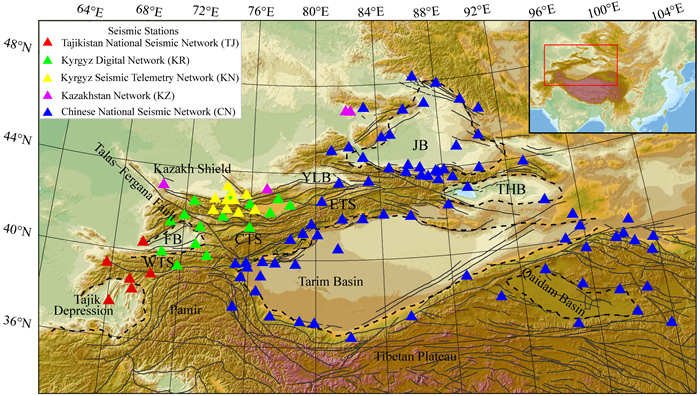
天山造山带主要位于哈萨克斯坦、吉尔吉斯斯坦和我国境内,距离印度—欧亚板块碰撞带约2000 km,在东西方向上绵延近2500 km,是世界上最典型的陆内造山带之一(图 1).天山造山带自西向东可分为三部分:西天山(费尔干纳断裂西侧)、中天山(费尔干纳断裂东侧至东经80°之间)以及位于中国境内的东天山(东经80°以东,Burtman, 2015).天山造山带由数条近EW向平行山脉及山间盆地组成,同时夹于塔里木盆地、准噶尔盆地和哈萨克地台等几个刚性块体之间.这些构造块体不仅影响和反映了不同地质构造单元的演化进程,而且控制了天山造山带地区中强地震的活动,形成了特殊的地质构造环境(Xu et al., 2002; Lei and Zhao, 2007).GPS研究结果表明,天山造山带正经历着明显的南北向地壳缩短变形,最大缩短速率约20 mm·a-1(Abdrakhmatov et al., 1996; Zubovich et al., 2010), 近乎于印度—欧亚板块汇聚速率的一半,表明天山造山带的隆起可能受到印度—欧亚大陆碰撞的远程效应的影响,而塔里木盆地在天山构造过程中起到了应力传递的作用(Molnar and Tapponnier, 1975; England and Houseman, 1985; Craig et al., 2012).
|
图 1 天山造山带地区主要构造及台站分布图 CTS, 中天山;ETS, 东天山;WTS, 西天山;JB, 准噶尔盆地;THB, 吐鲁番—哈密盆地;YLB, 伊犁盆地;FB, 费尔干纳盆地.不同颜色的三角形代表不同的测震台网.黑色实线表示区域主要断层.黑色虚线表示主要沉积盆地的轮廓. Fig. 1 Sketch map of regional tectonics and seismic stations in Tien Shan orogenic belt CTS, Central Tien Shan; ETS, Eastern Tien Shan; WTS, Western Tien Shan; JB, Junggar Basin; THB, Turpan—Hami Basin; YLB, Yili Basin; FB, Fergana Basin.The triangles denote seismic networks used in the study. The black solid lines mark the major faults. The black dashed lines mark the outlines of the major sedimentary basins. |
长期以来,天山造山带的深部结构研究一直受到学者们的高度关注,并取得了一系列有意义的研究成果.三维体波地震层析成像结果表明,天山造山带的下方存在明显的低波速异常, 这些低波速异常可能与地幔热物质上涌有关(Roecker et al., 1993;Xu et al., 2002;Lei and Zhao, 2007;Omuralieva et al., 2009).接收函数研究表明,天山造山带大部分地区的地壳厚度约为60 km,与周围盆地和地台的地壳厚度存在近20 km的差异(Oreshin et al., 2002; Vinnik et al., 2004; Kumar et al., 2005).剪切波分裂结果表明,天山山脉地区的各向异性快波方向与山脉的走向平行,而与塔里木盆地和哈萨克地台的碰撞挤压方向近乎垂直,可能与塔里木盆地和哈萨克地台的南北双向俯冲及其导致的天山地区岩石圈地幔南北向缩短变形有关(Li and Chen, 2006; Li et al., 2010b; 江丽君等, 2010; Cherie et al., 2016; 鲍子文和高原, 2017).然而,这些研究大部分集中于天山造山带的局部地区,并没有针对整个天山造山带开展深部结构的研究工作,对整个天山造山带地区的动力学认识仍存在争议.因此本研究整合了西天山、中天山以及东天山地区的大量地震观测台站的连续波形数据开展瑞利面波相速度与方位各向异性研究,有助于提升对整个天山造山带地区深部结构的认识,为揭示该区域地球动力学过程提供新的地震学观测证据.
1 数据和方法本研究的数据主要来自5个台网,总共108个台站(图 1).第1个台网是TJ(Tajikistan National Seismic Network)宽频带地震观测台网,主要分布于西天山地区;第2个台网是KR(Kyrgyz Digital Network)宽频带地震观测台网,主要分布于费尔干纳盆地周围和中天山地区;第3个台网是KN(Kyrgyz Seismic Telemetry Network)宽频带地震观测台网,主要分布于中天山地区;第4个台网是KZ(Kazakhstan Network)宽频带地震观测台网,主要分布于哈萨克地台的边缘;第5个台网是CN(Chinese National Seismic Network)宽频带地震观测台网,主要分布于我国境内(国家测震台网数据备份中心, 2007; 郑秀芬等, 2009).为了保证数据具有较高的信噪比,我们选取2012年1月—2014年12月期间的连续波形数据用于瑞利面波相速度频散曲线的提取.
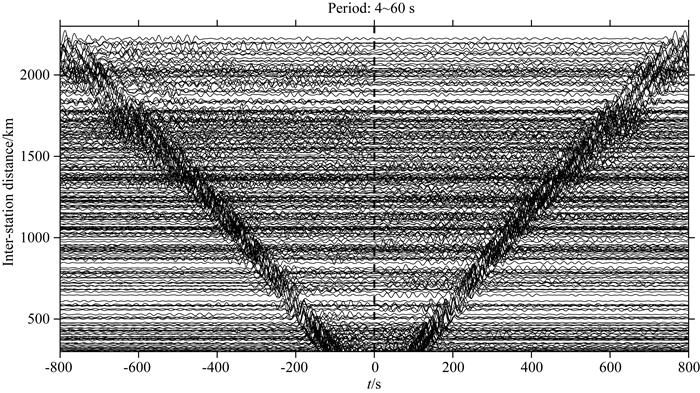
地震背景噪声的数据预处理主要参考前人的方法(Bensen et al., 2007; 吕子强和雷建设, 2016).首先是单台数据预处理,主要包括数据重采样,去均值、去倾斜分量和带宽为4~60 s的带通滤波,采用滑动绝对平均法进行时域归一化处理以消除地震信号和其他异常信号的影响,其中时窗长度选取带通滤波最大周期的一半.然后对归一化的数据进行频域谱白化,从而可以拓宽信号的频带并抑制某一单频信号的干扰,获得更加连续的频散曲线.最后对预处理完的背景噪声数据进行互相关计算.由于噪声源的分布通常是不均匀的,因而得到的互相关波形的正负时间分量往往存在不对称现象,为了提高互相关波形的信噪比,我们通过将互相关波形的正负分量取均值,从而得到正负半轴的“对称”分量(Lin et al., 2007).将互相关函数进行叠加和时间求导,则得到瑞利面波的经验格林函数.图 2为本研究提取到的部分台站经过带通滤波之后的经验格林函数,可以看出它们具有较好的对称性和较高的信噪比.
|
图 2 天山地区部分台站的经验格林函数(带通滤波4~60 s),黑色虚线代表中心对称轴 Fig. 2 Empirical Green functions extracted from the stacked cross-correlation of vertical component data (band-pass filtered at periods of 4~60 s), the black dashed line indicates symmetry axis |
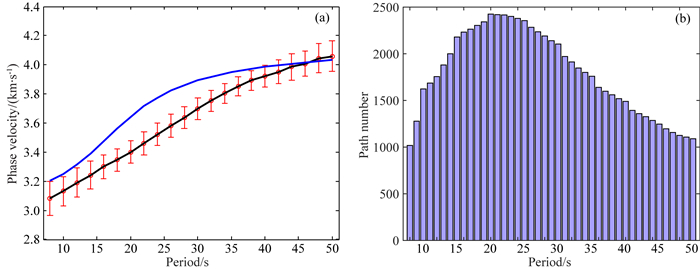
频散曲线的提取采用基于图像分析技术的相速度频散曲线提取方法(Yao et al., 2006).该方法定义信噪比为信号窗口振幅最大值与噪声窗口振幅平均值的比值.为了确保相速度频散曲线的测量精度,我们选取信噪比(SNR)大于5的波形资料用于频散曲线的提取.同时,为了满足远场面波格林函数的近似条件,选取台间距大于3个波长的波形记录,最终获得了天山造山带地区8~50 s周期的频散数据.图 3为最终提取到的研究区内的不同周期相速度的平均值和对应周期的标准差以及不同周期的射线路径数目.对比AK135模型和天山地区相速度的平均值,可以发现天山地区平均的地壳上地幔速度值小于全球平均速度模型,这与前人所提取到的频散曲线的结果基本一致(Guo et al., 2017),表明天山地区的岩石圈强度可能遭受到一定程度的弱化.
|
图 3 研究区内平均相速度及不同周期的射线数目 图(a)中黑色实线为不同周期的相速度平均值,红色误差棒为对应周期的标准差,蓝色实线为AK135模型的相速度值. Fig. 3 The average phase velocity and the number of ray-paths at different periods In figure (a), the black line represents the average phase velocity at different periods, the red error bars represent its standard deviations at the corresponding periods, and the blue line represents the phase velocity derived from AK135 earth model. |
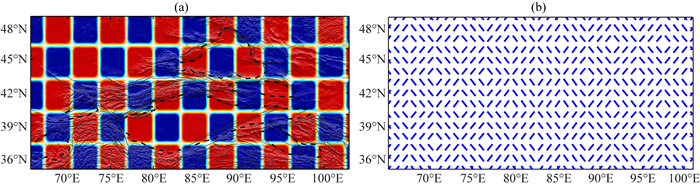
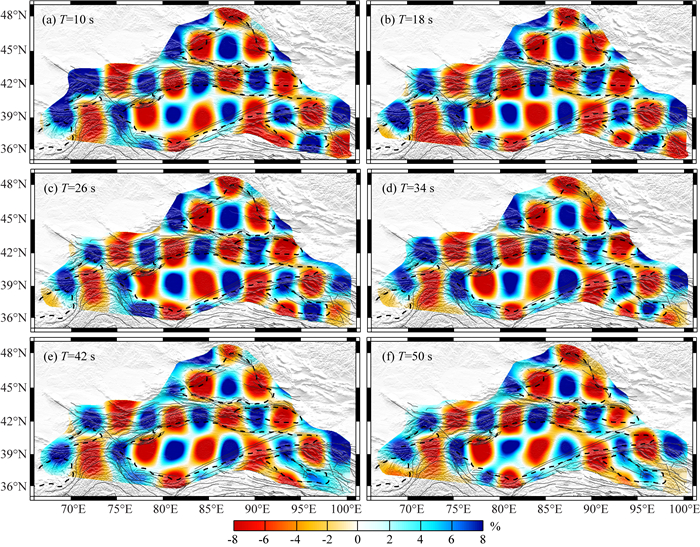
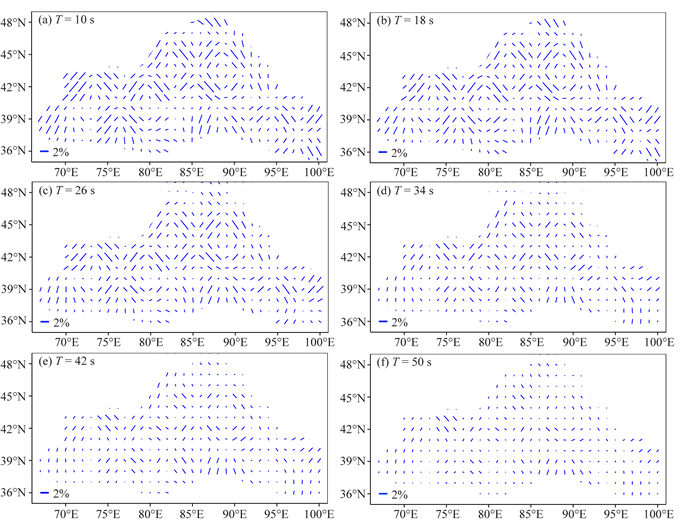
为了验证层析成像所用资料的空间分辨能力,我们开展了分辨率测试实验.在实验中,不同周期采用不同的初始速度模型,在每个周期的平均相速度值上加±8%的速度扰动量.对于方位各向异性,我们构建了各向异性强度为2%,方向为±45°的输入模型.图 4展示了3.0°×3.0°的初始速度与方位各向异性的输入模型.检测板实验的恢复结果与射线路径的分布有直接关系.尽管塔里木盆地的内部没有台站,但是位于塔里木盆地南部边缘的台站为本研究补充了更多的射线覆盖,从而提高了塔里木盆地内部地区的分辨率.周期为7~34 s的射线路径在整个天山造山带地区分布比较密集,因此反演恢复结果较好.周期为42 s和50 s的射线数量相对减少,恢复结果有所降低(图 5-6).整体而言,根据目前所用的资料,天山造山带地区的空间分辨率可以达到3.0°×3.0°.
|
图 4 3.0°×3.0°模型下的检测板测试输入模型 (a)初始速度模型,速度扰动范围为±8%; (b)方位各向异性模型,强度为2%,方向为±45°. Fig. 4 Input model for checkerboard resolution tests with a cell size of 3.0°×3.0° (a) Initial velocity model, the velocity perturbation varies within a range of ±8%; (b) Azimuthal anisotropy model with an anisotropic strength of 2% and fast directions of ±45°alternately. |
|
图 5 3.0°×3.0°模型下的不同周期的相速度恢复结果 红色代表低波速异常,蓝色代表高波速异常,色标位于图底,T为所用资料周期. Fig. 5 Results of checkerboard resolution tests using the data at different periods in the model with a cell size of 3.0°×3.0° Red and blue colors denote low and high velocity anomalies, respectively, the scale of which is shown at the bottom. T is the period of the data used. |
|
图 6 3.0°×3.0°模型下的不同周期的方位各向异性恢复结果 Fig. 6 Recovery results of anisotropy at different periods in the model with a cell size of 3.0°×3.0° |
|
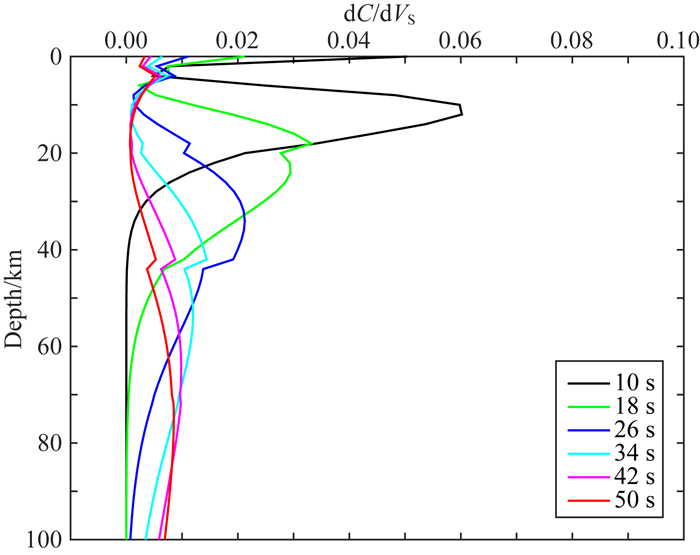
图 7 不同周期的瑞利面波相速度对S波的深度敏感核 Fig. 7 Depth sensitivity kernels of Rayleigh wave phase velocity at different periods |
我们利用8~50 s周期的瑞利面波相速度的频散曲线,采用Montagner(1986)发展的区域化反演算法对整个天山造山带地区进行0.5°×0.5°的网格划分,各向同性的平滑尺度选为200 km,各向异性的平滑尺度为400 km,最终得到周期8~50 s的瑞利面波相速度扰动和方位各向异性图像.
2 结果瑞利面波相速度主要与传播路径中的S波速度、P波速度及介质密度等有关,其中对S波速度更为敏感.由于瑞利面波的频散特征, 不同周期的瑞利面波可以反映不同深度范围的S波速度特征.图 7为不同周期基阶瑞利面波相速度对S波的深度敏感核.基阶瑞利面波相速度对大约1/3波长深度附近介质的S波速度结构最为敏感.周期越短,瑞利面波相速度的敏感深度范围越窄,随着周期的增加,敏感深度的范围也逐渐变宽.
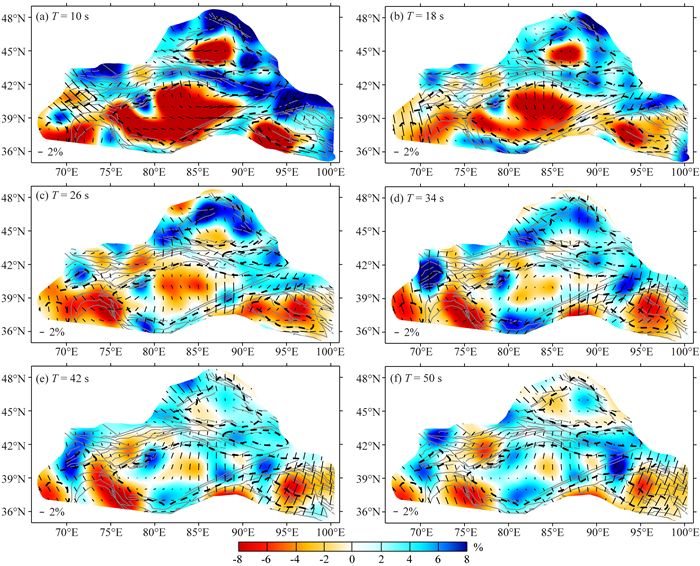
周期为10 s的瑞利面波相速度结果表现出与地表的地质构造单元具有较大的相关性(图 8a).低波速异常主要分布于沉积层厚度较大的盆地地区.如塔里木盆地、准噶尔盆地、柴达木盆地以及费尔干纳盆地,并且这些低波速异常形态与相应的构造块体的地表形态比较吻合.高波速异常主要分布于构造活动比较活跃的地区,如天山造山带、巴楚隆起以及山脉—盆地的边缘地区,其中伊塞克湖附近地区表现为相对弱的低波速异常.这与前人背景噪声层析成像的研究结果基本一致(Zheng et al., 2010; 唐小勇等, 2011; Li et al., 2012),但我们的结果更加清楚的展现了主要地质构造单元的波速异常形态.塔里木盆地内部的各向异性快波方向近EW向,而费尔干纳断裂附近的各向异性与断裂的走向一致,说明各向异性快波方向受地质构造及重大断裂的影响较大.周期18~26 s的瑞利面波相速度结果主要反映了中上地壳的结构特征(图 8b-c).塔里木盆地、准噶尔盆地及柴达木盆地主要呈现为低波速异常,随着周期的增加,低波速异常的幅度也逐渐减弱.塔里木盆地北部的低波速异常相对明显,前人研究认为,塔里木盆地北部沉积层的厚度最大可能达到16~18 km(Stolk et al., 2013), 表明塔里木盆地北部的低波速异常可能与沉积层的厚度有一定的相关性.中天山地区呈现出明显的低波速异常,并且低波速异常的形态逐渐向东天山地区扩展.费尔干纳盆地由低波速异常转变为高波速异常,而准噶尔盆地边缘仍然表现为相对稳定的高波速异常.东天山地区的各向异性快波方向表现为近NS向,中天山地区的各向异性快波方向表现为近EW向,而西天山地区的各向异性快波方向则表现为近NS向,整个天山造山带呈现出明显的分区特征.周期34~42 s的瑞利面波相速度结果主要反映了下地壳及上地幔顶部的结构特征(图 8d-e).准噶尔盆地和费尔干纳盆地主要呈现为高波速异常,塔里木盆地南部地区呈现为高波速异常,北部地区则呈现为低波速异常,同时可以发现天山地区的低波速异常主要集中于中天山地区.塔里木盆地和准噶尔盆地区域的各向异性快波方向逐渐转变为近NS向,并且各向异性的强度逐渐增强,这与Pn波速度结构的研究结果具有一定的相似性(Pei et al., 2007).周期50 s的瑞利面波相速度结果主要反映了上地幔地区的结构特征(图 8f).塔里木盆地北部地区仍然呈现为低波速异常,中天山地区的低波速异常幅度有所增强,费尔干纳盆地地区则主要表现为高波速异常,这与前人开展的区域尺度的体波层析成像的研究结果比较一致(Omuralieva et al., 2009; Lei, 2011).西天山和帕米尔高原区域的各向异性快波方向表现为近NW-SE向,与Pn波方位各向异性的结果比较一致(Lü et al., 2017).中天山区域的各向异性快波方向转变为NE-SW向,这与剪切波分裂的研究结果比较类似(Li and Chen, 2006),可能与中天山地区的地幔热物质上涌有关.
|
图 8 不同周期的二维瑞利面波相速度与方位各向异性分布图 红色和蓝色分别代表低波速和高波速异常,色标位于图底,T为所用的周期. Fig. 8 Maps of 2-D Rayleigh wave phase velocity and azimuthal anisotropy at different periods Red and blue colors denote low and high velocity anomalies, respectively, the scale of which is shown at the bottom. T is the period of the data used. |
目前研究普遍认为,天山造山带的复活再造运动很可能与印度板块北向俯冲具有一定的相关性(Molnar and Tapponnier, 1975; Sobel and Dumitru, 1997; Yin et al., 1998; Li et al., 2010a),然而,由于天山造山带的构造背景异常复杂,东天山、中天山及西天山受到不同构造块体的作用或者共同作用,因此其隆升机制和动力学机制仍然存在争议.
本文的研究结果表明,东天山地区中下地壳存在比较弱的低波速异常,而在上地幔区域则表现为明显的高波速异常(图 8c-f),前人的研究结果也揭示了类似的特征(Xu et al., 2002; Zhao et al., 2003).塔里木盆地和准噶尔盆地之间的上地幔区域各向异性快波方向主要表现为近NS向,暗示着塔里木盆地和准噶尔盆地的岩石圈已经俯冲至东天山的下方(Zhao et al., 2003; 高锐等, 2002; 郭飚等, 2006; Lü et al., 2019).Zhao等(2003)结合速度结构、密度结构以及电性结构等研究表明,在塔里木盆地和准噶尔盆地两个刚性块体的双向挤压下,塔里木盆地与天山造山带的地壳上地幔是层间插入与俯冲消减的过程.塔里木盆地的中上地壳插入天山造山带的中下地壳,塔里木盆地的下地壳连同岩石圈地幔俯冲至天山造山带的上地幔并消减.同时,由于塔里木地块的下地壳物质被带到天山造山带的上地幔,使东天山成为低密度与低波速块体,在重力均衡作用下致使东天山隆升,而隆升的速度与塔里木盆地向东天山下方俯冲消减的速度有关(赵俊猛等, 2001, 2003a).本文结果所呈现的东天山地区的中下地壳低波速异常和上地幔高波速异常,很大程度上是反映了塔里木盆地向东天山的俯冲过程.
大量研究结果表明,塔里木盆地和哈萨克地台的南北双向俯冲作用可能与中天山地区的岩石圈增厚和山脉隆升有关.塔里木盆地和哈萨克地台岩石圈碰撞所产生的碎片可能下沉至地幔深处,从而为上涌的地幔热物质提供了空间,而地幔热物质的上涌进一步加剧了山脉的隆升(Roecker et al., 1993; Chen et al., 1997; Lei and Zhao, 2007; Li et al., 2009; Lei, 2011; Koulakov, 2011; Wang et al., 2018).本文研究结果表明中天山地区的中下地壳存在低波速异常(图 8c-d),意味着中下地壳的强度相对较弱,这与接收函数和背景噪声的研究结果基本一致(Gilligan et al., 2014; Li et al., 2016; Lü and Lei, 2018),表明中天山地区的中下地壳可能存在部分熔融,这也得到了中天山地区镁铁岩包体分析结果的支持(Zheng et al., 2006; Bagdassarov et al., 2011).同时可以发现,相比于东天山,中天山地区的上地幔结构表现为明显的低波速异常,并且各向异性快波方向表现为NE-SW向(图 8f),与剪切波分裂的研究结果基本一致(Li and Chen, 2006),表明热的低波速物质可能一定程度上影响各向异性矿物的定向排列特征.同时可以发现,中天山下方的低波速异常从中下地壳一直延伸至上地幔区域,有些研究学者认为该低波速异常可能与小地幔柱有关(Friederich, 2003; Vinnik et al., 2004),也有研究学者推测该地区可能存在小尺度的地幔对流(Roecker et al., 1993; Tian et al., 2010).以上的研究结果均暗示着中天山地区的整个岩石圈结构已经弱化,可能与中天山地区上涌的地幔热物质有关.
GPS测量结果揭示了西天山地区的地壳缩短和岩石圈增厚与北向运动的帕米尔高原有着重要的联系(Zubovich et al., 2010).本文的研究结果表明,费尔干纳盆地中下地壳至上地幔表现为明显的高波速异常,而西天山及帕米尔高原则表现为低波速异常,这与前人所得到的层析成像的结果基本一致(Friederich,2003; Kufner et al., 2016; Li et al., 2018),可能与欧亚大陆岩石圈的俯冲、消减或冷物质进入软流圈有关.西天山区域的各向异性快波方向主要表现为近NW-SE向,这与Pn波方位各向异性的研究结果基本一致(Lü et al., 2017),可能是反映了印度—欧亚大陆板块碰撞并致使该区域地壳缩短和逐渐隆升的变形机制(赵俊猛等,2003a; Li et al., 2018).结合中深源地震分布、接收函数及剪切波速度结构等结果综合认为(Sippl et al., 2013; Kumar et al., 2005; Li et al., 2018),欧亚板块的大陆岩石圈可能已经南向俯冲至西天山与帕米尔高原的下方,并且印度与欧亚板块碰撞对于西天山地区的构造变形起着重要的作用.
研究普遍认为,塔里木盆地整体上表现为刚硬的块体,并在天山造山过程中起到了应力传递的作用(Molnar and Tapponnier, 1975; England and Houseman, 1985; Craig et al., 2012).根据拜城—大柴旦地球物理剖面的地壳与上地幔顶部的速度及Q值结构,推测塔里木盆地北部是一个刚性的块体,并且塔里木盆地不同区域向天山造山带消减的速度不同(赵俊猛等, 2003b; Zhao et al., 2006, 2008).而本文研究结果表明,在上地幔深度,塔里木盆地的东北区域存在弱的低波速异常(图 8e-f),暗示着塔里木盆地可能不是一个稳定的克拉通岩石圈块体.三维体波成像发现塔里木盆地南北两部分存在明显的速度差异,低波速异常与塔里木盆地中部近EW向分布的航磁高值异常带位置比较吻合,而盆地中部航磁异常可能反映了塔里木地块在震旦纪之前的拼合事件(Xu et al., 2002; 贾承造等, 2004).瞿辰等(2013)推测该地区上地幔可能存在局部熔融,波速扰动可能和该地区二叠纪岩石圈火山作用有关.同时,大地热流研究表明塔里木盆地内部地区存在一个高热流密度区,热流密度高达60 mW·m-2,与本文所呈现的低波速异常的位置比较一致(Hu et al., 2000; 冯昌格等, 2009; 王良书等, 1995).因此,我们推测塔里木盆地可能已经受到上涌的地幔热物质的侵蚀和破坏.
4 结论本研究整合了西天山、中天山以及东天山地区的大量地震观测台站的连续波形数据开展瑞利面波相速度与方位各向异性研究.研究结果表明,天山造山带地区存在明显的不均匀性.东天山区域的中下地壳表现为比较弱的低波速异常,而上地幔地区表现为明显的高波速异常且各向异性快波方向近NS向,可能与塔里木和准噶尔盆地向东天山的俯冲过程有关.中天山区域的上地幔表现为明显的低波速异常,且方位各向异性表现为近NE-SW向,推测地幔热物质上涌可能是导致中天山岩石圈弱化的重要因素.西天山及帕米尔高原的上地幔区域存在低波速异常,各向异性快波方向与板块的运动方向基本一致,表明印度与欧亚板块的碰撞以及欧亚大陆岩石圈俯冲对于西天山区域的构造演化起着重要的作用.
致谢 感谢中国地震局地球物理研究所国家数字测震台网数据备份中心及IRIS Data Management Center为本研究提供地震波形数据.感谢与王椿镛研究员的交流与探讨.两位审稿专家对本文提出的诸多宝贵建议,使文章增色不菲,在此一并表示感谢.
Abdrakhmatov K Y, Aldazhanov S A, Hager B H, et al. 1996. Relatively recent construction of the Tien Shan inferred from GPS measurements of present-day crustal deformation rates. Nature, 384(6608): 450-453. DOI:10.1038/384450a0 |
Bagdassarov N, Batalev V, Egorova V. 2011. State of lithosphere beneath Tien Shan from petrology and electrical conductivity of xenoliths. Journal of Geophysical Research:Solid Earth, 116(B1): B01202. DOI:10.1029/2009JB007125 |
Bao Z W, Gao Y. 2017. Crustal seismic anisotropy in the Tien Shan and adjacent areas. Chinese Journal of Geophysics (in Chinese), 60(4): 1359-1375. DOI:10.6038/cjg20170411 |
Bensen G D, Ritzwoller M H, Barmin M P, et al. 2007. Processing seismic ambient noise data to obtain reliable broad-band surface wave dispersion measurements. Geophysical Journal International, 169(3): 1239-1260. DOI:10.1111/j.1365-246X.2007.03374.x |
Burtman V S. 2015. Tectonics and geodynamics of the Tian Shan in the Middle and Late Paleozoic. Geotectonics, 49(4): 302-319. DOI:10.1134/S0016852115040020 |
Chen Y H, Roecker S W, Kosarev G L. 1997. Elevation of the 410 km discontinuity beneath the central Tien Shan:evidence for a detached lithospheric root. Geophysical Research Letters, 24(12): 1531-1534. DOI:10.1029/97GL01434 |
Cherie S G, Gao S S, Liu K H, et al. 2016. Shear wave splitting analyses in Tian Shan:Geodynamic implications of complex seismic anisotropy. Geochemistry, Geophysics, Geosystems, 17(6): 1975-1989. DOI:10.1002/2016GC006269 |
Craig T J, Copley A, Jackson J. 2012. Thermal and tectonic consequences of India underthrusting Tibet. Earth and Planetary Science Letters, 353-354: 231-239. DOI:10.1016/j.epsl.2012.07.01 |
Data Management Centre of China National Seismic Network. 2007. Waveform data of China National Seismic Network. Institute of Geophysics, China Earthquake Administration.http://www.seisdmc.ac.cn.
|
England C, Houseman G. 1985. Role of lithospheric strength heterogeneities in the tectonics of Tibet and neighbouring regions. Nature, 315(6017): 297-301. DOI:10.1038/315297a0 |
Feng C G, Liu S W, Wang L S, et al. 2009. Present-day geothermal regime in Tarim basin, northwest China. Chinese Journal of Geophysics (in Chinese), 52(11): 2752-2762. DOI:10.3969/j.issn.0001-5733.2009.11.010 |
Friederich W. 2003. The S-velocity structure of the East Asian mantle from inversion of shear and surface waveforms. Geophysical Journal International, 153(1): 88-102. DOI:10.1046/j.1365-246X.2003.01869.x |
Gao R, Xiao X C, Gao H, et al. 2002. Summary of deep seismic probing of the lithospheric structure across the West Kunlun-Tarim-Tianshan. Geological Bulletin of China (in Chinese), 21(1): 11-18. |
Gilligan A, Roecker S W, Priestley K F, et al. 2014. Shear velocity model for the Kyrgyz Tien Shan from joint inversion of receiver function and surface wave data. Geophysical Journal International, 199(1): 480-498. DOI:10.1093/gji/ggu225 |
Guo B, Liu Q Y, Chen J H, et al. 2006. Seismic tomography of the crust and upper mantle structure underneath the Chinese Tianshan. Chinese Journal of Geophysics (in Chinese), 49(6): 1693-1700. DOI:10.1002/cjg2.997 |
Guo Z, Gao X, Yao H J, et al. 2017. Depth variations of azimuthal anisotropy beneath the Tian Shan Mtrange (NW China) from ambient noise tomography. Journal of Asian Earth Sciences, 138: 161-172. DOI:10.1016/j.jseaes.2016.12.040 |
Hu S B, He L J, Wang J Y. 2000. Heat flow in the continental area of China:a new data set. Earth and Planetary Science Letters, 179(2): 407-419. DOI:10.1016/S0012-821X(00)00126-6 |
Jiang L J, Li Y H, Wu Q J. 2010. The shear wave splitting of Central Tien Shan and its implications. Chinese Journal of Geophysics (in Chinese), 53(6): 1399-1408. DOI:10.3969/j.issn.0001-5733.2010.06.018 |
Koulakov I. 2011. High-frequency P and S velocity anomalies in the upper mantle beneath Asia from inversion of worldwide traveltime data. Journal of Geophysical Research:Solid Earth, 116(B4): B04301. DOI:10.1029/2010JB007938 |
Kufner S K, Schurr B, Sippl C, et al. 2016. Deep India meets deep Asia:lithospheric indentation, delamination and break-off under Pamir and Hindu Kush (Central Asia). Earth and Planetary Science Letters, 435: 171-184. DOI:10.1016/j.epsl.2015.11.046 |
Kumar P, Yuan X, Kind R, et al. 2005. The lithosphere-asthenosphere boundary in the Tien Shan-Karakoram region from S receiver functions:evidence for continental subduction. Geophysical Research Letters, 32(7): L07305. DOI:10.1029/2004GL022291 |
Lü Y, Ni S D, Chen L, et al. 2017. Pn tomography with Moho depth correction from eastern Europe to western China. Journal of Geophysical Research:Solid Earth, 122(2): 1284-1301. DOI:10.1002/2016JB013052 |
Lü Z Q, GaoH Y, Lei J S, et al. 2019. Crustal and upper mantle structure of the Tien Shan orogenic belt from full-wave ambient noise tomography. Journal of Geophysical Research:Solid Earth, 124(4): 3987-4000. DOI:10.1029/2019JB017387 |
Lü Z Q, Lei J S. 2016. 3-D S-wave velocity structure around the 2015 MS8.1 Nepal earthquake source areas and strong earthquake mechanism. Chinese Journal of Geophysics (in Chinese), 59(12): 4529-4543. DOI:10.6038/cjg20161216 |
Lü Z Q, Lei J S. 2018. Shear-wave velocity structure beneath the central Tien Shan (NW China) from seismic ambient noise tomography. Journal of Asian Earth Sciences, 163: 80-89. DOI:10.1016/j.jseaes.2018.05.024 |
Lei J S, Zhao D P. 2007. Teleseismic P-wave tomography and the upper mantle structure of the central Tien Shan orogenic belt. Physics of the Earth and Planetary Interiors, 162(3-4): 165-185. DOI:10.1016/j.pepi.2007.04.010 |
Lei J S. 2011. Seismic tomographic imaging of the crust and upper mantle under the central and western Tien Shan orogenic belt. Journal of Geophysical Research:Solid Earth, 116(B9): B09305. DOI:10.1029/2010JB008000 |
Li A B, Chen C Z. 2006. Shear wave splitting beneath the central Tien Shan and tectonic implications. Geophysical Research Letters, 33(22): L22303. DOI:10.1029/2006GL027717 |
Li H Y, Li S, Song X D, et al. 2012. Crustal and uppermost mantle velocity structure beneath northwestern China from seismic ambient noise tomography. Geophysical Journal International, 188(1): 131-143. DOI:10.1111/j.1365-246X.2011.05205.x |
Li W, Chen Y, Yuan X H, et al. 2018. Continental lithospheric subduction and intermediate-depth seismicity:constraints from S-wave velocity structures in the Pamir and Hindu Kush. Earth and Planetary Science Letters, 482: 478-489. DOI:10.1016/j.epsl.2017.11.031 |
Li X P, Zhang L F, Wilde S A, et al. 2010a. Zircons from rodingite in the Western Tianshan serpentinite complex:Mineral chemistry and U-Pb ages define nature and timing of rodingitization. Lithos, 118(1-2): 17-34. DOI:10.1016/j.lithos.2010.03.009 |
Li Y H, Wu Q J, Jiang L J, et al. 2010b. Complex seismic anisotropic structure beneath the central Tien Shan revealed by shear wave splitting analyses. Geophysical Journal International, 181(3): 1678-1686. |
Li Y H, Shi L, Gao J Y. 2016. Lithospheric structure across the central Tien Shan constrained by gravity anomalies and joint inversions of receiver function and Rayleigh wave dispersion. Journal of Asian Earth Sciences, 124: 191-203. DOI:10.1016/j.jseaes.2016.05.003 |
Li Z W, Roecker S, Li Z H, et al. 2009. Tomographic image of the crust and upper mantle beneath the western Tien Shan from the MANAS broadband deployment:possible evidence for lithospheric delamination. Tectonophysics, 477(1-2): 49-57. DOI:10.1016/j.tecto.2009.05.007 |
Lin F C, Ritzwoller M H, Townend J, et al. 2007. Ambient noise Rayleigh wave tomography of New Zealand. Geophysical Journal International, 170(2): 649-666. DOI:10.1111/j.1365-246X.2007.03414.x |
Molnar P, Tapponnier P. 1975. Cenozoic tectonics of Asia:effects of a continental collision. Science, 189(4201): 419-426. DOI:10.1126/science.189.4201.419 |
Montagner J P. 1986. Regional three-dimensional structures using long-period surface waves. Annales Geophysicae, 4(3): 283-294. |
Omuralieva A, Nakajima J, Hasegawa A. 2009. Three-dimensional seismic velocity structure of the crust beneath the central Tien Shan, Kyrgyzstan:Implications for large-and small-scale mountain building. Tectonophysics, 465(1-4): 30-44. DOI:10.1016/j.tecto.2008.10.010 |
Oreshin S, Vinnik L, Peregoudov D, et al. 2002. Lithosphere and asthenosphere of the Tien Shan imaged by S receiver functions. Geophysical Research Letters, 29(8): 32-1. DOI:10.1029/2001GL014441 |
Pei S P, Zhao J M, SunY S, et al. 2007. Upper mantle seismic velocities and anisotropy in China determined through Pn and Sn tomography. Journal of Geophysical Research:Solid Earth, 112: B05312. DOI:10.1029/2006JB004409 |
Qu C, Yang W C, Yu C Q. 2013. Seismic velocity tomography and Poisson's ratio imaging in Tarim basin. Earth Science Frontiers (in Chinese), 20(5): 196-206. |
Roecker S W, Sabitova T M, Vinnik L P, et al. 1993. Three-dimensional elastic wave velocity structure of the Western and Central Tien Shan. Journal of Geophysical Research:Solid Earth, 98(B9): 15779-15795. DOI:10.1029/93JB01560 |
Sippl C, Schurr B, Tympel J, et al. 2013. Deep burial of Asian continental crust beneath the Pamir imaged with local earthquake tomography. Earth and Planetary Science Letters, 384: 165-177. DOI:10.1016/j.epsl.2013.10.013 |
Sobel E R, Dumitru T. 1997. Thrusting and exhumation around the margins of the western Tarim basin during the India-Asia collision. Journal of Geophysical Research:Solid Earth, 102(B3): 5043-5063. DOI:10.1029/96JB03267 |
Stolk W, Kaban M, Beekman F, et al. 2013. High resolution regional crustal models from irregularly distributed data:application to Asia and adjacent areas. Tectonophysics, 602: 55-68. DOI:10.1016/j.tecto.2013.01.022 |
Tang X Y, Fan W Y, Feng Y G, et al. 2010. Phase velocity tomography of Rayleigh wave in Xinjiang from ambient noise. Chinese Journal of Geophysics (in Chinese), 54(8): 2042-2049. DOI:10.3969/j.issn.0001-5733.2011.08.011 |
Tian X B, Zhao D P, Zhang H S, et al. 2010. Mantle transition zone topography and structure beneath the central Tien Shan orogenic belt. Journal of Geophysical Research:Solid Earth, 115(B10): B10308. DOI:10.1029/2008JB006229 |
Vinnik L P, Reigber C, Aleshin I M. 2004. Receiver function tomography of the central Tien Shan. Earth and Planetary Science Letters, 225(1-2): 131-146. DOI:10.1016/j.epsl.2004.05.039 |
Wang L S, Li C, Shi Y S. 1995. Distribution of terrestrial heat flow density in Tarim basin, Western China. Chinese Journal of Geophysics (Acta Geophysica Sinica) (in Chinese), 38(6): 855-856. |
Wang X S, Zhang X, Gao J, et al. 2018. A slab break-off model for the submarine volcanic-hosted iron mineralization in the Chinese Western Tianshan:Insights from Paleozoic subduction-related to post-collisional magmatism. Ore Geology Reviews, 92: 144-160. DOI:10.1016/j.oregeorev.2017.11.015 |
Xu Y, Liu F T, Liu J H, et al. 2002. Crust and upper mantle structure beneath western China from P wave travel time tomography. Journal of Geophysical Research:Solid Earth, 107(B10): 2220. DOI:10.1029/2001JB000402 |
Yao H J, Van Der Hilst R D, De Hoop M V. 2006. Surface-wave array tomography in SE Tibet from ambient seismic noise and two-station analysis-Ⅰ. Phase velocity maps. Geophysical Journal International, 166(2): 732-744. DOI:10.1111/j.1365-246X.2006.03028.x |
Yin A, Nie S, Craig P, et al. 1998. Late Cenozoic tectonic evolution of the southern Chinese Tian Shan. Tectonics, 17(1): 1-27. DOI:10.1029/97TC03140 |
Zhao J M, Liu G D, Lu Z X, et al. 2001. Crust-mantle transitional zone of Tianshan orogenic belt and Junggar basin and its geodynamic implication. Science in China Series D:Earth Sciences, 44(9): 824-837. DOI:10.1007/BF02907095 |
Zhao J M, Liu G D, Lu Z X, et al. 2003. Lithospheric structure and dynamic processes of the Tianshan orogenic belt and the Junggar basin. Tectonophysics, 376(3-4): 199-239. DOI:10.1016/j.tecto.2003.07.001 |
Zhao J M, Li Z C, Ma Z J. 2003a. Geophysical evidence for segmentation of the Tianshan. Earth Science Frontiers (in Chinese), 10(S1): 125-131. |
Zhao J M, Zhang X K, Deng H Z, et al. 2003b. Q value structure of the upper crust along the profile from Baicheng to DA Qaidam. Chinese Journal of Geophysics (in Chinese), 46(4): 503-509. |
Zhao J M, Mooney W D, Zhang X K, et al. 2006. Crustal structure across the Altyn Tagh Range at the northern margin of the Tibetan plateau and tectonic implications. Earth and Planetary Science Letters, 241(3-4): 801-814. |
Zhao J M, Cheng H G, Pei S P, et al. 2008. Deep structure at northern margin of Tarim Basin. Chinese Science Bulletin, 53(10): 1544-1554. |
Zheng J P, Griffinb W L, O'Reilly S Y, et al. 2006. Granulite xenoliths and their zircons, Tuoyun, NW China:insights into southwestern Tianshan lower crust. Precambrian Research, 145(3-4): 159-181. DOI:10.1016/j.precamres.2005.12.001 |
Zheng X F, Ouyang B, Zhang D N, et al. 2009. Technical systemconstruction of Data Backup Centre for China Seismograph Network and the data support to researches on the Wenchuan earthquake. Chinese Journal of Geophysics (in Chinese), 52(5): 1412-1417. DOI:10.3969/j.issn.0001-5733.2009.05.031 |
Zheng X F, Jiao W J, Zhang C H, et al. 2010. Short-period Rayleigh-wave group velocity tomography through ambient noise cross-correlation in Xinjiang, Northwest China. Bulletin of the Seismological Society of America, 100(3): 1350-1355. DOI:10.1785/0120090225 |
Zubovich A V, Wang X Q, Scherba Y G, et al. 2010. GPS velocity field for the Tien Shan and surrounding regions. Tectonics, 29(6): TC6014. DOI:10.1029/2010TC002772 |
鲍子文, 高原. 2017. 天山构造带及邻区地壳各向异性. 地球物理学报, 60(4): 1359-1375. DOI:10.6038/cjg20170411 |
冯昌格, 刘绍文, 王良书, 等. 2009. 塔里木盆地现今地热特征. 地球物理学报, 52(11): 2752-2762. DOI:10.3969/j.issn.0001-5733.2009.11.010 |
高锐, 肖序常, 高弘, 等. 2002. 西昆仑-塔里木-天山岩石圈深地震探测综述. 地质通报, 21(1): 11-18. DOI:10.3969/j.issn.1671-2552.2002.01.003 |
国家测震台网数据备份中心. 2007.国家测震台网地震波形数据.中国地震局地球物理研究所.http://www.seisdmc.ac.cn.
|
郭飚, 刘启元, 陈九辉, 等. 2006. 中国境内天山地壳上地幔结构的地震层析成像. 地球物理学报, 49(6): 1693-1700. DOI:10.3321/j.issn:0001-5733.2006.06.016 |
贾承造, 孙德龙, 周新源, 等. 2004. 塔里木盆地石油地质与勘探丛书——塔里木盆地板块构造与大陆动力学. 北京: 石油工业出版社: 1-202.
|
江丽君, 李永华, 吴庆举. 2010. 中天山及邻区S波分裂研究及其动力学意义. 地球物理学报, 53(6): 1399-1408. DOI:10.3969/j.issn.0001-5733.2010.06.018 |
吕子强, 雷建设. 2016. 2015年尼泊尔MS8.1地震震源区S波三维速度结构与强震发生机理研究. 地球物理学报, 59(12): 4529-4543. DOI:10.6038/cjg20161216 |
瞿辰, 杨文采, 于常青. 2013. 塔里木盆地地震波速扰动及泊松比成像. 地学前缘, 20(5): 196-206. |
唐小勇, 范文渊, 冯永革, 等. 2011. 新疆地区环境噪声层析成像研究. 地球物理学报, 54(8): 2042-2049. DOI:10.3969/j.issn.0001-5733.2011.08.011 |
王良书, 李成, 施央申. 1995. 塔里木盆地大地热流密度分布特征. 地球物理学报, 38(6): 855-856. DOI:10.3321/j.issn:0001-5733.1995.06.019 |
赵俊猛, 刘国栋, 赵国泽, 等. 2001. 天山造山带与准噶尔盆地壳幔过渡带及其动力学含义. 中国科学(D辑), 31(4): 272-282. |
赵俊猛, 李植纯, 马宗晋. 2003a. 天山分段性的地球物理学分析. 地学前缘, 10(S1): 125-131. |
赵俊猛, 张先康, 邓宏钊, 等. 2003b. 拜城-大柴旦剖面的上地壳Q值结构. 地球物理学报, 46(4): 503-509. |
郑秀芬, 欧阳飚, 张东宁, 等. 2009. "国家数字测震台网数据备份中心"技术系统建设及其对汶川大地震研究的数据支撑. 地球物理学报, 52(5): 1412-1417. DOI:10.3969/j.issn.0001-5733.2009.05.031 |