 2019, Vol. 62


2. 中国科学院大学, 北京 100049
2. University of Chinese Academy of Sciences, Beijing 100049, China
20世纪20年代,和达清夫首次发现并提出深震的概念(Wadati,1928).地震按深度通常可分3类:浅源地震(深度小于60 km)、中源地震(深度介于60~300 km之间)和深源地震(深度大于300 km).中深源地震与浅源地震在震级分布、震源时间函数、震源破裂速度和应力降等方面表现相似,但适用于浅源地震的脆性破裂理论无法解释中深源地震的发生(Frohlich, 1989, 2006;Green Ⅱ and Houston, 1995;Kirby et al., 1996).大多中深源地震发生在环太平洋俯冲地区,但在其他地区,例如天山西侧和喜马拉雅构造带西侧也分布有较深源的地震.在空间上中深源地震多以带状形态分布于俯冲板块内部,具有聚簇或群集特征,有的在中源地震深度范围内还形成间隔20~40 km的双地震带(Hasegawa et al., 1979;Peacock,2001).全球中深源地震的数量在60~300 km深度范围随深度增加呈指数减少,在300~400 km深度处出现最低值,在600 km深度范围又出现峰值(Vassiliou and Hager, 1988).地震观测记录(Frohlich,2006)和岩石矿物学实验、模型计算(Karato et al., 2001;Green Ⅱ,2007)结果表明中深源地震的空间分布主要受到板块温度、应力状态和物质成分的影响.
中深源地震的形成机理一直是地球科学研究的热点和备受争议的问题.通常认为,板块内含水矿物的脱水致脆(Dehydration embrittlement)作用可以导致中源地震的发生(Kirby et al., 1996).例如蛇纹石、角闪石、绿泥石等矿物在脱水过程中会引起岩石的弱化和脆化现象,从而产生断层的失稳.该机理能较好地解释中源地震双地震带的分布.在较低温度下,橄榄石到尖晶石会发生亚稳态相变(Olivine-spinel phase change),伴随相变可能会产生体积变化和不稳定剪切变形,最终导致深源地震的发生(Kirby et al., 1996;Green Ⅱ et al., 2010).Bridgman(1936)最早提出高速蠕变产生的热导致绝热剪切失稳(Adiabatic shear instability),温度的正反馈机制可以导致失稳的产生,从而产生深源地震.Liu和Zhang(2015)则提出了一种新的机制,认为俯冲洋壳和岩石圈在相变发生时存在体积变化差,从而在板片内部产生较大的应力,可以很好地解释600 km深度处深震数量的急剧增加.Zhan(2017)通过对全球中深源地震b值和分形维数的分析,提出了深源地震双机制模型,认为亚稳态橄榄楔(Metastable Olivine Wedge, MOW)内深源地震的发生主要受到“反裂隙断层作用”的影响(Transformational faulting),但破裂能够以动力剪切带(Dynamic shear bands)或剪切熔融的方式传播到MOW以外区域,且随着板块温度的升高,MOW厚度减小,地震分布的分形维数由2变为1.
中深源地震的形成与俯冲构造环境密不可分.西太平洋地区是世界上最典型的俯冲消减区,深源地震活动尤为活跃.从俯冲板片的年龄和俯冲速度角度来看,汤加俯冲地区(Tonga)具有全世界最大的俯冲热参数(Thermal parameter,~12000 km).地震层析成像研究表明停滞在660 km间断面之上的俯冲板片和下插进入到下地幔的板片在汤加地区并存(Fukao and Obayashi, 2013).该地区发生的4级以上中深源地震高达全球的67%,同时还频发“俯冲外侧”深源地震(Outboard earthquakes,后文也叫“外缘地震”)(Chen and Brudzinski, 2003;Frohlich,2006).沿日本—伊豆—小笠原一带的西北太平洋俯冲板块(Northwest Pacific plate)具有约6000~8000 km中等大小的热参数(Wiens and Gilbert, 1996;Frohlich,2006).俯冲板片在地幔过渡带内发生了大范围停滞(Huang and Zhao, 2006;Li et al., 2008),且出现板片的折曲增厚现象(Myhill,2013;Li et al., 2013, 2016).而在伊豆—小笠原地区,俯冲的太平洋板片在深部形态上发生转变,由板片停滞转换为南部的下插进入下地幔,迄今为止最深的Bonin地震(MW=7.9)就发生在俯冲板片发生撕裂区域附近(Zhao et al., 2017).该大地震的发生被认为是在俯冲构造环境下,与板块撕裂、板块内部的温度场、应力变化和相变等相关的综合因素所产生(Zhao et al., 2017).Myhill(2013)从板片俯冲形态入手,认为板片的弯曲变形(Buckling)改变了板片局部的应力状态,可以解释观测到的板片“折曲轴部”(Fold hinge)不同的深源地震震源机制分布.
随着全球地震台网的建立和完善,地震仪器精度的提高,已经可以获得更多、更准确、相对更为完备、震级更为统一的地震目录,为提取中深源地震时空分布特征,进而理解深震的发生机理创造了条件.本文特别选择了中深源地震数量较多,温度相对较低,但热参数和俯冲形态完全不同的西北太平洋俯冲地区(10°N—60°N,128°E—165°E,Northwest Pacific Plate,后文简记为NWP)和汤加地区(13°S—27°S,173°E —172°W,后文简记为Tonga)做为对比研究区域.将首先利用单键群方法将目标聚焦在两个特殊的深源地震簇上.这些特殊的地震簇通常和板块温度、应力状态和物质成分的改变相关,也可能指示了板块的剥落或残存的古老板块.本文将通过对这些特殊地震簇的地震学特征的分析,来探讨这些特殊深源地震簇发生的原因、形成的环境和对深震发生规律的启示.
1 数据和特殊聚簇的选取本研究把深度大于60 km的地震统一称为深震,并以300 km为界限区分中源地震和深源地震.采用的数据来自1977年1月至2018年9月的GCMT地震目录(Global Centroid Moment Tensor catalog).对GCMT、ISC以及USGS等不同目录的对比分析表明,GCMT目录的深震具有更准确的震源位置和震源机制参数(Kagan,2003;Frohlich,2006).GCMT目录统一采用具有绝对力学标度,可以客观描述地震绝对大小的矩震级MW(Moment magnitude)表示地震大小,在描述地震释放的能量上具有高度一致性,可以很好地用于深震聚簇及其他地震活动性的分析中.
首先利用最大曲率法(Maximum Curvature,MAXC)(Ogata and Katsura, 1993;Wiemer and Wyss, 2000;龙锋等,2009;黄亦磊等,2016)获得了NWP和Tonga地区深震的完备震级(Mc),即在一个时空范围内,地震台网能够100%检测到的最小震级(Rydelek and Sacks, 1989).该方法选取震级-频率曲线斜率最大处对应的震级为Mc.实际上,Mc通常对应非累积震级-频率分布中地震数目最多的震级.图 2a中实线给出了两个区域累积频率(Cum)的变化曲线;虚线给出了非累积频率(Non-Cum)的变化曲线.最终选取Mw5.2和5.3分别做为NWP和Tonga地区深震的完备震级.

|
图 2 聚簇分析过程中的必要参数Mc、Dc分析图和最终的聚簇结果 (a)NWP、Tonga区域深震(大于60 km)震级非累积频率与累积频率的分布图;(b)和(c)中黑色梯线表示聚簇数量随一系列SLC截止长度的变化,灰色折线表示黑色梯线的Laplacian结果,分别对应了NWP和Tonga区域;(d)截止长度为130 km时NWP深震空间聚簇分布,用颜色区分各个聚簇,其中,红色为G1N(Group1 in NWP),黄色G2N,橘黄色为G3N,蓝色为G4N,棕色为G5N,紫色为G6N,粉红色为G7N,黑色为G8N,白色表示地震数量少于3个的聚簇,绿色表示NWP区域除聚簇地震外的深震;(e)截止长度为75 km时Tonga区域的空间聚簇分布,其中,红色为G1T(Group1 in Tonga),蓝色G2T,黄色为G3T,白色为地震数量少于3个的聚簇,绿色表示除聚簇外的深震. Fig. 2 Figures of necessary parameters in the SLC analysis and results of clusters distribution (a) Distributions of non-cumulative and cumulative frequency of deep earthquakes (greater than 60 km) in NWP and Tonga regions. The black ladder lines in (b) and (c) are number of deep earthquake clusters in NWP and Tonga against the distances of cluster in SLC, and the grey broken lines are Laplacian results of the black ladder lines; (d) 3D view of isolated clusters of deep earthquakes. Clusters are distinguished by color, with red for G1N (Group 1 in NWP), yellow for G2N, orange for G3N, blue for G4N, brown for G5N, purple for G6N, pink for G7N, black for G8N, and white for clusters with no. of earthquakes less than 3; green circles are for deep earthquakes except clusters in NWP; (e) is, when distance of cluster is 75 km, spatial deep earthquakes of clusters in Tonga, in which, red is for G1T (Group 1 in Tonga), blue for G2T, yellow for G3T, white for clusters with earthquakes less than three, green for deep earthquakes except clusters in Tonga. |
采用单键群方法(Single-Link Cluster, SLC)(Frohlich and Davis, 1990)探究NWP、Tonga深震在空间上的聚簇分布特性,寻找特殊的深震聚簇.SLC方法能够发现和定义群集或者离散的地震事件.它以地震空间距离最短为原则,先把单个地震两两连接成子聚簇,子聚簇之间又以相同的原则连接为四四相连的子聚簇,以此递归的方式直到所有地震用单键连接在一起,再选取适当的截止长度(Distance of cluster,Dc),删除其中大于截止长度的单键,将地震分解为大小不同的地震聚簇.Frohlich和Davis(1990),Davis和Frohlich(1991)较早将该方法用于全球地震目录和地震活动性研究中.周蕙兰等(1997)和高原等(1998)将该方法引入到区域地震活动性研究中,分析青藏高原及周边地区的空间聚集性,探讨断层活动的分布特点.Gan等(2015)则将该方法用在了东北亚地区深源地震活动性和聚簇特征的分析中.
为判断合适的截止长度Dc,本文针对系列不同的截止长度Dc,计算与之对应的聚簇数量,再将拉普拉斯算子(Laplacian)作用于该聚簇数量曲线上,以凸显聚簇数量在不同Dc下的变化趋势(图 2b—2c).结果显示截止长度Dc小于~33 km时,两个区域Laplacian作用后的聚簇曲线均出现最大正幅度,在33 km出现最大负幅度.这表明在该空间距离下聚簇数量减小速度最大.该值与Frohlich提出的主震及其余震的空间截止长度约为30 km基本一致(Frohlich and Davis, 1990);在截止长度约为75 km时,两者Laplacian作用后的曲线变化明显减弱,这对应了空间邻近的多个大地震及其余震的聚簇截止长度(Frohlich and Davis, 1990;Davis and Frohlich, 1991);在截止长度大于~130 km以后,Laplacian作用后的曲线振幅鲜少变化,我们认为该值对应板块主体地震与特殊聚簇之间的截止长度.因此,选取130 km做为NWP区域的截止长度.结合前人在Dc上取值的经验(Frohlich and Davis, 1990;高原等,1998;Gan et al., 2015)以及本文对Dc值的测试结果,我们认为Tonga的深震数量多且空间分布相对聚集,因此选取75 km做为Tonga地区深震聚簇研究的截止长度,与前人(Frohlich and Davis, 1990;Davis and Frohlich, 1991;高原等,2000)把70 km做为地震群集特性的特征长度一致.
另外,地震定位是否准确也是影响聚簇结果的一个可能因素.研究中采用的是相对自洽、统一的GCMT目录(Kagan,2003).GCMT目录中深度的定位不确定性~15 km,也即地震位于真实深度±30 km范围内的概率为95%(Frohlich,2006).考虑到所取的截止长度远远大于地震深度的不确定性,因此,在目前选取的截止长度情况下,地震本身的定位不会对聚簇结果有影响.
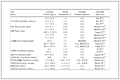
除去数量众多的背景深震外(图 2d—2e中绿色圆圈所示),NWP在截止长度为130 km时的聚簇数量为19,但仅有8个聚簇的地震数量大于2;Tonga在Dc为75 km时的聚簇数量高达25,但仅有3个聚簇的地震数量大于2,如表 1所示.基于以下原因,本文选取聚簇G1N和G1T做为研究的主要对象:(1)空间位置具有特殊性:G1N(图 2d)位于地震空区(Seismic gap)下方,这个空区在Gan等(2015)研究中已有发现,而G1T(图 2e)地震的截止深度很浅;(2)两个聚簇的地震数量相对较多(表 1).
|
表 1 西北太平洋和汤加俯冲地区聚簇地震的参数 Table 1 Parameters of the earthquake clustes beneath Northwest Pacific and Tonga subduction zones |
NWP地区的G1N聚簇位于纬度40.8°N—44.8°N,经度130°E—136.5°E范围内,共有44个地震,深度范围335~605 km,其正上方深度300 km处,存在明显的~300 km,500 km尺度地震空区(Gan et al., 2015).聚簇G2N和G4N亦分布于地震空区域周围,但是G3N、G5N、G6N、G7N、G8N都远离地震空区(图 2d).对于Tonga俯冲地区,聚簇G1T位于15°S—17.6°S,176°W—178°W之间,共有56个地震事件,分布于深度362~474 km之间.图 2d—e中红色点即给出了拟研究的G1T和G1N两个聚簇中的事件.为方便后文不同空间区域的对比研究,本文还引入两个概念——G1N_Slice和G1T_Slice,分别指代G1N和G1T所在纬度范围内的空间,包含了G1N、G1T,及其正上方、正下方的深震.
2 地震聚簇的分析 2.1 b值分析古登堡—里克特定理(也称G-R关系)给出了地震频度与震级的统计关系,其中的b值反映了区域内大小地震数量的相对比例,是地震活动性研究中的重要参量.b值的大小可以反映地下介质的特性和应力状态的变化(Schorlemmer et al., 2005;Narteau et al., 2009).对于深源地震,前人研究也表明b值的大小与俯冲板片的温度、板片的应变聚集和应力状态的改变相关(Myhill,2013;Gan et al., 2015;Zhan,2017).
本文采用极大似然法(Aki,1965)估计不同空间区域内地震的b值,并采用自举法(Bootstrapping)计算b值95%的置信区间.考虑到不同深度的深震发生机理可能是不同的,本文同时对NWP和Tonga地区的深源地震和全部深震等不同空间范围的事件也做了b值估计.
研究结果(图 3a)表明:对于NWP地区,G1N聚簇内地震的b值最小,仅为0.54,小于G2N聚簇的0.77、深源地震的0.65以及NWP所有深震的b值0.81;而Tonga地区G1T的b值为1.04, 和Tonga所有深震的b值1.00接近,略小于深源地震的b值1.09.本文对NWP、Tonga俯冲地区中源、深源地震的b值估计与Zhan(2017)用稳健回归方法获得的结果一致;对西北太平洋地区深源地震的b值~0.65也和Gan等(2015)给出的b~0.66一致,并且G1N地震簇的b值与Gan结果~0.60相近.考虑到G1N、G2N、G1T区域内b值的95%置信区间明显较大,可能是因为用于b值计算的地震数量较少,本文对这3组数据进行了不确定性分析,分别利用蒙特卡洛方法(Monte carlo)模拟以及1000次的自举抽样(Bootstrapping)计算b值(Zhan,2017).图 3b显示了地震数量最少的G2N聚簇的b值结果分布,其峰值均与初始估计的b值一致.其余两个区域的b值更加集中地分布在初始估计值附近,表明本文对G1N、G2N和G1T区深震的b值估计是统计可靠的.

|
图 3 不同区域的b值计算结果 (a)NWP区域的G1N、G2N以及该区域深震、深源地震,和Tonga区域的G1T、BC_C, BC_T以及该区域深震、深源地震的b值大小及其95%的置信区间;(b)以G2N聚簇地震为例,采用蒙特卡洛方法模拟以及1000次的自举抽样计算的b值分布,黑色代表蒙特卡洛方法,黄色代表自举法;(c)26°S—22°S,178°E—174°E,200~700 km的Tonga区域深源地震沿着剖线AB(图 1b)的投影,其中蓝色虚线和实线分别给出了BC_T和BC_C深震的范围. Fig. 3 Results of b-value for different sub-regions (a) b-values and uncertain estimation given by 95% confidence intervals for deep earthquakes in different sub-regions and depths ranges. (b) b value of earthquakes in G2N is simulated by Monte Carlo method (black) and 1000 bootstrapping (yellow); (c) Distribution of earthquakes projected along the profile in AB (Fig. 1b). The blue dashed and solid lines give the location of the specified BC_T and BC_C regions, respectively. |

|
图 1 文中用到的深震地理分布图 (a)西北太平洋俯冲地区;(b)汤加俯冲地区.地震数据来自哥伦比亚大学GCMT目录,圆圈代表地震,圆圈的颜色表示地震深度,圆圈的大小与地震释放的能量成比例,黑色曲线表示板块等深线.AB为图 3c中的剖线.黑色矩形框分别给出了G1N和G1T聚簇深震的分布范围,蓝色虚线和实线框对应Myhill(2013)明确给出的汤加俯冲板片出现“拉伸”和“压缩”性折曲的区域BC_T和BC_C. Fig. 1 Figures of geographic distribution of deep earthquakes Map showing distribution of deep earthquakes (circles) in NWP (a) and Tonga (b) regions. Earthquakes in Global CMT between 1977 and 2018 are chosen. Solid circles with various colors indicate the hypocenter depth, with circle sizes proportional to energy released by earthquakes. Black curve lines denote the depth contours of Wadati-Benioff zone in both regions; A-B indicates the sectional line of Fig. 3c. The black rectangle boxes indicate the geographic range of clusters G1N and G1T; The blue dashed line and solid line correspond to regions BC_T and BC_C respectively, where tensional and compressional hinges occur in the subducting plate beneath Tonga, which have been clearly identified by Myhill (2013). |
Slab2.0(Hayes et al., 2018)给出了最新的三维板块俯冲数据,它综合了主动源地震资料解释、接收函数、局部台网的地震目录以及地震波层析成像模型的结果,运用三维模拟方法获得直接、详细的板块形态数据.我们利用Slab2.0数据重点分析了俯冲板片在上地幔深部的形态变化.按照不同纬度切割G1N_Slice,将俯冲板片倾角的变化投影在深度图上.图 4a描绘了G1N_Slice沿不同纬度切片的板块俯冲形态,可以看出板片以相对小的角度开始俯冲,在进入到~200 km深度后,以~27°倾角继续平缓俯冲至500 km处,随后俯冲板片的倾角开始增加,且不同纬度切片上的变化趋势一致(图 4a),表明在550~600 km深度处,俯冲方向发生变化,板片向下弯折,出现了实质性的“折曲”.但G1T_Slice的纬度切片表现截然不同(图 4b):以较大的俯冲角度进入到岩石圈地幔,在350~400 km深度附近,最北部切片在深度上相继出现断离,不再继续延伸;中部和南部切片在400~500 km深度范围内的倾角剧烈变化,且中部切片在500 km深度范围内出现断离;这些不同纬度切片的倾角出现明显转折的深度不同,且转折的急缓程度差异也较大,完全不符合板片发生一致性折曲的明显特征,反而体现了局部、小尺度不规则的板片形态变化,暗示着存在其他不同尺度的构造原因.

|
图 4 板块形态随深度的变化 NWP(a)、Tonga(b)按不同纬度切割的板片倾角随深度的变化,可以直观表示板片俯冲形态的变化.数据来自Slab2.0. Fig. 4 Slab morphology varied with depth Variation of slab morphology along slices cut at different latitudes in NWP (a) and Tonga (b). Data is from Slab 2.0. |
Isacks和Molnar(1971)很早就发现深震震源机制解的主压应力轴(P轴)方向,或主张应力轴(T轴)方向与板块俯冲方向近乎平行.Myhill(2013)从板片形态对应力的影响角度出发,认为深源地震所处的板片如果向上弯曲,P轴平行板块;向下弯曲,则T轴平行于板块俯冲方向,并用板片不同方式的折曲解释深源地震在不同深度处的主压应力轴的分布.
利用事件的震源机制解对G1N、G1T及其附近板块内部的应力状态进行了分析.图 5a—d在赤平投影中给出了两个聚簇以及G1N_Slice和G1T_Slice中的深震主压/张应力轴分布.在330 km以深范围,NWP区域的G1N聚簇主压应力轴倾角基本稳定,分布于13°~53°范围,主要在20~35°范围内变化,均值为30°;而T轴的倾角随着深度的增加明显增大,特别是在500 km以深,T轴倾角从2°变化到70°,均值为39°,表明该深度的张应力出现较大的调整.对于Tonga俯冲地区,由于在深度~300 km处存在双地震带,P轴的倾角可以在0°~87°之间变化,平均倾角为34.2°;G1T聚簇中的P轴和T轴都没有出现类似G1N中的规律性变化.

|
图 5 主应力变化图 (a)、(b)为G1N_Slice深震的P轴、T轴的赤平投影;(c)、(d)为G1T_Slice深震的P轴、T轴的赤平投影.其中,黑色表示Slice中的背景地震,带颜色的符号表示聚簇中深震的应力轴,颜色表明了不同的地震深度.(e)为G1N_Slice的板块形态示意图,表明俯冲板片出现了向下的折曲,产生了局部张应力. Fig. 5 Features of principle stress axis Stereographic projections of P and T axes of deep earthquake in G1N_Slice (a—b) and G1T_Slice (c—d). Black symbols represent background earthquakes in Slices; Color symbols represent principal stress axes of deep earthquakes in the specified clusters, with the color indicating hypocenter depth. (e) A diagram of G1N_Slice shows that the subduction plate has a downward bending, resulting in local tensional stress. |
地震的深度分布是俯冲板块的地震学重要特征之一(Chen and Brudzinski, 2001;干微等,2012;Goes et al., 2017).图 6给出了两个研究区域地震的深度分布情况.本文对比了G1N_Slice深震、NWP中除去G1N外的深震、G1T_Slice深震以及Tonga中除G1T的深震深度分布.可以看出,G1N_Slice在260~350 km之间几乎无地震分布,其余深度的地震虽然数量较少,但地震分布的深度起伏特征与NWP区域总体一致:G1N_Slice在575 km出现频率峰值,而NWP在595 km出现频率峰值;G1N_Slice的截止深度为605 km,与NWP区域地震的截止深度625 km也大致相同(图 6a).但是G1T_Slice与Tonga地震的深度分布却呈现出显著的差异:G1T_Slice在375 km和425 km深度处出现频率峰值;Tonga地震在385 km和595 km出现频率峰值,其中385 km与G1T_Slice的第一个峰值375 km位置大致相同,第二个峰值595 km深度与G1T_Slice的两个峰值都相差很大;此外,G1T_Slice深震截止深度为474 km,而Tonga地震的截止深度为695 km(图 6b).

|
图 6 研究区域深震的深度分布 (a) NWP区域深震的深度分布,红色表示G1N_Slice的深震,灰色表示NWP除G1N外的所有深震;(b) Tonga区域深震的深度分布,红色表示G1T_Slice的深震,灰色表示Tonga除G1T外的所有深震. Fig. 6 Depth distribution of deep earthquakes in studied regions (a) Depth distribution of deep earthquakes in NWP zone, with red for deep earthquakes in G1N_Slice and grey for all deep earthquakes except G1N. (b) Same as (a), despite the red is for G1T_Slice, and the grey for Tonga. |
本文探讨了两个具有不同热参数的西太平洋俯冲地区NWP和Tonga区域的特殊聚簇G1N、G1T的深源地震特性,通过对地震活动性参数b值、俯冲板片的深部形态、震源机制,以及地震深度分布的分析,获取对特殊聚簇深源地震发生成因和形成环境的认识.
通过SLC方法检测到的聚簇G1N与周围的几个聚簇相距较远,且位于一处地震空区之下,该空区被认为可能代表了缺失的岩石圈板块(Gan et al., 2015).对b值的分析表明NWP区的所有深震的b值为0.81,其中,深源地震的b值减小到0.65,这表明该地区中源地震和深源地震的发生机理存在差异.而聚簇G1N则表现出和周围深震不一样的特性:该聚簇内深震的b值最小,约为0.54.对板片俯冲形态的分析表明该聚簇内的板片形态表现出急剧变化;震源机制解似乎也暗示在500 km以深,板片内部出现了张应力调整.但Tonga地区的特殊聚簇G1T的b值较大,和Tonga地区全部深震的b值,以及位于300~700 km范围之内的深源地震的b值相当.
Myhill(2013)曾明确指出在汤加地区存在几处典型的俯冲板片发生折曲区域(原文中Fig.7a区域),其中位于23°S—26°S,179.5°E—179.5°E,450~550 km深度处的板片发生下凹型变形,局部呈现出压性,震源机制解多表现为和局部板片形态相吻合的压性断层;而该区域紧邻的22°S—26°S,178°E—179.5°E,550~650 km区域,板片形态发生上隆,局部呈现张性,这和多数震源机制解给出的正断层型解吻合.以此研究为参考,将这两个区域的地震事件单独挑选出来,分别命名为BC_C(Buckling core-compression)和BC_T(Buckling core-tension)区域(图 1和图 3c),并对这两个区域的地震事件也做了b值分析(图 3a).结果显示,尽管这两个区域在空间上邻近,完备震级以上的地震事件数量也接近,分别有89和79个,但得到的b值却相差很大.压性折曲区BC_C的b值~1.26,是所有Tonga地区最高的;而张性折曲区BC_T内的b值为整个Tonga地区最小的,仅为0.93.Tonga俯冲带的BC_T区和NWP俯冲地区的G1N聚簇b值都相对较低,这表明就b值而言,这两个区域发生的深震在成因上具有内在关联.
深震的空间分布主要受到板块温度、应力状态以及物质成分的影响.板块内部应力的变化会增加中深源地震发生的频率(Isacks and Molnar, 1971;Alisic et al., 2010;Myhill,2013;Liu and Zhang, 2015;Zhang et al., 2019).全球深震震源机制研究表明,尽管深震的震源机制相对浅震较为规律,主压应力轴或主张应力轴大多与贝尼奥夫带平行,但仍有超过50%的深源地震的P轴远远偏离板片俯冲造成的下倾压缩或拉伸方向(Apperson and Frohlich, 1987).图 5a表明在G1N区域,当深度大于300 km时,深源地震的主压应力轴在30°附近变化,与日本—伊豆—小笠原一带板片以~30°角俯冲的形态相吻合.随着深度的增加,P轴倾角没有明显变化,依然与大尺度区域构造背景下的俯冲方向吻合;但T轴倾角却出现明显增加的趋势(图 5b),表明板块在G1N所在的区域内发生了形态上的改变,出现局部向下的弯曲(图 5e).对板片形态的分析也表明,沿G1N不同纬度切片的板片在400~500 km深度范围内出现趋势一致的转折,特别是在500 km深度处明显表现出板块弯曲的形态特征(图 4a).这些证据都支持了G1N特殊聚簇发生在板片形态出现明显变化的地区.类比Tonga地区板片出现明显拉张型“折曲”的BC_T区,我们认为NWP的特殊聚簇G1N低b值的出现是由于连续的俯冲板块抵达上地幔底部时,黏滞性阻力增大,板片发生折曲,产生局部张力,叠加在俯冲构造产生的大尺度压性背景上,使得局部应力出现调整,导致地震活动性的变化,b值呈现降低的趋势.
不同于G1N,G1T的主压力轴倾角呈现出多方向的特点(图 5c),主张力轴没有类似于G1N的倾角一致变化的现象(图 5d).同时Slab2.0数据显示不同的纬度范围内,Tonga板块的G1T特殊聚簇板片形态没有呈现较为一致、连续的变形,完全不具备G1N中展示的“板块折曲”的形态特征(图 4b).特别是G1T_Slice的深震深度分布特征与Tonga地区深震整体深度分布特征差别很大,~474 km的截止深度远远小于整个Tonga地区出现的~600 km的峰值深度和~680 km的截止深度.这表明Tonga地区G1T聚簇的产生另有其他原因.
在Tonga地区,太平洋板块以16~24 cm·a-1的速度向西俯冲(Pelletier et al., 1998;Müller et al., 2008).地震层析成像研究也揭示出汤加地区地幔中的高速异常体形态具有复杂性——既有部分板片下插进入到下地幔,还有向西延伸水平停滞在地幔过渡带内的板片(Fukao et al., 2001;Fukao and Obayashi, 2013).Chen和Brudzinski(2001)利用波形拟合方法也在Tonga俯冲地区检测到了两个独立但并置的板块.本文探测到的G1T聚簇在空间上位于Tonga地区深源地震聚集区的西侧,距离Tonga的贝尼奥夫—和达带50±20 km(Chen and Brudzinski, 2001).我们认为该聚簇深震不同于发生在汤加俯冲板块的其他深源地震,而是属于另一个板块或者板块残留体上的“外缘地震”(Outboard earthquakes)(Chen and Brudzinski, 2001).该“外缘地震”始于G1T聚簇,在地幔过渡带内一直向西延伸近1000 km.G1T聚簇内的地震具有和背景深震相当的b值,层析成像结果(Fukao and Obayashi, 2013)也显示G1T聚簇所在深度的高速异常体的值与周围的Tonga俯冲板块接近,说明它的整体温度很低,与之相关的板块或残留体年龄不会很老.我们认为,该板块是5~8 Ma前Vitiaz-Fiji系统快速俯冲的古老板块的残留体.G1T内的深震很可能是在快速俯冲并拆离后的古老板块的亚稳态橄榄石区内形成的(Brudzinski 2003,2005;Chen and Brudzinski, 2003),且古老的板块未能俯冲到深部致使深部的地震缺失,这也正是地震截止深度~ 474 km的原因.
我们也注意到,同样是西太平洋俯冲板块,NWP、Tonga地区深源地震的b值差别较大,前者较小,为0.65,而后者为1.09.很早就有研究表明不同俯冲区域的b值存在明显差别,b值的大小以及余震的数量和分布强烈受控于俯冲板块的温度(Giardini et al., 1985;Wiens and Gilbert, 1996).Tonga地区具有全球俯冲带最大的热参数,太平洋板块以~20 cm·a-1的速度快速俯冲,且俯冲板块年龄老、温度低,具有俯冲带中最高的b值.本文对Tonga地区深震以及深源地震的统计结果和前人(Wiens and Gilbert, 1996;Zhan,2017)最新的研究结果一致,支持深源地震在空间上沿着板块呈现二维分布(Zhan,2017)的推论.而热参数相对较小、温度相对高的NWP区域,b值在0.5~0.65之间变化,表明深源地震在空间分布上呈现一维形态(Zhan,2017).
对这两处特殊聚簇地震的分析可以看出,尽管都是太平洋板块俯冲地区发生的深震,其表现的特性和聚簇发生的成因和形成环境完全不同.俯冲板片的热参数在一阶上决定了深震发生的频度;板块俯冲过程中应力的改变,例如板块在上地幔底部受到的黏性阻力和板块负浮力,甚至低密度的橄榄石在地幔过渡带深度范围内以亚稳态方式存在而额外产生的板片内部压力(Bina,1997;Bina et al., 2001)等,都可以改变板块俯冲过程中板片的形态,局部弯曲的形态不同,应力调整的方式就不同,对深源地震活动性的改变也就不同.像在空间上彼此邻近的BC_T和BC_C区域,尽管都出现了板片的弯曲,但变形的形态不同,对地震活动性的影响也就不同.在Tonga俯冲地区,板片出现下凹式形变的BC_C区域具有较大的b值,我们认为局部出现的压应力叠加在俯冲构造背景形成的压应力上,应力的局部聚集促使更多中小地震的发生,从而b值增大.对于这一深源地震b值增大现象的解释和推论还需要结合前人对板片形态更准确的解译,在板片局域坐标系中利用震源机制解做更细致的分析.
4 结论本文对比研究了西太平洋俯冲地区两个具有不同热参数的NWP和Tonga俯冲带深震的特性,聚焦于SLC方法找到的两个特殊深震聚簇G1N和G1T的地震学特性,包括b值、板片俯冲形态、地震主应力轴特征,以及地震深度的分布等.NWP板块的G1N聚簇表现出极低的b值,板片形态在~500 km深度处发生大尺度一致性向下折曲,主张应力轴倾角随着深度的增加而明显增大.对比Tonga地区出现拉张式折曲的BC_T区域,我们认为G1N聚簇所在的俯冲板片在约500~600 km深度处表现出板片形态的折曲,产生的拉张应力叠加在以压性为主导的背景应力场上,导致地震活动性的变化.G1T聚簇的成因完全不同,地震发生在已经拆离的5~8 Ma前Vitiaz-Fiji系统古俯冲板块上,其板块内部的温度依然很低,并滞留在地幔过渡带内~500 km的深度处,致使G1T聚簇内地震的截止深度出现在~500 km.除去现在仍在活跃中的俯冲板块,温度足够低的年轻古板块残留体也可以是深震发生的聚集地.
致谢 感谢两位审稿人中肯的建议,感谢庄建仓教授的讨论并给出诸多建设性意见.文中高质量的GCMT目录数据来自www.globalcmt.org网站;图件制作主要利用了GMT软件包(www.soest.hawaii.edu/gmt).
Aki K. 1965. Maximum likelihood estimate of b in the formula logN=a-bM and its confidence limits. Bulletin of the Earthquake Research Institute, University of Tokyo, 43(2): 237-239. |
Alisic L, Gurnis M, Stadler G, et al. 2010. Slab stress and strain rate as constraints on global mantle flow. Geophysical Research Letters, 37(22): L22308. DOI:10.1029/2010gl045312 |
Apperson K D, Frohlich C. 1987. The relationship between Wadati-Benioff zone geometry and P, T and B axes of intermediate and deep-focus earthquakes. Journal of Geophysical Research:Solid Earth, 92(B13): 13821-13831. DOI:10.1029/Jb092ib13p13821 |
Bina C R. 1997. Patterns of deep seismicity reflect buoyancy stresses due to phase transitions. Geophysical Research Letters, 24(24): 3301-3304. DOI:10.1029/97gl53189 |
Bina C R, Stein S, Marton F C, et al. 2001. Implications of slab mineralogy for subduction dynamics. Physics of the Earth and Planetary Interiors, 127(1-4): 51-66. DOI:10.1016/S0031-9201(01)00221-7 |
Bridgman P W. 1936. Shearing phenomena at high pressure of possible importance for geology. The Journal of Geology, 44(6): 653-669. DOI:10.1086/624468 |
Brudzinski M R, Chen W P. 2003. A petrologic anomaly accompanying outboard earthquakes beneath Fiji-Tonga:corresponding evidence from broadband P and S waveforms. Journal of Geophysical Research:Solid Earth, 108(B6): ESE 2. DOI:10.1029/2002jb002012 |
Brudzinski M R, Chen W P. 2005. Earthquakes and strain in subhorizontal slabs. Journal of Geophysical Research:Solid Earth, 110(B8): B08303. DOI:10.1029/2004jb003470 |
Chen W P, Brudzinski M R. 2001. Evidence for a large-scale remnant of subducted lithosphere beneath Fiji. Science, 292(5526): 2475-2479. DOI:10.1126/science.292.5526.2475 |
Chen W P, Brudzinski M R. 2003. Seismic anisotropy in the mantle transition zone beneath Fiji-Tonga. Geophysical Research Letters, 30(13): 15. DOI:10.1029/2002gl016330 |
Davis S D, Frohlich C. 1991. Single-link cluster analysis, synthetic earthquake catalogues, and aftershock identification. Geophysical Journal International, 104(2): 289-306. DOI:10.1111/j.1365-246X.1991.tb02512.x |
Frohlich C. 1989. The nature of deep-focus earthquakes. Annual Review of Earth and Planetary Sciences, 17: 227-254. DOI:10.1146/annurev.ea.17.050189.001303 |
Frohlich C, Davis S D. 1990. Single-link cluster analysis as a method to evaluate spatial and temporal properties of earthquake catalogues. Geophysical Journal International, 100(1): 19-32. DOI:10.1111/j.1365-246X.1990.tb04564.x |
Frohlich C. 2006. Deep Earthquakes. Cambridge: Cambridge University Press: 100-101.
|
Fukao Y, Widiyantoro S, Obayashi M. 2001. Stagnant slabs in the upper and lower mantle transition region. Reviews of Geophysics, 39(3): 291-323. DOI:10.1029/1999rg000068 |
Fukao Y, Obayashi M. 2013. Subducted slabs stagnant above, penetrating through, and trapped below the 660 km discontinuity. Journal of Geophysical Research:Solid Earth, 118(11): 5920-5938. DOI:10.1002/2013JB010466 |
Gan W, Jin Z M, Wu Y, et al. 2012. A review of the mechanism of deep earthquakes:current situation and problems. Earth Science Frontiers (in Chinese), 19(4): 15-29. |
Gan W, Frohlich C, Jin Z M. 2015. Origin and significance of deep earthquake clusters surrounding a pronounced seismic gap in northeast China. Journal of Asian Earth Sciences, 100: 91-97. DOI:10.1016/j.jseaes.2015.01.002 |
Gao Y, Zhou H L, Liu Z, et al. 1998. Earthquake activities and seismic source characteristics in the neighboring zone of Sichuan Qinghai Xizang (Tibet), China. Seismology and Geology (in Chinese), 20(3): 413-422. |
Gao Y, Zhou H L, Ma Y L. 2000. SLC analysis on earthquake activity in the regions of Sichuan and Yunnan, China. Earthquake Research in China (in Chinese), 16(1): 86-91. DOI:10.3969/j.issn.1001-4683.2000.01.011 |
Giardini D, Dziewonski A M, Woodhouse J H. 1985. Centroid-moment tensor solutions for 113 large earthquakes in 1977-1980. Physics of the Earth and Planetary Interiors, 40(4): 259-272. DOI:10.1016/0031-9201(85)90037-8 |
Goes S, Agrusta R, van Hunen J, et al. 2017. Subduction-transition zone interaction:a review. Geosphere, 13(3): 644-664. DOI:10.1130/GES01476.1 |
Green Ⅱ H W, Houston H. 1995. The mechanics of deep earthquakes. Annual Review of Earth and Planetary Sciences, 23: 169-213. DOI:10.1146/annurev.ea.23.050195.001125 |
Green Ⅱ H W. 2007. Shearing instabilities accompanying high-pressure phase transformations and the mechanics of deep earthquakes. Proceedings of the National Academy of Sciences of the United States of America, 104(22): 9133-9138. DOI:10.1073/pnas.0608045104 |
Green Ⅱ H W, Chen W P, Brudzinski M R. 2010. Seismic evidence of negligible water carried below 400-km depth in subducting lithosphere. Nature, 467(7317): 828-831. DOI:10.1038/nature09401 |
Hasegawa A, Umino N, Takagi A, et al. 1979. Double-planed deep seismic zone and anomalous structure in the upper mantle beneath northeastern Honshu (Japan). Tectonophysics, 57(1): 1-6. DOI:10.1016/0040-1951(79)90098-2 |
Hayes G P, Moore G L, Portner D E, et al. 2018. Slab2, a comprehensive subduction zone geometry model. Science, 362(6410): 58-61. DOI:10.1126/science.aat4723 |
Huang J L, Zhao D P. 2006. High-resolution mantle tomography of China and surrounding regions. Journal of Geophysical Research:Solid Earth, 111(B9): B09305. DOI:10.1029/2005jb004066 |
Huang Y L, Zhou S Y, Zhuang J C. 2016. Numerical tests on catalog-based methods to estimate magnitude of completeness. Chinese Journal of Geophysics (in Chinese), 59(4): 1350-1358. DOI:10.6038/cjg20160416 |
Isacks B, Molnar P. 1971. Distribution of stresses in the descending lithosphere from a global survey of focal-mechanism solutions of mantle earthquakes. Reviews of Geophysics, 9(1): 103-174. DOI:10.1029/RG009i001p00103 |
Kagan Y Y. 2003. Accuracy of modern global earthquake catalogs. Physics of the Earth and Planetary Interiors, 135(2-3): 173-209. DOI:10.1016/s0031-9201(02)00214-5 |
Karato S I, Riedel M R, Yuen D A. 2001. Rheological structure and deformation of subducted Slabs in the mantle transition zone:implications for mantle circulation and deep earthquakes. Physics of the Earth and Planetary Interiors, 127(1-4): 83-108. DOI:10.1016/S0031-9201(01)00223-0 |
Kirby S H, Stein S, Okal E A, et al. 1996. Metastable mantle phase transformations and deep earthquakes in subducting oceanic lithosphere. Reviews of Geophysics, 34(2): 261-306. DOI:10.1029/96rg01050 |
Li C, van der Hilst R D, Engdahl E R, et al. 2008. A new global model for P wave speed variations in Earth's mantle. Geochemistry, Geophysics, Geosystems, 9(5): Q05018. DOI:10.1029/2007gc001806 |
Li J, Wang X, Wang X J, et al. 2013. P and SH velocity structure in the upper mantle beneath Northeast China:evidence for a stagnant Slab in hydrous mantle transition zone. Earth and Planetary Science Letters, 367: 71-81. DOI:10.1016/j.epsl.2013.02.026 |
Li J, Tosi N, Maierová P, et al. 2016. Evidence from caustic waveform modeling for long slab thickening above the 660-km discontinuity under northeast Asia: dynamic implications.//Morra G, Yuen D A, King S D, et al eds. Subduction Dynamics: From Mantle Flow to Mega Disasters. Washington, DC: American Geophysical Union, 211: 5-18, doi: 10.1002/9781118888865.ch1.
|
Liu L J, Zhang J S. 2015. Differential contraction of subducted lithosphere layers generates deep earthquakes. Earth and Planetary Science Letters, 421: 98-106. DOI:10.1016/j.epsl.2015.03.053 |
Long F, Wen X Z, Ni S D. 2009. Determination of temporal-spatial distribution of the regional minimum magnitudes of completeness:application to the Longmenshan fault zone. Earthquake (in Chinese), 29(3): 27-36. DOI:10.3969/j.issn.1000-3274.2009.03.004 |
Müller R D, Sdrolias M, Gaina C, et al. 2008. Age, spreading rates, and spreading asymmetry of the world's ocean crust. Geochemistry, Geophysics, Geosystems, 9(4): Q04006. DOI:10.1029/2007gc001743 |
Myhill R. 2013. Slab buckling and its effect on the distributions and focal mechanisms of deep-focus earthquakes. Geophysical Journal International, 192(2): 837-853. DOI:10.1093/gji/ggs054 |
Narteau C, Byrdina S, Shebalin P, et al. 2009. Common dependence on stress for the two fundamental laws of statistical seismology. Nature, 462(7273): 642-645. DOI:10.1038/nature08553 |
Ogata Y, Katsura K. 1993. Analysis of temporal and spatial heterogeneity of magnitude frequency distribution inferred from earthquake catalogues. Geophysical Journal International, 113(3): 727-738. DOI:10.1111/j.1365-246X.1993.tb04663.x |
Peacock S M. 2001. Are the lower planes of double seismic zones caused by serpentine dehydration in subducting oceanic mantle?. Geology, 29(4): 299-302. DOI:10.1130/0091-7613(2001)029〈0299:Atlpod〉2.0.Co;2 |
Pelletier B, Calmant S, Pillet R. 1998. Current tectonics of the Tonga-New Hebrides region. Earth and Planetary Science Letters, 164(1-2): 263-276. DOI:10.1016/S0012-821x(98)00212-X |
Rydelek P A, Sacks I S. 1989. Testing the completeness of earthquake catalogues and the hypothesis of self-similarity. Nature, 337(6204): 251-253. DOI:10.1038/337251a0 |
Schorlemmer D, Wiemer S, Wyss M. 2005. Variations in earthquake-size distribution across different stress regimes. Nature, 437(7058): 539-542. DOI:10.1038/nature04094 |
Vassiliou M S, Hager B H. 1988. Subduction zone earthquakes and stress in slabs. Pure and Applied Geophysics, 128(3-4): 547-624. DOI:10.1007/Bf00874550 |
Wadati K. 1929. Shallow and deep earthquakes. Geophysical Magazine, 2: 1-36. |
Wiemer S, Wyss M. 2000. Minimum magnitude of completeness in earthquake catalogs:Examples from Alaska, the western United States, and Japan. Bulletin of the Seismological Society of America, 90(4): 859-869. DOI:10.1785/0119990114 |
Wiens D A, Gilbert H J. 1996. Effect of slab temperature on deep-earthquake aftershock productivity and magnitude-frequency relations. Nature, 384(6605): 153-156. DOI:10.1038/384153a0 |
Zhan Z W. 2017. Gutenberg-Richter law for deep earthquakes revisited:a dual-mechanism hypothesis. Earth and Planetary Science Letters, 461: 1-7. DOI:10.1016/j.epsl.2016.12.030 |
Zhang H J, Wang F, Myhill R, et al. 2019. Slab morphology and deformation beneath Izu-Bonin. Nature Communications, 10(1): 1310. DOI:10.1038/s41467-019-09279-7 |
Zhao D P, Fujisawa M, Toyokuni G. 2017. Tomography of the subducting pacific slab and the 2015 Bonin deepest earthquake (MW7.9). Scientific Reports, 7: 44487. DOI:10.1038/Srep44487 |
Zhou H L, Liu Z, Gao Y. 1997. SLC Method and Earthquakes' clustering features in time-space in the top area of Kunlun-Altun-Arc. Earthquake Research in China (in Chinese), 13(3): 197-206. |
干微, 金振民, 吴耀, 等. 2012. 深源地震机理的回顾:现状与问题. 地学前缘, 19(4): 15-29. |
高原, 周蕙兰, 刘振, 等. 1998. 川青藏地区的地震活动及震源特征. 地震地质, 20(4): 413-422. |
高原, 周蕙兰, 马延路. 2000. 川滇地区地震活动单键群分析. 中国地震, 16(1): 86-91. DOI:10.3969/j.issn.1001-4683.2000.01.011 |
黄亦磊, 周仕勇, 庄建仓. 2016. 基于地震目录估计完备震级方法的数值实验. 地球物理学报, 59(4): 1350-1358. DOI:10.6038/cjg20160416 |
龙锋, 闻学泽, 倪四道. 2009. 区域最小完整性震级时空分布的确定——以龙门山断裂带为例. 地震, 29(3): 27-36. DOI:10.3969/j.issn.1000-3274.2009.03.004 |
周蕙兰, 刘振, 高原. 1997. 单键群方法与昆仑山-阿尔金山弧型构造顶部地震时空群集特征. 中国地震, 13(3): 197-206. |