 2010, Vol. 53


地壳介质中广泛存在各向异性特征,主要是因为地壳中存在大量直立的充满液体的定向排列EDA (Extensive-Dilatancy Anisotropy,大范围扩容各向异性)微裂隙[1].近震横波在地壳各向异性介质传播时,会分裂成近乎垂直偏振的快、慢两列波,快波偏振的优势方向与裂隙的走向一致,与原地最大主压应力方向一致,快、慢波的到时延迟受到介质中裂隙的物理特性和所含的流体特性的影响,对地壳应力场的变化非常灵敏[2~4].因此,横波分裂参数能够比较好地反映出区域应力状态和当地的局部构造特征,可以通过横波分裂来研究地壳介质特性和地壳应力状态[5~7],特别是探讨横波分裂参数在地震前后的时间变化,分析区域应力场变化[8~11].
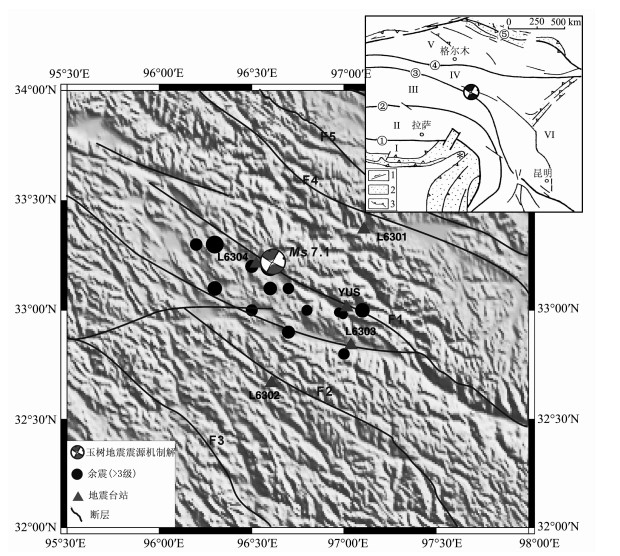
据中国国家地震台网中心测定,北京时间2010年4月14日7点49分,中国青海省玉树县(33.2°N,96.6°W)发生了Ms7.1的强烈地震,震源深度14km.玉树地震发生在NWW-NW走向的甘孜-玉树断裂带上(图 1).该断裂为左旋走滑性质,总长约500km,是巴颜喀拉地块的南边界.从板块构造背景分析,玉树地震是发生在印度板块向北推挤、青藏地块隆升、次级的巴颜喀拉活动地块向东挤出背景下的又一次大地震[12].玉树地震属于前震-主震-余震型,截止2010年5月底,已发生了2千多次余震,其中最大余震为6.3级地震.因此,玉树地震大量的余震序列为研究震源区横波分裂研究提供了丰富的数据资料.由于横波分裂的特性与震源上方最大水平应力分布相关的特性,利用横波分裂可以监测与地震活动有关的应力变化.横波分裂的现象对研究地震发生的机理和地震活动的应力背景有重要意义.
|
图 1 玉树地震震源区背景构造及地震台站、地震震中分布 F1甘孜-玉树断裂; F2字嘎寺-德钦断裂; F3杂多断裂; F4称多-曲麻莱-五道梁断裂; F5杂孕-楚玛尔河断裂.插图为青藏高原东部构造背景(根据文献[13]修改).1,大走滑断层; 2,高原边缘挤压带; 3,逆冲断层; Ⅰ,喜马拉雅地块; Ⅱ,藏北地块; Ⅲ,羌塘地块; Ⅳ,巴颜喀拉地块; Ⅴ,柴达木地块; Ⅵ,扬子地块; ①雅鲁藏布缝合带; ②班公-怒江缝合带; ③金沙江缝合带; ④东昆仑缝合带; ⑤西昆仑-祁连山缝合带. Fig. 1 Stations, aftershocks, and regional geologic setting of the study area F1 Garẑe-Yushu fault; F2 Zigasi-Dêqên fault; F3 Zadoi fault; F4 Chindu-Qumarlêb-Wudaoliang fault; F5 Zayun-QumarHe fault.The inset is sketch of geologic setting in the eastern Tibetan Plateau[13].1, Major strike-slip fault; 2, Peripheral compressional tectonic zone of the plateau; 3, Thrust fault; Ⅰ, Himalayablock; Ⅱ, North Tibetanblock; Ⅲ, Qiangtangblock; Ⅳ, Bayan Harblock; Ⅴ, Qaidam block; Ⅵ, Yangtze block; ① Yarlung Zangbo suture; ② Bangong-Nujiang suture; ③ Jinshajiang suture; ④ Eastern Kunlun suture; ⑤ Western Kunlun-Qilan suture. Full dots denote the stations. |
玉树Ms7.1地震发生后,青海省地震局在震源区架设了4个宽频带流动地震台(L6301、L6302、L6303和L6304,采样率为100),加上国家台YUS,本研究共收集了这五个地震台记录的波形资料,资料来自于中国地震局地球物理研究所“国家测震台网数据备份中心”[14].流动台的资料为2010年4月16日到2010年5月30日,由于L6301和L6302台不在余震区,未能找到符合进行横波分裂分析的地震记录图.为了进行主震前后的横波分裂参数对比分析,YUS台的资料为2010年2月1日到2010年5月30日.该区在前震Ms4.7级地震之前平静,很难找到符合进行横波分裂分析的地震记录图,仅找到了两个记录.尽管前震和主震之间有很多小震,但是由于这些小震离YUS台较远,不在横波窗内,未能找到适合的记录.
剪切波入射到地表时,如果入射角大于临界角就会发生全反射现象.用于横波分裂分析的地震波形记录要求在横波窗内.对于泊松介质(泊松比为0.25),横波窗口约为35°.然而,地表低速地层造成的射线弯曲通常可以将横波窗的角度有所扩展,在实际工作中可以选择入射角≤45°的波形资料[15, 16].
横波分裂最重要的特征参数是分裂的横波快波偏振方向和两个分裂横波之间的到时延迟.在地壳中,横波分裂的方位分布是由近垂直的和平行排列的微裂隙造成的.偏振方向对裂隙的走向和最大水平应力的方向给出估计,到时延迟是对应力强度的一种估测,或者可以看成是沿特定射线路径上裂隙分布的几何形态导致的应力效应[11].
横波分裂的参数可以通过可视化测量[17~19]或者用计算程序自动测定[20, 21].Voltiand Crampin (2003)[22]比较了自动的互相关函数方法和可视化测量方法的效果,他们认为可视化方法更为实用和可靠.
下面以YUS台站为例列出利用可视化方法在三分量地震记录中进行横波分裂测量的具体步骤[11]:
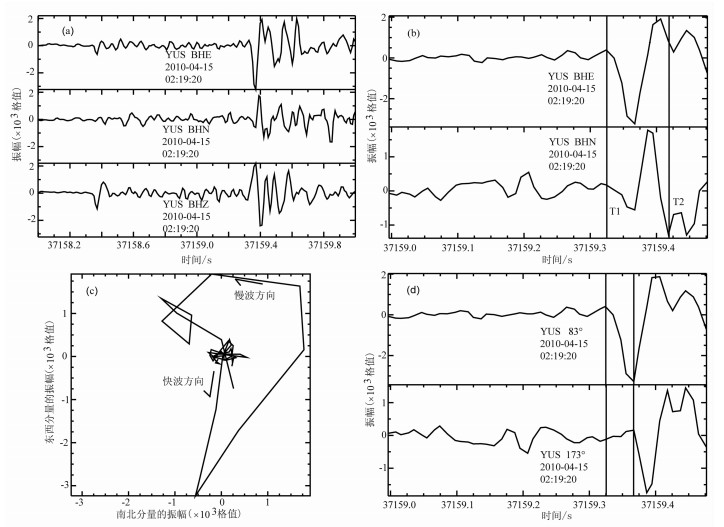
(1)地震波到达的初动信号通常比较清晰可靠,可用它来估算地震射线的入射方向.利用P波初动的水平向和垂直向记录测量地震射线的入射角,要求P波初动的垂直分量要大于两水平向分量(图 2a),以此判断到来的地震波是否在横波窗内;
|
图 2 横波分裂分析过程(以YUS台的记录为例) (a)原始波形的三分量记录图; (b)两个水平分量的地震记录图; (c)水平面内的横波质点运动图; (d)将水平向地震记录旋转至快慢波方向的地震图. Fig. 2 An example of shear wave splitting analysis for a recording at station YUS (a) Three-component records of original seismic waveform; (b) Two horizontal components of seismograms; (c) Shear wave motion in horizontal; (d) Seismograms rotated to the fast and slow shear wave directions. |
(2)根据两个水平向(EW和NS分量)的地震记录确定用于横波分裂的时间窗口(图 2b),高的信噪比对于获得可靠的结果是非常重要的;
(3)检查横波运动图是否显示存在两个分裂的波.图 2c给出的例子中有清晰的沿NEE方向偏振的横波快波和偏振方向与其垂直的慢波,这样可以获得快波的偏振方向;
(4)将两个水平向的地震图旋转至快波和慢波方向,就可看到两个不同到时的形状相似的信号.通过将水平向的地震图旋转至快波和慢波方向,可从地震图上直接测量其到时差(图 2d).给出的到时差根据震源到接收台站间射线路径长度进行了归一化处理.
3 结果和讨论对位于地震断裂带附近的固定和流动地震台站进行横波分裂研究.在大量记录中挑选出了位于横波窗内的近台横波记录数据,在L6303、L6304和YUS台的记录中测得了横波分裂的参数.利用上述可视化测量方法,获得了横波分裂的参数:快波偏振方向和归一化后的快、慢波到时延迟.表 1列出了各台站得到的横波分裂参数的平均结果.
|
表 1 各台站基本参数与横波分裂参数 Table 1 Station parameters and results of shear-wave splitting by station |
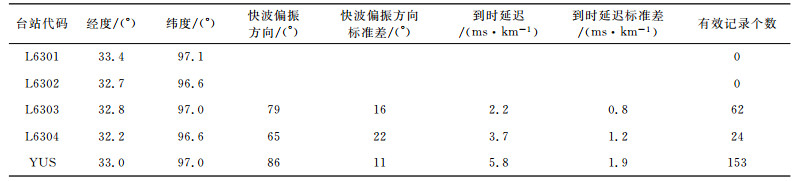
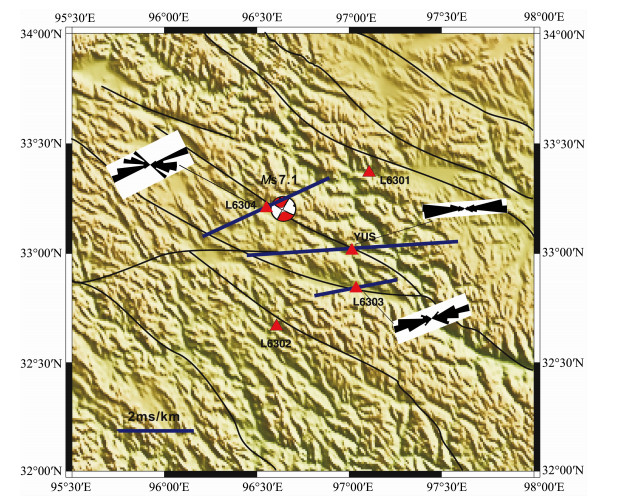
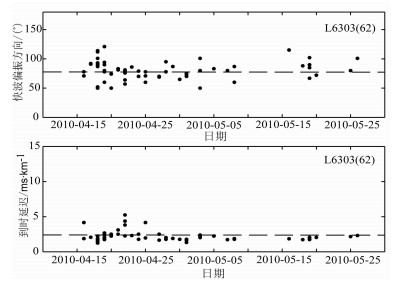
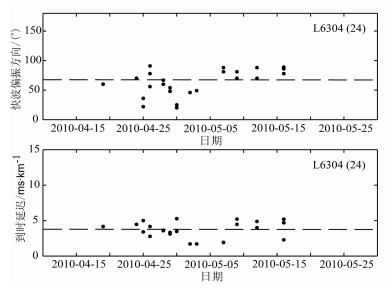
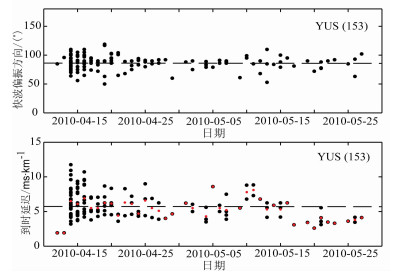
图 3给出了快波偏振方向和到时延迟分布的结果.从三个台站的等面积投影玫瑰图显示,快波优势偏振方向突出,其中L6303和YUS台的结果离散较小,而L6304台的结果离散较大.台站L6303的快波平均偏振方向为N79°E,L6304为N65°E,YUS为N86°E (表 1、图 4、图 5和图 6),它们与由玉树地震震源机制解[23]得到P轴方向(图 1和图 3)代表的最大主压应力方向N74°E差值小于15°,反映了区域内各台站得到的NEE向的快波偏振方向与该地区的最大主压应力方向基本一致.
|
图 3 横波分裂探测结果的分布 图中用线段表示横波分裂的参数,线段的方向代表快横波的偏振方向,线段的长度正比于快、慢波之间的到时延迟(经归一化),单位为ms·km-1.图中黑色玫瑰图为各台站快波偏振方向的等面积投影玫瑰图. Fig. 3 Distribution of the shear wave splitting results A blue line is used to represent the parameters of shear wave splitting. The line direction represents the polarization direction of the fast shear wave. The line length is proportional to the normalized delay time in the unit of ms/km. The black rose denotes the equal-area rose project diagram of fast shear wave polarizations at stations. |
|
图 4 L6303台到时延迟和快波偏振方向随时间的变化 虚线代表L6303台62个有效记录得到的横波分裂参数平均值. Fig. 4 Temporal changes of the normalized delay times and the fast shear wave directions for station L6303 The dashed denotes the average of shear wave splitting parameters of 62 events at station L6303. |
|
图 5 L6304台到时延迟和快波偏振方向随时间的变化 虚线代表L6304台24个有效记录得到的横波分裂参数平均值. Fig. 5 Temporal changes of the normalized delay times and the fast shear wave directions for station L6304 The dashed denotes the average of shear wave splitting parameters of 24 events at station L6304. |
|
图 6 YUS台到时延迟和快波偏振方向随时间的变化 虚线代表YUS台153个有效记录得到的横波分裂参数平均值,红点代表每天的有效记录得到的到时延迟平均值. Fig. 6 Temporal changes of the normalized delay times and the fast shear wave directions for station YUS The dashed denotes the average of shear wave splitting parameters of 153 events at station YUS. The red dots represent the average delay times of all events each day. |
上地壳中的地震横波分裂主要是由台站下方岩层中随应力方向排列的直立微裂隙产生的.横波分裂的探测结果说明了在主震和余震过程中区域应力场的变化特征.L6304和YUS台位于震源区甘孜-玉树断裂带的北支断裂上,它们的平均到时延迟分别为3.7ms·km-1和5.8ms·km-1.而位于甘孜-玉树断裂带的南支断裂上的L6303台,其平均到时延迟只有2.2 ms·km-1,小于位于北支断裂上的L6304和YUS台得到的结果.这一特征说明玉树主震和Ms6.3级最大余震发生在北支断裂上,在北支断裂上积累了很大的应力,而在南支断裂上应力积累较小,进一步表明北支断裂为玉树地震的发震断裂.对于YUS台的时间延迟大于主震附近的L6304台的结果,可能是由于主震发生后,应力得到了释放,使得L6304台的时间延迟变小.一方面在L6304台应力处于调整状态中,造成了该台得到的快波偏振方向和到时延迟变化比较大(图 5); 另一方面应力向东南方向的YUS台积累,造成了YUS台得到的到时延迟较大,这一点也得到了震源破裂过程的证实[24].L6304和YUS台得到的平均快波偏振方向与震源机制解P轴方向差值分别为9°和12°,大于L6303台的快波偏振方向与P轴方向的差值5°,从这一点也说明北支断裂上应力积累相对于南支断裂大,从而导致了L6304和YUS台的平均快波偏振方向与最大主压应力方向偏差较大.
玉树地震属于前震-主震-余震型,该区在前震Ms4.7级地震之前平静,很难找到符合进行横波分裂分析的地震记录图,有幸的是在主震前两天内找到了两个符合条件的记录,在2010年4月12日和2010年4月13日各测得了横波分裂的结果,让我们获得了跨越主震的时间段的横波分裂的探测结果(图 6).尽管前震和主震之间有很多小震,遗憾的是由于主震区的这些小震离YUS台较远,不在横波窗内,无法得到前震和主震时间段的各向异性变化特征.为了分析主震前后YUS台的到时延迟变化,我们根据图 6显示的到时延迟变化分为三段,主震前为第一段,主震后到2010年5月16日为第二段,5月16日之后为第三段.主震前的到时延迟较低,两个记录得到的第一段到时延迟都为1.9 ms·km-1.主震发生后到2010年5月16日的第二段,YUS台的到时延迟增强到3.2~11.8 ms·km-1,平均值为6.1ms·km-1,远高于主震前的水平.在2010年5月16日之后的第三段,测得的到时延迟为2.6~5.8ms·km-1,平均值为3.7ms·km-1,低于第二段的平均值,高于主震前的水平.YUS台的到时延迟随时间的这一变化特征意味着这个地区的地壳应力在主震后得到了增强,随着余震活动导致的应力释放,2010年5月16日之后,该地区应力减小,但是仍然维持了比主震前高的应力状态,预示着余震活动还将持续一段时间.
致谢感谢中国地震局地球物理研究所“国家测震台网数据备份中心”为本研究提供地震波形数据.感谢审稿人提出宝贵意见.
| [1] | Crampin S, Atkinson B K. Microcracks in the earth's crust. First Break , 1985, 3(3): 16-20. |
| [2] | Crampin S, Zatsepin S V. Modelling the compliance of crustal rock-Ⅱ. Response to temporal changes before earthquakes. Geophys. J. Int. , 1997, 129: 495-506. |
| [3] | Gao Y, Crampin S. Observations of stress relaxation before earthquakes. Geophys. J. Int. , 2004, 157(2): 578-582. DOI:10.1111/gji.2004.157.issue-2 |
| [4] | Zhang Z J, Teng J W, Badal J, et al. Construction of regional and local seismic anisotropic structures from wide-angle seismic data:crustal deformation in the southeast of China. Journal of Seismology , 2008. |
| [5] | 姚陈, 王培德, 陈运泰. 卢龙地区S波偏振与上地壳裂隙各向异性. 地球物理学报 , 1992, 35(3): 305–315. Yao C, Wang P D, Chen Y T. Shear wave polarization and upper crustal crack anisotropy in Lulong. Chinese J. Geophys. (in Chinese) , 1992, 35(3): 305-315. |
| [6] | 石玉涛, 高原, 赵翠萍, 等. 汶川地震余震序列的地震介质各向异性. 地球物理学报 , 2009, 52(2): 398–407. Shi Y T, Gao Y, Zhao C P, et al. A study of seismic anisotropy of Wenchuan earthquake sequence. Chinese J. Geophys. (in Chinese) , 2009, 52(2): 398-407. |
| [7] | 吴晶, 高原, 陈运泰, 等. 首都圈西北部地壳介质地震各向异性特征初步研究. 地球物理学报 , 2007, 50(1): 210–221. Wu J, Gao Y, Chen Y T, et al. Seismic anisotropy in the crust in Northwestern Capital area of China. Chinese J. Geophys. (in Chinese) , 2007, 50(1): 210-221. DOI:10.1002/cjg2.v50.1 |
| [8] | Crampin S, Volti T, Stefansson R. A successfully stress-forecast earthquake. Geophys J Int , 1999, 138: F1-F5. DOI:10.1046/j.1365-246x.1999.00891.x |
| [9] | Gao Y, Crampin S. Temporal variations of shear-wave splitting in field and laboratory in China. J Appl Geophys , 2003, 54: 279-287. DOI:10.1016/j.jappgeo.2003.01.002 |
| [10] | 郑秀芬, 陈朝辉, 张春贺. 1999年台湾集集地震余震区-嘉义地区地震的剪切波分裂参数随时间变化的研究. 地球物理学报 , 2008, 51(1): 149–157. Zheng X F, Chen C H, Zhang C H. Study on temporal variations of shear-wave splitting in the Chiayi area, aftershock zone of 1999 Chichi earthquake, Taiwan. Chinese J. Geophys. (in Chinese) , 2008, 51(1): 149-157. |
| [11] | 丁志峰, 武岩, 王辉, 等. 2008年汶川地震震源区横波分裂的变化特征. 中国科学D辑:地球科学 , 2008, 51(12): 1712–1716. Ding Z F, Wu Y, Wang H, et al. Variations of shear wave splitting in the 2008 Wenchuan earthquake region. Science in China (Series D-Earth Sciences) (in Chinese) , 2008, 51(12): 1712-1716. DOI:10.1007/s11430-008-0141-1 |
| [12] | 陈立春, 王虎, 冉永康, 等. 玉树Ms7. 1级地震地表破裂与历史大地震.科学通报 , 2010, 55: 1200–1205. Chen L C, Wang H, Ran Y K, et al. The Ms7. 1 Yushu earthquake surface ruptures and historical earthquakes. Chinese Sci Bull (in Chinese) , 2010, 55: 1200-1205. |
| [13] | 汪一鹏.青藏高原活动构造基本特征.见:马宗晋, 王一鹏, 张燕平, 主编.青藏高原岩石圈现今变动与动力学.北京:地震出版社, 2001. 251~262 Wang Y P. Principal features of the active tectonics in Tibetan Plateau. In:Ma Z, Wang Y, Zhang Y, eds. Study on the Recent Deformation and Dynamics of the Lithosphere of Qinghai-Xizang Plateau (in Chinese). Beijing:Seismologiacl Press, 2001. 251~262 |
| [14] | 郑秀芬, 欧阳飚, 张东宁, 等. "国家数字测震台网数据备份中心"技术系统建设及其对汶川大地震研究的数据支撑. 地球物理学报 , 2009, 52(5): 1412–1417. Zheng X F, Ouyang B, Zhang D N, et al. Technical system construction of Data Backup Centre for China Seismograph Network and the data support to researches on the Wenchuan earthquake. Chinese J. Geophys. (in Chinese) , 2009, 52(5): 1412-1417. |
| [15] | Menke W, Brandsdottir B, Jakobsdottir S, et al. Seismic anisotropy in the crust at the mid-Atlantic plate boundary in south-west Iceland. Geophs J Int , 1994, 119: 783-790. DOI:10.1111/gji.1994.119.issue-3 |
| [16] | Crampin S, Peacock S. A review of shear-wave splitting in the compliant crack-critical anisotropic Earth. Wave Motion , 2005, 41: 59-77. DOI:10.1016/j.wavemoti.2004.05.006 |
| [17] | Chen T C, Booth D C, Crampin S. Shear-wave polarizations near the North Anatolian fault-Ⅲ. Observations of temporal changes. Geophys J Royal Astron Soc , 1987, 91: 287-311. DOI:10.1111/j.1365-246X.1987.tb05228.x |
| [18] | Liu Y, Crampin S, Main I. Shear-wave anisotropy:spatial and temporal variations in time delays at Parkfield, Central California. Geophys J Int , 1997, 130: 771-785. DOI:10.1111/gji.1997.130.issue-3 |
| [19] | Peacock S, Crampin S, Booth D C, et al. Shear-wave splitting in the Anza seismic gap, Southern California:temporal variations as possible precursors. J Geophys Res , 1988, 93: 3339-3356. DOI:10.1029/JB093iB04p03339 |
| [20] | Shih X R, Meyer R P, Schneider J F. An automated, analytical method to determine shear-wave anisotropy. Tectonophysics , 1989, 165: 271-278. DOI:10.1016/0040-1951(89)90052-8 |
| [21] | 高原, 刘希强, 梁维, 等. 剪切波分裂系统分析方法(SAM)软件系统. 中国地震 , 2004, 20(1): 101–107. Gao Y, Liu X Q, Liang W, et al. Systematic analysis method of shear-wave splitting:SAM software system. Earthquake Research in China (in Chinese) , 2004, 20(1): 101-107. |
| [22] | Volti T, Crampin S. A four-year study of shear-wave splitting in Iceland:1. Background and preliminary analysis. In:Nieuwland D A ed. New Insights Into Structural Interpretation and Modeling. Geol Soc Lond, Spec Publ, 2003, 212:117~133 |
| [23] | 刘超, 许力生, 陈运泰. 2010年4月14日青海玉树地震快速矩张量解. 地震学报 , 2010, 32(3): 366–368. Liu C, Xu L S, Chen Y T. Quick moment tensor solution for 14 April 2010 Yushu, Qinghai, earthquake. Acta Seismologica Sinica (in Chinese) , 2010, 32(3): 366-368. |
| [24] | 张勇, 许力生, 陈运泰. 2010年青海玉树地震震源过程. 中国科学D辑:地球科学 , 2010, 40(7): 819–821. Zhang Y, Xu L S, Chen Y T. Source process of the 2010 Yushu, Qinghai, earthquake. Science in China (Series D-earth Sciences) (in Chinese) , 2010, 40(7): 819-821. |