中图分类号: TM727.2;TM771
 , , , , ,
2. 国网江苏省电力有限公司电力科学研究院,江苏 南京 211103
 张贺铭(1999),男,硕士,研究方向为配电网故障处理(E-mail:zhangheming5504@163.com);
 |
陈实(1990),男,博士,高级工程师,从事电力系统继电保护与控制工作。
基于电力电子设备的柔性互联设备可以克服传统联络开关无法闭环运行的缺点[1-5],同时可以解决分布式光伏以及充电桩接入带来的线路负载不均、过电压等问题[6-11],因此近年来得到大量研究和初步的示范应用[12-13]。为提高柔性互联设备的能量密度和运行效率,部分柔性互联场景采用无隔离变压器的设计[14],比如杭州江东新城示范工程[15]和英国“Active Response”项目[16]。
智能软开关(soft open point, SOP)是典型的柔性互联设备之一,其通过背靠背换流器实现电能的双向传输[17-18]。在非隔离型柔性互联场景中,SOP一侧发生接地故障时,零序分量会传递至健全侧系统,从而扩大故障影响范围[19]。有学者提出在柔性互联装置中引入零序分量抑制策略,从而避免对健全侧系统的影响。文献[20-21]分别针对单隔离变和无隔离变的柔性互联装置,提出采用零序电压控制策略实现故障隔离;基于无隔离变型换流器,文献[22-23]结合换流器模型,对模块化多电平换流器(modular multi-level converter, MMC)和电压源换流器(voltage source converter, VSC)提出两种不同的零序抑制策略。但是由于单相接地故障后相电压可能升高为线电压,此时采用原调制比的VSC或冗余子模块不足的MMC,可能无法完全抑制零序分量。因此,VSC须提高正常运行时的直流侧极间电压,而MMC须采用更多全桥子模块才能实现零序分量的完全抑制。
发生单相接地故障后,若SOP未采用零序分量抑制策略,其运行特性与合环运行的联络开关类似。文献[24]从故障隔离的角度分析适用于合环运行的配电网电源接线方式;文献[25]指出“花瓣”型配电网合环后发生故障,传统基于故障电流识别的保护方法不再适用;文献[26]结合地区配电网案例表明,合环运行发生接地故障时零序保护失效,事故风险极高,需要在原有保护基础上增设纵差保护。需要注意的是,上述研究均基于传统配电网合环运行场景,而柔性互联系统投入零序抑制策略后,这些保护失效问题是否仍然存在尚待研究。
我国配电网中性点接地方式包括小电流接地和小电阻接地[27-28]两种,其中小电流系统一般采用暂态零序电压/电流实现单相接地故障的选线告警或延时跳闸,小电阻系统则采用零序电流保护实现单相接地故障识别[29]。根据中性点接地方式的不同,柔性互联系统既可能是采用相同中性点接地方式的系统,也可能是小电流和小电阻系统互联接地方式的系统。非隔离型柔性互联装置接入后,由于系统存在多个中性点,零序电气量的分布特征可能发生显著变化[30-31],这一现象与传统合环运行的特征并不相同,必然影响现有单相接地故障检测方法的可靠性。然而,目前关于非隔离型柔性互联设备零序抑制策略对保护系统影响的研究仍属空白。
基于此,文中首先建立非隔离型SOP的零序分量数学模型及等值电路,推导零序分量传递方程;在此基础上,针对小电流系统互联、小电阻系统互联、小电流和小电阻互联系统,分析零序分量抑制策略投入前后接地故障检测方法的适应性;最后通过仿真验证理论分析的正确性。
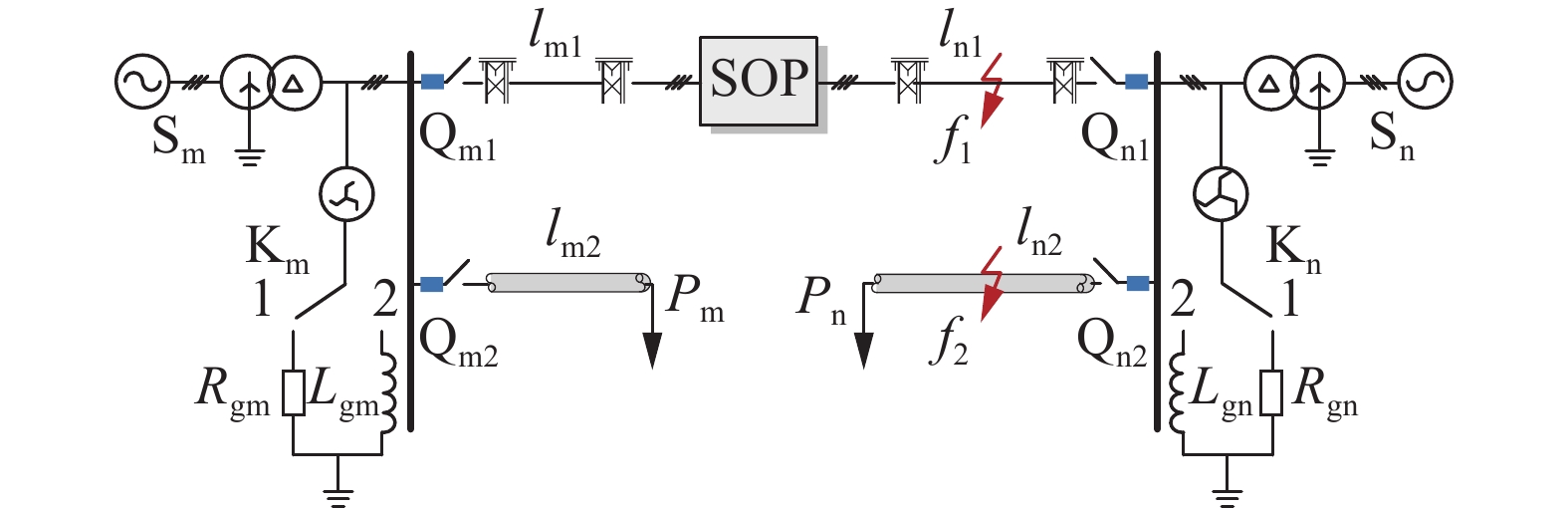
1 非隔离型柔性互联SOP的零序分量传递特性 1.1 SOP零序等值电路在中压配电网中,非隔离型SOP通常用于连接2个配电系统。非隔离型柔性互联系统拓扑如图1所示。Sm、Sn为2个配电系统的交流电源;接地变压器通过改变开关Km和Kn的位置实现交流侧不同的接地方式,取1时为小电阻接地方式,取2时为消弧线圈接地方式;Qm1、Qm2和Qn1、Qn2分别为m侧和n侧的线路1、线路2的继电保护装置和测量装置;lm1、lm2和ln1、ln2分别为m侧和n侧的线路1、线路2;Pm、Pn为负荷;Rgm、Rgn分别为m侧、n侧经小电阻接地方式中的电阻值;Lgm、Lgn分别为m侧、n侧经消弧线圈接地方式中的电感值;f1、f2为不同故障点。
|
图 1 非隔离型柔性互联系统拓扑 Fig. 1 Topology of non-isolated flexible interconnected system |
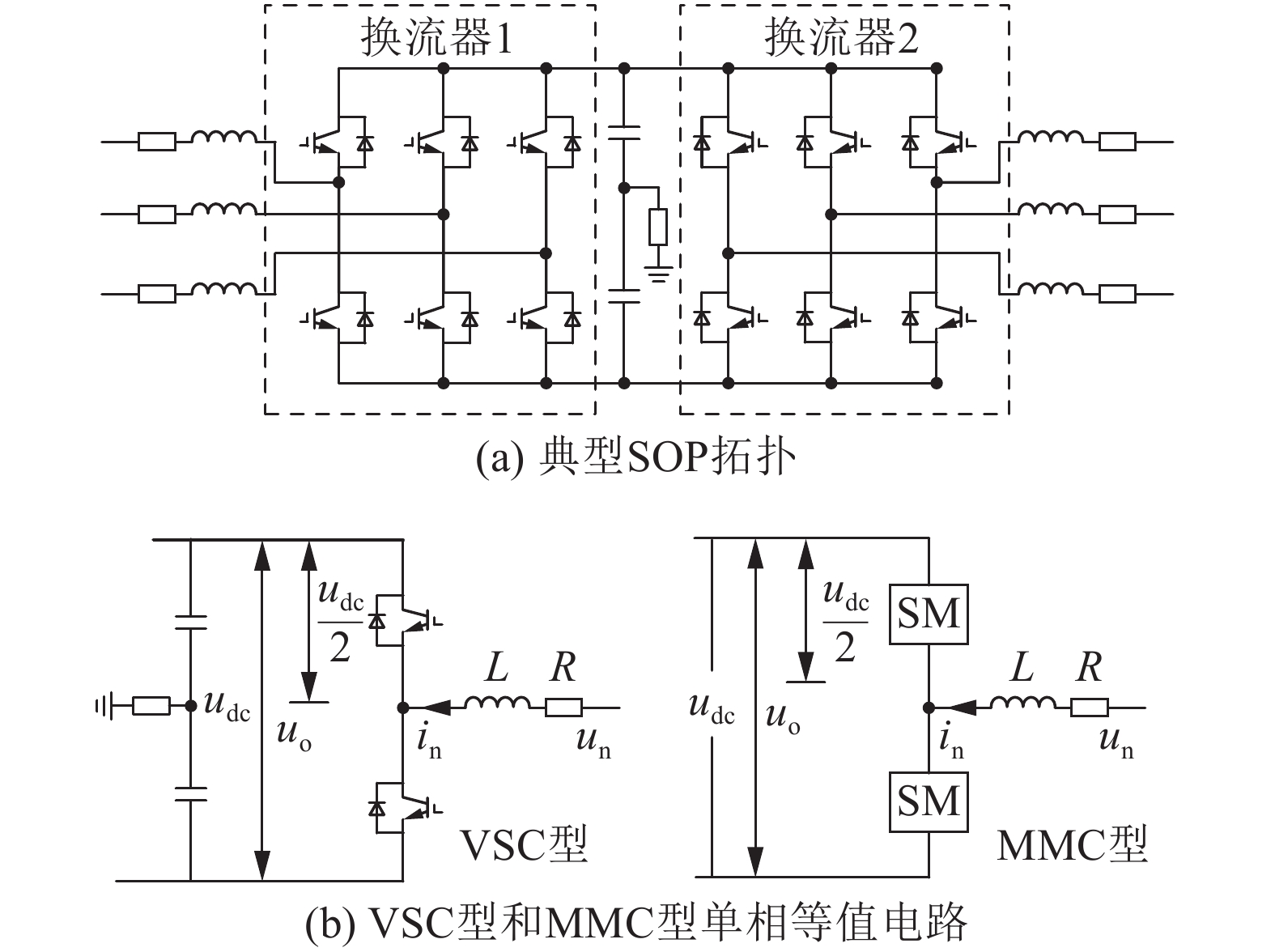
典型SOP拓扑及其两种换流器类型的单相等值电路如图2所示。其中,VSC型采用直流侧经箝位电阻接地方式[32],MMC型采用直流侧不接地方式[33]。其中,udc为直流母线极间电压;uo为直流侧中性点等效对地电压;R、L分别为换流器内滤波器等效电阻和电感;un、in分别为换流器输出交流电压和电流;SM为MMC的子模块。
|
图 2 典型SOP拓扑及其单相等值电路 Fig. 2 Typical SOP topology and its single-phase circuit |
由图2换流器的单相等值电路可得:
| $ {u_\varphi } - {i_\varphi }R - L\frac{{{\text{d}}{i_\varphi }}}{{{\text{d}}t}} = \frac{{{u_{{\text{dc}}}}}}{2}{S _\varphi } + {u_{\text{o}}} $ | (1) |
式中:
| $ {e}_{0}=\frac{{u}_{\text{dc}}}{2}({S} _{\text{a}}+{S} _{\text{b}}+{S} _{\text{c}}) $ | (2) |
根据对称分量法,由式(1)和式(2)可得SOP两侧换流器关于零序分量的数学模型:
| $ \left\{ \begin{gathered} {u_{{\text{m0}}}} - {i_{{\text{m0}}}}R - L\frac{{{\text{d}}{i_{{\text{m0}}}}}}{{{\text{d}}t}} = {e_{{\text{m0}}}} + {u_{\text{o}}} \\ {u_{{\text{n0}}}} - {i_{{\text{n0}}}}R - L\frac{{{\text{d}}{i_{{\text{n0}}}}}}{{{\text{d}}t}} = {e_{ {{\text{n0}}} }} + {u_{\text{o}}} \\ \end{gathered} \right. $ | (3) |
式中:um0、im0和un0、in0分别为m侧和n侧换流器出口处的零序电压、零序电流;em0、en0分别为m侧和n侧换流器内部等效零序虚拟电势。
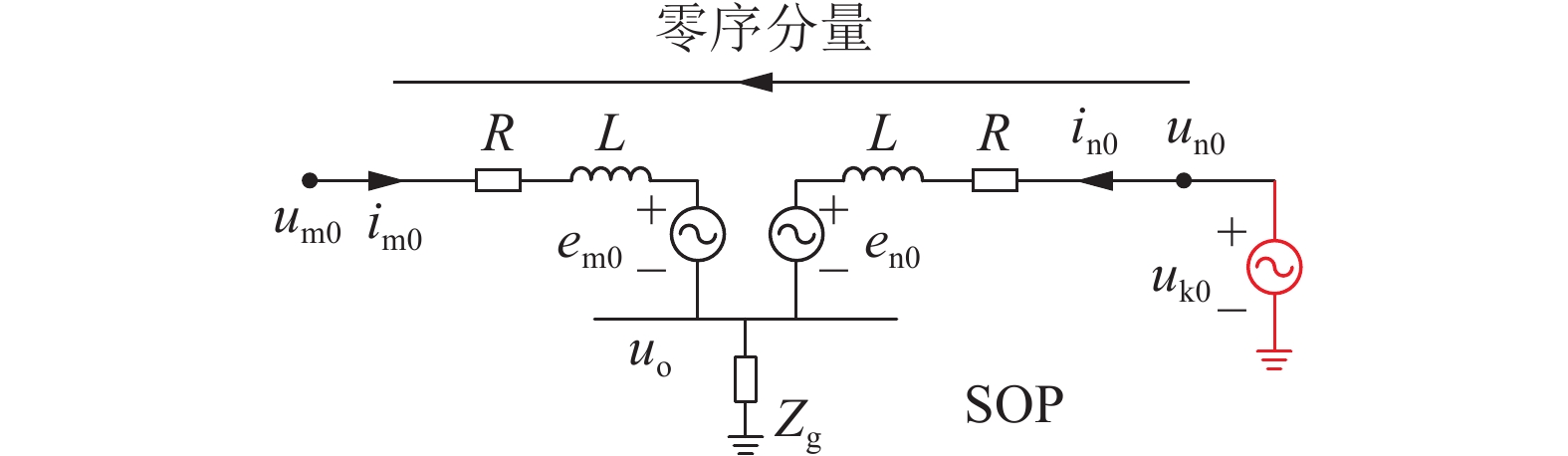
1.2 零序分量的传递特性系统一侧发生故障,SOP故障端会出现零序分量。由式(3)得到SOP的零序等值电路如图3所示。其中,uk0为故障点等效零序电压;Zg为不同接地方式下的换流器直流侧等效阻抗。具体参数如表1所示,其中,Rg为换流器接地电阻;C为换流器中性点电容;
|
图 3 SOP零序等值电路 Fig. 3 SOP zero-sequence equivalent circuit |

|
表 1 换流器内部典型接地方式下等效阻抗的取值 Table 1 The value of equivalent impedance under typical grounding modes inside the converter |
在不投入零序分量控制策略时,对低于换流器开关频率的分量,换流器内部虚拟电势的零序分量为0。假设换流器内部滤波器的等效阻抗为ZP=R+jωL,对图3列写基尔霍夫电流、电压定律方程,可得SOP的零序分量传递方程:
| $\begin{split} &\left[ \begin{gathered} {{ u}_{{\text{m0}}}} \\ {{ i}_{{\text{m0}}}} \\ \end{gathered} \right] = \frac{1}{{{Z_{\text{g}}}}} \begin{bmatrix} {\begin{array}{*{20}{c}} {{Z_{\text{P}}} + {Z_{\text{g}}}}&{ - ({Z_{\text{P}}} + 2{Z_{\text{g}}}){Z_{\text{P}}}} \\ 1&{ - ({Z_{\text{P}}} + {Z_{\text{g}}})} \end{array}} \end{bmatrix} \left[ \begin{gathered} {{ u}_{{\text{n0}}}} \\ {{ i}_{{\text{n0}}}} \\ \end{gathered} \right]\\&\\[-5pt] \end{split} $ | (4) |
由式(4)可知,当系统一侧出现零序分量,换流器健全侧的零序分量会受到换流器内部等效阻抗和直流侧接地方式的影响。
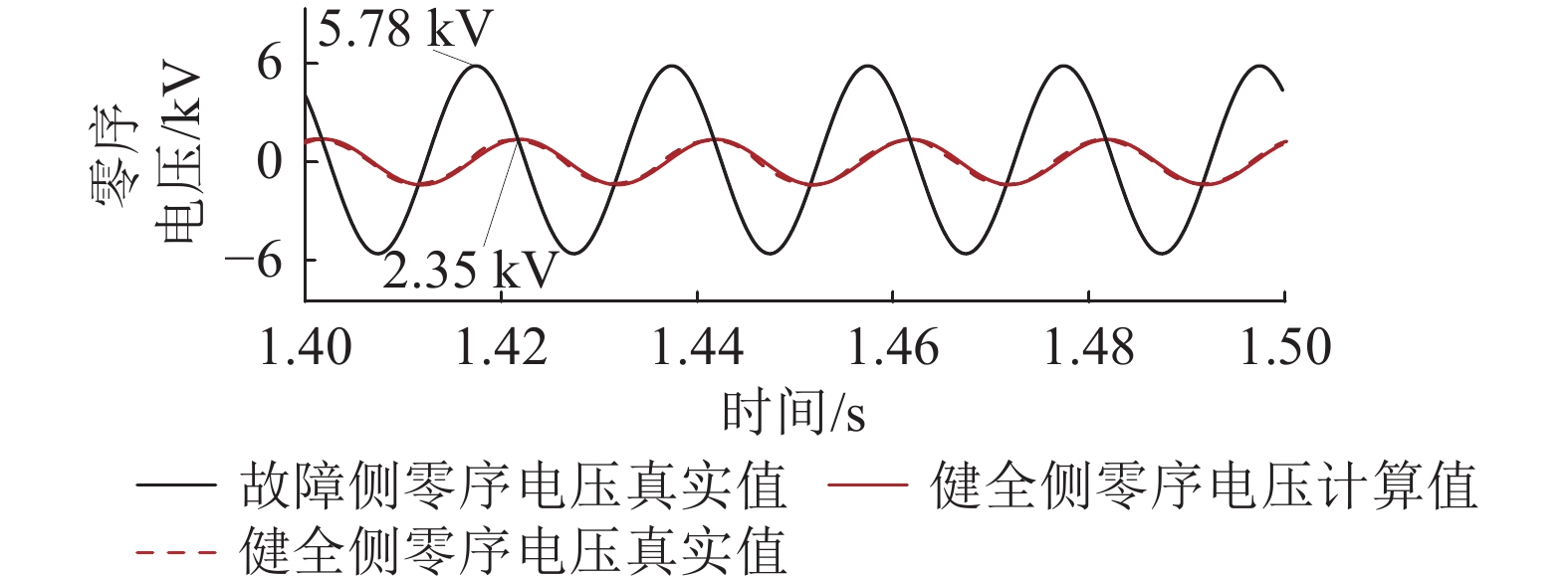
图4给出小电阻互联系统中交流侧发生单相接地故障时,故障侧零序电压和健全侧换流器出口处零序电压的真实波形,并将真实波形与式(4)的健全侧零序电压计算波形进行对比。
|
图 4 故障侧零序电压真实波形和健全侧零序电压的计算波形与真实波形 Fig. 4 Zero-sequence voltage real waveform on the fault side and zero-sequence voltage calculated waveform versus the real waveform on the healthy side |
从图4可以看出,即使在健全系统中也会出现零序分量,导致保护可能误动,因此需要系统投入零序抑制策略。在正常运行时,换流器的调制比一般为0.80~0.95,当系统发生单相接地故障时,非故障相电压最严重时会升高至线电压,此时调制比可能会到达1.5左右。文献[22]提出的VSC型抑制策略和文献[23]提出的MMC型抑制策略中,如果保持原换流器调制参数不变,则无法完全抑制零序分量。此时需要改变VSC的原有调制比和MMC型投入全桥子模块的个数,才能实现零序分量的完全抑制。
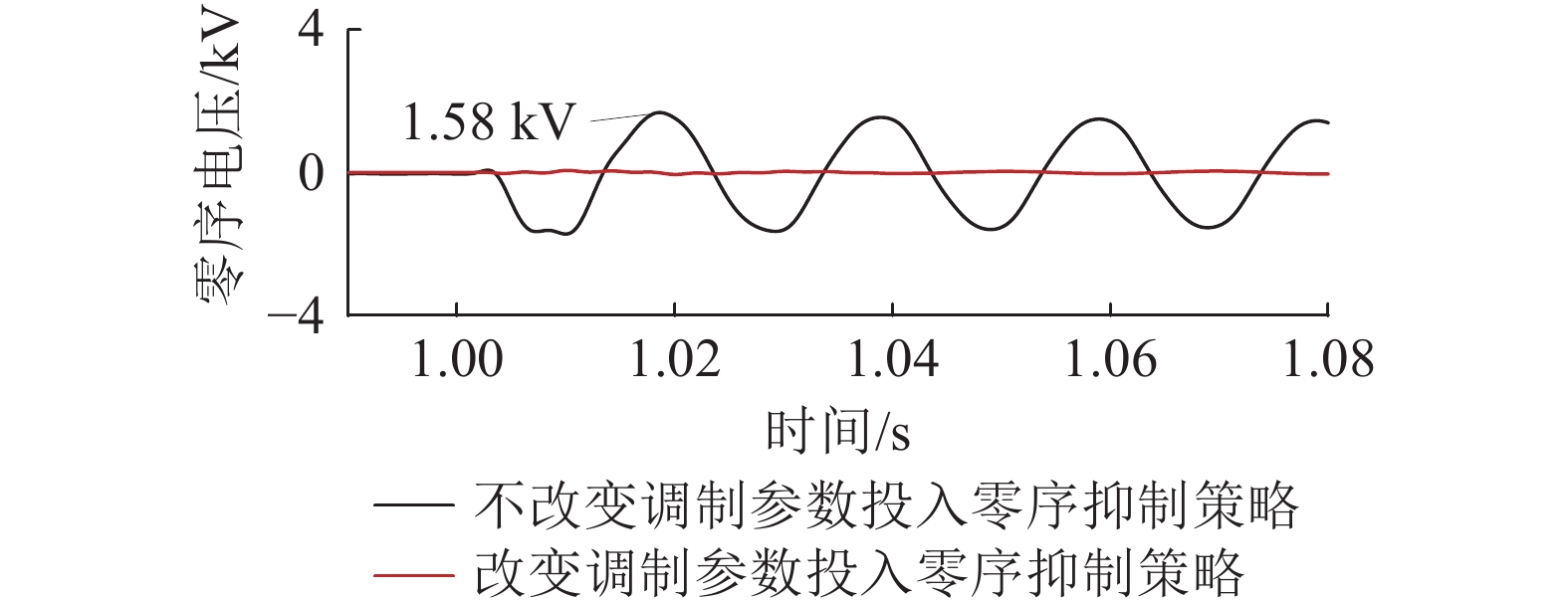
以小电阻系统中VSC型SOP柔性互联场景为例,图5对比单相接地故障后,不改变调制参数和改变调制参数并投入零序分量抑制策略时的健全侧零序电压波形。
|
图 5 两种场景下健全侧零序电压波形 Fig. 5 Zero-sequence voltage waveforms on the healthy side under two scenarios |
从图5可以看出部分抑制时,健全侧相比于图4中不投入抑制策略时零序电压幅值降低,但仍有较大值,改变调制参数完全抑制时健全侧零序电压幅值基本为0,此时健全侧不再受到零序分量的影响。
2 不同接地方式系统互联后的接地故障检测方法适应性分析 2.1 小电流互联系统保护分析目前小电流系统常用的暂态量选线法一般基于零序电流和零序电压导数的关系,对于健全线路,零序电流和零序电压导数满足正电容约束,而故障线路满足负电容约束。即定义m侧暂态零序电流im0(t)和零序电压u0(t)方向系数为:
| $ {D_{\text{m}}} = \frac{1}{T}\int_0^T {{i_{{\text{m0}}}}(t){\text{d}}} {u_0}(t) $ | (5) |
式中:T为暂态过程持续时间。若Dm>0,则判断为健全线路;Dm<0,则判断为故障线路。
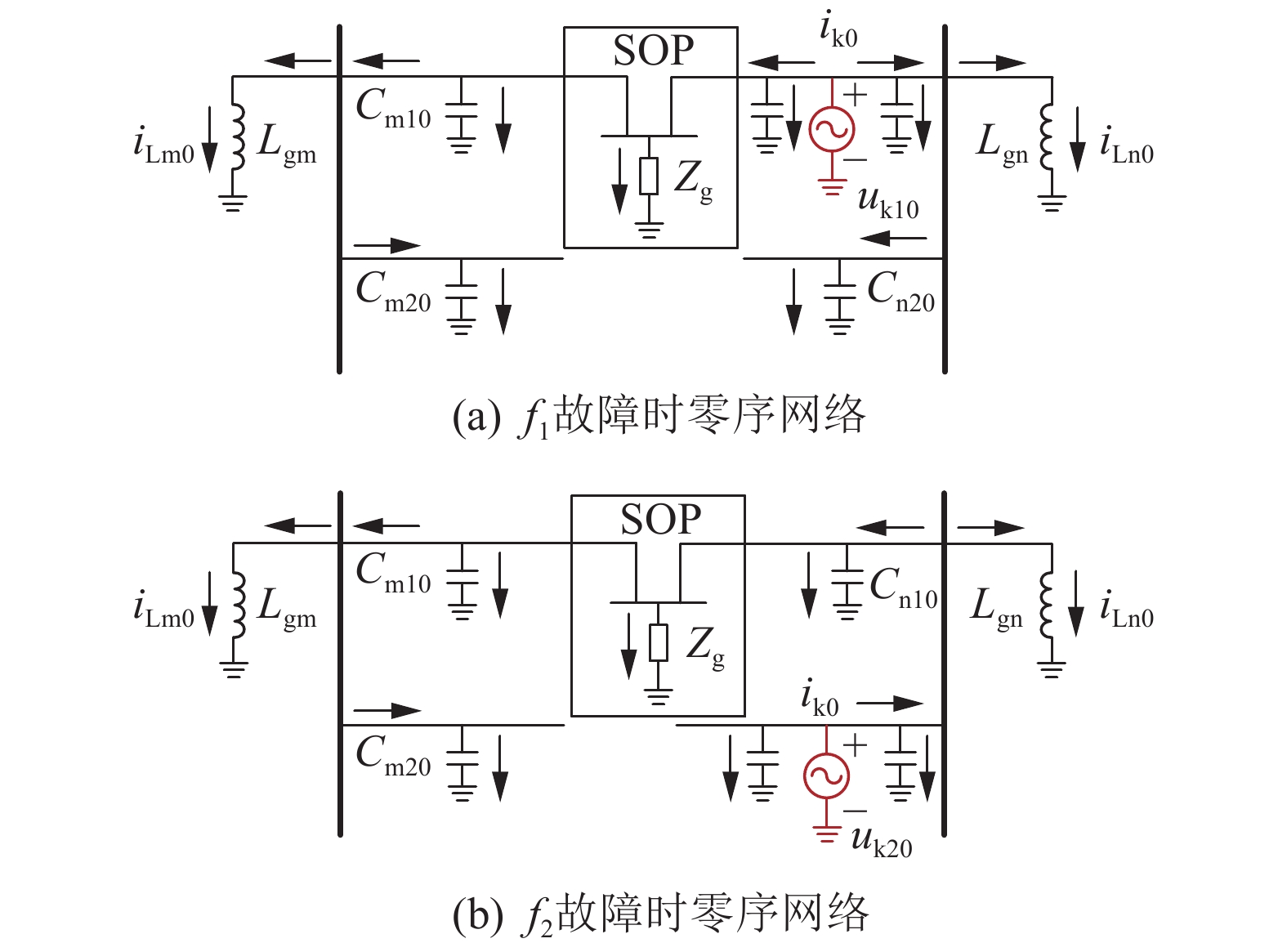
对于图1中的柔性互联系统,当n侧系统不同馈线发生单相接地故障时的零序网络如图6所示。其中Cm10、Cm20、Cn10、Cn20分别为m侧、n侧的线路1和线路2等效对地电容;ik0为零序电流;iLm0、iLn0分别为流过m侧、n侧消弧线圈的零序电流;uk10、uk20分别为f1、f2故障点等效零序电压源。
|
图 6 小电流互联系统单相接地故障时零序网络 Fig. 6 Zero-sequence network during single-phase grounding fault in low-current interconnected system |
从图6中可以看出,零序电流经过SOP时会通过换流器直流侧中性点分流,但在表1所示SOP的典型接地方式下Zg很大,分流的零序电流基本可以忽略不计。此外,故障侧电流方向均能正确反映故障,但柔性互联设备接入线路lm1的接地故障检测装置会认为故障点在其下游,保护可能误判。
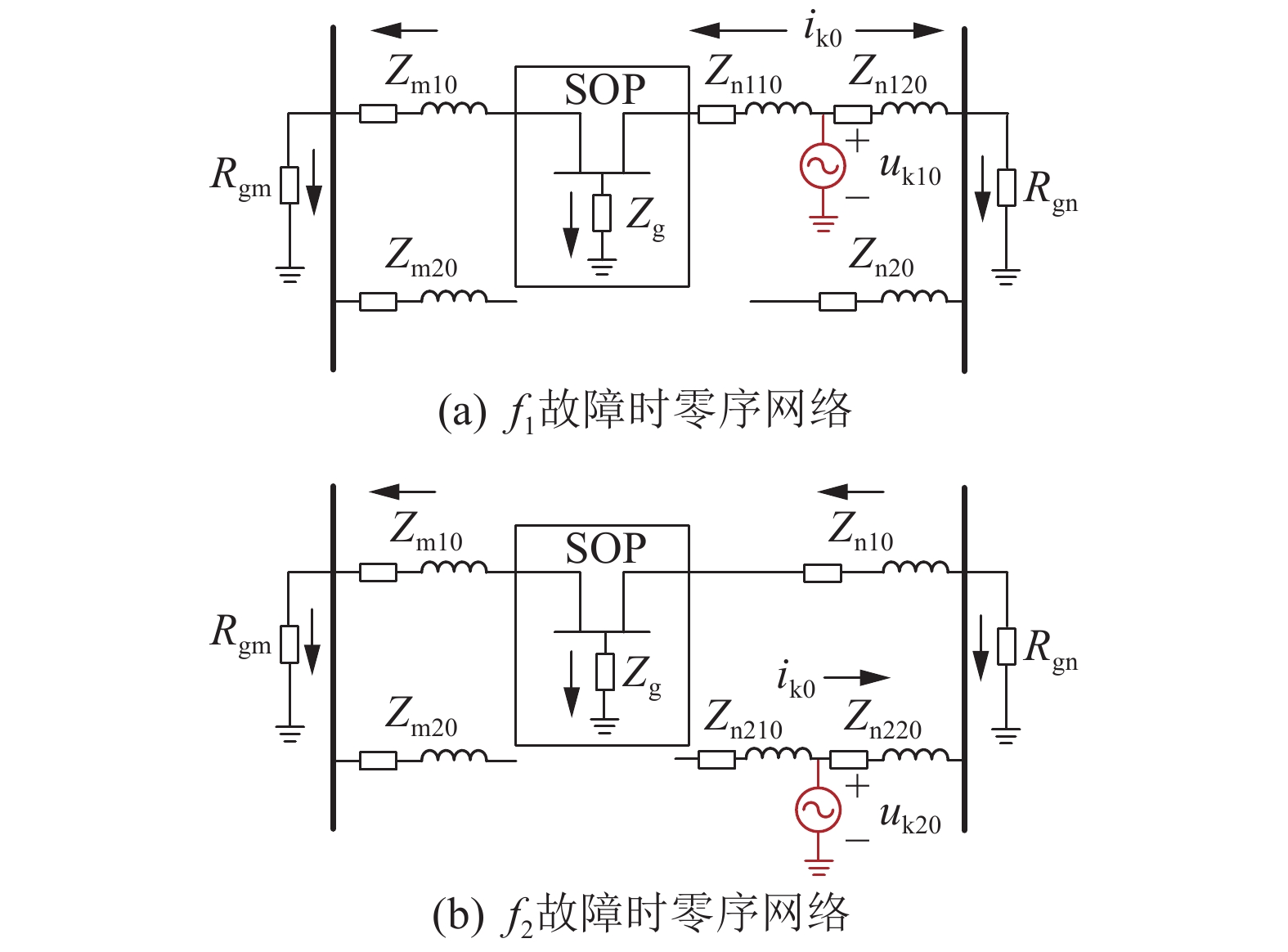
2.2 小电阻互联系统保护分析对于非隔离柔性互联系统,由于零序分量分布的变化,此时小电阻接地系统所采用的零序电流保护可能存在误动的现象。图7给出小电阻互联后,不同位置故障的零序网络。其中Zm10、Zm20分别为健全侧线路1和线路2的等效零序阻抗;Zn10、Zn20为故障侧中非故障线路的等效阻抗;Zn110为f1故障时故障点到SOP线路的等效阻抗;Zn210为f2故障时故障点到线路末端的等效阻抗;Zn120、Zn220分别为故障点到线路1和线路2的等效阻抗。
|
图 7 小电阻互联系统单相接地故障时零序网络 Fig. 7 Zero-sequence network during single-phase grounding fault in low-resistance interconnected system |
由图7可知,f1发生故障时,对于n侧,线路ln1的保护会检测到很大的零序电流,保护可以正确动作;对于m侧,由于中性点也经小电阻接地,线路lm1保护测量的零序电流为故障点零序电流在健全系统的分流,零序电流幅值可能也会使零序电流保护误动作。
当f2发生故障时,对于n侧,线路ln2保护测量的故障点零序电流,可以正确动作,线路ln1和lm1的保护测量的电流同样为故障点零序电流的分流,保护可能误动作。
2.3 小电流和小电阻互联系统保护分析当故障侧发生在小电阻侧时,小电阻故障侧的故障特征与2.2节分析一致,小电流健全侧的故障特征与2.1节分析一致。
当故障侧为小电流系统,健全侧为小电阻系统时,零序网络拓扑如图8所示。

|
图 8 小电阻和小电流系统互联时小电流侧单相接地故障时零序网络 Fig. 8 Zero-sequence network during single-phase grounding fault on the low current side in case of low-resistance and low-current interconnection systems |
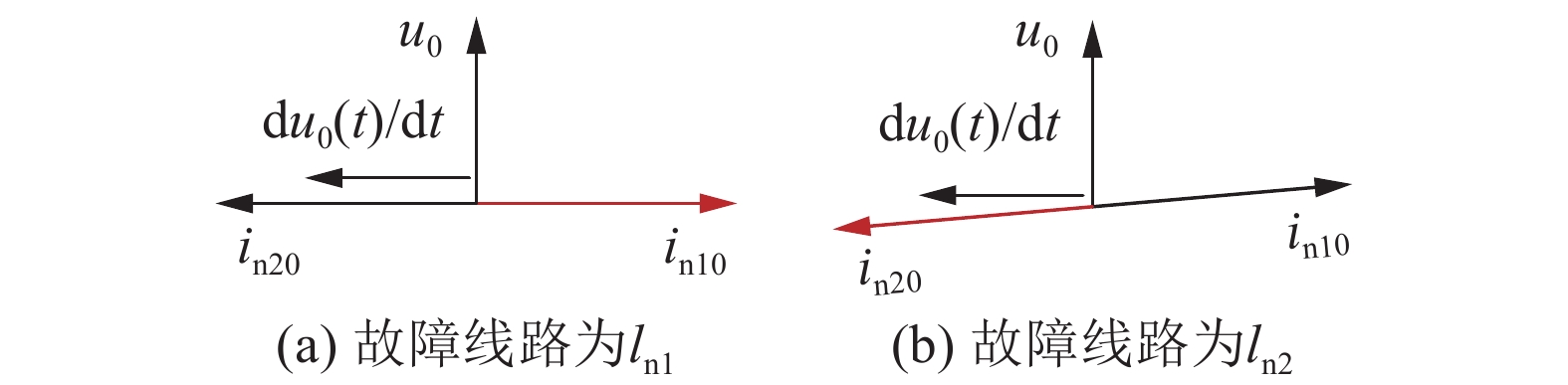
健全侧系统保护适应性与2.2节分析一致。但对于故障侧系统,需要考虑保护安装处零序电流的相位,如图9所示。图中in10、in20分别为流过线路ln1、ln2保护安装处的零序电流。当发生f1故障时,流过健全线路的零序电流为容性,故障线路的零序电流相位与其相反,因此可以正确判断故障线路。零序分量的相位关系如图9(a)所示。但对于故障点至SOP安装处之间的终端,尽管零序电流流向负荷侧,但因为零序电流呈阻感性,如图9(b)所示,此时会误判为故障点在其下游。当发生f2故障时,故障侧系统的健全线路零序电流同样为阻感性,此时选线装置和馈线终端同样都可能发生误判。
|
图 9 故障出线处零序分量相位关系 Fig. 9 Phase relationship of zero-sequence component at the fault outgoing line |
基于PSCAD建立如图1所示的仿真模型,其中VSC直流侧采用箝位电阻接地方式,MMC直流侧采用不接地方式,模型具体参数如表2所示。
|
|
表 2 模型参数 Table 2 Model parameters |
设置2种场景,场景1:换流器未投入零序抑制策略;场景2:换流器不改变调制参数投入零序抑制策略。
3.2 小电流互联系统保护仿真验证采用式(5)所示方向系数判据,当出线ln1处发生f1故障时,各出线的方向系数如表3所示。当出现ln2处发生f2故障时,各出线的方向系数如表4所示。
|
|
表 3 小电流互联系统f1故障时零序抑制前后各出线方向系数 Table 3 Direction coefficients of each outgoing line before and after zero-sequence suppression in case of f1 fault in low-current interconnected system |
|
|
表 4 小电流互联系统f2故障时零序抑制前后各出线方向系数 Table 4 Direction coefficients of each outgoing line before and after zero-sequence suppression in case of f2 fault in low-current interconnection system |
由表3和表4可知,在不改变原有调制参数的情况下,SOP投入零序抑制策略前后,故障侧故障线路的Dm均小于0,根据式(5)均能正确识别故障线路,但在健全侧中与SOP串联的线路由于存在零序分量,导致测得Dm均小于0,此时可能会误动。
3.3 小电阻互联系统保护仿真验证当出线ln1处发生f1故障时,各出线的零序分量如表5所示。当出线ln2处发生f2故障时,各出线的零序分量如表6所示。
|
|
表 5 小电阻互联系统f1故障时零序抑制前后各出线零序分量 Table 5 Zero-sequence components of each outgoing line before and after zero-sequence suppression in case of f1 fault in low-resistance interconnected system |
|
|
表 6 小电阻互联系统f2故障时零序抑制前后各出线零序分量 Table 6 Zero-sequence components of each outgoing line before and after zero-sequence suppression in case of f2 fault in low-resistance interconnection system |
由表5和表6可知,当SOP未投入零序抑制策略时,f1故障时健全侧系统出现零序分量,f2故障时健全侧系统和故障侧健全线路均出现零序分量,存在保护误动现象。在不改变调制参数的情况下投入SOP零序抑制策略,部分场景仍可能存在保护误动情况,即保护动作可靠性仍存在不足。
3.4 小电流和小电阻互联系统保护仿真验证当故障侧为小电阻系统,健全侧为小电流系统时,出线ln1处发生f1故障后,故障侧出线的零序分量如表7所示,健全侧出线的方向系数如表8所示。当出线ln2处发生f2故障时,故障侧出线的零序分量如表9所示,健全侧出线的方向系数如表10所示。这两种情况下,在投入零序抑制前,故障n侧保护均可以正确动作,但健全m侧lm1采用的暂态零序电流极性法会出现误动作;在不改变调制参数的情况下投入零序抑制策略后,系统保护仍可能存在误动的现象。
|
|
表 7 f1故障时零序抑制前后故障侧(小电阻侧)的各出线零序分量 Table 7 Zero-sequence components of each outgoing line on the faulty side (low-resistance side) before and after zero-sequence suppression in case of f1 fault |
|
|
表 8 f1故障时零序抑制前后健全侧(小电流侧)的各出线方向系数 Table 8 Direction coefficients of each outgoing line before and after zero-sequence suppression on the healthy side (low-current side) in case of f1 fault |
|
|
表 9 f2故障时零序抑制前后故障侧(小电阻侧)的各出线零序分量 Table 9 Zero-sequence components of each outgoing line on the faulty side (low-resistance side) before and after zero-sequence suppression in case of f2 fault |
|
|
表 10 f2故障时零序抑制前后健全侧(小电流侧)的各出线方向系数 Table 10 Direction coefficients of each outgoing line before and after zero-sequence suppression on the healthy side (low-current side) in case of f2 fault |
当故障侧为小电流系统,健全侧为小电阻系统时,出线ln1处发生f1故障后,健全侧出线的零序分量如表11所示,故障侧出线的方向系数如表12所示。在投入零序抑制前,故障n侧保护均可以正确动作,但健全m侧lm1流过很大的零序电流,会产生误动作;在不改变调制参数的情况下投入零序抑制策略后,系统保护仍可能存在误动的现象。
|
|
表 11 f1故障时零序抑制前后健全侧(小电阻侧)的各出线零序分量 Table 11 Zero-sequence components of each outgoing line on the healthy side (low-resistance side) before and after zero-sequence suppression in case of f1 fault |
|
|
表 12 f1故障时零序抑制前后故障侧(小电流侧)的各出线方向系数 Table 12 Direction coefficients of each outgoing line before and after zero-sequence suppression on the faulty side (low-current side) in case of f1 fault |
当出线ln2处发生f2故障时,健全侧出线的零序分量如表13所示,故障侧出线的方向系数如表14所示。
|
|
表 13 f2故障时零序抑制前后健全侧(小电阻侧)的各出线零序分量 Table 13 Zero-sequence components of each outgoing line on the healthy side (low-resistance side) before and after zero-sequence suppression in case of f2 fault |
|
|
表 14 f2故障时零序抑制前后故障侧(小电流侧)的各出线方向系数 Table 14 Direction coefficients of each outgoing line before and after zero-sequence suppression on the faulty side (low-current side) in case of f2 fault |
由表13和表14可知,在投入零序抑制前,故障n侧保护不能正确动作,同时健全m侧lm1流过很大的零序电流,会产生误动作。在不改变调制参数的情况下投入零序抑制,系统保护可能存在误动的现象。
综上所述,在非隔离型柔性互联系统中一侧发生接地故障时,若不改变调制参数直接投入零序抑制策略,零序分量无法完全抑制,部分分量会传递至健全侧,导致健全侧也出现误判。由图5可知,此时需要改变调制参数后再投入SOP的零序抑制策略,实现零序分量的完全抑制,保护才能正确动作。
4 结论文中分析非隔离型柔性互联配电网中的零序分量传递特性,并研究不同中性点接地方式系统柔性互联后的接地故障检测保护方法适应性。理论分析和仿真结果表明,当SOP未采用零序分量抑制或抑制效果不佳时,会对接地故障检测方法产生以下影响:
(1) 对于健全侧系统,故障发生后,若SOP所在支路的保护能识别故障,也可能导致误动作或误告警,进而扩大故障范围。
(2) 对于故障侧系统,若故障线路为SOP所在支路,则故障线路的保护均能正确识别故障。若故障线路不在SOP所在支路,故障线路的保护均能正确动作。但当健全侧系统为小电阻接地方式时,故障侧系统中SOP所在支路的保护能识别故障,可能导致误动作或误告警。
基于上述研究结论,建议深入研究零序分量抑制策略对柔性互联设备拓扑和控制策略的要求,实现零序分量的完全抑制。对于无法实现零序分量完全抑制的柔性互联场景,建议至少在一侧配置隔离变压器,以提高保护系统的适应性。
| [1] |
考虑有源配电网运行灵活性的智能储能软开关优化规划[J]. 电力工程技术, 2023, 42(1): 143-153. HUANG Zitong, XU Yonghai, YE Xingjie. Optimal planning of soft open point integrated with energy storage system considering operation flexibility of active distribution network[J]. Electric Power Engineering Technology, 2023, 42(1): 143-153. DOI:10.12158/j.2096-3203.2023.01.017 (  0) 0) |
| [2] |
考虑移动储能和智能软开关的配电网多时间尺度协同调度[J]. 供用电, 2024, 41(7): 39-48. WANG Zizheng, CHEN Yujia, SHAO Lituo, et al. Multi time scale collaborative scheduling of distribution networks considering mobile energy storage and soft open point[J]. Distribution & Utilization, 2024, 41(7): 39-48. ( 0) |
| [3] |
考虑含储能的三端智能软开关与需求侧响应的主动配电网有功无功协调优化[J]. 电力系统保护与控制, 2024, 52(3): 104-118. MI Yang, SHEN Jie, LU Changkun, et al. Active and reactive power coordination optimization of an active distribution network considering a three-terminal soft open point with energy storage and demand response[J]. Power System Protection and Control, 2024, 52(3): 104-118. ( 0) |
| [4] |
考虑可平移负荷和智能软开关的主动配电网故障恢复方法[J]. 电力科学与技术学报, 2024, 39(1): 183-192. YANG Dechang, WU Yan, HRVOJE P, et al. Fault recovery of active distribution network considering translatable load and soft open point[J]. Journal of Electric Power Science and Technology, 2024, 39(1): 183-192. ( 0) |
| [5] |
考虑智能软开关电压支撑的城市配电网弹性提升方法[J]. 电力建设, 2023, 44(7): 77-86. ZHAO Jingjing, LI Zibo, LIU Shuai, et al. Resilience lifting method of urban distribution network considering soft open point voltage support[J]. Electric Power Construction, 2023, 44(7): 77-86. ( 0) |
| [6] |
多电压等级配电系统智能软开关协同配置[J]. 中国电机工程学报, 2024, 44(17): 6831-6844. WANG Chengshan, WANG Rui, JI Haoran, et al. Coordinated allocation of SOP in multi-voltage distribution network[J]. Proceedings of the CSEE, 2024, 44(17): 6831-6844. ( 0) |
| [7] |
“双碳” 目标下我国能源电力低碳转型路径[J]. 中国电机工程学报, 2023, 43(5): 1663-1672. SHU Yinbiao, ZHAO Yong, ZHAO Liang, et al. Study on low carbon energy transition path toward carbon peak and carbon neutrality[J]. Proceedings of the CSEE, 2023, 43(5): 1663-1672. ( 0) |
| [8] |
含风电光伏电力系统概率潮流计算改进方法研究[J]. 电力科学与技术学报, 2023, 38(5): 34-43. GAN Yan, HUANG Jingwen, WU Jun, et al. Research on probabilistic power flow calculation improvement method of power system including wind and photovoltaic power generation[J]. Journal of Electric Power Science and Technology, 2023, 38(5): 34-43. ( 0) |
| [9] |
考虑变流器无功调节特性的含高比例分布式光伏配电网电压控制方法[J]. 电力系统保护与控制, 2024, 52(20): 105-118. OU Yihao, JIANG Tong, ZHANG Yihang, et al. Voltage regulation method for a distribution network with high-penetration of distributed photovoltaic energy considering a converter's reactive power regulation characteristics[J]. Power System Protection and Control, 2024, 52(20): 105-118. ( 0) |
| [10] |
含高比例分布式光伏配电网的规划与优化运行[J]. 供用电, 2024, 41(6): 1-2. WU Junyong. Planning and optimal operation of distributed photovoltaic distribution network with high proportion[J]. Distribution & Utilization, 2024, 41(6): 1-2. ( 0) |
| [11] |
不同光伏渗透率下考虑需求响应的配电网储能双层规划[J]. 高压电器, 2024, 60(10): 64-77. ZHOU Yan, LIU Weimin, CHEN Fan, et al. Bi-level planning of energy storage in distribution network considering demand response under different penetration rates of photovoltaic[J]. High Voltage Apparatus, 2024, 60(10): 64-77. ( 0) |
| [12] |
ZHANG G, BAN G B, XU Y T, et al. Seamless handover technology of flexible interconnected distribution network based on DC distribution center[C]//2021 IEEE 4th International Electrical and Energy Conference (CIEEC). Wuhan, China. IEEE, 2021: 1-5.
( 0) |
| [13] |
CHEN W M, DENG S S, CHEN M X, et al. Engineering design and practice of grouped distribution station areas based on flexible DC interconnection[C]//2022 IEEE 6th Conference on Energy Internet and Energy System Integration (EI2). Chengdu, China. IEEE, 2022: 2857-2861.
( 0) |
| [14] |
中压配电网柔性互联设备的电路拓扑与控制技术综述[J]. 电力系统自动化, 2023, 47(6): 18-29. ZHANG Guoju, PEI Wei, YANG Peng, et al. Review on circuit topology and control technology of flexible interconnection devices for medium-voltage distribution network[J]. Automation of Electric Power Systems, 2023, 47(6): 18-29. DOI:10.7500/AEPS20221030004 ( 0) |
| [15] |
直流配电系统示范工程现状与展望[J]. 电力自动化设备, 2021, 41(5): 219-231. JIANG Songhan, PENG Ke, XU Bingyin, et al. Current situation and prospect of demonstration projects of DC distribution system[J]. Electric Power Automation Equipment, 2021, 41(5): 219-231. ( 0) |
| [16] |
JAKEMAN N, COLEBROOK J, GRELLA L, et al. Development of power electronic devices to provide dynamic power sharing on 400 V and 11 kV distribution networks[C]//CIRED 2021-The 26th International Conference and Exhibition on Electricity Distribution. Online Conference. London: IET, 2021: 547-551.
( 0) |
| [17] |
JIANG X, ZHOU Y, MING W L, et al. An overview of soft open points in electricity distribution networks[J]. IEEE Transactions on Smart Grid, 2022, 13(3): 1899-1910. DOI:10.1109/TSG.2022.3148599 ( 0) |
| [18] |
基于智能软开关的柔性互联交直流配电系统分布式优化[J]. 电力系统自动化, 2021, 45(8): 95-103. JIA Shanxiang, PENG Ke, LI Xidong, et al. Distributed optimization of flexible interconnected AC/DC distribution system based on soft open point[J]. Automation of Electric Power Systems, 2021, 45(8): 95-103. ( 0) |
| [19] |
非隔离型低压柔性互联装置的低频地线环流产生机理及抑制策略[J]. 电网技术, 2024, 48(9): 3965-3973. YUAN Yubo, LIU Ruihuang, SHI Mingming, et al. Mechanism and suppression strategy of low-frequency ground circulating current for non-isolated flexible interconnection device[J]. Power System Technology, 2024, 48(9): 3965-3973. ( 0) |
| [20] |
单变压器分区互联装置接地故障特性研究及控制保护策略设计[J]. 中国电机工程学报, 2017, 37(23): 6901-6909,7080. ZHOU Yang, YIN Changxin, HE Zhiyuan, et al. Characteristic investigation and control of single transformer interconnecting device under grounding fault condition[J]. Proceedings of the CSEE, 2017, 37(23): 6901-6909,7080. ( 0) |
| [21] |
ZHANG Y T, ZHANG S Q, LUO X T. Propagation mechanism and suppression measures of AC-side asymmetric faults between AC and DC hybrid microgrid[C]//2023 IEEE 3rd International Conference on Electronic Technology, Communication and Information (ICETCI). Changchun, China. IEEE, 2023: 945-958.
( 0) |
| [22] |
无变压器非对称式柔性多状态开关的零序抑制策略[J]. 高电压技术, 2019, 45(10): 3084-3091. XU Feng, LU Yi, LI Jihong, et al. Zero-sequence suppression strategy of transformerless asymmetric flexible multi-state switch[J]. High Voltage Engineering, 2019, 45(10): 3084-3091. ( 0) |
| [23] |
基于无变压器型电压源换流器的柔性多状态开关零序抑制策略[J]. 电力系统自动化, 2023, 47(14): 124-129. XU Feng, LU Yi, HUANG Xiaoming, et al. Zero-sequence suppression strategy of flexible multi-state switch based on transformerless voltage source converter[J]. Automation of Electric Power Systems, 2023, 47(14): 124-129. DOI:10.7500/AEPS20220720004 ( 0) |
| [24] |
基于故障隔离分析的合环运行配电网电源接线方式研究[J]. 供用电, 2019, 36(9): 46-51,78. CAI Yanchun, WANG Li, CAO Jie. Research on power connection mode of the closed-loop operation distribution network based on fault isolation[J]. Distribution & Utilization, 2019, 36(9): 46-51,78. ( 0) |
| [25] |
基于配电管理系统的“花瓣” 型配电网供电恢复控制策略[J]. 电力系统自动化, 2016, 40(1): 102-107,128. HUA Huangsheng, LIU Yuquan, ZHANG Junquan, et al. Recovery control scheme for petal-shape distribution network based on distribution management system[J]. Automation of Electric Power Systems, 2016, 40(1): 102-107,128. DOI:10.7500/AEPS20150204001 ( 0) |
| [26] |
地区配电网合环运行研究及典型故障分析[J]. 电工电气, 2017(1): 38-42. MA Zhoujun. Research and typical fault analysis on loop-closed operation mode for regional distribution network[J]. Electrotechnics Electric, 2017(1): 38-42. DOI:10.3969/j.issn.1007-3175.2017.01.010 ( 0) |
| [27] |
小电流接地故障选线装置零序电压启动分析[J]. 供用电, 2022, 39(5): 54-60. TIAN Junyang, LIU Ying, XUE Yongduan, et al. Analysis of zero sequence voltage starting of small current grounding fault line selection device[J]. Distribution & Utilization, 2022, 39(5): 54-60. ( 0) |
| [28] |
配电网小电阻接地对可靠性影响分析[J]. 电工技术, 2022(23): 121-122,126. TIAN Jiahao, YAO Linpeng. Analysis of the influence of small resistance grounding on distribution network reliability[J]. Electric Engineering, 2022(23): 121-122,126. ( 0) |
| [29] |
10 kV配网级差保护与馈线自动化混合应用实用化策略与方法[J]. 电工技术, 2024(19): 60-63. HE Meilu, XUE Pengfei, ZHENG Zehui, et al. Hybridized application of sectional difference protection and feeder automation in 10 kV distribution networks[J]. Electric Engineering, 2024(19): 60-63. ( 0) |
| [30] |
具备接地故障电流转移功能的配电网柔性多状态开关设计方法研究[J]. 中国电机工程学报, 2022, 42(24): 8910-8921. ZHANG Binlong, GUO Moufa, JIAN Yujie. Research on design method of flexible multi-state switch with ground fault current transfer function for distribution networks[J]. Proceedings of the CSEE, 2022, 42(24): 8910-8921. ( 0) |
| [31] |
基于波形相似性的柔性互联配电网短路故障区段定位方法[J]. 电力工程技术, 2025, 44(1): 104-114. CHEN Jiming, CHEN Wencong, ZHANG Zhihua, et al. Short-circuit fault location method of flexible interconnected distribution network based on waveform similarity[J]. Electric Power Engineering Technology, 2025, 44(1): 104-114. DOI:10.12158/j.2096-3203.2025.01.011 ( 0) |
| [32] |
基于两电平电压源型换流器的直流微网交直流侧接地方式[J]. 南方电网技术, 2021, 15(2): 116-123. WEI Chengzhi, LI Ming, LI Chunhua, et al. Grounding modes at AC and DC side of DC microgrid with two-level voltage source converters[J]. Southern Power System Technology, 2021, 15(2): 116-123. ( 0) |
| [33] |
基于MMC的柔性直流系统接地方式研究[J]. 高电压技术, 2018, 44(4): 1247-1253. MEI Nian, CHEN Dong, WU Fangjie, et al. Study on grounding methods for MMC-based VSC-HVDC systems[J]. High Voltage Engineering, 2018, 44(4): 1247-1253. ( 0) |
, , , , ,
2. State Grid Jiangsu Electric Power Co., Ltd. Research Institute, Nanjing 211103, China