

Relationship between severity and recurrence of hypertriglyceridemic acute pancreatitis
-
摘要:目的
探讨高甘油三酯血症性急性胰腺炎(HTG-AP)发作次数与疾病严重程度之间的关联性。
方法共纳入305例来自扬州大学附属医院的HTG-AP患者。根据急性胰腺炎的发作次数将患者分为初发组、首次复发组和多次复发组,比较各组患者的疾病严重程度。
结果纳入的305例HTG-AP患者中,217例(71.15%)为初发,56例(18.36%)为首次复发,32例(10.49%)为多次复发。初发组中重度急性胰腺炎(包括中度重症急性胰腺炎和重症急性胰腺炎)患者占比为25.81%(56/217),高于首次复发组的12.50%(7/56),两组均远低于多次复发组的43.75%(14/32)。床旁急性胰腺炎严重程度指数评分和CT严重程度指数评分在3组之间也存在差异(P<0.05),多次复发组高于其他两组。
结论HTG-AP患者的复发次数与病情严重程度密切相关,相较于首次复发,多次复发患者病情更重。
Abstract:ObjectiveTo investigate the relationship between the number of attacks of hypertriglyceridemic acute pancreatitis (HTG-AP) and the severity of the disease.
MethodsA total of 305 patients with HTG-AP from the Affiliated Hospital of Yangzhou University were enrolled. Patients were categorized into the first attack group, the first relapse group, and the multiple relapse group based on the number of acute pancreatitis attacks, and the severity of the disease among the groups was compared.
ResultsAmong the 305 patients with HTG-AP, 217 (71.15%) experienced their first attack, 56 (18.36%) had their first relapse, and 32 (10.49%) had multiple relapses. The proportion of patients with moderately severe or severe acute pancreatitis in the first attack group was 25.81% (56/217), which was higher than that in the first relapse group (12.50% [7/56]), but significantly lower than that (43.75%[14/32]) observed in the multiple relapse group. Additionally, there were significant differences in bedside index for severity in acute pancreatitis (BISAP) and computed tomography severity index (CTSI) scores among the 3 groups (P<0.05), with the multiple relapse group showing significantly higher scores than the other 2 groups.
ConclusionThe number of relapses in patients with HTG-AP is closely associated with the severity of the disease; the more relapses, the more severe the condition.
-
Keywords:
- acute pancreatitis /
- hypertriglyceridemia /
- relapse /
- disease severity
-
急性胰腺炎(acute pancreatitis,AP)是常见的胃肠急症之一,通常表现为轻度自限性疾病,特征为胰腺无菌性炎症,死亡率较低[1]。然而,约20%的AP患者可能发展为重症,导致胰腺坏死、感染、全身性炎症反应及持续性多器官功能衰竭,甚至死亡[2-3],给医疗系统和社会带来巨大负担[4-5]。尽管大多数AP患者能够完全康复,但部分患者可能发展为复发性急性胰腺炎(recurrent acute pancreatitis,RAP)。研究显示,17%~29%的AP患者经历过一次或多次复发[6-8]。频繁的AP发作不仅给患者带来身心痛苦和经济负担,还可能导致胰腺不可逆损伤,严重影响患者生活质量。目前在AP复发与病情严重程度之间的关系上,不同研究的结论存在分歧[9-10]。先前研究表明,许多RAP患者出现胰腺坏死,且RAP患者中的重症比例及并发症发生率高于初发AP患者[10]。但也有研究发现,RAP的严重程度低于初发AP[9]。
近年来,我国AP的病因结构比例发生了明显变化,其中高甘油三酯血症性急性胰腺炎(hypertriglyceridemic acute pancreatitis,HTG-AP)的比例逐年上升,在过去十年中逐渐成为AP的主要原因之一[11-12]。此外,已有研究表明高甘油三酯血症与胰腺炎复发密切相关[13]。本研究旨在探讨HTG-AP的发作次数与疾病严重程度之间的关系。
1 资料和方法
1.1 研究对象
本研究采用回顾性队列研究方法,病例资料来源于扬州大学附属医院,收集2013年1月至2021年12月收治的因AP住院患者的资料。纳入标准:(1)年龄18~75岁;(2)入院诊断为HTG-AP;(3)在发病后7 d内入院并在入院时接受系统的实验室检查。排除标准:(1)有肿瘤病史;(2)严重肝胆疾病;(3)因同一次发作导致反复多次住院。本研究已获扬州大学附属医院伦理委员会批准。
1.2 诊断标准和评估工具
HTG-AP诊断标准为AP患者的空腹血清甘油三酯水平≥11.3 mmol/L,或在5.65~11.3 mmol/L范围内且伴有乳糜血清,同时排除其他AP病因[14]。若1例患者经历了2次或更多次的AP发作,并且每次发作之间至少间隔3个月,则诊断为RAP[15]。病情严重程度诊断分级采用2012年修订版亚特兰大诊断分级标准[16],分为轻症急性胰腺炎(mild acute pancreatitis,MAP)、中度重症急性胰腺炎(moderately severe acute pancreatitis,MSAP)和重症急性胰腺炎(severe acute pancreatitis,SAP)。采用床旁急性胰腺炎严重程度指数(bedside index for severity in acute pancreatitis,BISAP)评分[17]和CT严重程度指数(CT severity index,CTSI)评分[18]分别对患者病情进行评估。
1.3 资料收集
收集患者的人口统计学资料和临床资料,人口统计学资料包括年龄、性别、BMI,临床资料包括吸烟史、饮酒史、基础疾病(糖尿病、高血压、冠心病、脂肪肝)、AP发作情况、发作距治疗时间、实验室指标、影像学数据、局部并发症、器官功能衰竭和住院时间等。所有数据均由2名研究人员独立从医院信息系统中获取和记录,以确保数据的准确性。
1.4 统计学处理
采用SPSS 26.0软件对数据进行处理。对于正态分布且方差齐的数据,以x±s表示,多组间比较采用单因素方差分析。对于非正态分布的数据,以M(Q1,Q3)表示,多组间比较采用Kruskal-Wallis H检验。对于分类数据,以例数和百分数表示,组间比较采用χ2检验或Fisher确切概率法。采用logistic回归分析评估复发次数对疾病严重程度的影响。检验水准(α)为0.05。
2 结果
2.1 各组HTG-AP患者一般资料
从扬州大学附属医院2013年1月到2021年12月收治的病例中筛选出1 409例因AP入院的患者,其中符合纳入和排除标准的HTG-AP患者共305例。305例HTG-AP患者中,217例(71.15%)为初发(初发组),56例(18.36%)为首次复发(首次复发组),32例(10.49%)复发次数≥2次(多次复发组)。与初发组相比,首次复发组和多次复发组的发作距治疗时间缩短(P<0.001);初发组住院时间长于首次复发组(P=0.008)。在基础疾病方面,3组合并高血压、糖尿病、脂肪肝的比例差异无统计学意义(均P>0.05),但合并冠心病的比例差异有统计学意义(P=0.022),表现为多次复发组和首次复发组高于初发组。在性别、年龄、BMI、吸烟史和饮酒史方面,3组之间差异均无统计学意义(均P>0.05)。见表 1。
表 1 各组HTG-AP患者一般资料比较指标 初发组N=217 首次复发组N=56 多次复发组N=32 P值 性别, n (%) 0.975 男 167 (76.96) 44 (78.57) 25 (78.12) 女 50 (23.04) 12 (21.43) 7 (21.88) 年龄/岁, M (Q1, Q3) 41.00 (35.50, 49.00) 45.00 (36.25, 48.00) 42.00 (35.00, 50.00) 0.639 BMI/(kg·m-2), x±s 27.11±3.19 26.99±3.66 25.91±2.64 0.162 高血压, n (%) 57 (26.27) 17 (30.36) 9 (28.12) 0.822 冠心病, n (%) 1 (0.46) 2 (3.57) 2 (6.25) 0.022 糖尿病, n (%) 65 (29.95) 16 (28.57) 12 (37.50) 0.660 脂肪肝, n (%) 139 (64.06) 36 (64.29) 14 (43.75) 0.086 吸烟, n (%) 87 (40.09) 20 (35.71) 12 (37.50) 0.817 饮酒, n (%) 63 (29.03) 17 (30.36) 12 (37.50) 0.646 TG/(mmol·L-1), M (Q1, Q3) 12.53 (8.12, 20.92) 15.33 (8.87, 21.25) 12.78 (9.15, 20.38) 0.710 发作距治疗时间/h, M (Q1, Q3) 12.0 (9.0, 24.0) 8.5 (5.0, 13.0) 10.0 (5.0, 12.0) <0.001 住院时间/d, M (Q1, Q3) 11.50 (9.00, 14.00) 10.00 (7.75, 12.00) 11.00 (10.00, 13.00) 0.008 HTG-AP:高甘油三酯血症性急性胰腺炎;BMI:体重指数;TG:甘油三酯. 2.2 各组HTG-AP患者病情严重程度比较
由表 2可见,HTG-AP患者复发次数与病情严重程度分级有关(P=0.007),初发组中重度AP(MSAP及SAP)患者占比为25.81%(56/217),高于首次复发组的12.50%(7/56),两组均远低于多次复发组的43.75%(14/32)。此外,3组患者BISAP评分和CTSI评分差异有统计学意义(均P<0.05),表现为多次复发组的评分高于其他两组(图 1)。
表 2 各组HTG-AP患者病情严重程度分级和并发症比较n%) 指标 初发组N=217 首次复发组N=56 多次复发组N=32 P值 修订版亚特兰大诊断分级 0.007 MAP 161 (74.19) 49 (87.50) 18 (56.25) MSAP 45 (20.74) 5 (8.93) 12 (37.50) SAP 11 (5.07) 2 (3.57) 2 (6.25) 胸腔积液 78 (35.94) 10 (17.86) 11 (34.38) 0.035 腹水 52 (23.96) 8 (14.29) 5 (15.62) 0.204 SIRS 47 (21.66) 6 (10.71) 10 (31.25) 0.058 器官功能衰竭 11 (5.07) 2 (3.57) 2 (6.25) 0.830 胰腺/胰周局部并发症 18 (8.29) 3 (5.36) 7 (21.88) 0.025 APFC 11 (5.07) 1 (1.79) 6 (18.75) 0.007 ANC 5 (2.30) 2 (3.57) 1 (3.12) 0.599 PPC 2 (0.92) 0 0 0.443 WON 0 0 0 1.000 IPN 0 0 0 1.000 HTG-AP:高甘油三酯血症性急性胰腺炎;MAP:轻症急性胰腺炎;MSAP:中度重症急性胰腺炎;SAP:重症急性胰腺炎;SIRS:全身炎症反应综合征;APFC:急性胰周液体积聚;ANC:急性坏死物积聚;PPC:胰腺假性囊肿;WON:包裹性坏死;IPN:感染性胰腺坏死. 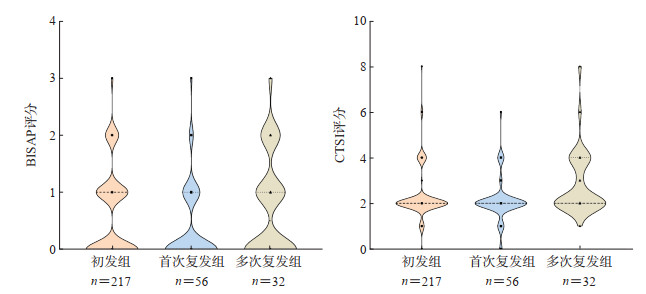 图 1 各组HTG-AP患者BISAP评分和CTSI评分比较HTG-AP:高甘油三酯血症性急性胰腺炎;BISAP:床旁急性胰腺炎严重程度指数;CTSI:计算机断层扫描严重程度指数.
 下载:
全尺寸图片
除上述分级及评分标准外,并发症同样是评估AP严重程度的重要指标。由表 2可见,3组患者全身炎症反应综合征(systemic inflammatory response syndrome,SIRS)发生率差异接近有统计学意义(P=0.058),表现为多次复发组高于首次复发组;3组患者胸腔积液发生率差异有统计学意义(P=0.035),表现为初发组和多次复发组高于首次复发组;3组患者器官功能衰竭和腹水发生率差异均无统计学意义(P=0.830、P=0.204)。此外,28例患者(9.18%)出现胰腺/胰周局部并发症,其中18例(5.90%)发生急性胰周液体积聚(acute peripancreatic fluid collection,APFC),8例(2.62%)发生急性坏死物积聚(acute necrotic collection,ANC),2例(0.66%)发生胰腺假性囊肿(pancreatic pseudocyst,PPC),未见包裹性坏死(walled-off necrosis,WON)和感染性胰腺坏死(infected pancreatic necrosis,IPN)。3组之间胰腺/胰周局部并发症的总发生率及APFC发生率差异有统计学意义(P=0.025、P=0.007),表现为多次复发组高于其他两组。
2.3 AP复发次数对疾病严重程度影响的logistic回归分析
采用logistic回归分析评估AP复发次数与疾病严重程度之间的关系,疾病严重程度指标包括修订版亚特兰大诊断分级、局部并发症及系统并发症。结果显示,与初发组相比,首次复发组的中重度AP(MSAP及SAP)和胸腔积液发生风险较低(OR=0.411,95%CI 0.176~0.959,P=0.040;OR=0.387,95%CI 0.185~0.810,P=0.012);相比之下,多次复发与中重度AP和胰腺/胰周局部并发症发生风险增高有关(OR=2.236,95%CI 1.044~4.790,P=0.038;OR=3.096,95%CI 1.177~8.142,P=0.022)。
3 讨论
本研究将复发性HTG-AP患者细分为首次复发组和多次复发(≥2次)组,研究结果显示,首次复发患者的病情相对初发的HTG-AP患者较轻,而多次复发患者的病情较初发和首次复发患者更为严重。
大量研究表明,与其他病因引起的AP相比,HTG-AP患者的病情更为严重,表现为更高的ICU入住率、延长的住院时间、更高的器官功能衰竭发生率及更高的SIRS发生率[9, 19]。目前,HTG-AP的发病机制尚不完全清楚。研究发现,大量甘油三酯在胰腺脂蛋白脂肪酶的作用下水解成游离脂肪酸(free fatty acid,FFA),超负荷的FFA通过抑制线粒体复合物[20]、引起腺泡细胞内钙离子超载[20-21]、促进炎症介质释放[22]、抑制胰腺导管功能[23]等多种机制加重胰腺损伤,并进一步造成胰腺外远隔器官功能衰竭[24]。脂质沉积会加重胰腺炎症反应,最终导致胰腺坏死。在这一过程中,更多甘油三酯被释放,进一步升高血脂,形成恶性循环[25]。这可能解释了多次复发患者病情更加严重的原因。进一步分析发现,多次复发患者的病情加重可能与以下机制密切相关:首先,反复发作引起的“炎症-坏死-纤维化”过程逐渐削弱胰腺的结构完整性和功能修复能力。每次复发都会导致胰腺腺泡细胞损伤的累积,表现为纤维化程度加重及胰腺导管功能障碍,这可能进一步增加胰液排出阻力,加重胰腺内压升高及坏死范围扩大。其次,多次复发可能增强系统性炎症反应的强度和频率,促炎因子(如TNF-α、IL-6)持续高水平表达,而抗炎因子(如IL-10)的相对不足进一步导致炎症反应的失控,增加远隔器官(如肺、肾)功能衰竭的发生风险[15]。
早期治疗AP的关键措施之一是液体复苏。大量研究表明,及时进行早期液体复苏可降低AP患者死亡率,减少SIRS及器官功能衰竭的发生[26-27]。然而,本研究发现,初发AP患者中重度AP发生率及胸腔积液发生率高于首次复发患者,发作距治疗时间和住院时间长于首次复发患者,这可能是由于初发患者对AP认识不足,就医延迟,从而导致病情较重。首次复发患者因为有先前的经验积累能够早期就医,病情相对较轻。多次复发患者虽然能够及时就医,但由于胰腺功能的累积损伤及炎症反应的加剧,其病情趋于恶化。因此,在HTG-AP的管理中,不仅需要加强对患者疾病认知的教育、优化医疗救治流程,还应重点关注复发患者,尤其是多次复发患者的早期干预与个体化治疗。当然,发作距治疗时间对HTG-AP患者病情的影响还需要进一步的临床研究。
本研究存在一些不足之处。(1)所有患者均来自同一中心,可能存在固有的偏倚。(2)由于本研究未对具体的治疗措施(如药物选择、剂量调整等个体化干预)进行深入调查,无法完全排除这些因素对复发及病情加重的潜在影响。(3)尽管本研究回顾性收集了9年的病例资料,但样本量仍较小。因此,本研究结果需要通过更大规模、多中心的研究加以验证。
总而言之,HTG-AP患者的复发次数与病情严重程度密切相关,相较于首次复发,多次复发患者病情更重。但初发患者可能因缺乏对疾病的认识导致就医延迟,病情相较于首次复发反而更重。
-
图 1 各组HTG-AP患者BISAP评分和CTSI评分比较
HTG-AP:高甘油三酯血症性急性胰腺炎;BISAP:床旁急性胰腺炎严重程度指数;CTSI:计算机断层扫描严重程度指数.
下载:
全尺寸图片
表 1 各组HTG-AP患者一般资料比较
指标 初发组N=217 首次复发组N=56 多次复发组N=32 P值 性别, n (%) 0.975 男 167 (76.96) 44 (78.57) 25 (78.12) 女 50 (23.04) 12 (21.43) 7 (21.88) 年龄/岁, M (Q1, Q3) 41.00 (35.50, 49.00) 45.00 (36.25, 48.00) 42.00 (35.00, 50.00) 0.639 BMI/(kg·m-2), x±s 27.11±3.19 26.99±3.66 25.91±2.64 0.162 高血压, n (%) 57 (26.27) 17 (30.36) 9 (28.12) 0.822 冠心病, n (%) 1 (0.46) 2 (3.57) 2 (6.25) 0.022 糖尿病, n (%) 65 (29.95) 16 (28.57) 12 (37.50) 0.660 脂肪肝, n (%) 139 (64.06) 36 (64.29) 14 (43.75) 0.086 吸烟, n (%) 87 (40.09) 20 (35.71) 12 (37.50) 0.817 饮酒, n (%) 63 (29.03) 17 (30.36) 12 (37.50) 0.646 TG/(mmol·L-1), M (Q1, Q3) 12.53 (8.12, 20.92) 15.33 (8.87, 21.25) 12.78 (9.15, 20.38) 0.710 发作距治疗时间/h, M (Q1, Q3) 12.0 (9.0, 24.0) 8.5 (5.0, 13.0) 10.0 (5.0, 12.0) <0.001 住院时间/d, M (Q1, Q3) 11.50 (9.00, 14.00) 10.00 (7.75, 12.00) 11.00 (10.00, 13.00) 0.008 HTG-AP:高甘油三酯血症性急性胰腺炎;BMI:体重指数;TG:甘油三酯. 表 2 各组HTG-AP患者病情严重程度分级和并发症比较
n%) 指标 初发组N=217 首次复发组N=56 多次复发组N=32 P值 修订版亚特兰大诊断分级 0.007 MAP 161 (74.19) 49 (87.50) 18 (56.25) MSAP 45 (20.74) 5 (8.93) 12 (37.50) SAP 11 (5.07) 2 (3.57) 2 (6.25) 胸腔积液 78 (35.94) 10 (17.86) 11 (34.38) 0.035 腹水 52 (23.96) 8 (14.29) 5 (15.62) 0.204 SIRS 47 (21.66) 6 (10.71) 10 (31.25) 0.058 器官功能衰竭 11 (5.07) 2 (3.57) 2 (6.25) 0.830 胰腺/胰周局部并发症 18 (8.29) 3 (5.36) 7 (21.88) 0.025 APFC 11 (5.07) 1 (1.79) 6 (18.75) 0.007 ANC 5 (2.30) 2 (3.57) 1 (3.12) 0.599 PPC 2 (0.92) 0 0 0.443 WON 0 0 0 1.000 IPN 0 0 0 1.000 HTG-AP:高甘油三酯血症性急性胰腺炎;MAP:轻症急性胰腺炎;MSAP:中度重症急性胰腺炎;SAP:重症急性胰腺炎;SIRS:全身炎症反应综合征;APFC:急性胰周液体积聚;ANC:急性坏死物积聚;PPC:胰腺假性囊肿;WON:包裹性坏死;IPN:感染性胰腺坏死. -
[1] Iannuzzi J P, King J A, Leong J H, et al. Global incidence of acute pancreatitis is increasing over time:a systematic review and meta-analysis[J]. Gastroenterology, 2022, 162(1):122-134. DOI: 10.1053/j.gastro.2021.09.043. [2] Peery A F, Crockett S D, Murphy C C, et al. Burden and cost of gastrointestinal, liver, and pancreatic diseases in the United States: update 2021[J]. Gastroenterology, 2022, 162(2): 621-644. DOI: 10.1053/j.gastro.2021.10.017. [3] Baron T H, DiMaio C J, Wang A Y, et al. American Gastroenterological Association clinical practice update: management of pancreatic necrosis[J]. Gastroenterology, 2020, 158(1): 67-75.e1. DOI: 10.1053/j.gastro.2019.07.064. [4] Szatmary P, Grammatikopoulos T, Cai W, et al. Acute pancreatitis: diagnosis and treatment[J]. Drugs, 2022, 82(12): 1251-1276. DOI: 10.1007/s40265-022-01766-4. [5] Lou D, Shi K, Li H P, et al. Quantitative metabolic analysis of plasma extracellular vesicles for the diagnosis of severe acute pancreatitis[J]. J Nanobiotechnology, 2022, 20(1): 52. DOI: 10.1186/s12951-022-01239-6. [6] Hallensleben N D, Umans D S, Bouwense S A, et al. The diagnostic work-up and outcomes of 'presumed' idiopathic acute pancreatitis: a post-hoc analysis of a multicentre observational cohort[J]. United European Gastroenterol J, 2020, 8(3): 340-350. DOI: 10.1177/2050640619890462. [7] García-Rayado G, Varela-Moreiras G, Lanas Á, et al. Dietary fat patterns and outcomes in acute pancreatitis in Spain[J]. Front Med, 2020, 7: 126. DOI: 10.3389/fmed.2020.00126. [8] Párniczky A, Kui B, Szentesi A, et al. Prospective, multicentre, nationwide clinical data from 600 cases of acute pancreatitis[J]. PLoS One, 2016, 11(10): e0165309. DOI: 10.1371/journal.pone.0165309. [9] Zhang X L, Li F, Zhen Y M, et al. Clinical study of 224 patients with hypertriglyceridemia pancreatitis[J]. Chin Med J, 2015, 128(15): 2045-2049. DOI: 10.4103/0366-6999.161361. [10] Yang D, Shen X, Ke L, et al. Clinical features of recurrent acute pancreatitis: experience from a single center[J]. Pancreas, 2017, 46(5): e36-e37. DOI: 10.1097/MPA.0000000000000822. [11] Lai T, Li J, Zhou Z, et al. Etiological changes and prognosis of hospitalized patients with acute pancreatitis over a 15-year period[J]. Dig Dis Sci, 2024, 69(1): 56-65. DOI: 10.1007/s10620-023-08172-0. [12] He W, Wang G, Yu B, et al. Elevated hypertriglyceridemia and decreased gallstones in the etiological composition ratio of acute pancreatitis as affected by seasons and festivals: a two-center real-world study from China[J]. Front Cell Infect Microbiol, 2022, 12: 976816. DOI: 10.3389/fcimb.2022.976816. [13] Yu B, Li J, Li N, et al. Progression to recurrent acute pancreatitis after a first attack of acute pancreatitis in adults[J]. Pancreatology, 2020, 20(7): 1340-1346. DOI: 10.1016/j.pan.2020.09.006. [14] Fortson M R, Freedman S N, Webster P D 3rd. Clinical assessment of hyperlipidemic pancreatitis[J]. Am J Gastroenterol, 1995, 90(12): 2134-2139. [15] Sand J, Nordback I. Acute pancreatitis: risk of recurrence and late consequences of the disease[J]. Nat Rev Gastroenterol Hepatol, 2009, 6(8): 470-477. DOI: 10.1038/nrgastro.2009.106. [16] Banks P A, Bollen T L, Dervenis C, et al. Classification of acute pancreatitis: 2012: revision of the Atlanta classification and definitions by international consensus[J]. Gut, 2013, 62(1): 102-111. DOI: 10.1136/gutjnl-2012-302779. [17] Wu B U, Johannes R S, Sun X, et al. The early prediction of mortality in acute pancreatitis: a large population-based study[J]. Gut, 2008, 57(12): 1698-1703. DOI: 10.1136/gut.2008.152702. [18] Balthazar E J, Robinson D L, Megibow A J, et al. Acute pancreatitis: value of CT in establishing prognosis[J]. Radiology, 1990, 174(2): 331-336. DOI: 10.1148/radiology.174.2.2296641. [19] Yang L, Liu J, Xing Y, et al. Comparison of BISAP, ranson, MCTSI, and APACHE Ⅱ in predicting severity and prognoses of hyperlipidemic acute pancreatitis in Chinese patients[J]. Gastroenterol Res Pract, 2016, 2016: 1834256. DOI: 10.1155/2016/1834256. [20] Navina S, Acharya C, DeLany J P, et al. Lipotoxicity causes multisystem organ failure and exacerbates acute pancreatitis in obesity[J]. Sci Transl Med, 2011, 3(107): 107ra110. DOI: 10.1126/scitranslmed.3002573. [21] Criddle D N, Raraty M G T, Neoptolemos J P, et al. Ethanol toxicity in pancreatic acinar cells: mediation by nonoxidative fatty acid metabolites[J]. Proc Natl Acad Sci U S A, 2004, 101(29): 10738-10743. DOI: 10.1073/pnas.0403431101. [22] Noel P, Patel K, Durgampudi C, et al. Peripancreatic fat necrosis worsens acute pancreatitis independent of pancreatic necrosis via unsaturated fatty acids increased in human pancreatic necrosis collections[J]. Gut, 2016, 65(1): 100-111. DOI: 10.1136/gutjnl-2014-308043. [23] Maléth J, Balázs A, Pallagi P, et al. Alcohol disrupts levels and function of the cystic fibrosis transmembrane conductance regulator to promote development of pancreatitis[J]. Gastroenterology, 2015, 148(2): 427-439.e16. DOI: 10.1053/j.gastro.2014.11.002. [24] Kiss L, Fűr G, Pisipati S, et al. Mechanisms linking hypertriglyceridemia to acute pancreatitis[J]. Acta Physiol (Oxf), 2023, 237(3): e13916. DOI: 10.1111/apha.13916. [25] Park D H, Kim M H, Chari S T. Recent advances in autoimmune pancreatitis[J]. Gut, 2009, 58(12): 1680-1689. DOI: 10.1136/gut.2008.155853. [26] Warndorf M G, Kurtzman J T, Bartel M J, et al. Early fluid resuscitation reduces morbidity among patients with acute pancreatitis[J]. Clin Gastroenterol Hepatol, 2011, 9(8): 705-709. DOI: 10.1016/j.cgh.2011.03.032. [27] Buxbaum J L, Quezada M, Da B, et al. Early aggressive hydration hastens clinical improvement in mild acute pancreatitis[J]. Am J Gastroenterol, 2017, 112(5): 797-803. DOI: 10.1038/ajg.2017.40.
