

Human papillomavirus vaccination and cervical cancer prevention and treatment: a bibliometric analysis (2006-2025)
-
摘要:目的
探讨人乳头瘤病毒(HPV)疫苗接种与宫颈癌防治相关研究态势,为后续相关研究奠定基础。
方法基于Web of Science核心合集数据库,检索2006-2025年HPV疫苗接种与宫颈癌防治相关研究领域文献,进行数据清洗,剔除重复及不相关文献,采用VOSviewer、CiteSpace、R语言等软件对入选文献进行可视化分析。
结果共纳入4 808篇文献,发文量从2006年的58篇增长至2024年的368篇,呈稳定上升趋势。美国和中国是该领域的主要贡献国,澳大利亚墨尔本大学的Garland SM为最高产作者。该领域载文量最高的期刊为Vaccine,最高产机构为WHO。关键词聚类和突现分析表明,研究热点主要涉及病原体与发病机制、疫苗技术与免疫反应、公共卫生与认知,且近年研究前沿已从基础病毒学与临床试验转向疫苗接种覆盖率、疫苗犹豫及中低收入地区可及性等实际应用议题。
结论2006年以来HPV疫苗接种与宫颈癌防治研究整体文献产出稳定上升,逐渐形成了主要的热点研究领域,朝着以实现全球消除为目标的公共卫生实践方向推进,但仍需推动理论知识向公平可及的干预实践转化,并通过深化国际合作来弥合不同地区间的实施差异。
Abstract:ObjectiveTo investigate the research landscape of human papillomavirus (HPV) vaccination and cervical cancer prevention and treatment, and to lay a foundation for future research.
MethodsRelevant studies on HPV vaccination and cervical cancer prevention and treatment published between 2006 and 2025 were retrieved from the Web of Science Core Collection. After data cleaning and removal of duplicate and irrelevant documents, a visualization analysis was conducted using software tools including VOSviewer, CiteSpace, and R.
ResultsA total of 4 808 publications were included. The annual number of articles increased steadily from 58 in 2006 to 368 in 2024. The United States and China were the major contributing countries in this field, and Professor Garland SM from the University of Melbourne was the most prolific author. Vaccine ranked first in publication output, and the World Health Organization (WHO) was the most productive institution. Research hotspots primarily focused on pathogens and pathogenesis, vaccine technologies and immune responses, as well as public health and cognition. In recent years, research frontiers have shifted from basic virology and clinical trials to practical application-oriented issues such as vaccination coverage, vaccine hesitancy, and accessibility in low- and middle-income settings.
ConclusionSince 2006, the overall research output on HPV vaccination and cervical cancer prevention and treatment has steadily increased, with the gradual formation of major research hotspot areas. The field is advancing toward public health practices aimed at global elimination, yet efforts are still needed to translate theoretical knowledge into equitable and accessible interventions and to bridge implementation disparities across regions through deepened international collaboration.
-
Keywords:
- cervical neoplasms /
- human papillomavirus /
- vaccination /
- bibliometrics
-
宫颈癌是全球重大公共卫生问题,也是女性癌症发病与死亡的主要原因之一[1]。据GLOBOCAN 2022全球癌症统计数据估计,全球宫颈癌新发病例约66万例,死亡病例约35万例,分别占女性新发癌症病例总数的14.1%和癌症死亡总数的7.1%[2]。绝大多数宫颈癌病例可归因于高危型人乳头瘤病毒(human papillomavirus,HPV)的持续感染[3]。高危型HPV与宫颈癌的病因学关联最早于20世纪80年代初被确立,这一里程碑式发现为后续预防策略的制定奠定了基础[4]。迄今为止,WHO推荐用于宫颈癌筛查的高危型HPV共包含14种基因型,它们是驱动宫颈癌致癌过程的主要因素[5]。首款HPV疫苗于2006年获得美国FDA批准用于女性,2009年获批用于男性[6-7]。2019年首个中国国产二价HPV疫苗获批上市,2025年首个国产九价HPV疫苗和四价HPV疫苗相继获批上市[8-10]。与此同时,二十一价HPV疫苗也在研发中。
鉴于HPV疫苗接种及宫颈癌研究在生物学、临床实践及公共卫生领域具有重大意义,自疫苗问世以来,相关科学文献呈现爆发式增长,亟需通过全面分析来梳理研究趋势和演变脉络、识别关键贡献者并揭示新兴研究主题。本研究采用文献计量学方法,对2006年以来全球范围内关于HPV疫苗接种与宫颈癌防治的科研成果展开研究。
1 资料和方法
1.1 数据检索与收集
数据来源于Web of Science核心合集(Web of Science Core Collection,WoSCC)。检索式如下:TS=(“human papillomavirus vaccine” OR “human papillomavirus vaccination” OR “HPV vaccine” OR “HPV vaccination” OR Gardasil OR Cervarix) AND TS=(“cervical neoplasm*” OR “cervical cancer*” OR “cervical carcinoma*”) AND DT=(article OR review) AND PY=(2006-2025) AND LA=(English)。检索范围限定于科学引文索引扩展版(SCI-Expanded)。
1.2 数据清洗与质量控制
本研究对检索文献执行了多阶段筛选与质量控制流程。数据清洗包括使用CiteSpace软件(版本6.4.1)完成数据去重、合并同义词,并对异常值进行识别与标准化处理。为确保结论的稳健性,本研究实施了多维验证:(1)交叉工具验证,利用R语言Bibliometrix软件包(版本4.0.1)提取相同原始数据,与VOSviewer软件(版本1.6.20)和CiteSpace软件分析结果进行比对,以减少单一软件算法偏差;(2)流程跟踪验证,记录数据清洗全流程,确保所有操作具有可复现性。
1.3 文献计量分析与可视化
利用VOSviewer软件绘制合作网络并开展共引分析[11],通过CiteSpace软件进行文献与关键词计量学分析[12],运用Bibliometrix软件包对H指数等进行补充性分析[13]。
2 结果
2.1 年度发文量与被引频次趋势
本研究通过WoSCC数据库开展全面文献检索。经数据清洗、剔除重复文献后,最终确定4 808篇文献用于后续的文献计量学分析。由图 1可见,HPV疫苗接种与宫颈癌防治研究领域年度发文量呈现显著且持续的上升态势,从2006年的58篇大幅增长至2024年的峰值368篇;各年度平均被引频次则呈现波动特征,2020年达到6.64次的最高点。
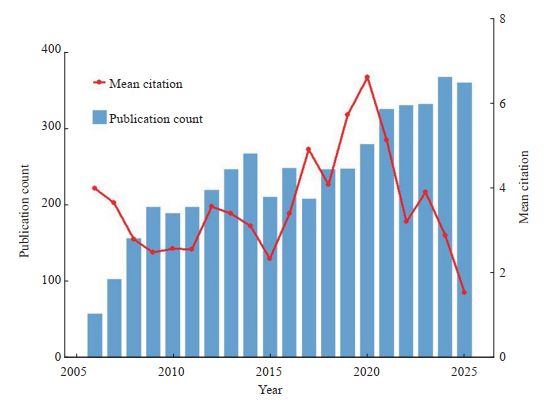 图 1 人乳头瘤病毒疫苗接种与宫颈癌防治研究领域年度发文量与平均被引频次趋势Fig. 1 Trends in annual publication count and mean citations on human papillomavirus vaccination and cervical cancer prevention and treatment
 下载:
全尺寸图片
2.2 国家贡献与合作
全球HPV疫苗接种与宫颈癌防治研究的领导地位高度集中,但其合作模式呈现出不同特征(表 1)。尽管美国(29.2%)和中国(10.7%)在研究产出量上处于领先地位,但其国际合作比例相对较低,多国合作出版物(multiple- country publication,MCP)比例均不足30%。而法国、比利时、南非、德国等国家国际合作程度较高,其MCP比例不低于50%。
表 1 人乳头瘤病毒疫苗接种与宫颈癌防治研究领域基于通信作者所在国家的文献产出(前20位)与合作情况Table 1 Publication output (Top 20) and collaboration by corresponding authors' countries in human papillomavirus vaccination and cervical cancer prevention and treatmentRank Country Document Percentage/% MCP/% Rank Country Document Percentage/% MCP/% 1 USA 1 404 29.2 26.9 11 Netherlands 84 1.7 36.9 2 China 514 10.7 20.6 12 South Africa 83 1.7 55.4 3 UK 237 4.9 37.6 13 Sweden 76 1.6 44.7 4 Australia 212 4.4 42.0 14 Korea 75 1.6 21.3 5 Japan 166 3.4 12.0 17 Germany 74 1.5 50.0 6 Italy 163 3.5 22.1 14 Brazil 72 1.5 31.9 7 Canada 150 3.1 42.7 18 Denmark 72 1.5 34.7 8 France 137 2.8 56.9 16 Spain 67 1.4 38.8 9 India 96 2.0 24.0 19 Iran 60 1.2 18.3 10 Belgium 86 1.8 68.6 20 Malaysia 49 1.0 28.6 MCP: Multiple-country publication. 2.3 机构与学者贡献
在涉及的5 767家机构中,一批国际公共卫生机构与顶尖大学主导了这一领域(表 2)。其中,WHO和伦敦大学的发文量位居前列。值得注意的是,国际癌症研究机构(International Agency for Research on Cancer,IARC)凭借最多的连接数与总连接强度,成为机构合作网络中的核心枢纽(图 2)。紧随其后的是美国国家癌症研究所(National Cancer Institute,NCI)与墨尔本大学。在中国的研究机构中,北京协和医学院、香港大学、厦门大学位居前列(表 2)。
表 2 人乳头瘤病毒疫苗接种与宫颈癌防治研究领域全球和中国发文量排前10位的研究机构Table 2 Top 10 institutions by publication output in human papillomavirus vaccination and cervical cancer prevention and treatment worldwide and in ChinaGlobal China Institution Document Centrality Institution Document World Health Organization (Global) 227 0.02 Peking Union Medical College 79 >University of London (UK) 226 0.06 University of Hong Kong 59 >Harvard University (USA) 176 0.04 Xiamen University 33 >Centers for Disease Control and Prevention (USA) 159 0.02 Peking University 32 >National Institutes of Health (USA) 156 0.02 Sichuan University 32 >International Agency for Research on Cancer (Global) 147 0.03 Chinese University of Hong Kong 30 >National Cancer Institute (USA) 138 0.04 Zhejiang University 22 >University of Melbourne (Australia) 135 0.13 Zhengzhou University 22 >University of California System (USA) 120 0.05 Nanjing Medical University 19 >London School of Hygiene & Tropical Medicine (UK) 128 0.03 Fudan University 16 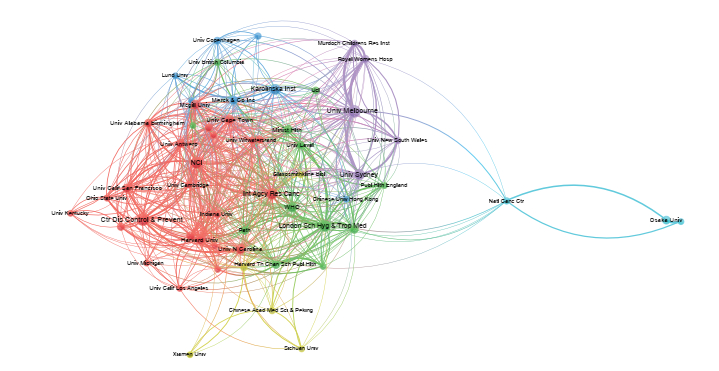 图 2 人乳头瘤病毒疫苗接种与宫颈癌防治研究领域全球研究机构合作网络Fig. 2 Global institutional collaboration network in human papillomavirus vaccination and cervical cancer prevention and treatment下载:
全尺寸图片
在作者学术贡献层面,作为高产作者与高频被引学者,Garland SM展现出显著的学术影响力;相比之下,Markowitz LE等学者凭借最高H指数彰显了其深远影响;而Schiffman M尽管发文量较少,却凭借卓越的引用影响力脱颖而出;来自北京协和医学院的乔友林(Qiao YL)是中国综合影响力最高的作者之一(表 3)。作者共引网络(图 3)将这些学术贡献映射为7个不同的知识集群,其中规模最大的集群聚焦于疫苗效力与免疫原性(如Villa LL)、真实世界有效性与安全性(如Markowitz LE)以及流行病学建模(如Arbyn M)等。
表 3 人乳头瘤病毒疫苗接种与宫颈癌防治研究领域全球和中国产出及影响力最高的10位作者Table 3 Top 10 authors with the highest publication output and impact worldwide and in China in human papillomavirus vaccination and cervical cancer prevention and treatmentRank Most production globally Highest H-index globally Most production in China Highest H-index in China Author Document Author H-index Citation Author Document Author H-index 1 Garland SM 68 Markowitz LE 32 5 783 Qiao YL 54 Qiao YL 26 2 Markowitz LE 60 Garland SM 32 5 199 Zhao FH 31 Zhao FH 20 3 Kim JJ 60 Kim JJ 32 4 518 Li J 30 Wu TC 17 4 Dillner J 58 Dillner J 29 4 363 Zhang X 29 Zhang X 14 5 Canfell K 56 Canfell K 28 4 366 Zhang J 25 Hu SY 14 6 Ueda Y 54 Brewer NT 28 2 710 Hu SY 20 Li J 14 7 Qiao YL 54 Smith JS 28 2 645 Liu Y 16 Zhang J 13 8 Brotherton JML 53 Schiffman M 27 6 102 Zhang L 16 Hong Y 11 9 Saraiya M 50 Castle PE 27 5 544 Wang L 14 Ngan HYS 11 10 Smith JS 48 Bosch FX 27 5 098 Wong LP 13 Xia NS 11 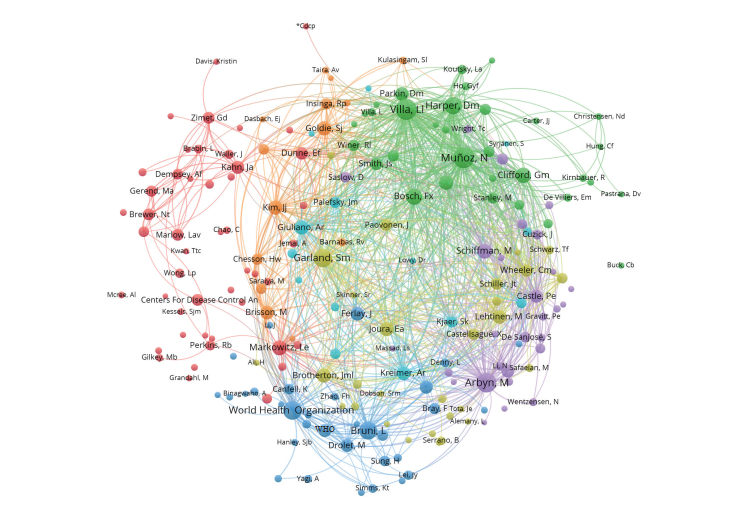 图 3 人乳头瘤病毒疫苗接种与宫颈癌防治研究领域作者共引网络Fig. 3 Author co-citation network in human papillomavirus vaccination and cervical cancer prevention and treatment下载:
全尺寸图片
2.4 知识基础与演化路径分析
学术期刊分析结果(表 4)显示,Vaccine是该领域的领先期刊,无论是载文量(445篇)还是影响力(H指数为67)均位居榜首。高被引文献(表 5)分析显示,这些文献主要围绕三大主题展开:全球及地区疾病负担(例如Arbyn M,2020;de Martel C,2017)、临床筛查指南与管理(例如Saslow D,2012)、疫苗效力与推广实施(例如Lei JY,2020;Markowitz LE,2014)。共引网络分析揭示了相关文献在学术层面的聚类特征,形成四大核心研究领域:疫苗效力与全球战略、病毒学与致癌机制、疫苗临床试验、疫苗接种行为与政策。这一领域演化路径通过突现分析(图 4)得到印证,其中WHO于2020年发布的《加速消除宫颈癌全球战略》为近期研究前沿,表明当前该领域正朝着以实现全球消除为目标的公共卫生实践方向推进。
表 4 人乳头瘤病毒疫苗接种与宫颈癌防治研究领域发文量排前10位的学术期刊Table 4 Top 10 academic journals by publication output in human papillomavirus vaccination and cervical cancer prevention and treatmentRank Source Document IF (2024) H-index 1 Vaccine 445 3.5 67 2 Hum Vaccin Immunother 184 3.5 32 3 PLoS One 188 2.6 36 4 Vaccines (Basel) 134 3.4 19 5 BMC Public Health 118 3.6 32 6 Int J Cancer 87 4.7 32 7 Asian Pac J Cancer Prev 66 21 8 Front Public Health 65 3.4 15 9 Prev Med 65 3.2 27 10 Gynecol Oncol 61 4.1 29 IF: Impact factor. 表 5 人乳头瘤病毒疫苗接种与宫颈癌防治研究领域被引频次排前10位的文献Table 5 Top 10 most cited documents in human papillomavirus vaccination and cervical cancer prevention and treatmentRank Title Author Source Year Citation 1 Estimates of incidence and mortality of cervical cancer in 2018: a worldwide analysis Arbyn M Lancet Glob Health 2020 2 864 2 Cervical cancer Cohen PA Lancet 2019 1 990 3 Worldwide burden of cancer attributable to HPV by site, country and HPV type de Martel C Int J Cancer 2017 1 760 4 HPV vaccination and the risk of invasive cervical cancer Lei JY New Engl J Med 2020 1 060 5 American Cancer Society, American Society for Colposcopy and Cervical Pathology, and American Society for Clinical Pathology screening guidelines for the prevention and early detection of cervical cancer Saslow D Am J Clin Pathol 2012 1 029 6 Cervical cancer: a global health crisis SmallL W Cancer Am Cancer Soc 2017 973 7 Cancer of the cervix uteri Bhatla N Int J Gynecol Obstet 2018 913 8 Human papillomavirus vaccination: recommendations of the Advisory Committee on Immunization Practices (ACIP) Markowitz LE MMWR Recomm Rep 2014 816 9 Annual report to the nation on the status of cancer, 1975-2009, featuring the burden and trends in human papillomavirus (HPV)-associated cancers and HPV vaccination coverage levels Jemal A J Natl Cancer I 2013 806 10 Attitudes to vaccination: a critical review Yaqub O Soc Sci Med 2014 761 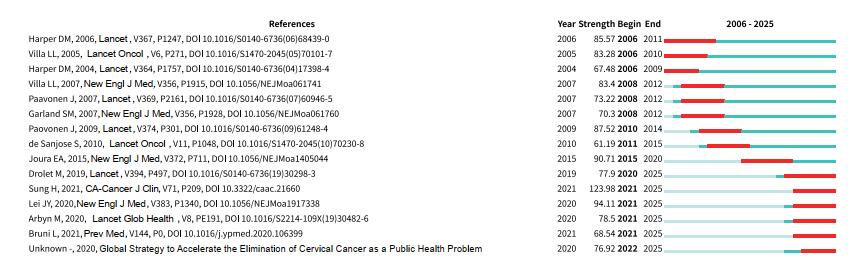 图 4 人乳头瘤病毒疫苗接种与宫颈癌防治研究领域突现强度最高的15篇参考文献Fig. 4 Top 15 references with the strongest citation bursts in human papillomavirus vaccination and cervical cancer prevention and treatment下载:
全尺寸图片
2.5 研究热点主题与演变趋势
关键词聚类分析(图 5)识别出11个主要集群(#0至#10),这些集群可进一步归类为3个核心研究维度。维度Ⅰ为病原体与发病机制(#2、#8、#9),聚焦病因学与疾病谱系研究。其中,集群#2(HPV)是病毒基础研究的核心;集群#9(宫颈)与集群#8(肛门癌)反映了HPV感染引发的两类主要癌症,显示研究范围已从传统关注的宫颈癌拓展至其他HPV相关癌症领域。维度Ⅱ为疫苗技术与免疫反应(#3、#5、#6、#7),围绕疫苗的微观作用机制展开探讨。其中,集群#3(CervarixTM)涉及对特定疫苗的临床研究;集群#7(类病毒颗粒)与疫苗核心技术直接相关;集群#5(免疫记忆)与集群#6(抗体介导的中和作用)则共同阐释了疫苗在人体内触发持久有效保护性免疫反应的原理。维度Ⅲ为公共卫生与认知(#0、#1、#4、#10),聚焦宏观层面的策略制定与公众认知提升。其中,集群#1(知识)围绕HPV疫苗的认知度、态度及接受度展开研究;集群#4(建议)涵盖权威机构制定的疫苗接种与筛查指南;集群#10(筛查项目)与集群#0(成本效益)密切关联,两者共同构成公共卫生决策的核心要素——通过评估筛查项目的成本效益,实现资源配置的优化。
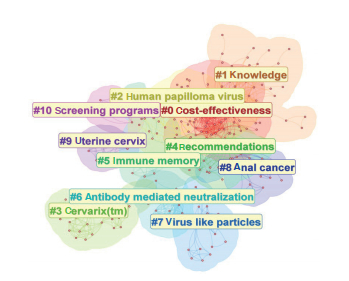 图 5 人乳头瘤病毒疫苗接种与宫颈癌防治研究领域关键词聚类分析Fig. 5 Cluster analysis of keywords in human papillomavirus vaccination and cervical cancer prevention and treatment下载:
全尺寸图片
关键词突现分析按起始年份排序显示了该领域研究热点的演变趋势(图 6)。在早期阶段(2006-2007年),研究重点集中在HPV本身的基础与临床研究,包括高危型(16型、18型)、疫苗效力的随机对照试验、疫苗技术(类病毒颗粒)。随后,研究重点转向证据综合(系统评价,2013-2018年)和扩大疫苗适应证(肛门癌,2012-2017年)。2016年后,研究前沿已转向疫苗的实际应用与推广,包括疫苗接种覆盖率、疫苗犹豫现象、中低收入地区疫苗可及性。
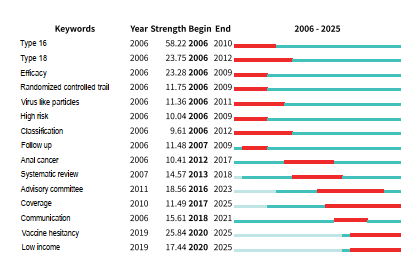 图 6 人乳头瘤病毒疫苗接种与宫颈癌防治研究领域突现强度排前15位的关键词Fig. 6 Top 15 keywords with the strongest burst strength in human papillomavirus vaccination and cervical cancer prevention and treatment下载:
全尺寸图片
3 讨论
3.1 总体发展与领域影响力演变
2006-2024年,HPV疫苗接种与宫颈癌防治研究领域的年发文量从58篇激增至368篇,这一显著增长反映出全球对HPV疫苗接种与宫颈癌防治的持续高度关注。然而,论文平均被引频次呈波动趋势,这可能有以下两方面原因:(1)部分新近发表的文献由于时间尚短,尚未进入被引增长的常态周期,短期内拉低了整体均值,预计随着时间推移,其中的高质量成果将逐步累积引用;(2)总体变化趋势主要受文献数量的持续增长、研究重心向临床应用与区域研究的转移、HPV疫苗技术日趋成熟等因素影响,随着领域的不断发展,学术产出正日益强调公共卫生服务的普及与公平性,而非单纯追求突破性创新。这一趋势在临床实践中同样明显,例如基于风险分级的筛查路径优化和宫颈病变规范化管理流程的推广,使研究产出更贴近诊疗一线的可操作需求。同时,随着WHO《加速消除宫颈癌全球战略》的推进,各国正着力提升HPV疫苗覆盖率与筛查可及性,相关实施性研究、成本效果评估和区域性防控策略报道逐渐增多。
3.2 全球合作格局
美国与中国尽管发文量位居前列,国际合作程度却相对有限(MCP<30%)。两者在HPV疫苗接种与宫颈癌防治研究领域的主导地位可能源于各自的巨额投入,由此构建起自给自足的大型研究生态系统[14-15]。相比之下,以德国、法国和比利时为代表的欧洲集群高度依赖国际合作(MCP≥50%),这体现出其对市场规模较小或资金环境分散的战略性适应[16-17]。非洲与南美洲在该研究领域处于边缘位置,凸显出科研能力、基础设施及议程设置权方面持续存在的结构性不平等[18-19]。在这一格局中,南非是一个特殊案例(MCP为55.4%)。它之所以拥有较高的国际合作率,可能是因为其本身就是非洲的科研枢纽,具备相对完备的科研体系,能够与全球以及非洲其他国家形成双向联结,且非洲一直是全球援助和关注的对象。尽管该领域的知识生产高度集中,疾病负担的分布却并非如此。通过定向支持与协作能力建设来弥合这些差距,对于推动全球宫颈癌防控的公平进展至关重要。在此过程中,推动科研大国将技术优势转化为全球公共健康产品应成为未来国际科研合作的关键方向。中国正逐渐从“科研大国”向“科研合作枢纽”转型,通过平台共建与技术转移,积极促进与发展中国家的科研合作,成为连接全球科研体系的关键节点[20]。中国在“南南合作”中向非洲发展中国家推广HPV疫苗及低成本筛查技术,推动宫颈癌防控纳入全球健康议程,对宫颈癌防控的全球可及性做出了直接贡献[21-24]。
3.3 核心机构与高影响力学者
IARC为主要合作中心,WHO与NCI为次要合作方。这一国际公共卫生机构的核心作用凸显出HPV疫苗接种与宫颈癌防治研究是一个高度政策驱动且注重实践的领域[25-26]。这与个别高水平大学主导的研究领域[27]形成鲜明对比,进一步强调了公共卫生机构所协调的全球协作的重要性。以高校及医院为核心力量的中国科研体系在产出上表现卓越,但在发起并主导此类政策导向的科研协作方面仍面临挑战,尤其是在将政策驱动的研究转化为基层临床操作规范和区域性公共卫生行动方面。未来,如何借鉴此类国际网络的核心机制,培育或强化中国自身的战略性、枢纽型公共卫生研究实体,或是提升我国全球影响力的关键。
为避免将研究成果数量与学术影响力质量混为一谈,更准确地评估作者在该领域的实质性贡献,应从多个维度对作者影响力展开评估[28]。本研究将学者的学术贡献划分为三大类型:Garland SM代表广影响力型学者,这类学者通过高产出与高被引率实现研究成果的广泛传播,进而拓展学科知识边界;Markowitz LE代表深度影响力型学者,其较高的H指数彰显出持续性的基础性贡献,对学科发展产生深远影响;Schiffman M则代表精准影响力型学者,被引频次异常突出,这一特征证明精准聚焦的高质量研究能够产生超乎寻常的学术影响力。北京协和医学院的乔友林(Qiao YL)是中国最具综合影响力的研究者之一,他聚焦中国HPV筛查及疫苗接种的流行病学研究,其将全球议题与本土实践相结合的研究范式为后续学者提供了关键参照。
3.4 知识演化与未来趋势
通过对高被引文献、共引网络及文献突现态势的分析,可清晰勾勒出HPV疫苗接种与宫颈癌防治领域知识的演进轨迹。该领域从病毒学与致癌作用的基础研究起步,历经疫苗临床试验的关键阶段,最终聚焦于现实世界有效性及实施科学层面。这一演进过程在WHO 2020年《加速消除宫颈癌全球战略》引发的大规模引用突现中得到显著体现,表明当前研究前沿已由全球消除目标下的实际挑战主导,涵盖疫苗接种率、政策落地及健康公平性等关键问题。在临床实践层面,这体现为基于风险分级的宫颈癌筛查方案的优化、HPV自取样技术的推广以及低资源地区简化诊疗流程的探索;在公共卫生落地方面,则表现为适龄学生HPV疫苗补种项目、偏远地区筛查移动平台建设以及多部门协作的消除策略成本效果评估。
然而,这一发展轨迹并非线性路径,而是演变为一个动态的自我优化循环。疾病负担、筛查指南与疫苗效力构成了该循环的核心要素。基础研究持续为公共卫生项目提供理论支撑,而实际实施中产生的数据则形成了关键的反馈机制。例如,疫苗接种后流行率变化的研究成果以及筛查策略的经济评估,直接为基础模型的优化与临床指南的更新提供了依据[29-32]。因此,当前的研究前沿正成为实施科学与基础研究、转化研究相互反馈的交汇点。关键挑战在于确保这些科学进展能够转化为惠及所有人群的公平健康成果[33]。
3.5 研究热点与前沿领域
关键词聚类分析揭示出HPV疫苗接种与宫颈癌防治研究领域的3个内在维度,它们构成了从基础病毒学研究到公共卫生影响的逻辑转化路径。不过,这一知识结构并非一成不变。通过关键词突现分析捕捉到的研究热点时间演变勾勒出该领域沿此转化路径的发展轨迹。这一探索始于维度Ⅰ(病原体与发病机制)的基础研究,重点在于验证病毒效力并深入解析病毒特性,类病毒颗粒和16型病毒等早期突现关键词正是该阶段的典型代表。这些基础性工作直接推动了维度Ⅱ(疫苗技术与免疫反应)中先进工具的研发,其核心平台正是基于类病毒颗粒技术。作为当前所有HPV预防性疫苗的核心成分,类病毒颗粒在疫苗开发中发挥着关键作用[34]。类病毒颗粒主要由衣壳蛋白L1组成,能够自我组装以模拟病毒结构,由于缺乏病毒DNA,因此具有非感染性且安全性良好,同时能有效触发特定中和抗体的产生,防止病毒侵入细胞。除这一实例外,新一代工具正深刻拓展我们的认知:类器官模型可在人体组织微环境中重现HPV诱导的完整癌变过程[35-37];基因编辑技术为通过靶向病毒的基本储存库——共价闭合环状DNA实现治愈提供了理论蓝图[38-40];与此同时,单细胞测序技术揭示了疫苗诱导免疫反应与肿瘤微环境的复杂性,从而为治疗性疫苗和联合免疫疗法的开发开辟了新方向[41-42]。最终,这些工具的成效将在公共卫生与认知领域(维度Ⅲ)接受检验。这一转变由WHO 2020年《加速消除宫颈癌全球战略》推动,该战略将全球研究重点重新导向实施科学与健康公平。随着这些技术的有效性得到证实,该领域自然进入证据整合与研究范围拓展阶段,具体体现为系统评价的爆发式增长以及研究重点向肛门癌等其他领域延伸[43]。这一转变凸显了核心挑战的关键性转变:从证明疫苗有效性转向确保疫苗覆盖人群。正是在此处,动态分析与维度Ⅰ(病原体与发病机制)形成了有力的交叉。
近年来,围绕HPV疫苗接种覆盖率、疫苗犹豫现象及低收入国家疫苗接种实施情况的研究显著增多,这表明免疫规划的最终考验在于能否实现公平且有效的疫苗部署。实证研究已对不同社会经济背景国家的国家免疫规划展开比较:澳大利亚、丹麦等高收入国家的青少年HPV疫苗接种率均超过85%,而众多中低收入国家虽有卢旺达(77%)、乌干达(95%)等成功试点案例,却仍面临疫苗接种规模扩大的系统性障碍[44]。值得关注的是,HPV疫苗犹豫仍是关键瓶颈。例如,在日本,因缺乏充分证据支撑的安全性担忧,政府于2013-2022年暂停主动建议接种,导致HPV疫苗接种率从70%以上骤降至不足1%[45-46],这一案例说明即便在资源充足地区,公众信任也可能快速流失[47]。这些研究结果强调,仅依靠科学有效性远远不够,还需建立持续的沟通机制[47-50]、推行性别包容性政策(如将HPV疫苗接种范围扩大至男性群体)[51-52]、设置灵活的补种机制[53-54]、制定合理的接种时间[55-58]、保障可负担的价格[59],以弥合疫苗可及性与实际接种率之间的差距。
与这些实施挑战并行的是,HPV疫苗研究的前沿领域也在从单纯的预防向更广泛的方向拓展。新兴的治疗性疫苗,如目前中国处于早期试验阶段的mRNA疫苗(例如RCZL11,ChiCTR2500108397)和多肽疫苗候选物(例如PDS0101[60]),均旨在靶向持续性HPV感染及HPV驱动的肿瘤,有望将宫颈癌管理从一级预防升级为覆盖疾病全程的综合治疗模式。
3.6 局限性与未来展望
本研究借助系统性文献计量分析梳理了2006-2025年间HPV疫苗接种与宫颈癌防治研究的学术脉络,揭示了该领域迅猛的发展态势和独特的协作模式,以及从病毒学基础研究到全球消除战略的完整演进历程。本研究尚存在以下局限性。(1)数据来源仅局限于WoSCC数据库,这可能遗漏其他数据库或非英语语种的重要文献。(2)作为文献计量学研究,本研究分析聚焦于研究的结构特征与定量趋势,未对研究内容本身展开深入解读。(3)近期发表的文献引用频次较低,导致最新研究的潜在影响力可能未被充分捕捉。虽然HPV疫苗接种与宫颈癌防治领域研究已日趋成熟,并形成了清晰统一的发展目标,然而,未来的成功不仅取决于持续的科技创新,更关键的是将现有知识转化为全球可及的有效干预措施。加强全球协作将有助于推动研究成果惠及资源匮乏地区,从而将宫颈癌消除的愿景转化为普世性现实。
-
图 1 人乳头瘤病毒疫苗接种与宫颈癌防治研究领域年度发文量与平均被引频次趋势
Fig. 1 Trends in annual publication count and mean citations on human papillomavirus vaccination and cervical cancer prevention and treatment
下载:
全尺寸图片
图 2 人乳头瘤病毒疫苗接种与宫颈癌防治研究领域全球研究机构合作网络
Fig. 2 Global institutional collaboration network in human papillomavirus vaccination and cervical cancer prevention and treatment
下载:
全尺寸图片
图 3 人乳头瘤病毒疫苗接种与宫颈癌防治研究领域作者共引网络
Fig. 3 Author co-citation network in human papillomavirus vaccination and cervical cancer prevention and treatment
下载:
全尺寸图片
图 4 人乳头瘤病毒疫苗接种与宫颈癌防治研究领域突现强度最高的15篇参考文献
Fig. 4 Top 15 references with the strongest citation bursts in human papillomavirus vaccination and cervical cancer prevention and treatment
下载:
全尺寸图片
图 5 人乳头瘤病毒疫苗接种与宫颈癌防治研究领域关键词聚类分析
Fig. 5 Cluster analysis of keywords in human papillomavirus vaccination and cervical cancer prevention and treatment
下载:
全尺寸图片
图 6 人乳头瘤病毒疫苗接种与宫颈癌防治研究领域突现强度排前15位的关键词
Fig. 6 Top 15 keywords with the strongest burst strength in human papillomavirus vaccination and cervical cancer prevention and treatment
下载:
全尺寸图片
表 1 人乳头瘤病毒疫苗接种与宫颈癌防治研究领域基于通信作者所在国家的文献产出(前20位)与合作情况
Table 1 Publication output (Top 20) and collaboration by corresponding authors' countries in human papillomavirus vaccination and cervical cancer prevention and treatment
Rank Country Document Percentage/% MCP/% Rank Country Document Percentage/% MCP/% 1 USA 1 404 29.2 26.9 11 Netherlands 84 1.7 36.9 2 China 514 10.7 20.6 12 South Africa 83 1.7 55.4 3 UK 237 4.9 37.6 13 Sweden 76 1.6 44.7 4 Australia 212 4.4 42.0 14 Korea 75 1.6 21.3 5 Japan 166 3.4 12.0 17 Germany 74 1.5 50.0 6 Italy 163 3.5 22.1 14 Brazil 72 1.5 31.9 7 Canada 150 3.1 42.7 18 Denmark 72 1.5 34.7 8 France 137 2.8 56.9 16 Spain 67 1.4 38.8 9 India 96 2.0 24.0 19 Iran 60 1.2 18.3 10 Belgium 86 1.8 68.6 20 Malaysia 49 1.0 28.6 MCP: Multiple-country publication. 表 2 人乳头瘤病毒疫苗接种与宫颈癌防治研究领域全球和中国发文量排前10位的研究机构
Table 2 Top 10 institutions by publication output in human papillomavirus vaccination and cervical cancer prevention and treatment worldwide and in China
Global China Institution Document Centrality Institution Document World Health Organization (Global) 227 0.02 Peking Union Medical College 79 >University of London (UK) 226 0.06 University of Hong Kong 59 >Harvard University (USA) 176 0.04 Xiamen University 33 >Centers for Disease Control and Prevention (USA) 159 0.02 Peking University 32 >National Institutes of Health (USA) 156 0.02 Sichuan University 32 >International Agency for Research on Cancer (Global) 147 0.03 Chinese University of Hong Kong 30 >National Cancer Institute (USA) 138 0.04 Zhejiang University 22 >University of Melbourne (Australia) 135 0.13 Zhengzhou University 22 >University of California System (USA) 120 0.05 Nanjing Medical University 19 >London School of Hygiene & Tropical Medicine (UK) 128 0.03 Fudan University 16 表 3 人乳头瘤病毒疫苗接种与宫颈癌防治研究领域全球和中国产出及影响力最高的10位作者
Table 3 Top 10 authors with the highest publication output and impact worldwide and in China in human papillomavirus vaccination and cervical cancer prevention and treatment
Rank Most production globally Highest H-index globally Most production in China Highest H-index in China Author Document Author H-index Citation Author Document Author H-index 1 Garland SM 68 Markowitz LE 32 5 783 Qiao YL 54 Qiao YL 26 2 Markowitz LE 60 Garland SM 32 5 199 Zhao FH 31 Zhao FH 20 3 Kim JJ 60 Kim JJ 32 4 518 Li J 30 Wu TC 17 4 Dillner J 58 Dillner J 29 4 363 Zhang X 29 Zhang X 14 5 Canfell K 56 Canfell K 28 4 366 Zhang J 25 Hu SY 14 6 Ueda Y 54 Brewer NT 28 2 710 Hu SY 20 Li J 14 7 Qiao YL 54 Smith JS 28 2 645 Liu Y 16 Zhang J 13 8 Brotherton JML 53 Schiffman M 27 6 102 Zhang L 16 Hong Y 11 9 Saraiya M 50 Castle PE 27 5 544 Wang L 14 Ngan HYS 11 10 Smith JS 48 Bosch FX 27 5 098 Wong LP 13 Xia NS 11 表 4 人乳头瘤病毒疫苗接种与宫颈癌防治研究领域发文量排前10位的学术期刊
Table 4 Top 10 academic journals by publication output in human papillomavirus vaccination and cervical cancer prevention and treatment
Rank Source Document IF (2024) H-index 1 Vaccine 445 3.5 67 2 Hum Vaccin Immunother 184 3.5 32 3 PLoS One 188 2.6 36 4 Vaccines (Basel) 134 3.4 19 5 BMC Public Health 118 3.6 32 6 Int J Cancer 87 4.7 32 7 Asian Pac J Cancer Prev 66 21 8 Front Public Health 65 3.4 15 9 Prev Med 65 3.2 27 10 Gynecol Oncol 61 4.1 29 IF: Impact factor. 表 5 人乳头瘤病毒疫苗接种与宫颈癌防治研究领域被引频次排前10位的文献
Table 5 Top 10 most cited documents in human papillomavirus vaccination and cervical cancer prevention and treatment
Rank Title Author Source Year Citation 1 Estimates of incidence and mortality of cervical cancer in 2018: a worldwide analysis Arbyn M Lancet Glob Health 2020 2 864 2 Cervical cancer Cohen PA Lancet 2019 1 990 3 Worldwide burden of cancer attributable to HPV by site, country and HPV type de Martel C Int J Cancer 2017 1 760 4 HPV vaccination and the risk of invasive cervical cancer Lei JY New Engl J Med 2020 1 060 5 American Cancer Society, American Society for Colposcopy and Cervical Pathology, and American Society for Clinical Pathology screening guidelines for the prevention and early detection of cervical cancer Saslow D Am J Clin Pathol 2012 1 029 6 Cervical cancer: a global health crisis SmallL W Cancer Am Cancer Soc 2017 973 7 Cancer of the cervix uteri Bhatla N Int J Gynecol Obstet 2018 913 8 Human papillomavirus vaccination: recommendations of the Advisory Committee on Immunization Practices (ACIP) Markowitz LE MMWR Recomm Rep 2014 816 9 Annual report to the nation on the status of cancer, 1975-2009, featuring the burden and trends in human papillomavirus (HPV)-associated cancers and HPV vaccination coverage levels Jemal A J Natl Cancer I 2013 806 10 Attitudes to vaccination: a critical review Yaqub O Soc Sci Med 2014 761 -
[1] Singh D, Vignat J, Lorenzoni V, et al. Global estimates of incidence and mortality of cervical cancer in 2020:a baseline analysis of the WHO Global Cervical Cancer Elimination Initiative[J]. Lancet Glob Health, 2023, 11(2):e197-e206. DOI: 10.1016/S2214-109X(22)00501-0. [2] Bray F, Laversanne M, Sung H, et al. Global cancer statistics 2022: GLOBOCAN estimates of incidence and mortality worldwide for 36 cancers in 185 countries[J]. CA Cancer J Clin, 2024, 74(3): 229-263. DOI: 10.3322/caac.21834. [3] McBride A A. Human malignancies associated with persistent HPV infection[J]. Oncologist, 2024, 29(6): 457-464. DOI: 10.1093/oncolo/oyae071. [4] zur Hausen H. Papillomaviruses in the causation of human cancers: a brief historical account[J]. Virology, 2009, 384(2): 260-265. DOI: 10.1016/j.virol.2008.11.046. [5] Cenci M, Rossi F, Pisani T. Detection of 14 high-risk human papillomavirus (HPV) genotypes within the Italian cervical cancer screening[J]. In Vivo, 2023, 37(5): 2161-2165. DOI: 10.21873/invivo.13314. [6] Markowitz L E, Dunne E F, Saraiya M, et al. Quadrivalent human papillomavirus vaccine: recommendations of the Advisory Committee on Immunization Practices (ACIP)[J]. MMWR Recomm Rep, 2007, 56(RR-2): 1-24. [7] Centers for Disease Control and Prevention CDC. FDA licensure of quadrivalent human papillomavirus vaccine (HPV4, Gardasil) for use in males and guidance from the Advisory Committee on Immunization Practices (ACIP)[J]. MMWR Morb Mortal Wkly Rep, 2010, 59(20): 630-632. [8] 中国生物. 健康护航 新年献礼! 首批国产四价HPV疫苗批签发落地[N/OL]. (2025-12-31)[2026-1-27]. https://mp.weixin.qq.com/s/XY5xV1h99F6ZFmUPPykAFw. [9] 梅子仪. 国产九价"上线", HPV疫苗市场再生变局[N]. 南方日报, 2025-06-13(B03). DOI: 10.28597/n.cnki.nnfrb.2025.004306. [10] 腾讯网. 刚刚!首个国产四价HPV疫苗获批上市[N/OL]. (2025-09-28)[2026-1-26]. https://news.qq.com/rain/a/20250928A07JQZ00. [11] van Eck N J, Waltman L. Software survey: VOSviewer, a computer program for bibliometric mapping[J]. Scientometrics, 2010, 84(2): 523-538. DOI: 10.1007/s11192-009-0146-3. [12] Chen C. Science mapping: a systematic review of the literature[J]. J Data Inf Sci, 2017, 2(2): 1-40. DOI: 10.1515/jdis-2017-0006. [13] Aria M, Cuccurullo C. Bibliometrix: an R-tool for comprehensive science mapping analysis[J]. J Informetr, 2017, 11(4): 959-975. DOI: 10.1016/j.joi.2017.08.007. [14] Dreyer J. How China can become a biotechnology superpower[J]. Nature, 2025, 642(8068): 570-571. DOI: 10.1038/d41586-025-01888-1. [15] Moses H 3rd, Matheson D H, Cairns-Smith S, et al. The anatomy of medical research: US and international comparisons[J]. JAMA, 2015, 313(2): 174-189. DOI: 10.1001/jama.2014.15939. [16] Howard J H. Australia's research system compared to global peers[EB/OL]. (2024-09-18)[2025-11-12]. https://www.innovationaus.com/australias-researchsystem-compared-to-global-peers/. [17] European Commission: DG Research and Innovation. Horizon Europe strategic plan (2021-2024)[EB/OL]. (2021-03-15)[2025-11-12]. https://www.europeansources.info/record/horizon-europe-strategic-plan-2021-2024/. [18] United Nations Educational, Scientific and Cultural Organization. UNESCO 2021 science report: the race against time for smarter development (chapter 1)[EB/OL]. (2021-03-15)[2025-11-12]. https://www.unesco.org/reports/science/2021/en/race4smarter-development. [19] Büyüm A M, Kenney C, Koris A, et al. Decolonising global health: if not now, when?[J]. BMJ Glob Health, 2020, 5(8): e003394. DOI: 10.1136/bmjgh-2020-003394. [20] Geng H, Wu Y, Chen S X. The displacement effects of US-China political tensions on China's international and domestic research collaboration: evidence from the "China initiative"[J]. Scientometrics, 2025, 130(11): 6191-6226. DOI: 10.1007/s11192-025-05465-1. [21] 联合国人口基金驻华代表处. 南南合作助力塞拉利昂防治宫颈癌[EB/OL]. (2023-09-10)[2026-01-26]. https://china.unfpa.org/zh-Hans/news/%E5%8D%97% E5%8D%97%E5%90%88%E4%BD%9C%E5%8A%A9%E5%8A%9B%E5%A1%9E%E6%8B%89%E5%88%A 9%E6%98%82%E9%98%B2%E6%B2%BB%E5%AE% AB%E9%A2%88%E7%99%8C. [22] 广州市妇女儿童医疗中心. 以"中国经验"守护非洲妇女健康, 邱琇赴坦桑尼亚开展宫颈癌筛查海外培训[EB/OL]. (2025-12-04)[2026-01-26]. https://mp.weixin.qq.com/s/v_w2KLeazNybm78EwsaY8w. [23] 国际在线. 中国医疗队赴塞拉利昂完成全国首次宫颈癌HPV筛查项目[EB/OL]. (2025-03-09)[2026-01-26]. https://www.163.com/dy/article/JQ7JMUEJ051497H3.html. [24] 中国医学科学院肿瘤医院. 中国H P V疫苗与宫颈癌筛查技术在低资源国家的应用示范项目启动会在京顺利召开[EB/OL]. (2023-08-15)[2026-01-26]. https://dce.cicams.ac.cn/NewsLo ad/20231008/2023100816475582345.html. [25] Elit L, Haruyama R, Gatti A, et al. Examining policy cohesion for cervical cancer worldwide: analysis of WHO country reports[J]. ESMO Open, 2020, 5(6): e000878. DOI: 10.1136/esmoopen-2020-000878. [26] Bouvard V, Wentzensen N, Mackie A, et al. The IARC perspective on cervical cancer screening[J]. N Engl J Med, 2021, 385(20): 1908-1918. DOI: 10.1056/NEJMsr2030640. [27] Sun M, Yin Y, Chen D, et al. Small molecules in lung cancer targeted therapy: a two-decade bibliometric analysis and visualization (2005-2024)[J]. Clin Cancer Bull, 2025, 4(1): 13. DOI: 10.1007/s44272-025-00041-3. [28] Bornmann L. Measuring impact in research evaluations: a thorough discussion of methods for, effects of and problems with impact measurements[J]. High Educ, 2017, 73(5): 775-787. DOI: 10.1007/s10734-016-9995-x. [29] Zou Z, Fairley C K, Ong J J, et al. Domestic HPV vaccine price and economic returns for cervical cancer prevention in China: a cost-effectiveness analysis[J]. Lancet Glob Health, 2020, 8(10): e1335-e1344. DOI: 10.1016/S2214-109X(20)30277-1. [30] Brisson M, Kim J J, Canfell K, et al. Impact of HPV vaccination and cervical screening on cervical cancer elimination: a comparative modelling analysis in 78 low-income and lower-middle-income countries[J]. Lancet, 2020, 395(10224): 575-590. DOI: 10.1016/S0140-6736(20)30068-4. [31] Villa L L, Richtmann R. HPV vaccination programs in LMIC: is it time to optimize schedules and recommendations?[J]. J Pediatr, 2023, 99(Suppl 1): S57-S61. DOI: 10.1016/j.jped.2022.11.012. [32] Jit M, Brisson M, Laprise J F, et al. Comparison of two dose and three dose human papillomavirus vaccine schedules: cost effectiveness analysis based on transmission model[J]. BMJ, 2015, 350: g7584. DOI: 10.1136/bmj.g7584. [33] Zhao F, Lang J, Qiao Y, et al. How can China achieve WHO's 2030 targets for eliminating cervical cancer?[J]. BMJ, 2024, 386: e078641. DOI: 10.1136/bmj-2023-078641. [34] Roden R B S, Stern P L. Opportunities and challenges for human papillomavirus vaccination in cancer[J]. Nat Rev Cancer, 2018, 18(4): 240-254. DOI: 10.1038/nrc.2018.13. [35] Maru Y, Tanaka N, Ebisawa K, et al. Establishment and characterization of patient-derived organoids from a young patient with cervical clear cell carcinoma[J]. Cancer Sci, 2019, 110(9): 2992-3005. DOI: 10.1111/cas.14119. [36] Seol H S, Oh J H, Choi E, et al. Preclinical investigation of patient-derived cervical cancer organoids for precision medicine[J]. J Gynecol Oncol, 2023, 34(3): e35. DOI: 10.3802/jgo.2023.34.e35. [37] Lõhmussaar K, Oka R, Espejo Valle-Inclan J, et al. Patient-derived organoids model cervical tissue dynamics and viral oncogenesis in cervical cancer[J]. Cell Stem Cell, 2021, 28(8): 1380-1396. e6. DOI: 10.1016/j.stem.2021.03.012. [38] Wei Y, Zhao Z, Ma X. Description of CRISPR-Cas9 development and its prospects in human papillomavirus-driven cancer treatment[J]. Front Immunol, 2022, 13: 1037124. DOI: 10.3389/fimmu.2022.1037124. [39] Kermanshahi A Z, Ebrahimi F, Taherpoor A, et al. HPV-driven cancers: a looming threat and the potential of CRISPR/Cas9 for targeted therapy[J]. Virol J, 2025, 22(1): 156. DOI: 10.1186/s12985-025-02783-x. [40] Khairkhah N, Bolhassani A, Najafipour R. Current and future direction in treatment of HPV-related cervical disease[J]. J Mol Med (Berl), 2022, 100(6): 829-845. DOI: 10.1007/s00109-022-02199-y. [41] Qiu J, Qu X, Wang Y, et al. Single-cell landscape highlights heterogenous microenvironment, novel immune reaction patterns, potential biomarkers and unique therapeutic strategies of cervical squamous carcinoma, human papillomavirus-associated (HPVA) and non-HPVA adenocarcinoma[J]. Adv Sci (Weinh), 2023, 10(10): e2204951. DOI: 10.1002/advs.202204951. [42] Guo C, Qu X, Tang X, et al. Spatiotemporally deciphering the mysterious mechanism of persistent HPV-induced malignant transition and immune remodelling from HPVinfected normal cervix, precancer to cervical cancer: integrating single-cell RNA-sequencing and spatial transcriptome[J]. Clin Transl Med, 2023, 13(3): e1219. DOI: 10.1002/ctm2.1219. [43] de Martel C, Plummer M, Vignat J, et al. Worldwide burden of cancer attributable to HPV by site, country and HPV type[J]. Int J Cancer, 2017, 141(4): 664-670. DOI: 10.1002/ijc.30716. [44] World Health Organization. Human papillomavirus (HPV) vaccination coverage[EB/OL]. [2025-12-03]. https://immunizationdata.who.int/global/wiisedetail-page/human-papillomavirus-(hpv)-vaccinationcoverage. [45] Simms K T, Hanley S J B, Smith M A, et al. Impact of HPV vaccine hesitancy on cervical cancer in Japan: a modelling study[J]. Lancet Public Health, 2020, 5(4): e223-e234. DOI: 10.1016/S2468-2667(20)30010-4. [46] Yagi A, Ueda Y, Oka E, et al. Even though active recommendation for HPV vaccination has restarted, Japan's rates have not recovered[J]. Cancer Sci, 2024, 115(7): 2410-2416. DOI: 10.1111/cas.16167. [47] Vorsters A, van Damme P. HPV immunization programs: ensuring their sustainability and resilience[J]. Vaccine, 2018, 36(35): 5219-5221. DOI: 10.1016/j.vaccine.2018.06.066. [48] Corcoran B, Clarke A, Barrett T. Rapid response to HPV vaccination crisis in Ireland[J]. Lancet, 2018, 391(10135): 2103. DOI: 10.1016/S0140-6736(18)30854-7. [49] Brewer N T, Hall M E, Malo T L, et al. Announcements versus conversations to improve HPV vaccination coverage: a randomized trial[J]. Pediatrics, 2017, 139(1): e20161764. DOI: 10.1542/peds.2016-1764. [50] Saslow D, Sienko J, Nkonga J L Z, et al. Creating a national coalition to increase human papillomavirus vaccination coverage[J]. Acad Pediatr, 2018, 18(2S): S11-S13. DOI: 10.1016/j.acap.2017.06.003. [51] Daley E M, Vamos C A, Zimet G D, et al. The feminization of HPV: reversing gender biases in US human papillomavirus vaccine policy[J]. Am J Public Health, 2016, 106(6): 983-984. DOI: 10.2105/AJPH.2016.303122. [52] Gray Brunton C, Pow J, Carnegie E, et al. Commentary and methodological insights: reaching girls/women, boys/men and vulnerable groups to maximise uptake for the human papillomavirus vaccine[J]. Hum Vaccin Immunother, 2025, 21(1): 2478705. DOI: 10.1080/21645515.2025.2478705. [53] Yagi A, Ueda Y, Nakagawa S, et al. Can catch-up vaccinations fill the void left by suspension of the governmental recommendation of HPV vaccine in Japan?[J]. Vaccines, 2022, 10(9): 1455. DOI: 10.3390/vaccines10091455. [54] Yagi A, Nakagawa S, Ueda Y, et al. Effectiveness of catch-up and routine program of the 9-valent vaccine on cervical cancer risk reduction in Japan[J]. Cancer Sci, 2024, 115(3): 916-925. DOI: 10.1111/cas.16055. [55] You T, Zhao X, Hu S, et al. Optimal allocation strategies for HPV vaccination introduction and expansion in China accommodated to different supply and dose schedule scenarios: a modelling study[J]. EClinicalMedicine, 2023, 56: 101789. DOI: 10.1016/j.eclinm.2022.101789. [56] Zou Z, Zhang L. The one-dose schedule opens the door to rapid scale-up of HPV vaccination[J]. BMC Med, 2023, 21(1): 387. DOI: 10.1186/s12916-023-03097-x. [57] Prem K, Choi Y H, Bénard É, et al. Global impact and cost-effectiveness of one-dose versus two-dose human papillomavirus vaccination schedules: a comparative modelling analysis[J]. BMC Med, 2023, 21(1): 313. DOI: 10.1186/s12916-023-02988-3. [58] Barnabas R V. Evidence to action: single-dose HPV vaccination and cervical HPV infection[J]. N Engl J Med, 2025, 393(24): 2471-2473. DOI: 10.1056/nejme2515387. [59] Zhou W, Lu X, Lu J, et al. Parental willingness to pay and preference for human papillomavirus vaccine for girls aged 9-14 in subsidy scenarios in Shanghai, China[J]. Hum Vaccin Immunother, 2024, 20(1): 2372883. DOI: 10.1080/21645515.2024.2372883. [60] Smalley Rumfield C, Pellom S T, Morillon Ii Y M, et al. Immunomodulation to enhance the efficacy of an HPV therapeutic vaccine[J]. J Immunother Cancer, 2020, 8(1): e000612. DOI: 10.1136/jitc-2020-000612.
