

Application of conformal sphincter preservation operation in sphincter-preserving treatment for low rectal cancer: a 13-year retrospective cohort analysis
-
摘要:目的
总结本中心开展低位直肠癌适形切除保肛手术(CSPO)13年的临床经验,分析围手术期安全性及肿瘤学结局,并评估手术技术改进对术后肛门功能的影响。
方法回顾性纳入2012年1月至2024年12月在海军军医大学第一附属医院接受CSPO的332例低位直肠癌患者,按病例纳入时间分为早期组(2012-2019年)和近期组(2020—2024年),比较两组患者围手术期资料及术后肛门功能等指标。
结果332例患者均成功实施CSPO手术,早期组和近期组分别纳入155和177例患者。早期组和近期组术中出血量和手术时间差异均无统计学意义[(43.94±19.07)mL vs(41.35±13.70)mL,P=0.162;(180.20±69.03)min vs(187.22±49.98)min,P=0.285]。与早期组相比,近期组微创手术比例提高[90.4%(160/177)vs 41.3%(64/155),P<0.001],经肛适形切除应用比例增加[76.3%(135/177)vs 14.2%(22/155),P<0.001],手工吻合比例上升[54.2%(96/177)vs 19.4%(30/155),P<0.001],术后住院时间缩短[6(6,6)d vs 6(6,7)d,P<0.001]。两组术后并发症发生率差异无统计学意义[22.6%(40/177)vs 29.0%(45/155),P=0.181]。Kaplan-Meier生存曲线分析显示,全组患者3、5年无病生存率分别为85.6%、81.8%,总生存率分别为93.1%、89.9%。功能学评估显示,造口还纳满1年的214例患者总体Wexner肛门失禁评分为5.50(3.00,9.00)分,低位前切除术综合征(LARS)评分为29.00(20.00,34.00)分,近期组两项评分均低于早期组[Wexner肛门失禁评分:5.00(2.00,8.00)分vs 6.00(4.00,10.00)分,P=0.034;LARS评分:25.00(16.00,32.00)分vs 31.00(25.00,36.00)分,P<0.001],同时近期组患者重度LARS(LARS评分≥30分)发生率下降[36.4%(39/107)vs 56.1%(60/107),P=0.004]
结论CSPO能够安全实现低位直肠癌的保肛治疗,具有良好的应用价值和长期肿瘤学安全性。近年来经肛离断、手工吻合等改良技术的应用有效改善了患者术后肛门功能。
Abstract:ObjectiveTo summarize our 13-year experience with conformal sphincter preservation operation (CSPO) for low rectal cancer, evaluate perioperative safety and oncologic outcomes, and assess the impact of technical refinements on postoperative anorectal function.
MethodsA total of 332 patients with low rectal cancer who underwent CSPO at The First Affiliated Hospital of Naval Medical University from Jan. 2012 to Dec. 2024 were retrospectively enrolled. They were categorized into early-period group (2012-2019) or recent-period group (2020-2024). Perioperative data and postoperative anorectal function were compared between the 2 groups.
ResultsAll 332 patients successfully underwent CSPO. The early- and recent-period groups included 155 and 177 patients, respectively. There were no significant differences in intraoperative blood loss ([43.94±19.07] mL vs [41.35±13.70] mL, P=0.162) or operative time ([180.20±69.03] min vs [187.22±49.98] min, P=0.285) between the 2 groups. Compared with the early-period group, the recent-period group showed a markedly higher rate of minimally invasive surgery (90.4% [160/177] vs 41.3% [64/155], P<0.001), an increased use of transanal conformal resection (76.3% [135/177] vs 14.2% [22/155], P<0.001), a higher proportion of hand-sewn anastomosis (54.2% [96/177] vs 19.4% [30/155], P<0.001), and a shorter postoperative hospital stay (6 [6, 6] d vs 6 [6, 7] d, P<0.001). There was no significant difference in the incidence of postoperative complications between the 2 groups (22.6% [40/177] vs 29.0% [45/155], P=0.181). Kaplan-Meier survival analysis showed that the 3- and 5-year disease-free survival (DFS) rates of the overall cohort were 85.6% and 81.8%, respectively; the corresponding overall survival (OS) rates were 93.1% and 89.9%, respectively. Functional assessment showed that among the 214 patients who had undergone stoma reversal for at least 1 year, the overall Wexner incontinence score was 5.50 (3.00, 9.00), and the low anterior resection syndrome (LARS) score was 29.00 (20.00, 34.00). Both scores were lower in the recent-period group than in the early-period group (Wexner incontinence score: 5.00 [2.00, 8.00] vs 6.00 [4.00, 10.00], P=0.034; LARS score: 25.00 [16.00, 32.00] vs 31.00 [25.00, 36.00], P<0.001). Meanwhile, the incidence of severe LARS (LARS score ≥30) was lower in the recent-period group (36.4% [39/107] vs 56.1% [60/107], P=0.004).
ConclusionCSPO enables safe sphincter preservation for low rectal cancer, demonstrating favorable clinical value and long-term oncological safety. In recent years, technical refinements, particularly transanal transection and hand-sewn anastomosis, have been associated with improved postoperative functional outcomes.
-
低位直肠癌的保肛治疗是直肠癌领域的研究重点。随着新辅助放化疗、免疫治疗的广泛应用,低位直肠癌的保肛治疗进入了精准医疗时代[1]。在此背景下,外科医生不再仅仅追求保留肛门的外形,更加注重肛门功能的保留[2-3]。本中心基于对肛管解剖结构和肛门生理的深入研究,于2012年率先提出了低位直肠癌适形保肛手术(conformal sphincter preservation operation,CSPO)这一功能性保肛术式。CSPO摒弃了传统手术在肿瘤远端1 cm处横行离断直肠的切除方法,采用直视下根据肿瘤位置设计斜行切除线,在保证切缘安全的情况下最大限度保留肿瘤对侧正常肠壁及齿状线,保肛的同时尽可能减少对肛门括约肌复合体的损伤,改善术后肛门功能。早期实践经验表明,实施CSPO后本中心直肠癌患者的保肛率由76%提高至92%,且患者术后肛门功能主观满意度良好[4]。近年来,随着影像学评估方法、新辅助治疗和微创手术技术的发展,CSPO的应用范围也在逐步扩展。前期本中心已对部分接受CSPO患者的相关资料进行阶段性总结,但样本量偏小[5]。本研究则收集13年间在本中心接受CSPO的患者的临床病理资料,总结分析围手术期结果、手术技术变化情况、肿瘤学结局及术后肛门功能,探讨CSPO在低位直肠癌保肛治疗中的应用价值。
1 资料和方法
1.1 研究对象
本研究为回顾性单中心队列研究。连续纳入2012年1月至2024年12月在海军军医大学第一附属医院肛肠外科完成CSPO的低位直肠癌患者。纳入标准:患者具有强烈的保肛意愿;年龄18~75岁;病理证实为直肠腺癌;术前直肠MRI检查显示肿瘤下缘距肛缘≤5 cm;符合Bordeaux分型中的Ⅱ~Ⅲ型或经新辅助治疗后符合上述分型;术前肛门功能良好,即Wexner肛门失禁评分<10分,低位前切除术综合征(low anterior resection syndrome,LARS)评分<20分。排除标准:合并同时性或异时性(5年以内)恶性肿瘤;合并肿瘤远处转移;合并肠梗阻、肠穿孔、肠出血等需要急诊手术;既往接受结直肠或肛门部手术;术中发现肿瘤转移,不能根治性切除;同步切除其他脏器;缺失关键临床资料。为比较CSPO在不同发展阶段的临床应用情况及相关结局,将最终纳入的患者根据病例纳入时间顺序分为两组:2012-2019年为早期组,2020-2024年为近期组。本研究已通过海军军医大学第一附属医院伦理委员会审批(CHEC2025-514)。
1.2 术前评估与治疗
所有患者术前均行肠镜及影像学检查。影像学检查包括胸部CT、肝脏MRI及直肠高分辨率MRI,必要时加做经直肠超声以评估肿瘤肛管侵犯范围[6-8]。临床分期依据美国癌症联合委员会第8版分期系统[9]执行。经多学科诊疗团队(multi-disciplinary team,MDT)讨论,对临床分期为cT3~4和/或cN+的局部进展期患者先行新辅助治疗,具体方案依据患者实际情况制定(新辅助放疗剂量一般为50 Gy/25次[10])。新辅助治疗后约6~8周[11]重新评估,如达到临床完全缓解或接近临床完全缓解,则经MDT讨论可考虑“观察等待”策略[12-13]。其余患者(包括未行新辅助治疗者及新辅助治疗后未采取“观察等待”策略者)若符合CSPO适应证,则采取CSPO治疗。
1.3 手术方法
腹部手术阶段严格遵循全直肠系膜切除术(total mesorectal excision,TME)原则,采用中间入路向下游离直肠系膜至盆底肛提肌裂孔水平,清扫第253组淋巴结后常规低位结扎肠系膜下动脉,保留左结肠动脉。向远端游离的过程中注意保护盆腔自主神经。腹腔游离达肛提肌水平后即停止,不进入内外括约肌间隙。然后转入肛门部手术阶段,根据肿瘤距齿状线的距离、盆腔解剖条件及术者判断,选择不同的离断方式,包括经肛适形切除(transanal conformal resection,TaCR)或拖出式适形切除(pull-through conformal resection,PTCR)两种方式。两种离断方式均在直视下根据肿瘤位置设计远端斜行切除线,确保肿瘤远侧切缘及侧方切缘均≥1 cm[14],最大限度保留肿瘤对侧的正常直肠壁、齿状线结构和内括约肌[15]。前100例患者均行术中快速冰冻病理评估远切缘状态,其中1例患者因术中冰冻病理反复取材后仍提示远切缘阳性,改行腹会阴联合切除术。切除标本后完成肠管吻合。根据术中实际情况选择吻合方式(手工吻合或器械吻合),手工吻合采用3-0可吸收线间断全层缝合,器械吻合通常使用25号管状吻合器。所有患者均行预防性末端回肠造口。
1.4 随访及评价指标
所有患者术后定期门诊随访,前2年每3个月随访1次,之后每半年随访1次。随访内容包括直肠指诊、肿瘤标志物和影像学检查等,以监测肿瘤复发、转移及吻合口情况[6-7]。围手术期并发症定义为术后60 d内发生的不良事件[16],采用Clavien-Dindo分级评估严重程度。主要肿瘤学结局指标包括5年总生存率和5年无病生存率,次要结局指标包括术后并发症发生率及造口还纳率等。对造口已还纳且满1年的患者进行肛门功能评估,包括Wexner肛门失禁评分(总分0~20分)和LARS评分(总分0~42分),根据评分结果判定肛门失禁程度和LARS分级,重度肛门功能障碍主要指Wexner肛门失禁评分≥10分的重度失禁或LARS评分≥30分的重度LARS[17-18]。
1.5 统计学处理采用SPSS
27.0软件进行统计学分析。计量资料采用Kolmogorov-Smirnov法检验是否符合正态分布,符合正态分布的计量资料以x±s表示,组间比较采用独立样本t检验;不符合正态分布的计量资料以M(Q1,Q3)表示,组间比较采用Mann-Whitney U检验。计数资料以例数和百分数表示,组间比较采用χ2检验。采用Kaplan-Meier法绘制生存曲线,部分患者因失访或未发生结局而删失。检验水准(α)为0.05。
2 结果
2.1 一般资料
2012-2024年本中心共完成CSPO手术332例,其中早期组(2012-2019年)155例,近期组(2020-2024年)177例。两组患者年龄、性别、BMI及主要基础疾病等基线资料差异无统计学意义(均P>0.05)。近期组接受术前新辅助放疗的比例为51.4%,高于早期组的34.2%(P=0.002)。两组患者肿瘤距肛缘距离中位数均为3.0 cm(P=0.771),肿瘤浸润深度(基于MRI的肿瘤T分期)及淋巴结转移(基于MRI的肿瘤N分期)分布差异均无统计学意义(均P>0.05)。见表 1。
表 1 早期组与近期组接受CSPO治疗的低位直肠癌患者基线资料比较Table 1 Comparison of baseline characteristics of low rectal cancer patients undergoing CSPO between early- and recent-period groupsIndex Early-period N=155 Recent-period N=177 Statistic P value Age/year, x±s 57.30±10.77 59.23±11.66 t=1.558 0.120 BMI/(kg·m-2), x±s 23.26±4.10 23.32±3.83 t=0.134 0.894 Gender, n (%) χ2=0.336 0.562 Male 104 (67.1) 124 (70.1) Female 51 (32.9) 53 (29.9) Comorbidity, n (%) Hypertension 35 (22.6) 54 (30.5) χ2=2.647 0.108 Diabetes mellitus 21 (13.5) 27 (15.3) χ2=0.194 0.659 Neoadjuvant radiotherapy, n (%) 53 (34.2) 91 (51.4) χ2=9.975 0.002 Tumor distance from anal verge on MRI/cm, M (Q1, Q3) 3.0 (3.0, 4.0) 3.0 (2.5, 4.0) Z=-0.290 0.771 Depth of tumor invasion (mrT), n (%) χ2=0.502 0.478 T1-2 91 (58.7) 96 (54.2) T3-4 64 (41.3) 81 (45.8) Lymph node metastasis (mrN), n (%) χ2=0.000 0.984 N0 111 (71.6) 128 (72.3) N+ 44 (28.4) 49 (27.7) CSPO: Conformal sphincter preservation operation; BMI: Body mass index; MRI: Magnetic resonance imaging; mrT: MRIbased T-staging; mrN: MRI-based N-staging. 2.2 手术情况
两组患者术中出血量和手术时间差异均无统计学意义(均P>0.05)。在手术方式方面,近期组微创手术比例为90.4%,高于早期组的41.3%(χ2=90.787,P<0.001)。在吻合方式上,早期组以器械吻合为主(80.6%),近期组则以手工吻合为主(54.2%)。在离断方式上,早期组多数采用PTCR(85.8%),近期组则采用TaCR较多(76.3%)。术后病理结果显示两组pT分期差异无统计学意义(P=0.066),但近期组患者pT分期相对较晚;两组淋巴结阳性率差异无统计学意义(χ2=2.941,P=0.086)。在围手术期并发症方面,两组Clavien-Dindo Ⅰ~Ⅲ级并发症发生率差异无统计学意义(P=0.181)。两组吻合口相关并发症(吻合口漏、出血、狭窄)的发生率差异均无统计学意义(均P>0.05)。近期组术后住院时间较早期组缩短(Z=-3.241,P<0.001)。早期组和近期组的预防性造口还纳率分别为92.9%和91.0%(P=0.518),未行造口还纳原因大多为术后肿瘤复发、转移需持续治疗,少部分患者因术后吻合口狭窄或其他原因死亡;早期组和近期组再次造口率分别为2.6%和1.1%,差异无统计学意义(P=0.322)。见表 2。
表 2 早期组与近期组接受CSPO治疗的低位直肠癌患者手术资料比较Table 2 Comparison of perioperative data of patients with low rectal cancer undergoing CSPO between early- and recent-period groupsIndex Early-period N=155 Recent-period N=177 Statistic P value Intraoperative blood loss/mL, x±s 43.94±19.07 41.35±13.70 t=1.436 0.162 Operative time/min, x±s 180.20±69.03 187.22±49.98 t=-1.071 0.285 Surgical approach, n (%) χ2=90.787 <0.001 Open surgery 91 (58.7) 17 (9.6) Minimally invasive (laparoscopic/robotic) 64 (41.3) 160 (90.4) Anastomotic method, n (%) χ2=42.699 <0.001 Stapled 125 (80.6) 81 (45.8) Hand-sewn 30 (19.4) 96 (54.2) Transection method, n (%) χ2=127.754 <0.001 TaCR 22 (14.2) 135 (76.3) PTCR 133 (85.8) 42 (23.7) Pathological T stage, n (%) χ2=3.380 0.066 pT0-1 40 (25.8) 31 (17.5) pT2-3 115 (74.2) 146 (82.5) Pathological N stage, n (%) χ2=2.941 0.086 pN0 123 (79.4) 126 (71.2) pN+ 32 (20.6) 51 (28.8) Perioperative complication, n (%) 45 (29.0) 40 (22.6) χ2=1.796 0.181 Clavien-Dindo Ⅰ 13 (8.4) 12 (6.8) Clavien-Dindo Ⅱ 21 (13.5) 19 (10.7) Clavien-Dindo Ⅲ 11 (7.1) 9 (5.1) Postoperative anastomotic complication, n (%) Anastomotic leakage 21 (13.5) 17 (9.6) χ2=1.268 0.260 Anastomotic bleeding 4 (2.6) 2 (1.1) χ2=0.980 0.322 Anastomotic stenosis 7 (4.5) 3 (1.7) χ2=2.251 0.133 Postoperative hospital stay/d, M (Q1, Q3) 6 (6, 7) 6 (6, 6) Z=-3.241 <0.001 Distal resection margina/cm, M (Q1, Q3) 0.5 (0.4, 1.0) 0.6 (0.5, 1.0) Z=-0.856 0.392 Stoma reversal rate, n (%) 144 (92.9) 161 (91.0) χ2=0.418 0.518 Re-stoma rate, n (%) 4 (2.6) 2 (1.1) χ2=0.980 0.322 a: The distal resection margin was measured by postoperative pathological examination. Specimens may undergo shrinkage after formalin fixation; intraoperatively, distal transection was strictly performed with a margin ≥ 1 cm. CSPO: Conformal sphincter preservation operation; TaCR: Transanal conformal resection; PTCR: Pull-through conformal resection. 2.3 生存分析
随访时间截至2025年12月,全组患者的中位随访时间为49(31,72)个月。采用Kaplan-Meier法绘制无病生存和总生存曲线(图 1)。因10年随访病例数有限、生存率估计标准误较大,故本研究主要报告3年及5年生存结局。结果显示,全组患者3、5年无病生存率分别为85.6%、81.8%,3、5年总生存率分别为93.1%、89.9%。
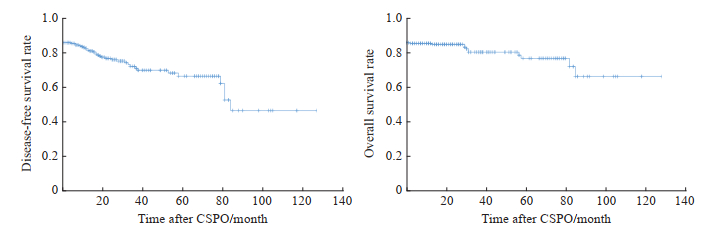 图 1 接受CSPO治疗的低位直肠癌患者术后无病生存和总生存分析(Kaplan-Meier法)Fig. 1 Postoperative disease-free survival and overall survival analyses of patients with low rectal cancer undergoing CSPO (Kaplan-Meier method)CSPO: Conformal sphincter preservation operation.
 下载:
全尺寸图片
2.4 肛门功能
共有214例造口还纳术后满1年的患者纳入肛门功能评价。总体上,患者术后Wexner肛门失禁评分为5.50(3.00,9.00)分,Wexner肛门失禁评分≥10分的重度失禁发生率为21.5%(46/214);LARS评分为29.00(20.00,34.00)分,LARS评分≥30分的重度LARS发生率为46.3%(99/214)。分层分析显示,不同吻合方式的患者肛门功能差异无统计学意义(均P>0.05);在离断方式方面,TaCR组与PTCR组患者Wexner肛门失禁评分、重度失禁发生率和重度LARS发生率差异无统计学意义(均P>0.05),但TaCR组LARS评分低于PTCR组(P=0.048);是否接受新辅助放疗对术后肛门功能有显著影响,新辅助放疗组Wexner肛门失禁评分、重度失禁发生率、LARS评分、重度LARS发生率均高于未行新辅助放疗组(均P<0.05);不同时期患者术后肛门功能亦存在差异,早期组Wexner肛门失禁评分、LARS评分、重度LARS发生率均高于近期组(均P<0.05),但重度失禁发生率与近期组相比差异无统计学意义(P=0.096)。见表 3。
表 3 不同分层低位直肠癌患者CSPO术后肛门功能的比较Table 3 Comparison of anal function between different groups of patients with low rectal cancer after CSPOGroup Wexner incontinence score LARS score Score, M (Q1, Q3) Score≥10, n (%) Score, M (Q1, Q3) Score≥30, n (%) Overall N=214 5.50 (3.00, 9.00) 46 (21.5) 29.00 (20.00, 34.00) 99 (46.3) Anastomotic method Stapled N=128 5.00 (3.00, 9.00) 23 (18.0) 29.00 (22.00, 34.00) 61 (47.7) Hand-sewn N=86 6.00 (3.00, 10.00) 23 (26.7) 29.00 (17.75, 34.00) 38 (44.2) Statistic Z=-1.013 χ2=2.347 Z=-0.348 χ2=0.249 P value 0.331 0.125 0.782 0.618 Transection method TaCR N=96 5.00 (3.00, 8.00) 15 (15.6) 28.00 (16.25, 33.00) 40 (41.7) PTCR N=118 6.00 (2.75, 10.00) 31 (26.3) 29.50 (22.75, 34.00) 59 (50.0) Statistic Z=-1.124 χ2=3.555 Z=-1.979 χ2=1.479 P value 0.261 0.059 0.048 0.224 Neoadjuvant radiotherapy Yes N=90 7.00 (3.00, 10.00) 29 (32.2) 31.00 (21.5, 36.25) 49 (54.4) No N=124 5.00 (2.00, 8.00) 17 (13.7) 29.00 (20.00, 32.00) 50 (40.3) Statistic Z=-2.874 χ2=10.591 Z=-2.259 χ2=4.183 P value 0.004 0.001 0.024 0.041 Time period Early-period N=107 6.00 (4.00, 10.00) 28 (26.2) 31.00 (25.00, 36.00) 60 (56.1) Recent-period N=107 5.00 (2.00, 8.00) 18 (16.8) 25.00 (16.00, 32.00) 39 (36.4) Statistic Z=-2.124 χ2=2.769 Z=-3.525 χ2=8.289 P value 0.034 0.096 <0.001 0.004 CSPO: Conformal sphincter preservation operation; TaCR: Transanal conformal resection; PTCR: Pull-through conformal resection. 3 讨论
本研究总结本中心13年间行CSPO治疗的低位直肠癌患者的临床资料,对患者围手术期资料、肿瘤学结局及肛门功能进行了系统分析。从手术安全性与肿瘤学安全性的角度看,CSPO的围手术期安全性与其他低位保肛术式[19-20]无明显区别,说明在团队技术成熟与流程规范化的基础上,CSPO并不会因为肿瘤位置低而带来额外的围手术期并发症,反而能够在微创手术与加速康复理念的帮助下使患者更早康复。在肿瘤学结局方面,接受CSPO的患者在总生存和无病生存方面也有较好的表现。2013年Akagi等[21]的一项系统综述显示,接受括约肌间切除术(intersphincteric resection,ISR)的患者5年总生存率和无病生存率分别为79%~97%和69%~86%;2019年日本的大样本研究结果显示,接受ISR的患者5年总生存率为73.6%~92.8%,5年无病生存率为56.4%~87.5%[22]。本中心接受CSPO患者的3、5年无病生存率分别为85.6%、81.8%,3、5年总生存率分别为93.1%、89.9%,说明CSPO并非以牺牲肿瘤学结局换取保肛或保功能,证明了CSPO术式的安全性。这一结果为低位直肠癌患者在保证生存率的前提下争取更高的生活质量提供了有力的临床依据。
在术后肛门功能方面,CSPO患者术后Wexner肛门失禁评分和LARS评分也较文献中其他低位保肛术式[23-24]更低,这可能得益于CSPO独特的分离方式,特别是对末端直肠肛管区域的处理。首先,CSPO在腹部仅游离至肛提肌裂孔处而不进入括约肌间隙,避免了对括约肌间隙内神经、感受器等精细结构的损伤,并保护了联合纵肌在括约肌间隙内形成的交织结构。这些神经肌肉结构对于维持正常控便功能至关重要,术中予以保留有助于术后功能恢复。其次,CSPO采用个体化适形离断直肠的方式,尽可能保留肿瘤对侧的正常直肠壁、齿状线及部分肛门内括约肌。齿状线区黏膜和肛门内括约肌在肛门感觉及反射性控便中发挥重要作用,而CSPO的离断方式从解剖上更多地保留了这一区域。最后,由于保留了较多远端肠壁,CSPO尽可能提高吻合口距肛缘的相对位置,从而增加了吻合口距肛缘的距离,有助于降低LARS的发生风险。以上这些因素共同作用,使CSPO术后患者的肛门功能得到最大限度的保留。
本研究按病例纳入时间进行分组,组间手术方式的差异反映了CSPO在临床实践中的阶段性演变。在CSPO的开展过程中,本团队也在不断改进手术技术。离断方式由PTCR(85.8%)逐步改进为TaCR(76.3%),吻合方式由器械吻合(80.6%)逐渐转变为手工吻合(54.2%),微创手术比例从41.3%提高至90.4%。这种转变在严格保证肿瘤R0切除的同时最大程度减少了对肛管结构的损伤。尽管近期组患者肿瘤pT分期更高(P=0.066)、新辅助放疗比例更大(P=0.002),但术中出血量、手术时间、围手术期总体并发症发生率与早期组相比无明显差异,吻合口相关并发症亦未增多。同时,近期组住院时间进一步缩短、Wexner肛门失禁评分和LARS评分较早期组明显下降(均P<0.05)。这一趋势表明,针对保肛术式的持续改良确实能够减轻低位直肠癌患者术后常见的排便功能障碍,提高患者术后生活质量。低位直肠癌手术治疗的难点在于直肠的离断与吻合。视野狭窄、角度受限、组织牵拉和水肿等因素都可能会影响最终的肛门功能[25-26]。TaCR的优势在于减少了肠管逆行拖出过程中对肛管组织的牵拉损伤。这种更精细的处理方式可能使患者术后排便的急迫感更轻、分次排便更少、控便更稳定。吻合方式上近年来主要以手工吻合为主,器械吻合虽然便捷,但在超低位吻合中,吻合口的最终位置不如手工吻合精准,吻合时产生的吻合圈会造成剩余不多的远端肠壁被额外切除。手工吻合可能需要更长的操作时间,但它可在满足切缘要求的前提下尽量保留齿状线周围黏膜和关键肛管结构,避免器械吻合带来额外的肠壁损失,并更容易获得理想的吻合口位置。吻合方式、离断方式并不是决定功能结局的唯一因素,它们与吻合口并发症以及新辅助放疗等因素相互叠加,最终影响患者术后的肛门功能结局。从本研究的时间序列看,手工吻合与TaCR比例的提高与肛门功能评分的改善同步出现,而且并发症发生率并未因此上升,说明这种转变具备一定可行性,也符合以功能为目标的手术方式改良。
本研究显示新辅助放疗是影响术后肛门功能的因素之一。术前接受新辅助放疗的患者术后Wexner肛门失禁评分和LARS评分均高于未行新辅助放疗的患者,重度失禁及重度LARS的发生风险也明显增高(均P<0.05)。这提示术前放疗所引起的盆底肌肉纤维化及自主神经损伤可能是术后排便功能障碍的重要原因。结合本中心对直肠超微结构的研究,放疗可对肛门内外括约肌、联合纵肌及齿状线上方黏膜的精细结构造成损伤,表现为肌纤维与细胞器结构破坏、黏膜微结构改变等,即便部分损伤具有可逆性,也可能在一定时间内削弱控便能力与感觉反馈[27]。因此,对于需要行新辅助放疗的患者,应在术前与患者充分讨论可能的功能预后,在围手术期给予更积极的功能锻炼和康复指导,以减少术后功能不良对生活质量的影响。在制定治疗策略时,需权衡放化疗带来的肿瘤学获益和功能损失。值得注意的是,本研究中近期组接受术前新辅助放疗的比例明显高于早期组(51.4% vs 34.2%,P=0.002),在新辅助放疗这一功能减损因素比例显著升高的情况下,近期组肛门功能反而改善,这更有力地印证了手术技术的改良对术后肛门功能具有一定的增益效应。
综上所述,本研究从治疗效果、术式变化、肛门功能3个层面对CSPO的真实效果进行了总结,进一步验证了CSPO术式在低位直肠癌治疗中兼顾肿瘤根治性与功能保留的效果。未来工作方向主要包括以下两方面:一是围绕新辅助放疗的相关风险并结合解剖学研究,探究如何进一步提高患者的术后肛门功能;二是开展CSPO对比ISR的前瞻性、多中心随机对照研究,以更高等级的证据验证CSPO的安全性及肛门功能保护作用。最终目标是推动CSPO成为治疗低位直肠癌可推广的手术策略,在保证肿瘤学安全性的前提下持续提升患者的功能获益与生活质量。
-
图 1 接受CSPO治疗的低位直肠癌患者术后无病生存和总生存分析(Kaplan-Meier法)
Fig. 1 Postoperative disease-free survival and overall survival analyses of patients with low rectal cancer undergoing CSPO (Kaplan-Meier method)
CSPO: Conformal sphincter preservation operation.
下载:
全尺寸图片
表 1 早期组与近期组接受CSPO治疗的低位直肠癌患者基线资料比较
Table 1 Comparison of baseline characteristics of low rectal cancer patients undergoing CSPO between early- and recent-period groups
Index Early-period N=155 Recent-period N=177 Statistic P value Age/year, x±s 57.30±10.77 59.23±11.66 t=1.558 0.120 BMI/(kg·m-2), x±s 23.26±4.10 23.32±3.83 t=0.134 0.894 Gender, n (%) χ2=0.336 0.562 Male 104 (67.1) 124 (70.1) Female 51 (32.9) 53 (29.9) Comorbidity, n (%) Hypertension 35 (22.6) 54 (30.5) χ2=2.647 0.108 Diabetes mellitus 21 (13.5) 27 (15.3) χ2=0.194 0.659 Neoadjuvant radiotherapy, n (%) 53 (34.2) 91 (51.4) χ2=9.975 0.002 Tumor distance from anal verge on MRI/cm, M (Q1, Q3) 3.0 (3.0, 4.0) 3.0 (2.5, 4.0) Z=-0.290 0.771 Depth of tumor invasion (mrT), n (%) χ2=0.502 0.478 T1-2 91 (58.7) 96 (54.2) T3-4 64 (41.3) 81 (45.8) Lymph node metastasis (mrN), n (%) χ2=0.000 0.984 N0 111 (71.6) 128 (72.3) N+ 44 (28.4) 49 (27.7) CSPO: Conformal sphincter preservation operation; BMI: Body mass index; MRI: Magnetic resonance imaging; mrT: MRIbased T-staging; mrN: MRI-based N-staging. 表 2 早期组与近期组接受CSPO治疗的低位直肠癌患者手术资料比较
Table 2 Comparison of perioperative data of patients with low rectal cancer undergoing CSPO between early- and recent-period groups
Index Early-period N=155 Recent-period N=177 Statistic P value Intraoperative blood loss/mL, x±s 43.94±19.07 41.35±13.70 t=1.436 0.162 Operative time/min, x±s 180.20±69.03 187.22±49.98 t=-1.071 0.285 Surgical approach, n (%) χ2=90.787 <0.001 Open surgery 91 (58.7) 17 (9.6) Minimally invasive (laparoscopic/robotic) 64 (41.3) 160 (90.4) Anastomotic method, n (%) χ2=42.699 <0.001 Stapled 125 (80.6) 81 (45.8) Hand-sewn 30 (19.4) 96 (54.2) Transection method, n (%) χ2=127.754 <0.001 TaCR 22 (14.2) 135 (76.3) PTCR 133 (85.8) 42 (23.7) Pathological T stage, n (%) χ2=3.380 0.066 pT0-1 40 (25.8) 31 (17.5) pT2-3 115 (74.2) 146 (82.5) Pathological N stage, n (%) χ2=2.941 0.086 pN0 123 (79.4) 126 (71.2) pN+ 32 (20.6) 51 (28.8) Perioperative complication, n (%) 45 (29.0) 40 (22.6) χ2=1.796 0.181 Clavien-Dindo Ⅰ 13 (8.4) 12 (6.8) Clavien-Dindo Ⅱ 21 (13.5) 19 (10.7) Clavien-Dindo Ⅲ 11 (7.1) 9 (5.1) Postoperative anastomotic complication, n (%) Anastomotic leakage 21 (13.5) 17 (9.6) χ2=1.268 0.260 Anastomotic bleeding 4 (2.6) 2 (1.1) χ2=0.980 0.322 Anastomotic stenosis 7 (4.5) 3 (1.7) χ2=2.251 0.133 Postoperative hospital stay/d, M (Q1, Q3) 6 (6, 7) 6 (6, 6) Z=-3.241 <0.001 Distal resection margina/cm, M (Q1, Q3) 0.5 (0.4, 1.0) 0.6 (0.5, 1.0) Z=-0.856 0.392 Stoma reversal rate, n (%) 144 (92.9) 161 (91.0) χ2=0.418 0.518 Re-stoma rate, n (%) 4 (2.6) 2 (1.1) χ2=0.980 0.322 a: The distal resection margin was measured by postoperative pathological examination. Specimens may undergo shrinkage after formalin fixation; intraoperatively, distal transection was strictly performed with a margin ≥ 1 cm. CSPO: Conformal sphincter preservation operation; TaCR: Transanal conformal resection; PTCR: Pull-through conformal resection. 表 3 不同分层低位直肠癌患者CSPO术后肛门功能的比较
Table 3 Comparison of anal function between different groups of patients with low rectal cancer after CSPO
Group Wexner incontinence score LARS score Score, M (Q1, Q3) Score≥10, n (%) Score, M (Q1, Q3) Score≥30, n (%) Overall N=214 5.50 (3.00, 9.00) 46 (21.5) 29.00 (20.00, 34.00) 99 (46.3) Anastomotic method Stapled N=128 5.00 (3.00, 9.00) 23 (18.0) 29.00 (22.00, 34.00) 61 (47.7) Hand-sewn N=86 6.00 (3.00, 10.00) 23 (26.7) 29.00 (17.75, 34.00) 38 (44.2) Statistic Z=-1.013 χ2=2.347 Z=-0.348 χ2=0.249 P value 0.331 0.125 0.782 0.618 Transection method TaCR N=96 5.00 (3.00, 8.00) 15 (15.6) 28.00 (16.25, 33.00) 40 (41.7) PTCR N=118 6.00 (2.75, 10.00) 31 (26.3) 29.50 (22.75, 34.00) 59 (50.0) Statistic Z=-1.124 χ2=3.555 Z=-1.979 χ2=1.479 P value 0.261 0.059 0.048 0.224 Neoadjuvant radiotherapy Yes N=90 7.00 (3.00, 10.00) 29 (32.2) 31.00 (21.5, 36.25) 49 (54.4) No N=124 5.00 (2.00, 8.00) 17 (13.7) 29.00 (20.00, 32.00) 50 (40.3) Statistic Z=-2.874 χ2=10.591 Z=-2.259 χ2=4.183 P value 0.004 0.001 0.024 0.041 Time period Early-period N=107 6.00 (4.00, 10.00) 28 (26.2) 31.00 (25.00, 36.00) 60 (56.1) Recent-period N=107 5.00 (2.00, 8.00) 18 (16.8) 25.00 (16.00, 32.00) 39 (36.4) Statistic Z=-2.124 χ2=2.769 Z=-3.525 χ2=8.289 P value 0.034 0.096 <0.001 0.004 CSPO: Conformal sphincter preservation operation; TaCR: Transanal conformal resection; PTCR: Pull-through conformal resection. -
[1] Cercek A, Lumish M, Sinopoli J, et al. PD-1 blockade in mismatch repair-deficient, locally advanced rectal cancer[J]. N Engl J Med, 2022, 386(25):2363-2376.DOI: 10.1056/nejmoa2201445. [2] Christensen P, IM Baeten C, Espín-Basany E, et al. Management guidelines for low anterior resection syndrome: the MANUEL project[J]. Colorectal Dis, 2021, 23(2): 461-475. DOI: 10.1111/codi.15517. [3] Pieniowski E H A, Nordenvall C, Palmer G, et al. Prevalence of low anterior resection syndrome and impact on quality of life after rectal cancer surgery: population-based study[J]. BJS Open, 2020, 4(5): 935-942. DOI: 10.1002/bjs5.50312. [4] Sun G, Lou Z, Zheng K, et al. Comparison of functional and oncological outcome of conformal sphincter preservation operation, low anterior resection, and abdominoperineal resection in very low rectal cancer: a retrospective comparative cohort study with propensity score matching[J]. Langenbecks Arch Surg, 2023, 408(1): 208. DOI: 10.1007/s00423-023-02925-1. [5] 楼征, 张卫. 超低位直肠癌的保肛手术及综合治疗[J]. 中华消化外科杂志, 2023, 22(6): 714-718. DOI: 10.3760/cma.j.cn115610-20230415-00169. [6] Glynne-Jones R, Wyrwicz L, Tiret E, et al. Rectal cancer: ESMO clinical practice guidelines for diagnosis, treatment and follow-up[J]. Ann Oncol, 2017, 28(suppl_4): iv22-iv40. DOI: 10.1093/annonc/mdx224. [7] Beets-Tan R G H, Lambregts D M J, Maas M, et al. Magnetic resonance imaging for clinical management of rectal cancer: updated recommendations from the 2016 European Society of Gastrointestinal and Abdominal Radiology (ESGAR) consensus meeting[J]. Eur Radiol, 2018, 28(4): 1465-1475. DOI: 10.1007/s00330-017-5026-2. [8] Chen L, Liu X, Zhang W, et al. The predictive value of tumor volume reduction ratio on three-dimensional endorectal ultrasound for tumor response to chemoradiotherapy for locally advanced rectal cancer[J]. Ann Transl Med, 2022, 10(12): 666. DOI: 10.21037/atm-22-2418. [9] Amin M B, Greene F L, Edge S B, et al. The eighth edition AJCC cancer staging manual: continuing to build a bridge from a population-based to a more "personalized" approach to cancer staging[J]. CA Cancer J Clin, 2017, 67(2): 93-99. DOI: 10.3322/caac.21388. [10] Wo J Y, Ashman J B, Bhadkamkar N A, et al. Radiation therapy for rectal cancer: an ASTRO clinical practice guideline focused update[J]. Pract Radiat Oncol, 2025, 15(2): 124-143. DOI: 10.1016/j.prro.2024.11.003. [11] 中国临床肿瘤学会指南工作委员会. 中国临床肿瘤学会(CSCO)结直肠癌诊疗指南2019[M]. 北京: 人民卫生出版社, 2019. [12] Garcia-Aguilar J, Patil S, Gollub M J, et al. Organ preservation in patients with rectal adenocarcinoma treated with total neoadjuvant therapy[J]. J Clin Oncol, 2022, 40(23): 2546-2556. DOI: 10.1200/JCO.22.00032. [13] Fernandez L M, São Julião G P, Figueiredo N L, et al. Conditional recurrence-free survival of clinical complete responders managed by watch and wait after neoadjuvant chemoradiotherapy for rectal cancer in the International Watch & Wait Database: a retrospective, international, multicentre registry study[J]. Lancet Oncol, 2021, 22(1): 43-50. DOI: 10.1016/S1470-2045(20)30557-X. [14] 朱晓明, 楼征, 白辰光, 等. 低位直肠癌拖出式适形切除术肠壁侧切缘安全距离的初步探讨[J]. 中华胃肠外科杂志, 2016, 19(9): 1025-1029. DOI: 10.3760/cma.j.issn.1671-0274.2016.09.014. [15] 中华医学会外科学分会结直肠外科学组, 中国医师协会结直肠肿瘤专业委员会, 中国医师协会肛肠医师分会, 等. 低位直肠癌适形保肛手术操作标准(2023版)[J]. 中华胃肠外科杂志, 2023, 26(10): 907-914. DOI: 10.3760/cma.j.cn441530-20230829-00073. [16] Dindo D, Demartines N, Clavien P A. Classification of surgical complications: a new proposal with evaluation in a cohort of 6 336 patients and results of a survey[J]. Ann Surg, 2004, 240(2): 205-213. DOI: 10.1097/01.sla.0000133083.54934.ae. [17] Emmertsen K J, Laurberg S. Low anterior resection syndrome score: development and validation of a symptom-based scoring system for bowel dysfunction after low anterior resection for rectal cancer[J]. Ann Surg, 2012, 255(5): 922-928. DOI: 10.1097/SLA.0b013e31824f1c21. [18] Paquette I M, Varma M G, Kaiser A M, et al. The American Society of Colon and Rectal Surgeons' clinical practice guideline for the treatment of fecal incontinence[J]. Dis Colon Rectum, 2015, 58(7): 623-636. DOI: 10.1097/DCR.0000000000000397. [19] Du Q, Yang W, Zhang J, et al. Oncologic outcomes of intersphincteric resection versus abdominoperineal resection for lower rectal cancer: a systematic review and meta-analysis[J]. Int J Surg, 2024, 110(4): 2338-2348. DOI: 10.1097/JS9.0000000000000205. [20] Peng B, Lu J, Wu Z, et al. Intersphincteric resection versus abdominoperineal resection for low rectal cancer: a meta-analysis[J]. Surg Innov, 2020, 27(4): 392-401. DOI: 10.1177/1553350620918414. [21] Akagi Y, Kinugasa T, Shirouzu K. Intersphincteric resection for very low rectal cancer: a systematic review[J]. Surg Today, 2013, 43(8): 838-847. DOI: 10.1007/s00595-012-0394-3. [22] Yamada K, Saiki Y, Takano S, et al. Long-term results of intersphincteric resection for low rectal cancer in Japan[J]. Surg Today, 2019, 49(4): 275-285. DOI: 10.1007/s00595-018-1754-4. [23] Denost Q, Moreau J B, Vendrely V, et al. Intersphincteric resection for low rectal cancer: the risk is functional rather than oncological. A 25-year experience from Bordeaux[J]. Colorectal Dis, 2020, 22(11): 1603-1613. DOI: 10.1111/codi.15258. [24] Chen H, Ma B, Gao P, et al. Laparoscopic intersphincteric resection versus an open approach for low rectal cancer: a meta-analysis[J]. World J Surg Oncol, 2017, 15(1): 229. DOI: 10.1186/s12957-017-1304-3. [25] Ye L, Huang M, Huang Y, et al. Risk factors of postoperative low anterior resection syndrome for colorectal cancer: a meta-analysis[J]. Asian J Surg, 2022, 45(1): 39-50. DOI: 10.1016/j.asjsur.2021.05.016. [26] Sun R, Dai Z, Zhang Y, et al. The incidence and risk factors of low anterior resection syndrome (LARS) after sphincter-preserving surgery of rectal cancer: a systematic review and meta-analysis[J]. Support Care Cancer, 2021, 29(12): 7249-7258. DOI: 10.1007/s00520-021-06326-2. [27] 王晨. 低位直肠癌适形保肛术后肛门功能的影响因素及其解剖学基础[D]. 上海: 中国人民解放军海军军医大学, 2024.
