

Phase Properties of Photon-Added Coherent States for Nonharmonic Oscillators in a Nonlinear Kerr Medium
Cite this Article
Jahanbakhsh F., Honarasa G.. Phase Properties of Photon-Added Coherent States for Nonharmonic Oscillators in a Nonlinear Kerr Medium. Communications in Theoretical Physics, 2018, 69(4): 387 
Permissions
Phase Properties of Photon-Added Coherent States for Nonharmonic Oscillators in a Nonlinear Kerr Medium
† Corresponding author. E-mail:
Abstract
Abstract
The potential of nonharmonic systems has several applications in the field of quantum physics. The photon-added coherent states for annharmonic oscillators in a nonlinear Kerr medium can be used to describe some quantum systems. In this paper, the phase properties of these states including number-phase Wigner distribution function, Pegg-Barnett phase distribution function, number-phase squeezing and number-phase entropic uncertainty relations are investigated. It is found that these states can be considered as the nonclassical states.
1 Introduction
The standard coherent state is a particular kind of the quantum states, which its dynamics is similar to oscillatory behavior of a classical harmonic oscillator.[1] These states are defined by the annihilation and creation operators of the harmonic oscillator. Some quantum mechanical systems can be described by the nonharmonic potentials.[2–3] The Gazeau-Klauder coherent state of the anharmonic oscillator has been introduced by Roy.[4] Also, the coherent states for nonharmonic oscillators using generalized Heisenberg algebra have been constructed.[5]
Construction and generation of the nonclassical states is one of the most exciting subjects in quantum optics because their applications in the fields of quantum information processing and quantum computation. Therefore, with the aim of finding nonclassical states many generalizations on the standard coherent states have been nominated. One of the most important generalizations is the photon-added coherent states.[6] The photon-added coherent states can be considered as the nonlinear coherent states with certain nonlinearity function.[7] Also, the photon-subtracted and photon-added coherent states corresponding to the inverse bosonic operators have been introduced in 2004.[8] Furthermore, Zavatta et al. produced the single photon-added coherent state |α, 1⟩ experimentally in 2005.[9] A method for generating the two photon-added coherent state |α,2⟩ has been suggested by Kalamidas et al.[10] The photon-added coherent states and their generalizations have received considerable attention in recent years.[11–14] Roman-Ancheyta et al. constructed deformed Photon-added nonlinear coherent states for a one-mode field in a Kerr medium.[15]
Recently, the photon-added coherent states for nonharmonic oscillators in a nonlinear Kerr medium have been introduced by Al-Rajhi using generalized Heisenberg algebra.[16] In the present paper, the phase properties as well as the number-phase entropic uncertainty relation of these states are investigated. For these purpose, the photon-added coherent states for nonharmonic oscillators are reviewed in Sec.
2 Photon-Added Coherent States for Anharmonic Oscillators
The Hamiltonian for anharmonic oscillators can be expressed by[4]




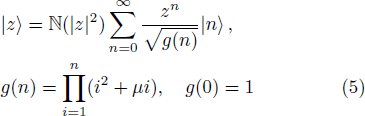


3 Number-Phase Wigner Function6 ) in (9 ), leads to
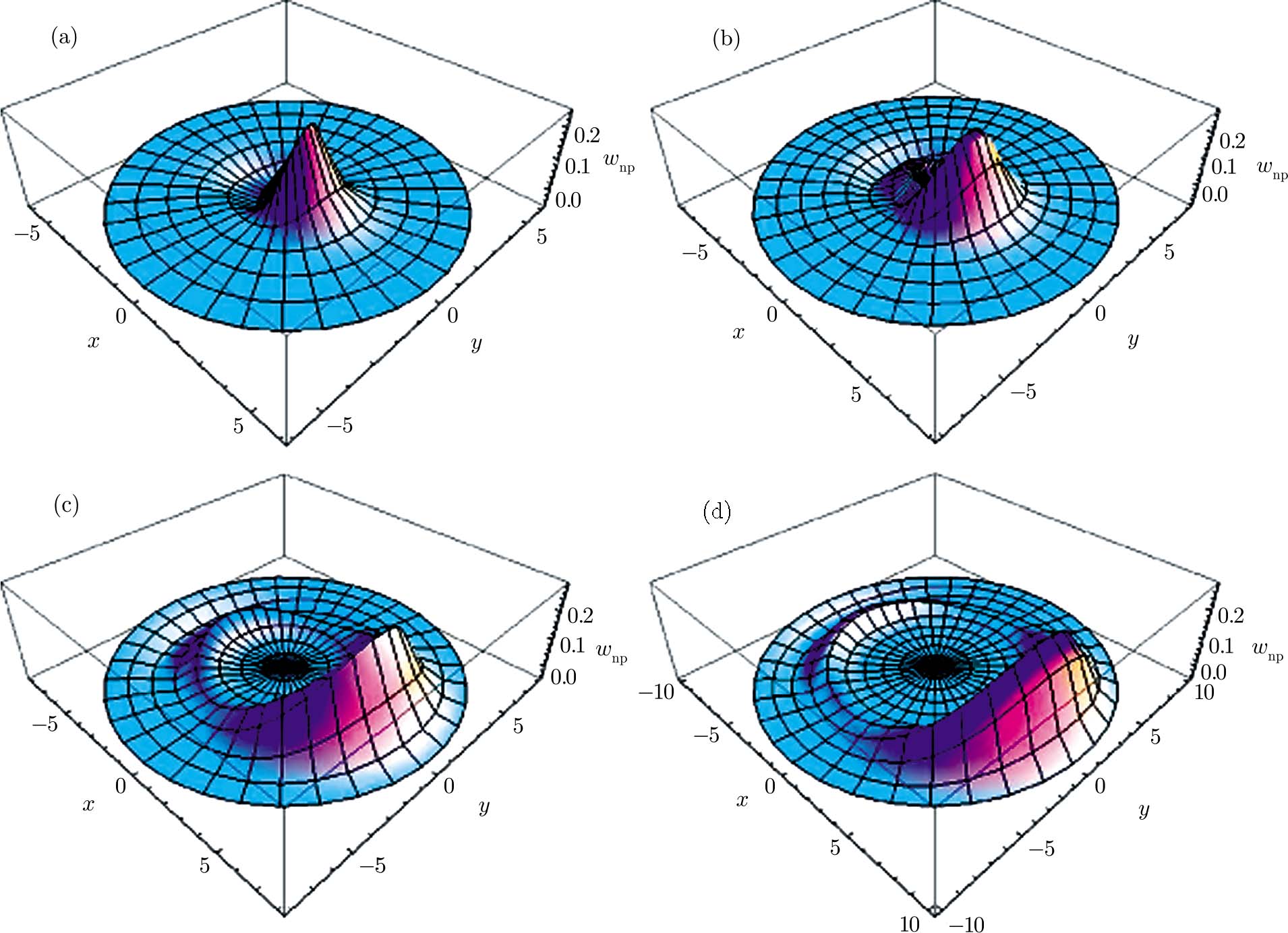
1 , the number-phase Wigner distribution function has been plotted versus two new variable x = n cos(θ) and y = n sin(θ) for different values of photon added number m. The figure is drawn as curves of constant integer n (concentric rings) crossed by curves of constant θ (radial lines). It is clear that the Wigner function is negative in some regions for all values of m and this represents these states are nonclassical states.
The number-phase Wigner function characterizes the quantum statistics of the photons and phase observable of a quantum state. This distribution function may be negative in some regions of number-phase space for specific quantum states that represents the nonclassical signature of these states. The number-phase Wigner operator can be expressed as follows:[17–18]


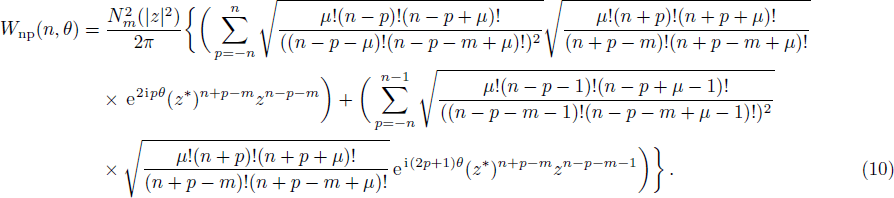
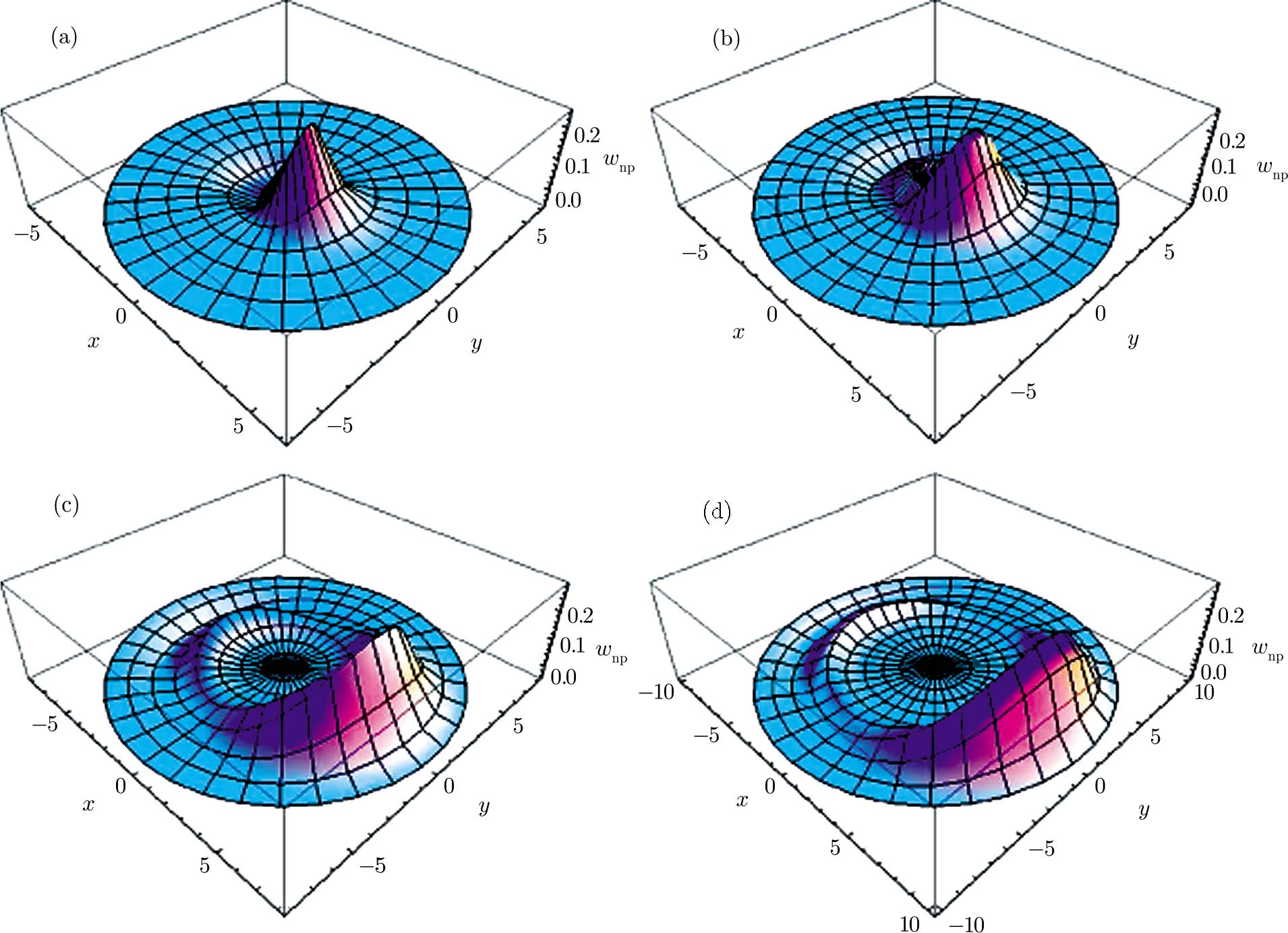 | Fig. 1 Plot of the number-phase Wigner function associated with the photon-added coherent states for anharmonic oscillators with |z| = 1 and μ = 1 for (a) m = 0, (b) m = 1, (c) m = 3 and (d) m = 5. |
4 Pegg-Barnett Phase Distribution Function11 ) is given by
6 ) and (11 ) in (14 ), the Pegg-Barnett phase distribution function P(θ) is obtained as follows
Based on Pegg-Barnett method, a complete set of s + 1 dimension phase state are well-defined by[19]






Figure
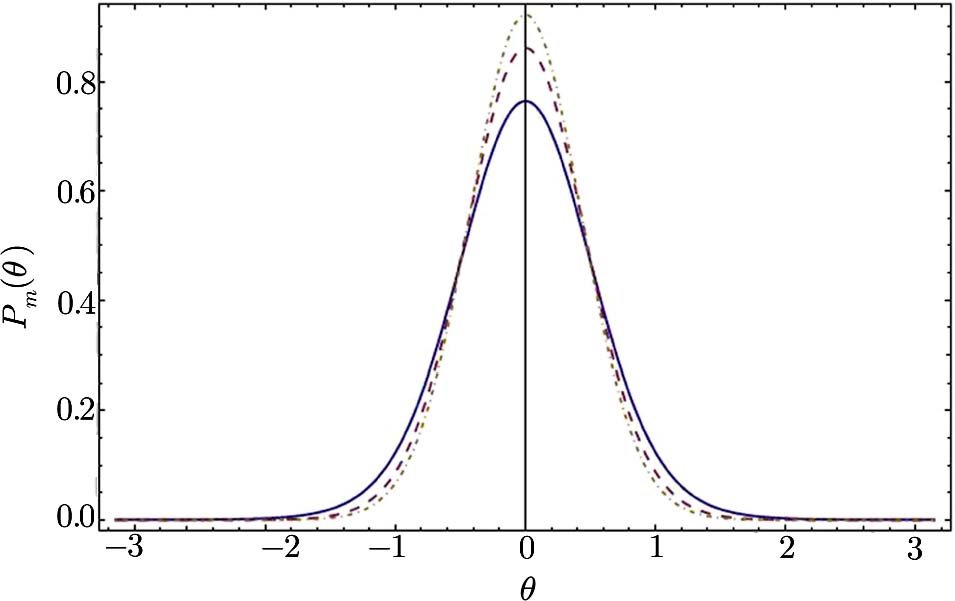
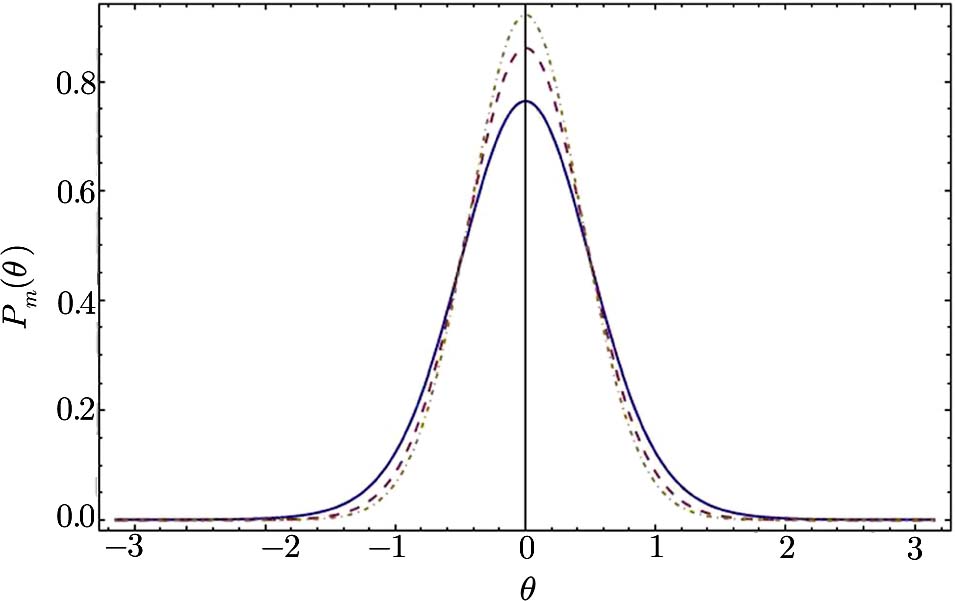 | Fig. 2 Pegg-Barnett phase distribution function associated with the photon-added coherent states for anharmonic oscillators versus θ with |z| = 2 and μ = 2 for m = 1 (solid curve), m = 3 (dashed curve) and m = 5 (dot-dashed curve). |
5 Number-Phase Squeezing
The phase and number operators are conjugate to each other and consequently, satisfy the following uncertainty relation





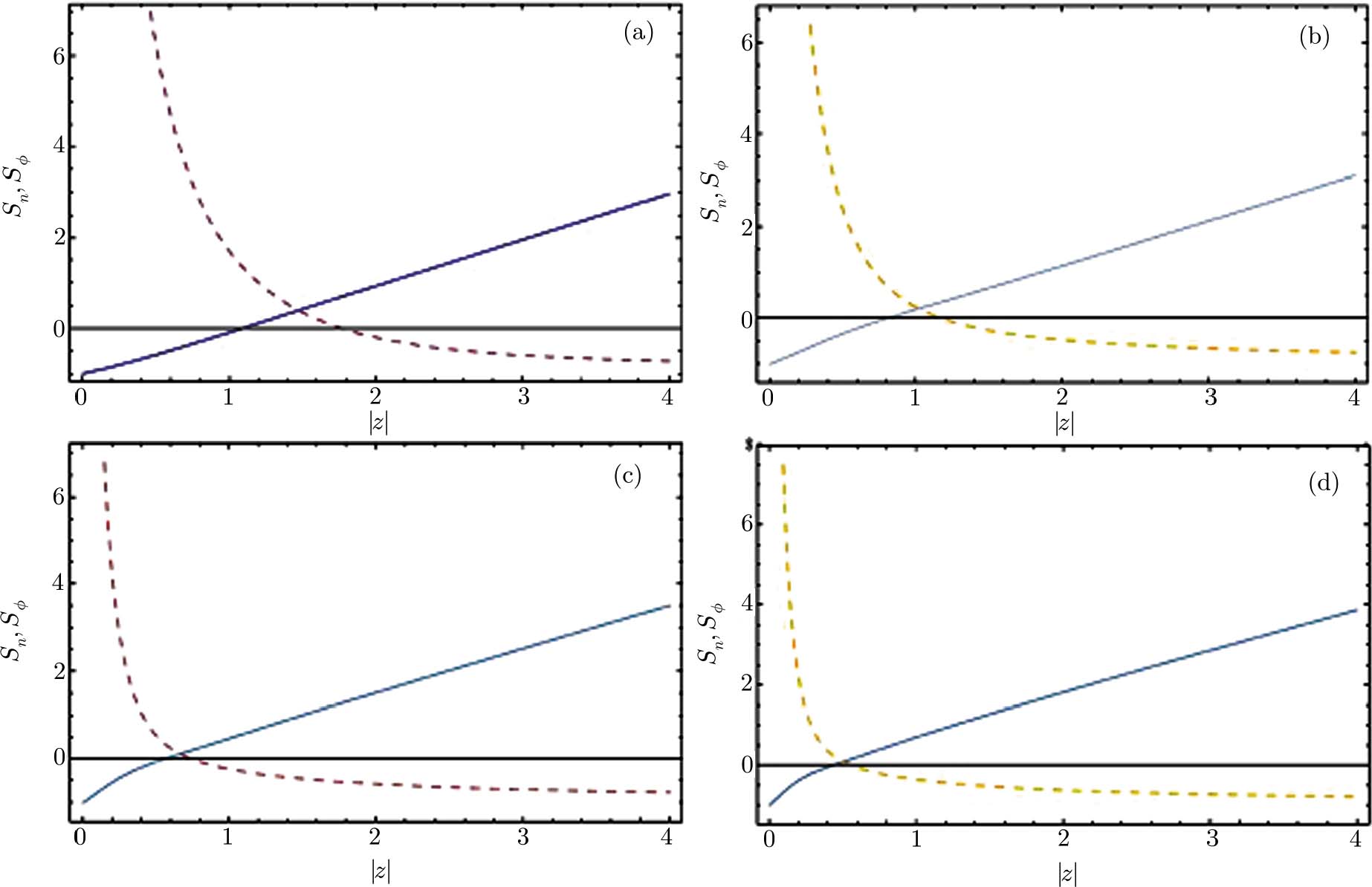
The number and phase squeezing parameters associated with these states are shown in Fig.
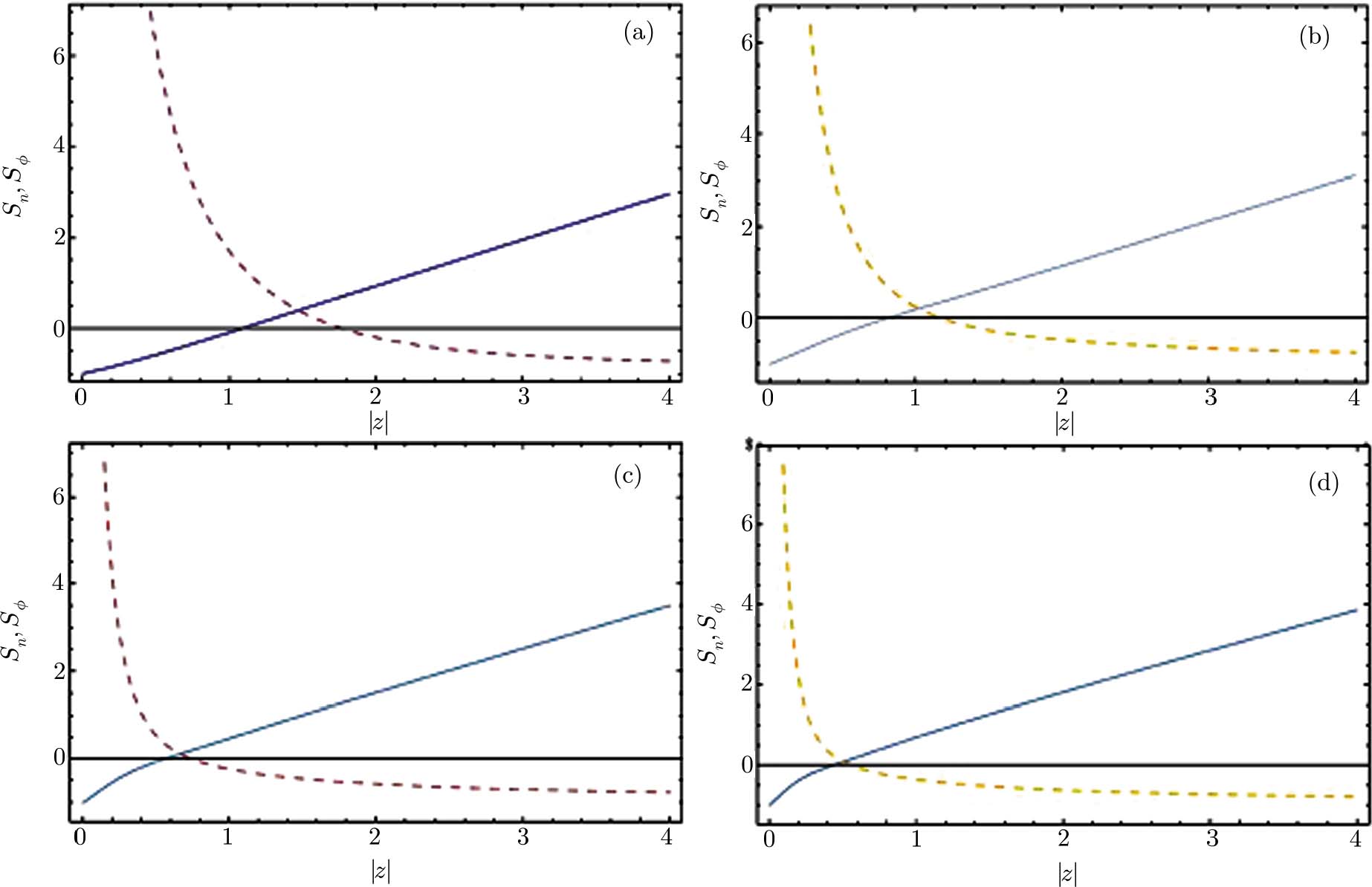 | Fig. 3 Plot of the number and phase squeezing associated with the photon-added coherent states for anharmonic oscillators versus |z| with μ = 1 for (a) m = 0, (b) m = 1, (c) m = 3, and (d) m = 5. |
6 Number-phase Entropic Uncertainty Relations15 ). Also, the photon number entropy for introduced states is defined as
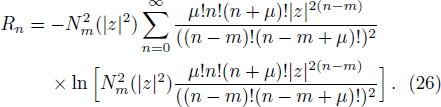
6 ) in (25 ) the following expression for photon number entropy of photon-added coherent states associated with anharmonic oscillators can be obtained
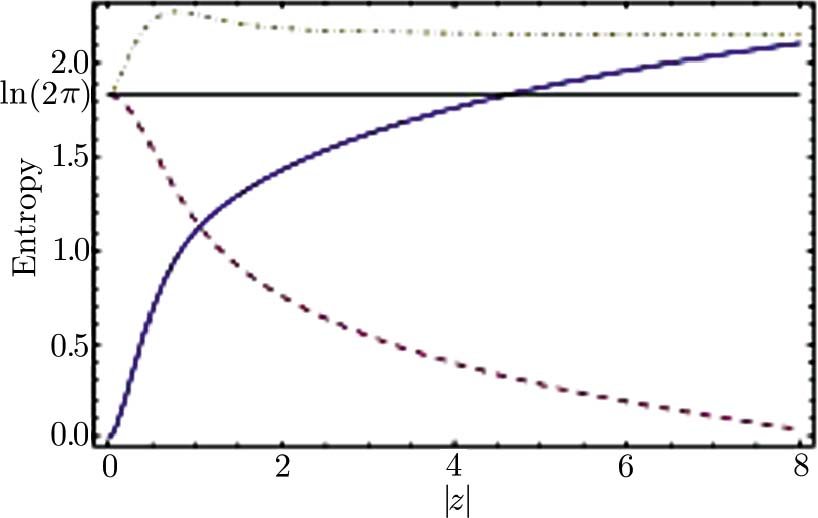
4 , Rϕ, Rn and their sum have been depicted versus |z| for photon-added coherent states corresponding to anharmonic oscillators with m = 1. The figure shows that Rn increases while Rϕ decreases with increasing z. It can be observed that their sum according to Eq. (23 ) has a lower bound ln(2π). Also, because of the vacuum is an eigenstate of the number operator, the sum Rn + Rϕ is exactly ln(2π) at z = 0.
The Shannon entropies (SA and SB) of two conjugate operators A and B, with eigenvalue equations A|an⟩ = an|an⟩ and B|bn⟩ = bn|an⟩, are limited by the entropy uncertainty relation SA + SB ≥ ln(s + 1). Here A and B are defined on the (s + 1)-dimensional space. This uncertainty relation which has been suggested by Kraus[20] and then proven by Massen and Uffink,[21] depends on dimension of the state space. Vaccaro et al. defined new quantities RA and RB as follows





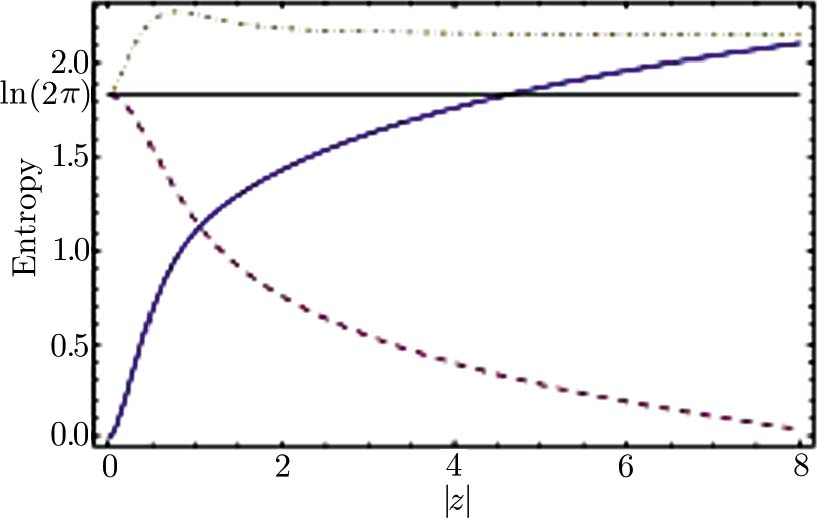 | Fig. 4 Plots of Rn (solid curve), Rϕ (dashed curve) and their sum (dot-dashed curve) versus |z| associate with the photon-added coherent states for anharmonic oscillators in a Kerr medium with μ = 1 and m = 1. |
7 Summary and Conclusion
The phase and number properties of physical systems are very important. In this work, the number-phase Wigner function, phase distribution function, number-phase squeezing and number-phase entropic uncertainty relation of the photon-added coherent states for anharmonic oscillators are studied using Pegg-Barnett formalism. The number-phase Wigner function corresponding to these generalized coherent states is negative in some regions. The results show also that these states represent number or phase squeezing for different ranges of |z|. Therefore, these states are nonclassical states. The photon-added coherent state for anharmonic oscillators can be considered as an intermediate state between the coherent states for anharmonic oscillators and the Fock states. Construction of a photon-added coherent state for anharmonic oscillators by adding photon to the coherent state for anharmonic oscillators is a proper way to have a quantum state with more nonclassicality. The curves of Pegg-Barnett phase distribution function show that this distribution function has only a single peak in θ = 0 and as m increases, the peak is more localized with respect to θ. Finally, it is found that the number-phase entropic uncertainty relation associated with the photon-added coherent states for anharmonic oscillators has a lower bound ln(2π) for all values of photon added number m.
Reference
| [1] | |
| [2] | |
| [3] | |
| [4] | |
| [5] | |
| [6] | |
| [7] | |
| [8] | |
| [9] | |
| [10] | |
| [11] | |
| [12] | |
| [13] | |
| [14] | |
| [15] | |
| [16] | |
| [17] | |
| [18] | |
| [19] | |
| [20] | |
| [21] | |
| [22] | |
| [23] |