


Entanglement Swapping in the Presence of White and Color Noise
Cite this Article
Dotsenko Ivan S., Korobka R.. Entanglement Swapping in the Presence of White and Color Noise. Communications in Theoretical Physics, 2018, 69(2): 143 
Permissions
Entanglement Swapping in the Presence of White and Color Noise
† Corresponding author. E-mail:
Abstract
Abstract
The influence of white and color noise on the outcome of the entanglement swapping process is investigated in a four-qubit system. Critical degree of noise in initial state, that could destroy entanglement in a result state is presented. The entanglement characteristics, such as concurrence, tangle, etc. are compared. Results could be helpful for experiments regarding entanglement swapping as conditions for initial quantum entangled states, to obtain entangled result state.
1 Introduction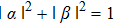
2 ) states are entangled, because they cannot be represented in a form of a product of individual qubits vector states.





The entanglement phenomenon gradually became an object of intensive research after Aspect’s group[1] had convincingly (through experiments) proven the violation of Bell’s inequalities by the entangled states.
It became clear with time that entanglement is a new resource of nature, which can be created, preserved, distributed, concentrated and transmitted over a distance. Nowadays, entanglement is actually being created and processed in many physics laboratories. Entangled states carriers are quite versatile, it could be photons, ions, atoms, molecules, crystals and more. Discovering the role of entangled states stimulated emergence of new areas in modern physics, such as quantum computing, quantum cryptography and quantum communication.
As it is well known, an arbitrary state of any single qubit can always be represented as a vector in two-dimensional Hilbert space:

The principal difference between qubits and classical bits is a possibility of existence of states in a form of superposition of basis vectors.
The state of two-qubit system is described by a vector in a 4-dimensional Hilbert space, which is the tensor product of Hilbert spaces of individual qubits. The most common bases in this space are computational (standard) basis in the form of a tensor product of relevant basis states of individual qubits:

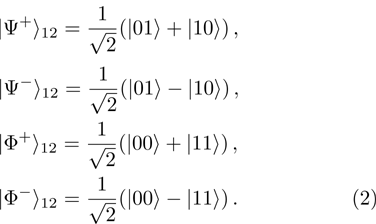
The most interesting and unusual phenomenon, based on entanglement, is a quantum teleportation and entanglement swapping (ES). First, the scheme (protocol) of unknown qubit state teleportation was proposed in Ref. [3] (Bennett et al.). Detailed reference to the original work on quantum teleportation can be found, for example in Refs. [4] and [5].
For some time it was believed that entangled system state, consisting of two or more quantum subsystems (particles, photons), is created only during their simultaneous birth in a single event from a common source, or as a result of subsystems interaction. However, in 1993[6] (Zukowski et al.) a protocol was proposed, as a result of which the quantum correlations (entanglement) could be created between the particles that may be located at great distance from each other, and which did not share a common history. This process is called the entanglement swapping (ES).
A paper by Zukowski et al. for a short time was widely appraised among scholars. Dur et al.[7] developed a quantum communication protocol for long distances using quantum repeaters with ES as their element. Xue et al.[8] proposed ES scheme, which is based on three-particle GHZ state for the needs of quantum cryptography. The entanglement swapping process is sometimes called the entanglement teleportation or teleportation of entangled states. Tsai et al.[9] used GHZ-like state for teleportation of pure EPR state. At the same time in addition to theoretical developments of teleportation protocols and ES, the real experiments[10–13] are gradually improved in physics laboratories. For a correct assessment of real possibilities to transfer quantum state over long distances, all factors that affect the signal quality at all stages of its formation and passage through channels of communication should be taken into consideration. A detailed discussion of this topic can be found at Ref. [14]. To study the overall influence of all these factors, it is necessary, in our point of view, to display full understanding of physical processes in each single element of the communication channel.
Entanglement swapping is used in real elements of quantum communication channels, such as quantum repeaters. Quantum states at the input of these elements always have some level of noise. Motivation of this research is to get to know how type and level of noise at the input of such elements will affect on the quality of output state. The aim of this work is a theoretical study of the effect made by the presence of noises in initially created entangled states on the final state obtained as a result of entanglement swapping operation.
For better explanation of the gist of this paper we remind the essence of the entanglement swapping phenomenon that can be illustrated by a specific example.
Let two sources independently form one pair of qubits each in one of the entangled EPR states of Eq. (

This operation is called an incomplete projective measurement. Mathematically, the operation is considered as a projection of the state 

By regrouping summands, the state vector 

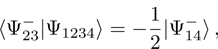
Since the operation of projection on a particular state is incomplete von Neumann measurement, so as a result of projection we obtain state vector, which is non-normalized. In this very case, multiple repeating of the operation preparing 





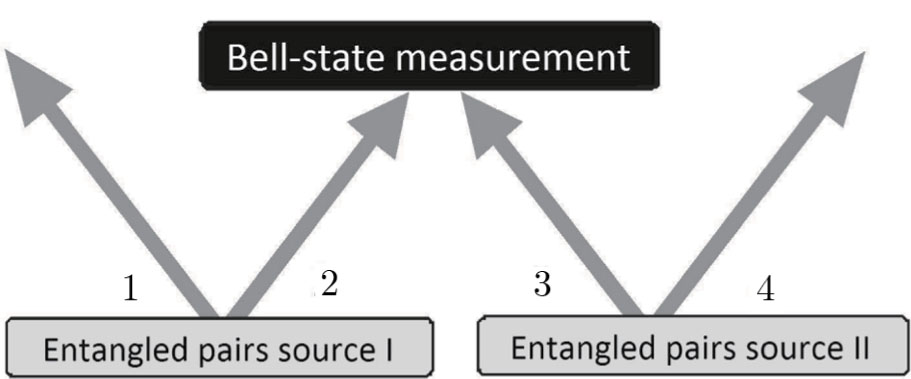
ES process can be represented as a simple scheme (Fig.
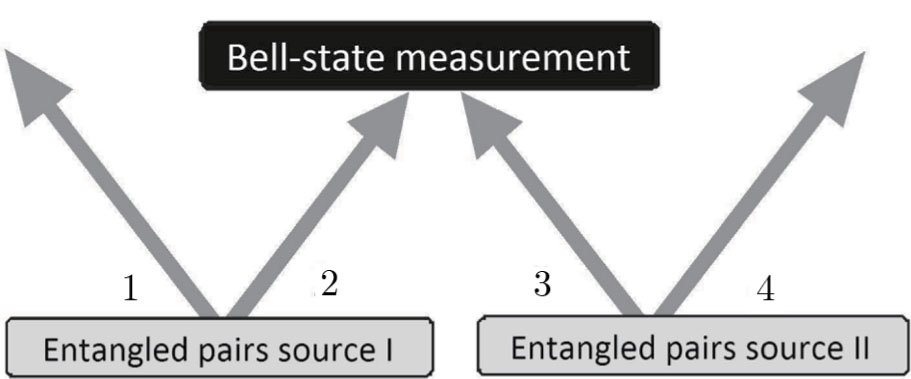 | Fig. 1 Scheme of entanglement swapping process implementation. |
Note that the entanglement of 1 and 4 qubits occurs just at the moment of projecting on the state 
It is considered in the analyzed example, that both qubit pairs are prepared in a pure Bell’s state 
In this paper the process of entanglement swapping is considered under condition of presence of different types of noise in initially prepared entangled states.
For a comparative analysis of states of initially prepared and final pairs of qubits, below we use known characteristics of entanglement: concurrence (C), tangle (τ), entanglement of formation (Ef); characteristics of degree of mixture: von Neumann entropy of two-qubit state condition (E), purity (Tr 
For the initial state of two-qubit system and for states, produced by ES we will calculate next sequence of characteristics (points (i)–(ix) will be calculated in next chapters for initial state, and (x)–(xi) as comparative characteristics between initial and final states):
(i) Matrix 

(ii) Product

(iii) Eigenvalues of the matrix 

(iv) Concurrence:

(v) Tangle:

(vi) Entanglement of formation:

(vii) Purity:

(viii) Linear entropy:

(ix) Von Neumann entropy:

(x) Trace metric δ, which is a measure of the distance between two states:
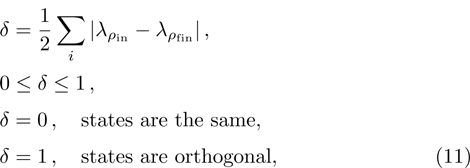

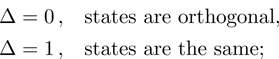
(xi) Fidelity

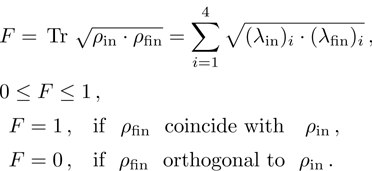
Let us consider the phenomenon of entanglement swapping in a case where each of the two qubit pairs is formed in a mixed state.
2 Entanglement Swapping in the Case of Presence of White Noise in the Initial State

14 ) is a pure state 
14 ) is white noise. The corresponding density matrix in the computational basis is:2 ) it is represented by a diagonal matrix:17 ) on Bells state 


14 ) by replacement of (
15 ) and (16 ) after replacing 


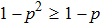
20 ) we obtained:20 ) 










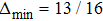


Let us add all the basic states with the same weight coefficients to the pure state 

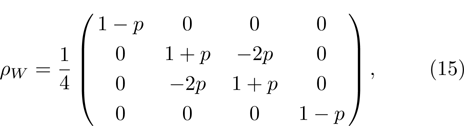
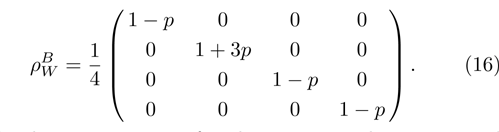

Supposing that qubit pairs with numbers (1, 2) and (3, 4) are prepared independently, the density operator of two pairs of qubits system is represented as tensor product of states (


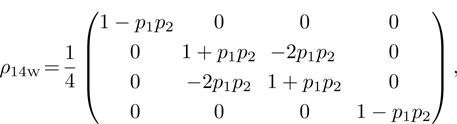
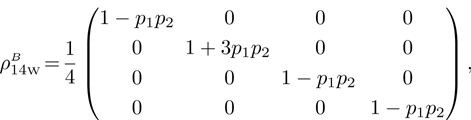
(i) If one of the qubit pairs is prepared in a pure state (

(ii) If both qubit pairs are prepared in the mixed state, then the resulting state of qubits pair 1 and 4 will be noisier than the state of each of the initially prepared pairs.
Let us consider the case 

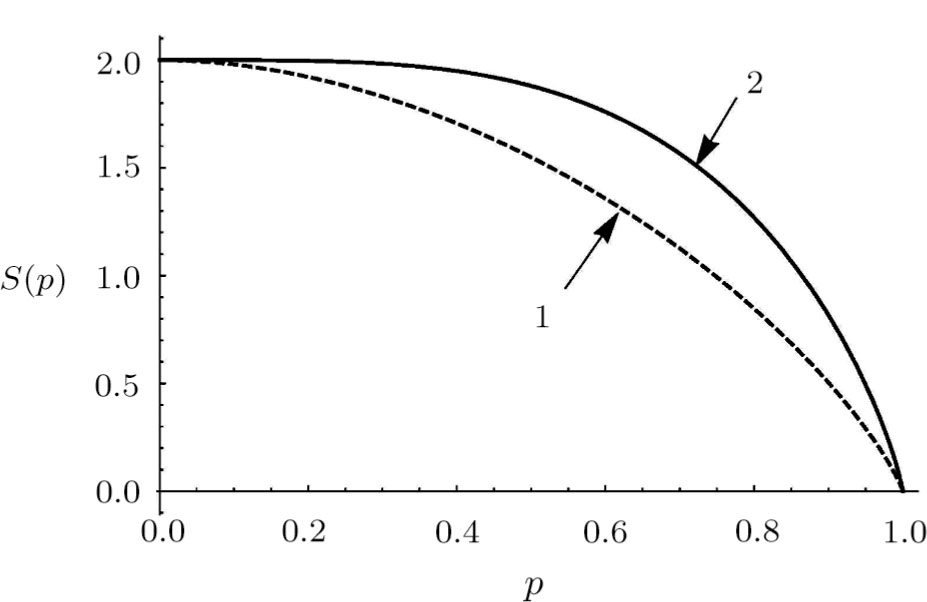
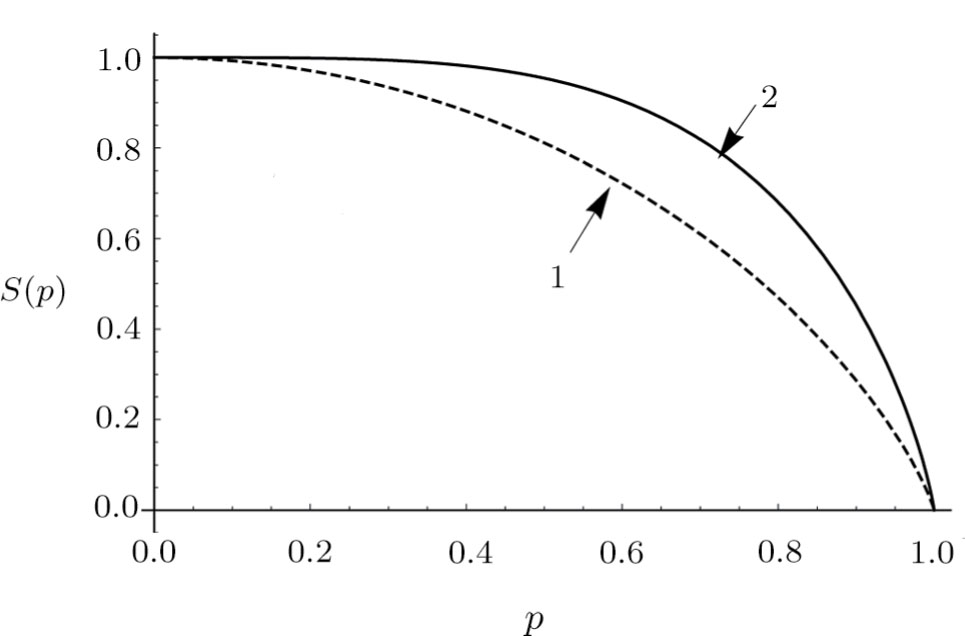
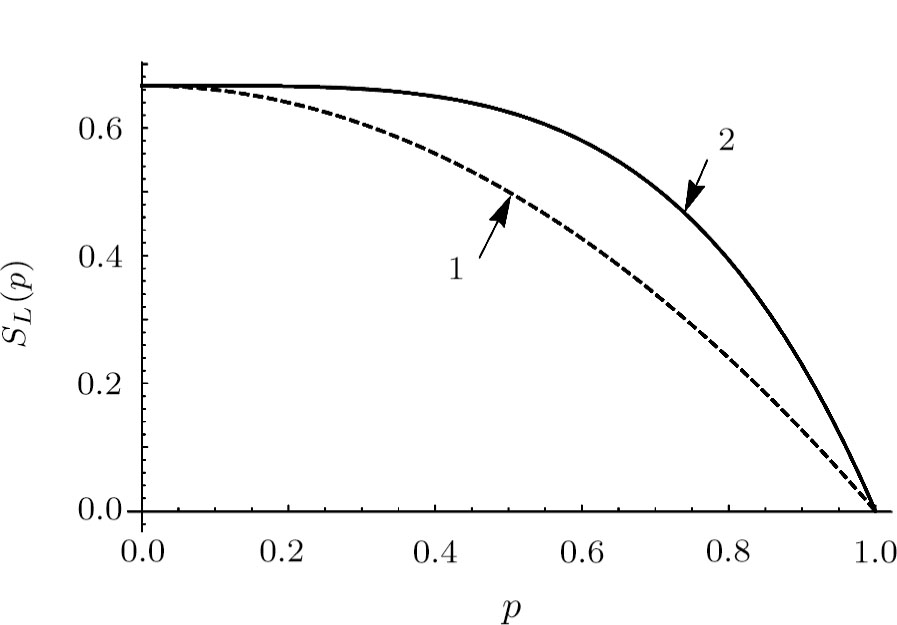
Comparison of the von Neumann entropy values for each of the initial and final pairs of qubits gives a clear demonstration of an increase in admixture of white noise. Figure
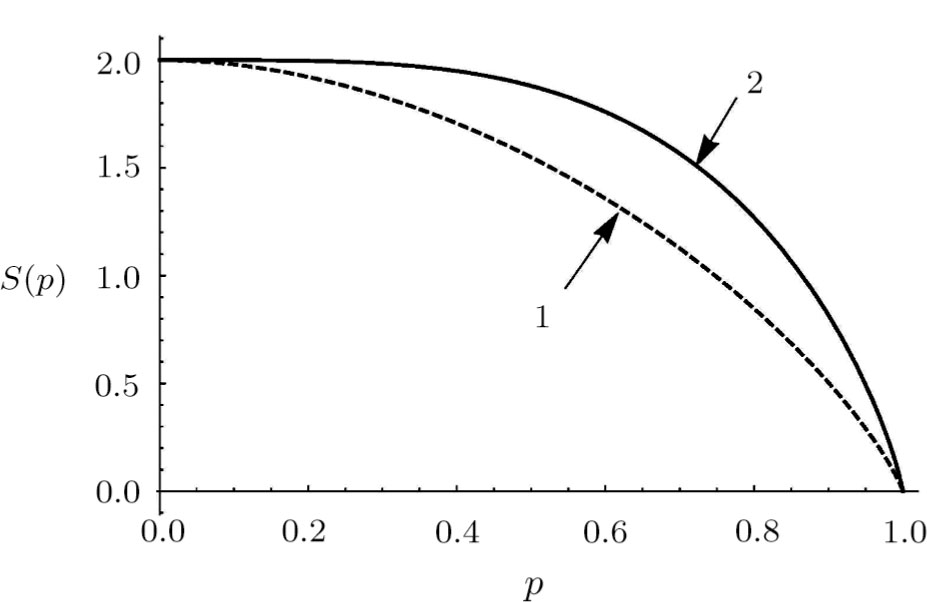 | Fig. 2 Dependence of the von Neumann entropy on parameter p. Curve 1 for each initial qubit pairs (Werner state), curve 2 for qubit pair, obtained by ES procedure. |
The figure shows that the entropy of the final pair of qubits for 


According to the Perez-Gorodetsky criterion[16–17] the positive partially transposed (PPT) density matrix is necessary and sufficient condition for the absence of entanglement in the two-qubit systems. Violation of this condition indicates the presence of entanglement.
Partially transposed density matrix of initial state (
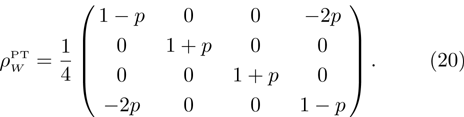
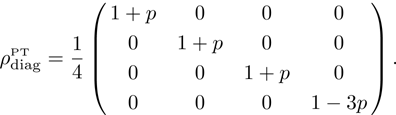

The range of p, for which final state is entangled, is defined by similarity of 
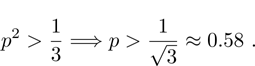
Now let us consistently follow point-by-point the steps (i)–(xi) mentioned above in Sec. 
(i) Matrix 
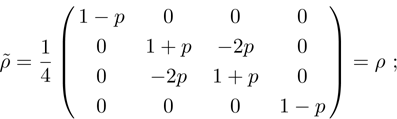
(ii) Product 


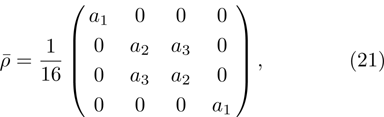
(iii) Eigenvalues of matrix (

(iv) “Concurrence” (
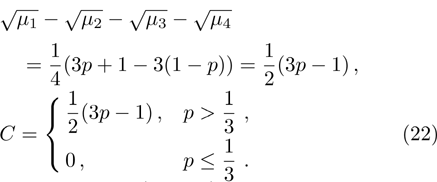
(v) “Tangle” (
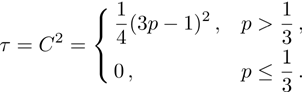
(vi) “Entanglement of formation” (
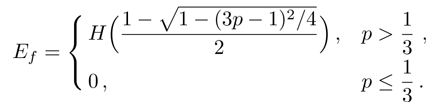
(vii) Purity (

(viii) Linear entropy (

(ix) Von Neumann entropy (

(x) Trace metric δ (

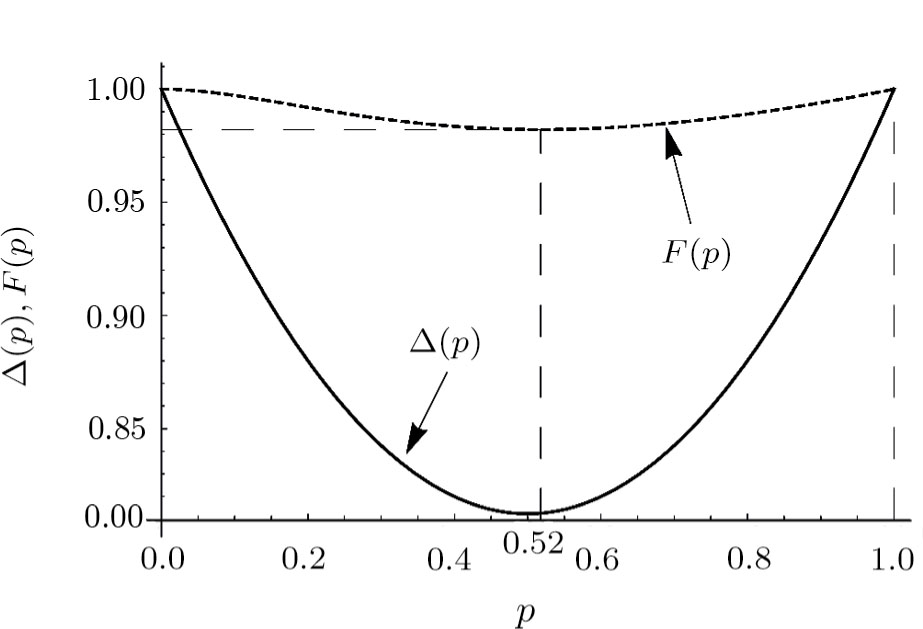
(xi) Fidelity (

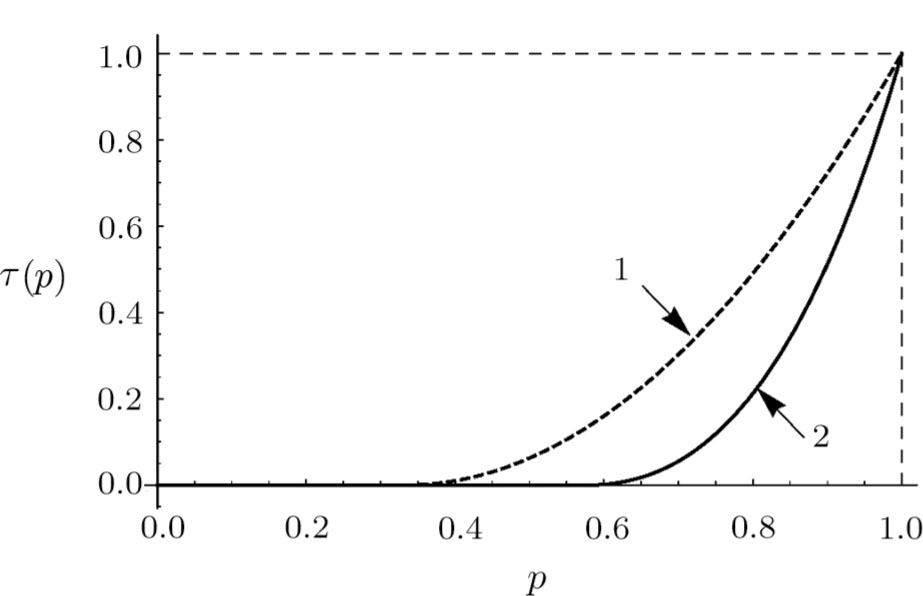
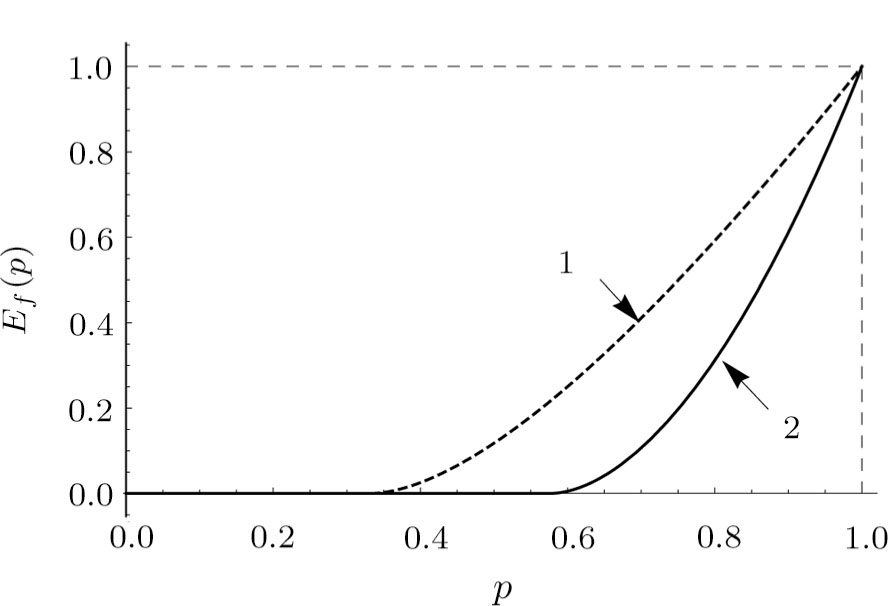
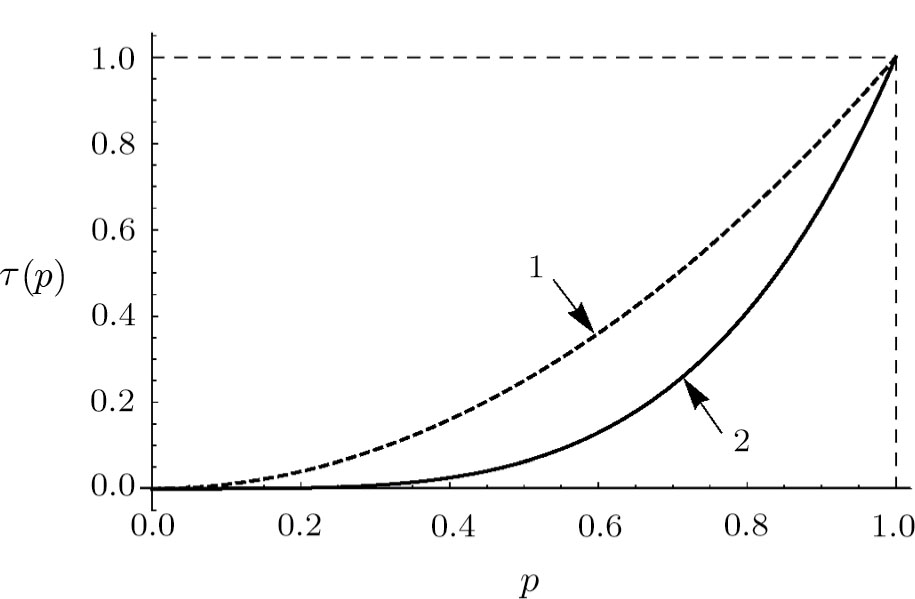
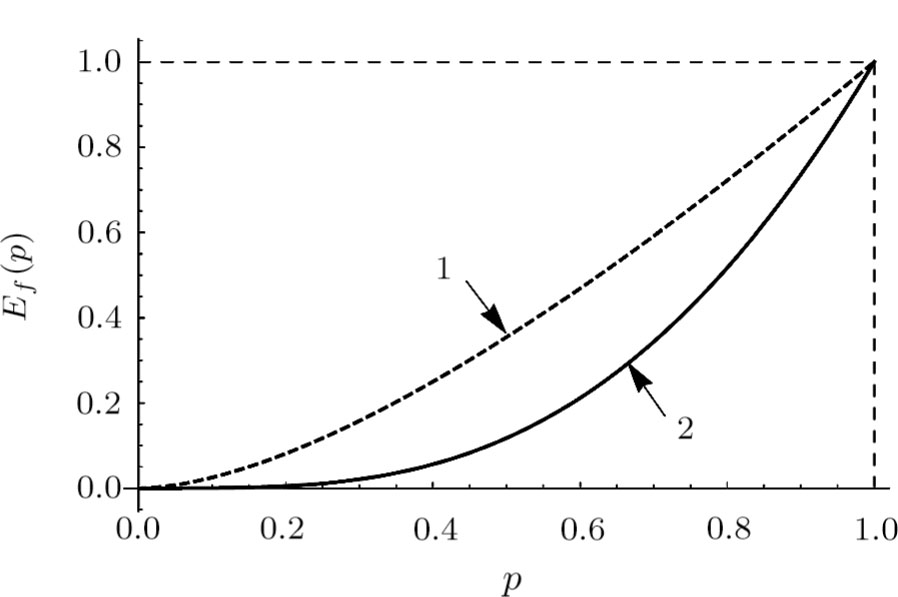
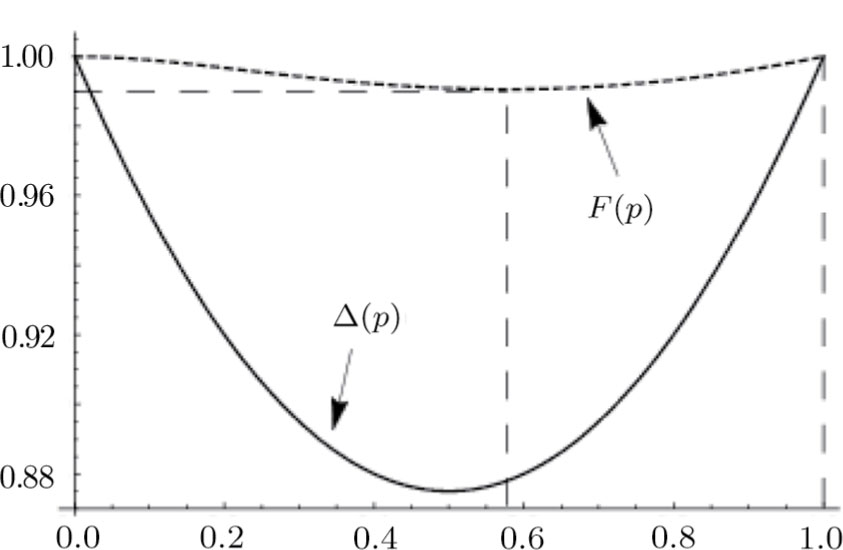
Figures 
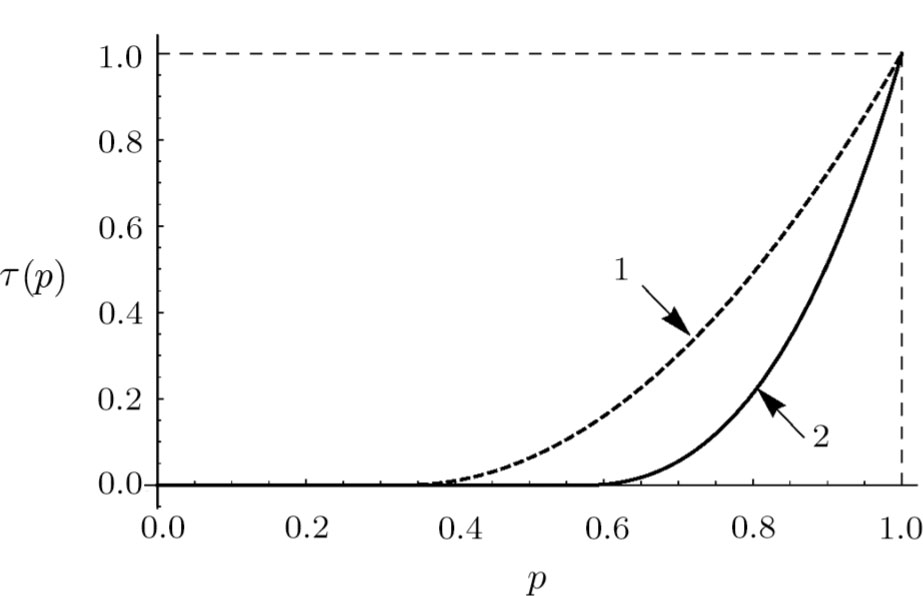 | Fig. 3 “Tangle” dependence of state qubits pairs on parameter p. Curve 1 is for initially prepared state of qubits pair (Werner state), curve 2 for qubits pair state obtained as a result of the ES operation. |
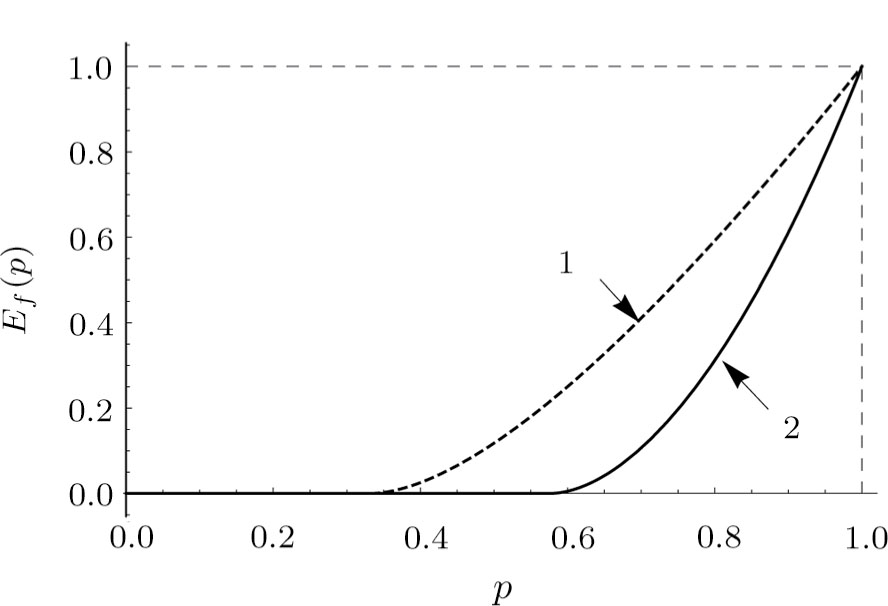 | Fig. 4 Dependence “entanglement of formation” of qubits pair state on parameter p. Curve 1 is for initially prepared state of qubits pair (Werner state), curve 2 for qubits pair state obtained as a result of the operation ES. |
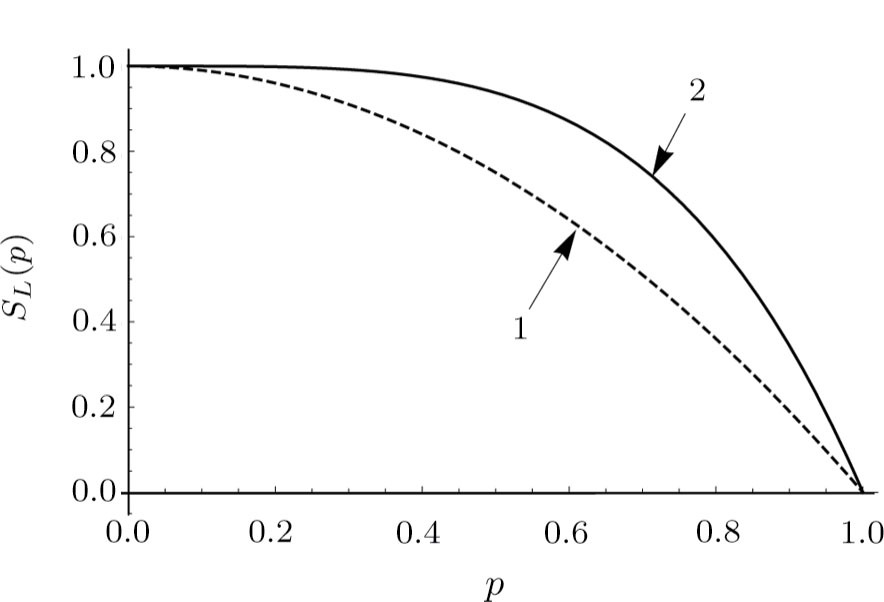 | Fig. 5 Dependence of linear entropy of qubit pair on parameter p. Curve 1 is for initially prepared state of qubits pair (Werner state), curve 2 for qubits pair state obtained as a result of the operation ES. |
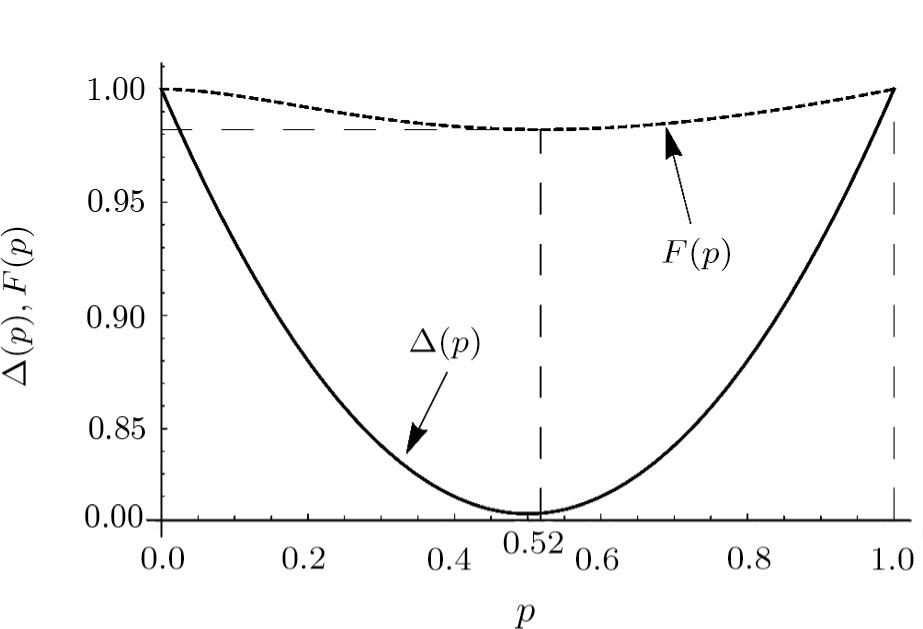 | Fig. 6 Dependences of similarity characteristics between initial and final states  |
3 Entanglement Swapping in the Case of Presence of Color Noise in the Initial States
2 ):23 ) with different parameters p1 and p2 in expression (17 ) and (18 ) we obtain the following matrix representation ρ14:24 ) and (25 ), following the replacement 


7 ):


Let us now analyze the final state of qubits pair after ES operation in the case of presence of color noise in the initial states.
The initial state of each qubits pair (ρ12 and ρ34) now looks as follows:[18]

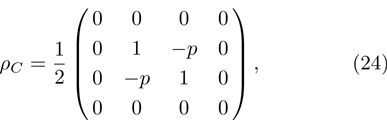
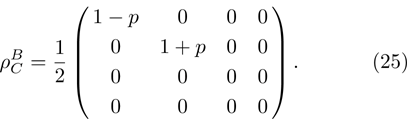
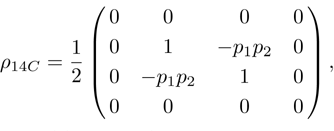
Hence, it follows that if one of the qubit pairs (e.g. a pair from first and second qubits) is prepared in the pure state (
For 

As a result of the operation ES, the share of color noise increases. So far 

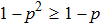
Figure
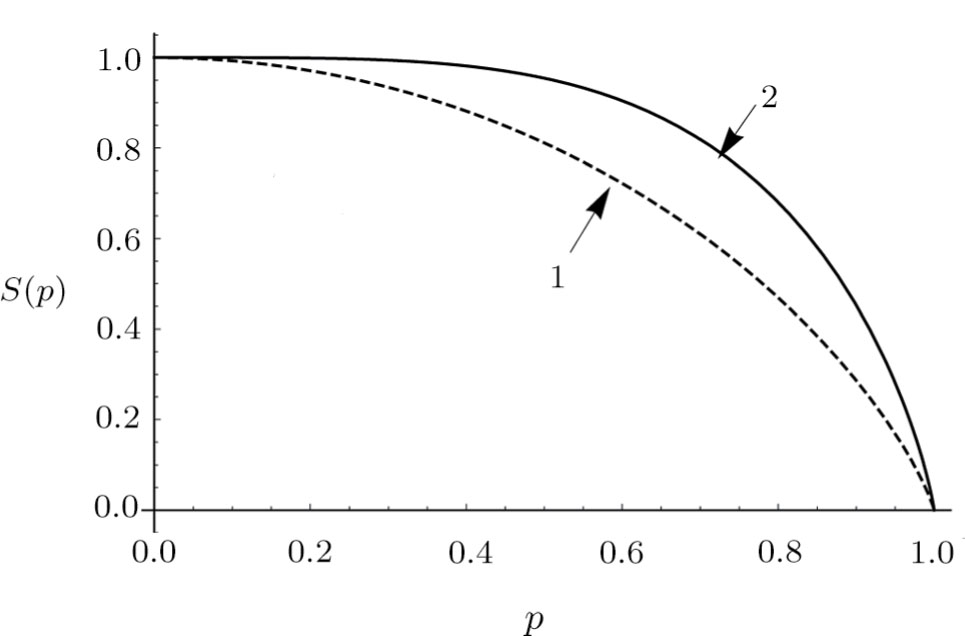 | Fig. 7 Dependence of von Neumann entropy on p in the presence of color noise. Curve 1 is for initially prepared states of qubits pairs, curve 2 for qubits pair state obtained as a result of the ES operation. |
The figure shows that the entropy of the final qubits pair for 


Let us also indicate that the maximum entropy value (for p = 0) equals 

Reduced density matrix corresponding to the matrices (
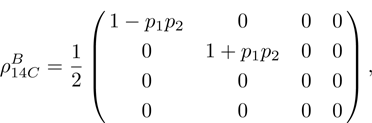
Partially transposed density matrix of the initial state of qubits pair in the standard basis looks as follows:
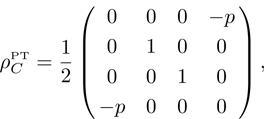
Using the similarity of initial and final states (

Below we present the values of characteristics (i)–(ix) only for initially prepared pairs of qubits. The same values for the qubit state pairs obtained by ES operation, are defined by similarity 
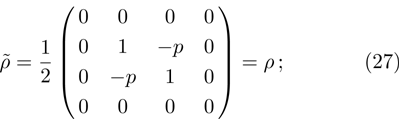
(i) Matrix 
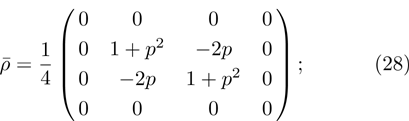
(ii) Product 


(iii) Eigenvalues of the matrix (

(iv) “Concurrence” (

(v) “Tangle” (


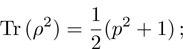
(vii) Purity (
(viii) Linear entropy (

(ix) von Neumann entropy (

(x) Parameters δ (

(xi) Fidelity (

Figures
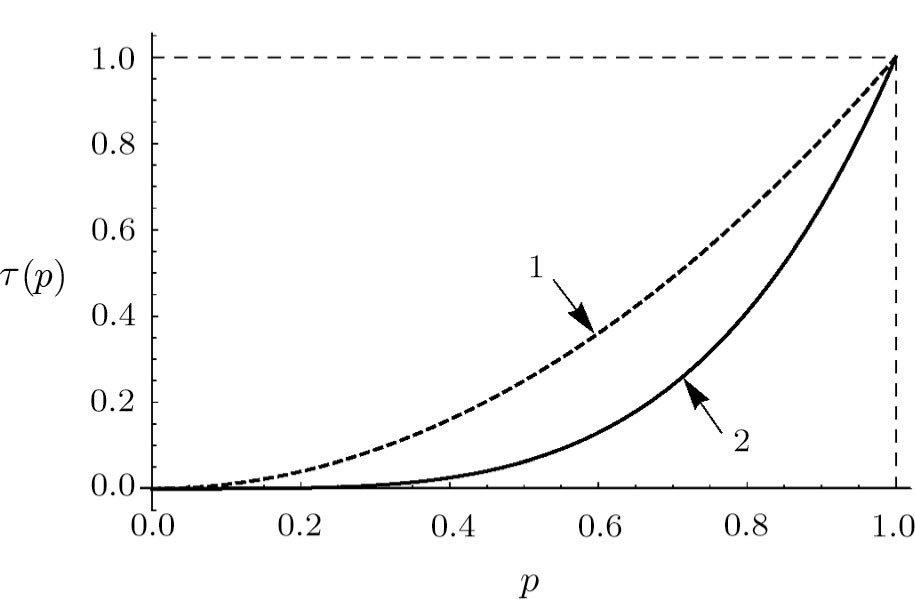 | Fig. 8 Dependence of “tangle” on p parameter. Curve 1 is for initially prepared states of qubits pairs (color noise), curve 2 for qubits pair state obtained as a result of the ES operation. |
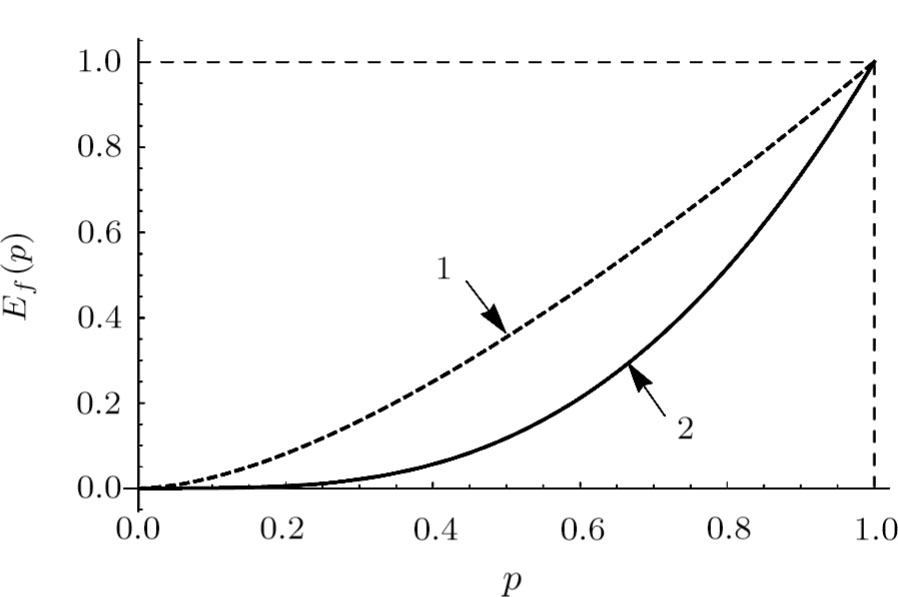 | Fig. 9 Dependence of “entanglement of formation” on p parameter. Curve 1 is for initially prepared states of qubits pairs (color noise), curve 2 for qubits pair state obtained as a result of the ES operation. |
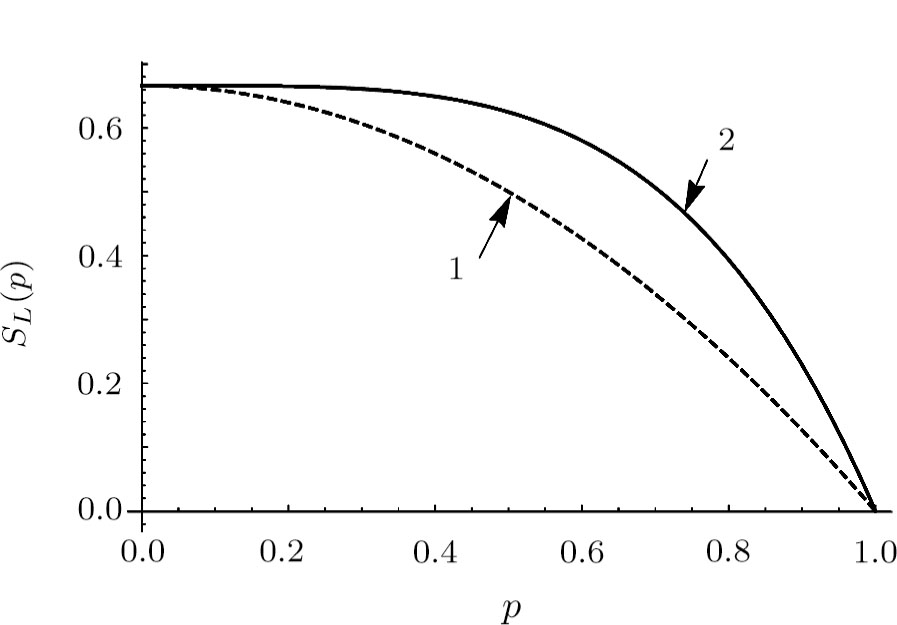 | Fig. 10 Dependence of linear entropy on p parameter. Curve 1 is for initially prepared states of qubits pairs (color noise), curve 2 for qubits pair state obtained as a result of the ES operation. |
Figure 
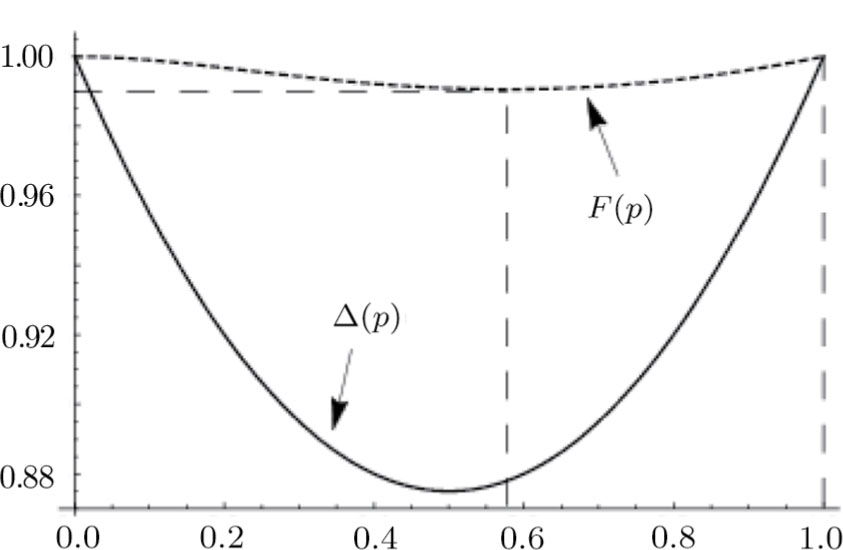 | Fig. 11 Dependence of  |
4 Entanglement Swapping in the Case of Presence of White and Color Noise in the Initial States


31 ) with different parameters p1, p2, r1 and r2 into expression (17 ) and (18 ) the matrix representation of qubits pair state 1 and 4 as a result of operation ES will look as follows:






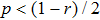

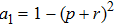
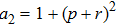



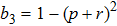
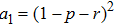




12 ) as 



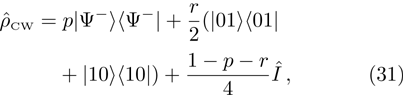
Let us assume now that there is simultaneous presence of white and color noise in the initial states of two pairs of qubits.
State of initially prepared pairs in this case is defined by density operator:[19]
Density matrix (
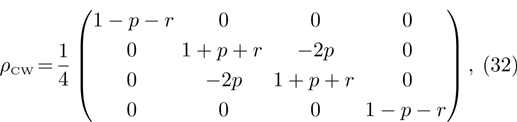
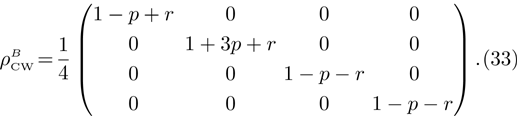
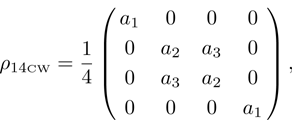
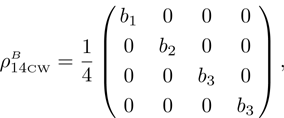
While 

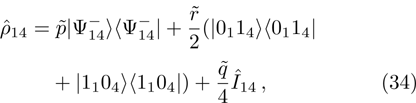

Let us analyze now the redistribution 


For p = 1 (then r = 0 and q = 0) we obtain: 


For p = 0 and 


For p = 0, r = 0 (then q = 1) 


If in the initial state (

For 
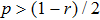
Density matrix of state (
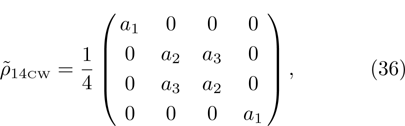
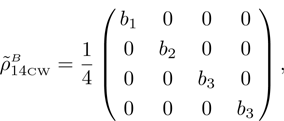
For any 


Reduced density matrices corresponding to the matrices (
Let us find a range of p and r when a state of each initially prepared pairs is entangled. Partially transposed density matrix for the state of each initially prepared pairs in standard basis looks as follows:
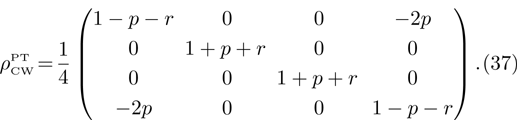
After diagonalization of Eq. (
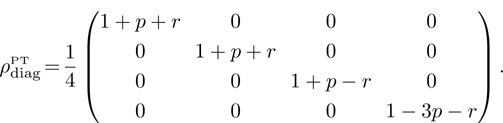
Due to conditions (


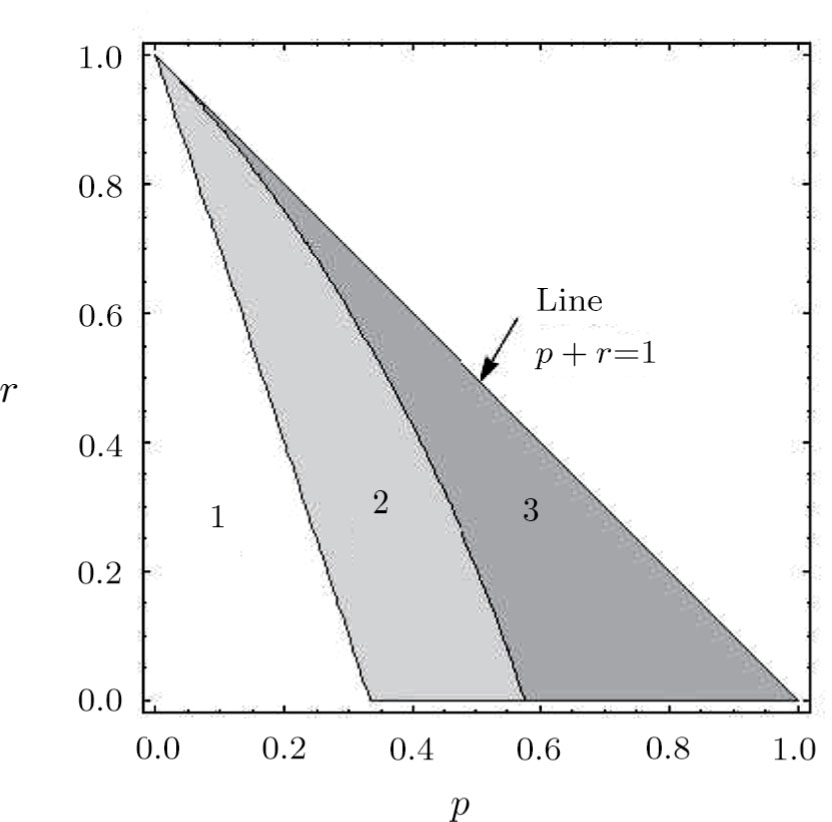
Let us now find the range of values p and r, for which the final states are entangled. Such a range one can express by means of inequality, which results from Eqs. (

Figure
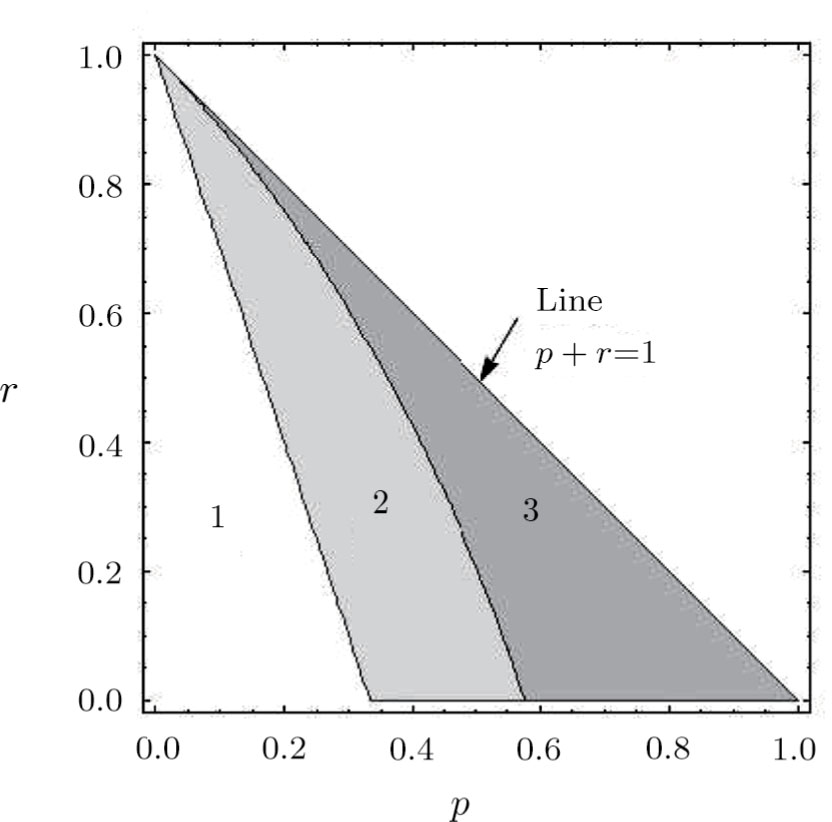 | Fig. 12 Ranges of parameters p and r: 1 is for initial and final states are nentangled (separable), 2 for initial state is entangled, final is unentangled, 3 for initial and final states are entangled. |
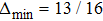
The graph shows that there is a range of parameter values (in Fig.
Let us now give initial state characteristics according to points (i)–(ix). Corresponding characteristics for final state could be found from below values for initial state, by applying designations from Eq. (

(i) Matrix 
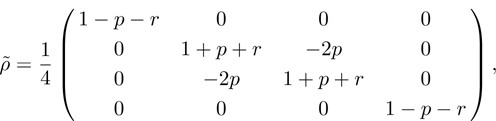
(ii) Product 
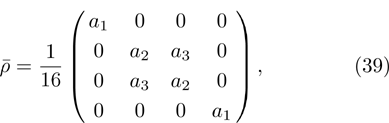
(iii) Eigenvalues of the matrix (
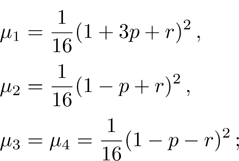
(iv) “Concurrence” (
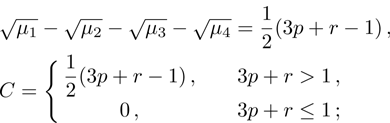
(v) “Tangle” (

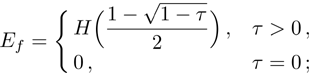
(vi) “Entanglement of formation” (
(vii) Purity (

(viii) Linear entropy (

(ix) von Neumann entropy (

(x) Parameter δ (

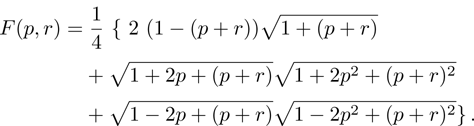
(xi) Parameter F (
5 Conclusions
(i) If one of the qubits pair is prepared in a pure state (

(ii) Entanglement swapping produces various schemes of white and color noise redistribution. It depends on ratio between white and color noise in the initial states. (Detailed description of different schemes of redistribution see above in the text).
(iii) In the entanglement swapping process for some range of parameters values p and r occur total decoherentization of state –entangled state becomes an unentangled one.
(iv) Results could be helpful for experiments regarding entanglement swapping as conditions for prepared quantum entangled states, to obtain result state as also entangled. It could be used for configuration of quantum communication channels devices such as quantum repeaters.
Reference
| [1] | |
| [2] | |
| [3] | |
| [4] | |
| [5] | |
| [6] | |
| [7] | |
| [8] | |
| [9] | |
| [10] | |
| [11] | |
| [12] | |
| [13] | |
| [14] | |
| [15] | |
| [16] | |
| [17] | |
| [18] | |
| [19] |