


Semi-Relativistic Two-Body States of Spinless Particles with a Scalar-Type Interaction Potential
Cite this Article
Thylwe K. E.. Semi-Relativistic Two-Body States of Spinless Particles with a Scalar-Type Interaction Potential. Communications in Theoretical Physics, 2018, 69(2): 127 
Permissions
Semi-Relativistic Two-Body States of Spinless Particles with a Scalar-Type Interaction Potential
† Corresponding author. E-mail:
Abstract
Abstract
A semi-relativistic quantum approximation for mutual scalar interaction potentials is outlined and discussed. Equations are consistent with two-body Dirac equations for bound states of zero total angular momentum. Two-body effects near the non-relativistic limit for a linear scalar potential is studied in some detail.
Keyword:relativistic quantum mechanics;two-body effects;two-body scalar potentials;bound states;quark potential
1 Introduction
Relativistic two-body effects may be studied using quantum field equations,[1] two-body Dirac equations,[2–6] and/or by equations resulting from direct quantum-operator substitutions of 

Semay et al.[2] and Ferreira[3] showed explicit results from a 16-components Dirac approach for scalar potentials of the confining type and bound states with vanishing total spin. The main interest of these authors is related to quark spectra. The relevant second-order differential equations obtained are simple and provide some understanding of important two-body effects.
Duviryak (2008),[4] also applying a Dirac-type method, presented solvable two-body models in connection with light mesons and Regge trajectories. No explicit results for scalar potentials are given. However, the general results seem to be relevant in the present context.
Moshinsky and Requer (2003)[6] studied two equal fermionic masses in the context of positronium formations. It seems close to other procedures related to sub-atomic interactions. No explicit results for scalar potentials are given.
In the present study the semi-relativistic approach[8–10] is applied with scalar (mass-type) potentials. In addition a “local-momentum” approximation is suggested to find the Dirac-type equations of Refs. [2–4] for two-body spectra with vanishing total spin.
The basic equations for calculating bound state energies are presented in Sec.
2 Semi-relativistic Local-Momentum Equations


1 ), i.e. in6 ).

12 ) is an unspecified scalar function of r. If 


12 ) solves Eq. (1 ) approximately. The left hand member in Eq. (1 ) is approximated, yielding

18 ) is derived it may be applied to both scattering and bound states.
In this section the “local-momentum” approximation used to simplify the semi-relativistic equation is outlined. This approach appears to be closely related to the one of Krolikowski.[7] The semi-relativistic quantum (SRQ) approximation of two interacting spinless particles starts from a Hamiltonian of classical special relativity. For an instantaneous scalar potential 


The momentum operator 


The equations of the local-momentum approximation can be derived by imagining two particles entering from free space towards a finite interaction region. In free space a plane wave 

By expanding the square roots in the basic SRQ Eq. (



The radial component 



Hence, the plane wave satisfies Eq. (
A generalization of the above semi-relativistic observations for plane waves leads to the local-momentum approximation. To this end, let a general wave be expanded as





An alternative mass notation is given in terms of the reduced mass μ and the total mass m


Hence, the leading-order local-momentum approximation is based on the second-order differential equation

Eq. (
2.1 Non-relativistic limit


By letting the relevant non-relativistic energy ϵ be defined by


In the single-mass limit the coefficient in Eq. (

 | Table 1
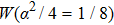
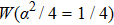
Local-momentum energy levels for the linear potential in Eq. ( |
This agrees with an exact spin symmetry model of the light-heavy quark-mass system in Ref. [12], provided the light mass component is represented by μ. Also, 
3 Linear Scalar Potential

29 ) 


Eq. (






The reduced differential equation becomes


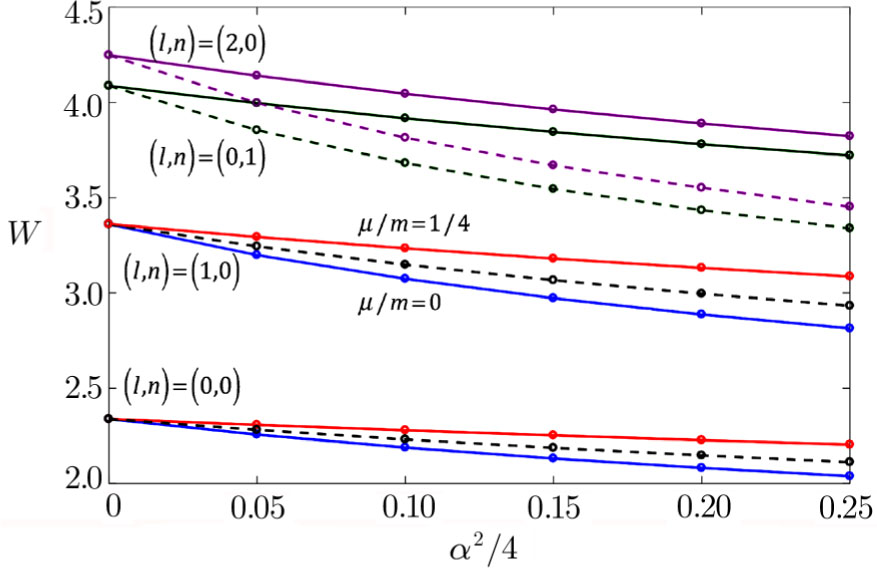
Numerical computations based on Eq. (

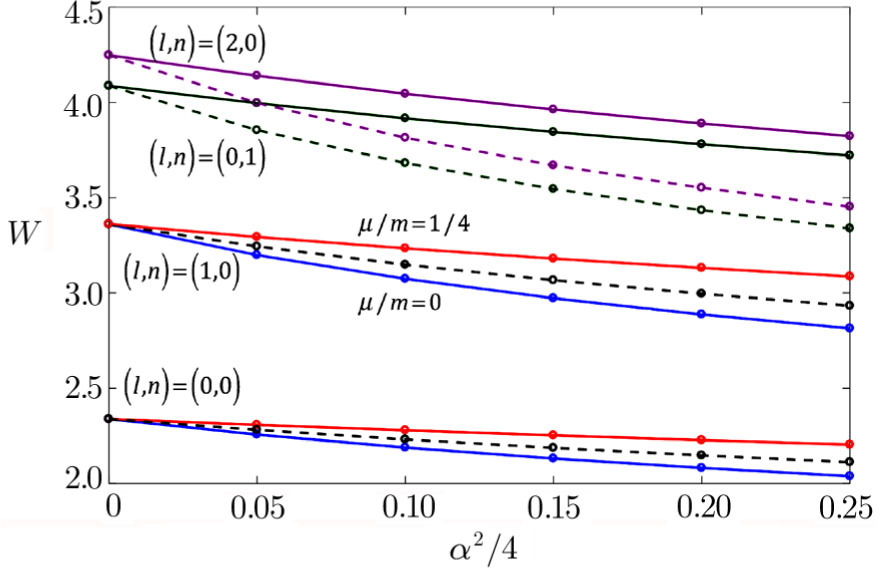 | Fig. 1 (Color online) Energy levels (W) as function of relativity (    |
The level spacing with respect to n is wider than that with respect to l (see Fig.
4 Summary
An approximation of the semi-relativistic approach, the “local-momentum approximation”, is outlined. Bound-state conditions appear similar to those of two-body approaches based on the Dirac theory for fermions.
The two-body effect found is that single-mass conditions are more sensitive to relativistic corrections. In the single-mass limit a spectrum corresponding to the spin symmetry of the single-particle Dirac equation is obtained.
Reference
| [1] | |
| [2] | |
| [3] | |
| [4] | |
| [5] | |
| [6] | |
| [7] | |
| [8] | |
| [9] | |
| [10] | |
| [11] | |
| [12] | |
| [13] |