A New Negative Discrete Hierarchy and Its N-Fold Darboux Transformation
Zhang Ning1, , Xia Tie-Cheng2
1Department of Basical Courses, Shandong University of Science and Technology, Taian 271019, China
2Department of Mathematics, Shanghai University, Shanghai 200444, China


† Corresponding author. E-mail: zhangningsdust@126.com

Abstract
Abstract

Starting from a matrix discrete spectral problem, we derive a negative discrete hierarchy. It is shown that the hierarchy is integrable in the Liouville sense and possesses a bi-Hamiltonian structure. Furthermore, its N-fold Darboux transformation is established with the help of gauge transformation of Lax pair. As an application of the Darboux transformation, some new exact solutions for a discrete equation in the negative hierarchy are obtained.

1 Introduction

It is an important task in soliton theory to find integrable lattice system such as those connecting with well-known physical meaning equations. In past decades, lots of nonlinear integrable lattice soliton systems have been obtained and discussed successfully, e.g. the Ablowitz–Ladik lattice,[1] the Toda lattice,[2] the differential-difference KdV equation,[3] the Blaszakl–Marciniak lattice,[45] and so on.[610] It is well known, there are many systematic approaches to obtain explicit solutions of lattice soliton systems, such as the inverse scattering transformation,[11] the Hirota technique,[12] the algebra-geometric method,[13] the Darboux transformation,[1415] etc. Among them, it has been proved that Darboux transformation is one of the most fruitful algorithmic procedures to get explicit solutions of nonlinear partial differential equations from a trivial seed.[1622]

In this paper, we consider a discrete spectral problem

where , are potentials, and λ is the spectral parameter and . For a lattice function , the shift operator E, the inverse of E and difference operator D are defined as follows

If let , , then the spctral problem (1) can be changed into the spectral problem

which was considered by Ding et al., where only a positive discrete hierarchy and 1-fold Darboux transformation were obtained.[23] So in this paper, we would like to further consider a negative discrete hierarchy and its properties associated with spectral problem (1).

The organization of this paper is as follows. In Sec. 2, we first establish a negative discrete hierarchy related to the spectral problem (1). In Sec. 3, it is shown that the hierarchy is integrable in Liouville sense and possesses bi-Hamiltonian structure. In Sec. 4, an N-fold Darboux transformation for negative discrete hierarchy is established with the help of gauge transformations of Lax pair. As an application, some exact solutions for a discrete equation in the negative hierarchy are given in Sec. 5.

2 A New Negative Discrete Hierarchy

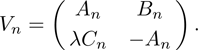
In order to get the discrete integrable system, we first proceed to solve the stationary discrete zero curvature equation

where

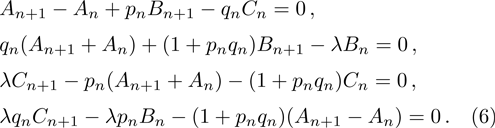
From Eq. (5), it is easy to obtain the following recursion relations

Substituting

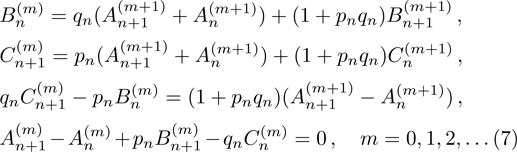
into Eq. (6) and comparing each power of λ yields

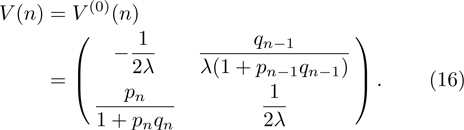
If we choose the initial values as

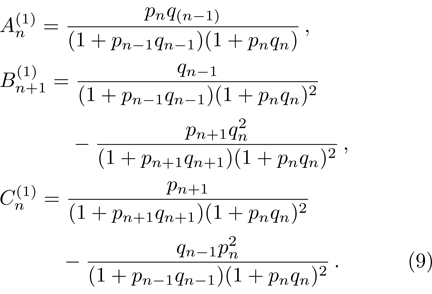
then , , () are determined from the recursion relations (7). In particular, the first set is

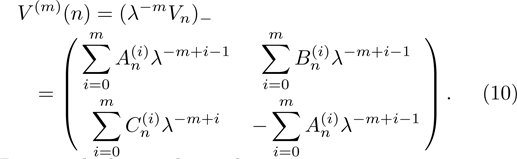
For any integer , we choose

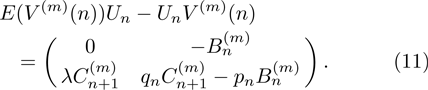
Direct calculation shows that

Consider auxiliary spectral problem

then compatibility condition between Eqs. (1) and (12) gives zero curvature equation

which is equivalent to integrable discrete hierarchy

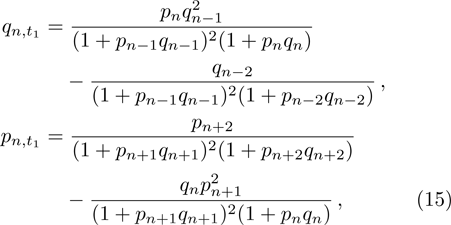
We can give the first two discrete integrable systems in the hierarchy:

When m = 0, the hierarchy (13) gives

When m = 1, the hierarchy (13) gives

Eq. (14) is a new negative discrete system, whose time part of the Lax pairs is

3 Bi-Hamiltonian Structures of the Hierarchy

Define

where

By implying the discrete trace identity

we have

with ε to be determined later. Substituting expressions

into Eq. (20) and comparing the coefficient of , we obtain

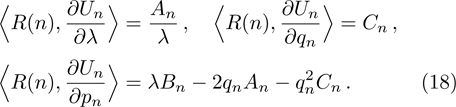
Taking m = 1 in Eq. (21), a direct calculation shows that ε = 0, so we get

The hierarchy (13) can be re-written in the form

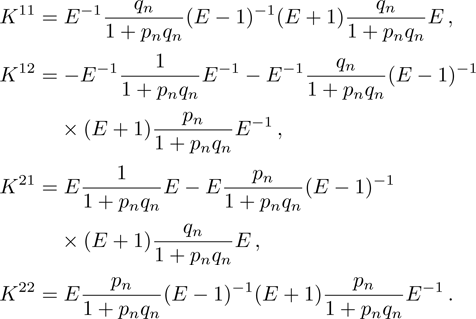
where

where

It is easy to verify that J and K are all skew-symmetric operators, i.e. , . Then substituting Eq. (22) into Eq. (23) gives the bi-Hamitonian structure for the hierarchy (13)

We can further prove the following theorem:

4 -Fold Darboux Transformation

As an illustrative example, we construct the N-fold Darboux transformation for the system (14) based on its Lax pair

In fact, the Darboux transformation of the system (14) is a special gauge transformation of Lax pair (26) and (27). Consider the following gauge transformation

where Tn is a Darboux matrix. The eigenfunction should satisfy the following new Lax pair (26) and (27) with Un and replaced by and respectively

We can construct the Darboux matrix Tn as follows
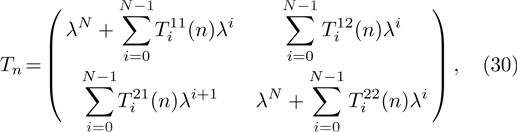
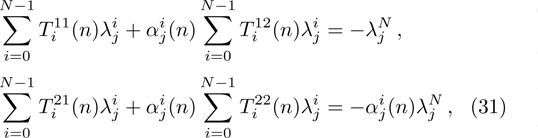
where , , , are given by a linear algebraic system

where are two basic solutions of Lax pair (26) and (27), and are parameters suitably chosen so that the determinant of the coefficients of the system (31) is nonzero. According to Eqs. (30)–(32), we can show that is a (2N)-th order polynomial of λ

By using above fact, we can prove the following proposition.

By using above facts, we can obtain the following theorem:

5 The Exact Solutions

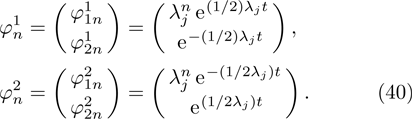
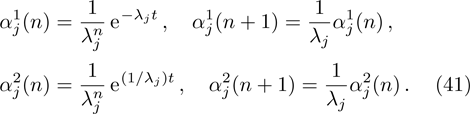
In this section, we will give some exact solutions of system (14) via Darboux transformation (39). Taking the trivial solution , , we obtain two kinds of exact solutions of the Lax pair (26) and (27) with as follow

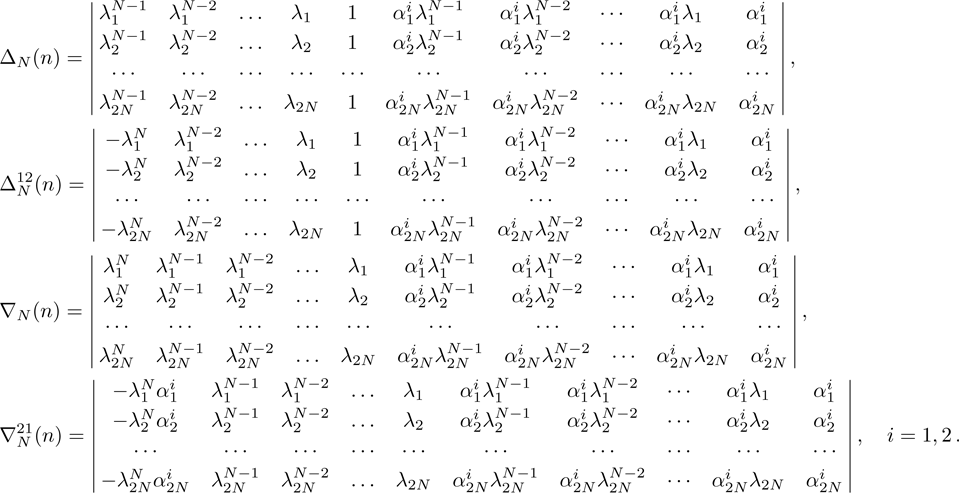
According to Eqs. (32) and (36), we have

By use of Cramer’s rule, the linear algebraic system (41) leads to

with

Next, we give some exact solutions of the system (14) via Darboux transformation (39) for two cases when N = 1 and N = 2 respectively.

Reference
[1] Ablowitz M. J. Ladik J. F. J. Math. Phys. 16 1975 598
[2] Tu Gui-Zhang J. Phys. A: Math. Gen. 23 1990 3903
[3] Tamizhmani K. M. Lakshmana M. J. Phys. A: Math. Gen. 16 1983 3773
[4] Blaszak M. Marciniak K. J. Math. Phys. 35 1994 4661
[5] Yu Fa-Jun Li Li J. Modern Phys. B 25 2011 3371
[6] Li Xin-Yue Zhao Qiu-lan Li Yu-Xia Dong Huan-He J. Nonl. Sci. Appl. 8 2015 496
[7] Wang Xiang-Rong Zhang Xiao-En Zhao Pei-Yi Abst. Appl. Anal. ID 253102 2014 1
[8] Xu Xi-Xiang Appl. Math. Comput. 216 1 2010 344
[9] Zhang Ning Dong Huan-He Modern Phys. Lett. B 23 2009 3491
[10] Zhang Ning Xia Tie-Cheng Int. J. Nonl. Sci. Num. Simulat. 16 2015 301
[11] Ablowitz M. J. Segur H. Solitons and the Inverse Scattering Transform SIAM Philadelphia 1981
[12] Ryogo Hirota Junkichi Satsuma Progr. Theoret. Phys. Suppl. 59 1976 64
[13] Li Yu-Qing Dong Huan-He Yin Bao-Shu J. Appl. Math. ID 416472 2014 1
[14] Matveev V. B. Salle M. A. Darboux Transformations and Solitons Springer-Verlag Berlin 1991
[15] Gu Chao-Hao Hu He-Sheng Zhou Zi-Xiang Darboux Transformation in Soliton Theory and Its Geometric Applications Shanghai Scientific and Technical Publishers Shanghai 1999
[16] Zhang Yong Dong Huan-He Zhang Xiao-En Yang Hong-Wei Comput. Math. Appl. 73 2017 246
[17] Zhang Yu-Feng Zhang Hong-Qing Gong Xin-Bo Gongcheng Shuxue Xuebao 18 2001 93 (in Chinese)
[18] Ma Wen-Xiu Geng Xian-Guo Centrc de Recherches Mathematiques CMR Proceedings and Lecture Notes 29 2001 313
[19] Fan En-Gui J. Phys. A 38 2005 1063
[20] Lou Sen-Yue Jia Man Tang Xiao-Yan Huang Fei Phys. Rev. E 75 2007 056318
[21] Fan En-Gui Commun. Theor. Phys. 37 2002 145
[22] Lou Sen-Yue Jia Man Huang Fei Tang Xiao-Yan Int. J. Theor. Phys. 46 2007 2082
[23] Ding Hai-Yong Xu Xi-Xiang Zhao Xiang-Dong Chin. Phys. 13 2004 0125
[24] Dong Huan-He Zhang Yong Zhang Xiao-En Commun. Nonl. Sci. Numer. Simulat. 36 2016 354