Proper Teleparallel Homothetic Vector Fields in General Cylindrically Symmetric Space-Times in Teleparallel Theory of Gravitation Using Diagonal Tetrads
Cite this Article
Shabbir Ghulam, Ali Shahani Masoom, Amer Qureshi M., Mahomed F. M.. Proper Teleparallel Homothetic Vector Fields in General Cylindrically Symmetric Space-Times in Teleparallel Theory of Gravitation Using Diagonal Tetrads. Communications in Theoretical Physics, 2017, 68(5): 611 
Permissions
Proper Teleparallel Homothetic Vector Fields in General Cylindrically Symmetric Space-Times in Teleparallel Theory of Gravitation Using Diagonal Tetrads
† Corresponding author. E-mail:
Abstract
Abstract
In this paper we consider the most general form of non-static cylindrically symmetric space-times in order to study proper teleparallel homothetic vector fields using the direct integration technique and diagonal tetrads. This study also covers static cylindrically symmetric, Bianchi type I, non-static and static plane symmetric space-times as well. Here, we will only discuss the cases which do not fall in the category of static cylindrically symmetric, Bianchi type I, non-static and static plane symmetric space-times. From the above study we show that very special classes of the above space-times yield 6, 7 and 8 teleparallel homothetic vector fields with non-zero torsion.
1. Introduction


1 ) the vector field X is called teleparallel homothetic (proper teleparallel homothetic when 
The idea of symmetries of space-time is nearly as old as the origination of the theory of general relativity itself. Symmetries have a vital role in general relativity, which enables one to understand the physical and geometrical aspects of space-times (the details can be found in Refs. [1–2]). Symmetries provide the laws of conservation[3] and physical information about the underlying space-time. For example, self-similarity solutions are extensively used for cosmological perturbations, star formation, gravitational collapse, primordial black holes, cosmological voids, and cosmic censorship.[4] Furthermore, symmetries have been studied in the theory of general relativity based on Riemannian geometry and in the theory of teleparallel gravity based on the Weitzenbck geometry.[5] In general relativity, Einstein’s field equations are invoked to illustrate the interaction of matter. These gravitational field equations being non-linear require some symmetry restrictions on the space-time metric. Symmetries are useful in the study of laws of conservation of matter in a space-time.[3] In general relativity many exact solutions of Einstein’s field equations are obtained, the details of which can be found in Ref. [6]. Solutions of these equations are then classified according to its Killing, homothetic and conformal vector fields.[7–11] The theory of general relativity uses Einstein’s field equations to unify mass and energy with the geometric structure of the space-time. Geometric description of the theory has been verified through experiments at the classical level and seems to be true in nature while at the quantum level interactions among the particles do not follow such a description. The quest to obtain consistency and a unified field theory started at this point and Einstein made an attempt at the unification of the laws of the general theory of relativity and quantum gravity. He introduced the notion called absolute parallelism. Although Einstein did not succeed in his attempt, modern researchers have taken up the challenge to unify other known interactions with quantum gravitation. Various endeavors make it possible to give a structure to gravitation other than the metric tensor. In these investigations the metric tensor can be written as a by-product of these structures. One of these structures, known as a tetrad field, is now an elementary entity in teleparallel theory.[12] In this theory the gravitational interaction of particles are defined only by torsion in the space-time and the curvature is zero due to mass in the space-time. Much interest has been expended to explore the teleparallel versions of exact solutions in general relativity. Pereira et al.[13] obtained stationary axisymmetric Kerr and Schwarzschild solutions of teleparallel versions in general relativity. An investigation on the energy contents as well as the energy and momentum distribution in both general relativity and teleparallel theory of gravitation was carried out by Sharif and his collaborators.[14–15] The localization of energy and momentum in general relativity remains a focal problem. Different investigators like Einstein,[16] Landau–Lifshitz,[17] Papapetrou,[18] Tolman,[19] and Bergmann[20] defined their own energy momentum complexes to tackle this problem. These definitions to localize energy and momentum complexes have limitations and do not provide a meaningful physical local energy momentum density. Moller[21] was the first to introduce and define an energy momentum complex which is consistent in all coordinate systems. Many workers[22–23] have dealt with the energy localization problem in the teleparallel theory of gravitation. The crux of this theory is that energy can be localized and the results of teleparallel theory of gravitation and general relativity are consistent. Keeping in mind the interest of symmetries in the teleparallel theory of gravitation, the authors in Ref. [24] introduced the teleparallel version of the Lie derivative for Killing vector fields and utilized these equations to find the teleparallel Killing vector fields in the Einstein universe. In Refs. [25–32] the researchers have made further progress to classify different space-times according to their teleparallel Killing vector fields. From the above study they showed that some time teleparallel theory gives more conservation laws as compared with the theory of general relativity. In Refs. [33–36] the authors extended this work to proper teleparallel homothetic vector fields and they classified different space-times according to their proper teleparallel homothetic vector fields. In this paper, we classify non-static cylindrically symmetric space-times according to their proper teleparallel homothetic vector fields. The teleparallel homothetic equation is defined as[33–34]


2. Main Results2 ), the non-trivial tetrad components denoted by 

3 ) are[37]1 ). Expanding Eq. (1 ) and using Eqs. (2 ) and (4 ), one arrives at
5 ) and (6 ), one determines


5 ) to (12 ) we need to determine the above functions. If one proceeds further after some tedious calculations, there exist the following cases which are:


14 ) admits six linearly independent teleparallel homothetic vector fields, in which five are teleparallel Killing vector fields which are given as the following: 
15 ) the proper teleparallel homothetic vector fields are


5 ) to (12 ) we deduce

17 ) admits eight linearly independent teleparallel homothetic vector fields in which seven are teleparallel Killing vector fields given as 






18 ), are as follows


5 ) to (12 ) we find the teleparallel homothetic vector fields

20 ) admits eight linearly independent teleparallel homothetic vector fields in which seven are teleparallel Killing vector fields given as 






21 ) are given by


5 ) to (12 ) we deduce the teleparallel homothetic vector fields



23 ) admits eight linearly independent teleparallel homothetic vector fields in which seven are teleparallel Killing vector fields given as 






24 ) are given as follows


5 ) to (12 ) we find the teleparallel homothetic vector fields



26 ) admits seven linearly independent teleparallel homothetic vector fields in which six are teleparallel Killing vector fields given as 





27 ) are given as follows


5 ) to (12 ) we find the teleparallel homothetic vector fields



29 ) admits seven linearly independent teleparallel homothetic vector fields in which six are teleparallel Killing vector fields given as 





30 ) are as


5 ) to (12 ) we arrive at the teleparallel homothetic vector fields









33 ) are


5 ) to (12 ) we find the teleparallel homothetic vector fields



35 ) admits seven linearly independent teleparallel homothetic vector fields in which six are teleparallel Killing vector fields given as 





36 ) are given as follows



5 ) to (12 ) we find the teleparallel homothetic vector fields



38 ) admits eight linearly independent teleparallel homothetic vector fields in which seven are teleparallel Killing vector fields given as 





39 ) are as below


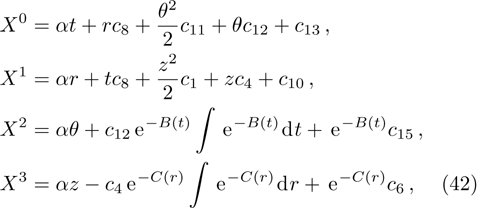
5 ) to (12 ) we deduce the teleparallel homothetic vector fields








42 ) are as given below
Consider the non-static cylindrically symmetric space-times in usual coordinates 













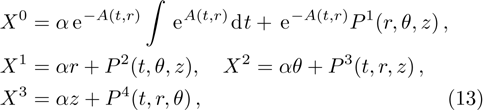
It is significant to note that when A = constant, B = constant, and C = constant then all the torsion components are zero and the space-time becomes the Minkowski space-time, which gives contradicts our assumption. We do not consider this case further. It is also important to mention here in Cases 1, 2, 3, 4, and 5 the space-times become non-static plane symmetric and its proper homothetic vector files were discussed in Ref. [35]. In Cases 6, 7, 8, 9, and 10 the space-times become Bianchi type I and its proper homothetic vector files were discussed in Ref. [33]. Case 11 the space-time becomes static cylindrically symmetric and its proper homothetic vector files were discussed in Ref. [34]. Hence we only discuss each of the remaining cases from 12 to 21 in turn.
In Case 12 we have A = constant, B = B(t, r), C = C(t, r), and 

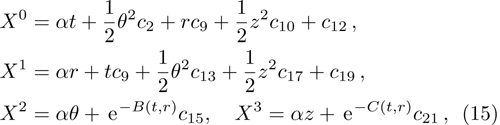
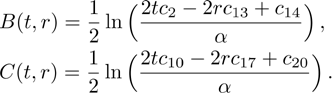
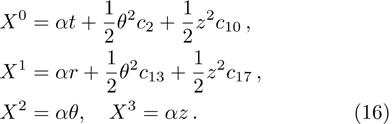
In Case 13 we have C = C(t, r), and A = B = constant. After rescalings of t and θ the space-time (

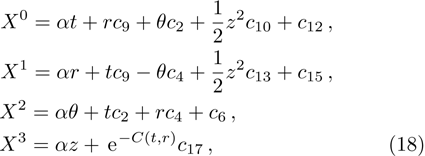


In Case 14 we have B = B(t, r), and A = C = constant. After appropriate rescalings of t and z the space-time (

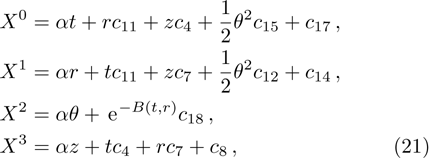


In Case 15 we have A = A(t), B = B(t), C = C(t), and A = C. In this case the space-time (
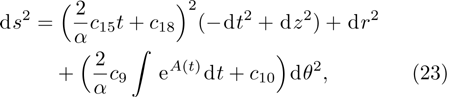
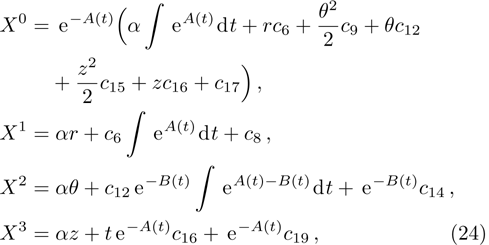

In Case 16 we have A = A(t), B = B(t), C = C(t, r), and 
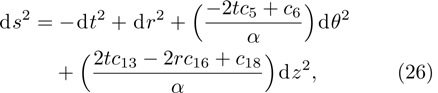
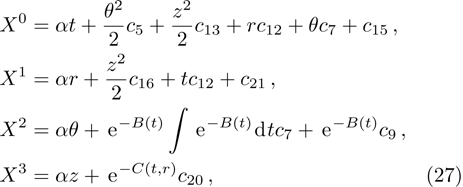

In the present Case 17 we have A = A(t), B = B(t), C = C(t, r), and A = B. The space-time (
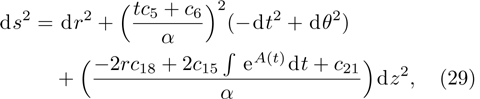
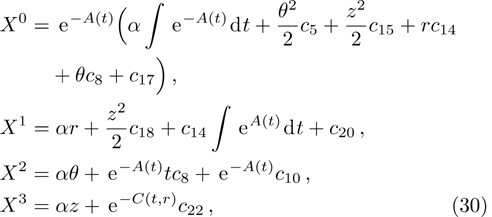
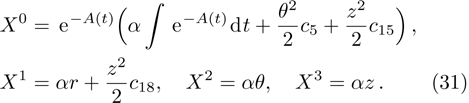
In Case 18 we have A = constant, B = B(t, r), and C = C(t). After a rescaling of t the space-time (

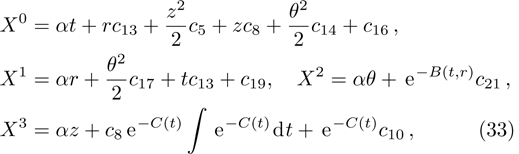

In Case 19 we have 



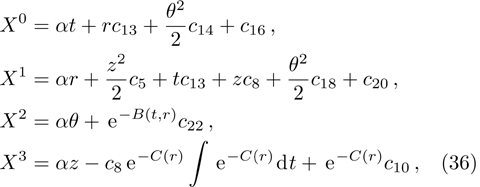

In Case 20 we have A = A(t), B = B(r), C = C(t), and A = C. The space-time (
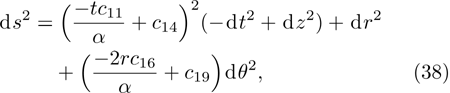
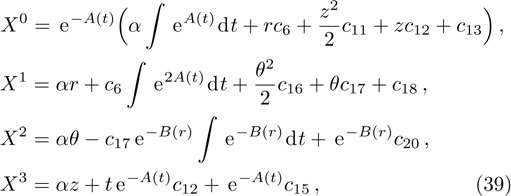

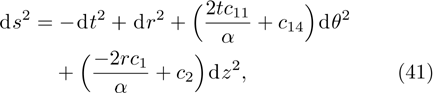
In the present Case 21 we have A = A(t), B = B(t), C = C(r) and 

3. Summary
In this paper, a study of most general form of the cylindrically symmetric non-static space-times for proper teleparallel homothetic vector fields in teleparallel theory of gravitation is given by using a direct integration technique. This study also covers static cylindrically symmetric, Bianchi type I, non-static and static plane symmetric space-times which we do not include because it is given in Refs. [33–35]. From this study, we find that the space-time (
(a) The case for which the space-time (
(b) The cases when the space-time (
(c) The cases when the space-time (
It is significant to note that in this work we have discussed only those cases in which proper teleparallel homothetic vector fields exist. Otherwise the space-time (
Acknowledgement
One of the authors FMM is grateful to the National Research Foundation, NRF, of South Africa for research funding through two grants.
Reference
| [1] | |
| [2] | |
| [3] | |
| [4] | |
| [5] | |
| [6] | |
| [7] | |
| [8] | |
| [9] | |
| [10] | |
| [11] | |
| [12] | |
| [13] | |
| [14] | |
| [15] | |
| [16] | |
| [17] | |
| [18] | |
| [19] | |
| [20] | |
| [21] | |
| [22] | |
| [23] | |
| [24] | |
| [25] | |
| [26] | |
| [27] | |
| [28] | |
| [29] | |
| [30] | |
| [31] | |
| [32] | |
| [33] | |
| [34] | |
| [35] | |
| [36] | |
| [37] |