

Coherent-State Approach for Majorana Representation
Cite this Article
Liu Hao-Di, Fu Li-Bin, Wang Xiao-Guang. Coherent-State Approach for Majorana Representation. Communications in Theoretical Physics, 2017, 67(6): 611 
Permissions
Coherent-State Approach for Majorana Representation
† Corresponding author. E-mail:
Abstract
Abstract
By representing a quantum state and its evolution with the Majorana stars on the Bloch sphere, the Majorana representation provides us an intuitive way to study a physical system with SU(2) symmetry. In this work, based on coherent states, we propose a method to establish the generalization of Majorana representation for a general symmetry. By choosing a generalized coherent state as a reference state, we give a more general Majorana representation for both finite and infinite systems and the corresponding star equations are given. Using this method, we study the squeezed vacuum states for three different symmetries, Heisenberg–Weyl, SU(2) and SU(1,1), and express the effect of squeezing parameter on the distribution of stars. Furthermore, we also study the dynamical evolution of stars for an initial coherent state driven by a nonlinear Hamiltonian, and find that at a special time point, the stars are distributed on two orthogonal large circles.
1. Introduction
The Majorana representation (MR), which provides an intuitive picture to study a physical system with a high dimensional projective Hilbert space,[1] has attracted revived attention in recent years. Despite being introduced about 80 years ago, this representation, which endows quantum state with visualization, has become an efficient tool to study the symmetric related feature of quantum system, such as spinor boson gases,[2–7] multilevel qubits,[8] and Lipkin–Meshkov–Glick model,[9–10] since it naturally provides an intuitive way to study the geometrical perspectives of these systems, e.g., geometric phase,[11–16] and entanglement.[17–22]
As we know, a two-level pure state can be described by a point on the Bloch sphere, and its evolution is perfectly represented by the trajectory of the point on the sphere. However, it seems hard to extend this geometric interpretation to a higher dimensional quantum states, since it is difficult to visualize the trace in high dimensional space. Faced with this, the early ingenious work of Majorana told us that we can study the problem from a different perspective: including more points on the two-dimensional Bloch sphere instead picturing one single point on a high dimensional geometric structure. In MR, one can describe a spin-J state intuitively by 2J points on the Bloch sphere. These points are called Majorana stars of the state. Therefore, the physics information of a spin state, such as dynamic evolution, geometric phase, mutiparticle entanglement, can be represented by these stars.
However, this elegant geometric representation can only be used to study a pure spin state which has SU(2) symmetry. With the increasing attention of MR, how to extend this representation to mixed states or pure states with other symmetries becomes a fascinating problem. Recently, Giraud et al. proposed a generalization to arbitrary spin-j mixed state of the MR in terms of tensors that share the most important properties of Bloch vectors based on covariant matrices introduced by Weinberg.[23] Moreover, for any n-dimensional pure state, the parameterization process in Majorana representation can also be borrowed to define 
In this work, we present a new extension for the MR. Based on the definitions of generalized coherent states[24] with the ladder and number operators, we choose the coherent state as a reference state and propose a procedure of establishing representation like MR for an arbitrary symmetry. We show that this coherent-state approach for MR can not only be used to typical states like coherent states and squeezed vacuum states for a particular symmetry, such as Heisenberg–Weyl (HW), SU(2), and SU(1,1) symmetries, but also can reproduce the change of symmetry in the period evolution of a quantum state. In this respect, it provides an intuitive way to study the quantum system which carries a particular symmetry. Furthermore, we find that the same type of state in our coherent-state approach for MR based on the different coherent states of the different symmetries possess the same distribution of the stars on the Bloch sphere.
This paper is organized as follows. In Subsec.
2. Majorana Representation and Its Coherent-State Approach
2.1. Majorana Representation


5 ). These numbers completely describe the state and can be geometrically described by 2j points on a plane or on a unit sphere via relation
8 ) into (7 ) leads to1 ) and (11 ), one finds5 ) leads to

We first introduce the MR which was developed for spins.[1] A generic spin-j state
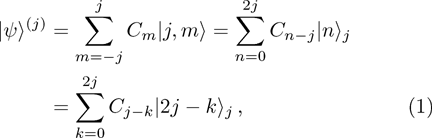
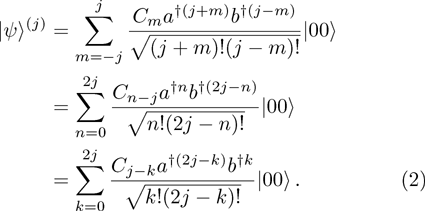
Then, we meet a homogeneous polynomial of degree 2j




Using Eq. (


Now, as an example, we consider a spin coherent state (SCS) defined by[25–26]


2.2. Coherent-State Approach


16 ) becomes
For the system with the symmetry of a Lie group G, there exists a method to construct the coherent states.[24] The generators Li of group G satisfy the commutation relation


Using the creation operator, a generic state 


Interestingly, if we decompose the complex numbers λm as 


The coherent state can be defined as[24]


Technically, we can establish this new representation in three steps:
(i) Constructing the ladder operator 


(ii) Using the coherent state as a reference to fix the ladder operator and Majorana points. To represent the coherent state as one point on the Bloch sphere, we define a nonlinear creation operator 


(iii) Establishing the equation for Majorana stars. If we meet an infinite system, the cutoff can be made as the all excitations for a physical state cannot be infinite. With this procedure, we next apply this CSA to some physical systems with particular symmetries.
3. Applications for Several Symmetries
3.1. Spin State for SU(2) Symmetry


25 ), let 


5 ). Obviously, from this form, all stars for the SCS (11) coincide. Next, using this coherent-state approach, we generalize MR from finite SU(2) systems to systems with infinite dimensions.
First, we need to guarantee our CSA can reproduce the MR for SU(2) symmetry. The spin operators Jx, Jy, Jz as the generators of SU(2) have the commutation relations




From Eq. (


We solve this puzzle by introducing the nonlinear creation operator as




3.2. Single Mode Boson State for HW Symmetry


37 ) in terms of 
In a similar way with the above discussion, we consider the bosonic single-mode system which has HW symmetry. Its generators are the boson creation operator 


The coherent state can be obtained by action of the displacement operator,


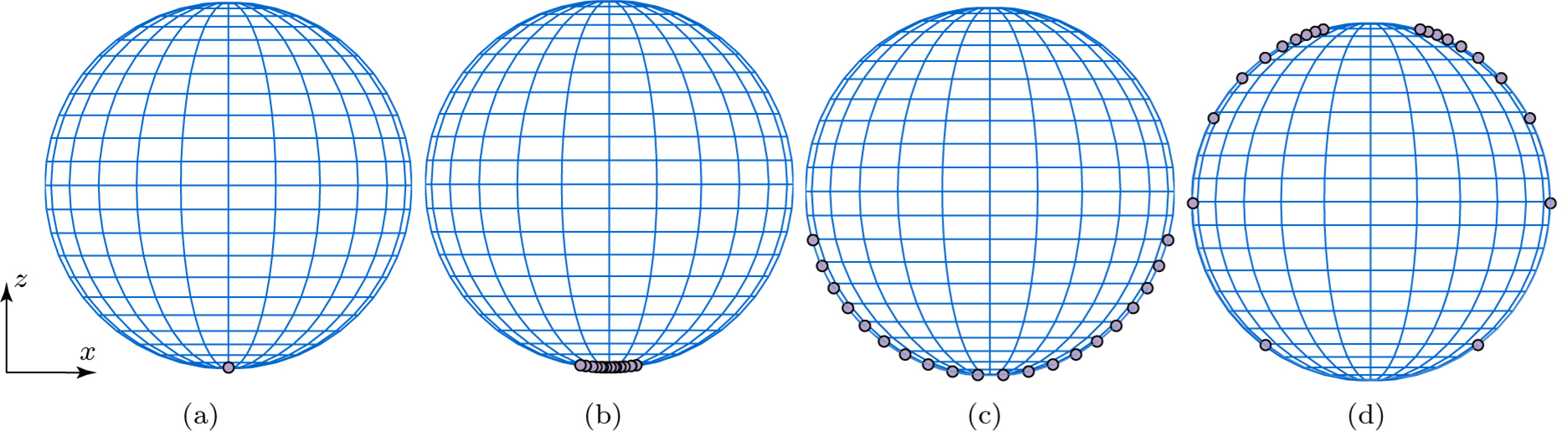
Different with the situation of SU(2), if we want to establish a geometric representation by stars, we need to truncate the infinite to a finite number Nc (since the excitations can not be infinite for a real physical state, the truncation is very physically reasonable, and the choice of Nc will be shown in fig.




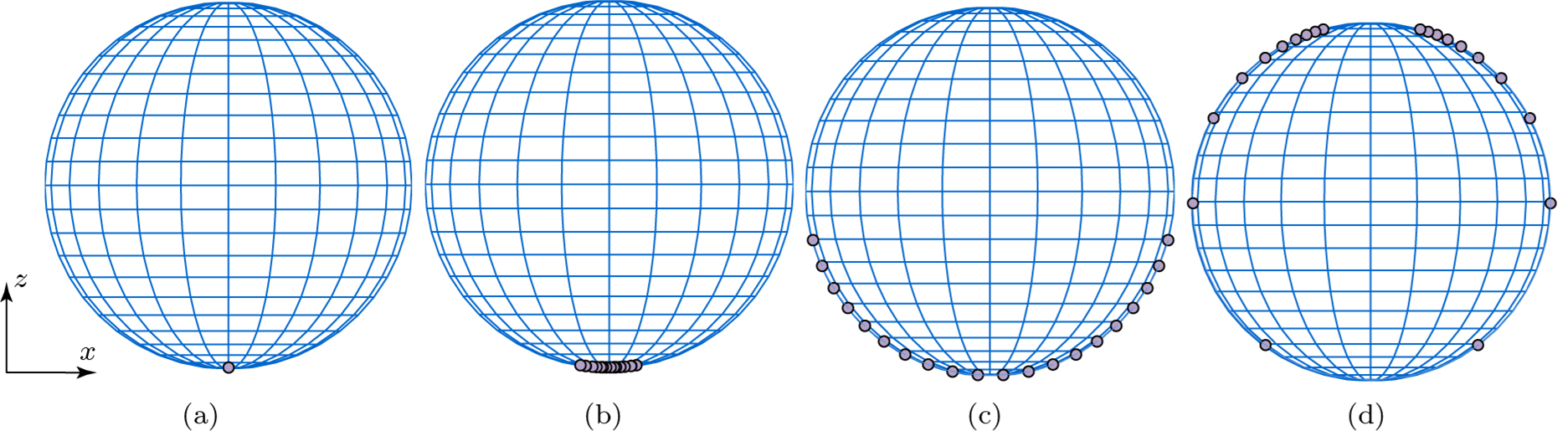 | Fig. 1. Bloch representation of CSA for the squeezed vacuum state with      |
3.3. State for SU(1, 1) Symmetry


53 ) into the above equation, one finds again all the stars coincide. Thus, we have obtained three star equations, respectively for SU(2), HW, and SU(1,1) systems. Next, we apply these equations to real quantum states.
Another useful symmetry is SU(1, 1) symmetry, which has been widely applied to study spin squeezing in quantum metrology[27,28] and some non-conservative physical systems.[29–32] Similar with group SU(2), group SU(1, 1) also has three generators K1, K2 and K3 which satisfy


From Eq. (




Again we truncate the upper to a finite number Nc and define the nonlinear operator





4. Squeezed Vacuum State in CSA

45 ), we arrive at the star equation for the SMSV


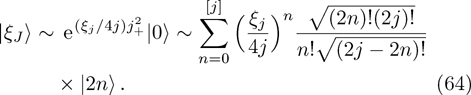
64 ) and (65 ) into Eqs. (34 ) and (59 ), respectively, we obtain two star equations for the two squeezed states as

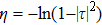
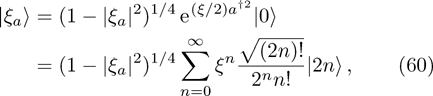
So far, we have presented how to establish the CSA for some kinds of symmetries. This coherent-state based method provides us a geometric tool to study properties of quantum states. We now consider a class of quantum state, i.e., squeezed states. First, we consider the typical single-mode squeezed vacuum (SMSV) state



Similarly, one spin squeezed state for SU(2) symmetry is defined as[33–34]


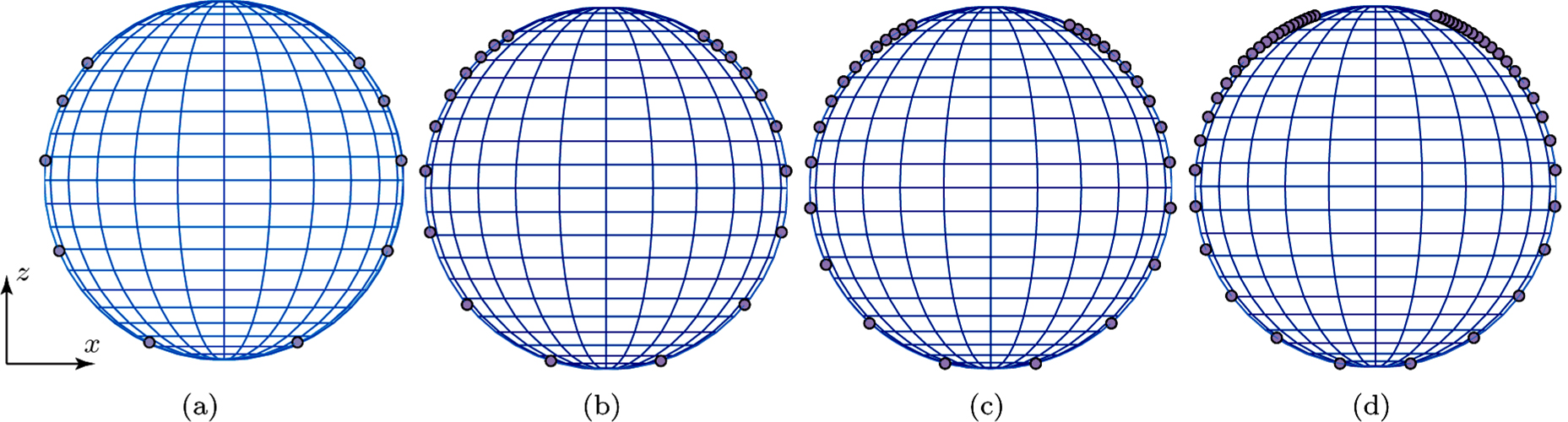
As the above three star equations become same for the states we have chosen, we here only consider bosonic squeezed vacuum state. For even Nc, we have 




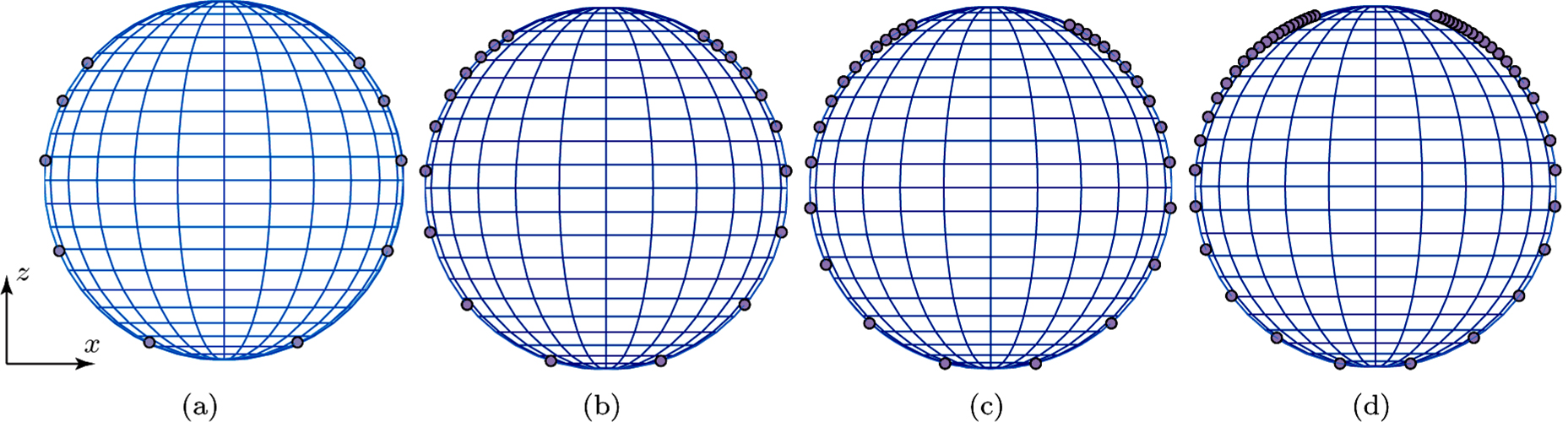 | Fig. 2. Bloch representation of CSA for the SMSV states with      |
5. Example: Quantum Evolution in CSA Representation


3 .39 ) and (45 ), the star equation for this superposition of two coherent states becomes




75 ) can be derived as

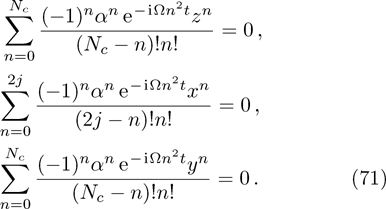
3 , and the stars are distributed on one large circle.3 ). Thus, the period evolution of a quantum state can be perfectly reflected by the period changes of stars on the Bloch sphere. Moreover, if 

71 ), these interesting phenomena can be observed in all of these three different symmetries.
To describe the quantum dynamics in CSA representation, we now consider a nonlinear Hamiltonian of the form[35]



Substituting Eq. (
It is easy to find that this state is periodic with a period 


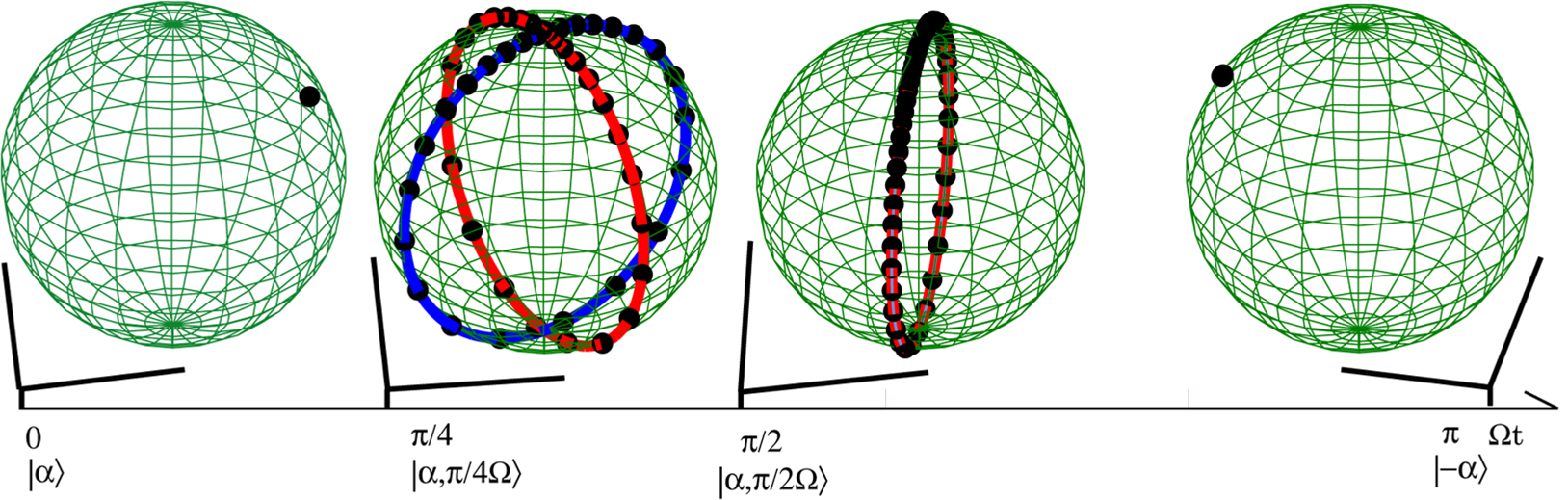 | Fig. 3. Bloch representation of CSA for the states     |
By Eqs. (

As the state arrives at 





When the state evolves a half period, the state reverts to a single coherent state as

6. Conclusions
The Majorana representation provides us a geometric tool to study the quantum states with SU(2) symmetry and their evolutions. Our study here is to show how can we extend this elegant method to the system with both finite and infinite dimensions. We found that the key of the answer is the coherent state. The definitions of coherent states in different kinds of symmetries inspired us a method to build the representation by ladder and number operators and provide a reference state to our representation. By study three different symmetries, we show this coherent-state approach of Majorana representation can well characterize squeezed states for different symmetries and the dynamical evolution of a quantum state. In this work, we only consider the situation with one pair of ladder operators. However, if there are more pairs of ladder operators, such as SU(3) symmetry, we may need a more complex geometric structure (like three correlated spheres), this will be discussed in our future work. Accordingly, there are also more symmetries like SU(N) 
Reference
| [1] | |
| [2] | |
| [3] | |
| [4] | |
| [5] | |
| [6] | |
| [7] | |
| [8] | |
| [9] | |
| [10] | |
| [11] | |
| [12] | |
| [13] | |
| [14] | |
| [15] | |
| [16] | |
| [17] | |
| [18] | |
| [19] | |
| [20] | |
| [21] | |
| [22] | |
| [23] | |
| [24] | |
| [25] | |
| [26] | |
| [27] | |
| [28] | |
| [29] | |
| [30] | |
| [31] | |
| [32] | |
| [33] | |
| [34] | |
| [35] | |
| [36] |