Exact Solutions to (3+1) Conformable Time Fractional Jimbo–Miwa, Zakharov–Kuznetsov and Modified Zakharov–Kuznetsov Equations
Cite this Article
Korkmaz Alper. Exact Solutions to (3+1) Conformable Time Fractional Jimbo–Miwa, Zakharov–Kuznetsov and Modified Zakharov–Kuznetsov Equations. Communications in Theoretical Physics, 2017, 67(5): 479 
Permissions
Exact Solutions to (3+1) Conformable Time Fractional Jimbo–Miwa, Zakharov–Kuznetsov and Modified Zakharov–Kuznetsov Equations
† Corresponding author. E-mail:
Abstract
Abstract
Exact solutions to conformable time fractional (3+1)-dimensional equations are derived by using the modified form of the Kudryashov method. The compatible wave transformation reduces the equations to an ODE with integer orders. The predicted solution of the finite series of a rational exponential function is substituted into this ODE. The resultant polynomial equation is solved by using algebraic operations. The method works for the Jimbo–Miwa, the Zakharov–Kuznetsov, and the modified Zakharov–Kuznetsov equations in conformable time fractional forms. All the solutions are expressed in explicit forms.
Keyword:fractional (3+1)-dimensional Jimbo-Miwa equation;fractional modified Zakharov-Kuznetsov equation;modified Kudryashov method;fractional Zakharov-Kuznetsov equation;exact solutions
1 Introduction


The particular integer ordered form of the time fractional Jimbo–Miwa (JM) equation of the type

The time fractional Zakharov–Kuznetsov (KZ) equation is of the form

When the nonlinearity of the ZK equation is increased to three, the equation is named as the modified ZK (mZK) equation and the conformable time fractional form of the equation becomes

The related literature contains various methods from Lie symmetries to expansion, ansatz methods or first integral methods for the exact solutions of the nonlinear PDEs.[17–20] The PDE systems can also be solved exactly by using smart techniques like Riemann–Hilbert or Bäcklund transformation methods. These solutions can be in multi soliton solution form.[21–23] Ansatz methods are another technique to construct exact solutions to PDEs even fractional one.[24–26]
In the present study, finite series of a rational exponential function types solutions are derived for the three dimensional fractional PDEs in conformable sense listed above. All the solutions are expressed explicitly. Before explaining the used procedure, some significant descriptions and calculus properties of the conformable derivative are summarized below.
2 Preliminaries
Consider a function 



3 Modified Kudryashov Method





Let P be



Assume that Eq. (


Substituting the predicted solution (9) and its derivatives into Eq. (

4 Solutions to (3+1)-Dimensional JM Equation
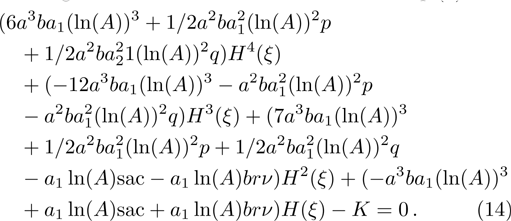
1 ) leads
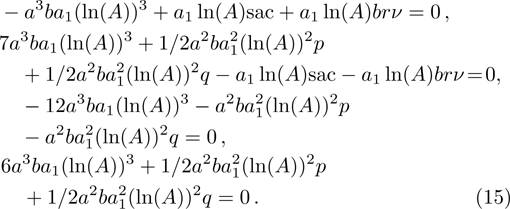
15 ) for a0, a1, a, b, c, ν gives


The JM equation given in Eq. (



It is clear that an 




5 Solutions to (3+1)-Dimensional ZK Equation



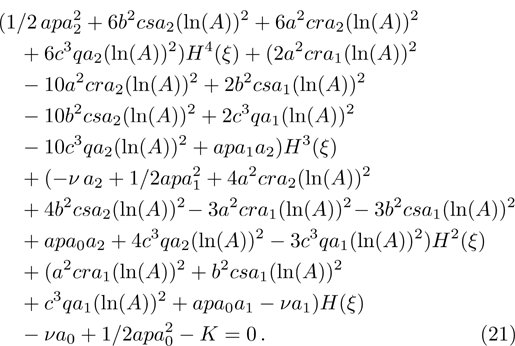
20 ) yields

20 ) is determined as
2 ) is expressed as

22 ).
The wave transformation (7) reduces the fractional ZK equation (





6 Solutions to (3+1)-Dimensional mZK Equation


26 ), a polynomial equation of 


26 ) is constructed as


3 ) are of the form
The modified form of the ZK equation in the time fractional form (3) is reduced to







7 Conclusion
The method of Kudryashov in modified form is implemented to derive the exact solutions to (3+1)-dimensional conformable time fractional JM, ZK, and mZK equations. The valid and compatible traveling wave transformation reduces these equations to integer ordered ODEs. The predicted solution of the finite series form of a rational exponential function is substituted into the resultant ODEs. The algebraic operations are used to determine the relations between the coefficients originated from both the equations and the transformation. Once these relations are determined, the traveling wave type solutions in three dimensions are developed explicitly.
Reference
| [1] | |
| [2] | |
| [3] | |
| [4] | |
| [5] | |
| [6] | |
| [7] | |
| [8] | |
| [9] | |
| [10] | |
| [11] | |
| [12] | |
| [13] | |
| [14] | |
| [15] | |
| [16] | |
| [17] | |
| [18] | |
| [19] | |
| [20] | |
| [21] | |
| [22] | |
| [23] | |
| [24] | |
| [25] | |
| [26] | |
| [27] | |
| [28] | |
| [29] | |
| [30] | |
| [31] | |
| [32] |