
Investigation of Conformable Fractional Schrödinger Equation in Presence of Killingbeck and Hyperbolic Potentials
Cite this Article
Chung Won Sang, Zare Soroush, Hassanabadi Hassan. Investigation of Conformable Fractional Schrödinger Equation in Presence of Killingbeck and Hyperbolic Potentials. Communications in Theoretical Physics, 2017, 67(3): 250 
Permissions
Investigation of Conformable Fractional Schrödinger Equation in Presence of Killingbeck and Hyperbolic Potentials
† Corresponding author. E-mail:
Supported by the National Research Foundation of Korea Grant Funded by the Korean Government under Grant No. NRF-2015R1D1A1A01057792
Abstract
Abstract
In this article, conformable fractional form of Schrödinger equation has been presented. Then in this formalism two different and well-known potential have been come in. Wave function of these potential are obtained in terms of Heun function and energy eigen values of each case is determined as well.
1 Introduction
Idea of using fractional form of Schrödinger equation, has been one the most novel and fundamental idea. This topic was introduced first by Laskin in the path integral of the Lévy trajectories.[1–4] This form of Schrödinger equation can be written as

In what follows, we organized this article as follows: Section
2 Conformable Fractional Form of Schrödinger-Equation

For a smooth function in x, μ(x), the μ(x) deformed derivative (shortly μ-derivative) is defined by
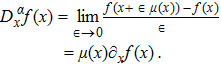
In the 
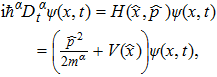
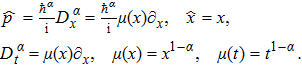
Here we call 



The coordinate realizations of the position operator and momentum operator are
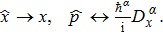

If we set 


Therefore

3 Interactions
Now we are in a position that we should consider some physical interactions for considered formalism. First we set Killingbeck potential after that a hyperbolic interaction, will be studied.
3.1 Killingbeck Potential10 ). We will have
By considering Killingbeck Potential as follows and substituting it into Eq. (

Thus by substitution new ansatz function


On the other hand by getting changing variable 


For a suitable boundary condition

On the other hand the biconfluent Heun equation is as

By comparing Eqs. (




Let us present solution of Eq. (


On the other hand by attention to Eq. (
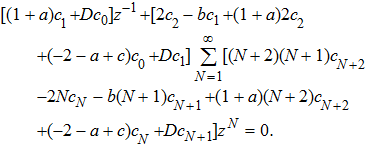
Thus we arrive at the recurrent relations for series coefficients



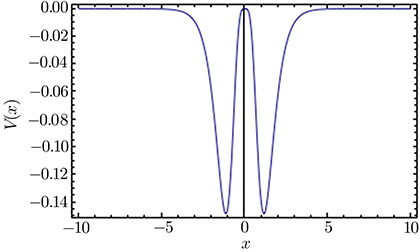
3.2 Hyperbolic Potential25 ) as the following form:
25 ) is depicted as
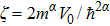



Consider the following class of potentials, defined by two physical parameters 
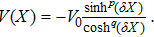
Therefore we consider the hyperbolic double well potential under consideration above equation with[28]
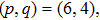
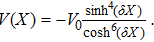
Thus by substituting Eq. (
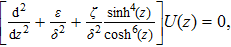

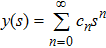
Let us to choose the ansatz solution 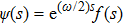
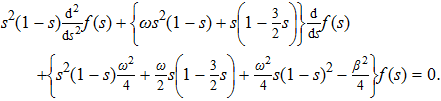
With 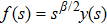


This is Heuns confluent differential equation. It has as a solution around the regular singular point s = 0 given by the confluent Heun function.[29–31]






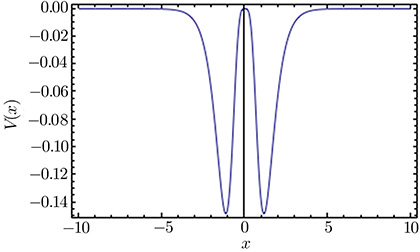 | Fig. 1 Plot of the hyperbolic double-well potential under consideration, Eq. ( |
By transformed 



Thus we have found the following solution to the Schrödinger Eq. (


Conclusion
In this study, after presenting conformable fractional form of Schrödinger equation, we considered two different potentials as interactions of system. In the first case, Killingbeck potential was studied and for the next case hyperbolic potential. In order to obtain wave functions and energy eigen values, we took some ansatz that functions which caused to find the wave function with the aim of biconfluent and confluent Heun functions respectively. Using series expansions energy eigen values were obtained as well.
Reference
| [1] | |
| [2] | |
| [3] | |
| [4] | |
| [5] | |
| [6] | |
| [7] | |
| [8] | |
| [9] | |
| [10] | |
| [11] | |
| [12] | |
| [13] | |
| [14] | |
| [15] | |
| [16] | |
| [17] | |
| [18] | |
| [19] | |
| [20] | |
| [21] | |
| [22] | |
| [23] | |
| [24] | |
| [25] | |
| [26] | |
| [27] | |
| [28] | |
| [29] | |
| [30] | |
| [31] |