Hypergeometric Series Solution to a Class of Second-Order Boundary Value Problems via Laplace Transform with Applications to Nanofluids
Cite this Article
Ebaid Abdelhalim, Wazwaz Abdul-Majid, Alali Elham, Masaedeh Basem S.. Hypergeometric Series Solution to a Class of Second-Order Boundary Value Problems via Laplace Transform with Applications to Nanofluids. Communications in Theoretical Physics, 2017, 67(3): 231 
Permissions
Hypergeometric Series Solution to a Class of Second-Order Boundary Value Problems via Laplace Transform with Applications to Nanofluids
† Corresponding author. E-mail:
Abstract
Abstract
Very recently, it was observed that the temperature of nanofluids is finally governed by second-order ordinary differential equations with variable coefficients of exponential orders. Such coefficients were then transformed to polynomials type by using new independent variables. In this paper, a class of second-order ordinary differential equations with variable coefficients of polynomials type has been solved analytically. The analytical solution is expressed in terms of a hypergeometric function with generalized parameters. Moreover, applications of the present results have been applied on some selected nanofluids problems in the literature. The exact solutions in the literature were derived as special cases of our generalized analytical solution.
Keyword:ordinary differential equation;hypergeometric series;boundary value problem;exact solution;Laplace transform;nanofluid
1 Introduction
1 ) is transformed into the following ODE of polynomial coefficients [Ref. [7], Eq. (12 )]32 )–(33 )], who have used the variable 
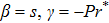


In the field of boundary layer flow and heat transfer of nanofluids,[1–8] many scientific problems are governed by partial differential equations. By using the similarity variable η, these partial differential equations are then transformed into a set of ordinary differential equations with variable coefficients of exponential orders of the form 



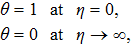




A main observation of these studies is that the temperature of nanofluids and the nano-particles concentration are usually governed by second-order ordinary differential equations. In this paper, we consider a generalized second-order ordinary differential equation of the temperature of nanofluids θ(t) in the form:


The objective of this work is to introduce an analytical procedure to obtaining the closed-form solution of Eqs. (
2 Analytic Solution

In this section, an analytical procedure is to be presented to solve the second-order boundary value problem (

2.1 The Complementary Solution10 ), it follows12 ), we obtain
13 ), we obtain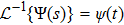
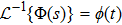
14 ) becomes

Consider the homogenous part of Eq. (




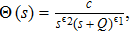
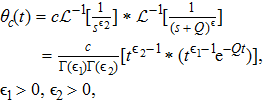





2.2 The Particular Solution21 ) is a particular solution of Eq. (7 ). On substituting Eq. (21 ) into Eq. (7 ) and collecting terms of like powers, we have23 ) as follows,25 ), the general solution (9 ) becomes26 ).15 ) on 


26 ) and the boundary conditions (8 ), which can be easily verified by direct substitution. Furthermore, it will be proved in the next section that such analytic solution reduces to the corresponding solutions in the literature as special cases.
Regarding the particular solution, it can be assumed in the form
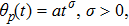






The solution given by Eq. (




3 Applications
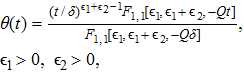
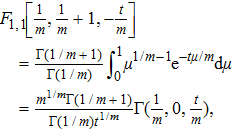
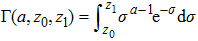
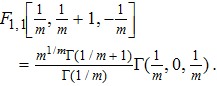
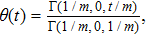
3.1 Heat Transfer of Carbon-Nanotubes32 ) reduces to36 ) and (37 ) into Eq. (35 ), it then follows19 )].
The heat transfer of carbon-nanotubes is governed by the homogenous ODE given by Eqs. (



3.2 Heat Transfer of Cu-Water and Ag-Water Nanofluids
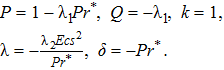
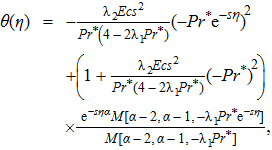
39 )–(40 ) into Eq. (30 ) we obtain the following exact solution for Eqs. (5 )–(6 ):
41 ) is the same expression obtained by Kameswaran et al. (Eq. (36 ) in Ref. [2]) for the temperature distribution as a special case of the current results. Furthermore, the exact solution derived above by Eq. (41 ) can be easily verified by direct substitution into Eq. (9 ). The Laplace transform has many advantages over the other methods which can be summarized as follows. It is well know that many standardized differential equations of second-order with variable coefficients have well known solutions such as Kummer’s equation, Airy’s equation, Legendre’s equation, Bessel’s equation, …, etc. However, if the investigated differential equation is of different form than those mentioned above we have in that case to search for another method of solution. Since most of the differential equations are of forms differ than those mentioned above, then Laplace transform is one of the effective tools to achieve this task.
Kameswaran et al.[2] have derived Eqs. (

4 Conclusion
In this paper, the exact solution of a class of second-order ordinary differential equations with variable coefficients arises in nanofluids has been obtained. The generalized analytical solution is expressed in terms of the hypergeometric series. The obtained results have been applied on selected problems in nanofluids and therefore compared with those in the literature. At particular choices for the coefficients, the current class reduces to similar published boundary value problems. Hence, the corresponding solutions in the literature were derived as special cases of our generalized analytical solution.
5 Conflict of Interest
The author(s) declare(s) that there is no conflict of interest regarding the publication of this paper.
Reference
| [1] | |
| [2] | |
| [3] | |
| [4] | |
| [5] | |
| [6] | |
| [7] | |
| [8] |