

Higher-Order Corrections to Earthʼs Ionosphere Shocks
Cite this Article
Abdelwahed H.G., El-Shewy E.K.. Higher-Order Corrections to Earthʼs Ionosphere Shocks. Communications in Theoretical Physics, 2017, 67(1): 90 
Permissions
Higher-Order Corrections to Earthʼs Ionosphere Shocks
† Corresponding author. E-mail:
Supported by the Deanship of Scientific Research at Prince Sattam Bin Abdulaziz University under the Research Project No. 2015/01/4787
Abstract
Abstract
Nonlinear shock wave structures in unmagnetized collisionless viscous plasmas composed fluid of positive (negative) ions and nonthermally electron distribution are examined. For ion shock formation, a reductive perturbation technique applied to derive Burgers equation for lowest-order potential. As the shock amplitude decreasing or enlarging, its steepness and velocity deviate from Burger equation. Burgers type equation with higher order dissipation must be obtained to avoid this deviation. Solution for the compined two equations has been derived using renormalization analysis. Effects of higher-order, positive- negative mass ratio Q, electron nonthermal parameter δ and kinematic viscosities coefficient of positive (negative) ions 

Keyword:nonthermal electrons;ion shock waves;Burgers equation;Burger type equation;renormalization method;higher-order dissipation
1 Introduction
Research on ion-acoustic waves (IAWs) in ion pair plasmas has gained considerable amount of momentum over the last few years.[1–2] Positive-negative ion have been observed in many astrophysical environments.[3] More specifically, Negative ions are present in D-region altitudes of the ionosphere of Earth in coexistence with electrons as they are formed primarily by electron added to electronegative species.[4] In last few years, ion solitary waves in ion-pair plasmas investigated both numerically and experimentally.[5–6] In past, the nonthermal particles observed in many space environments.[7–9] However, several theoretical studies on nonlinear waves show that, electrons and ions non-thermal distributions are convenient in analyzing observation data in space plasma.[7–12] Cairns et al.[9] discussed the nonthermal electron effect on the ion acoustic wave existence. Elwakil et al.[2] inspected ion acoustic modulation instability characteristics in plasma having nonthermal electronsand positive-negative ions. It is reported that, the instability conditions affected by nonthermal electron parameter in D and F regions in Earth’s ionosphere. Gill et al.[13] investigated rarefactive and compressive soliton properties in two polarized ions plasma. Recently, nonthermality effect of positron-electron have been examined on the properties of improved compressive-rarefactive solitons generated in warm ion plasma.[14] On the other hand, there are many theoretical methods for studying nonlinear properties in plasma physics. Reductive perturbation analysis (RPT) aim to study the propagation of small wave amplitude.[15] As the wave amplitude enlarge, the solitary profile sidetrack from the nonlinear equation. In order to beat this deviation, the amplitude modulation of electrostatic nonlinear waves has been studied by many investigators.[16–19] Kalejahi et al.[19] discussed the higher order nonlinear effects in a relativistic plasma. Abdelwahed and El-Shewy[16] improved the soliton shape of solitary wave directly by using algebraic analysis for solving the field equations. Chatterjee et al.[17] examined the region of solitary wave existence in nonthermal ions plasma. They discussed the effect of nonthermal ions and electron density on the properties of obtained dressed form. Accordingly, to improve the description of experimental data, the effect of fluctuation of charge of dusty plasma on the dressed nonlinear soliton waves has been investigated.[20] On the other hand, dusty size effect on the dressed soliton like wave amplitude and energy have been discussed in dust plasma containing dust grains and nonthermal ions.[21] Physically, some phenomenon like kinematic viscosity, collisions between plasma components and Landau damping are responsible for shocks formation in Earth ionosphere.[22–24] The shock wave existence and propagation have been investigated experimentally and theoretically.[25–31] Cairns et al.[32] investigated laminar ion shocks to explain observations on ion acceleration laser plasmas. Abdelwahed[33] obtained the higher order dissipation in terms of Burger-type equation to modulate the broadband auroral electrostatic shock noise. From theoretical point of view, Kadomtsev–Petviashvili–Burgers (KPB) equation has been derived by Hussain et al.[34] They discussed the diffraction and dissipation effects on the shock wave structures in epi plasma with kappa distributed positrons and electrons. More specifically, the obliqueness of solitary shocks in a magnetized viscous plasma have been studied.[35] Abdelwahed and el-Shewy[36] studied the nonlinear features of rational and double layer ion acoustic solitary solutions. Furthermore, Masood and Rizvi[37] investigated the viscosity effect of negative and positive ions in dissipative plasma medium in a planar geometry. Also, kinematic viscosity effect on formation of shock waves in asymmetric pair ion plasmas has been examined.[38] It was noted that, kinematic viscosity enhances the amplitude of shock profile. In this study, the higher-order acoustic shock modulation in plasmas with negative-positive ions and nonthermal electrons have been considered. In Sec.
2 Basic Equations
1 )–(5 ), 


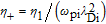
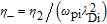

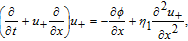
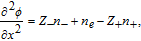
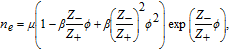
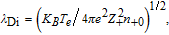
A system of three collisionless unmagnetized plasmas components having viscous fluid of positive (+) and negative (−) ion and nonthermally electron distribution. The normalized equations are given by:
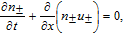



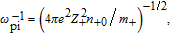

2.1 Nonlinear Calculations


The slow stretched co-ordinates in (RPT) method[15] are given by:
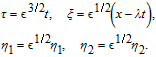
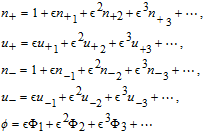
The speed of the wave λ and ϵ is a small real parameter. Expanding quantities in Eqs. (
The last equations are valid with conditions: 


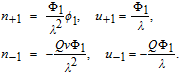
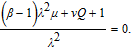
The next equations of 





Put out 


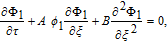
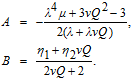
Equation (
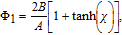
The physical quantities 


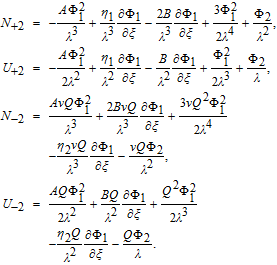
Equations for the next order in ϵ are given by:





Eliminating 




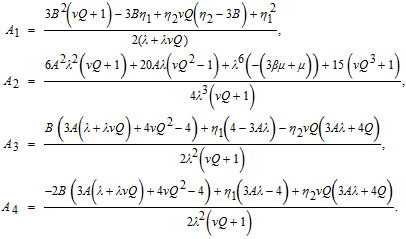
In summary, our model reduced to nonlinear Burger equation (


3 Stationary Solution

By using Eq. (
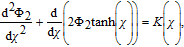
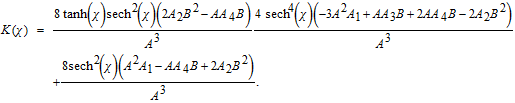
According to the homogeneous equation of Eq. (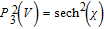


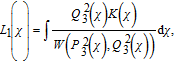
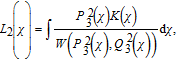
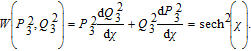
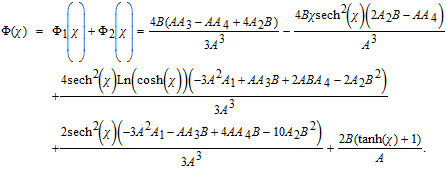
Then, the formal stationary IA shock solution is given by:
4 Model Results and Discussions
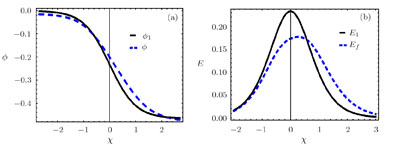
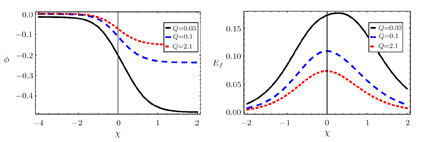
Shock waves are studied in unmagnetized viscous positive negative ion plasmas. Numerical values have been introduced for Earth’s ionosphere (D- and F-regions).[1–2,22–23] According to the wave dissipation caused by kinematic viscosity, the studied system supports electrostatic shock waves. However, the main essential stimulus was to study the contribution of higher-order electric field structures associated to the shock waves. The comparison of lowest order and higher-order shock noise and associated electric field structures are shown in Fig. 


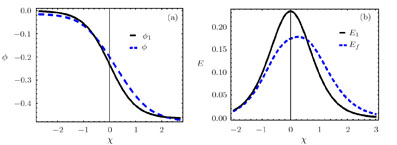 | Fig. 1 The comparison of lowest and higher-order shock profile and associated electric field structures for Q = 0.03,     |
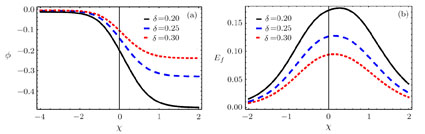
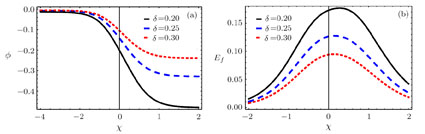 | Fig. 2 Variation of higher-order shock profile ϕ and associated electric field structures Ef vs. χ and δ for     |
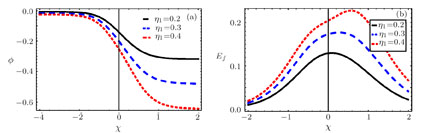
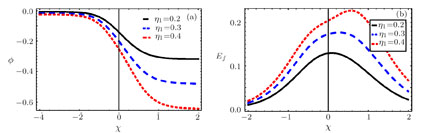 | Fig. 3 Variation of higher-order shock profile ϕ and associated electric field structures Ef vs. χ and      |
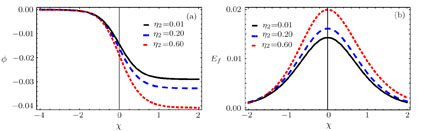
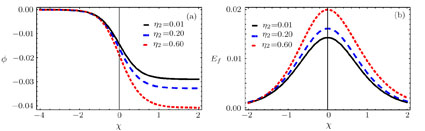 | Fig. 4 Variation of higher-order shock profile ϕ and associated electric field structures Ef vs. χ and      |
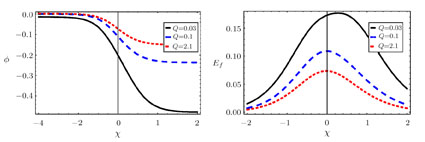 | Fig. 5 Variation of higher-order shock profile ϕ and associated electric field structures Ef vs. χ and Q for     |
5 Conclusion
Ion shock waves are discussed in three collisionless unmagnetized plasmas components having viscous fluid of positive (+) and negative (−) ion and nonthermally electron distribution. The nonlinear Burger equation (


Reference
| 1 | |
| 2 | |
| 3 | |
| 4 | |
| 5 | |
| 6 | |
| 7 | |
| 8 | |
| 9 | |
| 10 | |
| 11 | |
| 12 | |
| 13 | |
| 14 | |
| 15 | |
| 16 | |
| 17 | |
| 18 | |
| 19 | |
| 20 | |
| 21 | |
| 22 | |
| 23 | |
| 24 | |
| 25 | |
| 26 | |
| 27 | |
| 28 | |
| 29 | |
| 30 | |
| 31 | |
| 32 | |
| 33 | |
| 34 | |
| 35 | |
| 36 | |
| 37 | |
| 38 | |
| 39 | |
| 40 | |
| 41 |