 2019, Vol. 37
扩展功能

文章信息
- 马茗茗, 王昌勇, 许兴斌, 王小宇, 费瑛, 李雅楠
- MA MingMing, WANG ChangYong, XU XingBin, WANG XiaoYu, FEI Ying, LI YaNan
- Adams和Couch法古盐度恢复结果的可靠性检验——以青海湖布哈河口区沉积物为例
- Testing the Reliability of Adams Formula and Couch Formula for Estimating Paleosalinity: Case study of the Buha River Estuary, Qinghai Lake
- 沉积学报, 2019, 37(6): 1224-1233
- ACTA SEDIMENTOLOGICA SINCA, 2019, 37(6): 1224-1233
- 10.14027/j.issn.1000-0550.2019.009
-
文章历史
- 收稿日期:2018-11-08
- 收修改稿日期: 2019-01-30


2. 中国石油青海油田分公司, 甘肃敦煌 736202
2. Qinghai Oilfield, CNPC, Dunhuang, Gansu 736202, China
古盐度恢复是岩相古地理研究的重要内容之一,通过古盐度恢复,不仅可以了解沉积水体性质,还可以根据盐度的变化确定湖岸线位置、物源方向及湖泊中心位置[1]。同时,目前越来越多的研究表明不少陆相含油气盆地烃源岩的发育与湖泊水体盐度存在密切联系[2],微咸水—半咸水环境有利于烃源岩的发育[3-4],而且一定的水体盐度容易导致湖水因密度差异而分层,有利于形成较强的还原环境和有机质的保存[5]。因此,湖泊水体古盐度的恢复对油气勘探也具有重要意义。古盐度恢复的方法主要有沉积磷酸盐法[6]、同位素法[7-11]、硼元素法[12-13]、Sr/Ba比值法[2, 14]、Ba/Ca比值法[15-17]、浮游生物形态及组合法[18-19]、生物标志物法[20-24]、稀有气体法[25-27]等。其中硼元素法在我国应用最多,特别是Couch法和Adams法由于可以定量恢复沉积水体古盐度而在我国应用最广,一般认为Adams法主要适用于以伊利石为主的泥岩,而Couch法则适用于复杂黏土矿物组成的泥岩[2],由于两种方法的古盐度计算结果常存在较大差异[28],导致其古盐度的恢复结果难以让人信服。为了检验Adams公式和Couch公式对陆相地层沉积水体古盐度恢复结果的可靠性,此次研究以青海湖布哈河口区沉积物为例做了一系列的测量分析实验,并在此基础上,研究沉积水体中硼浓度与盐度之间的关系、以及沉积物中硼浓度与水体中硼浓度的关系,并根据沉积物中硼浓度、利用Adams公式和Couch公式分别对水体盐度进行计算,与盐度实测值进行对比,以此检验两种古盐度定量恢复方法的可靠性,从而达到本次研究的目的。
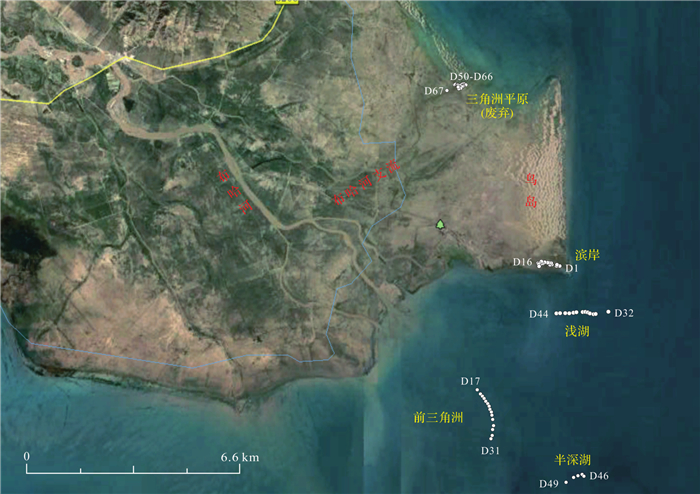
1 样品与实验本次研究系统采集了青海湖布哈河口区不同沉积环境、不同盐度条件下的表层沉积物和底层水体样品(图 1),包括滨岸、布哈河、布哈河三角洲平原及前三角洲、浅湖及半深湖等沉积环境(在采样过程中由于三角洲前缘位于浅水区域,船只无法抵达,因此没有采集三角洲前缘的样品),其中:水体样品现场测量其盐度,过滤后在实验室利用ICP-MS测量其硼浓度;沉积物样品剔除新鲜植物后滤水,后置于烤箱在106 ℃条件下烘烤24 h,然后捣碎并用200目(筛孔尺寸约74 μm)的筛网筛选(在后面的浸泡实验中,“伊利石”、“高岭石”和“蒙脱石”样品在玛瑙研钵研磨后也通过用200目的筛网筛选),以保证实验中各个样品粒度均 < 74 μm,然后分别测量沉积物中硼浓度、TOC含量、主要矿物组成及黏土矿物成分[30]。分析结果表明:滨岸和三角洲平原环境水体盐度、沉积物中TOC含量及硼的浓度值在较大范围内变化;浅湖、前三角洲、及半深湖等沉积环境水体盐度、沉积物中TOC含量及硼的浓度值差别较小;半深湖沉积物中TOC含量普遍较高,次为前三角洲沉积,浅湖沉积物中TOC含量最低;滨湖环境水体盐度、沉积物中TOC含量及硼的浓度可能出现异常高值(表 1);样品13,水体盐度18.03‰,高于半深湖水盐度值12.09‰;样品10,TOC高达4.29%,对应硼浓度高达351.3 mg·kg-1。
| 样号 | 水体盐度/wt.‰ | 沉积物中TOC含量/wt.% | 沉积物中硼浓度/(mg·kg-1) | 沉积物中平均TOC含量/wt.% | 沉积环境 |
| 1 | 11.54 | 0.94 | 57.3 | 1.15 | 滨岸 |
| 2 | 11.32 | 0.77 | 59.3 | ||
| 3 | 11.36 | 0.91 | 91.3 | ||
| 4 | 9.072 | 1.12 | 88.3 | ||
| 5 | 7.983 | 0.76 | 121.3 | ||
| 6 | 9.024 | 0.06 | 41.3 | ||
| 7 | 11.18 | 1.82 | 141.3 | ||
| 8 | 10.44 | 0.85 | 91.3 | ||
| 9 | 3.209 | 0.83 | 79.3 | ||
| 10 | 7.956 | 4.29 | 351.3 | ||
| 11 | 5.287 | 0.61 | 121.3 | ||
| 12 | 9.259 | 2.18 | 151.3 | ||
| 13 | 18.03 | 1.02 | 91.3 | ||
| 14 | 3.789 | 0.40 | 111.3 | ||
| 15 | 8.011 | 0.79 | 111.3 | ||
| 16 | 11.12 | 1.03 | 78.3 | ||
| 17 | 11.36 | 1.14 | 90.3 | 1.29 | 前三角洲 |
| 18 | 11.84 | 1.15 | 91.3 | ||
| 19 | 11.72 | 1.15 | 91.3 | ||
| 20 | 11.59 | 1.13 | 43.3 | ||
| 21 | 11.68 | 1.06 | 111.3 | ||
| 22 | 11.77 | 1.30 | 101.3 | ||
| 23 | 11.72 | 1.19 | 101.3 | ||
| 24 | 11.79 | 1.38 | 121.3 | ||
| 25 | 11.9 | 1.31 | 121.3 | ||
| 26 | 11.37 | 1.44 | 121.3 | ||
| 27 | 11.73 | 1.27 | 111.3 | ||
| 28 | 11.64 | 1.40 | 101.3 | ||
| 29 | 11.24 | 1.42 | 121.3 | ||
| 30 | 11.58 | 1.54 | 121.3 | ||
| 31 | 11.3 | 1.52 | 121.3 | ||
| 32 | 12.02 | 0.66 | 46.3 | 0.48 | 浅湖 |
| 33 | 11.8 | 0.55 | 60.3 | ||
| 34 | 11.69 | 0.51 | 67.3 | ||
| 35 | 11.72 | 0.47 | 49.3 | ||
| 36 | 11.54 | 0.46 | 61.3 | ||
| 37 | 11.75 | 0.36 | 50.3 | ||
| 38 | 11.82 | 0.44 | 56.3 | ||
| 39 | 11.62 | 0.33 | 52.3 | ||
| 40 | 11.95 | 0.39 | 76.3 | ||
| 41 | 11.67 | 0.42 | 63.3 | ||
| 42 | 11.59 | 0.46 | 52.3 | ||
| 43 | 11.9 | 0.88 | 62.3 | ||
| 44 | 11.64 | 0.29 | 51.3 | ||
| 45 | 12.02 | 1.94 | 121.3 | 1.75 | 半深湖 |
| 46 | 11.97 | 1.38 | 131.3 | ||
| 47 | 12.09 | 1.92 | 121.3 | ||
| 48 | 11.87 | 1.73 | 141.3 | ||
| 49 | 11.76 | 1.78 | 151.3 | ||
| 50 | 4.329 | 0.40 | 39.3 | 0.37 | 三角洲平原 |
| 51 | 4.448 | 0.06 | 52.3 | ||
| 52 | 6.085 | 0.10 | 46.3 | ||
| 53 | 8.301 | 0.11 | 37.3 | ||
| 54 | 7.353 | 0.09 | 29.3 | ||
| 55 | 11.03 | 0.49 | 58.3 | ||
| 56 | 7.006 | 0.15 | 40.3 | ||
| 57 | 9.734 | 0.19 | 33.3 | ||
| 58 | 10.14 | 0.27 | 26.3 | ||
| 59 | 10.21 | 0.21 | 63.3 | ||
| 60 | 10.56 | 0.44 | 75.3 | ||
| 61 | 10.46 | 0.57 | 49.3 | ||
| 62 | 10.17 | 0.82 | 72.3 | ||
| 63 | 9.46 | 1.24 | 64.3 | ||
| 64 | 10.49 | 0.47 | 46.3 | ||
| 65 | 2.472 | 0.57 | 41.3 | ||
| 66 | 1.223 | 0.12 | 15.3 | ||
| 67 | 0.715 5 | 0.61 | 30.3 | 0.61 | 布哈河 |
X衍射全岩分析结果表明:布哈河口区沉积物组成较为复杂,主要包括石英、斜长石、钾长石、方解石、白云石及少量文石、黄铁矿、沸石及黏土矿物,其中黏土矿物含量介于6%~36%,主要包括伊利石、高岭石、绿泥石及少量伊/蒙混层矿物(表 2)。
| 样号 | 黏土含量 | 石英 | 钾长石 | 斜长石 | 方解石 | 白云石 | 黄铁矿 | 沸石 | 文石 | 伊利石 | 高岭石 | 绿泥石 | 伊/蒙混层(I/S)b | S%(I/S)c | 沉积物中硼浓度/(mg·kg-1) | 沉积环境 |
| 1 | 16 | 50 | 5 | 13 | 8 | 8 | 61 | 21 | 18 | 57.3 | 滨岸 | |||||
| 2 | 11 | 52 | 18 | 10 | 9 | 47 | 26 | 27 | 59.3 | |||||||
| 3 | 29 | 39 | 13 | 19 | 61 | 22 | 17 | 91.3 | ||||||||
| 4 | 18 | 38 | 28 | 10 | 6 | 62 | 38 | 88.3 | ||||||||
| 5 | 14 | 43 | 11 | 18 | 9 | 6 | 60 | 19 | 21 | 121.3 | ||||||
| 6 | 6 | 23 | 17 | 47 | 4 | 1 | 2 | 56 | 27 | 18 | 41.3 | |||||
| 7 | 20 | 33 | 5 | 28 | 9 | 5 | 65 | 19 | 16 | 141.3 | ||||||
| 8 | 19 | 45 | 19 | 13 | 4 | 71 | 29 | 91.3 | ||||||||
| 9 | 26 | 37 | 10 | 13 | 10 | 4 | 61 | 39 | 79.3 | |||||||
| 10 | 23 | 34 | 4 | 15 | 12 | 3 | 9 | 57 | 29 | 14 | 351.3 | |||||
| 11 | 19 | 44 | 23 | 10 | 5 | 52 | 21 | 27 | 121.3 | |||||||
| 12 | 12 | 27 | 53 | 8 | 69 | 31 | 151.3 | |||||||||
| 13 | 15 | 39 | 15 | 20 | 11 | 61 | 39 | 91.3 | ||||||||
| 14 | 13 | 42 | 28 | 13 | 4 | 71 | 29 | 111.3 | ||||||||
| 15 | 18 | 49 | 19 | 8 | 5 | 59 | 26 | 15 | 111.3 | |||||||
| 16 | 15 | 52 | 20 | 8 | 4 | 68 | 32 | 78.3 | ||||||||
| 17 | 33 | 27 | 12 | 21 | 4 | 3 | 69 | 31 | 90.3 | 前三角洲 | ||||||
| 18 | 36 | 26 | 13 | 18 | 4 | 3 | 56 | 25 | 19 | 91.3 | ||||||
| 19 | 30 | 31 | 13 | 19 | 4 | 3 | 65 | 35 | 91.3 | |||||||
| 20 | 36 | 23 | 14 | 20 | 6 | 70 | 30 | 43.3 | ||||||||
| 21 | 34 | 23 | 11 | 11 | 15 | 5 | 63 | 37 | 111.3 | |||||||
| 22 | 31 | 28 | 13 | 19 | 6 | 3 | 47 | 36 | 17 | 101.3 | ||||||
| 23 | 36 | 22 | 15 | 17 | 6 | 3 | 63 | 37 | 101.3 | |||||||
| 24 | 33 | 23 | 14 | 18 | 9 | 4 | 59 | 41 | 121.3 | |||||||
| 25 | 30 | 27 | 15 | 19 | 5 | 3 | 59 | 41 | 121.3 | |||||||
| 26 | 33 | 24 | 16 | 19 | 5 | 4 | 62 | 38 | 121.3 | |||||||
| 27 | 32 | 24 | 16 | 19 | 6 | 4 | 55 | 25 | 20 | 111.3 | ||||||
| 28 | 35 | 25 | 16 | 15 | 6 | 4 | 47 | 32 | 21 | 20 | 101.3 | |||||
| 29 | 31 | 21 | 21 | 19 | 4 | 4 | 58 | 27 | 15 | 121.3 | ||||||
| 30 | 31 | 24 | 15 | 19 | 5 | 5 | 44 | 22 | 34 | 20 | 121.3 | |||||
| 31 | 31 | 25 | 17 | 18 | 6 | 3 | 60 | 19 | 22 | 121.3 | ||||||
| 32 | 17 | 36 | 33 | 10 | 3 | 3 | 67 | 33 | 46.3 | 浅湖 | ||||||
| 33 | 26 | 34 | 5 | 21 | 11 | 3 | 1 | 69 | 31 | 60.3 | ||||||
| 34 | 19 | 45 | 22 | 9 | 4 | 56 | 22 | 21 | 67.3 | |||||||
| 35 | 15 | 40 | 12 | 16 | 10 | 6 | 53 | 29 | 18 | 49.3 | ||||||
| 36 | 17 | 39 | 4 | 27 | 8 | 4 | 58 | 22 | 20 | 61.3 | ||||||
| 37 | 17 | 38 | 30 | 11 | 3 | 2 | 65 | 16 | 19 | 50.3 | ||||||
| 38 | 17 | 40 | 11 | 19 | 13 | 71 | 29 | 56.3 | ||||||||
| 39 | 16 | 36 | 5 | 17 | 24 | 2 | 60 | 23 | 17 | 52.3 | ||||||
| 40 | 15 | 44 | 20 | 14 | 5 | 2 | 54 | 26 | 19 | 76.3 | ||||||
| 41 | 15 | 42 | 13 | 18 | 10 | 58 | 21 | 21 | 63.3 | |||||||
| 42 | 11 | 49 | 5 | 21 | 11 | 3 | 64 | 36 | 52.3 | |||||||
| 43 | 18 | 44 | 14 | 17 | 6 | 2 | 72 | 28 | 62.3 | |||||||
| 44 | 13 | 45 | 10 | 20 | 9 | 3 | 65 | 35 | 51.3 | |||||||
| 45 | 27 | 24 | 6 | 19 | 13 | 3 | 8 | 58 | 42 | 121.3 | 半深湖 | |||||
| 46 | 26 | 32 | 16 | 14 | 2 | 10 | 46 | 32 | 23 | 131.3 | ||||||
| 47 | 33 | 27 | 5 | 13 | 11 | 3 | 9 | 56 | 25 | 19 | 121.3 | |||||
| 48 | 31 | 29 | 13 | 14 | 3 | 10 | 51 | 32 | 17 | 141.3 | ||||||
| 49 | 32 | 29 | 14 | 14 | 11 | 46 | 36 | 17 | 151.3 | |||||||
| 50 | 19 | 40 | 8 | 20 | 11 | 3 | 52 | 22 | 26 | 39.3 | 三角洲平原 | |||||
| 51 | 9 | 38 | 27 | 12 | 9 | 2 | 2 | 52 | 28 | 20 | 52.3 | |||||
| 52 | 12 | 47 | 8 | 18 | 9 | 4 | 2 | 53 | 22 | 25 | 46.3 | |||||
| 53 | 10 | 43 | 13 | 17 | 8 | 4 | 4 | 59 | 41 | 37.3 | ||||||
| 54 | 6 | 32 | 5 | 44 | 10 | 3 | 40 | 16 | 24 | 20 | 20 | 29.3 | ||||
| 55 | 22 | 29 | 5 | 27 | 13 | 4 | 63 | 37 | 58.3 | |||||||
| 56 | 10 | 33 | 6 | 26 | 19 | 3 | 3 | 67 | 14 | 19 | 40.3 | |||||
| 57 | 14 | 31 | 38 | 9 | 8 | 54 | 20 | 26 | 33.3 | |||||||
| 58 | 12 | 42 | 33 | 9 | 5 | 51 | 33 | 16 | 26.3 | |||||||
| 59 | 15 | 43 | 4 | 21 | 14 | 2 | 53 | 28 | 18 | 63.3 | ||||||
| 60 | 23 | 30 | 7 | 24 | 12 | 4 | 56 | 44 | 75.3 | |||||||
| 61 | 20 | 40 | 24 | 14 | 2 | 61 | 39 | 49.3 | ||||||||
| 62 | 20 | 37 | 9 | 17 | 11 | 6 | 57 | 29 | 14 | 72.3 | ||||||
| 63 | 18 | 39 | 6 | 26 | 9 | 2 | 70 | 30 | 64.3 | |||||||
| 64 | 17 | 21 | 10 | 39 | 10 | 3 | 60 | 40 | 46.3 | |||||||
| 65 | 19 | 32 | 3 | 26 | 12 | 8 | 55 | 24 | 21 | 41.3 | ||||||
| 66 | 13 | 42 | 4 | 29 | 8 | 4 | 52 | 31 | 17 | 15.3 | ||||||
| 67 | 20 | 36 | 4 | 23 | 14 | 3 | 52 | 29 | 19 | 30.3 | 布哈河 |
Adams et al.[12]认为沉积物中的硼主要来自于伊利石的吸附作用,并根据达维河口区沉积物中吸附硼浓度和实测水体盐度,建立了定量计算水体盐度的公式:
Y=0.097 7X-7.043
式中:Y为水体盐度,‰;X为“校正硼”含量,即沉积物中硼浓度/沉积物中伊利石含量[31]。
Couch[13]认为对硼有明显吸附能力的黏土矿物主要包括伊利石、蒙脱石和高岭石,并且伊利石、蒙脱石及高岭石对硼的吸附系数大致为4:2:1,因此在进行古盐度恢复前需要将沉积物中实测的硼浓度(B)换算为“相当硼”,即高岭石硼(Bk)。
Bk=B/(4Xi+2Xm+Xk)
式中:Xi、Xm、Xk分别为通过X衍射分析确定的伊利石、蒙脱石和高岭石的含量。
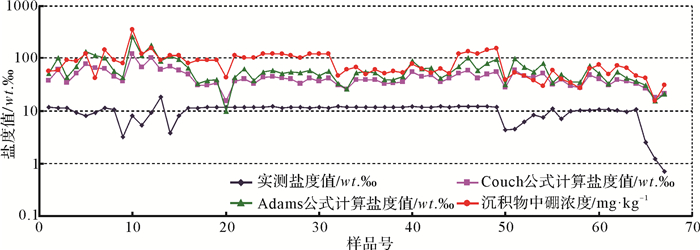
主要根据青海湖布哈河口区沉积物中黏土矿物组成及沉积物中硼的浓度(表 2),分别采用Adams公式和Couch公式对湖泊水体盐度进行计算,结果发现:绝大部分样品的Adams公式计算值和Couch公式计算值远高于实测盐度值,其中Adams公式盐度计算值最高,Adams公式盐度计算值和Couch公式盐度计算值具有相同的变化趋势,即硼含量越高、计算盐度值越大,盐度计算值与实测盐度值无明显相关性(图 2),说明两种方法不能直接用于陆相咸化湖盆沉积水体盐度的恢复。
|
| 图 2 Couch公式及Adams公式盐度计算结果与实测值对比(n=67) Fig.2 Measured salinity vs. salinity calculated by Couch formula and Adams formula (n=67) |
在分析Adams公式和Couch公式定量恢复水体盐度失效的原因之前,首先需要了解硼法(包括Adams公式和Couch公式)恢复古盐度的理论基础,其次需要明确沉积物中吸附硼浓度的主要因素。
3.1 硼法恢复古盐度的理论基础自然界水体中硼的浓度是盐度的线性函数,因而黏土矿物从水体中吸收的硼含量与水体的盐度呈双对数关系[31-32],黏土中硼元素的含量可以指示其形成时水介质的古盐度值,可根据佛伦德奇吸收方程恢复沉积环境的古盐度。
lgB=C1lgS+C2。
式中:B为吸收硼含量(单位:10-6),S为盐度,‰,C1和C2是常数,此方程式即为利用硼和黏土矿物定量计算古盐度的理论基础,同样也是Adams公式和Couch公式计算水体盐度的理论依据,同时也仅考虑了黏土矿物对硼的吸附作用。
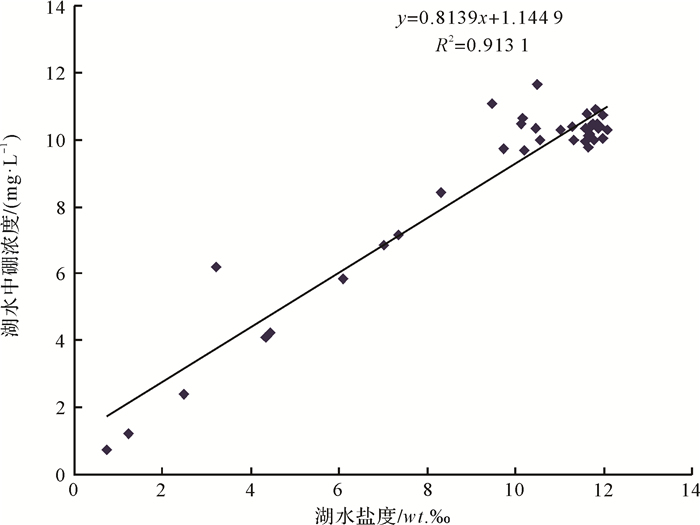
青海湖水盐度和硼浓度的测量结果表明:水体盐度与水体中硼的浓度确实存在明显的线性相关性(图 3,R2 > 0.95),也就是说水体盐度越高,水体中硼的浓度越高,如果沉积物中硼的浓度亦与水体中硼的浓度呈正比,那么才能用沉积物中硼的浓度作为指示水体盐度的指标,才能直接利用沉积物中硼的浓度对沉积水体古盐度进行恢复。
|
| 图 3 青海湖水中硼浓度与盐度相关图(n=38) Fig.3 Boron concentration in Qinghai Lakewater vs. salinity (n=38) |
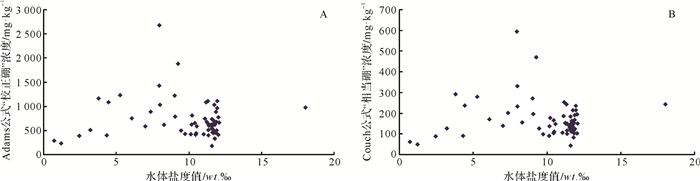
但事实上,在接近的湖泊水体盐度范围11‰~12‰条件下,沉积物中硼的浓度介于43.3~151.3 mg·kg-1(表 1),变化极大,沉积物中硼的浓度与沉积水体盐度之间缺乏明显相关性,甚至某些低盐度的样点(样号10)上覆湖水盐度仅7.956‰,但其对应表层沉积物中硼浓度则高达351.3 mg·kg-1,说明沉积物中硼的浓度并不一定能直接反映沉积水体盐度。Adams认为沉积物中对硼起主要吸附作用的是伊利石[12],而Couch则认为伊利石、蒙脱石和高岭石对硼均有一定的吸附性,但吸附系数有差异[13],根据表 2分别计算了各样点Adams公式“校正硼”[31]的浓度和Couch公式“相当硼”[13]的浓度,并分别与对应实测水体盐度值投点进行分析(图 4),可以发现两种方法计算的“相当硼”浓度与水体实测盐度之间无明显关系,这一结果并非否定了佛伦德奇吸收方程,而可能是由于沉积物中硼的来源并非仅仅来自于沉积物中黏土矿物的吸附作用所导致的。
|
| 图 4 沉积物中“校正硼”和“相当硼”浓度与实测水体盐度值之间的关系(n=67) Fig.4 Adjusted boron and equivalent boron uptake in sediments vs. measured salinity (n=67) |
沉积物中硼(B全岩)的来源主要包括三部分:继承自母岩陆源碎屑物质的继承硼(B继承)、沉积物(主要是黏土矿物等)从湖水中的吸附硼(B吸附)、有机质中吸收及吸附的硼(B有机)三部分[30],说明沉积物中的硼浓度同时受母岩性质、黏土矿物含量及组成、有机质丰度等因素共同影响[33]。
通过样品的分离和提纯,估算出布哈河口区沉积物中继承硼的含量介于(0.82~17.96)mg·kg-1,平均为8.73 mg·kg-1[30],在B全岩中所占比重较小。在富有机质的土壤或沉积物中,黏土矿物中吸附硼的含量B吸附远低于有机质中硼B有机的含量[34, 35],甚至可以忽略沉积物中的B吸附影响[30]。
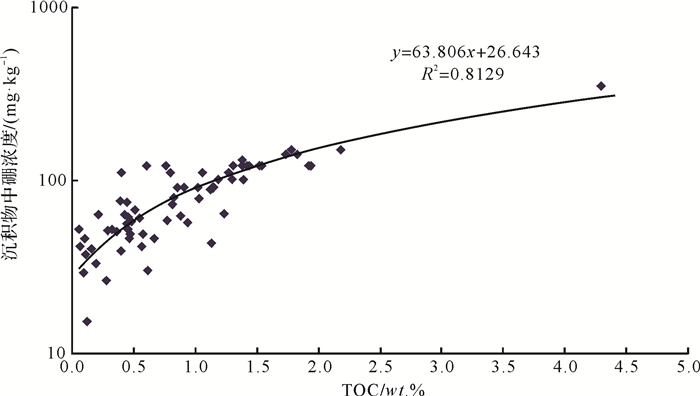
事实上,硼作为一种植物生长所必需的营养元素,在植物体生殖器官的建成和发育过程中起着关键作用[36],硼主要以硼酸的形式被植物吸收,可以通过跨脂双分子层的被动扩散、转运蛋白的主动运输等方式在植物体内运输[37],并以细胞壁硼—糖复合物的形式在植物体内聚集[38-39],植物死亡后硼随植物遗体进入沉积物,因此在富有机质土壤或煤系地层中通常具有较高的含量[40-41]。从本次研究的分析和测试数据来看,沉积物中有机碳总量TOC与硼浓度存在明显线性正相关性(图 5),其相关系数R2高达0.90,说明沉积物中的硼主要与有机质含量有关,沉积物中有机质对硼的富集能力远超过黏土矿物对硼的吸收,这就是导致沉积物中硼浓度无法直接反映水体盐度、进而导致Adams公式和Couch公式失效的原因。
|
| 图 5 沉积物中硼浓度与沉积物TOC相关图(n=67) Fig.5 Boron uptake in sediments vs. TOC(n=67) |
自然界河流、湖泊、海洋沉积中或多或少都存在一定数量的有机质,Adams公式主要是根据达维河口湾现代表层沉积物分析结果和底部水体实测盐度建立的[12],而用于建立Couch公式的样品则主要来源于尼日尔三角洲[13],河口湾或三角洲地区的沉积物很难不含任何有机质,但Adams和Couch均默认为沉积物中的硼除去B继承,主要来自于黏土矿物从海水中吸附。当然,我们已无从考证Adams或Couch当年采集的沉积物样品有机质含量的高低,并以此作为推翻两个古盐度恢复公式的依据,但有一点可以确认:Couch公式和Adams公式都没有考虑沉积物中有机质对硼的影响,因此,对富有机质的沉积物进行古盐度恢复是不可行的。
4 硼作为古盐度指标的可行性从现有研究成果来看,利用Couch公式和Adams公式定量恢复沉积水体古盐度遇到了挑战,但由于水体中硼浓度与盐度极好的相关性[13, 33]、硼在沉积物中容易被快速吸附[30]以及在泥质沉积物中不易迁移的特性[30, 42],因此硼元素无疑是反映古盐度的较好的指标。本次研究分别采集了3件“伊利石”、“高岭石”和“蒙脱石”样品用于浸泡试验,经过X衍射分析发现:“伊利石”样品黏土含量仅36%,石英含量64%,其中黏土矿物主要由65%的伊利石和35%的绿泥石组成;“高岭石”样品黏土矿物含量93%,石英含量7%,黏土矿物几乎全部由高岭石组成;“蒙脱石”样品黏土矿物含量91%,石英含量9%,黏土矿物几乎全部为蒙脱石(表 3)。在浸泡实验前对3件“伊利石”、“高岭石”和“蒙脱石”样品中硼的浓度进行了分析,样品中原始硼含量分别为11.98 mg·kg-1、6.68 mg·kg-1和57.16 mg·kg-1。需要说明的是,虽然用于浸泡实验的样品本身含有一定量的硼,但并不影响实验结果,因为在新的环境条件下(含硼的盐水溶液)沉积物必将吸附或者释放出一定数量的硼,在这一过程中使得沉积物中的硼达到新的平衡,由此可确定该实验条件下沉积物对硼的吸附能力。3件样品成分相对简单,且共存的矿物石英基本没有吸附能力,绿泥石对硼的吸附实验尚未见报道,但李世红等[43]做过绿泥石对Cs+、Yb3+的吸附试验,发现绿泥石的吸附效应较弱,几乎可以忽略。本次实验分别称取7 g的“伊利石”、“高岭石”和“蒙脱石”样品,各自浸泡在200 mL的青海湖水样品(硼浓度10.47 mg·kg-1)中60天,然后通过滤纸过滤对样品进行回收,并对浸泡样品进行低温烘干处理,然后分析样品中硼浓度,发现浸泡后“伊利石”、“高岭石”和“蒙脱石”样品中硼含量分别为9.90 mg·kg-1、28.67 mg·kg-1和83.24 mg·kg-1(表 3),仅“伊利石”样品中的硼浓度出现轻微的下降,而“高岭石”和“蒙脱石”样品中硼浓度均出现不同程度的升高。如果忽略绿泥石对硼的吸附作用,根据黏土矿物含量对各浸泡样品吸附的硼浓度进行折算(实测硼/黏土含量),发现在硼浓度为10.47 mg·kg-1的溶液中,伊利石、高岭石和蒙脱石中吸附硼的浓度分别为42.28 mg·kg-1、30.86 mg·kg-1和91.24 mg·kg-1(表 3)。这一实验结果显然与Couch[13]的看法存在较大差异,但蒙脱石对硼的吸附能力远大于伊利石和高岭石这一实验结果却符合我们对蒙脱石强烈吸附性的认知。
| 矿物 | 主要矿物/% | 黏土矿物组成/% | 质量/g | 溶液体积/mL | 溶液中硼浓度/ (mg·kg-1) | 浸泡时间/天 | 浸泡前硼浓度/ (mg·kg-1) | 浸泡后硼浓度/ (mg·kg-1) | 折算后硼浓度/ (mg·kg-1) | |||||
| 黏土总量 | 石英 | 蒙脱石 | 伊利石 | 高岭石 | 绿泥石 | |||||||||
| I | 36 | 64 | 65 | 35 | 7.00 | 200 | 10.47 | 60 | 11.98 | 9.90 | 42.28 | |||
| K | 93 | 7 | 100 | 7.00 | 200 | 10.47 | 60 | 6.68 | 28.67 | 30.86 | ||||
| S | 91 | 9 | 100 | 7.00 | 200 | 10.47 | 60 | 57.16 | 83.24 | 91.24 | ||||
| 注:I代表“伊利石”样品,K代表“高岭石”样品,S代表“蒙脱石”样品。 | ||||||||||||||
当然,本次吸附试验较为简单,但证明黏土矿物确实能够吸附溶液中的硼,因此根据沉积物中黏土矿物中硼的浓度,是可以对水体中硼浓度、进而对水体盐度进行恢复的。在未来可能的条件下还应该选取纯度更高的黏土矿物甚至是有机碳在不同浓度的硼溶液中进行浸泡试验,以期获得不同矿物在不同浓度条件下对硼的吸附曲线。当然,在利用硼进行古盐度恢复时,必须消除有机质的影响,即:对沉积物中的有机质进行分离,这是进行黏土矿物中硼含量进行古盐度恢复的关键。本次研究由于经费限制和样品消耗等原因,没有对沉积物中的有机质进行分离,相信通过有机质分析消除B有机的影响后,再减去通过提纯试验估算出的B继承的含量,沉积物中剩余的硼即为B吸附含量,符合佛伦德奇吸收方程,可以反映水体盐度。但即便消除了有机质对硼的影响,恐怕Adams公式和Couch公式也同样难以准确反映沉积水体盐度,除非当年来自达维河口湾和尼日尔三角洲地区的样品真的不含任何有机质。沉积物中的硼元素通过分离,有一部分是可以反映沉积水体盐度的,甚至用于盐度的定量计算,但需要全新的实验并建立新的经验公式。
5 结论(1)Adams公式和Couch公式均未考虑有机质对硼的富集效应,因此不适合于针对富有机质泥岩沉积水体古盐度的恢复。
(2)黏土矿物及有机质均对水体中的硼有明显的吸附作用,黏土矿物中蒙脱石对硼的吸附作用最强,当沉积物中黏土矿物与有机质共存时,有机质含量是影响沉积物中硼浓度的主要因素,这是导致Adams公式和Couch公式失效的重要原因。
(3)利用沉积物黏土矿物中吸附硼浓度,对沉积水体盐度进行定量恢复仍然是一种可行的方法,但必须通过一系列的浸泡试验建立新的计算公式,同时,针对富有机质泥岩沉积水体古盐度的恢复必须对有机质进行分离,消除有机质对硼的影响。
| [1] |
王昌勇, 郑荣才, 王海红, 等. 鄂尔多斯盆地姬塬地区长6油层组物源区分析[J]. 沉积学报, 2008, 26(6): 933-938. [Wang Changyong, Zheng Rongcai, Wang Haihong, et al. Provenance analysis of Chang-6 oil reservoir set in Jiyuan region in Ordos Basin[J]. Acta Sedimentologica Sinica, 2008, 26(6): 933-938.] |
| [2] |
郑荣才, 柳梅青. 鄂尔多斯盆地长6油层组古盐度研究[J]. 石油与天然气地质, 1999, 20(1): 20-25. [Zheng Rongcai, Liu Meiqing. Study on palaeosalinity of Chang-6 oil reservoir set in Ordos Basin[J]. Oil & Gas Geology, 1999, 20(1): 20-25.] |
| [3] |
倪春华, 周小进, 王果寿, 等. 鄂尔多斯盆地南缘平凉组烃源岩沉积环境与地球化学特征[J]. 石油与天然气地质, 2011, 32(1): 38-46. [Ni Chunhua, Zhou Xiaojin, Wang Guoshou, et al. Sedimentary environment and geochemical characteristics of hydrocarbon source rocks in the Pingliang Formation, southern margin of the Ordos Basin[J]. Oil & Gas Geology, 2011, 32(1): 38-46.] |
| [4] |
郭来源, 张士万, 解习农, 等. 鄂西-渝东地区下侏罗统东岳庙段泥岩地球化学特征及有机质富集模式[J]. 地球科学, 2017, 42(7): 1235-1246. [Guo Laiyuan, Zhang Shiwan, Xie Xinong, et al. Geochemical characteristics and organic matter enrichment of the Dongyuemiao member mudstone of Lower Jurassic in the western Hubei-eastern Chongqing[J]. Earth Science, 2017, 42(7): 1235-1246.] |
| [5] |
刘人和, 唐书恒, 梁峰. 我国东北地区伸展盆地油页岩成矿规律及控制因素研究[J]. 中国石油勘探, 2010, 15(6): 76-80, 86. [Liu Renhe, Tang Shuheng, Liang Feng. Study on formation laws and controlling factors of oil shale deposits in extensional basins in Northeast China[J]. China Petroleum Exploration, 2010, 15(6): 76-80, 86.] |
| [6] |
Nelson B W. Sedimentary phosphate method for estimating paleosalinities[J]. Science, 1967, 158(3803): 917-920. |
| [7] |
肖普夫T.古海洋学[M].仇祥华, 朱西岭, 译.北京: 海洋出版社, 1984: 200-201. [Schopf T. Paleooceanography[M]. Qiu Xianghua, Zhu Xiling, trans. Beijing: Ocean Publishing House, 1984: 200-201.]
|
| [8] |
Rohling E J. Paleosalinity:confidence limits and future applications[J]. Marine Geology, 2000, 163(1/2/3/4)): 1-11. |
| [9] |
Pekar S F, McHugh C M G, Christie-Blick N, et al. Estuarine processes and their stratigraphic record:paleosalinity and sedimentation changes in the Hudson Estuary(North America)[J]. Marine Geology, 2004, 209(1/2/3/4): 113-129. |
| [10] |
Sampei Y, Matsumoto E, Dettman D L, et al. Paleosalinity in a brackish lake during the Holocene based on stable oxygen and carbon isotopes of shell carbonate in Nakaumi Lagoon, Southwest Japan[J]. Palaeogeography, Palaeoclimatology, Palaeoecology, 2005, 224(4): 352-366. |
| [11] |
Peros M C, Reinhardt E G, Schwarcz H P, et al. High-resolution paleosalinity reconstruction from Laguna de la Leche, north coastal Cuba, using Sr, O, and C isotopes[J]. Palaeogeography, Palaeoclimatology, Palaeoecology, 2007, 245(3/4): 535-550. |
| [12] |
Adams T D, Haynes J R, Walker C T. Boron in holocene illites of the Dovey estuary, Wales, and its relationship to palaeosalinity in cyclothems[J]. Sdimentology, 1965, 4(3): 189-195. |
| [13] |
Couch E L. Calculation of paleosalinities from boron and clay mineral data[J]. AAPG Bulletin, 1971, 55(10): 1829-1837. |
| [14] |
Zhang M M, Liu Z J, Xu S Z, et al. Analysis for the paleosalinity and Lake-level changes of the oil shale measures in the Lucaogou Formation in the Sangonghe area of southern margin, Junggar Basin[J]. Petroleum Science and Technology, 2014, 32(16): 1973-1980. |
| [15] |
Carroll J, Falkner K K, Brown E T, et al. The role of the Ganges-Brahmaputra mixing zone in supplying barium and 226Ra to the Bay of Bengal[J]. Geochimica et Cosmochimica Acta, 1993, 57(13): 2981-2990. |
| [16] |
Moore W S. High fluxes of radium and barium from the mouth of the Ganges-Brahmaputra River during low river discharge suggest a large groundwater source[J]. Earth and Planetary Science Letters, 1997, 150(1/2): 141-150. |
| [17] |
Weldeab S, Lea D W, Schneider R R, et al. 155, 000 years of West African monsoon and ocean thermal evolution[J]. Science, 2007, 316(5829): 1303-1307. |
| [18] |
de Vernal A, Henry M, Matthiessen J, et al. Dinoflagellate cyst assemblages as tracers of sea-surface conditions in the Northern North Atlantic, Arctic and sub-Arctic seas:The new 'n=677' data base and its application for quantitative palaeoceanographic reconstruction[J]. Journal of Quaternary Science, 2001, 16(7): 681-698. |
| [19] |
Bollmann J, Herrle J O. Morphological variation of Emiliania huxleyi and sea surface salinity[J]. Earth and Planetary Science Letters, 2007, 255(3/4): 273-288. |
| [20] |
李任伟, 林大兴, 黄宛平, 等. 苏北盆地有机地球化学环境分析[J]. 中国科学(B辑), 1986, 30(6): 647-655. [Li Renwei, Lin Daxing, Huang Wanping, et al. Organic geochemical analysis of environments of Subei Basin[J]. Science in China(Seri. B), 1986, 30(6): 647-655.] |
| [21] |
李任伟. 伽马蜡烷的地质产状及古环境意义[J]. 科学通报, 1988, 33(20): 1574-1576. [Li Renwei. Geological occurrence and its paleoenvironmental significance of gammacerane[J]. Chinese Science Bulletin, 1988, 33(20): 1574-1576.] |
| [22] |
李任伟. 高盐环境和生油[J]. 中国科学(B辑), 1988(3): 303-313. [Li Renwei. High salt environment and oil generation[J]. Science in China (Seri. B), 1988(3): 303-313.] |
| [23] |
余文超, 杜远生, 周琦, 等. 黔北务川-正安-道真地区铝土矿系中生物标志物及其地质意义[J]. 古地理学报, 2012, 14(5): 651-662. [Yu Wenchao, Du Yuansheng, Zhou Qi, et al. Biomarkers of bauxite-bearing strata and its geological significance in Wuchuan-Zheng'an-Daozhen area, northern Guizhou province[J]. Journal of Palaeogeography, 2012, 14(5): 651-662.] |
| [24] |
崔滔, 焦养泉, 杜远生, 等. 黔北务正道地区铝土矿形成环境的古盐度识别[J]. 地质科技情报, 2013, 32(1): 46-51. [Cui Tao, Jiao Yangquan, Du Yuansheng, et al. Analysis on paleosalinity of sedimentary environment of bauxite in WuchuanZheng'an-Daozhen area, northern Guizhou province[J]. Geological Science and Technology Information, 2013, 32(1): 46-51.] |
| [25] |
Ballentine C J, Hall C M. Determining paleotemperature and other variables by using an error-weighted, nonlinear inversion of noble gas concentrations in water[J]. Geochimica et Cosmochimica Acta, 1999, 63(16): 2315-2336. |
| [26] |
Brennwald M S, Scheidegger Y, Tomonaga Y, et al. New applications of noble gases as environmental proxies in unusual aquatic environments[J]. Geochimica et Cosmochimica Acta, 2006, 70(18): A66. |
| [27] |
毛光周, 刘晓通, 安鹏瑞, 等. 无机地球化学指标在古盐度恢复中的应用及展望[J]. 山东科技大学学报(自然科学版), 2018, 37(1): 92-102, 118. [Mao Guangzhou, Liu Xiaotong, An Peng-rui, et al. Application and outlook of inorganic geochemical indexes in reconstruction of palaeosalinity[J]. Journal of Shandong University of Science and Technology(Natural Science), 2018, 37(1): 92-102, 118.] |
| [28] |
王昌勇, 郑荣才, 刘哲, 等. 鄂尔多斯盆地陇东地区长9油层组古盐度特征及其地质意义[J]. 沉积学报, 2014, 32(1): 159-165. [Wang Changyong, Zheng Rongcai, Liu Zhe, et al. Paleosalinity of Chang 9 reservoir in Longdong area, Ordos Basin and its geological significance[J]. Acta Sedimentologica Sinica, 2014, 32(1): 159-165.] |
| [29] |
魏亚琼, 王昌勇, 孟祥豪, 等. 青海湖布哈河口区表层沉积物有机质分析及其比较沉积学意义[J]. 湖泊科学, 2017, 29(5): 1254-1264. [Wei Yaqiong, Wang Changyong, Meng Xianghao, et al. Organic matter analysis of surface sediment in Buha Estuary region and its comparative sedimentology significance[J]. Journal of Lake Sciences, 2017, 29(5): 1254-1264.] |
| [30] |
王昌勇, 孟祥豪, 魏亚琼, 等. 咸水湖盆沉积物原始有机碳定量恢复的新方法:以青海湖布哈河口区沉积物为例[J]. 湖泊科学, 2018, 30(2): 552-566. [Wang Changyong, Meng Xianghao, Wei Yaqiong, et al. A new method of reconstruction of original total organic carbon for sediments in salt water lakes-A case study on modern sediments in Buha River Estuary, Lake Qinghai[J]. Journal of Lake Sciences, 2018, 30(2): 552-566.] |
| [31] |
Walker C T, Price N B. Departure curves for computing paleosalinity from boron in illites and shales[J]. AAPG Bulletin, 1963, 47(5): 833-841. |
| [32] |
周仰康, 何锦文, 王子玉.硼作为古盐度指标的应用[C]//沉积学和有机地球化学学术会议论文选集.北京: 科学出版社, 1984: 55-57. [Zhou Yangkang, He Jinwen, Wang Ziyu. Application of B as an index for palaeosalinity[C]//Collected papers of sedimentology and organic geochemistry academic conference. Beijing: Science Press, 1984: 55-57.]
|
| [33] |
Wang C Y, Lin S G, Wei Y Q, et al. Major factors influencing boron adsorption in sediments-a case study of modern sediments in Qinghai Lake[J]. Environmental Earth Sciences, 2017, 76: 181. |
| [34] |
曹凑贵, 蔡崇发, 张光远, 等. 鄂南丘陵区棕红壤硼分级及时空分布[J]. 土壤, 1999(3): 144-148, 154. [Cao Cougui, Cai Chongfa, Zhang Guangyuan, et al. The grading of brown soil and its space-time distribution of hilly region of South Hubei province[J]. Soil, 1999(3): 144-148, 154.] |
| [35] |
曹凑贵, 张光远, 王运华, 等. 鄂南丘陵区棕红壤硼的分布和迁移特点及其调控[J]. 土壤学报, 2001, 38(1): 96-103. [Cao Cougui, Zhang Guangyuan, Wang Yunhua, et al. Distribution, removing and regulation of boron in brown-red soil in the hilly region of south Hubei province[J]. Acta Pedologica Sinca, 2001, 38(1): 96-103.] |
| [36] |
孙爱德, 徐庆彩, 刘丽华, 等. 植物中硼分离方法的建立及其同位素质谱测定[J]. 分析化学, 2014, 42(1): 83-87. [Sun Aide, Xu Qingcai, Liu Lihua, et al. Separation and analysis of boron and its isotopic composition in plants[J]. Chinese Journal of Analytical Chemistry, 2014, 42(1): 83-87.] |
| [37] |
熊鲜艳, 郎春秀, 杜海, 等. 植物对硼的吸收、转运及其遗传调控(综述)[J]. 亚热带植物科学, 2011, 40(1): 90-94. [Xiong Xianyan, Lang Chunxiu, Du Hai, et al. Uptake and transport of boron in plants and their genetic regulations[J]. Subtropical Plant Science, 2011, 40(1): 90-94.] |
| [38] |
Matoh T. Boron in plant cell walls[J]. Plant Soil, 1997, 193(1/2): 59-70. |
| [39] |
石磊, 徐芳森. 植物硼营养研究的重要进展与展望[J]. 植物学通报, 2007, 24(6): 789-798. [Shi Lei, Xu Fangsen. Main progresses in boron nutrition research in plants and its prospects[J]. Chinese Bulletin of Botany, 2007, 24(6): 789-798.] |
| [40] |
孙建华, 李继云. 北京郊区几种典型土壤对硼的吸附性能[J]. 环境科学, 1998, 19(5): 66-74. [Sun Jianhua, Li Jiyun. Adsorbing boron properties of five typical soils from suburban in Beijing[J]. Environmental Science, 1998, 19(5): 66-74.] |
| [41] |
Eskenazy G, Delibaltova D, Mincheva E. Geochemistry of boron in Bulgarian coals[J]. International Journal of Coal Geology, 1994, 25(1): 93-110. |
| [42] |
李成凤, 肖继风. 用微量元素研究胜利油田东营盆地沙河街组的古盐度[J]. 沉积学报, 1988, 6(4): 100-107. [Li Chengfeng, Xiao Jifeng. The application of trace element to the study on paleosalinities in Shahejie Formation of Dongying Basin in Shengli oilfield[J]. Acta Sedimentologica Sinica, 1988, 6(4): 100-107.] |
| [43] |
李世红, 李春江, 于涛, 等. Cs+和Yb3+在方解石、高岭石、蒙脱石、绿泥石和海绿石上的吸附实验研究[J]. 核化学与放射化学, 2002, 24(2): 70-76, 83. [Li Shihong, Li Chunjiang, Yu Tao, et al. Study of adsorption behaviors of Cs+ and Yb3+ on calcite, kaolinite, montmorillonite, chlorite and glauconite[J]. Journal of Nuclear and Radiochemistry, 2002, 24(2): 70-76, 83.] |