 2016, Vol. 34
扩展功能

文章信息
- 宗娴, 石学法, 葛晨东, 邹建军, Sergey Gorbarenko, 乔淑卿, 董智
- ZONG Xian, SHI XueFa, GE ChenDong, ZOU JianJun, Sergey Gorbarenko, QIAO ShuQing, DONG Zhi
- 日本海百年来沉积速率及粒度指示意义
- Sedimentation Rate and Implications of Sediment Grain Size of Japan Sea during the Last Hundred Years
- 沉积学报, 2016, 34(3): 516-522
- ACTA SEDIMENTOLOGICA SINCA, 2016, 34(3): 516-522
- 10.14027/j.cnki.cjxb.2016.03.009
-
文章历史
- 收稿日期: 2015-08-24
- 收修改稿日期: 2016-01-19


2. 国家海洋局第一海洋研究所 海洋沉积与环境地质国家海洋局重点实验室 山东青岛 266061;
3. 青岛海洋科学与技术国家实验室 海洋地质过程与环境功能实验室 山东青岛 266061;
4. 俄罗斯科学院远东分院太平洋海洋研究所 符拉迪沃斯托克 690041
2. Key Laboratory of Marine Sedimentology and Environment Geology, First Institute of Oceanography, State Oceanic Administration, Qingdao, Shandong 266061, China;
3. Qingdao National Laboratory for Marine Science and Technology, Function Laboratory for Marine Geology and Environment, Qingdao, Shandong 266061, China;
4. V.I. Il'ichev Pacific Oceanological Institute, Russian Academy of Science, Vladivostok 690041, Russia
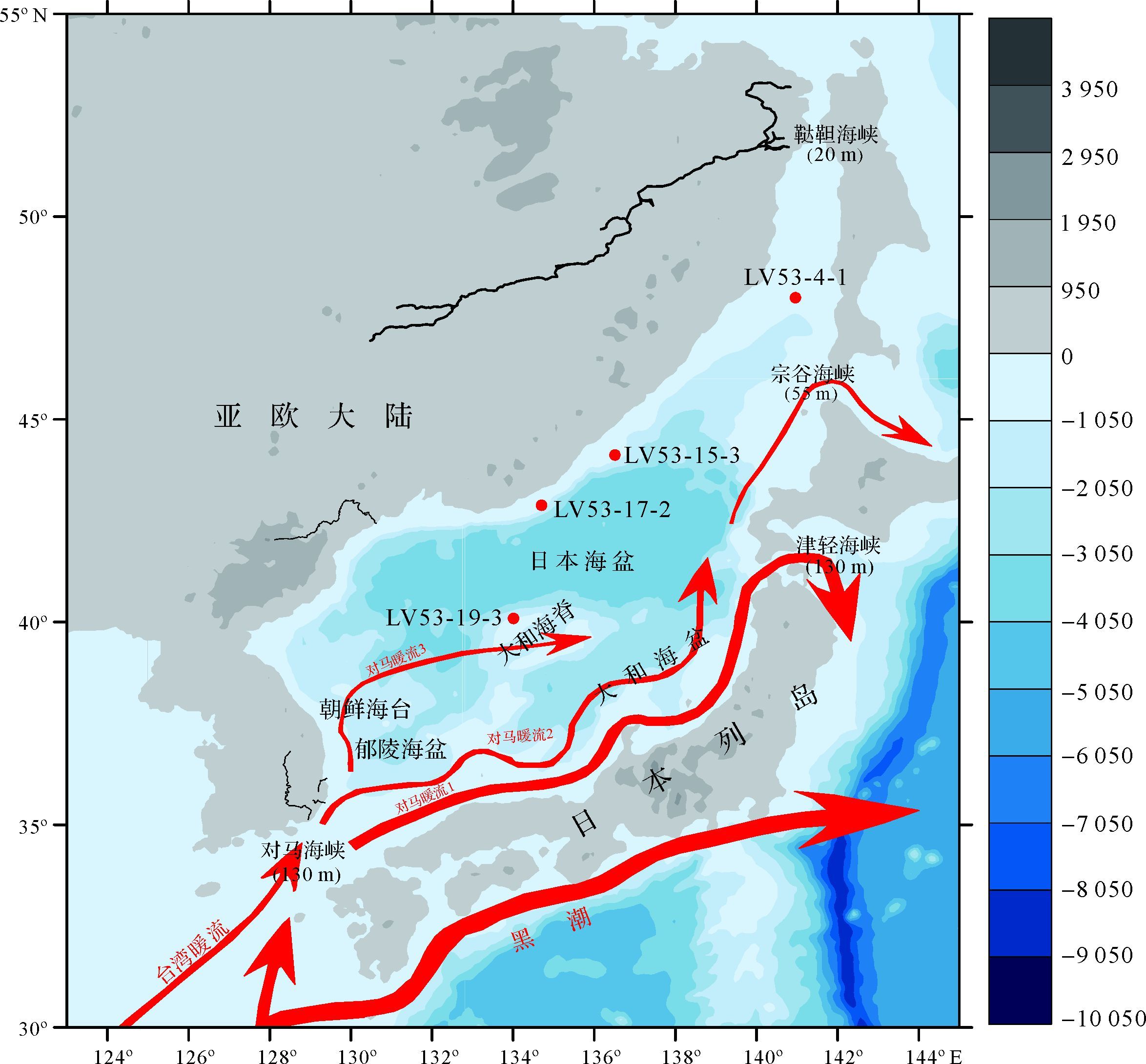
理解和重建过去百年以来人类活动及环境和气候变化历史需要可靠的年代标尺。210Pb作为238U核素衰变系列的中间产物,其半衰期仅有22.3 a,广泛应用于湖泊、河口、陆坡、陆架和石笋等百年时间尺度的环境重建研究[1-5]。日本海是西北太平洋一个半封闭的边缘海,横跨温带和寒带两个气候带,既受低纬黑潮暖流的影响,又受高纬极区大气环流的控制[6-7]。日本海还处于西风带影响之下,风带位置的南北移动造成季风锋面位置的变化会对河流径流产生影响。日本海独特的地理位置和地形地貌特征决定了它在西北太平洋边缘海中的特殊性,对其百年以来的环境和沉积过程开展研究对于认识西北太平洋的现代全球变化具有重要意义。
日本海已有的古海洋学研究报道多关注千年—轨道尺度的环境和气候变化过程[8-10],但是对其百年以来的环境和沉积过程研究程度较低。Lee et al.[11]通过研究郁陵盆地210Pb比活度指出在沉积物混合层之下的沉积速率介于0.033~0.116 cm/a;Hong et al.[12]研究指出郁陵盆地的沉积速率介于0.06~0.22 cm/a,推断沉积物主要来源于对马暖流携带的悬浮颗粒、大气降尘以及河流输入的悬浮颗粒。Nagashima et al.[13]认为大和海盆的陆源沉积物来源主要为亚洲季风和西风漂流带来的欧亚大陆的粉尘,其次为日本本州岛上河流的输入。Masayooshi et al.[14]发现210Pb在日本海边缘普遍较高,且受东亚冬季风的影响,其值在冬天高于夏天。前人的研究主要集中于日本海南部郁陵海盆[12, 15],对日本海中部、北部和西部百年以来沉积过程研究还未见报道。
基于210Pb推算岩芯年龄模型存在多种模式,包括恒定初始比活度模式(CA)、恒定供给速率模式(CRS)、恒定通量—恒定累积速率模式(CF-CS)以及阶段性恒定通量模式(PF)。每种模式各有优缺点,在应用时都存在一定的前提条件。Sanchez-Cabeza et al.[16]对不同210Pb定年模式进行了评述,并就210Pb定年的准确性给出了一个评估流程。但其主要是针对理想的210Pb衰变模式,对于表层发生混合的情形,康兴伦[17]则提出了一个解决方案—逐渐逼近法。该 方法本质上还是CF-CS模式,是在结合初始通量(源自CRS模式)和质量累积速率(源自CF-CS模式)两个参数后,对源自CF-CS模式的质量累积速率和沉积速率进行了修正。基于前人推荐的210Pb定年方法,本文通过对日本海4个沉积岩芯(图 1)中的210Pb活度进行了分析,确定了其百年以来的年代框架。
|
| 图 1 日本海地理和地形及取样站位图 Fig. 1 Geography and isobaths showing the bottom topography(in meters) of the Japan Sea,and the locations of multicores |
4个沉积岩芯(LV53-4-1、LV53-15-3、LV53-17-2和LV53-19-3)是在国家海洋局第一海洋研究所和俄罗斯科学院远东分院太平洋海洋研究所于2010年11月实施的日本海联合调查航次中由多管采样器采集,调查站位见图 1。多管岩芯采集后,立即按1 cm或2 cm间隔取样,并冷冻存储。在实验室分析时,对沉积物样品进行冷冻干燥,并对沉积物湿样和干样分别进行称重,计算含水量。在除去沉积物中的碳酸盐和有机质后,在国家海洋局第一海洋研究所海洋沉积与环境地质国家海洋局重点实验室用激光粒度仪对沉积物粒度进行测试。
210Pb在中国科学院地理与湖泊研究所分析测试中心用γ谱仪(HPGe GWL-120-15)测定。210Pb测试误差小于10%。基于210Pbex剖面,采用CRS模式[1, 18]建立了4个岩芯的年代框架,结合沉积物粒径数据,探讨了百年以来沉积物粒径所指示的日本海古环境演化历史。
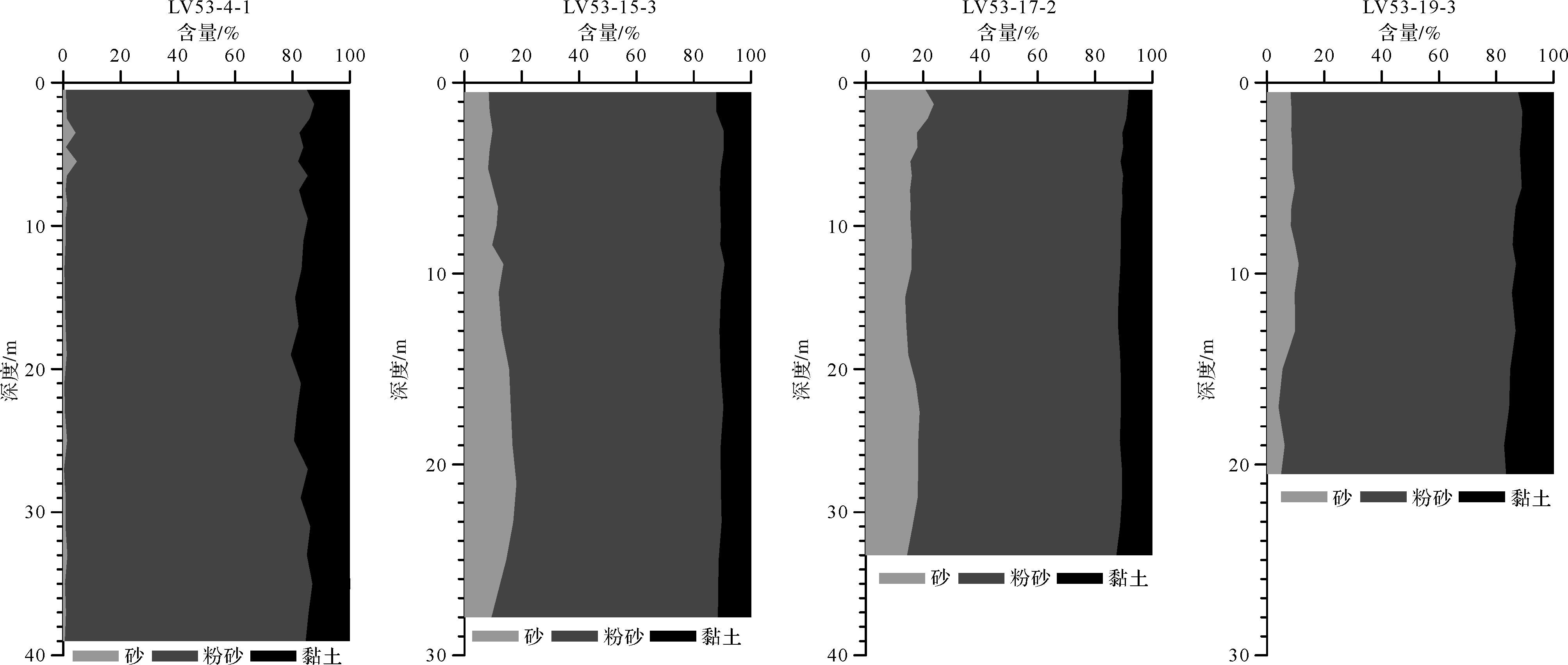
2 结果与讨论 2.1 岩性及粒度特征4个沉积岩芯(LV53-4-1、LV53-15-3、LV53-17-2、LV53-19-3)尽管位于不同的区域,但是沉积物类型皆以粉砂为主(详见图 2),介于65%~82%,砂含量变化较大,表明4个研究区域的物质来源和沉积动力环境存在差异。其中,位于日本海北部陆坡的LV53-4-1岩芯,仅在上层检测到砂成分,表明该岩芯所在位置沉积动力环境稳定。位于日本海西部陆坡的LV53-15-3和LV53-17-2岩芯砂质成分在整个岩芯中都可以检测到。LV53-19-3岩芯位于日本海大和海脊,远离陆地并被较深的海盆隔离,但是在整个岩芯中都检测出砂质组分,一般认为该区域陆源碎屑物质主要由风搬运而来。
|
| 图 2 多管样沉积物组分垂向剖面图 Fig. 2 Vertical profiles of sediment composition in multicore samples |
日本海4个站位沉积岩芯总210Pb活度(210Pbtotal)和过剩210Pb活度(210Pbex)分析结果见图 3。结果显示日本海中部(LV53-19-3)、北部(LV53-4-1)和西部(LV53-15-3、LV53-17-2)210Pbex活度不存在数量级差异,介于390~600 Bq/kg,与已报道的大和 海脊、韩国高原和郁陵盆地的210Pbex比活度接近[19]。在垂向剖面上,4个沉积岩芯中210Pbex总体上随深度呈指数递减趋势,但在不同岩芯,210Pbex剖面分布趋势存在差异。在LV53-4-1和LV53-19-3岩芯,可以观测到表层发生混合,且混合层厚度不一致。在LV53-15-3和LV53-17-2岩芯并未观测到类似现象,表明不同区域日本海底层沉积环境存在差异。不同岩芯中,210Pbex达到本底深度也存在差异,LV53-4-1、LV53-15-3、LV53-17-2和LV53-19-3岩芯达到本底深度分别为28 cm、18 cm、28 cm和16 cm。

|
| 图 3 210Pbex、210PbTotal和226Ra活度剖面图 Fig. 3 Profiles of 210Pbex,210PbTotal and 226Ra plotting against depth |
基于CF-CS模式和逐渐逼近法计算了日本海4个岩芯的沉积速率和质量累积速率(表 1),其平均沉积速率介于0.18~0.4 cm/a之间,最低值出现在大和海脊(0.18 cm/a),最高值出现在日本海北部(0.4 cm/a),高于日本海南部郁陵盆地的沉积速率(0.06~0.22 cm/a),这可能是因为浅水区域底栖生物数量比受到日本海特征水影响的深水区域要多[12] 。同时,基于CRS模式计算了4个岩芯的沉积速率,分别为0.19 cm/a、0.33 cm/a、0.37 cm/a和0.42 cm/a,这与CF-CS模式和逐渐逼法算出的结果基本一致。
| 站位 | 水深/m | 表层210Pbex/(Bq/kg) | 210Pbex通量/Bq/(m2·a) | 混合深度/cm | 质量累积和沉积速率 | |||
| 间隔/cm | 质量累积速率/[g/(cm2·a)] | 沉积速率/(cm/a) | ||||||
| CF-CS | CRS | |||||||
| LV53-4-1 | 891 | 525.96 | 1 887 | 7 | 7~38 | 0.24 | 0.40 | 0.42 |
| LV53-15-3 | 885 | 556.43 | 1 446 | — | 0~18 | 0.25 | 0.34 | 0.33 |
| LV53-17-2 | 1 164 | 392.34 | 1 369 | — | 0~18 | 0.29 | 0.35 | 0.37 |
| 18~28 | 0.16 | 0.19 | ||||||
| LV53-19-3 | 732 | 430.83 | 991 | 3 | 3~16 | 0.12 | 0.18 | 0.19 |
统计发现,日本海近百年来的沉积物累积速率和水深无显著相关性(表 1),推测其与沉积物来源和水动力有关。下文以LV53-4-1站位和LV53-19-3站位的岩芯为例进行说明。LV53-4-1岩芯位于日本海北部,靠近鞑靼海峡。董津生等[20]通过P-Vector方法得出鞑靼海峡的体积输运为零,表明该区域水动 力较弱;Martin et al.[21]研究指出阿穆尔河(黑龙江)是日本海淡水的一个重要贡献源,它通过鞑靼海峡进入日本海,其携带的悬浮颗粒是日本海北部沉积物的一个主要来源,因此LV53-4-1站位高沉积速率(0.42 cm/a)可能与弱水动力条件和较多的供给源有关。LV53-19-3站点位于大和海脊,海洋动力环境受亚极地锋影响,动力比较强。该区域陆源沉积物主要来自风尘和对马暖流搬运[12]。LV53-19-3站位研究区受沉积物供给能力的制约,且处于较强的水动力环境中,因此沉积速率较低(0.19 cm/a)。
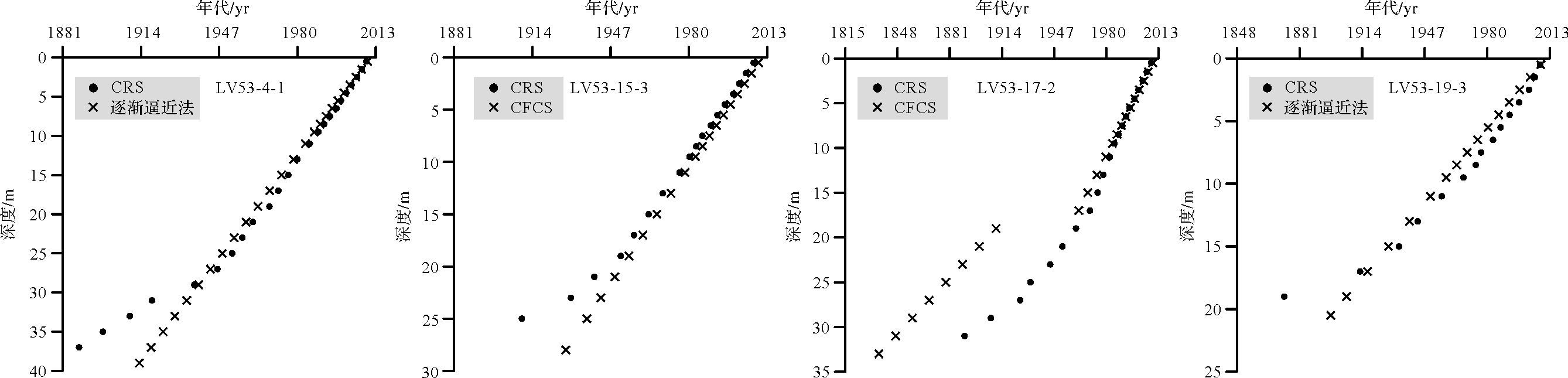
2.4 年代框架基于CRS模式和CF-CS模式分别建立了4个岩芯的年代框架(图 4)。图 4显示,在岩芯上部两种方法所获得的年龄基本一致,但是越到岩芯底部差异越大。尽管两种模式所计算的沉积速率相近,但是在某一时间段内210Pb通量不随时间变化,而在大多数情况下沉积通量很难保持在恒定的水平上,因此认为CRS模式计算的210Pb年龄更为合理。
|
| 图 4 日本海多管样岩芯CRS和CF-CS年代模式比较 Fig. 4 Comparison of CRS and CFCS age models of multicores in the Japan Sea |
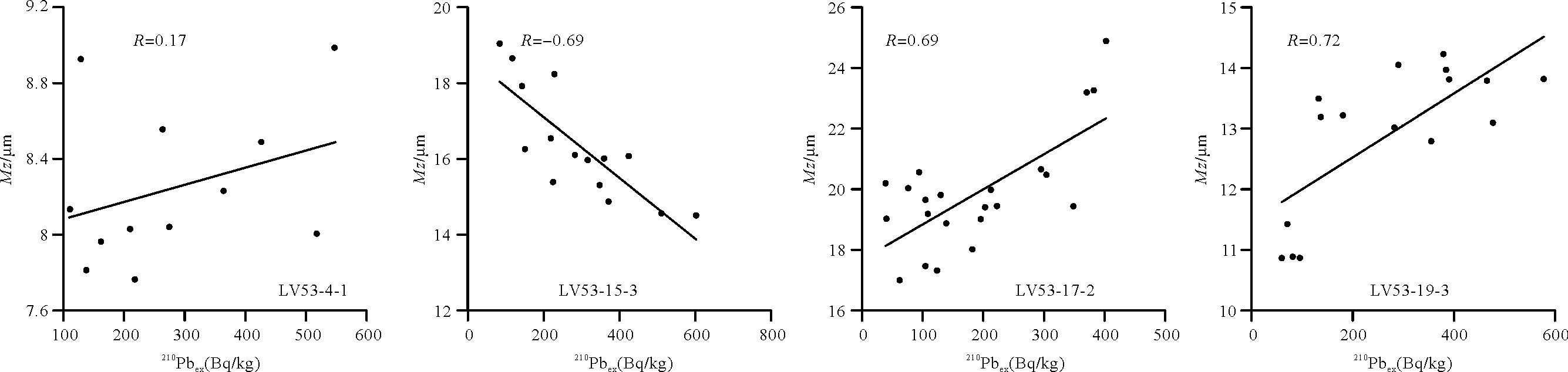
前人的研究表明,210Pbex与沉积物粒度存在显著的相关性,沉积物粒度越细,210Pbex含量越高[22-24],这与沉积物粒度越细,其表面积越大,吸附较多的210Pbex有关。本文所研究的4个岩芯的沉积物类型都以粉砂和黏土质粉砂为主,其中粉砂含量分别为77.2%~86.5%、71.3%~81.6%、67.7%~74.4%和75.8%~80.5%。平均粒径与210Pbex 的相关性分析表明(图 5),4个沉积岩芯中沉积物粒径与210Pbex并不存在一致的对应关系。例如,在LV53-15-3岩芯中,存在较为显著的负相关,而在LV53-17-2及LV53-19- 3岩芯中则存在较为显著的正相关。上述结果表明在日本海沉积物粒度不是控制210Pbex活度的一个主要因素。
|
| 图 5 沉积物平均粒径与210Pbex相关性散点图 Fig. 5 The scatter plots of the correlation between sediment mean grain size (Mz) and 210Pbex |
碎屑沉积物粒度是反映沉积物组分、结构的一个基本参数,主要受沉积动力、沉积环境以及物质来源等因素的影响。日本海作为一个半封闭的边缘海,其沉积物主要来自风尘、河流及对马暖流搬运的陆源碎屑物质[13, 25-26]。本研究中4个沉积岩芯的沉积物组成尽管都以细粒沉积物为主(粉砂或黏土质粉砂),但是在百年尺度上,沉积物粒径发生了剧烈的波动,且在不同区域呈现不同的分布模式,表明沉积环境和水动力条件发生了变化。
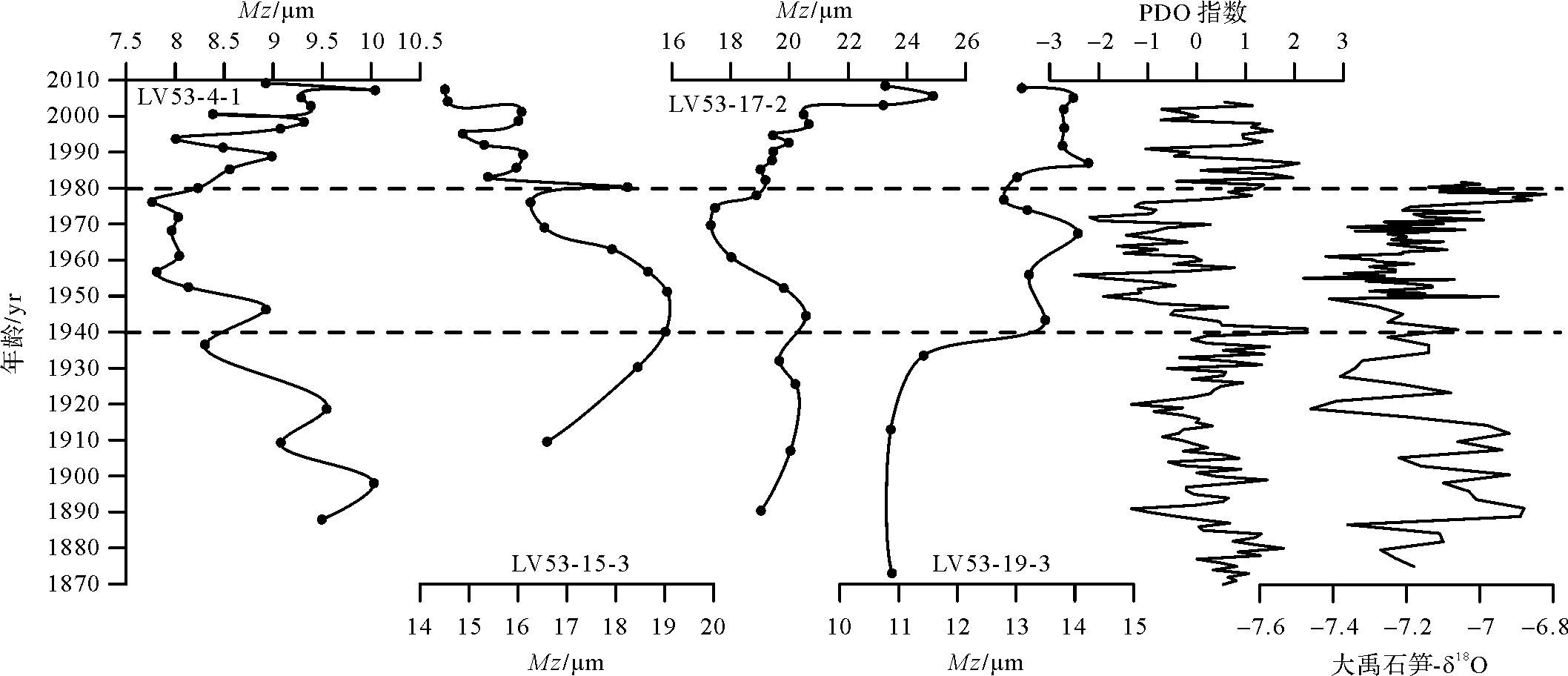
LV53-4-1岩芯结果显示,日本海北部沉积速率相对较高,自1980年以来沉积物平均粒径呈现逐渐增加的趋势;在1880—1940年时段逐渐减小。日本海北部大量淡水多来自阿穆尔河径流,沉积物平均粒径的变化趋势表明,黑龙江径流对日本海北部的影响自1980年以来逐渐增强,而在1880—1940年时段则较弱。尽管LV53-15-3和LV53-17-2岩芯都位于日本海西部陆坡并且位置相邻,但是无论210Pbex分布模式,还是沉积物平均粒径变化趋势都存在显著差异。由于两个站位相邻,可以推测二者物质来源一致,因此引起沉积物粒径分布模式差异的主要原因可能与具体站位水动力强弱差异有关。在日本海中部,LV53-19-3岩芯远离陆地,其沉积物供给来源相对单一,主要为风尘输入[13, 26-28],因此百年以来沉积物粒径垂向分布模式的变化主要受风力和水动力条件强弱的影响,其最为显著的特征是1940年以前,日本海中部沉积物粒径明显小于1940年以后的。尽管本文研究的4个岩芯沉积物平均粒径存在不同的垂向分布模式,这与不同区域水动力条件、物源、搬运及扩散方式有关;但是图 6显示它们发生变化的时间点皆在1940年和1980年。除LV53-15-3外,1980年以来沉积粒径存在快速增加的趋势,而在1940—1980年,多管岩芯沉积物粒径则呈现过度时段的变化特征,因此我们认为4个岩芯所记录的沉积物粒度变化还可能还受区域气候变化模式的影响。
|
| 图 6 日本海百年以来沉积环境演化 Fig. 6 Evolution of sedimentary environment over the last century in the Japan Sea |
北太平洋涛动(PDO)和东亚夏季风存在显著的年际和十年际尺度变化周期,他们是调控北太平洋热带外区域气候的主要模态。前人研究[29]指出PDO指数在百年以来出现两个周期,第一周期为1890—1924年的冷相位及1924—1946年的暖相位,第二周期为1947—1975年的冷相位以及1976至今的暖相位。在1946年之后经历了一轮显著的纬向转化期,分界点在1976年前后。 Gordon发现日本海海平面在暖相位时降低而在冷相位时升高[30]。位于我国秦岭地区的大禹洞穴,石笋氧同位素记录也表明东亚夏季风强度在1940年和1980年前后发生了显著变化[31](图 6)。东亚夏季风主要通过降水对日本海的沉积物、营养盐输入以及海水盐度等产生影响,而东亚冬季风主要影响日本海深层水的形成及通风[27, 32]。
在本研究中,岩芯的沉积物粒度变化模式时间点与其基本一致,可能表明在百年尺度上,日本海沉积动力环境变化与PDO和东亚季风之间存在紧密的联系。由于东亚季风和PDO存在数十年尺度的变化周期,在该尺度上,其必然会对区域物质的产生、输运和沉积产生影响。尽管目前我们对他们之间的内在联系方式和机制仍然缺乏深入的了解,但是已有沉积物粒径数据表明,在气候模态发生转换时段,其信号也保存在沉积物中。
3 结论(1) 基于210Pb确定的沉积速率介于0.18~0.40 cm/a,最高值出现在日本海北部,最低值出现在大和海脊,沉积速率受沉积通量和水运力条件共同制约。通过CRS模式和CF-CS模式(或逐渐逼近法)分别建立了4个岩芯的年代框架,认为CRS模式计算的210Pb年龄更为合理。
(2) 过去一百年,4个岩芯的沉积物平均粒径发生了剧烈的变化,但是在1940年和1980年沉积物粒度分布模式同时发生了改变。沉积物粒径不仅记录了日本海不同区域物源和水运力环境变化信息,还反映区域气候模态的转变。
致谢 中国科学院南京地理与湖泊研究所湖泊与环境变化国家重点开放实验室夏威岚协助测定210Pb,在此表示衷心感谢。
| [1] | 叶崇开. 137Cs法和210Pb法对比研究鄱阳湖近代沉积速率[J]. 沉积学报,1991,9(1):106-114. [Ye Chongkai. Contrasting investigation by 137Cs method and 210Pb method for the prensent sedimentation rate of Poyang Lake, Jiangxi[J]. Acta Sedimentologica Sinica, 1991, 9(1): 106-114.] |
| [2] | Sanchez-Cabeza J A, Druffel E R M. Environmental records of anthropogenic impacts on coastal ecosystems: an introduction[J]. Marine Pollution Bulletin, 2009, 59(4/5/6/7): 87-90. |
| [3] | Nozaki Y, Tsubota H, Kasemsupaya V, et al. Residence times of surface water and particle-reactive 210Pb and 210Po in the East China and Yellow Seas[J]. Geochimica et Cosmochimica Acta, 1991, 55(5): 1265-1272. |
| [4] | Wei C L, Murray J W. The behavior of scavenged isotopes in marine anoxic environments: 210Pb and 210Po in the water column of the Black Sea[J]. Geochimica et Cosmochimica Acta, 1994, 58(7): 1795-1811. |
| [5] | Kaste J M, Friedland A J, Stürup S, et al. Using stable and radioactive isotopes to trace atmospherically deposited Pb in montane forest soils[J]. Environmental Science & Technology, 2003, 37(16): 3560-3567. |
| [6] | Minoura K, Akaki K, Nemoto N, et al. Origin of deep water in the Japan Sea over the last 145 kyr[J]. Palaeogeography, Palaeoclimatology, Palaeoecology, 2012, 339-341: 25-38. |
| [7] | Lee K E. Surface water changes recorded in Late Quaternary marine sediments of the Ulleung Basin, East Sea (Japan Sea)[J]. Palaeogeography, Palaeoclimatology, Palaeoecology, 2007, 247(1/2): 18-31. |
| [8] | Ikehara K, Itaki T. Millennial-scale fluctuations in seasonal sea-ice and deep-water formation in the Japan Sea during the Late Quaternary[J]. Palaeogeography, Palaeoclimatology, Palaeoecology, 2007, 247(1/2): 131-143. |
| [9] | Watanabe S, Tada R, Ikehara K, et al. Sediment fabrics, oxygenation history, and circulation modes of Japan Sea during the Late Quaternary[J]. Palaeogeography, Palaeoclimatology, Palaeoecology, 2007, 247(1/2): 50-64. |
| [10] | Gorbarenko S A, Southon J R. Detailed Japan Sea paleoceanography during the last 25 kyr: constraints from AMS dating and δ18O of planktonic foraminifera[J]. Palaeogeography, Palaeoclimatology, Palaeoecology, 2000, 156(3/4): 177-193. |
| [11] | Lee T, Hyun J H, Mok J S, et al. Organic carbon accumulation and sulfate reduction rates in slope and basin sediments of the Ulleung Basin, East/Japan Sea[J]. Geo-Marine Letters, 2008, 28(3): 153-159. |
| [12] | Hong G H, Kim S H, Chung C S, et al. 210Pb-derived sediment accumulation rates in the southwestern East Sea (Sea of Japan)[J]. Geo-Marine Letters, 1997, 17(2): 126-132. |
| [13] | Nagashima K, Tada R, Tani A, et al. Contribution of aeolian dust in Japan Sea sediments estimated from ESR signal intensity and crystallinity of quartz[J]. Geochemistry, Geophysics, Geosystems, 2007, 8(2): doi: 10.1029/2006GC001364. |
| [14] | Yamamoto M, Sakaguchi A, Sasaki K, et al. Seasonal and spatial variation of atmospheric 210Pb and 7Be deposition: features of the Japan Sea side of Japan[J]. Journal of Environmental Radioactivity, 2006, 86(1): 110-131. |
| [15] | Bahk J J, Chough S K, Han S J. Origins and paleoceanographic significance of laminated muds from the Ulleung Basin, East Sea (Sea of Japan)[J]. Marine Geology, 2000, 162(2): 459-477. |
| [16] | Sanchez-Cabeza J A, Ruiz-Fernández A C. 210Pb sediment radiochronology: an integrated formulation and classification of dating models[J]. Geochimica et Cosmochimica Acta, 2012, 82: 183-200. |
| [17] | 康兴伦. 210Pb测年法的数据处理问题[J]. 海洋科学,1986,10(6):13-17. [Kang Xinglun. On the data treatment of 210Pb dating method[J]. Marine Science, 1986, 10(6): 13-17.] |
| [18] | Koide M, Bruland K W, Goldberg E D. 228Th/232Th and 210Pb geochronologies in marine and lake sediments[J]. Geochimica et Cosmochimica Acta, 1973, 37(5): 1171-1187. |
| [19] | Hong G H, Lee S H, Kim S H, et al. Sedimentary fluxes of 90Sr, 137Cs, 239, 240Pu and 210Pb in the East Sea (Sea of Japan)[J]. Science of the Total Environment, 1999, 237-238: 225-240. |
| [20] | 董津生,徐佳佳. 日本海主要海峡体积输运的季节变化特征[J]. 海洋湖沼通报,2011(1):13-20. [Dong Jinsheng, Xu Jiajia. Seasonal variation of volume transport through straits around Japan Sea using variational algorithm[J]. Transactions of Oceanology and Limnology, 2011(1): 13-20.] |
| [21] | Martin S, Kawase M. The southern flux of sea ice in the Tatarskiy Strait, Japan Sea and the generation of the Liman Current[J]. Journal of Marine Research, 1998, 56(1): 141-155. |
| [22] | Nittrouer C A, Sternberg R W, Carpenter R, et al. The use of 210Pb geochronology as a sedimentological tool: application to the Washington continental shelf[J]. Marine Geology, 1979, 31(3/4): 297-316. |
| [23] | 张瑞,潘少明,汪亚平,等. 长江河口水下三角洲210Pb分布特征及其沉积速率[J]. 沉积学报,2009,27(4):704-713. [Zhang Rui, Pan Shaoming, Wang Yaping, et al. Sedimentation rates and characteristics of radionuclide 210Pb at the subaqueous delta in Changjiang Estuary[J]. Acta Sedimentologica Sinica, 2009, 27(4): 704-713.] |
| [24] | 刘升发,石学法,刘焱光,等. 东海内陆架泥质区沉积速率[J]. 海洋地质与第四纪地质,2009(6):1-7. [Liu Shengfa, Shi Xuefa, Liu Yanguang, et al. Sedimentation rate of mud area in the East China Sea inner continental shelf[J]. Marine Geology & Quaternary Geology, 2009(6): 1-7.] |
| [25] | 邹建军,石学法,刘焱光,等. 末次冰期以来日本海陆源沉积的地球化学记录及其对海平面和气候变化的响应[J]. 海洋地质与第四纪地质,2010(2):75-86. [Zou Jianjun, Shi Xuefa, Liu Yanguang, et al. Geochemical record of terrigenous sediments from the sea of Japan since last glacial and its response to sea level and climate change[J]. Marine Geology & Quaternary Geology, 2010(2):75-86.] |
| [26] | Nagashima K, Tada R, Matsui H, et al. Orbital-and millennial-scale variations in Asian dust transport path to the Japan Sea[J]. Palaeogeography, Palaeoclimatology, Palaeoecology, 2007, 247(1/2): 144-161. |
| [27] | Tada R. The Japan Sea sediments and variability of East Asian Monsoon: toward the IODP drilling of the Japan Sea and East China Sea[J]. The Quaternary Research (Daiyonki-Kenkyu), 2013, 51(3): 151-164. |
| [28] | Tada R. Onset and evolution of millennial-scale variability in the Asian monsoon and its impact on paleoceanography of the Japan Sea[M]//Clift P, Kuhnt W, Wang P, et al. Continent-Ocean Interactions Within East Asian Marginal Seas. Washington DC: American Geophysical Union Geophysical Monograph, 2004, 149: 283-298. |
| [29] | D'Arrigo R, Wilson R, Jacoby G. On the long-term context for late twentieth century warming[J]. Journal of Geophysical Research: Atmospheres (1984-2012), 2006, 111(D3), doi: 10.1029/2005JD006352. |
| [30] | Gordon A L, Giulivi C F. Pacific decadal oscillation and sea level in the Japan/East Sea[J]. Deep Sea Research Part I: Oceanographic Research Papers, 2004, 51(5): 653-663. |
| [31] | Tan Liangcheng, Cai Yanjun, Cheng Hai, et al. Summer monsoon precipitation variations in central China over the past 750 years derived from a high-resolution absolute-dated stalagmite[J]. Palaeogeography, Palaeoclimatology, Palaeoecology, 2009, 280(3/4): 432-439. |
| [32] | Irino T, Tada R. High-resolution reconstruction of variation in aeolian dust (Kosa) deposition at ODP site 797, the Japan Sea, during the last 200 ka[J]. Global and Planetary Change, 2003, 35(1/2): 143-156. |