 2016, Vol. 34
扩展功能

文章信息
- 张文龙, 陈刚, 章辉若, 高磊, 杨甫, 师晓林, 申锦江
- ZHANG WenLong, CHEN Gang, ZHANG HuiRuo, GAO Lei, YANG Fu, SHI XiaoLin, SHEN JinJiang
- 唐王陵昭陵组砾岩碎屑锆石U-Pb年代学分析
- Detrital Zircon U-Pb Geochronology from Zhaoling Formation in Tangwangling
- 沉积学报, 2016, 34(3): 497-505
- ACTA SEDIMENTOLOGICA SINCA, 2016, 34(3): 497-505
- 10.14027/j.cnki.cjxb.2016.03.007
-
文章历史
- 收稿日期: 2014-09-04
- 收修改稿日期: 2015-06-23


2. 中国石油长庆油田分公司勘探部 西安 710021;
3. 国土资源部煤炭资源勘查与综合利用重点实验室 西安 710016
2. PetroChina Changqing Oilfield Company, Xi'an 710021, China;
3. Key Laboratory of Coal Resources Exploration and Comprehensive Utilization, Ministry of Land and Resources, Xi'an 710016,China
唐王陵砾岩主要为一套缺乏典型古生物年代化石的海相碎屑岩—砾岩沉积建造组合,局限出露于鄂尔多斯(地块)盆地南缘东起陕西礼泉唐王陵、西经永寿磨子沟至岐山交界—窟山沟的狭长一带。该套地层自被发现以来,其沉积时代主要存在晚前寒武纪与奥陶纪之争[1, 2, 3, 4, 5, 6, 7, 8, 9, 10, 11, 12, 13, 14]。上世纪70—90年代,有学者认为唐王陵砾岩(尤其是上部层段昭陵组)的建造组合与沉积岩相特征类似于鄂尔多斯地块西缘贺兰山—青龙山一带的正目观组和南缘近邻北秦岭洛南上张湾地区的罗圈组,它们应该同属于鄂尔多斯地块西、南缘晚前寒武纪陆缘裂陷带的活动型碎屑岩或冰碛砾岩沉积[1, 2, 3, 4, 5, 6, 7, 8],翦万筹等[4]、邵磊等[7]和周鼎武等[8]先后在该套砾岩下段的泥页岩及其下伏页岩中获得了晚前寒武纪碳质大化石和Rb-Sr年龄记录。上世纪80年代以来,有学者将其与邻近区带地层时代基本明确的中晚奥陶世赵老峪组、平凉组和背锅山组对比,洪庆玉[12]等曾报道在昭陵组下伏燧石角砾白云岩中发现有海绵骨针和放射虫等化石碎片,认为它们同属于鄂尔多斯地块南缘中晚奥陶世的活动型海相重力流沉积[9, 10, 11, 12, 13, 14]。长期以来,唐王陵砾岩的时代归属及其沉积物源环境的争议,一直影响和制约着人们对鄂尔多斯地块西南缘及其相邻区域晚前寒武纪—奥陶纪构造—岩相古地理面貌、原始盆地特征及其相关油气地质条件的认识。
近年来,碎屑锆石U-Pb年代学在碎屑岩沉积哑地层的时代及其物源环境分析方面取得了重要进展,并已有不少较为成功的研究实例[15, 16, 17, 18]。高精度的碎屑锆石U-Pb年龄谱,很好地架起了盆地碎屑岩沉积与其相邻造山带或隆起蚀源区之间的联系[19, 20, 21],尤其是碎屑锆石U-Pb的最小年龄或最新年龄组分被视为限定碎屑沉积哑地层时代下限的有效途径[22, 23]。鄂尔多斯地块南缘长期存有争议的唐王陵砾岩在礼泉县庄河沟—皇坪沟—柳树沟剖面的层型露头和保存条件最好,翦万筹等[4]最早将广义的唐王陵砾岩自下而上划分为庄河沟组页岩、皇坪组硅质角砾白云岩和昭陵组砂砾岩,大致对应于洪庆玉等[12]所称唐王陵组的唐一段、唐二段和唐三至唐四段,它们之间均呈整合或平行不整合接触关系。 本文重点选择柳树沟剖面的唐王陵砾岩上部层段昭陵组(习称狭义的唐王陵砾岩),进行了野外剖面勘测和昭陵组下段(唐三段)砂岩夹层、上段(唐四段)含砾砂岩夹层的样品采集,完成了4件(含砾)砂岩样品的LA-ICP-MS碎屑锆石U-Pb定年分析,探讨唐王陵昭陵组砾岩的时代归属及其可能的碎屑物质来源。
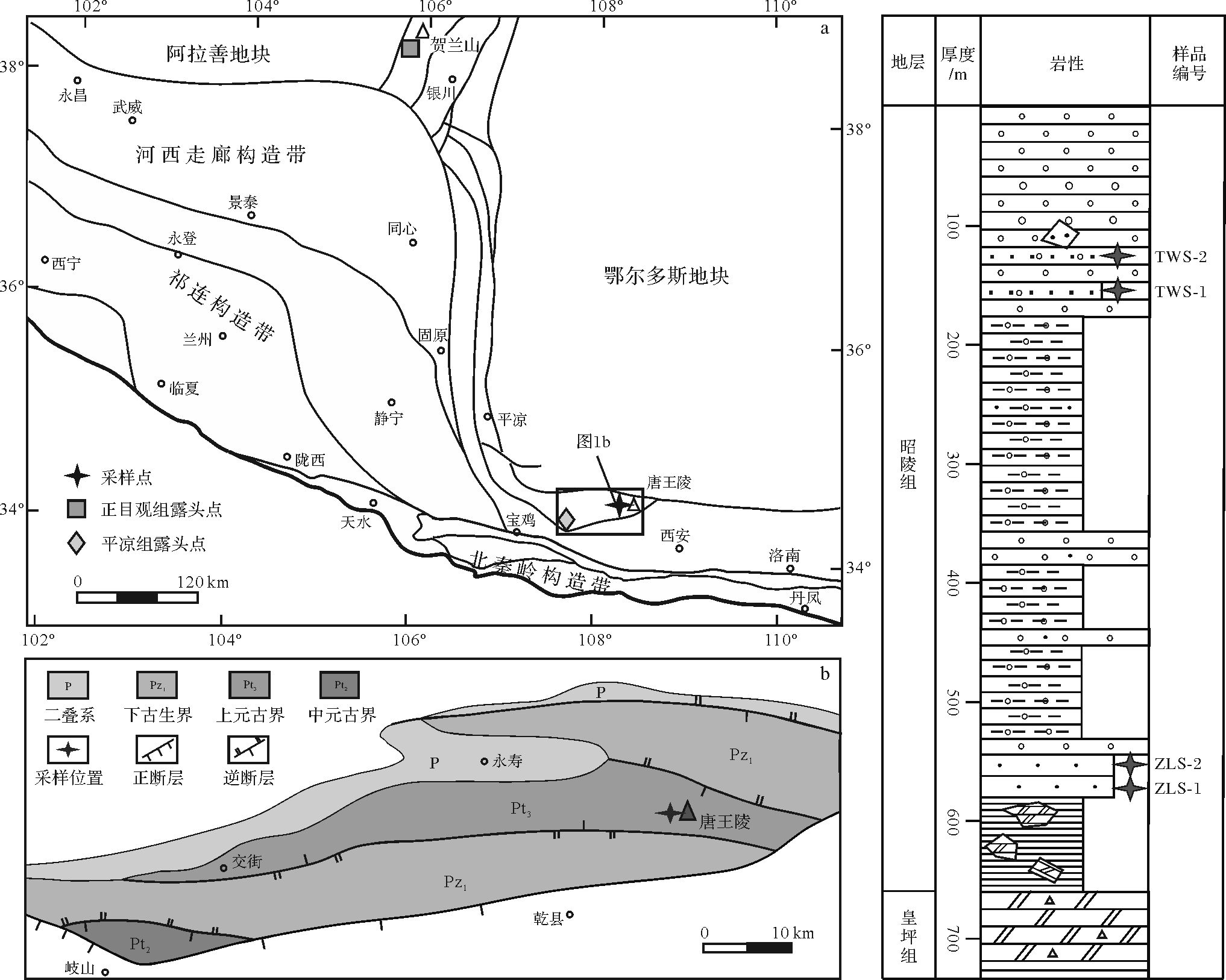
1 地质背景与采样位置鄂尔多斯盆地南缘西邻祁连—河西走廊(六盘山)—贺兰山构造带,南隔渭河地堑与秦岭造山带相依,地处稳定的鄂尔多斯(华北)地块与活动的祁连—秦岭造山带之间,具有长期复杂的区域构造背景。已有研究表明,这一地区不仅发育中晚元古代—早古生代多旋回陆缘裂陷海槽—弧后边缘海相沉积,而且至少经历了加里东晚期和燕山中期不同深度层次的挤压冲断构造变形作用,造成广义的唐王陵砾岩(庄河沟组页岩—皇坪组白云岩—昭陵组砾岩)呈狭长一带、近东西走向出露于鄂尔多斯盆地南缘的渭北隆起地区(图 1),以浅变质—强变形构造岩体的形式夹持于两条断面倾向相反的脆—韧性逆冲断层之间[24],南侧与相对较弱断褶变形的奥陶系马家沟组或平凉组之间被(礼泉)庄河沟—(岐山)窟山沟脆—韧性逆冲断层分隔,北侧东段沿张家嘴断层逆冲于宽缓断褶变形的寒武系之上,西段则被上古生界下二叠统含煤碎屑岩层系以高角度不整合关系覆盖,指示盆地南缘包括广义唐王陵砾岩在内的前二叠纪地层遭受了加里东晚期的脆—韧性逆冲褶断构造变形作用。
碎屑锆石U-Pb定年分析样品ZLS-1和ZLS-2采自唐王陵砾岩昭陵组下部含砾泥岩(或称副砾岩)层段的灰绿色砂岩夹层(图 1),其中ZLS-1采样地理坐标为34°37′19.4″ N、108°27′56.2″ E,ZLS-2采样地理坐标为34°37′20.6″ N、108°27′57.9″ E;样品TWS-1和TWS-2采自唐王陵砾岩昭陵组上部复成分砾岩(或称正砾岩)层段的浅肉红色含砾砂岩夹层(图 1),其中TWS-1采样地理坐标为34°37′44″ N、108°28′41.6″ E,TWS-2采样地理坐标为34°37′44.2″ N、108°28′45.5″ E。
|
| 图 1 鄂尔多斯盆地南缘地质构造格架与昭陵组沉积建造特征 Fig. 1 Geo-tectonics of the southern Ordos Basin and the lithologic character of Zhaoling Formation |
锆石分选在河北省区域地质矿产调查研究所实验中心进行,采用常规重液和电磁分选并结合双目镜下手工挑选的方法获取纯净锆石颗粒;锆石样品制靶、显微结构镜下观察和锆石U-Pb定年分析均在西北大学大陆动力学国家重点实验室完成。采用FEI公司XL30型SFEG电子束进行锆石阴极发光CL显微图像分析,用以进行锆石显微结构特征研究和锆石颗粒、激光剥蚀位置的选定,在此基础上开展了鄂尔多斯盆地南缘唐王陵砾岩昭陵组4件(含砾)砂岩样品的激光剥蚀等离子质谱(LA-ICP-MS)锆石U-Pb定年分析。
锆石U-Pb定年采用美国Agilent公司生产的ICP-MS激光剥蚀等离子质谱仪,分析所用单点剥蚀激光斑束直径为30 μm,频率为10 Hz,以氦气(He)作为剥蚀物质的载气,每个样品点的气体背景采集时间是30 s,信号采集时间为40 s。锆石U-Pb年龄测定以国际标准锆石91500为外标,元素含量测定以NIST610为外标,采用GLITTER(ver4.0 Macyuarie University)程序进行单颗粒锆石U-Pb原位测试数据处理[25],通过Isoplot(ver3.0)宏程序绘制锆石U-Pb年龄谐和图,选取谐和度在90%~110%的测年数据制作频率分布直方图和年龄数据讨论。若206Pb/238U年龄≥1.0 Ga,谐和度定义为(206Pb/238U年龄)/(207Pb/206Pb年龄)×100%,并以207Pb/206Pb年龄作为锆石表面年龄;若206Pb/238U年龄<1.0 Ga,谐和度定义为(206Pb/238U年龄)/(207Pb/235U年龄)×100%,并以206Pb/238U年龄作为锆石表面年龄。
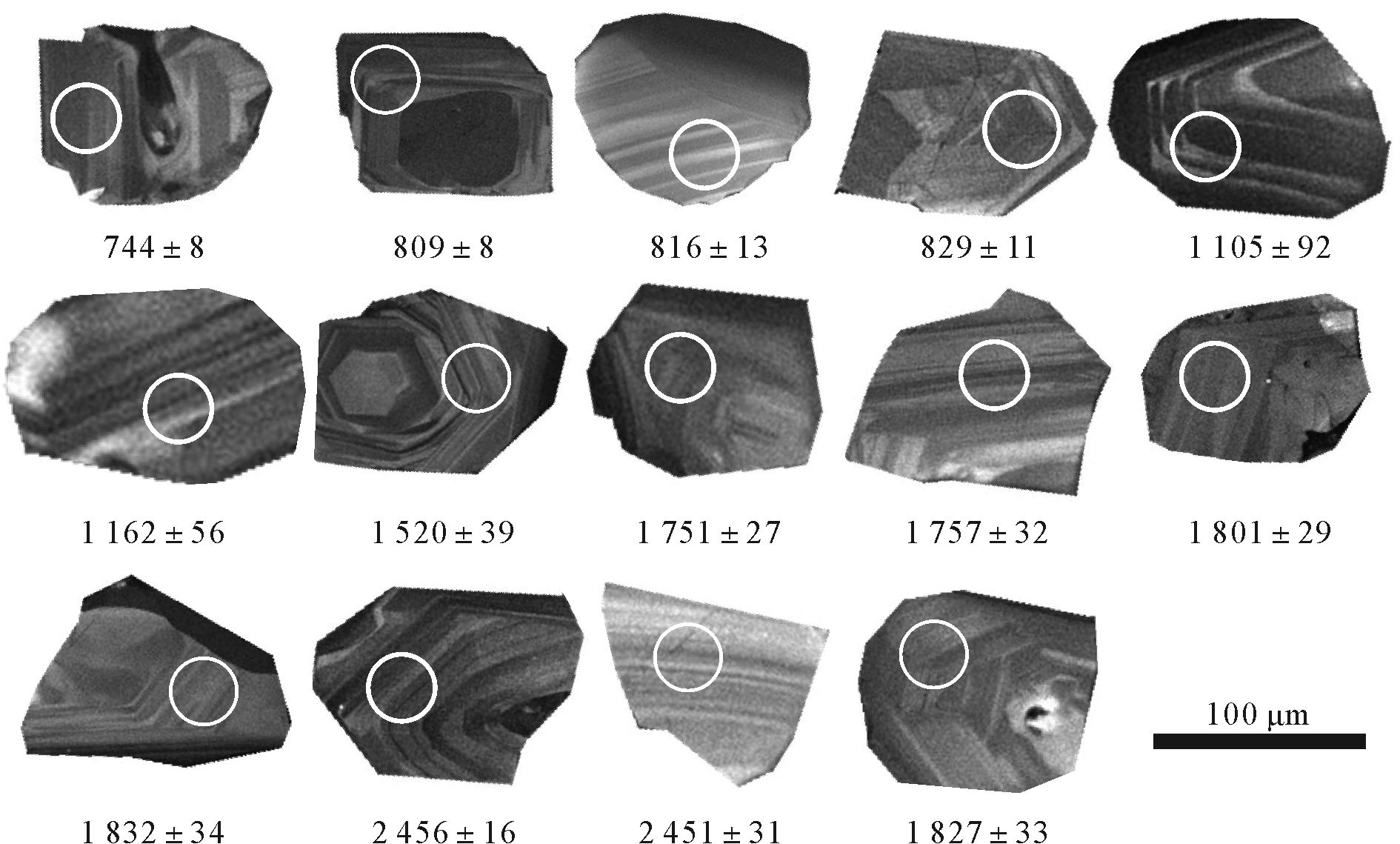
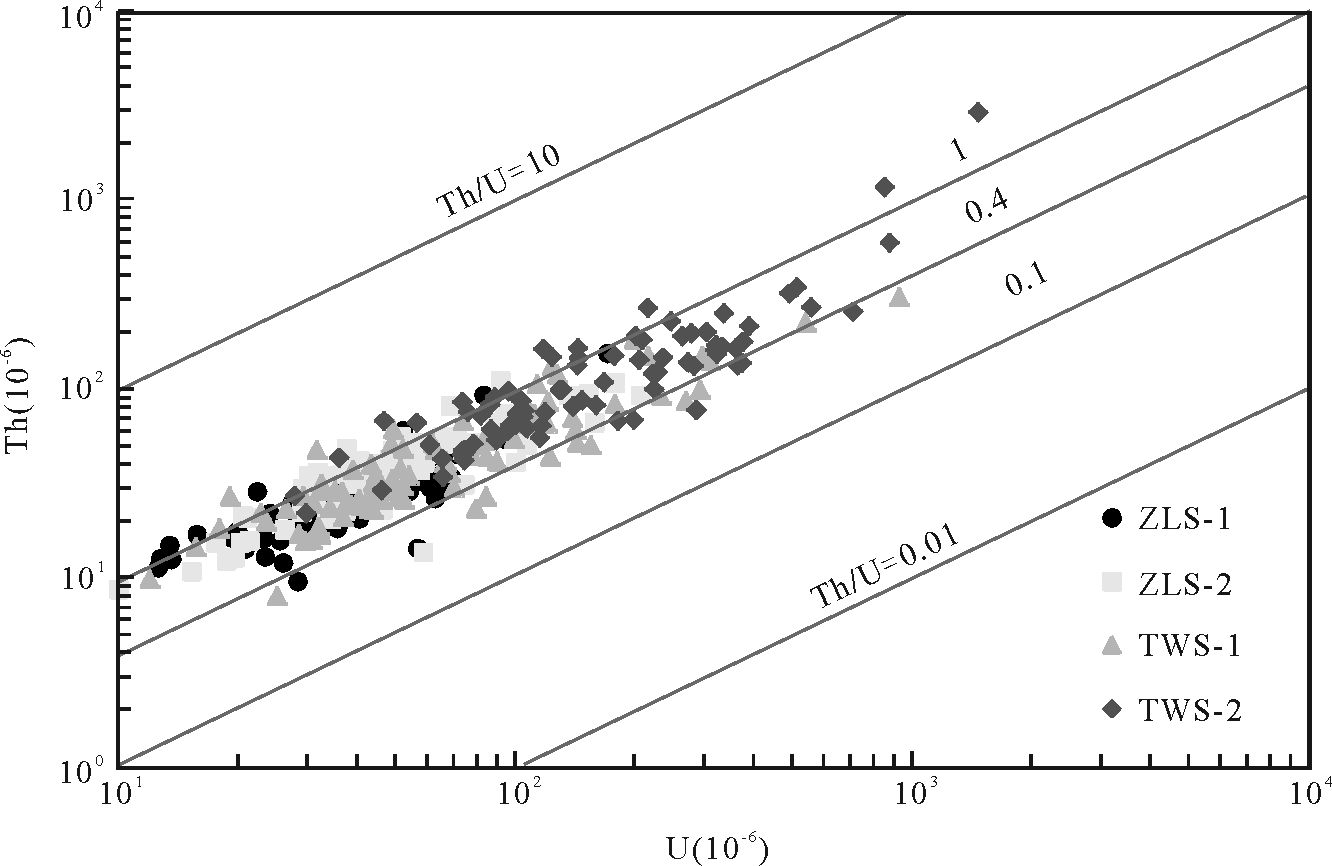
2.2 锆石成因类型唐王陵砾岩昭陵组的碎屑锆石均为玫瑰色,主要粒径为0.01~0.20 mm,磨圆度中等,说明经历了一定距离的搬运。阴极发光(CL)图像显示(图 2),绝大多数锆石具有震荡环带结构,属于岩浆成因的碎屑锆石;个别锆石颗粒具有核幔边结构,暗示该类锆石后期受到了热液变质作用影响。锆石样品点的Th、U含量及Th/U比值变化范围较大,Th、U含量分别为0.77~2 957×10-6和10.08~1 468×10-6,Th/U比值分布在0.003~2.01(图 3),其中Th/U比值大于0.4的岩浆成因锆石占94.1%、小于0.1的变质锆石仅占0.29%(1颗),进一步表明本次测试锆石多属于岩浆碎屑锆石[26, 27, 28]。
|
| 图 2 锆石阴极发光(CL)图像 Fig. 2 CL images of zircons |
|
| 图 3 锆石Th、U含量和Th/U比值 Fig. 3 Th,U content and Th/U ratios of zircons |
(1) 昭陵组下段碎屑锆石U-Pb年龄
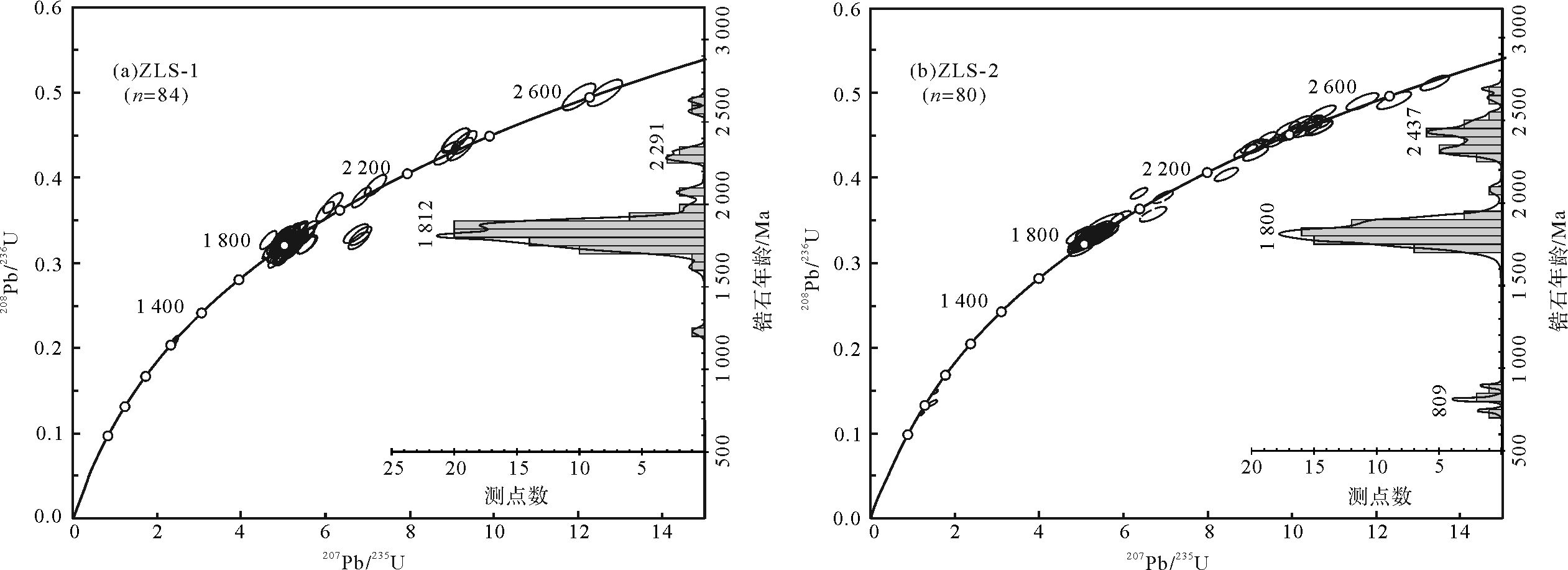
昭陵组下段偏下部的ZLS-1样品有84个测点的锆石U-Pb年龄通过了谐和度判别,测年数据分布在1 230~2 631 Ma,主要集中在1 618~1 989 Ma(n=74)和2 274~2 334 Ma(n=5)两个年龄区间,相应的峰值年龄分别为1 812 Ma和2 291 Ma (图 4a)。昭陵组下段偏上部的ZLS-2样品有80个测点的锆石U-Pb年龄通过了谐和度判别,测年数据分布在744~2 688 Ma,主要集中在744~890 Ma(n=4)、1 705~1 916 Ma(n=53)和2 284~2 531 Ma(n=20)三个年龄区间,相应的峰值年龄依次为809 Ma、1 800 Ma和 2 437 Ma(图 4b),单颗粒锆石最小年龄为744 Ma。显然,昭陵组下段两个样品都只包含较为古老的前寒武纪碎屑锆石,主峰年龄1.8 Ga±,次峰年龄接近2.3~2.4 Ga±;偏上部层段的ZLS-2样品具有相对偏小的 晚前寒武纪(744~890 Ma)年龄组分,其中包含的单 颗粒锆石U-Pb测年数据分别为744 Ma、809 Ma和890 Ma。
|
| 图 4 昭陵组下段碎屑锆石U-Pb谐和曲线与年龄谱特征 Fig. 4 Concordia curve and age spectra characteristics of detrital zircons from the lower section of Zhaoling Formation |
(2) 昭陵组上段碎屑锆石U-Pb年龄
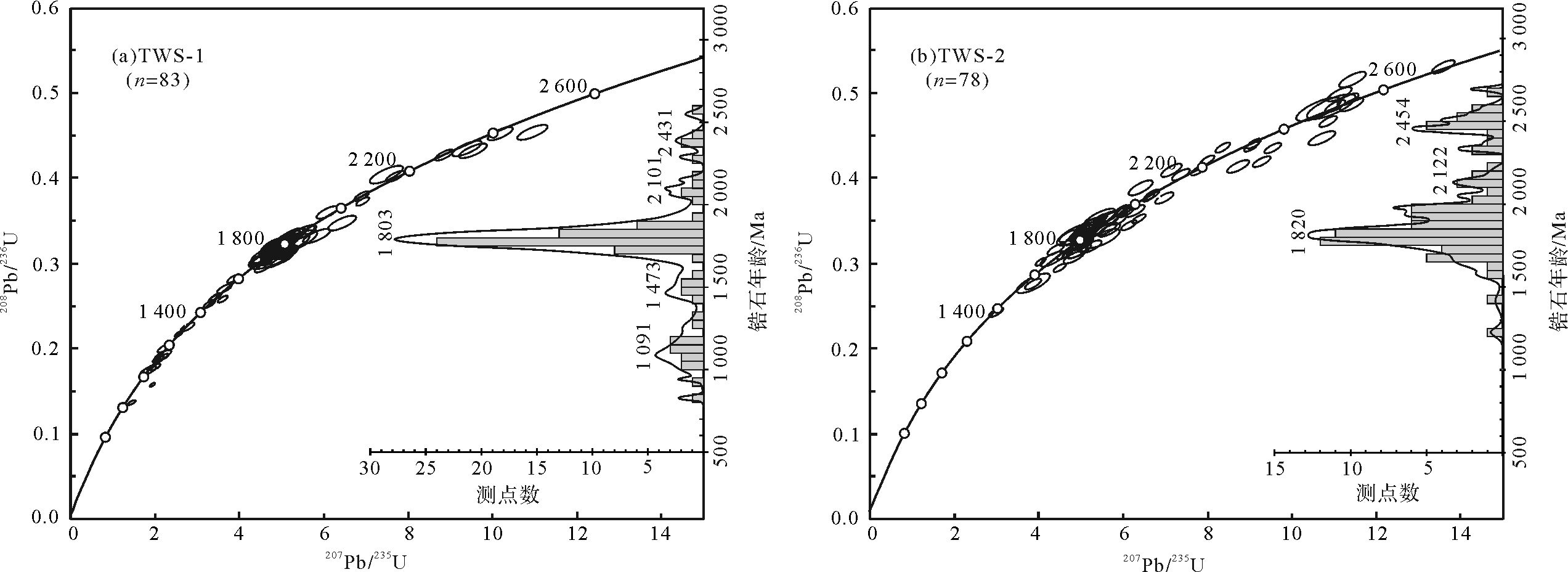
昭陵组上段偏下部的TWS-1样品有83个测点的锆石U-Pb年龄通过了谐和度判别,测年数据分布在829~2 551 Ma,主要集中在1 005~1 185 Ma(n=10)、1 449~1 586 Ma(n=6)、1 697~1 930 Ma (n=53)、2 000~2 153 Ma(n=5)和2 287~2 551 Ma (n=4)五个年龄区间,相应的峰值年龄依次为1 091 Ma、1 473 Ma、1 803 Ma、2 101 Ma和和2 433 Ma (图 5a),其中属于晚前寒武纪或新元古代的单颗粒锆石U-Pb测年数据有两个,分别为829 Ma和943 Ma。昭陵组上段偏上部的TWS-2样品有78个测点的锆石U-Pb年龄通过了谐和度判别,测年数据分布在1 226~2 696 Ma,主要集中在1 568~2 055 Ma(n=55)、2 109~2 209 Ma(n=6)和2 336~2 588 Ma (n=14) 三个年龄区间,相应的峰值年龄依次为1 820 Ma、2 122 Ma和2 454 Ma(图 5b)。显然,这两件样品与上述昭陵组下段样品基本相似,同样只包含前寒武纪碎屑锆石,且具有近乎一致的1.8 Ga±主峰年龄和大致接近的2.43~2.45 Ga±次峰年龄。从年轻年龄组分来看,昭陵组上段TWS-1样品最年轻的单颗粒锆石年龄(829 Ma)和年轻组分的峰值年龄(1 091 Ma),均比昭陵组下段ZLS-2样品相对偏老一些,但依然落入或接近晚前寒武纪年龄区间。
|
| 图 5 昭陵组上段碎屑锆石U-Pb谐和曲线与年龄谱特征 Fig. 5 Concordia curve and age spectra characteristics of detrital zircons from the upper section of Zhaoling Formation |
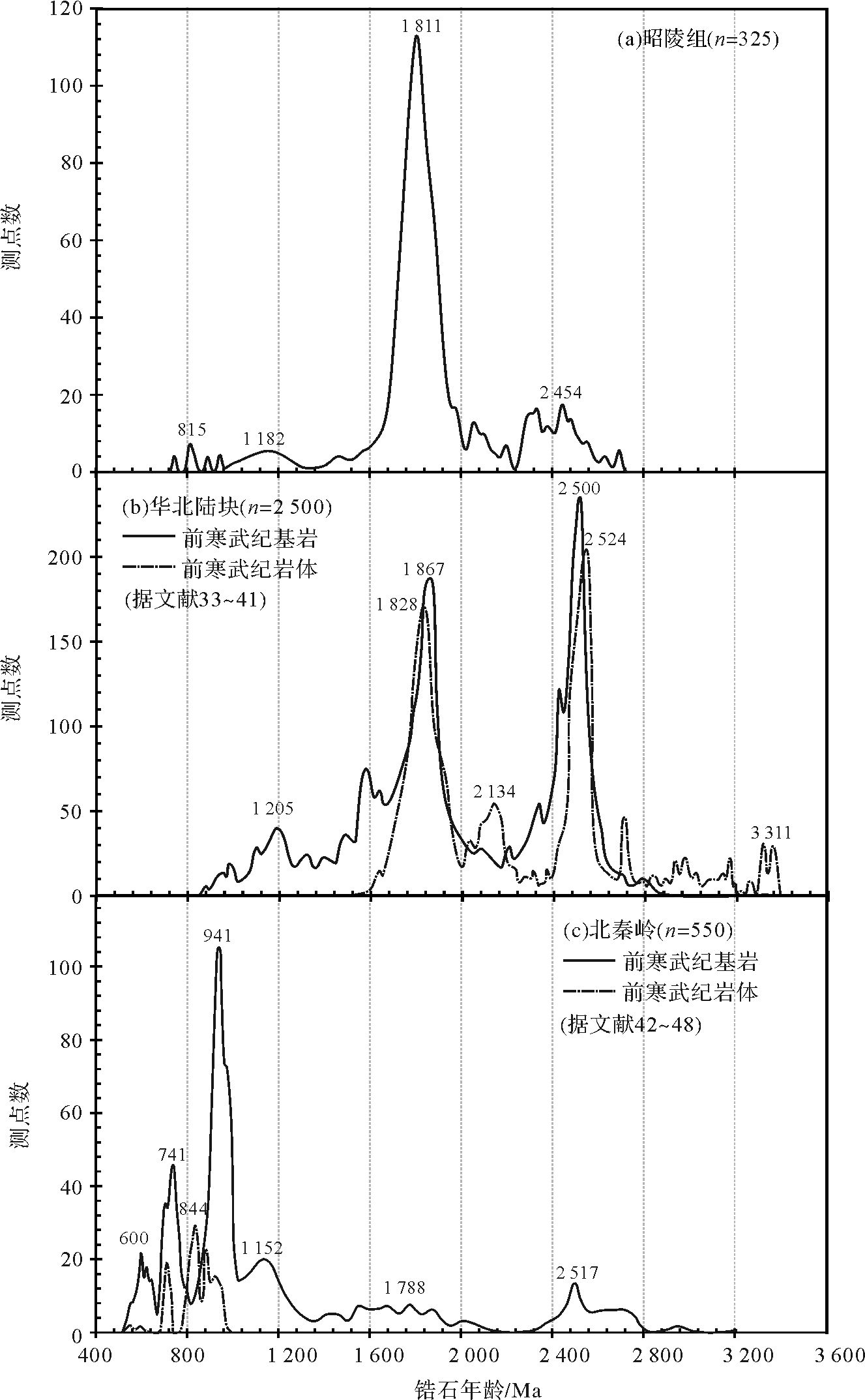
鄂尔多斯盆地南缘昭陵组4件样品锆石U-Pb年龄数据的整合统计编图结果表明,325个年龄数据分布在744~943 Ma(n=6)、1 005~1 412 Ma(n=15)、1 449~2 209 Ma(n=255)和2 274~2 696 Ma(n=49)四个年龄区间,相应的峰值年龄从新到老依次为815 Ma、1 182 Ma、1 811 Ma和2 454 Ma(图 6a),其中有两件样品的6颗锆石分别获得了属于晚前寒武纪或新元古代的744 Ma、809 Ma、816 Ma、829 Ma、890 Ma和940 Ma单颗粒碎屑锆石年轻年龄记录。由此可以看出,唐王陵砾岩昭陵组的物源碎屑组分只包含较为古老的前寒武纪碎屑锆石,明显缺乏近邻地区尤其是相邻秦岭造山带早古生代以来构造岩浆活动事件的年代学记录;测年样品的单颗粒锆石最小年龄为744 Ma,选择测年数据统计分析的年轻组分峰值年龄概率事件估计,唐王陵砾岩沉积时代的下限年龄应该不老于815 Ma。
|
| 图 6 昭陵组锆石U-Pb年龄谱的区域对比特征 Fig. 6 Comparison chart of zircon age spectra from the Zhaoling Formation and its adjacent areas |
与之相关,唐王陵砾岩昭陵组与我们新近在鄂尔多斯盆地西缘贺兰山南寺剖面获得的震旦系正目观组砾岩的碎屑锆石U-Pb年龄数据非常接近,后者的单颗粒锆石最小年龄为823 Ma,年轻组分的峰值年龄为833 Ma(另文待刊),二者的沉积建造类型和碎屑锆石U-Pb年龄谱特征显示出较好的一致性。南寺剖面正目观组砾岩上覆在中元古界蓟县系燧石条带白云岩之上、且被下寒武统苏峪口组底部磷块岩层覆盖的层型关系,很早就已基本上鲜有争议地将其划归晚前寒武纪震旦系[29, 30]。此外,唐王陵砾岩昭陵组下段泥页岩层中,翦万筹等[4]曾获得了属于前寒武纪的碳质大化石,周鼎武等[8]对该段泥页岩样品的Rb-Sr同位素测年给出了属于震旦纪的654±19 Ma铷—锶等时线年龄。因此,唐王陵砾岩昭陵组的地层时代应该主体属于晚前寒武纪或震旦纪。
与之相反,鄂尔多斯盆地南缘柳树沟剖面唐王陵砾岩昭陵组与西侧近邻岐山交街剖面奥陶系平凉组的碎屑锆石U-Pb年龄谱存在显著差异,突出地表现在平凉组砂岩及其凝灰岩夹层样品的锆石U-Pb年龄谱的主值年龄区间主要分布在407~477 Ma(n=58、占样品测点总数的72.5%),相应的峰值年龄为晚奥陶世的454 Ma[31],大致接近北秦岭地区早古生代晚期岛弧增生带构造岩浆活动的峰值年龄[32]。这不仅进一步证实平凉组的沉积时代主体属于晚奥陶世[10, 13],同时不支持先前有学者[9, 10, 11, 12, 13, 14]将包括昭陵组在内的唐王陵砾岩与平凉组对比而统一划归晚奥陶世的认识。
3.2 沉积物源鄂尔多斯盆地南缘唐王陵昭陵组砾岩4件样品的锆石U-Pb年龄谱均存在1.8 Ga±的主峰年龄,同时还以低峰态形式给出了0.8 Ga±、1.18 Ga±和1.8 Ga±的三个次级峰值年龄(图 6a)。已有研究表明,鄂尔多斯盆地所在华北陆块的早前寒武纪基底岩系普遍发育1.8 Ga±构造岩浆事件和2.5 Ga±地壳快速增生事件的峰值年龄(图 6b),但显著缺乏晚前寒武纪—古生代的锆石U-Pb年代学记录[33, 34, 35, 36, 37, 38, 39, 40, 41];鄂尔多斯盆地南缘相邻北秦岭造山带的晚前寒武纪变质杂岩则普遍存在(0.6~1.1)Ga±、尤其是0.94 Ga±的晚前寒武纪锆石U-Pb年龄主峰(图 6c),部分发育相对微弱的早前寒武纪1.78 Ga±和2.5 Ga±的次级峰值年龄[42, 43, 44, 45, 46, 47, 48]。
上述锆石U-Pb年龄谱的区域对比分析可以看出,鄂尔多斯盆地南缘唐王陵砾岩昭陵组早前寒武纪1.8 Ga±主峰年龄和2.5 Ga±次峰年龄的碎屑锆石沉积物源,主体来自于华北(鄂尔多斯)陆块的变质基底岩系;峰值年龄接近1.18 Ga±和0.8 Ga±的晚前寒武纪或新元古代的碎屑锆石沉积物源,应该主要来自于相邻北秦岭地区的晚前寒武纪火山—侵入岩或变质杂岩系。由此认为,鄂尔多斯地块(盆地)南缘晚前寒武纪或震旦纪昭陵组砾岩沉积具有分别来自(华北)稳定陆块和(北秦岭)活动带的双向混合物源特征,有可能指示晚前寒武纪或震旦纪的华北(鄂尔多斯)陆块边缘与北秦岭之间总体处于一种有限宽度域的陆缘裂陷沉积—构造环境。
4 主要结论与认识(1) 鄂尔多斯盆地南缘唐王陵昭陵组砾岩碎屑锆石U-Pb年龄主要分布在744~943 Ma(n=6)、1 005~1 412 Ma(n=15)、1 449~2 209 (n=255)和2 274~2 696 Ma(n=49)四个主值年龄区间,相应的峰值年龄主要集中在815 Ma、1 182 Ma、1 811 Ma和2 454 Ma。
(2) 鄂尔多斯盆地南缘昭陵组碎屑锆石U-Pb年龄谱及其年轻年龄组分(744~943 Ma)与盆地西缘贺兰山的震旦纪正目观组基本一致,但明显有别于同一区带晚奥陶世平凉组的碎屑锆石U-Pb年龄分布特征,由此限定唐王陵昭陵组砾岩的地层时代为晚前寒武纪或震旦纪。
(3) 碎屑锆石U-Pb年龄谱的区域对比分析结果表明,唐王陵昭陵组砾岩的沉积物源具有分别来自(华北)稳定陆块和(北秦岭)活动带的双向混合物源特征,有可能暗示晚前寒武纪的华北(鄂尔多斯)陆块边缘与北秦岭之间总体处于一种有限宽度域的陆缘裂陷沉积—构造环境。
| [1] | 张文堂,朱兆玲,袁克兴,等. 华北南部、西南部寒武系及上前寒武系的分界[J]. 地层学杂志,1979,3(1):51-56. [Zhang Wentang, Zhu Zhaoling, Yuan Kexing. et al. Boundaries of Earlier Precambrian and Precambrian in southern and southwest of North China Plate[J]. Journal of Stratigraphy, 1979, 3(1): 51-56.] |
| [2] | 刘鸿允,董榕生,李建林,等. 论震旦系划分与对比问题[J]. 地质科学,1980(4):307-321. [Liu Hongyun, Dong Rongsheng, Li Jianlin, et al. Problems of classification and correlation of the Sinian System[J]. Scientia Geological sinica, 1980(4): 307-321.] |
| [3] | 张吉森,费安琦. 陕西礼泉县唐王岭震旦纪晚期冰碛砾岩[J]. 地层学杂志,1981,5(1):10-15. [Zhang Jisen, Fei Anqi. Ice conglomerate debt of Late Sinian in Tangwangling Shaanxi province[J]. Journal of Stratigraphy, 1981, 5(1): 10-15.] |
| [4] | 翦万筹,叶俭. 论“唐王陵砾岩”的层位[J]. 西安地质学院学报,1983,5(2):1-8. [Jian Wanchou, Ye Jian. A discussion about the formation on conglomerate of Tangwangling[J]. Journal of Xi'an Geological Institute, 1983, 5(2): 1-8.] |
| [5] | 叶俭,成玉,兰晓东,等. 昭陵砾岩的成因[J]. 长安大学学报:地球科学版,1983(1):8-21. [Ye Jian, Cheng Yu, Lan Xiaodong, et al. The cause of Zhaoling conglomerates[J]. Journal of Chang'an University: Earth Science Edition, 1983(1): 8-21.] |
| [6] | 傅嘉媛. 陕西礼泉唐王陵组微古植物组合及其地层时代讨论[C]//中国地质科学院天津地质矿产研究所论文集. 北京:中国地质学会,1985,13:75-86. [Fu Jiayuan. Micropalaeoflora assemblage from Tangwangling formation of Liquan, Shaanxi and discussion on its stratigraphic age[C]//Proceedings of Bulletin Tianjin Institute Geology and Mineral Resources. Beijing: Geological Society of China, 1985, 13: 75-86.] |
| [7] | 邵磊. 陕西乾县磨子沟晚前寒武纪地层新资料[J]. 西北大学学报:自然科学版,1988,18(1): 96-106. [Shao Lei. The new data about the Late Precambrian strata of Mozigou in Qianxian county, Shaanxi province[J]. Journal of Northwest University: Natural Science Edition, 1988, 18(1): 96-106.] |
| [8] | 周鼎武,赵重远,李银德,等. 鄂尔多斯盆地西南缘地质特征及其与秦岭造山带的关系[M]. 北京:地质出版社,1994:1-178. [Zhou Dingwu, Zhao Chongyuan, Li Yinde, et al. Geological Features of Southwest Margin of Ordos Basin and Its Relationships with Qinling orogenic belt[M]. Beijing: Geological Publishing House, 1994: 1-178.] |
| [9] | 李钦仲,杨应章,贾金昌. 陕西礼泉“唐王陵砾岩”的时代及其成因[J]. 陕西地质,1983,1(1): 47-56,78-79. [Li Qinzhong, Yang Yingzhang, Jia Jinchang. Age and origin of the Tangwangling Conglomerate of Liquan in Shaanxi[J]. Geology of Shaanxi, 1983, 1(1): 47-56, 78-79.] |
| [10] | 张二朋,陈书铭. 陕西省区域地质志[M]. 西安:陕西省地质矿产局,1982:1-637. [Zhang Erpeng, Chen Shuming, Regional Geology of Shaanxi Province, People,s Republic of China[M]. Xi,an: Geology and Mineral Resources of Shaanxi Province, 1982: 1-637.] |
| [11] | 陈万川,郝蜀民,黄家斌. 陕西唐王陵组沉积物重力流特征和形成机理[J]. 石油实验地质,1984,6(3):203-212. [Chen Wanchuan, Hao Shumin, Huang Jiabin. Characteristics and formational mechanism of the sediment gravity flow of the Tangwangling Formation of Shaanxi[J]. Experimental Petroleum Geology, 1984, 6(3): 203-212.] |
| [12] | 洪庆玉. 唐王陵组岩石学特征及沉积物重力流[J]. 石油与天然气地质,1985,6(1):49-59. [Hong Qingyu. On the petrology and sediment gravity flows of the Tangwangling Formation[J]. Oil and Gas Geology, 1985, 6(1): 49-59.] |
| [13] | 马润华. 陕西省岩石地层[M]. 武汉:中国地质大学出版社,1998:1-291. [Ma Runhua. Rock Formations of Shaanxi Province[M]. Wuhan: China University of Geosciences Press, 2008: 1-291.] |
| [14] | 何自新,杨华,袁效奇. 鄂尔多斯盆地地质剖面图集[M]. 北京:石油工业出版社,2004:1-422. [He Zixin, Yang Hua, Yuan Xiaoqian. The Geological Section Atlas of Ordos Basin[M]. Beijing: Petroleum Industry Press, 2004: 1-422.] |
| [15] | Rainbird R H, Hamilton M A, Young G M. Detrital zircon geochronology and provenance of the Torridonian NW Scotland[J]. Journal of the Geological Society, 2001, 158(1): 15-27. |
| [16] | Stewart J H, Gehrels G E, Barth A P, et al. Detrital zircon provenance of Mesoproterozoic to Cambrian arenites in the western United States and northwestern Mexico[J]. Geological Society of America Bulletin, 2001, 113(10): 1343-1356. |
| [17] | Surpless K D, Graham S A, Covault J A, et al. Does the Great Valley Group contain Jurassic strata? Reevaluation of the age and early evolution of a classic forearc basin[J]. Geology, 2006, 34(1): 21-24. |
| [18] | Brown E H, Gehrels G E. Detrital zircon constraints on terrane ages and affinities and timing of orogenic events in the San Juan Islands and North Cascades, Washington[J]. Canadian Journal of Earth Science, 2007, 44(10): 1375-1396. |
| [19] | Andersen T. “Detrital zircons as tracers of sedimentary provenance: limiting conditions from statistics and numerical simulation” authors response to a comment by Dr. P. Vermeesch[J]. Chemical Geology, 2006, 226(1/2): 74-75. |
| [20] | 闫义,林舸,王岳军,等. 盆地陆源碎屑沉积物对源区构造背景的指示意义[J]. 地球科学进展,2002,17(1):85-90. [Yan Yi, Lin Ge, Wang Yuejun, et al. The indication of continental detrital sediment to tectonic setting[J]. Advance in Earth Sciences, 2002, 17(1): 85-90.] |
| [21] | Bhatia M R. Plate tectonics and geochemical composition of sandstones[J]. The Journal of Geology, 1983, 91(6): 611-627. |
| [22] | Nelson D R. An assessment of the determination of depositional ages for Precambrian clastic sedimentary rocks by U-Pb dating of detrital zircons[J]. Sedimentary Geology, 2001, 141-142: 37-60. |
| [23] | Dickinson W R, Gehrels G E. Use of U-Pb ages of detrital zircons to infer maximum depositional ages of strata: a test against a Colorado Plateau Mesozoic database[J]. Earth and Planetary Science Letters, 2009, 288(1/2): 115-125. |
| [24] | 袁卫国,王平. 鄂尔多斯盆地南部地区的加里东运动[J]. 西安地质学院学报,1996,18(1):36-42. [Yuan Weiguo, Wang Ping. On the Caledonian movement in the southern Eerduos Basin[J]. Journal of Xi'an college of Geology, 1996, 18(1): 36-42.] |
| [25] | Yuan Honglin, Gao Shan, Liu Xiaoming, et al. Accurate U-Pb age and trace element determinations of zircon by laser ablation-inductively coupled plasma-mass spectrometry[J]. Geostandards and Geoanalytical Research, 2004, 28(3): 353-370. |
| [26] | Belousova E A, Griffin W L, O'Reilly S Y, et al. Igneous zircon: trace element composition as an indicator of source rock type[J]. Contributions to Mineralogy and Petrology, 2002, 143(5): 602-622. |
| [27] | Corfu F, Hanchar J M, Hoskin P W O, et al. Atlas of zircon textures[J]. Reviews in Mineralogy and Geochemistry, 2003, 53(1): 469-495. |
| [28] | 吴元保,郑永飞. 锆石成因矿物学研究及其对U-Pb年龄解释的制约[J]. 科学通报,2004,49(16):1589-1604. [Wu Yuanbao, Zheng Yongfei. Genesis of zircon and its constraints on interpretation of U-Pb age[J]. Chinese Science Bulletin, 2004, 49(16): 1589-1604.] |
| [29] | 霍福臣. 宁夏地质概论[M]. 北京:科学出版社,1989:1-287. [Huo Fuchen. Introduction to Geology in Ningxia[M]. Beijing: Science Press, 1989: 1-287.] |
| [30] | 宁夏回族自治区地质矿产局. 宁夏回族自治区区域地质志[M],北京:地质出版社,1990:1-522. [Bureau of Geology and mineral resources of the Ningxia Hui Autonomous Region. Regional Geology of Ningxia Hui Autonomous Region[M]. Beijing: Geological Publishing House, 1990: 1-522.] |
| [31] | 杨甫,陈刚,陈强,等. 鄂尔多斯盆地西南缘上奥陶统平凉组碎屑岩锆石U-Pb年龄及物源分析[J]. 地质论评,2015,61(1):172-182. [Yang Fu, Chen Gang, Chen Qiang, et al. U-Pb dating of detrital zircon from Upper Ordovician Pingliang Formation in the southwest margin of the Ordos Basin and provenance analysis[J]. Geological Review, 2015, 61(1): 172-182.] |
| [32] | 张成立,刘良,王涛,等. 北秦岭早古生代大陆碰撞过程中的花岗岩浆作用[J]. 科学通报,2013,58(23):2323-2329. [Zhang Chengli, Liu Liang, Wang Tao, et al. Granitic magmatism related to Early Paleozoic continental collision in the North Qinling belt[J]. Chinese Science Bulletin, 2013, 58(23): 2323-2329.] |
| [33] | Guan Hong, Sun Min, Wilde S A, et al. SHRIMP U-Pb zircon geochronology of the Fuping Complex: implications for formation and assembly of the North China Craton[J]. Precambrian Research, 2002, 113(1/2): 1-18. |
| [34] | Zhao Guochun, Wilde S A, Cawood P A, et al. SHRIMP U-Pb zircon ages of the Fuping Complex: implications for Late Archean to Paleoproterozoic accretion and assembly of the North China Craton[J]. American Journal of Science, 2002, 302(3): 191-226. |
| [35] | 赵太平,翟明国,夏斌,等. 熊耳群火山岩锆石SHRIMP年代学研究:对华北克拉通盖层发育初始时间的制约[J]. 科学通报,2004,49(22):2342-2349. [Zhao Taiping, Zhai Mingguo, Xia Bin, et al. Zircon U-Pb SHRIMP dating for the volcanic rocks of the Xiong'er Group: constraints on the initial formation age of the cover of the North China Craton[J]. Chinese Science Bulletin, 2004, 49(22): 2342-2349.] |
| [36] | 耿元生,杨崇辉,宋彪,等. 吕梁地区18亿年的后造山花岗岩:同位素年代和地球化学制约[J]. 高校地质学报,2004,10(4):477-487. [Geng Yuansheng, Yang Chonghui, Song Biao, et al. Post-orogenic granites with an age of 1800 Ma in Lvliang area, North China Craton: Constraints from isotopic geochronology and geochemistry[J]. Geological Journal of China Universities, 2004, 10(4): 477-487.] |
| [37] | 翟明国,胡波,彭澎,等. 华北中—新元古代的岩浆作用与多期裂谷事件[J]. 地学前缘,2014,21(1):100-119. [Zhai Mingguo, Hu Bo, Peng Peng, et al. Meso-Neoproterozoic magmatic events and multi-stage rifting in the NCC[J]. Earth Science Frontiers, 2014, 21(1): 100-119.] |
| [38] | Wan Yusheng, Wilde S A, Liu Dunyi, et al. Further evidence for -1.85 Ga metamorphism in the Central Zone of the North China Craton: SHRIMP U-Pb dating of zircon from metamorphic rocks in the Lushan area, Henan province[J]. Gondwana Research, 2006, 9(1/2): 189-197. |
| [39] | 第五春荣,孙勇,袁洪林,等. 河南登封地区嵩山石英岩碎屑锆石U-Pb年代学、Hf同位素组成及其地质意义[J]. 科学通报,2008,53(16):2828-2839. [Diwu Chunrong, Sun Yong, Yuan Honglin, et al. U-Pb ages and Hf isotopes for detrital zircons from quartzite in the paleoproterozoic Songshan Group on the southwestern margin of the North China Craton[J]. Chinese Science Bulletin, 2008, 53(18): 2828-2839.] |
| [40] | 赵国春. 华北克拉通基底主要构造单元变质作用演化及其若干问题讨论[J]. 岩石学报,2009,25(8):1772-1792. [Zhao Guochun. Metamorphic evolution of major tectonic units in the basement of the North China Craton: Key issues and discussion[J]. Acta Petrologica Sinica, 2009, 25(8): 1772-1792.] |
| [41] | Wilde S A, Zhao Guochun. Archean to Paleoproterozoic evolution of the North China Craton[J]. Journal of Asian Earth Sciences, 2005, 24(5): 519-522. |
| [42] | Shi Yu, Yu Jinhai, Santosh M. Tectonic evolution of the Qinling orogenic belt, Central China: new evidence from geochemical, zircon U-Pb geochronology and Hf isotopes[J]. Precambrian Research, 2013, 231: 19-60. |
| [43] | Wang Tao, Wang Xiaoxia, Zhang Guowei, et al. Remnants of a Neoproterozoic collisional orogenic belt in the core of the Phanerozoic Qinling orogenic belt (China)[J]. Gondwana Research, 2003, 6(4): 699-710. |
| [44] | 王洪亮,何世平,陈隽璐,等. 北秦岭西段胡店片麻状二长花岗岩LA-ICP-MS锆石U-Pb测年及其地质意义[J]. 中国地质,2007,31(1):17-25. [ Wang Hongliang, He Shiping, Chen Junlu, et al. LA-ICP-MS zircon U-Pb dating of the Hudian gneissic monzogranite in the western segment of the North Qinling and its geological significance[J]. Geology in China, 2007, 31(1): 17-25.] |
| [45] | Chen Zhihong, Lu Songnian, Li Huaikun, et al. Constraining the role of the Qinling orogen in the assembly and break-up of Rodinia: tectonic implications for Neoproterozoic granite occurrences[J]. Journal of Asian Earth Sciences, 2006, 28(1): 99-115. |
| [46] | 第五春荣,孙勇,刘良,等. 北秦岭宽坪岩群的解体及新元古代N-MORB[J]. 岩石学报,2010,26(7):2025-2038. [Diwu Chunrong, Sun Yong, Liu Liang, et al. The disintegration of Kuanping Group in North Qinling orogenic belts and Neo-proterozoic N-MORB[J]. Acta Petrologica Sinica. 2010, 26(7): 2025-2038.] |
| [47] | 杨力,陈福坤,杨一增,等. 丹凤地区秦岭岩群片麻岩锆石U-Pb年龄:北秦岭地体中—新元古代岩浆作用和早古生代变质作用的记录[J]. 岩石学报,2010,26(5):1589-1603. [Yang Li, Chen Fukun, Yang Yizeng, et al. Zircon U-Pb ages of the Qinling Group in Danfeng area: recording mesoproterozoic and neoproterozoic magmatism and Early Paleozoic metamorphism in the North Qinling terrain[J]. Acta Petrologica Sinica, 2010, 26(5): 1589-1603.] |
| [48] | 万渝生,刘敦一,董春艳,等. 西峡北部秦岭群变质沉积岩锆石SHRIMP定年:物源区复杂演化历史和沉积、变质时代确定[J]. 岩石学报,2011,27(4):1172-1178. [Wan Yusheng, Liu Dunyi, Dong Chunyan, et al. SHRIMP zircon dating of meta-sedimentary rock from the Qinling Group in the north of Xixia, North Qinling Orogenic Belt: constraints on complex histories of source region and timing of deposition and metamorphism[J]. Acta Petrologica Sinica, 2011, 27(4): 1172-1178.] |