 2015, Vol. 33
扩展功能

文章信息
- 杨仁超, 金之钧, 孙冬胜, 樊爱萍
- YANG RenChao, JIN ZhiJun, SUN DongSheng, FAN AiPing
- 鄂尔多斯晚三叠世湖盆异重流沉积新发现
- Discovery of Hyperpycnal Flow Deposits in the Late Triassic Lacustrine Ordos Basin
- 沉积学报, 2015, 33(1): 10-20
- ACTA SEDIMENTOLOGICA SINCA, 2015, 33(1): 10-20
- 10.14027/j.cnki.cjxb.2015.01.002
-
文章历史
- 收稿日期:2013-11-08
- 收修改稿日期:2014-04-15


2. 中国石化股份公司石油勘探开发研究院 北京 100083
2. Petroleum Exploration and Production Research Institute, SINOPEC, Beijing 100083
深水砂质沉积不仅记录了输入盆地的重力流,而且是具有重要经济价值的油气储层,成为当前学术研究和油气工业共同关注的焦点[1,2,3],但人们对于这些将碎屑沉积物远距离搬运至深水盆地的流体仍然知之甚少[4]。虽然滑塌型浊流和砂质碎屑流理论可以解释一些深水砂体的成因,但滑塌型浊流和砂质碎屑流的发生不仅需要碎屑物质在盆地边缘的长期积累,且需要一定的触发机制,而受气候控制的季节性洪水事件更易发生。笔者在鄂尔多斯盆地南部延长组长7~长6油层组深湖相沉积中,发现一种沉积特征明显不同于砂质碎屑流沉积和滑塌浊积岩的深水砂体,认为是洪水异重流的沉积产物——异重岩。异重流沉积对于深湖相砂体的成因研究、湖盆中心地区的储层预测和油气勘探具有重要意义。 1 研究进展与地质概况 1.1 异重流的概念、形成条件与识别标志
经典的“触发型”浊流学说解释了一部分深海沉积物的成因,肯定了事件沉积的重要意义[5],但如何确保“触发型”浊流赖以发生的大量沉积物的快速积累?大量的深水砂岩是否主要为滑塌浊积岩?砂质碎屑流理论部分地否定了经典的浊积岩鲍马序列[6];而异重流新认识是对“触发型”浊流理论提出了有益的补充[7,8,9,10]。一些河口无三角洲的深水峡谷沉积显然与“触发型”浊流无关,沉积物以一种高密度流的形式向盆地搬运,Bates[11]将这种与洪水期河流有关的高密度流称为异重流(hyperpycnal flow)。Mulder等[7]将源自洪水输入的异重流沉积与滑坡形成的“触发型”浊流沉积区分开来,异重流即洪水形成的稳定性浊流[8,9]。因此,广义的浊流应包括:①受偶然因素诱发斜坡滑塌而成的“触发型”浊流;②由高密度洪水潜入低密度水体形成的稳定性浊流——异重流。
尽管针对异重流曾存在质疑[12],但异重流作为一种将沉积物搬运到深水盆地的重要机制引起了广泛关注[10,13,14]。异重流及其沉积物——hyperpycnite(异重岩?)广泛存在于现代沉积和中—新生代沉积地层中[15,16,17]。对异重流及其产物——hyperpycnite(异重岩?)的研究已成为国外研究的热点[10,14,16,18]。许多现代河流都可能产生异重流[13,19,20,21],小型富泥砂河流能够形成异重流,彻底改变了人们关于沉积物从陆到海搬运的观念[22,23],异重岩的提出要求人们重新认识狭义的“触发型”浊流沉积——滑塌浊积岩[24]。
异重流的形成主要受构造、气候、地形、水体密度差和水深等因素控制。异重流可以保存一系列气候和构造背景记录[25]。季节性的洪水河流,尤其是山区的短源河流是形成异重流的重要机制[10,26,27]。发生异重流的密度条件仍有较大争议,从1~40 kg/m3不等[28]。异重流的形成受两种水体的密度差、地形、流速等因素影响,单独讨论浓度条件是有失偏颇的。对于主要受气候和构造控制的陆相淡水湖盆而言,地形陡峭、洪水频发、碎屑物质供给丰富、湖水密度较低等特征容易满足异重流的形成条件。
典型的异重流沉积或异重岩序列的特征为:一系列底部向上变粗的单元(洪水增强期)和向上变细的单元(洪水衰退期)成对出现[13];但同一岩层内的逆粒序和正粒序也可能由碎屑流的强弱转换形成[29],故粒序特征不是异重岩的唯一标识,需根据粒序组合及其它特征综合判断。其它沉积特征还有:洪峰期形成的层内微侵蚀面有时将粒序层隔开[23,25];序列底部常有侵蚀面,粒度与浊积岩相似,杂基含量甚高,砂层多为杂基支撑,顶部为水平层理的泥质覆盖;槽模、工具模等底模构造可见[30];顶部富含陆源有机质(顶部具陆源有机质层)和淡水硅藻[9,14]。
异重流作为一种特殊类型的浊流,与砂质碎屑流、“触发型”浊流等存在复杂的关系[3,31]。地震、火山等构造活动、风暴、波浪、孔隙压力的释放引起的斜坡失稳是“触发型”浊流发生的主要原因[32,33,34,35,36];浊流可能源自富砂河口坝(或分流河道)的垮塌,或直接源自洪水异重流[37]。斜坡自上向下可经历崩塌—碎屑流—浊流的演化序列[13];浊流也可向碎屑流转变[38,39];一次流体事件可具多种流体形式,并伴随着流体类型的转换[4,16,40]。由于不同类型的重力流可发生于统一的地质背景中,故异重流沉积可与砂质碎屑流、滑塌型浊流沉积共存,流体的多样性决定了重力流沉积类型的复杂性,不能以偏代全。 1.2 地质概况
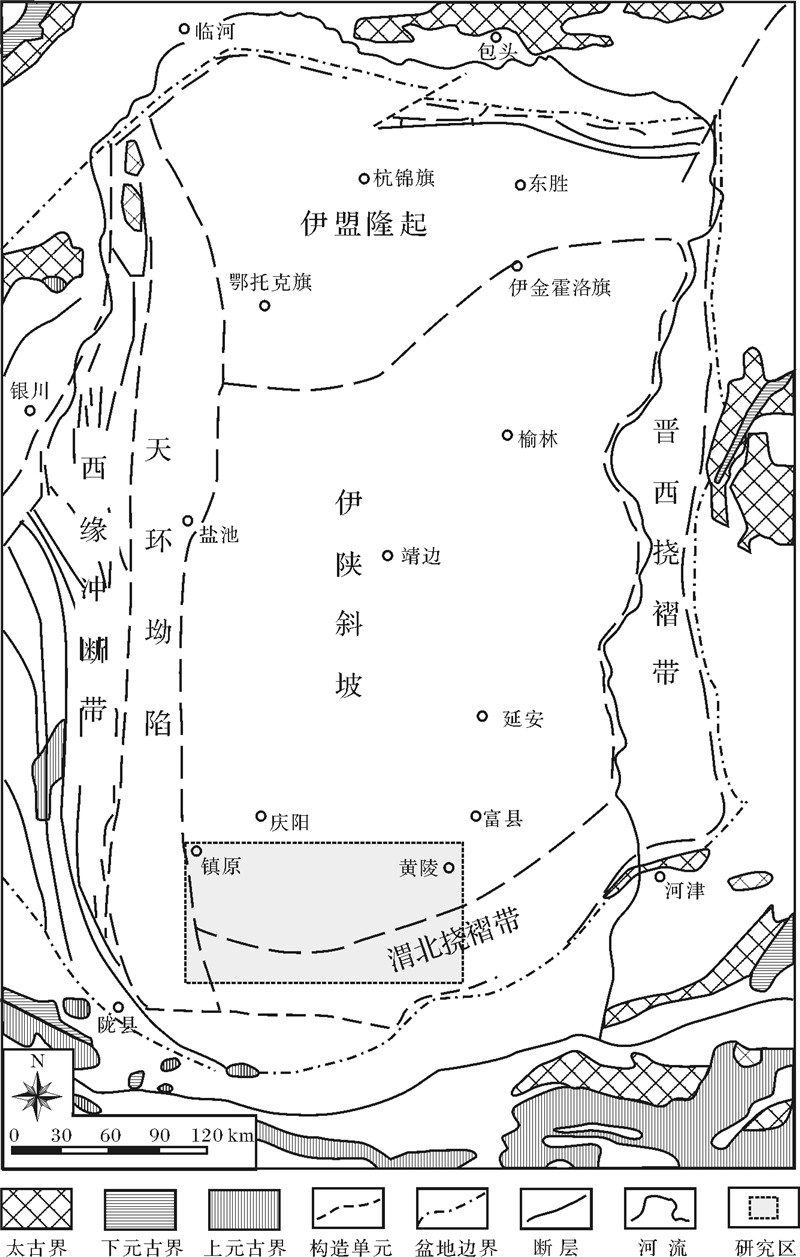
鄂尔多斯盆地面积约25×104 km2,盆地南、北分别被渭河地堑、河套地堑分隔,东、西分别为晋西挠褶带和西缘逆冲断裂带所夹持,其主体部分伊陕斜坡为一地层坡度一般不足1°的不对称单斜构造。盆地边缘断裂褶皱较发育,盆地内部构造相对简单。研究区位于鄂尔多斯盆地南部,跨伊陕斜坡、渭北挠褶带及天环坳陷3个一级构造单元(图 1);范围主要包括镇原、泾川、彬县、长武、旬邑和宜君等地区。上三叠统延长组以河流、三角洲和湖泊沉积为主,厚度在1 000~1 300 m之间,底部与中三叠统纸坊组呈假整合接触,顶部有不同程度的侵蚀,与下侏罗统延安组呈假整合接触。自下而上以凝灰岩标志层(K0~K9)的出现和电性特征,可划分为10个油层组(长1~长10)。其中长7沉积期是湖盆发育鼎盛时期,也是中生界烃源岩最发育的时期。
|
| 图 1 鄂尔多斯盆地构造单元图 Fig. 1 Tectonic units of Ordos Basin |
鄂尔多斯盆地上三叠统深水砂体为浊积岩的观点曾对后续研究产生了重要影响[41,42],并衍生了滑塌浊积岩[43,44]、厚层块状浊积岩[45]与坡移浊积扇[46]等多种解释。邹才能等[47]曾提出湖盆中心发育洪水浊积扇及滑塌浊积扇等重力流成因砂体;延长组砂质碎屑流最为发育[48,49],深水沉积研究中夸大了浊流沉积作用[50];厚层砂体可能为深水重力流—牵引流沉积复合体 [51]。中三叠末期,扬子板块与华北板块的缝合造成秦岭的快速隆升和鄂尔多斯盆地的拗陷;盆地南、西南方向的秦岭地区和六盘山地区提供了丰富的碎屑物源[52];盆地南部古地形较陡,坡度3.5°~5.5°;延长组沉积物特征与古生物化石反映了温湿的古气候条件;张家滩油页岩(长7下部)沉积于最大湖泛期,深湖相沉积广布。上述背景预示鄂尔多斯盆地南部晚三叠世具备重力流(包括异重流)的发育条件。尽管国内曾有学者论及洪水期河流的注入可形成湖底重力流成因砂体[47,48],但具说服力的实例较少,与滑塌浊积岩的区别仍不明显。 2 延长组异重岩 2.1 岩芯中的宏观特征
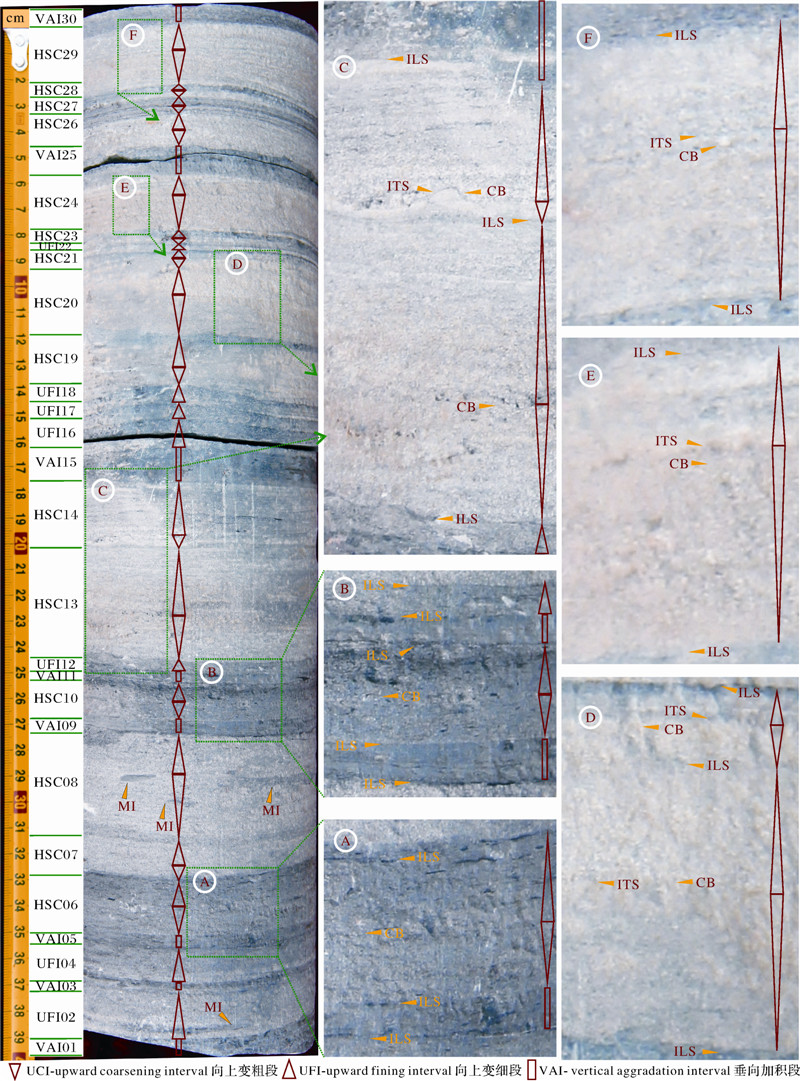
研究区异重流沉积的宏观特征为:一系列反映洪水增强期的逆粒序和洪水衰减期的正粒序成对出现;泥质含量与粒序特征一致,粒度越细,泥质含量越高;事件沉积层界面处片状云母矿物富集;层内可见微侵蚀面;形成于深水沉积背景,事件沉积层可为垂向加积的深湖相暗色泥岩间隔。现以泾河4井长7油层组岩芯(张家滩油页岩之上)为例,说明异重流沉积的宏观特征。在一段39.5 cm长的岩芯中,发育了反映不同沉积作用类型和多期事件的30个沉积细层(图 2),由垂向加积层、正粒序层、逆粒序—正粒序层等细层构成了深湖背景下的异重流沉积。通过局部放大,发现即使厚度仅2.5 cm的泥质岩也是由不同的沉积作用形成(图 2A,B),灰黑色纯泥岩代表了滞水环境下的垂向加积作用(VAI);之上的深灰色泥质岩细层代表一次事件沉积,下部逆粒序(UCI)与上部正粒序(UFI)分别代表了事件沉积作用的逐渐增强然后衰弱;内部界线模糊,较粗碎屑物(CB)含量在中部最高,中部颜色略浅;但事件沉积层(HSC)与滞水环境灰黑色泥岩之间界线(ILS)清楚。
砂岩细层内部的逆粒序—正粒序组合、泥质含量和颜色变化也记录了洪水事件的增强而后减弱,最大洪峰的能量足够强时,可能对早先沉积的逆粒序层产生一定的侵蚀,有时可见层内微侵蚀面(ITS),一般对应于层内粒度最粗处(图 2C~F);砂层中部粒度最粗处,偶见少量泥砾(MI),可能由洪水的冲刷侵蚀和滞留沉积而成。但该段岩芯底部的2层泥质砂岩仅具正粒序,可能与事件沉积作用的强度或洪峰期的侵蚀作用有关。上述粒序特征及其组合显然与牵引流、触发型浊流(一般仅具正粒序)、砂质碎屑流(以块状构造为主)不同,造成上述特征的事件沉积的可能为深湖背景下的洪水异重流。 2.2 薄片中的微观特征
研究区延长组砂岩、粉砂岩薄片中也具有上述粒序组合特征(图 3)。逆粒序—正粒序组合代表一次洪水异重流事件的增强和衰退过程,事件沉积层之间常有清楚的界线(图 3,JH13-2),界面附近沉积物粒度细、泥质含量高,沉积层中部粒度最大,如细砂岩层中部粒度最大可达0.3 mm,而界面附近粒度介于0.1~0.15 mm之间(图 3a),黑云母、白云母等片状矿物呈层状富集(图 3b)。一些砂岩和粉砂岩层内部呈现明暗相间的条带,薄片中的条带界线不清楚(图 3,JH13-13)。条带是由粒度大小、泥质和暗色有机质含量多少造成的;明亮条带内部的碎屑粒径介于0.05~0.1 mm;粉砂级碎屑含量较高(80%±),其中石英含量大于碎屑体积的90%,填隙物较少(20%±),暗色有机质少(图 3c)。暗色条带内部的碎屑粒径介于0.02~0.05 mm;粉砂级碎屑含量较低(60%±),填隙物较多(40%±),暗色有机质高(图 3d)。该沉积条带现象可能预示了事件沉积层之间无明显侵蚀或沉积间断,或由洪水事件的强弱连续变化造成。粉砂岩中还常见到一些暗色的条带或细脉状层理(图 3,ZH2-5),镜下观察发现,这些暗色条带或细脉状纹层往往对应于事件沉积层之间的微侵蚀界面或沉积间断面,一系列逆粒序—正粒序层组成的事件沉积层的叠置,事件沉积层间可有清楚的界线,底部可见微弱的侵蚀现象(图 3e,f),泥质含量变化与粒度相一致。粒度变化及粒序组合也不尽相同,若洪水快速衰退,则沉积物粒度迅速变细,形成以粉砂质泥岩沉积,顶部形成暗色有机质富集层(图 3f);若洪水异重流的洪峰持续时间较长,则有可能将代表洪水增强期的逆粒序沉积层侵蚀殆尽,从而仅保留洪峰期及衰退期的正粒序层(图 3g)。 2.3 平面分布特征
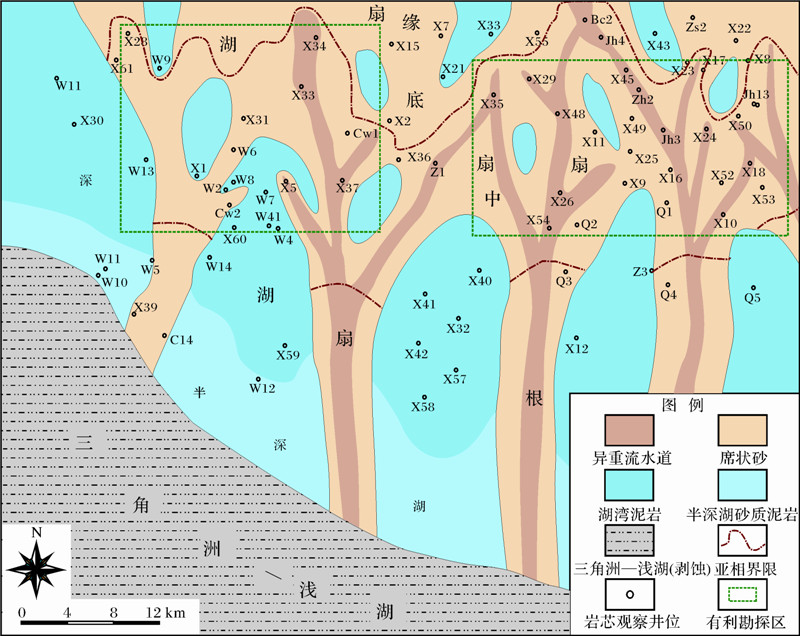
通过对盆地南部87口岩芯的观察,发现长7~长6油层组异重岩分布于盆地半深湖—深湖沉积区,异重流沉积的分布与注入河流暨物源的方向一致(图 4),自分流河口向盆地中心分布,异重流在斜坡地带的水道内呈高速流动而较少分叉;至深湖区平缓地带,异重流速度逐渐降低,水道可出现分叉与汇合,水
|
|
图 2 JH4井延长组长7油层组异重流沉积宏观特征
岩芯深度:1 446.97~1 447.36 m,长73亚油层组;HSC.异重流沉积组合;VA.垂向加积段;UCI.逆粒序层;UFI.正粒序层;ILS.层间界面;ITS.微侵蚀面;CB.粒度最粗带;MI.泥砾 Fig. 2 Macro features of hyperpycnal flow deposits in the 7th oil member of Yanchang Formation in Well JH4 |
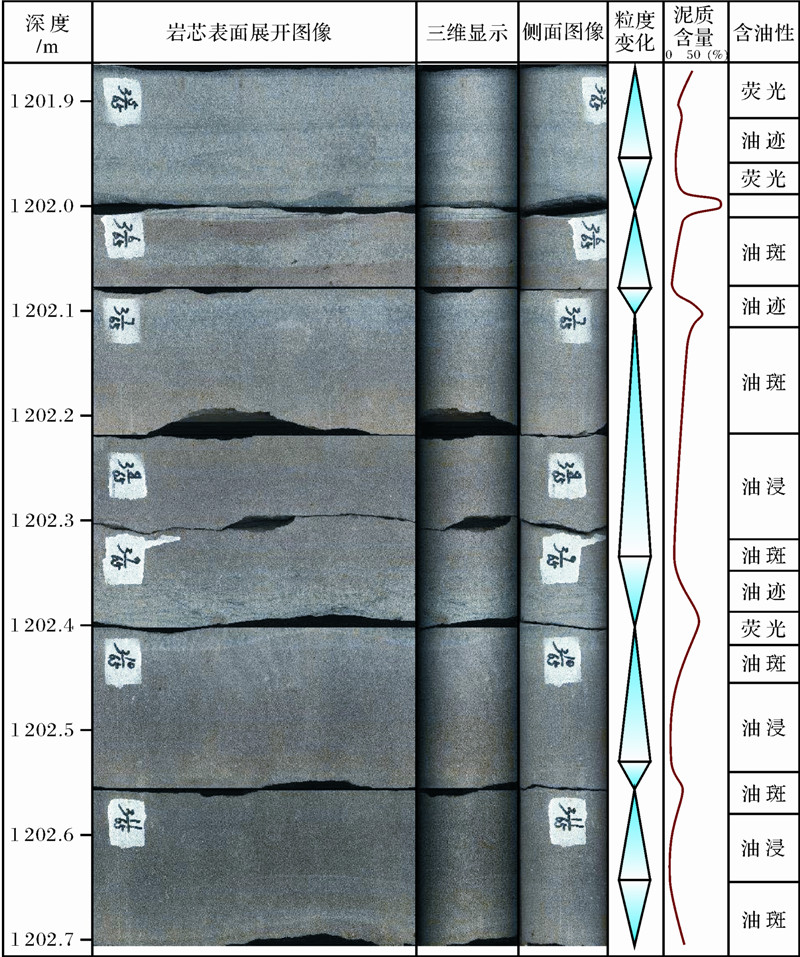
道沉积物以细砂岩为主,粉砂岩次之。水道外围区域则可由悬浮沉积物形成较大范围的席状砂,沉积物粒度较细,以粉砂岩、泥质粉砂岩为主。通过大量的岩芯观测,发现异重流沉积的湖底扇自南向北依次发育扇根、扇中和扇缘亚相,其中以扇中亚相的异重流水道砂体最为发育,本文预测的有利勘探区与油田生产实际吻合较好(图 4)。既使在同一异重流水道内,随着异重流速度和水动力条件自南向北逐渐减弱,沉积物整体表现出粒度逐渐变细、单层砂岩厚度减薄的趋势。如JH3井长7油层组异重流事件沉积单层厚度最大可达30 cm(图 5),以细砂岩为主;而向北的ZH2井、JH13井、JH4井多以薄层的细砂岩、粉砂岩、泥质粉砂岩为主,单层厚度多在0.1~5 cm。 2.4 含油性特征
由异重流沉积叠置而成的厚层砂体可作为油气储层,异重流沉积作用的旋回性决定了异重岩储层的岩性差异和储层非均质性,含油性亦存在较强的层内非均质性(图 5)。异重流沉积旋回中部粒度粗,泥质含量低,含油性较好,多为油浸或油斑含油;异重流沉积界面附近粒度细,泥质含量较高,含油性差,多为油迹或荧光显示;异重岩的含油性差异与异重流事件沉积的旋回性具有较好的一致性。
|
|
|
图 3 鄂尔多斯盆地南部延长组异重岩微观特征 样品信息:JH13-2,1428m;JH13-13,1 363.8 m;ZH2-5,1 230 m;左侧为薄片自然光,右侧局部放大图皆为单偏光。 Fig. 3 Micro features of hyperpycnite in Yanchang Formation in the southern Ordos Basin |
|
| 图 4 长7油层组异重岩平面展布 Fig. 4 Distribution of hyperpycnite in the 7th oil member |
|
| 图 5 JH3井异重岩与含油性 Fig. 5 Hyperpycnite and oiliness in Well JH3 |
两种密度差异较大的水体在重力作用下的分层流动即可形成异重流[5],由洪水产生的异重流即洪水异重流[8]。洪水期河流径流量和及其携带的沉积物通量远远大于平水期,洪水通过三角洲平原分流河道的分洪作用,在各分流河口快速进入汇水盆地。受地形坡度影响具有较高的动能和势能的洪水,经分流河道分洪进入湖盆之后,仍可向前流动一定距离;并在滨浅湖区形成水平方向的回流(图 6)。由于滨浅湖区水体浅,不足以形成密度分层,洪水与湖水可发生一定程度的混合作用。洪水因携带大量泥砂而呈现出相对于湖水的高密度特征;随着水体在三角洲前缘沉积坡折带之下逐渐加深,高密度洪水与低密度湖水产生分层流动,高密度洪水潜入低密度湖水之下[21],沿三角洲前缘斜坡形成快速流动的底流。由于洪水异重流与湖水呈现分层流动而较少混合,沉积物主要受紊流支撑,以悬浮的方式被搬运[7];且快速流动的底流可对下伏沉积物进行侵蚀、扰动,使新的悬浮物质不断加入底流,故洪水异重流具有较好的稳定性[9]。洪水异重流沿斜坡底部的注入必然造成深水区水面涌高,从而产生垂向的回流(图 6,局部放大1);回流造成洪水携带的大量植物碎片在异重流潜入点附近聚集[54],可被滨浅湖区水平方向的回流驱动向分流间湾漂移,或可解释在长7~长6油层组深水沉积中难以见植物碎片之现象。
现代水库泄洪调沙实验表明,洪水异重流可沿水库底部流动而直抵大坝底部的泄洪口[54]。故只要湖底存在一定的坡度,洪水异重流可沿水体底部作长距离搬运,直至地形低洼的湖盆中心地带。当盆地坡度和异重流流速逐渐消失后,异重流携带的悬浮沉积物便沉淀下来。受洪水先增强后逐渐减弱的影响,沉积物出现逆粒序—正粒序组合[13],一个沉积组合代表一次完整的洪水事件沉积(图 6,局部放大2)。当洪峰足够强时, 可对先期沉积的逆粒序层产生不同程度的侵蚀[23],形成非对称的粒序层组合或不完整的粒序层。而堰塞湖、水库溃坝作用则形成突然增强然后逐渐衰弱的异重流沉积,呈现出以正粒序层为主的沉积特征[18,19]。异重流水道沿斜坡移动,其能量损失较慢,沉积充填作用难以发生;受地形控制,水道较少分叉,可以发生汇合;而在坡度变缓的深湖区,异重流水道易于发生沉积充填、分叉或汇合。
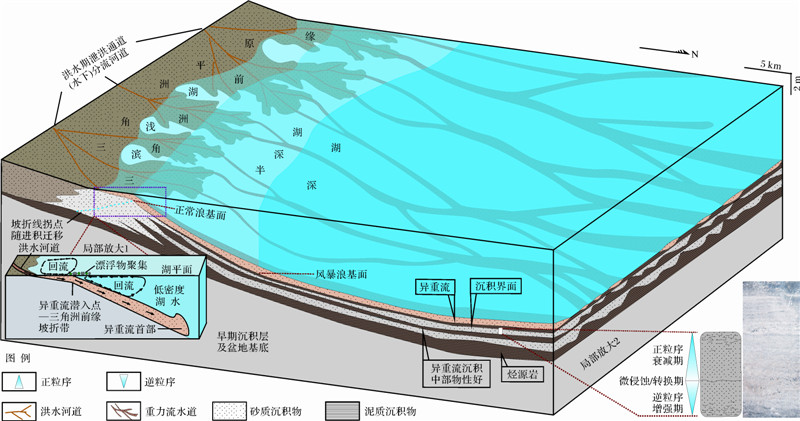
|
| 图 6 鄂尔多斯晚三叠世湖盆异重流沉积模式 Fig. 6 Depositional model of hyperpycnal flow in the Late Triassic lacustrine Ordos Basin |
平水期的水体密度差异不足以形成异重流,故在河口形成正常的三角洲沉积,可发育河口坝或延伸一定距离的水下分流河道沉积。这种在三角洲沉积区形成的沉积物积累,可以为滑塌、砂质碎屑流及(或)“触发型”浊流奠定物质基础;洪水异重流也可能诱发前缘斜坡滑塌形成砂质碎屑流或浊流。因此,异重岩也可与砂质碎屑流沉积、滑塌浊积岩共生,这些不同类型的深水重力流之间可能存在复杂的相互关系。 4 异重流沉积的地质意义
异重流作为一种源自洪水河流的特殊类型的浊流,其流体成因、沉积物搬运机制、沉积机理、沉积特征及储集砂体分布规律均有别于“触发型”浊流。“触发性”浊流需要碎屑物质的长期积累和一定的触发机制,而源自洪水河流的异重流因无需这些条件,更易于频繁发生。异重流是对“经典的”(触发型)浊流理论的发展和完善,对于客观、全面认识水下重力流沉积、有机质富集和储层预测具有重要的理论和现实意义。但目前国外的研究发现主要集中于新生代以来的海相沉积中,随着研究范围的扩展,陆相地层中将会有更多的发现。我国中新生代陆相沉积广泛发育,异重流沉积必将引起国内学者的广泛关注。
异重流将大量陆源有机质带入汇水盆地,不仅可以形成富有机质层,而且可改变水体的生态环境,对于烃源岩的形成具有积极作用。异重流无需碎屑物质的大量堆积和触发机制,异重流直接将碎屑物质从盆地边缘向盆地中心深水区长距离搬运,或许可以解释一些湖盆中心砂体及其条带状形态的成因。作为深水环境下形成的一种重要的储集砂体类型,其成因的不同必将造成砂体发育规模、分布规律及储集性能的差异。异重岩的中部粒度较粗、泥质含量低,储层物性和含油性明显好于其边部;岩性的差异决定了异重岩储层的层内非均质性。异重岩直接与长7段深湖相油页岩接触,具有显著的近源成藏优势。异重岩在沉积地层和油气储层中可能比此前想象的更为常见。异重流不仅为细粒沉积学研究提供了新的视角,而且其沉积产物对于非常规油气具有重要现实意义。异重岩将在未来的深水砂体预测和油气勘探中发挥更重要的作用。
致谢 中石化石油勘探开发研究院何治亮教授、陈纯芳、马立元、高金慧、刘春燕、伍新和、李松等同志参加了岩芯观察;中石化华北油田唐瑞鹏、宗敏、高丽等同志给予了帮助;审稿人和本文编辑对本文提出了宝贵的意见。谨致谢意!
| [1] | Etienne S, Mulder T, Bez M, et al. Multiple scale characterization of sand-rich distal lobe deposit variability: Examples from the Annot Sandstones Formation, Eocene-Oligocene, SE France [J]. Sedimentary Geology, 2012, 273-274: 1-18. |
| [2] | Valle G D, Gamberi F. Erosional sculpting of the Caprera confined deep-sea fan as a result of distal basin-spilling processes (eastern Sardinian margin, Tyrrhenian Sea) [J]. Marine Geology, 2010, 268(1/2/3/4): 55-66. |
| [3] | Di Celma C. Sedimentology, architecture, and depositional evolution of a coarse-grained submarine canyon fill from the Gelasian (early Pleistocene) of the Peri-Adriatic basin, Offida, central Italy [J]. Sedimentary Geology, 2011, 238(3/4): 233-253. |
| [4] | Talling P J, Masson D G, Sumner E J, et al. Subaqueous sediment density flows: depositional processes and deposit types [J]. Sedimentology, 2012, 59(7): 1937-2003. |
| [5] | 何起祥. 沉积动力学若干问题的讨论[J]. 海洋地质与第四纪地质,2010,30(4):1-10.[He Qixiang. A discussion on sediment dynamics[J]. Marine Geology & Quaternary Geology, 2010, 30(4): 1-10.] |
| [6] | Shanmugam G. High-density turbidity currents:are they sandy debris flows?[J]. Journal of Sedimentary Research, 1996, 66(1): 2-10. |
| [7] | Mulder T, Syvitski J P M. Turbidity currents generated at river mouths during exceptional discharges to the world oceans[J].The Journal of Geology, 1995, 103(3): 285-299. |
| [8] | Mulder T, Migeon S, Savoye B, et al.Inversely graded turbidite sequences in the deep Mediterranean: A record of deposits from flood-generated turbidity currents? [J]. Geo-Marine Letters, 2001, 21(2): 86-93. |
| [9] | Yoshida M, Yoshiuchi Y, Hoyanagi K. Occurrence conditions of hyperpycnal flows, and their significance for organic-matter sedimentation in a Holocene estuary, Niigata Plain, Central Japan [J]. Island Arc, 2009,18(2): 320-332. |
| [10] | Bourget J, Zaragosi S, Mulder T, et al. Hyperpycnal-fed turbidite lobe architecture and recent sedimentary processes: A case study from the Al Batha turbidite system, Oman margin [J]. Sedimentary Geology, 2010, 229(3): 144-159. |
| [11] | Bates C C. Rational theory of delta formation [J]. AAPG Bulletin, 1953, 37(9): 2119-2162. |
| [12] | Shanmugam G. Discussion on Mulder et al. (2001, Geo-Marine Letters 21: 86-93)Inversely graded turbidite sequences in the deep Mediterranean. A record of deposits from flood-generated turbidity currents? [J]. Geo-Marine Letters, 2002, 22(2): 108-111. |
| [13] | Mulder T, Syvitski J P M, Migeon S, et al. Marine hyperpycnal flows: initiation, behavior and related deposits. A review[J]. Marine & Petroleum Geology, 2003, 20(6/7/8): 861-882. |
| [14] | Khripounoff A, Vangriesheim A, Crassous P, et al. High frequency of sediment gravity flow events in the Var submarine canyon (Mediterranean Sea) [J]. Marine Geology, 2009, 263(1/2/3/4): 1-6. |
| [15] | McConnico T S, Bassett K N. Gravelly Gilbert-type fan delta on the Conway Coast, New Zealand: Foreset depositional processes and clast imbrications [J]. Sedimentary Geology, 2007, 198(3/4): 147-166. |
| [16] | Migeon S, Mulder T, Savoye B, et al. Hydrodynamic processes, velocity structure and stratification in natural turbidity currents: Results inferred from field data in the Var Turbidite System [J]. Sedimentary Geology, 2012, 245-246: 48-62. |
| [17] | Zavala C, Ponce J J, Arcuri M, et al. Ancient lacustrine hyperpycnites: a depositional model from a case study in the Rayoso Formation (Cretaceous) of west-central Argentina [J]. Journal of Sedimentary Research, 2006, 76(1): 41-59. |
| [18] | Mulder T, Zaragosi S, Jouanneau J M, et al. Deposits related to the failure of the Malpasset Dam in 1959: An analogue for hyperpycnal deposits from jökulhlaups [J]. Marine Geology, 2009, 260(1/2/3/4): 81-89. |
| [19] | Shirai M, Omura A, Wakabayashi T, et al. Depositional age and triggering event of turbidites in the western Kumano Trough, central Japan during the last ca. 100 years [J]. Marine Geology, 2010, 271(3/4): 225-235. |
| [20] | St-Onge G, Chapron E, Mulsow S, et al. Comparison of earthquake-triggered turbidites from the Saguenay (Eastern Canada) and Reloncavi (Chilean margin) Fjords: Implications for paleoseismicity and sedimentology[J]. Sedimentary Geology, 2012, 243-244: 89-107. |
| [21] | 余斌. 泥石流异重流入海的研究[J]. 沉积学报,2002,20(3):382-386. [Yu Bin. Research on debris flow into the sea as a density flow[J]. Acta Sedimentologica Sinica, 2002, 20(3): 382-386.] |
| [22] | Addington L D, Kuehl S A, McNinch J E. Contrasting modes of shelf sediment dispersal off a high-yield river:Waiapu River, New Zealand [J]. Marine Geology, 2007, 243(1/2/3/4): 18-30. |
| [23] | Soyinka O A, Slatt R M. Identification and micro-stratigraphy of hyperpycnites and turbidites in Cretaceous Lewis Shale,Wyoming[J]. Sedimentology, 2008, 55(5): 1117-1133. |
| [24] | Mutti E, Bernoulli D, Ricci L F, et al. Turbidites and turbidity currents from Alpine 'flysch' to the exploration of continental margins[J]. Sedimentology, 2009, 56(1): 267-318. |
| [25] | Lamb M P, Mohrig D. Do hyperpycnal-flow deposits record river-flood dynamics? [J]. Geology, 2009, 37(12): 1067-1070. |
| [26] | Dadson S J, Hovius N, Chen H, et al. Earthquake-triggered increase in sediment delivery from an active mountain belt [J]. Geology, 2004, 32(8): 733-736. |
| [27] | Milliman J D, Kao S J. Hyperpycnal discharge of fluvial sediment to the ocean: impact of super-typhoon Herb (1996) on Taiwanese Rivers [J].The Journal of Geology, 2005, 113(5): 503-516. |
| [28] | Johnson K S, Paull C K, Barry J P. A decal record of underflows from a coastal river into the deep sea[J]. Geology, 2001, 29(11): 1019-1022. |
| [29] | Shanmugam G. 50 years of the turbidite paradigm(1950-1990 s):deep-water processes and facies models-a critical perspective[J].Marine and Petroleum Geology, 2000, 17(2): 285-342. |
| [30] | Sáez A, Anadón P, Herrero M J, et al. Variable style of transition between Palaeogene fluvial fan and lacustrine systems, southern Pyrenean foreland, NE Spain [J]. Sedimentology, 2007, 54(2): 367-390. |
| [31] | Pouderoux H, Proust J N, Lamarche G, et al. Postglacial (after 18ka) deep-sea sedimentation along the Hikurangi subduction margin (New Zealand): Characterisation, timing and origin of turbidites [J]. Marine Geology, 2012, 295-298: 51-76. |
| [32] | Eilertsen R S, Corner G D, Aasheim O, et al. Facies characteristics and architecture related to palaeodepth of Holocene fjord-delta sediments [J]. Sedimentology, 2011, 58(7): 1784-1809. |
| [33] | Çağatay M N, Erel L, Bellucci L G, et al. Sedimentary earthquake records in the Īzmit Gulf, Sea of Marmara, Turkey [J]. Sedimentary Geology, 2012, 282: 347-359. |
| [34] | McHugh C M, Seeber L, Braudy N, et al. Offshore sedimentary effects of the 12 January 2010 Haiti earthquake [J]. Geology, 2011, 39(8): 723-724. |
| [35] | Eriş K K, Çağatay N, Beck C, et al. Late-Pleistocene to Holocene sedimentary fills of the Çinarcik Basin of the Sea of Marmara [J]. Sedimentary Geology, 2012, 281: 151-165. |
| [36] | You Y, Flemings P, Mohrig D. Dynamics of dilative slope failure [J]. Geology, 2012, 40(7): 663-666. |
| [37] | JacksonC A L, Johnson H D. Sustained turbidity currents and their interaction with debrite-related topography:Labuan Island, offshore NW Borneo, Malaysia [J]. Sedimentary Geology, 2009, 219(1/2/3/4): 77-96. |
| [38] | Talling P J, Wynn R B, Masson D G, et al. Onset of submarine debris flow deposition far from original giant landslide[J]. Nature, 2007, 450(7169): 541-544. |
| [39] | Haughton P D W, Davis C, McCaffrey W, et al. Hybrid sediment gravity flow deposits -classification, origin and significance[J]. Marine and Petroleum Geology, 2009, 26(10): 1900-1918. |
| [40] | Sumner E J, Talling P J, Amy L A, et al. Facies architecture of individual basin-plain turbidites: Comparison with existing models and implications for flow processes[J]. Sedimentology, 2012, 59(6): 1850- 1887. |
| [41] | 李文厚,邵磊,魏红红,等. 西北地区湖相浊流沉积[J]. 西北大学学报:自然科学版,2001,31(1):57-62.[Li Wenhou, Shao Lei, Wei Honghong, et al. Turbidity current deposits of lake facies in northwestern China[J]. Journal of Northwest University: Natural Science Edition, 2001, 31(1): 57-62.] |
| [42] | 王起琮,李文厚,赵虹,等. 鄂尔多斯盆地东南部三叠系延长组一段湖相浊积岩特征及意义[J]. 地质科学,2006,41(1):54-63.[Wang Qizong, Li Wenhou, Zhao Hong, et al. Characteristics and significance of lacustrine turbidites in the member 1 of Yanchang Formation, Upper Triassic in the southeastern Ordos Basin [J]. Chinese Journal of Geology, 2006, 41(1): 54-63.] |
| [43] | 郑荣才,文华国,韩永林,等. 鄂尔多斯盆地白豹地区长6油层组湖底滑塌浊积扇沉积特征及其研究意义[J]. 成都理工大学学报:自然科学版,2006,33(6):566-575.[Zheng Rongcai, Wen Huaguo, Han Yonglin, et al. Discovery and significance of sublacustrine slump turbidite fans in Chang 6 oil-bearing formation of Baibao region in Ordos Basin, China [J]. Journal of Chengdu University of Technology: Science & Technology Edition, 2006, 33(6): 566-575.] |
| [44] | 傅强,吕苗苗,刘永斗. 鄂尔多斯盆地晚三叠世湖盆浊积岩发育特征及地质意义[J]. 沉积学报,2008,26(2):186-192.[Fu Qiang, Lü Miaomiao, Liu Yongdou. Developmental characteristics of Turbidite and its implication on petroleum geology in Late-Triassic Ordos Basin [J]. Acta Sedimentologica Sinica, 2008, 26(2): 186-192.] |
| [45] | 夏青松,田景春. 鄂尔多斯盆地西南部上三叠统长6油层组湖底扇特征[J]. 古地理学报,2007,9(1):33-43.[Xia Qingsong, Tian Jingchun. Sedimentary characteristics of sublacustrine fan of the Interval 6 of Yanchang Formation of Upper Triassic in southwestern Ordos Basin [J]. Journal of Palaeogeography, 2007, 9(1): 33-43.] |
| [46] | Chen Quanhong, Li Wenhou, Gao Yongxiang, et al. The deep-lake deposit in the Upper Triassic Yanchang Formation in Ordos Basin, China and its significance for oil-gas accumulation[J]. Science China: Earth Sciences,2007, 50(S2): 47-58. |
| [47] | 邹才能,赵文智,张兴阳,等. 大型敞流坳陷湖盆浅水三角洲与湖盆中心砂体的形成与分布[J]. 地质学报,2008,82(6):815-825.[Zou Caineng, Zhao Wenzhi, Zhang Xingyang, et al. Formation and distribution of shallow-water deltas and central-basin sandbodies in large open depression lake basins [J]. Acta Geologica Sinica, 2008, 82(6): 815-825.] |
| [48] | 邹才能,赵政璋,杨华,等. 陆相湖盆深水砂质碎屑流成因机制与分布特征——以鄂尔多斯盆地为例[J]. 沉积学报,2009,27(6):1065-1075.[Zou Caineng, Zhao Zhengzhang, Yang Hua, et al. Genetic mechanism and distribution of sandy debris flows in terrestrial lacustrine basin [J]. Acta Sedimentologica Sinica, 2009, 27(6): 1065-1075.] |
| [49] | 李相博,付金华,陈启林,等. 砂质碎屑流概念及其在鄂尔多斯盆地延长组深水沉积研究中的应用[J]. 地球科学进展,2011,26(3):286-294.[Li Xiangbo, Fu Jinhua, Chen Qilin, et al. The concept of sandy debris flow and its application in the Yanchang Formation deep water sedimentation of the Ordos Basin [J]. Advances in Earth Science, 2011, 26(3): 286-294.] |
| [50] | 李相博,刘化清,完颜容,等. 鄂尔多斯盆地三叠系延长组砂质碎屑流储集体的首次发现[J]. 岩性油气藏,2009,21(4):19-21.[Li Xiangbo, Liu Huaqing, Wanyan Rong, et al. First discovery of the sandy debris flow from the Triassic Yanchang Formation, Ordos Basin [J]. Lithologic Reservoirs, 2009, 21(4):19-21.] |
| [51] | 付锁堂,邓秀芹,庞锦莲. 晚三叠世鄂尔多斯盆地湖盆沉积中心厚层砂体特征及形成机制分析[J]. 沉积学报,2010,28(6):1081-1089.[Fu Suotang, Deng Xiuqin, Pang Jinlian. Characteristics and mechanism of thick sandbody of Yanchang Formation at the centre of Ordos Basin[J]. Acta Sedimentologica Sinica, 2010, 26(6): 1081-1089.] |
| [52] | 刘池洋,赵红格,桂小军,等. 鄂尔多斯盆地演化—改造的时空坐标及其成藏(矿)响应[J]. 地质学报,2006,80(5):617-638.[Liu Chiyang, Zhao Hongge, Gui Xiaojun, et al. Space-time coordinate of the evolution and reformation and mineralization response in Ordos Basin [J]. Acta Geologica Sinica, 2006, 80(5): 617-638.] |
| [53] | 付国民,赵俊兴,张志升,等. 鄂尔多斯盆地东南缘三叠系延长组物源及沉积体系特征[J]. 矿物岩石,2010,30(1):99-105. [Fu Guomin, Zhao Junxing, Zhang Zhisheng, et al. The provenance and features of depositional system in the Yanchang Formation of Triassic in southeast area of Ordos Basin[J]. Journal of Mineralogy and Petrology, 2010, 30(1): 99-105.] |
| [54] | 李涛,谈广鸣,张俊华,等. 水库异重流研究进展[J]. 中国农村水利水电,2006(9):21-24.[Li Tao, Tan Guangming, Zhang Junhua, et al. Research advances in reservoir hyperpycnal flow [J].China Rural Water and Hydropower, 2006(9): 21-24.] |