 2014, Vol. 32
扩展功能

文章信息
- 刘畅, 张琴, 谢寅符, 乔李井宇, 孙杰夫, 梅啸寒
- LIU Chang, ZHANG Qin, XIE Yin-fu, QIAO Li-jing-yu, SUN Jie-fu, MEI Xiao-han
- 厄瓜多尔Oriente盆地东北部区块白垩系层序地层格架及发育模式
- Sequence Stratigraphic Framework and Development Model of the Cretaceous in Northeast Block, Oriente Basin, Ecuador
- 沉积学报, 2014, 32(6): 1123-1131
- ACTA SEDIMENTOLOGICA SINCA, 2014, 32(6): 1123-1131
-
文章历史
- 收稿日期:2014-04-25
- 收修改稿日期:2014-05-20


2. 中国石油勘探开发研究院 北京 100083
2. Research Institute of Petroleum Exploration and Development, PetroChina, Beijing 100083
In the sequence division of Cretaceous in the northeastern block of Oriente Basin, the characteristics of sequence boundary recognition at all levels are obvious. Second order sequence boundaries correspond to typical seismic profile unconformity truncation feature. Third order sequence boundaries include partly onlap, truncation and downlap seismic reflection termination. Drilling profile are all lithological abrupt change surface, showed the abrupt change surface in the well logging due to the sediments from the shallow water to the deep water. The lowstand of fourth order sequence are shelf marginal systems tracts. It is difficult to identify fourth order sequence boundaries in seismic line, but it is easy to identify in well logging. The key element to identify interfaces is to determine the first flooding surface and the maximum flooding surface. Mainly based on the change of parasequence group staked style in well logging, showed the conversion interface of aggradation-retrogradation-progradation. Fifth order sequence boundaries correspond to the main flooding surface. The identification of interfaces are depending on the thickness of the formation development, the overlay style, the well logging response characteristics and the basic upward shoaling succession cycle of the relative sea level.
Typical mixed clastic and carbonate gentle dipping slope sequence stratigraphy development mode has been identified in the study area. Cretaceous as a relatively complete second order sequence, experienced a complete sedimentary cycle that the relatively down-up-down sea level. Also, the third order sequence has apparent transgression-regression cycle which responds to sedimentary environment that undergo multi-period transitions from tidal flat to restricted platform, to inner shelf subaqueous shoal and to outer shelf mudstone. Then the sea level drops, meanwhile the sedimentary environment evolves into inner shelf limestone bank and restricted platform. Establishment of isochronous stratigraphic framework of the Cretaceous will provide scientific basis for predicting the distribution of favorable sand body in the northeast block, Oriente Basin.
厄瓜多尔Oriente盆地位于科迪勒拉山系和冈瓦纳地盾之间,是南美众多的次安第斯山前陆盆地之一(图 1),面积10×104 km2万平方公里,具有巨大的勘探潜力,是南美最大的产油盆地之一[1, 2, 3, 4, 5, 6, 7, 8, 9, 10, 11, 12, 13]。白垩系为Oriente盆地主要的勘探目的层系,自下而上包括Hollin组和Napo组[2, 3, 4, 5, 6, 7, 8, 9],东北部区块的面积为1 047 km2(图 1),主要烃源岩为白垩系Napo组海相页岩和灰岩,主要储层为白垩系的Napo组砂层[1, 2, 3, 4, 5, 6, 7],圈闭类型以低幅度构造和低幅构造控制下的地层岩性圈闭为主[14]。Oriente盆地在构造、沉积、储层、油藏等方面已经开展了大量的研究工作,并取得了很好的勘探开发成果[15, 16, 17, 18, 19, 20, 21]。盆地西陡东缓,轴向南北向,自古生代以来其构造演化经历了晚白垩世以前的裂谷盆地发育时期以及晚白垩世以后的前陆盆地发育时期。根据构造演化特征,Oriente盆地自西向东进一步分为西部逆冲前渊带、中部裂陷反转带和东部共轭走滑带3个次级构造单元[17, 18, 19]。Oriente盆地地层由变质岩基底和沉积充填两套大的层序构成,其沉积地层从下到上分为3部分:前白垩纪沉积层,与上覆地层为不整合面接触,其上是陆相、浅海相交互的白垩纪沉积层及后白垩纪陆相前陆地层[2,3]。主要研究目的层白垩系发育于Oriente盆地的裂后热沉降阶段,这一时期,东部的冈瓦纳地盾为白垩系沉积提供物源,在此基础上依次沉积了Hollin组和Napo组的“T”、“U”、“M2”、“M1”砂层,砂体类型为海陆交互相沉积[2, 3, 4, 5, 6, 7]。目前,前人关于研究区层序地层划分存在较大差异,姜在兴等(2007)建立了Oriente盆地南部区块Napo组的层序地层格架,识别出5个三级层序和15个四级层序[5, 6, 7, 8];朱筱敏等(2008)也重点对Oriente盆地中东部Hollin及Napo组开展了层序地层学研究。但是,不同学者对层序发育的个数、层序边界的位置和层序构成的认识有一定差别,尚未形成系统的统一认识。究其原因,除了层序地层划分标准不统一外,研究范围多局限于盆地局部地区,没有进行全区的对比,所用资料较为单一也是造成层序地层划分分歧较大的主要原因。因此,本文在借鉴前人研究的基础上,运用经典层序地层学基本原理和方法[22,23],通过对Oriente盆地三维测线的精细地震解释[24],并结合研究区测井和岩芯资料的综合分析,建立了Oriente盆地东北部区块精细等时层序地层格架,并对层序地层发育模式进行了探讨,以期为今后的沉积相研究和有利砂体预测提供更科学、可靠的地质依据。
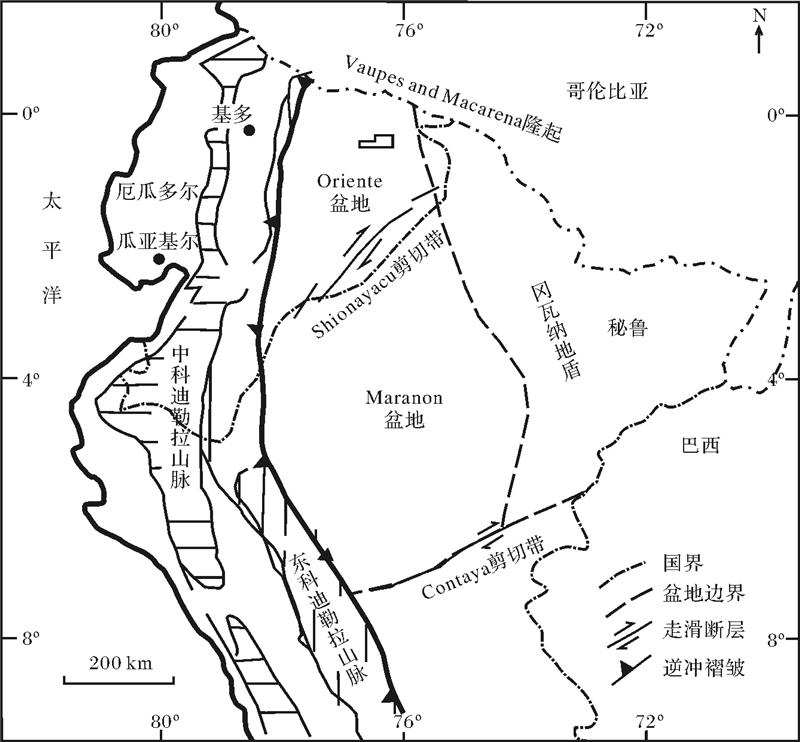
|
| 图 1 Oriente盆地及研究区位置 Fig. 1 Location of Oriente Basin and the study area |
综合应用钻测井、岩芯以及地震等资料,通过地震层序界面以及钻井层序界面的识别,并通过合成地震记录,井震结合,在单井层序划分的基础上,对连井剖面及其对应的地震剖面进行了划分(图 2),由点到线到面,建立了研究区白垩系Hollin组和Napo组的二级、三级、四级、五级的层序地层格架,共划分为1个二级层序,6个三级层序,16个四级层序(体系域),34个五级层序(准层序)(图 3)。
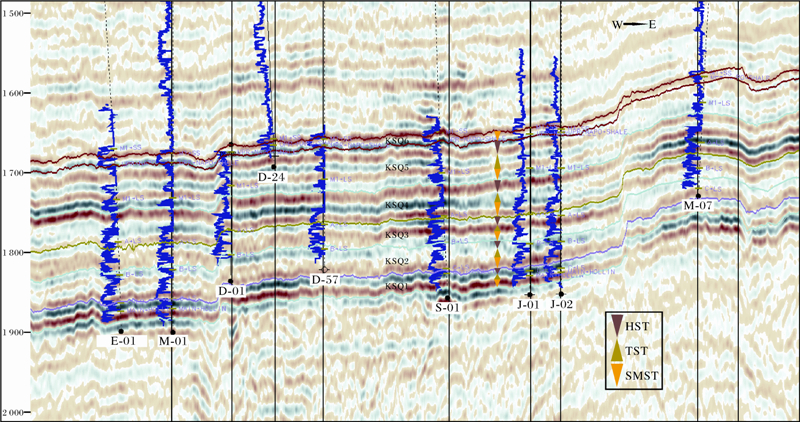
|
| 图 2 Oriente盆地东北部区块白垩系东西向地震层序划分 Fig. 2 East-west comparison profile of seismic sequence stratigraphy of Cretaceous in northeastern block,Oriente Basin |
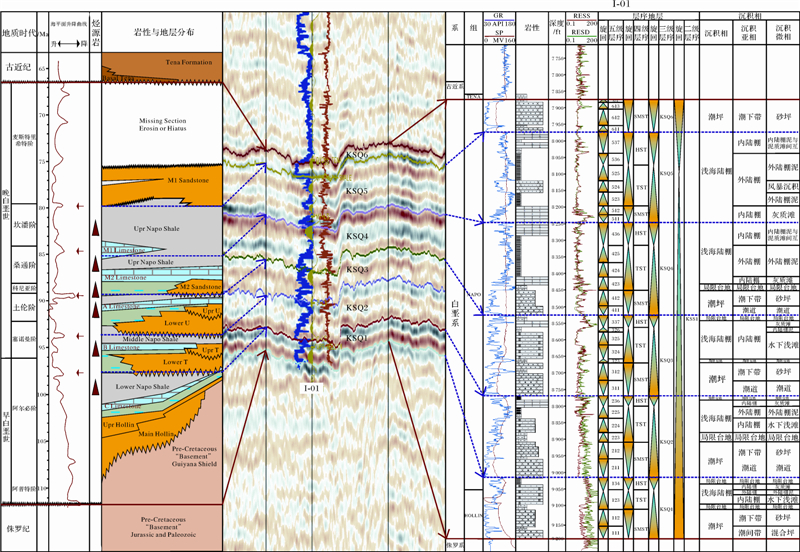
|
| 图 3 Oriente盆地东北部区块白垩系层序划分与岩性地层对比图 Fig. 3 Correlation of sequence division of Cretaceous and the lithological units in northeastern block,Oriente Basin |
整个白垩系Hollin组和Napo组构成一个完整的二级层序,即KSS1。KSS1又细分为6个三级层序,与岩石地层单位的对应关系如下(图 3):
(1) KSQ1相当于整个Hollin组和Napo组上覆的C灰岩,进一步划分为3个四级层序和4个五级层序;
(2) KSQ2相当于Napo组的T砂层和上覆的B灰岩,进一步划分为3个四级层序和6个五级层序;
(3) KSQ3相当于Napo组的U砂层和上覆的A灰岩,进一步划分为3个四级层序和7个五级层序;
(4) KSQ4相当于Napo组的M2灰岩和上覆泥岩,进一步划分为3个四级层序和6个五级层序;
(5) KSQ5相当于Napo组的M1灰岩和整个Upper Napo Shale,进一步划分为3个四级层序和7个五级层序;
(6) KSQ6相当于Napo组的M1_SS砂层和M1_Zone层,层序内部只发育1个四级层序,进一步划分为4个五级层序;
2 各级层序边界识别特征层序地层学的核心就是建立等时层序地层格架,其研究要点是层序界面的追踪[25,26]。层序是一套相对整一的、成因上存在联系的、顶底以不整合面或与之相对应的整合面为界的地层单元[22,23]。一个沉积层序可以包含若干个不同级次的沉积体系域以及准层序。层序级次划分实质就是对构造运动特征及不整合面级别的识别与划分,不同级别层序地层界面的识别是进行层序划分及建立等时层序地层格架的基础[26,27]。层序边界的形成代表了某一时间段在一定地区的沉积间断,其上下沉积地层在岩性、沉积相组合、电测曲线、地震反射特征上都会产生一些特殊的响应[28](表 1)。
| 资料类别 | 层序界面识别的主要标志 |
| 岩性及沉积相 | 岩性和颜色突变界面;深水沉积相突然上覆浅水沉积相;河道(潮道)冲刷面及界面之上发育的滞留沉积物;沉积旋回类型(或准层序组堆砌样式)的转化界面;沉积相突变 |
| 测井 | 自然伽马测井曲线突变界面;深浅电阻率测井的突然增大或降低;声波测井的突变界面 |
| 地震 | 地震反射终止关系;削截、顶超、上超和下超;地震反射波组的产状;地震反射波组的能量动力学特征;不同的地震反射的旋回特点 |
由于研究区主要研究目的层白垩系发育于盆地裂后热沉降阶段,因此构造运动不起主要作用,主要根据全球相对海平面变化,在研究区内划分出1个二级层序,即白垩系Hollin组和Napo组沉积时期全球相对海平面不断上升到快速下降,整体为一个水进—水退旋回,构成二级层序KSS1(图 3)。在地震剖面上,可以清晰地识别出Hollin组与下伏前白垩系之间的角度不整合,此界面为一个区域性的不整合界面,可作为白垩系二级层序的底界面;二级层序的顶界面,即M1与上覆地层之间的不整合,较底界面不明显(图 4)。
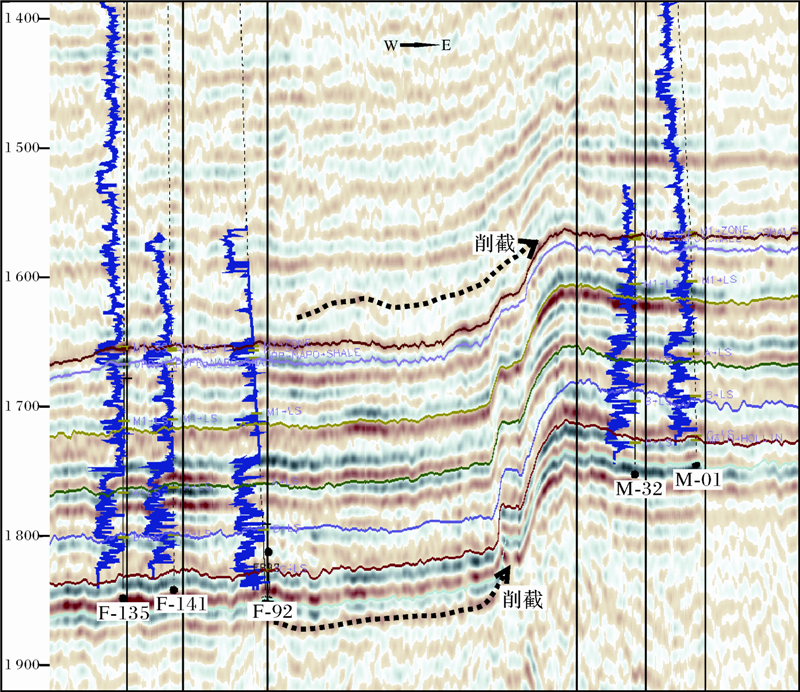
|
| 图 4 Oriente盆地东北部区块白垩系二级层序界面地震剖面反射特征 Fig. 4 Boundary of the second order sequence in seismic line in northeastern block,Oriente Basin |
三级层序边界识别的关键是确定不整合面[26]。本次研究主要依据钻测井与岩性资料,结合三维地震资料等,对研究区三级层序边界进行识别,建立白垩系层序地层格架。当海平面下降速率小于沉积滨线坡折处基底沉降速率时(海平面未发生相对下降),近端陆架不会暴露,从而形成II型层序边界。研究区白垩纪沉积层(Napo+Hollin组)整体坡度极缓,坡度小于0.5°~0.1°,层序边界缺乏明显的河流回春作用及深切谷,下部体系域缺少盆底扇和斜坡扇,沉积相带未发生明显地向盆地方向的迁移。因此,三级层序发育II型层序边界,由陆架边缘体系域(SMST)、海侵体系域(TST)和高位体系域(HST)组成[29,30]。由于研究区位于盆地的斜坡带,地层平缓稳定,因此地震剖面上各种同相轴反射终止关系不明显,仅在东部局部地区发现不整合接触关系,包括局部的上超、削截、下超等反射终止关系(图 5)。

|
| 图 5 Oriente盆地东北部区块白垩系三级层序界面地震剖面反射特征 Fig. 5 Boundary of the third order sequence in seismic line in northeastern block,Oriente Basin |
钻井剖面上三级层序边界均为岩性突变面,表现为测井曲线的突变面,浅水(潮坪或灰岩滩)沉积直接覆盖在深水沉积(内陆棚或外陆棚)之上。KSQ1底界面在测井曲线上的响应是砂岩与下伏泥岩的分界面;KSQ2和KSQ3底界面在测井曲线上的响应均为上覆砂岩与下伏灰岩的分界面;KSQ4底界面是M2砂岩与A灰岩之间的分界面;KSQ5的底界面则是M1灰岩与下伏大套泥岩—灰泥的分界面;KSQ6的底界面在测井曲线上的响应是上覆大套砂岩和下伏大套泥岩的分界面(图 3)。
2.3 四级层序划分及界面识别特征四级层序边界对应于体系域边界。由于研究区三级层序发育II型层序边界,因此低位域为陆架边缘体系域(SMST)。研究区四级层序边界在地震剖面上不易识别,主要依据测井资料进行识别,通过识别首次海泛面、最大海泛面和准层序组叠置样式的改变确定四级层序边界(图 6)。陆架边缘体系域(SMST)和海侵体系域(TST)之间的界限是首次海泛面,表现为明显的加积式准层序组与退积式准层序组的转换界面;海侵体系域(TST)和高位体系域(HST)之间的界限是最大海泛面,最大海泛面是一个层序中最大海侵时形成的界面,通常为GR曲线极大值处,是海侵体系域的顶界面并被上覆的高位体系域下超,它以从退积式准层序组变为进积式准层序组为特征,水体深度最大,之后水体深度开始减小,岩性一般为静水条件下的缓慢泥质沉积,有机质含量相对较高,位置一般处于大段泥岩的中部,常与凝缩层伴生(图 6)。研究区白垩系各三级层序陆架边缘体系域一般为潮坪砂岩或灰质滩组成,底界为侵蚀面,通常为加积序列;海侵体系域一般由局限台地、水下浅滩(灰质滩)及内陆棚、外陆棚相泥岩组成,泥岩沉积厚度大并且分布广,构成向上变细的退积序列,海岸线向陆迁移;高位体系域主要为内陆棚相清水环境灰岩沉积及局限台地组成,具有明显的沉积物向前推进的沉积特点(图 3)。

|
| 图 6 Oriente盆地东北部区块四级层序界面特征及叠置样式 Fig. 6 Boundary of the fourth order sequence and superposition styles in northeastern block,Oriente Basin |
五级层序以主要的海泛面为边界,结合旋回性进行划分。根据短期旋回的地层发育厚度、叠加样式、所反映的沉积物类型及沉积特征的相似性等,依靠相对海平面向上逐渐变浅的基本旋回(具体体现在岩性、泥岩颜色、沉积构造、沉积结构等方面)可以在四级层序的基础上再细分出五级层序,即准层序。研究区地层岩性主要有砂岩、泥岩和灰岩三大类,不同的岩性其测井响应特征明显不同。根据测井曲线响应特征划分岩性,从而识别短期旋回变化划分准层序。研究区泥岩在测井曲线上表现出高GR值低RESD值的特点,灰岩是中GR值高RESD值,砂岩呈低GR值中RESD值(图 7)。在以上识别特征的基础上,把研究区Hollin组和Napo组划分为34个五级层序(图 3)。

|
| 图 7 Oriente盆地东北部区块五级层序界面特征及叠置样式 Fig. 7 Boundary of the fifth order sequence and superposition styles in northeastern block,Oriente Basin |
五级层序界面特征相对较为复杂,内部岩性(岩相)变化主要表现为七种:①多期潮道、潮坪砂岩的叠置,测井曲线表现为箱形—钟形或齿化的箱形;②局限台地泥、灰泥向上变为海绿石石英砂岩的水下浅滩沉积;③水下浅滩的海绿石石英砂岩向上变为灰黑色、深灰色泥岩、页岩的外陆棚沉积;④外陆棚灰黑色、深灰色泥岩、页岩向上变为内陆棚灰岩滩沉积;⑤局限台地泥、灰泥向上变为内陆棚灰岩滩;⑥内陆棚灰岩向上变为灰黑色、深灰色泥岩、页岩的外陆棚沉积;⑦外陆棚灰黑色、深灰色泥岩、页岩中间夹有风暴砂岩沉积(图 3,7)。
3 层序地层发育模式白垩纪作为一个较为完整的二级层序,经历了相对海平面的下降—上升—下降完整的旋回变化,但总体趋势是海平面逐步上升占有明显优势。三级层序地层的旋回呈规律性变化,也具有明显的海进—海退的完整旋回。Hollin组沉积早期,相对海平面缓慢下降至最低并开始缓慢上升,由此开始了白垩纪长时期的海平面上升过程;到M1_LS至M1SS沉积时期,海平面上升至最大并开始缓慢下降。总体上,从Hollin组到Napo组的Upper Napo Shale层沉积时期,水体逐渐加深,沉积物岩性逐渐变细。从M1_LS到M1SS、M1 Zone沉积时期,水体退缩,潮道砂岩体广泛发育。自下而上,沉积环境经历了多期潮坪环境的潮道、潮坪砂岩向上过渡到局限台地、内陆棚的水下浅滩沉积,再向上就变为完全的外陆棚泥沉积,随后海平面下降,沉积环境回返到内陆棚的灰质滩沉积及局限台地沉积(图 3)。因此,研究区白垩系发育典型的混积型缓坡层序地层发育模式(图 8)。
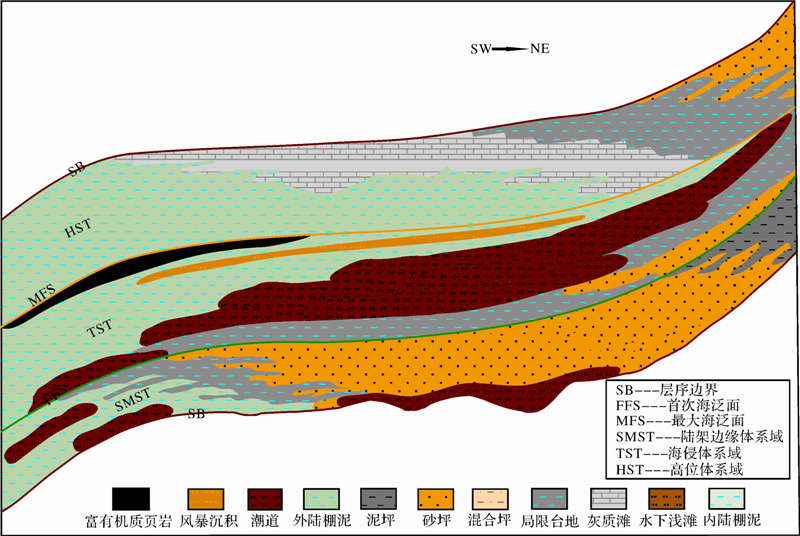
|
| 图 8 Oriente盆地东北部区块白垩系层序地层发育模式图 Fig. 8 Model of sequence stratigraphy in northeastern block,Oriente Basin |
(1) 综合利用岩芯、测井、地震等资料,完成二级、三级、四级、五级层序界面的厘定,确定了三级层序发育II型层序边界,建立了Oriente盆地东北部区块白垩系Hollin组和Napo组的精细等时层序地层格架,将Oriente盆地东北部区块划分为1个二级层序;6个三级层序;16个四级层序;34个五级层序。根据合成记录对地震剖面进行标定并与钻测井的层序地层划分相结合,实现了研究区白垩系在地震、钻测井资料方面层序地层划分的一致性。
(2) 在Oriente盆地东北部区块白垩系层序划分中,各级层序边界识别特征明显。二级层序边界对应地震剖面典型的削截不整合面特征;三级层序界面包括地震剖面上局部的上超、削截、下超等反射终止关系,钻井剖面上均为岩性突变面,表现为测井曲线的自然伽马、深浅电阻率、声波时差的异常突变面;四级层序低位域为陆架边缘体系域,界面的识别关键是确定首次海泛面和最大海泛面,主要依据钻测井剖面上准层序组叠置样式的改变,表现为加积式—退积式—进积式准层序组的转换界面;五级层序界面响应主要的海泛面,根据短期旋回的地层发育厚度、叠加样式、测井曲线响应特征等,依靠相对海平面向上逐渐变浅的基本旋回进行识别。
(3) 研究区发育典型的混积型缓坡层序地层发育模式。白垩纪作为一个较为完整的二级层序,经历了相对海平面的下降—上升—下降完整的旋回变化。三级层序地层的旋回呈规律性变化,也具有明显的海进—海退的完整旋回。自下而上,沉积环境经历了多期潮坪环境的潮道、潮坪砂岩向上过渡到局限台地、内陆棚的水下浅滩沉积,再向上变为完全的外陆棚泥沉积,随后海平面下降,沉积环境回返到内陆棚的灰质滩沉积及局限台地沉积。
致谢 在论文撰写过程中受到了陈和平、谢寅符和马中振等专家的亲切指导,在此一并感谢。
| [1] | 李文涛,赵铭江,张波,等. 厄瓜多尔Oriente盆地11区块油气勘探潜力分析[J]. 油气地质与采收率,2004,11(1):33-35[Li Wentao, Zhao Mingjiang, Zhang Bo, et al. Analysis on petroleum exploration potential in Block 11 of the Oriente Basin in Ecuador[J]. Petroleum Geology and Recovery Efficiency, 2004, 11(1): 33-35] |
| [2] | 徐佑德,柳忠泉,许世红,等. 厄瓜多尔Oriente盆地16区块油气地质及勘探潜力[J]. 海洋石油,2006,26(3):25-30[Xu Youde, Liu Zhongquan, Xu Shihong, et al. Analysis on petroleum geology and exploration potential in Block 16 of Oriente Basin in Ecuador[J]. Offshore Oil, 2006, 26(3): 25-30] |
| [3] | 丁增勇,陈文学,高彦楼,等. 厄瓜多尔Oriente盆地Horm-Nantu油田纳波组潮坪微相研究[J]. 海洋地质与第四纪地质,2009,29(6):43-50[Ding Zengyong, Chen Wenxue, Gao Yanlou, et al. Tidal microfacies of Napo Formation of Horm-Nantu Oil Field, Oriente Basin, Ecuador[J]. Marine Geology and Quaternary Geology, 2009, 29(6): 43-50] |
| [4] | 衣英杰,姜在兴,赵伯宇. 厄瓜多尔Oriente盆地南部潮坪相识别[J]. 科技信息,2010(13):421-422[Yi Yingjie, Jiang Zaixing, Zhao Boyu. Sedimentary microfacies in the South Block of Oriente Basin, Ecuador[J]. Science & Technology Information, 2010(13): 421-422] |
| [5] | 田继军,姜在兴,陈诗望. 厄瓜多尔Oriente盆地南部区块Napo组层序地层模式与岩性地层圈闭预测[J]. 现代地质,2010,24(4):678-684[Tian Jijun, Jiang Zaixing, Chen Shiwang. Sequence stratigraphy mode and lithologic traps prediction of Napo Formation in South Block of Oriente Basin, Ecuador[J]. Geoscience, 2010, 24(4): 678-684] |
| [6] | 陈诗望,姜在兴,田继军,等. 厄瓜多尔Oriente盆地南部区块沉积特征[J]. 海洋石油,2008,28(1):32-34[Chen Shiwang, Jiang Zaixing, Tian Jijun, et al. Sedimentary characteristics in the South Block of Oriente Basin, Ecuador[J]. Offshore Oil, 2008, 28(1): 32-34] |
| [7] | 牟汉生,姜在兴,田继军,等. 厄瓜多尔Oriente盆地南部区块Napo组层序地层特征及成藏条件分析[J]. 大庆石油地质与开发,2007,26(5):46-47[Mou Hansheng, Jiang Zaixing, Tian Jijun, et al. Sequence stratigraphy characteristics and reservoir generation conditions of Napo Formation in South Block of Oriente Basin, Ecuador[J]. Petroleum Geology & Oilfield Development in Daqing, 2007, 26(5): 46-47] |
| [8] | 陈诗望,姜在兴,滕彬彬,等. 厄瓜多尔奥连特盆地白垩系M1油藏沉积储层新认识[J]. 地学前缘,2012,19(1):182-187[Chen Shiwang, Jiang Zaixing, Teng Binbin, et al. New understanding of sedimentation and reservoir characteristics of M1 zone in Cretaceous strata of Oriente Basin, Ecuador[J]. Earth Science Frontiers, 2012, 19(1): 182-187] |
| [9] | 陈诗望,姜在兴,田继军,等. 厄瓜多尔Oriente盆地南部区块沉积模式及有利目标区预测[J]. 油气地质与采收率,2008,15(2):20-23[Chen Shiwang, Jiang Zaixing, Tian Jijun, et al. Sedimentary facies model and favorable target areas prediction, South Block, Oriente Basin, Ecuador[J]. Petroleum Geology and Recovery Efficiency, 2008, 15(2): 20-23] |
| [10] | Shanmugam G, Poffenberger M, Toro A J. Tide-dominated estuarine facies in the Hollin and Napo Formations. Sacha field,Oriente Basin, Ecuador[J]. AAPG Bulletin, 2000, 84(5): 652-654 |
| [11] | Richard O L, David B. Sand thickness prediction from band limited seismic attributes using neural networks:Oriente Basin, Ecuador [J]. SEG Expanded Abstracts, 2002, 21: 2451-2454 |
| [12] | 叶德燎,徐文明,陈荣林. 南美洲油气资源与勘探开发潜力[J]. 海外勘探,2007(2):70-76[Ye Deliao, Xu Wenming, Chen Ronglin. South American oil and gas resources and exploration potential[J]. Oversea Exploration, 2007(2): 70-76] |
| [13] | 何彬,刘毅,郝斐,等. 奥连特盆地油气系统特征与勘探潜力[J]. 石油天然气学报,2011,33(4):34-38[He Bin, Liu Yi, Hao Fei, et al. Petroleum system characteristics and exploration potential of Oriente Basin[J]. Journal of Oil and Gas Technology, 2011, 33(4): 34-38] |
| [14] | 李涛,魏春光,何雨丹. 南美前陆盆地隐蔽油气藏勘探[J]. 地球物理学进展,2012,27(1):320-325[Li Tao, Wei Chunguang, He Yudan. Exploration of subtle reservoir of foreland basin in South America[J]. Progress in Geophysics, 2012, 27(1): 320-325] |
| [15] | Dashwood M F, Abbotts I L. Aspects of the petroleum geology of the Oriente Basin, Ecuador[C]//Brooks J. Classic petroleum provinces: Geologic Society Special Publication,1990, 50: 89-117 |
| [16] | White H J, Skopec R A, Ramirez F A, et al. Reservoir characteristics of the Hollin and Napo Formations, western Oriente Basin, Ecuador[C]//Tankard A J, R. Suárez S, Welsink H J, Petroleum basins of South America. AAPG Memoir 62: 573-596 |
| [17] | Canfield R W, Bonilla G, Robbins R K. Sacha Oli field of Ecuatorian Oriente[J]. Bulletin of the American Association of Petroleum Geologists, 1982, 61: 1076-1090 |
| [18] | Higgs R. Tide-dominated estuarine facies in the Hollin and Napo (“T”and“U”) formations (Cretaceous), Sacha field,Oriente Basin, Ecuador: discussion[J]. AAPG Bulletin, 2002, 86(2): 329-334 |
| [19] | 丁增勇,陈文学,熊丽萍,等. 厄瓜多尔奥连特盆地构造演化特征[J]. 新疆石油地质,2010,31(2):211-215[Ding Zengyong, Chen Wenxue, Xiong Liping, et al. Tectonic evolution in Oriente Basin of Ecuador[J]. Xinjiang Petroleum Geology, 2010, 31(2): 211-215] |
| [20] | Baby P, Rivadenerra M, Christophoul F. Style and timing of deformation in the Oriente Basin of Eduador[C]. Extended Abstract ISAG99, 1999, 68-72 |
| [21] | Belotti Hugo, Jose Silvestro, Gustavo Conforto. Recognition of tectonic events in the conformation of structural traps in the eastern Oriente Basin, Ecuador[C]. AAPG Annual Convention, 2003, 5: 11-14 |
| [22] | 纪友亮,张世奇,张宏. 层序地层学原理及层序成因机制模式[M]. 北京:地质出版社,1998:1-30[Ji Youliang, Zhang Shiqi, Zhang Hong. Principles of Sequence Stratigraphy and Sequence Formation Mechanism Model[M]. Beijing: Geological Publishing House, 1998: 1-30] |
| [23] | 朱筱敏. 层序地层学[M]. 北京:石油大学出版社,2000:1-28[Zhu Xiaomin. Sequence Stratigraphy[M]. Beijing: University of Petroleum Press, 2000: 1-28] |
| [24] | 谢里夫. 勘探地震学[M]. 初英,等译.北京:石油工业出版社,1999[Sheriff R E. Exploration Seismology[M]. Translated by Chu Ying, et al. Beijing: Petroleum Industry Press, 1999] |
| [25] | 李思田,解习农,王华,等. 沉积盆地分析基础与应用[M]. 北京:高等教育出版社,2004[Li Sitian, Xie Xinong, Wang Hua, et al. Sedimentary Basin Analysis and Application[M]. Beijing: Higher Education Press, 2004] |
| [26] | 苗顺德,李秋芬,欧阳诚. 黄骅坳陷古近系层序地层格架特征及模式研究[J]. 中国地质,2008,35(2):256-263[Miao Shunde, Li Qiufen, Ouyang Cheng. Paleogene sequence stratigraphic framework and model in the Huanghua depression[J]. Geology in China, 2008, 35(2): 256-263] |
| [27] | 李思田,杨士恭,林畅松. 论沉积盆地等时地层格架和基本建造单元[J]. 沉积学报,1992,10(4):11-22[Li Sitian, Yang Shigong, Lin Changsong. On the chronostratigraphic framework and basic building blocks of sedimentary basin[J]. Acta Sedimentologica Sinica, 1992, 10(4): 11-22] |
| [28] | 操应长,姜在兴,夏斌,等. 利用测井资料识别层序地层界面的几种方法[J]. 石油大学学报:自然科学版,2003,27(2):23-26[Cao Yingchang, Jiang Zaixing, Xia Bin, et al. Some methods for identifying sequence boundaries and condensation sections using well logging[J]. Journal of the University of Petroleum, China, 2003, 27(2): 23-26] |
| [29] | Vail P R, Mitchum R J, Thompson S. Seismic stratigraphy and global changes of sea level, part3: Relative changes of sea level from cosatal onlap[C]//Payton C E. Seismic stratigraphy-applications to hydrocarbon exploration. Oklahoma: AAPG Memoir, 1977, 26: 63-81 |
| [30] | Vail P R. Seismic stratigraphy interpretation using sequence stratigraphy, part 1: seismic stratigraphy interpretation procedure[C]//Bally A W. Alas of Seismic Stratigraphy. AAPG Studies in Geology, 1987, 27: 1-10 |