 2014, Vol. 32
扩展功能

文章信息
- 宋慧波, 郭瑞睿, 王保玉, 胡斌
- SONG Hui-bo, GUO Rui-rui, WANG Bao-Yu, HU Bin
- 华北下二叠统太原组Zoophycos潜穴中碳酸盐岩微形体的特征及其意义
- Characteristics of Carbonate Micro-Shapes in Zoophycos Burrows from the Lower Permian Taiyuan Formation in North China and Their Significance
- 沉积学报, 2014, 32(5): 797-808
- ACTA SEDIMENTOLOGICA SINCA, 2014, 32(5): 797-808
-
文章历史
- 收稿日期:2013-8-12
- 收修改稿日期:2013-10-30


2. 河南省生物遗迹与成矿过程重点实验室 河南焦作 454000;
3. 中国矿业大学地球科学与测绘工程学院 北京 100083
2. Key Laboratory of Biogenic Traces & Sedimentary Minerals of Henan Province, Jiaozuo, Henan 454000;
3. College of Geoscience and Surveying Engineering, China University of Mining & Technology, Beijing 100083
遗迹化石记录了古生物的生命活动规律,反映出古生物的行为习性及其生命活动所处的生态环境,诸如水体深度、水体能量、水体盐度和温度、底层性质等。中国遗迹化石的研究已经历了八十余载,当下的研究阶段为拓展(创新)研究阶段(2004年至今),其中,从地球生物学角度对复杂遗迹化石进行研究逐渐成为新热点[1]。
Zoophycos(动藻迹)是一种大型复杂遗迹化石,主要发育于泥质沉积和碳酸盐岩沉积中,可以真正反映水和沉积物界面的情况[2, 3, 4],其整体呈螺旋形,具蹼状构造,剖面上为多层的板状构造,具回填纹充填。该遗迹化石从下寒武统到第四系、从陆源碎屑岩到碳酸盐岩、从滨海至深海沉积环境均有分布,形态复杂且精美,与此同时,也存在许多未解之谜,如造迹者归属与造迹过程、形成机理、宏观与微观的生态环境条件、生物学目的和指相意义等等。对造迹生物行为习性的分类与解释是解释古环境的基础,显然,不能简单地把Zoophycos定为觅食迹。关于Zoophycos的功能和生物学目的,目前已经提出了五种模式:食沉积物模式[5, 6, 7, 8, 9]、食海底表面碎屑物模式[10, 11, 12]、垃圾处理模式[13]、地窖储藏模式[13,14]、微生物培植园模式和化能共生模式[13, 14, 15, 16, 17, 18, 19, 20]。其中,后两种模式与微生物的生长、繁殖有一定的相关性。
地质微生物是一些具有特殊生理作用的微生物,例如硫化物氧化菌、蓝细菌、绿硫细菌和紫硫细菌、硫酸盐还原菌等,这些微生物影响着沉积成岩的地球化学过程,其生命活动改变着遗迹化石造迹者的生存环境,如氧化还原特性。地质微生物及其功能群与遗迹化石的造迹生物是密不可分的,它们或形成食物链/网、或在特殊氧化还原及酸碱度上形成寄生、偏害共栖、初级合作、互利共栖的关系[13, 18, 19]。假如这些微生物能够以化石的形式保存下来,那么Zoophycos潜穴中应该具有与这些微生物形态类似的矿物或矿物集合体。
因此,对Zoophycos潜穴中碳酸盐岩的微形体研究非常必要。本文选取了华北下二叠统太原组的三条典型剖面(焦作刘庄剖面、禹州大风口剖面和陵川附城剖面),对Zoophycos潜穴中碳酸盐岩微形体进行观察,以期对探讨碳酸盐岩沉淀过程、Zoophycos遗迹化石形成机理及其与微生物的共生关系有所贡献。
混入,为陆表海缓坡型碳酸盐岩沉积。
1 地层及沉积背景
华北下二叠统太原组是在华北陆表海碳酸盐岩台地背景下形成的,为一套滨海、浅海、潟湖和潮坪沉积,其上以灰岩或硅质岩顶面为界,与山西组呈整合接触,其下以最底部一层较稳定的灰岩为界,与本溪组整合接触。太原组以灰—深灰色薄—中厚层状生物碎屑灰岩为主,自下而上,下二叠统太原组通常分为四段,分别为下部碎屑岩段、下部灰岩段、中部碎屑岩段、上部灰岩段,总厚度一般为70~90 m[21]。下部碎屑岩段由薄—厚层状细砂岩、粉砂岩、砂质泥岩、碳质泥岩和煤组成;下部灰岩段含灰岩2~3层(局部达4~5层,其中下部2~3层较稳定),主要为深灰色中厚—厚层状含燧石灰岩、生物碎屑灰岩、泥晶灰岩、薄层细砂岩、粉砂岩、砂质泥岩、泥岩和煤;中部碎屑岩段由灰白色中厚—厚层状中—细粒石英砂岩、薄层粉砂岩和砂质泥岩组成,夹2~3层薄煤层及不稳定的生物碎屑微晶灰岩(常呈透镜体,1~3层);上部灰岩段含灰岩4~5层,以灰、深灰色生物碎屑微晶灰岩为主,夹薄层细砂岩、粉砂岩、砂质泥岩和薄煤层(煤线)。
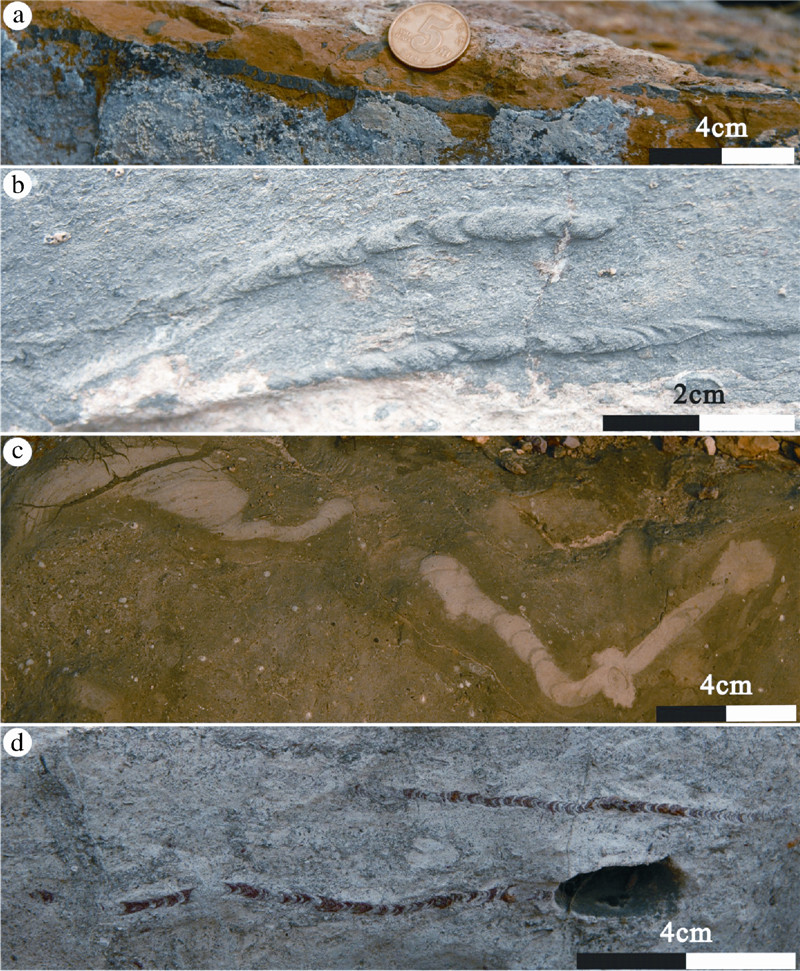
太原组各层灰岩层中发育大量的实体化石,例如蜓类、腕足类、腹足类、珊瑚、海百合等。遗迹化石以Zoophycos最为丰富,其他伴生的遗迹化石有Chondrites,Nereites,Palaeophycos,Rhizocorallium,Gordia,Taenidium,Teichichnus,Planolites,Thalassinoides等[22]。根据Zoophycos潜穴充填物颜色的不同,可将太原组Zoophycos分为四种类型,即具黑色、灰色、灰白色、红色充填物的Zoophycos。
前人已对华北太原组沉积环境做过许多研究[23,24],该区太原组的沉积经历了潟湖、潮坪→滨、浅海→潟湖、潮坪→滨、浅海→潮坪或三角洲的演变过程。该区碳酸盐岩的沉积过程中,陆源碎屑间歇性混入,为陆表海缓坡型碳酸盐岩沉积。
2 样品分析
河南焦作、禹州和山西附城二叠系太原组碳酸盐岩中包含不同颜色(黑色、灰色、灰白色和红色)充填的Zoophycos遗迹化石(图 1)。本文挑取了焦作和附城剖面中遗迹化石清晰、具有代表性的样品,用锤子砸出新鲜面,并挑选较平整的面作为观察面,且控制样品高度在8 mm以下。将样品用蒸馏水洗净,置于干燥箱内干燥,之后,利用导电胶固定在样品托上,置于离子溅射仪中喷金。样品处理完毕后,利用配有能谱仪(型号:INCA-ENERGY 250)的扫描电子显微镜(型号:JSM-6390/LV)对其进行精细观察及测定。
|
| 图 1 下二叠统太原组中四种颜色的Zoophycos潜穴充填物 a.黑色充填物;b.灰色充填物;c.灰白色充填物;d.红色充填物 Fig. 1 Four kinds of color filling in Zoophycos burrows from the Lower Permian Taiyuan Formation |
本次工作研究Zoophycos潜穴样品11个,发现了各种不同类型的碳酸盐岩微形体,并测定了其元素组成(表 1)。从表 1中可以看出样品的主要成分为CaCO3,在不同颜色的样品中,Fe、Si、P等元素的含量不尽相同。通过扫描电镜观察,在不同Zoophycos潜穴中共发现了六种形态完好的碳酸盐岩微形体,其形 状分别是:球状(表面光滑的球状体、表面具有不定形细粒结构的球状体、表面呈刺状细粒结构的球状体和球状集合体)、杆状(刺杆状分枝形网状体、刺杆状单体、螺旋杆状单体、双列杆状体、光滑直线形杆状单体、末端膨大的光滑杆状体)、簇状集合体、网状集合体、瓶状体和似脑球体。
| 样号 | 采样层位 | 充填物颜色 | 碳酸盐岩微形体种类 | 主要元素 | 其他元素 |
| F-6 | 附城L1 | 黑色 | 表面光滑的球状体、似脑球体 | C、O、Ca、Si | Mg、Al、Zr、S、K、Fe |
| F-8 | 附城L1 | 黑色 | 表面光滑的球状体、瓶状体、似脑球体 | C、O、Ca、Si | Na、Cl、Al、S |
| F-9 | 附城L3-1 | 灰白色 | 球状集合体 | C、O、Ca、Fe | S、Mn |
| F-13 | 附城L7 | 黑色 | 表面光滑的球状体、表面呈刺状细粒结构的球状体、螺旋杆状单体、光滑直线形杆状单体、 末端膨大的光滑杆状体、双列杆状体、瓶状体 | C、O、Ca、Si | Fe、S、K、Na、Cl、Si |
| J-3 | 焦作L2 | 灰色 | 表面具有不定形细粒结构的球状体 | C、O、Ca | Si |
| J-12 | 焦作L4-11 | 黑色 | 表面具有不定形细粒结构的球状体、球状集合体、双列杆状体 | C、O、Ca、Si | 无 |
| J-13 | 焦作L4-11 | 黑色 | 表面呈刺状细粒结构的球状体、光滑直线形杆状单体、网状集合体 | C、O、Ca、Si | K、Cl、Na、Al |
| J-20 | 焦作L6 | 红色 | 簇状集合体 | O、Ca、Fe、C | Si |
| J-24 | 焦作L7 | 黑色 | 刺杆状单体 | C、O、Ca、Si、P | Fe、Al、K、Cl、F |
| J-26 | 焦作L7-6 | 红色 | 表面光滑的球状体 | ||
| J-30 | 焦作L8-6 | 黑色 | 表面呈刺状细粒结构的球状体、表面具有不定形细粒结构的球状体、光滑直线形杆状单体 |
以往的研究表明,碳酸盐岩中保存完好的地质微生物化石有助于研究微生物矿化、佐证微生物引发碳酸盐沉淀。例如:龚一鸣等(2007)研究了广西来宾早二叠世茅口组深灰色灰岩中发育的Zoophycos遗迹化石,发现了其蹼层中存在着的螺旋菌状、球菌状微生物化石,其大小约0.4~3.0 μm,分子化石检测表明沉积物中存在较多还原态的硫,反映还原环境,推测这些特征可能与硫酸盐类还原菌有关[25]。杨克红等(2009)在南海北部几种不同形貌的冷泉碳酸盐岩中发现了碳酸盐岩球状集合体,经放大后分别呈现蠕虫状和丝状,均为微生物结构[26]。温志锋等(2010)在柴达木盆地新近纪叠层石暗层中发现了保存完好的微米级别的微生物球状构造,确定其为类似于Coccoid的硫还原微生物,另外发现的亚微米球状颗粒一方面是极端条件下微生物体脱水收缩后的产物,另一方面也是叠层石微生物席胞外聚合物质的重要组成部分[27]。本次研究发现的碳酸盐岩微形体与上述研究成果有一定的相似性(如表面光滑的球状体),但也发现许多新的形态类型。
3.1 碳酸盐岩球状体通过扫描电镜的精细观察,在Zoophycos充填物中发现了大量球状碳酸盐岩微形体,根据球体表面形貌、个体大小及产状特征,可将这些球状体进一步分为4种类型:类型1、2、3的球状体呈单体或多个独立体出现,类型4中球状体呈群出现。
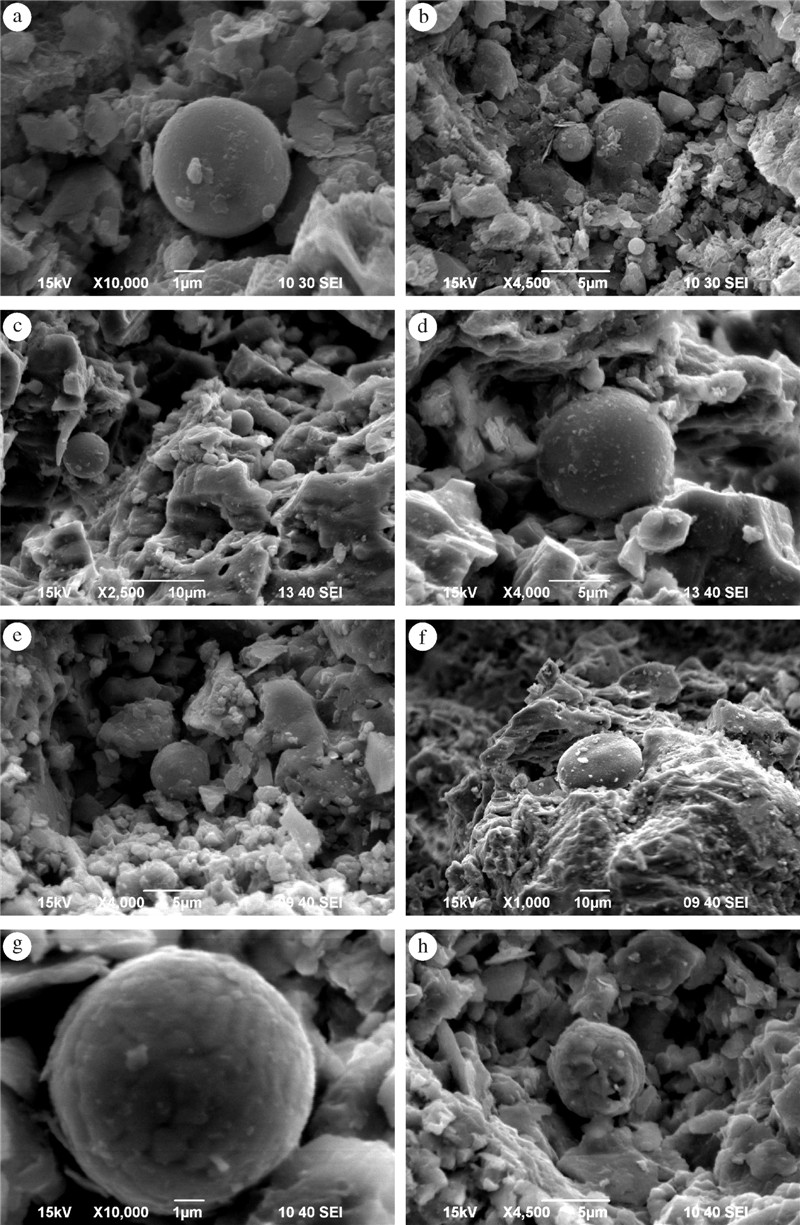
类型1为表面光滑的球状体(图 2),球状体保存完好,表面较光滑,含少量碎屑,直径变化相对较大,大部分集中于在2~15 μm。图 2f中的球体略扁,扁平面长29 μm,宽21 μm,在图 2h中,球体表面具有裂口。
|
| 图 2 类型1—表面光滑的碳酸盐岩球状体 a,b来源于样品J-26;c,d来源于样品F-6;e,f来源于样品F-8;g,h来源于样品F-13 Fig. 2 Type 1—Spheroid-like carbonates with smooth surface |
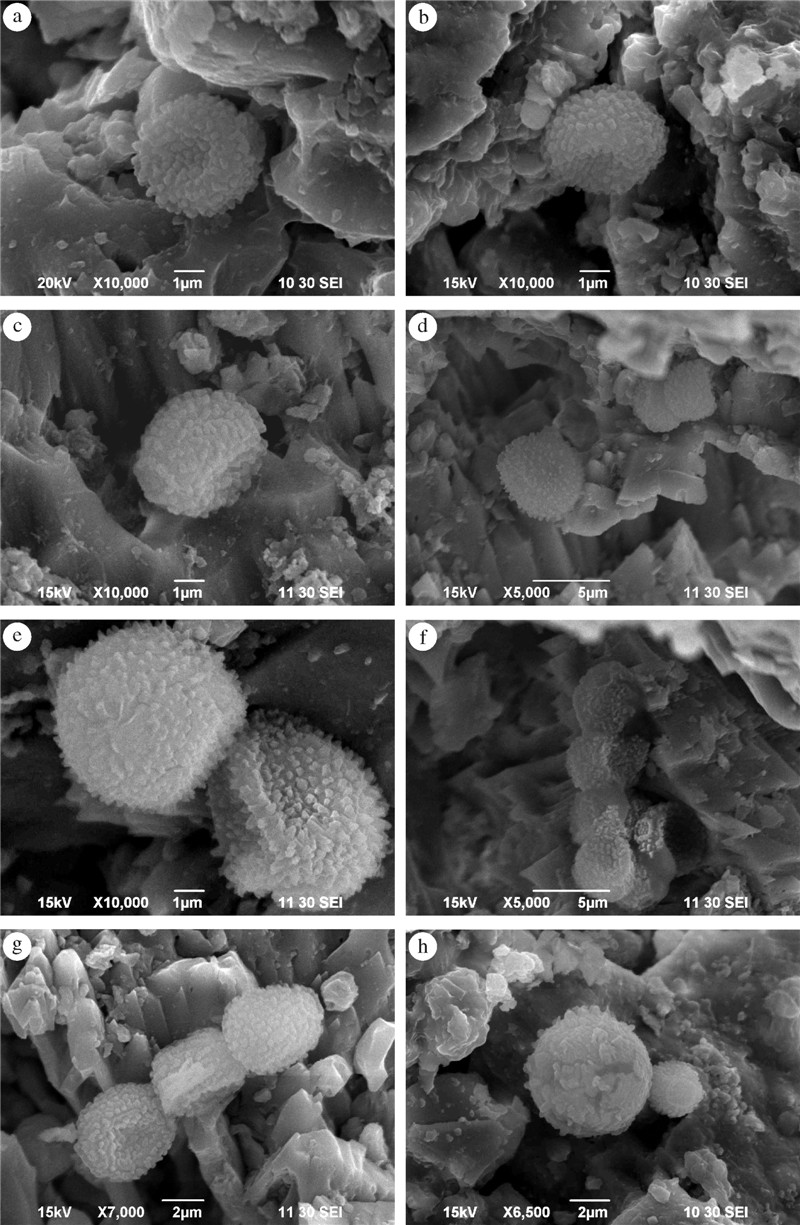
类型2为表面具有不定形细粒结构的球状体(图 3),该类型球状体直径在2~10 μm之间,外壁具有细粒结构,细粒有序排列,但形状不规则。其中,部分球状颗粒相互接触、呈2个球状体连生(图 3e,h)、3个球状体连生(图 3g)和4个球状体连生(图 3f)产出,有的球粒表面相对的两侧向内凹(图 3f,g),有的球粒具有裂纹(图 3h)。
|
| 图 3 类型2—表面具有不定形细粒结构的碳酸盐岩球状体 a来源于样品J-3;b,h来源于样品J-30;c,d,e,f,g均来源于样品J-12 Fig. 3 Type 2—Spheroid-like carbonates with unshaped surface and fine grain structure |
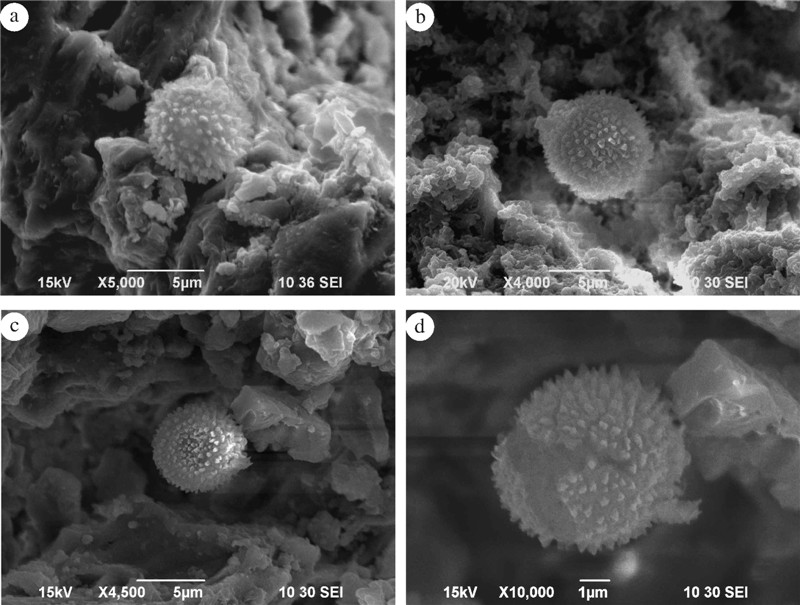
类型3为表面呈刺状细粒结构的球状体(图 4),该类型球状体的直径在6~9 μm之间,表面均具有刺状颗粒,在图 4d中,球体表面出现0.1~2 μm的裂纹,露出光滑的内部表层。
|
| 图 4 类型3—表面呈刺状细粒结构的碳酸盐岩球状体 a来源于样品F-13;b来源于样品J-13;c,d来源于样品J-30 Fig. 4 Type 3—Spheroid-like carbonates with thorn surface and fine grain structure |
以上三种类型的碳酸盐岩微形体颗粒均独立出现在方解石颗粒之间或缝隙中。
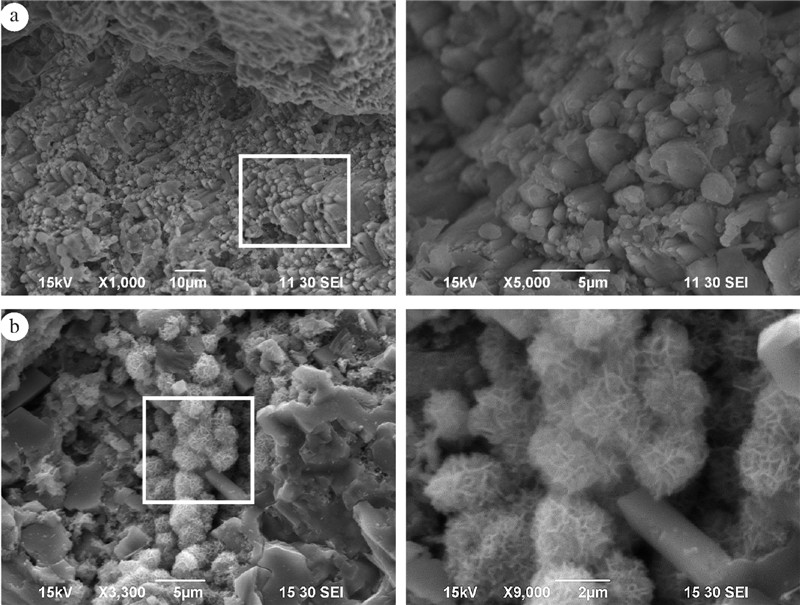
类型4为球状集合体(图 5),球状体成群出现、分布密集,嵌于方解石晶体间,直径较小。图 5a显示出整体呈葡萄状或串珠状的球状集合体,分布均匀有序,单个颗粒直径在0.2~1 μm左右,图 5b显示出由30个左右、表面呈蠕虫状的球状单体紧密相邻而成的集合体,球状单体直径为2~3 μm(右图为左图的放大图)。
|
| 图 5 类型4—碳酸盐岩球状集合体 a来源于样品J-12;b来源于样品F-9 Fig. 5 Type 4—Spheroid-like carbonate aggregates |
观察到的另一大类碳酸盐岩微形体呈杆状或枝杆状分布,按照表面特征、个体形状及分枝的分布状况,可进一步细分为以下6种类型。
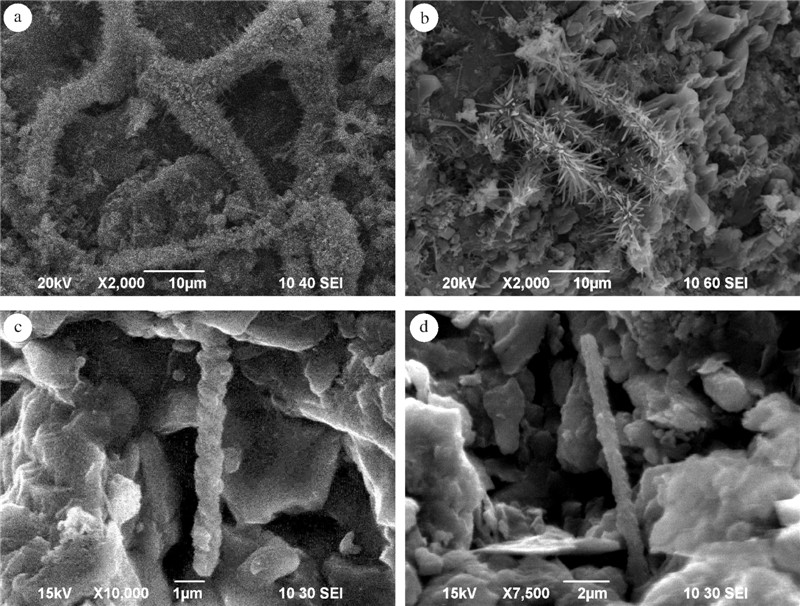
类型1为刺杆状分枝形网状体(图 6a),杆状体可见长达50 μm,直径2.0~7.5 μm,表面刺的长度在3~7 μm左右,直径小于1 μm,具有明显分枝并连结成不规则的网状形态。
|
| 图 6 刺状和螺旋状碳酸盐岩杆状体(a.类型1;b.类型2;c,d.类型3) a,b来源于样品J-24;c,d来源于样品F-13 Fig. 6 Carbonates of rhabditiform with thorn surface and spiral form (a. type 1; b. type 2; c,d. type 3) |
类型2为刺杆状单体(图 6b),杆状体可见长度达50 μm,直径1.5 μm,表面布满长短不一的刺,刺的长度在5~7 μm,直径小于1 μm,杆状单体彼此平行排列,成群产出。
类型3为螺旋杆状单体(图 6c,d),图 6c中杆状体长9 μm,直径约1 μm,呈螺旋状倒L形产出;图 6d中杆状体较细长,长11 μm,直径约0.9 μm,呈直杆螺旋状,独立分散产出。
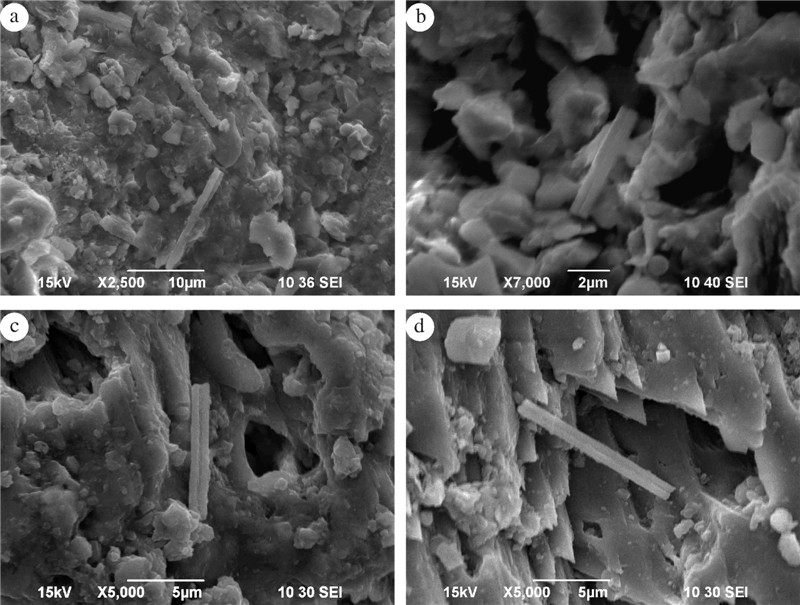
类型4为双列杆状体(图 7),杆状单体表面较光 滑,呈双列式紧密相贴,长度为8~12 μm,单列直径为0.55~0.88 μm,独立分散产出。
|
| 图 7 双列式排列的碳酸盐岩杆状体(类型4) a,b来源于样品F-13;c,d来源于样品J-12 Fig. 7 Carbonates of rhabditiform with biserial form (type 4) |
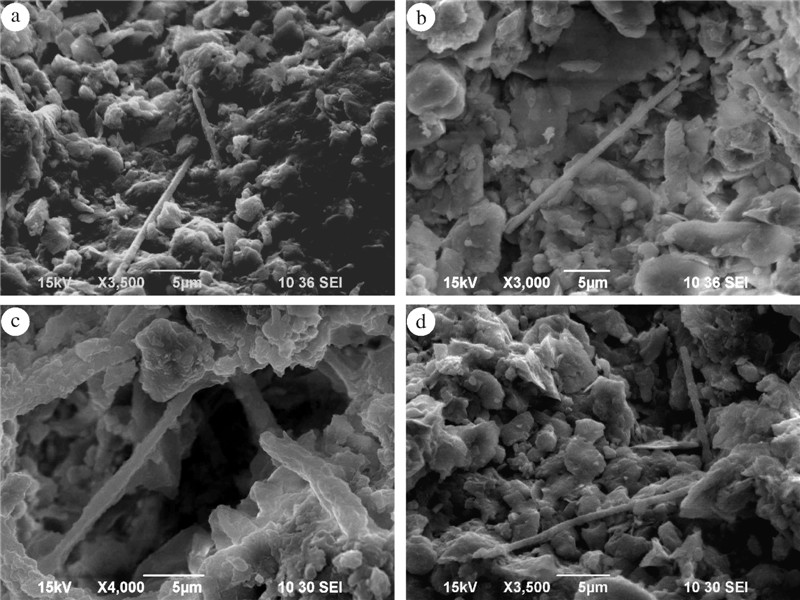
类型5为光滑直线形杆状单体(图 8),杆状单体长度在15~25 μm之间,横切面为圆形,直径在1 μm左右,独立分散产出。
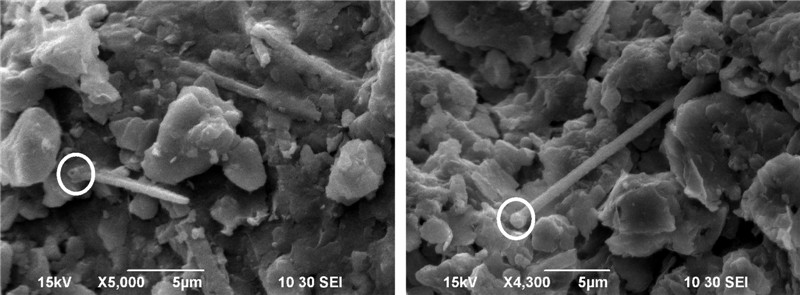
类型6为末端膨大的光滑杆状单体(图 9),图 9a中杆状体长7.67 μm,宽0.67 μm,末端膨大处直径约1 μm;图 9b中杆状体可见长15.38 μm,宽0.77 μm,末端膨大处直径约1.15 μm,独立分散产出。
|
| 图 8 光滑直线形碳酸盐岩杆状体(类型5) a,b,d均来源于样品F-13;c来源于样品J-30 Fig. 8 Carbonates of rhabditiform in a straight line with smooth surface (type 5) |
|
| 图 9 末端膨大的碳酸盐岩光滑杆状体(类型6) a,b均来源于样品F-13 Fig. 9 Carbonates of rhabditiform with smooth surface and expanding tail end (type 6) |
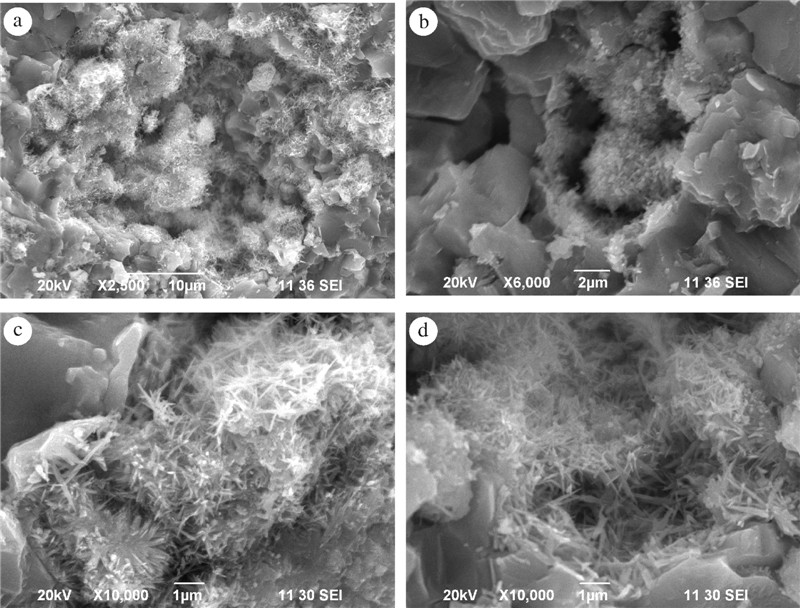
在河南焦作地区下二叠统太原组灰岩(L6)中,发现Zoophycos的红色充填物内产有较多的碳酸盐岩簇状集合体(图 10)。该集合体主要组成元素为C、O、Ca、Fe、Si,其中,Fe、O元素的重量百分比最高,二者之和可达90%。通过观察大量样品发现,这种碳酸盐岩集合体呈簇状出现,可见大量粒状、针状、长片状结构,集合体周边被方解石包围,方解石晶形良好。
|
| 图 10 河南焦作地区下二叠统太原组中的碳酸盐岩簇状集合体 a,b,c,d均来源于样品J-20 Fig. 10 Areatus carbonate aggregates in the Lower Permian Taiyuan Formation of Jiaozuo area,Henan province |
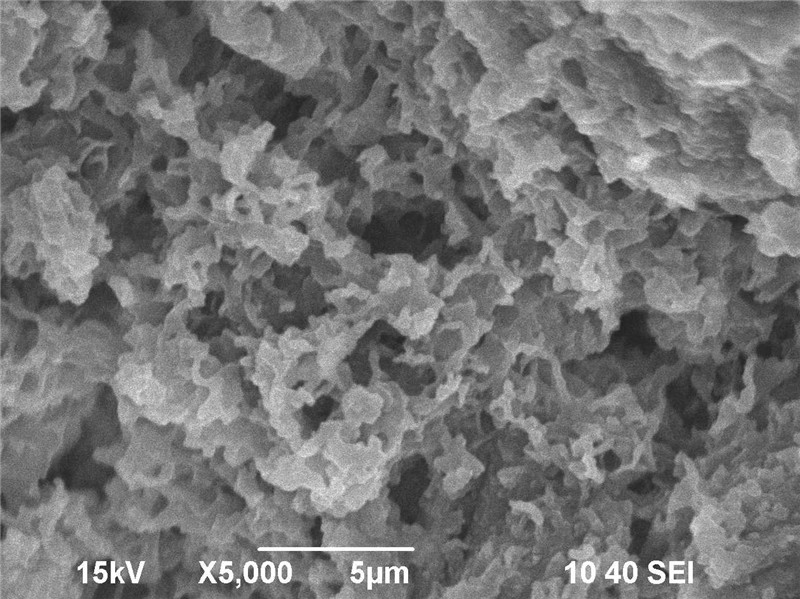
在河南焦作地区下二叠统太原组灰岩(L4)中,还发现Zoophycos的黑色充填物中呈现一种碳酸盐岩网状集合体(图 11),该集合体的网状单体形状多样,彼此交织叠覆,连结成网,单网形态不规则,其化学成分为CaCO3。
|
| 图 11 河南焦作地区下二叠统太原组中的碳酸盐 岩网状集合体(来源于样品J-13) Fig. 11 Net-like carbonate aggregates in the Lower Permian Taiyuan Formation of Jiaozuo area,Henan province |
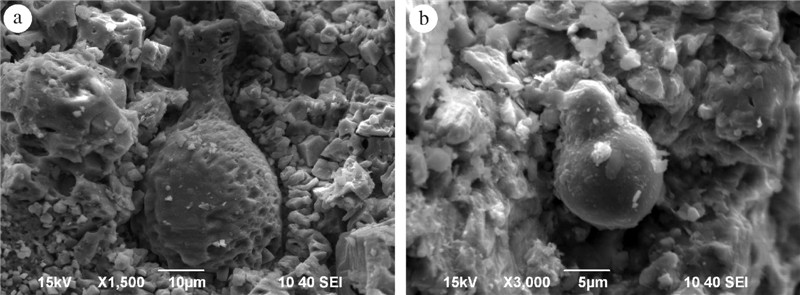
在山西附城地区下二叠统太原组的两层灰岩(L1,L7)中发现了两种碳酸盐岩瓶状体(图 12),其主要化学成分为CaCO3。图 12a中的瓶状体形如花瓶,顶部有开口,开口周围具碟形突缘,瓶壁上可见凹孔,瓶高57.1 μm,瓶肚直径为33.4 μm,瓶颈直径11.4 μm;图 12b中的瓶状体形如一只葫芦,表面较光滑,壳壁钙质,顶端未见开口,总高13 μm,上部直径5 μm,下部直径8.9 μm。二者呈孤立状态产出。
|
| 图 12 山西附城地区下二叠统太原组中的碳酸盐岩瓶状体 a来源于样品F-8;b来源于样品F-13 Fig. 12 Vase-like carbonates in the Lower Permian Taiyuan Formation of Fucheng area,Shanxi province |
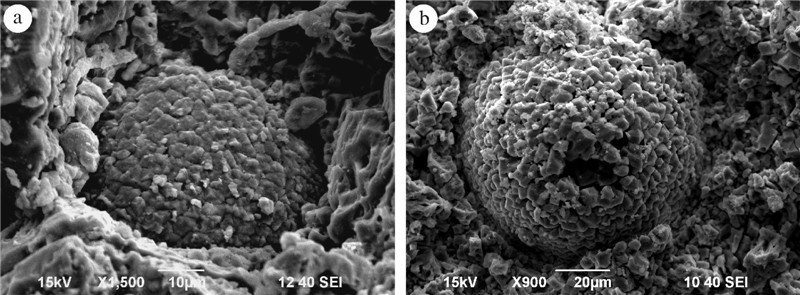
在山西附城地区下二叠统太原组灰岩(L1)中还发现了另外一种似脑球状的碳酸盐岩微形体(图 13),简称为碳酸盐岩似脑球体,呈孤立状态产出。其表面为不定型的细粒结构,主要化学成分为CaCO3。图 13a中的似脑球体测得长宽为50 μm × 40 μm,由细小的方解石晶体集结而成,周围显示出其他较大且不规则的方解石晶体;图 13b中的似脑球体测得长宽为86 μm × 80 μm,中部有一个开口,突显出立体状球形体,也是由细小的方解石晶体集结而成,与其周围的方解石晶体大小相似。
|
| 图 13 山西附城地区下二叠统太原组中的碳酸盐岩似脑球体 a来源于样品F-6;b来源于样品F-8 Fig. 13 Cerebrum-like carbonates in the Lower Permian Taiyuan Formation of Fucheng area,Shanxi province |
华北地区豫西和晋东南一带下二叠统太原组碳酸盐岩中的Zoophycos遗迹化石十分丰富,在利用扫描电子显微镜对Zoophycos潜穴中的充填物进行超微特征观察时,发现不同颜色充填物中含有多种形态特征的碳酸盐岩微形体,经研究取得以下认识:
(1) 在不同Zoophycos潜穴充填物内发现了六大类成因与微生物相关的碳酸盐岩微形体,包括球状体、杆状体、簇状集合体、网状集合体、瓶状体和似脑球体。其中,球状体又可进一步细分为表面光滑的球状体、表面具有不定形细粒结构的球状体、表面呈刺状细粒结构的球状体和球状集合体等四种类型,杆状体则可进一步细分为刺杆状分枝形网状体、刺杆状单体、螺旋杆状单体、双列杆状体、光滑直线形杆状单体和末端膨大的光滑杆状体等六种类型。这些碳酸盐岩微形体的发现表明,Zoophycos不仅仅是一个简单的觅食迹或食物储藏所,其造迹者很可能与微生物互利共生,并与食物链和氧化还原等生态环境条件密切相关。
(2) 本文发现的微形体中,有一部分具有微生物结构,但尚不能准确确定是何种微生物,若将地球微生物化石与分子化石的研究相结合,将有利于确定地球微生物的生物分类单位和生态特征。
(3) 此次研究,对解释宏体生物与微体生物间的关系有一定帮助,有助于探索地质微生物作用尤其是古生菌对地球化学过程的影响,同时,也为精细分析华北地区下二叠统太原组碳酸盐岩的形成过程及其沉积演化提供了新的微观资料。
| [1] | 龚一鸣, 胡斌, 卢宗盛, 等. 中国遗迹化石研究80年[J]. 古生物学报, 2009, 48(3):322-337[Gong Yiming, Hu Bin, Lu Zongsheng, et al. Study of trace fossils in the past eighty years in China[J]. Acta Palaeontologica Sinica, 2009, 48(3): 322-337] |
| [2] | 胡斌, 齐永安. 华北上石炭统太原组灰岩中的Zoophycos痕迹组构[J]. 煤田地质与勘探, 2000, 28(1):12-15[Hu Bin, Qi Yong'an. Zoophycos ichnofabric in limestones of Taiyuan Formation, North China[J]. Coal Geology & Exploration, 2000, 28(1): 12-15] |
| [3] | 胡斌, 周方, 宋慧波. 河南焦作地区下二叠统太原组遗迹化石及其沉积环境[J]. 古地理学报, 2010, 12(5):577-588[Hu Bin, Zhou Fang, Song Huibo. Ichnofossils and their sedimentary environments in the Lower Permian Taiyuan Formation in Jiaozuo area, Henan province[J]. Journal of Palaeogeography, 2010, 12(5): 577-588] |
| [4] | Hu Bin, Song Huibo, Liu Shunxi, et al. Sedimentary facies, ichnofossils and storm deposits in the Lower Permian Taiyuan Formation, Jiaozuo city, Henan province, central China[J]. Acta Geologica Polonica, 2010, 60(1): 45-52 |
| [5] | Seilacher A. Bathymetry of trace fossils[J]. Marine Geology, 1967, 5(5/6): 413-428 |
| [6] | Wetzel A, Werner F. Morphology and ecological significance of Zoophycos in deep-sea sediments off NW Africa[J]. Palaeogeography, Palaeoclimatology, Palaeoecology, 1981, 32: 185-212 |
| [7] | Wetzel A. The New Zealand Zoophycos revisited: morphology, ethology, and paleoecology-some notes for clarification[J]. Ichnos, 1992, 2: 91-92 |
| [8] | Olivero D. Zoophycos distribution and sequence stratigraphy. Examples from the Jurassic and Cretaceous deposits of Southeastern France[J]. Palaeogeography, Palaeoclimatology, Palaeoecology, 1996, 123(1/2/3/4): 273-287 |
| [9] | Olivero D. Early Jurassic to Late Cretaceous evolution of Zoophycos in the French Subalpine Basin (southeastern France)[J]. Palaeogeography, Palaeoclimatology, Palaeoecology, 2003, 192(1/2/3/4): 59-78 |
| [10] | Kotake N. Paleoecology of the Zoophycos producers[J]. Lethaia, 1989, 22(3): 327-341 |
| [11] | Kotake N. Non-selective surface deposit feeding by the Zoophycos producers[J]. Lethaia, 1991, 24(4): 379-385 |
| [12] | Kotake N. Deep-sea echiurans: possible producers of Zoophycos[J]. Lethaia, 1992, 25(3): 311-316 |
| [13] | Bromley R G.Zoophycos: strip mine, refuse dump, cache or sewage farm?[J]. Lethaia, 1991, 24(4): 460-462 |
| [14] | Löwemark L, Schäfer P. Ethological implications from a detailed X-ray radiograph and 14C study of the modern deep-sea Zoophycos [J]. Palaeogeography, Palaeoclimatology, Palaeoecology, 2003, 192(1/2/3/4): 101-121 |
| [15] | Fu S, Werner F. Is Zoophycos a feeding trace?[J]. Neus Jahrbuch fur Geologie und Paläontologie, Abhandlungen, 1995, 195(1/2/3): 37-47 |
| [16] | Miller W, D' Alberto L. Paleoethologic implications of Zoophycos from Late Cretaceous and Paleocene limestones of the Venetian Prealps, northeastern Italy[J]. Palaeogeography, Palaeoclimatology, Palaeoecology, 2001, 166(1/2): 237-247 |
| [17] | Bromley R G, Hanken N M. Structure and function of large, lobed Zoophycos, Pliocene of Rhodes, Greece[J]. Palaeogeography, Palaeoclimatology, Palaeoecology, 2003, 192(1/2/3/4): 79-100 |
| [18] | Gong Y M, Xu R, Xie S C, et al. Microbial and molecular fossils from the Permian Zoophycos in South China[J]. Science in China Series D: Earth Sciences, 2007, 50(8): 1121-1127 |
| [19] | Gong Y M, Shi G R, Weldon E A, et al. Pyrite framboids interpreted as microbial colonies within the Permian Zoophycos spreiten from southeastern Australia[J]. Geological Magazine, 2008, 145(1): 95-103 |
| [20] | Gong Y M, Shi G R, Zhang L J, et al. Zoophycos composite ichnofabrics and tiers from the Permian neritic facies in South China and south-eastern Australia[J]. Lethaia, 2010, 43(2): 182-196 |
| [21] | 宋慧波, 胡斌, 张璐, 等. 河南省太原组沉积时期岩相古地理特征[J]. 沉积学报, 2011, 29(5):876-888[Song Huibo, Hu Bin, Zhang Lu, et al. Characteristics of lithofacies paleogeography of the Taiyuan Formation sedimentary period, Henan province[J]. Acta Sedimentologica Sinica, 2011, 29(5): 876-888] |
| [22] | 宋慧波, 金毅, 胡磊, 等. 豫西地区下二叠统太原组遗迹组构及其沉积环境[J]. 地质学报, 2012, 86(6):972-984[Song Huibo, Jin Yi, Hu Lei, et al. Ichnofabrics and their sedimentary environment of the Lower Permian Taiyuan Formation, western Henan[J]. Acta Geologica Sinica, 2012, 86(6): 972-984] |
| [23] | 吴贤涛, 胡斌, 王观忠, 等. 豫西焦作地区上石炭统浅海碳酸盐中的风暴沉积[J]. 沉积学报, 1987, 5(4):1-13[Wu Xiantao, Hu Bin, Wang Guanzhong, et al. Storm deposits in Upper Carboniferous shallow marine carbonates of Jiaozuo, Henan[J]. Acta Sedimentologica Sinica, 1987, 5(4): 1-13] |
| [24] | 河南省地质矿产局. 河南省区域地质志[M]. 北京:地质出版社, 1989:205-214[Henan Department of Geology and Mineral Industries. Regional Geology of Henan Province[M]. Beijing: Geological Publishing House, 1989: 205-214] |
| [25] | 龚一鸣, 徐冉, 谢树成, 等. 遗迹化石Zoophycos中的微生物和分子化石[J]. 中国科学(D辑):地球科学, 2007, 37(6):713-719[Gong Yiming, Xu Ran, Xie Shucheng, et al. Microorganism and molecular fossil in Zoophycos ichnofossil[J]. Science China (Seri. D): Earth Sciences, 2007, 37(6): 713-719] |
| [26] | 杨克红, 初凤友, 赵建如, 等. 南海北部冷泉碳酸盐岩矿物微形貌及其意义探讨[J]. 矿物学报, 2009, 29(3):345-352[Yang Kehong, Chu Fengyou, Zhao Jianru, et al. Minerals' micro-shape and its significance of seep carbonates in the North of the South China Sea[J]. Acta Mineralogica Sinica, 2009, 29(3): 345-352] |
| [27] | 温志峰, 刘显太, 钟建华, 等. 柴达木盆地新近纪叠层石中微生物化石组合的发现与钙化方式研究[J]. 地质学报, 2010, 84(2):263-271[Wen Zhifeng, Liu Xiantai, Zhong Jianhua, et al. Discovery of microorganism fossil and study on microorganism induced calcification in Miocene stromatolites, Qaidam Basin, China[J]. Acta Geologica Sinica, 2010, 84(2): 263-271] |